

The Bridge Between the Spiritual and
Physical Realms of Human Beings
GA 202
5 December 1920, Dornach
Translate the original German text into any language:
Versions Available:
The Bridge Between the Spiritual and Physical Realms of Human Beings, tr. SOL
Fünfter Vortrag
Fifth Lecture
[ 1 ] Aus den gestrigen Darlegungen wird Ihnen hervorgegangen sein, daß man die Welt einseitig betrachtet, wenn man sie so betrachtet, wie das in besonders hervorragender Weise bei Hegel zum Vorschein kommt, wenn man sie so betrachtet, als ob sie durchzogen wäre von dem, was man den kosmischen Gedanken nennen kann. Ebenso einseitig betrachtet man die Welt, wenn man das Grundgefüge willensartiger Natur denkt. Es ist das die Idee Schopenhauers, die Welt willensartiger Natur zu denken. Wir haben gesehen, daß auch diese besondere Neigung, möchte ich sagen, die Welt anzusehen, sie als Gedankenwirkung anzusehen, hinweist auf die westliche Menschennatur, die mehr nach der Gedankenseite hin tendiert. Wir haben ja nachweisen können, wie Hegels Gedankenphilosophie eine andere Gestalt in den westlichen Weltanschauungen hat, und wie in Schopenhauers Empfindungen die Neigung lebt, die eigentlich den Menschen des Orients eigen ist, was sich ja darin zeigt, daß Schopenhauer die besondere Vorliebe für den Buddhismus, überhaupt für orientalische Weltanschauung hat.
[ 1 ] It will have become clear to you from yesterday’s remarks that one views the world one-sidedly if one regards it in the way that is particularly evident in Hegel—that is, as if it were permeated by what might be called the cosmic idea. One views the world just as one-sidedly when one conceives of its fundamental structure as being of a volitional nature. This is Schopenhauer’s idea: to conceive of the world as being of a volitional nature. We have seen that this particular inclination—if I may say so—to view the world as an effect of thought also points to Western human nature, which tends more toward the intellectual side. We have, after all, been able to demonstrate how Hegel’s philosophy of thought takes on a different form in Western worldviews, and how Schopenhauer’s sentiments reflect a tendency that is actually characteristic of Easterners—as evidenced by Schopenhauer’s particular fondness for Buddhism and, more generally, for Eastern worldviews.
[ 2 ] Nun ist im Grunde genommen jede solche Betrachtungsweise nur zu beurteilen, wenn man sie von jenem Gesichtspunkte aus überschauen kann, den die Geisteswissenschaft gibt. Von diesem Gesichtspunkte aus erscheint allerdings eine solche Zusammenfassung der Welt unter dem Gesichtspunkte des Gedankens oder unter dem Gesichtspunkte des Willens als etwas Abstraktes, und es ist ja insbesondere die neuere Zeit der Menschheitsentwickelung, die, wie wir öfter betont haben, noch zu solchen Abstraktionen neigt. Geisteswissenschaft muß die Menschheit wiederum zurückbringen zu einem konkreten Auffassen, zu einem wirklichkeitsgemäßen Auffassen der Welt. Aber gerade einem solchen wirklichkeitsgemäßen Auffassen der Welt werden die inneren Gründe erscheinen können, warum solche Einseitigkeiten Platz greifen. Das, was solche Menschen sehen, wie Hegel, Schopenhauer, die ja immerhin große, bedeutende, geniale Geister sind, das ist natürlich durchaus in der Welt vorhanden; es muß nur in der richtigen Weise angeschaut werden.
[ 2 ] Essentially, any such perspective can only be properly assessed if one can view it from the standpoint provided by spiritual science. From this perspective, however, such a synthesis of the world—whether from the standpoint of thought or from the standpoint of will—appears as something abstract; and it is, in particular, the more recent phase of human development that, as we have often emphasized, still tends toward such abstractions. Spiritual science must lead humanity back to a concrete understanding, to a realistic understanding of the world. But it is precisely within such a realistic understanding of the world that the inner reasons why such one-sided views take hold will become apparent. What people like Hegel and Schopenhauer—who are, after all, great, significant, and brilliant minds—see is, of course, certainly present in the world; it merely needs to be viewed in the right way.
[ 3 ] Wir wollen uns heute zunächst einmal klar werden darüber, daß wir in uns als Menschen den Gedanken erleben. Wenn also der Mensch von seinem Gedankenerlebnis spricht, so hat er dieses Gedankenerlebnis unmittelbar. Er könnte dieses Gedankenerlebnis natürlich nicht haben, wenn nicht die Welt von Gedanken durchsetzt wäre. Denn wie sollte der Mensch, indem er die Welt sinnlich wahrnimmt, aus seinem sinnlichen Wahrnehmen heraus den Gedanken gewinnen, wenn der Gedanke nicht in der Welt als solcher vorhanden wäre.
[ 3 ] Today, let us first of all make it clear to ourselves that we experience thought within ourselves as human beings. So when a person speaks of their experience of thought, they have this experience of thought directly. Of course, they could not have this experience of thought if the world were not permeated by thoughts. For how could a person, in perceiving the world through the senses, derive thought from their sensory perception if thought were not present in the world as such?
[ 4 ] Nun ist aber, wie wir ja aus anderen Betrachtungen wissen, die menschliche Hauptesorganisation so gebaut, daß sie eben besonders fähig ist, den Gedanken hereinzunehmen aus der Welt. Sie ist aus den Gedanken heraus geformt, aus den Gedanken heraus gebildet. Die menschliche Hauptesorganisation aber weist uns ja zu gleicher Zeit nach dem vorigen Erdenleben hin. Wir wissen, daß das menschliche Haupt eigentlich das metamorphosische Ergebnis der vorigen Erdenleben ist, während die menschliche Gliedmaßenorganisation auf die künftigen Erdenleben hinweist. Grob gesprochen: Unseren Kopf haben wir dadurch, daß unsere Gliedmaßen aus dem vorhergehenden Erdenleben sich zum Kopf metamorphosiert haben. Unsere Gliedmaßen, wie wir sie jetzt an uns tragen, mit alledem, was zu ihnen gehört, werden sich metamorphosieren zu dem Haupte, das wir in dem nächsten Erdenleben an uns tragen werden. In unserem Haupte arbeiten ja gegenwärtig, vorzugsweise in dem Leben zwischen Geburt und Tod, die Gedanken. Diese Gedanken sind, wie wir auch gesehen haben, zugleich die Umgestaltung, die Metamorphose desjenigen, was in unseren Gliedmaßen in dem vorigen Erdenleben als Wille wirkte. Und dasjenige wiederum, was als Wille wirkt in unseren gegenwärtigen Gliedmaßen, das wird zum Gedanken umgebildet sein in dem nächsten Erdenleben.
[ 4 ] Now, as we know from other considerations, the human head is structured in such a way that it is particularly capable of taking in thoughts from the world. It is shaped by thoughts, formed from thoughts. At the same time, however, the human head points us back to our previous earthly life. We know that the human head is actually the result of a metamorphosis from previous earthly lives, while the structure of the human limbs points toward future earthly lives. To put it simply: We have our head because our limbs from the previous earthly life have metamorphosed into the head. Our limbs, as we now possess them, along with everything that belongs to them, will metamorphose into the head that we will possess in our next earthly life. After all, it is in our head that thoughts are currently at work, especially in the life between birth and death. These thoughts are, as we have also seen, at the same time the transformation, the metamorphosis, of that which acted as will in our limbs during our previous earthly life. And that which acts as will in our present limbs, in turn, will be transformed into thought in our next earthly life.
[ 5 ] Wenn Sie das überschauen, können Sie sich sagen: Der Gedanke, er erscheint eigentlich als dasjenige, was in der Menschheitsevolution fortdauernd als Metamorphose aus dem Willen hervorgeht. Der Wille erscheint eigentlich als dasjenige, was gewissermaßen der Keim des Gedankens ist. — So daß wir sagen können: Es entwickelt sich der Wille allmählich in den Gedanken hinein. Was zuerst Wille ist, wird später Gedanke. Wenn wir Menschen uns betrachten, so müssen wir, wenn wir uns als Hauptesmenschen ansehen, zurückblicken auf unsere Vorzeit, indem wir in dieser Vorzeit den Willenscharakter hatten. Wenn wir nach der Zukunft schauen, müssen wir uns gegenwärtig den Willenscharakter in unseren Gliedmaßen zuschreiben und müssen sagen: Das wird in der Zukunft dasjenige, was in unserem Haupte ausgebildet wird, der Gedankenmensch. Aber wir tragen fortwährend diese beiden in uns. Wir sind gewissermaßen bewirkt aus dem Weltenall dadurch, daß sich in uns der Gedanke aus der Vorzeit mit dem Willen, der in die Zukunft hinein will, zusammenorganisiert.
[ 5 ] If you consider this, you can say to yourself: Thought actually appears as that which, throughout human evolution, continually emerges from the will as a metamorphosis. The will actually appears as that which is, so to speak, the seed of thought. — So that we can say: The will gradually develops into thought. What is first will later becomes thought. When we look at ourselves as human beings—specifically as head-human beings—we must look back on our prehistory, recognizing that in that prehistory we possessed the character of the will. When we look toward the future, we must currently attribute the character of the will to our limbs and say: “In the future, this will become what is formed in our head—the thinking human being.” But we continually carry both of these within us. We are, so to speak, shaped by the universe through the way in which thought from the past organizes itself within us together with the will that strives toward the future.
[ 6 ] Nun wird das, was so den Menschen gewissermaßen aus dem Zusammenfluß von Gedanke und Wille organisiert, deren Ausdruck dann die äußere Organisation ist, das, was den Menschen gewissermaßen so durchorganisiert, besonders anschaulich, wenn man es vom Standpunkte geisteswissenschaftlicher Forschung betrachtet.
[ 6 ] Now, what organizes human beings, as it were, through the convergence of thought and will—the expression of which is then their external organization—that which, in a sense, organizes human beings in this way, becomes particularly clear when viewed from the perspective of spiritual scientific research.
[ 7 ] Derjenige, der sich hinaufentwickeln kann zu den Erkenntnissen der Imagination, der Inspiration, der Intuition, der sieht ja am Menschen nicht bloß den äußerlich sichtbaren Kopf, sondern er sieht objektiv dasjenige, was durch das Haupt Gedankenmensch ist. Er sieht gewissermaßen auf die Gedanken hin. So daß wir sagen können: Mit denjenigen Fähigkeiten, die dem Menschen als die zunächst normalen zukommen zwischen Geburt und Tod, zeigt sich das Haupt in der Konfiguration, in der es eben einmal da ist. Durch die entwickelte Erkenntnis in Imagination, Inspiration, Intuition wird auch das Gedanklich-Kraftliche, was ja der Hauptesorganisation zugrunde liegt, was von den früheren Inkarnationen herüberkommt, sichtbar, wenn wir uns dieses Ausdruckes in übertragenem Sinne bedienen. Wie wird es sichtbar? So, daß wir für dieses Sichtbarwerden, für dieses selbstverständlich geistig-seelische Sichtbarwerden nur den Ausdruck brauchen können: es wird wie leuchtend.
[ 7 ] The person who is able to develop to the level of the insights of imagination, inspiration, and intuition does not merely see the outwardly visible head in a human being, but objectively perceives that which, through the head, constitutes the thinking human being. In a sense, they look toward the thoughts. So we can say: With the faculties that are initially normal to human beings between birth and death, the head manifests itself in the configuration in which it simply is. Through the developed insight of imagination, inspiration, and intuition, the thought-force—which underlies the organization of the head and comes from earlier incarnations—also becomes visible, if we use this expression in a figurative sense. How does it become visible? In such a way that, for this becoming visible—for this, of course, spiritual-soul-related becoming visible—we can only use the expression: it becomes as if luminous.
[ 8 ] Gewiß, wenn die Menschen, die durchaus auf dem Gesichtspunkte des Materialismus stehenbleiben wollen, solche Sachen kritisieren, dann sieht man sogleich, wie stark der gegenwärtigen Menschheit die Empfindungsfähigkeit fehlt, um aufzufassen, was mit solchen Dingen eigentlich gemeint ist. Ich habe deutlich genug in meiner «Theosophie» und in anderen Schriften darauf hingewiesen, daß es sich darum handelt, daß natürlich nicht eine neue physische Welt, gewissermaßen eine neue Auflage der physischen Welt erscheint, wenn in Imagination, Inspiration, Intuition hingeschaut wird auf das, was der Gedankenmensch ist. Aber dieses Erlebnis ist eben durchaus dasselbe, was man der physischen Außenwelt gegenüber am Lichte hat. Genau gesprochen müßte man sagen: Der Mensch hat am äußeren Lichte ein gewisses Erlebnis. Dasselbe Erlebnis, das der Mensch durch die sinnliche Anschauung des Lichtes in der äußeren Welt hat, hat er gegenüber dem Gedankenelemente des Hauptes für die Imagination. So daß man sagen kann: Das Gedankenelement, objektiv geschaut, wird als Licht geschaut, besser gesagt, als Licht erlebt. — Wir leben, indem wir denkende Menschen sind, im Lichte. Das äußere Licht sieht man mit physischen Sinnen; das Licht, das zum Gedanken wird, sieht man nicht, weil man darinnen lebt, weil man es selber ist als Gedankenmensch. Man kann dasjenige nicht sehen, was man zunächst selber ist. Wenn man heraustritt aus diesen Gedanken, wenn man in die Imagination, Inspiration eintritt, dann stellt man sich ihm gegenüber, und dann sieht man das Gedankenelement als Licht. So daß wir, wenn wir von der vollständigen Welt reden, sagen können: Wir haben das Licht in uns; nur erscheint es uns da nicht als Licht, weil wir darinnen leben, und weil, indem wir uns des Lichtes bedienen, indem wir das Licht haben, es in uns zum Gedanken wird. — Sie bemächtigen sich gewissermaßen des Lichtes; das Licht, das Ihnen sonst draußen erscheint, das nehmen Sie in sich auf. Sie differenzieren es in sich. Sie arbeiten in ihm. Das ist eben Ihr Denken, das ist ein Handeln im Lichte. Sie sind ein Lichtwesen. Sie wissen nicht, daß Sie ein Lichtwesen sind, weil Sie im Lichte drinnen leben. Aber Ihr Denken, das Sie entfalten, das ist das Leben im Lichte. Und wenn Sie das Denken von außen anschauen, dann sehen Sie durchaus Licht.
[ 8 ] Certainly, when people who insist on remaining firmly rooted in materialism criticize such things, one immediately sees how greatly present-day humanity lacks the sensitivity to grasp what is actually meant by such matters. I have pointed this out clearly enough in my Theosophy and in other writings: the point is that, of course, a new physical world—a new edition of the physical world, so to speak—does not appear when one looks through imagination, inspiration, and intuition at what the thinking human being is. But this experience is precisely the same as what one has with regard to the physical external world in relation to light. Strictly speaking, one would have to say: The human being has a certain experience of external light. The same experience that a person has through the sensory perception of light in the external world is the experience they have in relation to the element of thought in the head, which is the basis for imagination. So one can say: The element of thought, viewed objectively, is perceived as light—or rather, experienced as light. — As thinking human beings, we live in the light. One sees external light with the physical senses; one does not see the light that becomes thought, because one lives within it, because one is that light oneself as a thinking human being. One cannot see that which one is oneself in the first place. When one steps out of these thoughts, when one enters into imagination and inspiration, then one stands opposite it, and then one sees the element of thought as light. So that when we speak of the complete world, we can say: We have the light within us; only it does not appear to us as light there, because we live within it, and because, as we make use of the light, as we possess the light, it becomes thought within us. — You take possession of the light, so to speak; the light that otherwise appears to you from outside, you take into yourselves. You differentiate it within yourselves. You work within it. That is precisely your thinking; that is acting in the light. You are a being of light. You do not know that you are a being of light because you live within the light. But your thinking, which you unfold, is life in the light. And when you look at that thinking from the outside, you certainly see light.
[ 9 ] Denken Sie sich nun das Weltenall [siehe Zeichnung]. Sie sehen es — bei Tag natürlich — vom Lichte durchströmt, aber stellen Sie sich vor, Sie sähen dieses Weltenall von außen an. Und jetzt machen wir das Umgekehrte. Wir haben soeben das Menschenhaupt gehabt, das im Innern den Gedanken in seiner Entwickelung hat, und äußerlich Licht schaut. Im Weltenall haben wir Licht, das sinnlich angeschaut wird. Kommen wir aus dem Weltenall heraus, betrachten wir das Weltenall von außen [Pfeile], als was erscheint es da? Als ein Gefüge von Gedanken! Das Weltenall — innerlich Licht, von außen angesehen Gedanken. Das Menschenhaupt — innerlich Gedanke, von außen gesehen Licht.
[ 9 ] Now imagine the universe [see drawing]. You see it—during the day, of course—bathed in light, but imagine you were looking at this universe from the outside. And now let’s do the opposite. We have just considered the human head, which contains thought in its development on the inside and perceives light on the outside. In the universe, we have light that is perceived by the senses. If we step out of the universe and observe it from the outside [arrows], what does it appear to be? A structure of thoughts! The universe—internally light, externally seen as thoughts. The human head—internally thought, externally seen as light.
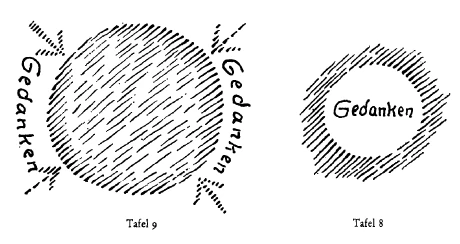
[ 10 ] Das ist eine Art der Anschauung des Kosmos, die Ihnen ungemein nützlich und aufschlußreich sein kann, wenn Sie sie verwerten wollen, wenn Sie wirklich auf solche Dinge eingehen. Es wird Ihr Denken, Ihr ganzes Seelenleben viel beweglicher werden, als es sonst ist, wenn Sie lernen, sich vorzustellen: Würde ich aus mir herauskommen, wie es ja fortwährend der Fall ist, wenn ich einschlafe, und zurückschauen auf mein Haupt, also auf mich als Gedankenmenschen, so sähe ich mich leuchtend. Würde ich aus der Welt, aus der durchleuchteten Welt herauskommen, die Welt von außen sehen, so würde ich sie als ein Gedankengebilde sehen. Ich würde die Welt als Gedankenwesenheit wahrnehmen. — Sie sehen, Licht und Gedanke gehören zusammen, Licht und Gedanke sind dasselbe, nur von verschiedenen Seiten gesehen.
[ 10 ] This is a way of viewing the cosmos that can be immensely useful and enlightening to you if you choose to make use of it, if you truly engage with such things. Your thinking, your entire inner life, will become much more flexible than it otherwise is if you learn to imagine: If I were to step outside of myself—as is constantly the case when I fall asleep—and look back at my head, that is, at myself as a being of thought, I would see myself glowing. If I were to step out of the world—out of the world bathed in light—and view the world from the outside, I would see it as a thought-form. I would perceive the world as a being of thought. — You see, light and thought belong together; light and thought are one and the same, merely viewed from different perspectives.
[ 11 ] Nun ist aber der Gedanke, der in uns lebt, eigentlich dasjenige, was aus der Vorzeit herüberkommt, was das Reifste in uns ist, das Ergebnis früherer Erdenleben. Was früher Wille war, ist Gedanke geworden, und es erscheint der Gedanke als Licht. Daraus werden Sie empfinden können: Wo Licht ist, ist Gedanke, aber wie? Gedanke, in dem eine Welt fortwährend erstirbt. Eine Vorwelt, eine vorzeitige Welt erstirbt im Gedanken, oder anders ausgesprochen, im Lichte. Das ist eines der Weltengeheimnisse. Wir schauen hinaus in das Weltenall. Es ist durchströmt vom Lichte. Im Lichte lebt der Gedanke. Aber in diesem gedankendurchdrungenen Lichte lebt eine ersterbende Welt. Im Lichte erstirbt fortwährend die Welt.
[ 11 ] But the thought that lives within us is actually that which comes to us from ancient times, that which is most mature within us—the result of earlier earthly lives. What was once will has become thought, and thought appears as light. From this you will be able to sense: Where there is light, there is thought—but in what sense? Thought in which a world is continually dying. A pre-world, a world of the past, is dying within thought—or, to put it another way, within the light. This is one of the mysteries of the world. We look out into the universe. It is permeated by light. Thought lives in the light. But within this light, permeated by thought, a world is dying. The world is constantly dying in the light.
[ 12 ] Indem so ein Mensch wie Hegel die Welt betrachtet, betrachtet er eigentlich das fortwährende Ersterben der Welt. Diejenigen Menschen werden ganz besonders Gedankenmenschen, welche zum Sinkenden, Ersterbenden, Sich-Ablähmenden der Welt eine besondere Neigung haben. Und im Ersterben wird die Welt schön. Die Griechen, die innerlich eigentlich durch und durch von lebendiger Menschenwesenheit waren, nach außen hatten sie ihre Freude, wenn in dem Ersterben der Welt die Schönheit erglänzte. Denn in dem Lichte, in dem die Welt erstirbt, erglänzt die Schönheit der Welt. Die Welt wird nicht schön, wenn sie nicht sterben kann, und indem sie stirbt, leuchtet sie, die Welt. So daß es eigentlich die Schönheit ist, welche aus dem Lichtesglanze der fortwährend ersterbenden Welt erscheint. So betrachtet man das Weltenall qualitativ. Mit Galilei hat die neuere Zeit begonnen, die Welt quantitativ zu betrachten, und man ist heute besonders stolz darauf, wenn man, wie es überall in unseren Wissenschaften geschieht, wo man es nur tun kann, die Naturerscheinungen durch die Mathematik, also durch das Tote begreifen kann. Hegel hat allerdings inhaltsvollere Begriffe verwendet zum Begreifen der Welt, als die mathematischen es sind; aber für ihn war besonders anziehend das Reifgewordene, das Ersterbende. Man möchte sagen: Hegel stand der Welt so gegenüber wie ein Mensch, der einem Baum gegenübersteht, der gerade strotzend von Blütenentfaltung ist. Im Momente, wo die Früchte sich entfalten wollen, aber noch nicht da sind, wo die Blüten zum äußersten gekommen sind, da wirkt in dem Baum die Lichtesgewalt, da wirkt in dem Baum dasjenige, was lichtgetragener Gedanke ist. So stand Hegel vor allen Erscheinungen der Welt. Er betrachtete die äußerste Blüte, dasjenige, was sich ganz und gar ins Konkreteste entfaltet.
[ 12 ] When a person like Hegel contemplates the world, he is actually contemplating the world’s ceaseless passing away. Those people who have a particular inclination toward the world’s decline, passing away, and withering become, above all, thinkers. And in its passing away, the world becomes beautiful. The Greeks, who were inwardly, in fact, thoroughly imbued with living humanity, found joy outwardly when beauty shone forth in the world’s dying. For in the light in which the world dies, the beauty of the world shines forth. The world does not become beautiful unless it can die, and as it dies, the world shines. So it is actually beauty that emerges from the radiance of the light of the world as it is constantly dying. This is how one views the universe qualitatively. With Galileo, the modern era began to view the world quantitatively, and today people take particular pride in being able—as happens everywhere in our sciences wherever possible—to understand natural phenomena through mathematics, that is, through the dead. Hegel, however, used more substantive concepts to understand the world than mathematics provides; but what was particularly appealing to him was that which had come to maturity, that which was in the process of fading. One might say: Hegel faced the world like a person standing before a tree that is just bursting with blossoms. At the moment when the fruits are about to unfold but are not yet there, when the blossoms have reached their peak, the power of light is at work in the tree; that which is thought borne by light is at work in the tree. This is how Hegel stood before all phenomena of the world. He contemplated the peak of blossoming, that which unfolds entirely into the most concrete form.
[ 13 ] Schopenhauer stand anders vor der Welt. Wenn wir den Schopenhauerschen Impetus prüfen wollen, dann müssen wir auf das andere im Menschen schauen, auf dasjenige, was beginnt. Es ist das Willenselement, das wir in unseren Gliedmaßen tragen. Ja, das erleben wir eigentlich so — ich habe öfter darauf hingewiesen —, wie wir die Welt erleben im Schlafe. Wir erleben es unbewußt, das Willenselement. Können wir denn auch dieses Willenselement irgendwie so von außen anschauen, wie wir den Gedanken von außen anschauen? Nehmen wir den Willen, irgendwie in einem menschlichen Gliede sich entfaltend, und fragen wir uns, wenn wir den Willen nun von der anderen Seite anschauen würden, wenn wir also vom Standpunkte der Imagination, der Inspiration, der Intuition den Willen betrachten: Was ist denn das Parallele im Anschauen gegenüber dem, daß wir den Gedanken als Licht schauen? Wie schauen wir den Willen, wenn wir ihn mit der entwickelten Kraft des Anschauens, der Hellsichtigkeit betrachten? Wenn wir den Willen mit der entwickelten Kraft des Anschauens, der Hellsichtigkeit betrachten, dann wird auch etwas erlebt, was wir äußerlich sehen. Wenn wir den Gedanken mit der Kraft des Hellsehens betrachten, wird Licht erlebt, Leuchtendes erlebt. Wenn wir den Willen mit der Kraft des Hellsehens betrachten, so wird er immer dicker und dicker, dieser Wille, und er wird Stoff. Wäre Schopenhauer hellsichtig gewesen, so würde dieses Willenswesen als ein Stoffautomat vor ihm gestanden haben, denn das ist die Außenseite des Willens, der Stoff. Innerlich ist der Stoff Wille, wie das Licht innerlich Gedanke ist. Und äußerlich ist der Wille Stoff, wie der Gedanke äußerlich Licht ist. Deshalb konnte ich auch bei früheren Betrachtungen darauf hinweisen: Wenn der Mensch in seine Willensnatur mystisch hinuntertaucht, so glauben diejenigen, die eigentlich mit der Mystik nur Faxen treiben, in Wirklichkeit aber nach dem Wohlbefinden, nach dem Erleben des ärgsten Egoismus streben, dann glauben solche In-sich-Hineinschauer, sie würden den Geist finden. Aber wenn sie weit genug kämen mit diesem In-sich-Hineinschauen, würden sie die wahre stoffliche Natur des Menscheninneren entdecken. Denn es ist nichts anderes als ein Untertauchen in den Stoff. Wenn man in die Willensnatur untertaucht, da enthüllt sich einem die wahre Natur des Stoffes. Die Naturphilosophen in der Gegenwart phantasieren ja nur, wenn sie sagen, daß der Stoff aus Molekülen und Atomen bestehe. Die wahre Natur des Stoffes findet man, wenn man mystisch in sich untertaucht. Da findet man die andere Seite des Willens, und die ist Stoff. Und in diesem Stoff, also in dem Willen enthüllt sich im Grunde genommen dasjenige, was fortwährend beginnende, keimende Welt ist.
[ 13 ] Schopenhauer viewed the world differently. If we want to examine Schopenhauer’s impetus, then we must look at the other aspect of the human being—that which gives rise to action. It is the element of will that we carry within our limbs. Yes, that is actually how we experience it—as I have often pointed out—just as we experience the world in sleep. We experience the element of will unconsciously. Can we also view this element of will from the outside in some way, just as we view thought from the outside? Let us take the will, unfolding in some way within a human limb, and ask ourselves: if we were to view the will from the other side—that is, if we were to observe the will from the standpoint of imagination, inspiration, and intuition—what would be the parallel in this observation to the way we perceive thought as light? How do we perceive the will when we observe it with the developed power of perception, of clairvoyance? When we observe the will with the developed power of perception, of clairvoyance, we also experience something that we see externally. When we observe the thought with the power of clairvoyance, we experience light, we experience something luminous. When we observe the will with the power of clairvoyance, this will becomes thicker and thicker, and it becomes matter. If Schopenhauer had been clairvoyant, this being of will would have stood before him as a material automaton, for that is the outer aspect of the will: matter. Internally, matter is will, just as light is internally thought. And outwardly, the will is matter, just as thought is outwardly light. That is why I was also able to point out in earlier reflections: When a person mystically delves into the nature of their will, those who are actually just fooling around with mysticism—but who in reality strive for well-being and the experience of the worst kind of egoism—believe that by looking inward, they will find the spirit. But if they went far enough with this looking inward, they would discover the true material nature of the human inner being. For it is nothing other than a plunge into matter. When one plunges into the nature of the will, the true nature of matter is revealed to one. Contemporary natural philosophers are merely fantasizing when they say that matter consists of molecules and atoms. The true nature of matter is found when one mystically plunges into oneself. There one finds the other side of the will, and that is matter. And in this matter—that is, in the will—what is essentially a world that is constantly beginning and sprouting is revealed.
[ 14 ] Sie schauen hinaus in die Welt: Sie sind vom Licht umflossen. In dem Lichte erstirbt eine vorzeitige Welt. Sie treten auf den harten Stoff auf — die Stärke der Welt trägt Sie. In dem Lichte erstrahlt gedanklich die Schönheit. In dem Erglänzen der Schönheit erstirbt die vorzeitige Welt. Die Welt geht auf in ihrer Stärke, in ihrer Kraft, in ihrer Gewalt, aber auch in ihrer Finsternis. In Finsternis geht sie auf, die zukünftige Welt, im stofflich-willensartigen Elemente.
[ 14 ] They look out into the world: they are enveloped by light. In that light, a premature world dies away. They step onto the hard substance—the strength of the world supports them. In that light, beauty shines forth in thought. In the radiance of beauty, the premature world dies away. The world dawns in its strength, in its power, in its might, but also in its darkness. In darkness it dawns, the future world, in the material-volitional elements.
[ 15 ] Wenn die Physiker einmal ernsthaft reden werden, dann werden sie sich nicht jenen Spekulationen hingeben, in denen heute von den Atomen und Molekülen gefaselt wird, sondern sie werden sagen: Die äußere Welt besteht aus Vergangenheit, und im Inneren trägt sie nicht Moleküle und Atome, sondern Zukunft. Und wenn man einmal sagen wird: Uns erscheint strahlend die Vergangenheit in der Gegenwart, und die Vergangenheit hüllt die Zukunft überall ein —, dann wird man von der Welt richtig reden, denn die Gegenwart ist überall nur dasjenige, was Vergangenheit und Zukunft zusammen wirken. Die Zukunft ist dasjenige, was eigentlich in der Stärke des Stoffes liegt. Die Vergangenheit ist dasjenige, was in der Schönheit des Lichtes erglänzt, wobei Licht für alles Sich-Offenbarende gesetzt ist, denn natürlich, auch was im Tone erscheint, was in der Wärme erscheint, ist hier ünter dem Lichte gemeint.
[ 15 ] When physicists finally speak seriously, they will not indulge in the speculations in which people today ramble on about atoms and molecules, but will say: The external world consists of the past, and at its core it contains not molecules and atoms, but the future. And when people finally say: “The past appears to us radiant in the present, and the past envelops the future everywhere”—then they will speak correctly about the world, for the present is everywhere nothing other than the interplay of past and future. The future is that which actually lies in the power of matter. The past is that which shines forth in the beauty of light, whereby light stands for everything that reveals itself; for, of course, what appears in sound and what appears in warmth is also meant here under the term “light.”
[ 16 ] Und so kann sich der Mensch nur selber verstehen, wenn er sich auffaßt als Zukunftskern, der umhüllt ist von dem, was ihm von der Vergangenheit herrührt, von der Lichtaura des Gedankens. Man kann sagen: Geistig gesehen ist der Mensch Vergangenheit, wo er in seiner Schönheitsaura erstrahlt, aber eingegliedert ist dieser Vergangenheitsaura, was als Finsternis sich beimischt dem Lichte, das aus der Vergangenheit herüberstrahlt, und was in die Zukunft hinüberträgt. Das Licht ist dasjenige, was aus der Vergangenheit herüberstrahlt, die Finsternis, was in die Zukunft hinüberweist. Das Licht ist gedanklicher Natur, die Finsternis ist willensartiger Natur. Hegel war dem Lichte zugeneigt, das sich entfaltet in dem Wachstumsprozesse, in den reifsten Blüten. Schopenhauer ist als Weltenbetrachter wie ein Mensch, der vor einem Baume steht und eigentlich keine Freude hat an der Blütenpracht, sondern der eine innerliche Anstachelung hat, nur zu warten, bis da aus den Blüten überall die Keime für die Früchte hervorsprießen. Das freut ihn, daß da drinnen Wachstumskraft ist, das stachelt ihn an, es wässert sich ihm der Mund, wenn er daran denken kann, daß da aus der Pfirsichblüte die Pfirsiche werden. Er wendet sich von der Lichtnatur dem zu, was ihn von innen ergreift, was sich aus der Lichtnatur der Blüte entfaltet als dasjenige, was stofflich auf seiner Zunge zerfließen kann, was sich als Früchte in die Zukunft hinüberentwickelt. Es ist tatsächlich die Zwienatur der Welt, und man betrachtet die Welt nur richtig, wenn man sie in ihrer Zwienatur betrachtet, denn dann kommt man darauf, wie diese Welt konkret ist, während man sie sonst nur in ihrer Abstraktheit betrachtet. Wenn Sie hinausgehen und sehen sich an die Bäume in ihrer Blüte, dann leben Sie eigentlich von der Vergangenheit. Also Sie betrachten die Frühlingsnatur der Welt und Sie können sich sagen: Was Götter in vergangenen Zeiten hineingewirkt haben in diese Welt, das offenbart sich in der Blütenpracht des Frühlings. Sie betrachten die fruchtende Welt des Herbstes, und Sie können sagen: Da beginnt eine neue Göttertat, da fällt ab, was aber weiterer Entwickelung fähig ist, was in die Zukunft sich hineinentwickelt.,
[ 16 ] And so a person can only understand themselves if they conceive of themselves as a core of the future, enveloped by what comes to them from the past—the luminous aura of thought. One might say: Spiritually speaking, human beings are the past, where they shine in their aura of beauty; but integrated into this aura of the past is that which, as darkness, mingles with the light that radiates from the past and carries into the future. The light is that which radiates from the past; the darkness is that which points toward the future. Light is of a conceptual nature; darkness is of a volitional nature. Hegel was drawn to the light that unfolds in the process of growth, in the ripest blossoms. As an observer of the world, Schopenhauer is like a person standing before a tree who does not actually take pleasure in the splendor of the blossoms, but who feels an inner urge simply to wait until the seeds for the fruit sprout from the blossoms everywhere. It delights him that there is a force of growth within; it spurs him on; his mouth waters when he can imagine that the peach blossoms will become peaches. He turns away from the luminous nature of the flower toward what grips him from within—what unfolds from the flower’s luminous nature as that which can melt on his tongue, that which develops into fruit and carries on into the future. It is indeed the dual nature of the world, and one can only view the world correctly by considering it in its dual nature; for only then does one realize how concrete this world is, whereas otherwise one views it only in its abstractness. When you go outside and look at the trees in bloom, you are actually living off the past. So you look at the springtime nature of the world and you can say to yourself: What the gods have woven into this world in times past is revealed in the splendor of spring’s blossoms. You look at the fruiting world of autumn, and you can say: There a new divine act begins; there falls away what is still capable of further development, what unfolds into the future.,
[ 17 ] So handelt es sich darum, daß man nicht bloß durch Spekulation ein Bild der Welt sich erwirbt, sondern daß man innerlich mit dem ganzen Menschen die Welt ergreift. Man kann tatsächlich in der Pflaumenblüte, ich möchte sagen, die Vergangenheit ergreifen, in der Pflaume die Zukunft erfühlen. Was einem in die Augen hereinscheint, das hängt innig zusammen mit dem, aus dem man geworden ist aus der Vergangenheit heraus. Was einem auf der Zunge im Geschmack zerschmilzt, das hängt innig zusammen mit demjenigen, aus dem man wiederersteht, wie der Phönix aus seiner Asche, in die Zukunft hinein. Da ergreift man die Welt in Empfindung. Und nach solchem «in Empfindung die Welt ergreifen» hat eigentlich Goethe getrachtet bei allem, was er in der Welt erschauen, empfinden wollte. Er hat zum Beispiel hingeschaut nach der grünen Pflanzenwelt. Er hatte ja nicht, was man heute als Geisteswissenschaft haben kann, aber indem er die Grünheit der Pflanzenwelt anschaute, hatte er doch in der Grünheit der Pflanze, die noch nicht ganz bis zum Blütenhaften sich entfaltet hatte, dasjenige, was in die Gegenwart hereinragt von dem eigentlich Vergangenen des Pflanzenhaften; denn in der Pflanze erscheint schon die Vergangenheit in der Blüte; aber, was noch nicht ganz so vergangen ist, das ist die Grünheit des Blattes.
[ 17 ] The point, then, is not merely to form an image of the world through speculation, but to grasp the world inwardly with one’s whole being. One can indeed, I would say, grasp the past in the plum blossom and sense the future in the plum. What shines into one’s eyes is intimately connected with that from which one has emerged out of the past. What melts on one’s tongue is intimately connected with that from which one rises anew, like the phoenix from its ashes, into the future. There, one grasps the world through sensation. And it was precisely this “grasping the world through sensation” that Goethe actually sought in everything he wished to perceive and feel in the world. For example, he looked at the green plant world. He did not, of course, have what we today might call the “science of the spirit,” but as he gazed upon the greenness of the plant world, he found in the greenness of the plant—which had not yet fully unfolded into bloom—that which projects into the present from the plant’s actual past; for in the plant, the past already appears in the bloom; but what is not quite so past yet is the greenness of the leaf.
[ 18 ] Sieht man die Grünheit der Natur, so ist das gewissermaßen etwas, was noch nicht so weit erstorben ist, was noch nicht so von der Vergangenheit ergriffen ist [siehe Zeichnung grün]. Das aber, was nach der Zukunft hinweist, ist dasjenige, was aus dem Finstern, aus dem Dunkeln herauskommt. Da, wo das Grün zum Bläulichen abgestuft ist, da ist das, was sich in der Natur als das Zukünftige erweist [blau].
[ 18 ] When one looks at the greenness of nature, it is, in a sense, something that has not yet died off entirely, something that has not yet been so completely overtaken by the past [see drawing in green]. But what points toward the future is that which emerges from the darkness, from the shadows. Where the green fades into a bluish hue, there lies what manifests itself in nature as the future [blue].
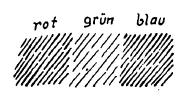
[ 19 ] Dagegen da, wo wir gewiesen werden in die Vergangenheit, wo dasjenige liegt, was reift, was die Dinge zum Blühen bringt, da ist die Wärme [rot], wo das Licht sich nicht nur aufhellt, sondern wo es sich innerlich durchdringt mit Kraft, wo es in die Wärme übergeht. Nun müßte man das Ganze eigentlich so zeichnen, daß man sagt: Man hat das Grüne, die Pflanzenwelt — so würde Goethe empfinden, wenn er es auch noch nicht in Geisteswissenschaft oder Geheimwissenschaft umgesetzt hat —, daranknüpfend die Finsternis, wo sich das Grüne bläulich abstuft. Das sich Aufhellende, von Wärme Erfüllende aber, das würde sich wiederum anschließen nach der oberen Seite hin. Da steht man aber selbst als Mensch, da hat man als Mensch innerlich das, was man in der grünen Pflanzenwelt äußerlich hat, da ist man innerlich als menschlicher Ätherleib, wie ich oftmals gesagt habe, pfirsichblütfarbig. Das ist auch die Farbe, die hier erscheint, wenn das Blau in das Rote übergreift. Das ist man aber selber. So daß man eigentlich, wenn man in die farbige Welt hinaussieht, sagen kann: Man steht selber in dem Pfirsichblütigen drinnen, hat gegenüber das Grün. Das bietet sich einem dann objektiv in der Pflanzenwelt dar. Man hat auf der einen Seite das Bläuliche, Finstere, auf der anderen Seite das Helle, Rötlich-Gelbliche. Aber weil man in dem Pfirsichblütigen drinnen ist, weil man da drinnen lebt, kann man das zunächst im gewöhnlichen Leben ebensowenig wahrnehmen, wie man den Gedanken als Licht wahrnimmt. Was man erlebt, das nimmt man nicht wahr, deshalb läßt man da das Pfirsichblüt aus und sieht nur auf das Rot hin, das man auf der einen Seite erweitert, und nach dem Blau hin, das man nach der anderen Seite erweitert; und so erscheint einem solch ein Regenbogenspektrum. Das ist aber nur eine Täuschung. Das wirkliche Spektrum würde man bekommen, wenn man dieses Farbenband kreisförmig biegen würde. Man biegt es in der Tat gerade, weil man als Mensch in dem Pfirsichblütigen drinnensteht, und so übersieht man nur von Blau bis zu Rot und von Rot bis zu Blau durch das Grün die farbige Welt. In dem Augenblicke, wo man diesen Aspekt haben würde, würde jeder Regenbogen als Kreis erscheinen, als in sich gebogener Kreis, als Rolle mit Kreisdurchschnitt.
[ 19 ] In contrast, where we are led back into the past—where that which matures and brings things to bloom lies—there is warmth [red], where the light not only brightens but also permeates inwardly with power, where it merges into warmth. Now, one would actually have to depict the whole thing in such a way that one says: There is the green, the plant world—this is how Goethe would perceive it, even if he had not yet translated it into spiritual science or esoteric science—and, building on that, the darkness, where the green gradates into bluish tones. But that which brightens and is filled with warmth would, in turn, follow on toward the upper side. But there one stands as a human being; there, as a human being, one possesses inwardly what one has outwardly in the green plant world; there, inwardly, as a human etheric body—as I have often said—one is the color of peach blossoms. That is also the color that appears here when blue blends into red. But that is oneself. So that, when one looks out into the world of colors, one can actually say: One stands within the peach-blossom hue oneself, with the green opposite. This then presents itself objectively in the plant world. On one side you have the bluish, dark tones; on the other, the light, reddish-yellowish tones. But because you are inside the peach-blossom hue—because you live there—you cannot perceive this in everyday life any more than you perceive a thought as light. What one experiences, one does not perceive; therefore, one leaves out the peach blossom hue and looks only toward the red, which one extends on one side, and toward the blue, which one extends on the other side; and thus such a rainbow spectrum appears to one. But this is only an illusion. One would obtain the real spectrum if one were to bend this band of colors into a circle. In fact, one bends it straight precisely because, as a human being, one stands within the peach blossom, and so one surveys the world of color only from blue to red and from red to blue through the green. The moment one were to have this perspective, every rainbow would appear as a circle—a circle bent in on itself, a roll with a circular cross-section.
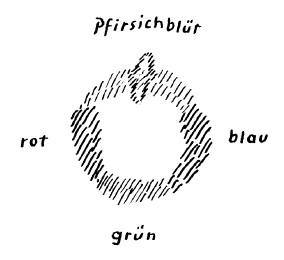
[ 20 ] Das letzte habe ich nur erwähnt, um Sie darauf aufmerksam zu machen, daß so etwas wie die Goethesche Naturanschauung durchaus zu gleicher Zeit eine Geistanschauung ist, daß sie dem geistigen Anschauen voll entspricht. Wenn man an Goethe, den Naturforscher, herantritt, so kann man sagen: Er hat eigentlich noch keine Geisteswissenschaft, aber er hat die Naturwissenschaft so betrachtet, daß es ganz im Sinne der Geisteswissenschaft ist. Was uns aber heute ganz wesentlich sein muß, das ist dieses, daß die Welt einschließlich des Menschen ein Durchorganisieren von Gedankenlicht, Lichtgedanken mit Willensstoff, Stoffwille ist, und daß dasjenige, was uns konkret entgegentritt, in der verschiedensten Weise aufgebaut oder mit Inhalt durchzogen ist aus Gedankenlicht, Lichtgedanken, Stoffwille, Willensstoft.
[ 20 ] I mentioned that last point only to draw your attention to the fact that something like Goethe’s view of nature is, at the same time, a view of the spirit—that it fully corresponds to spiritual perception. When one approaches Goethe, the natural scientist, one can say: He did not yet have a science of the spirit, but he viewed the natural sciences in a way that is entirely in the spirit of the science of the spirit. But what must be of essential importance to us today is this: that the world, including human beings, is a systematic organization of thought-light, light-thoughts with will-matter, and matter-will; and that what we encounter in concrete form is structured in the most diverse ways or permeated with content consisting of thought-light, light-thoughts, matter-will, and will-matter.
[ 21 ] So muß man qualitativ den Kosmos betrachten, nicht bloß quantitativ, dann kommt man mit diesem Kosmos zurecht. Dann gliedert sich aber auch hinein in diesen Kosmos ein fortwährendes Ersterben, ein Ersterben der Vorzeit im Lichte, ein Aufgehen der Zukunft in der Finsternis. Die alten Perser nannten aus ihrem instinktiven Hellsehen heraus, das, was sie als die ersterbende Vorzeit im Lichte fühlten, Ahura Mazdao, was sie als die Zukunft im finsteren Willen fühlten, Ahriman.
[ 21 ] One must therefore view the cosmos qualitatively, not merely quantitatively; only then can one come to terms with this cosmos. But then a continuous passing away is also woven into this cosmos—a passing away of the past in the light, and a dawning of the future in the darkness. The ancient Persians, drawing on their instinctive clairvoyance, called that which they sensed as the past fading away in the light “Ahura Mazdao,” and that which they sensed as the future in the dark will “Ahriman.”
[ 22 ] Und nun haben Sie diese zwei Welt-Entitäten, das Licht und die Finsternis: im Lichte den lebenden Gedanken, die ersterbende Vorzeit; in der Finsternis den entstehenden Willen, die kommende Zukunft. Indem wir so weit kommen, daß wir den Gedanken nicht mehr in seiner Abstraktheit bloß betrachten, sondern als Licht, den Willen nicht mehr in seiner Abstraktheit betrachten, sondern als Dunkelheit, ja in seiner materiellen Natur betrachten, indem wir dazu kommen, die Wärmeinhalte zum Beispiel des Lichtspektrums als mit der Vergangenheit, die Stoffseite, die chemische Seite des Spektrums mit der Zukunft zusammenfallend betrachten zu können, gehen wir aus dem bloßen Abstrakten ins Konkrete heraus. Wir sind nicht mehr solche ausgedörrte, pedantische, bloß mit dem Kopfe arbeitende Denker, wir wissen, das, was da in unserem Kopfe drinnnen denkt, ist eigentlich dasselbe, was uns als Licht umflutet. Und wir sind nicht mehr solche vorurteilsvolle Menschen, daß wir an dem Lichte bloß Freude haben, sondern wir wissen: In dem Lichte ist der Tod, eine ersterbende Welt. Wir können an dem Lichte auch die Weltentragik empfinden. Wir kommen also aus dem Abstrakten, aus dem Gedanklichen in das Flutende der Welt hinein. Und wir sehen in dem, was Finsternis ist, den aufgehenden Teil der Zukunft. Wir finden sogar das darinnen, was solche leidenschaftliche Naturen wie Schopenhauer aufstachelt. Kurz, wir dringen aus dem Abstrakten ins Konkrete hinein. Weltengebilde entstehen vor uns, statt bloßer Gedanken oder abstrakter Willensimpulse.
[ 22 ] And now you have these two worldly entities, light and darkness: in the light, the living thought, the fading past; in the darkness, the emerging will, the coming future. As we reach the point where we no longer view thought merely in its abstractness, but as light, and no longer view the will merely in its abstractness, but as darkness, indeed in its material nature—by coming to view, for example, the thermal content of the light spectrum as coinciding with the past, and the material and chemical aspects of the spectrum as coinciding with the future—we move from the purely abstract into the concrete. We are no longer such parched, pedantic thinkers who work solely with our heads; we know that what is thinking inside our heads is actually the same thing that floods us as light. And we are no longer such prejudiced people that we merely take joy in the light, but we know: In the light lies death, a world in the throes of dying. We can also sense the tragedy of the world in that light. We thus emerge from the abstract, from the realm of thought, into the surging flow of the world. And we see in what is darkness the dawning part of the future. We even find within it what stirs such passionate natures as Schopenhauer’s. In short, we move from the abstract into the concrete. World-forms arise before us, rather than mere thoughts or abstract impulses of the will.
[ 23 ] Das haben wir heute gesucht. Das nächste Mal werden wir in dem, was sich uns heute merkwürdig konkretisiert hat — der Gedanke zum Licht, der Wille zur Finsternis —, suchen den Ursprung von Gut und von Böse, Wir dringen also von der Innenwelt in den Kosmos hinein und suchen im Kosmos wiederum nicht bloß in einer abstrakten oder religiös-abstrakten Welt die Gründe für Gut und Böse, sondern wir wollen sehen, wie wir durchbrechen zu einer Erkenntnis von Gut und Böse, nachdem wir den Anfang damit gemacht haben, daß wir den Gedanken in seinem Lichte ergriffen, den Willen in seinem Finsterwerden erfühlt haben. Davon dann das nächste Mal weiter.
[ 23 ] That is what we have been exploring today. Next time, we will seek the origin of good and evil in what has taken on a strangely concrete form for us today—the thought of light, the will to darkness— We thus move from the inner world into the cosmos, and within the cosmos we seek the reasons for good and evil not merely in an abstract or religiously abstract world, but we want to see how we can break through to an understanding of good and evil, having begun by grasping the thought in its light and sensing the will in its descent into darkness. More on this next time.