Perspectives on Human Evolution
The Materialistic Impulse toward Knowledge
and the Task of Anthroposophy
GA 204
30 April 1921, Dornach
Translate the original German text into any language:
Versions Available:
The Spiritual Backgrounds of the Outer World, tr. SOL
Elfter Vortrag
Eleventh Lecture
[ 1 ] Wir haben im Verlaufe dieser Betrachtungen gesehen, welch wichtiger Punkt in der Menschheitsentwickelung des Abendlandes die Mitte des 19. Jahrhunderts ist. Wir haben aufmerksam darauf gemacht, wie in dieser Mitte des 19. Jahrhunderts gewissermaßen der Höhepunkt materialistischer Gesinnung, materialistischer Lebensansicht vorhanden ist; aber wir haben auch aufmerksam darauf machen müssen, wie das, was sich da im Menschen seit dem Beginn des 15. Jahrhunderts herausgerungen hat, eigentlich ein Geistiges ist, so daß man sagen könnte: Das war das Charakteristische in diesem Entwickelungspunkt neuzeitlicher Menschheitsentwickelung, daß der Mensch, indem er am geistigsten geworden ist, diese Geistigkeit nicht erfassen konnte, sondern sich nur erfüllte mit materialistischem Denken, materialistischem Fühlen und auch materialistischem Wollen und Tun. Und die Gegenwart steht ja noch immer unter den Nachwirkungen desjenigen, was sich da, ich möchte sagen, von vielen Menschen unvermerkt vollzogen hat und was ja innerhalb der Menschheitsentwickelung einen Höhepunkt erreicht hat. Wozu war dieser Höhepunkt da? — Er war da, weil ja ein Entscheidendes geschehen sollte in bezug auf das Erringen der Bewußtseinsseelenstufe durch die neuzeitliche Menschheit.
[ 1 ] In the course of these reflections, we have seen what an important juncture the mid-19th century represents in the development of Western civilization. We have drawn attention to how, in the mid-19th century, materialistic thinking and a materialistic view of life reached, so to speak, their peak; but we have also had to point out how what has been struggling to emerge within human beings since the beginning of the 15th century is in fact a spiritual reality, so that one could say: What was characteristic of this stage in the development of modern humanity was that, as human beings became most spiritual, they were unable to grasp this spirituality, but instead filled themselves only with materialistic thinking, materialistic feeling, and also materialistic willing and acting. And the present is still under the aftereffects of what took place—I would say—unnoticed by many people and which, after all, reached a climax within the development of humanity. What was the purpose of this climax? — It was there because something decisive was to happen with regard to modern humanity’s attainment of the level of the consciousness soul.
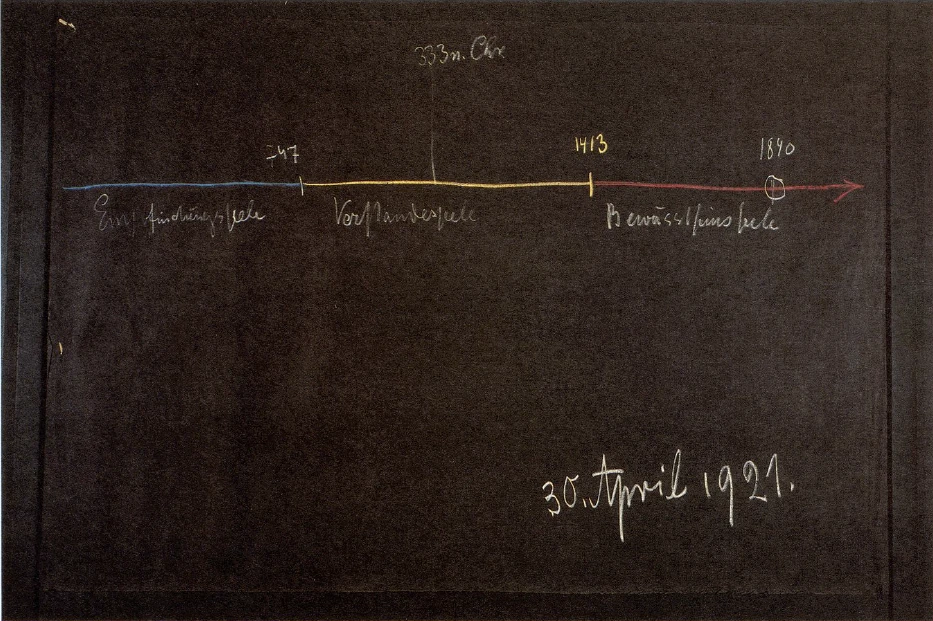
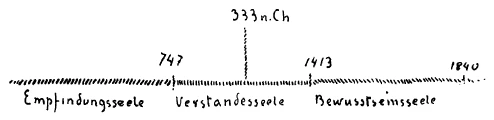
[ 2 ] Fassen wir einmal ins Auge, wie sich die Menschheitsentwickelung abgespielt hat, dann müssen wir sagen: Wir haben, wenn wir beginnen beim dritten nachatlantischen Zeitraum, etwa bis, sagen wit, zum Jahre 747 (siehe Zeichnung) vor dem Mysterium von Golgatha, was wir als die Entwickelung der Empfindungsseele in der Menschheit bezeichnen können. Es beginnt dann das Zeitalter der Verstandes- oder Gemütsseele, die bis zum Jahre 1413 etwa dauert, die ihren Höhepunkt erreicht in demjenigen Zeitpunkt, von dem die äußere Geschichte ja wenig mitteilt, der aber ins Auge gefaßt werden muß, wenn man überhaupt die europäische Entwickelung begreifen will. Es ist ungefähr der Zeitpunkt 333 nach Christus. Seit dem Jahre 1413 haben wir es zu tun mit der Entwickelung der Bewußtseinsseele, in welcher Entwickelung wir noch darinnenstehen, die eben ein entscheidendes Ereignis erlebte um das Jahr 1850, besser gesagt 1840.
[ 2 ] If we take a look at how human evolution has unfolded, we must say: Beginning with the third post-Atlantean epoch, roughly up to, let’s say, the year 747 (see diagram) before the Mystery of Golgotha, we have what we can describe as the development of the feeling soul in humanity. Then begins the age of the intellectual or emotional soul, which lasts roughly until the year 1413 and reaches its peak at a point about which external history reveals little, but which must be taken into account if one is to understand European development at all. This is approximately the year 333 A.D. Since the year 1413, we have been dealing with the development of the conscious soul—a development in which we are still immersed—and which experienced a decisive event around the year 1850, or rather 1840.
[ 3 ] Es war um dieses Jahr 1840 die Sache so, daß wenn wir die Menschheit als Ganzes auffassen — wie sich die einzelnen Nationen dazumal verhielten, das werden wir nachher gleich zu betrachten beginnen —, wir sagen können, daß, insofern wir auf repräsentative Persönlichkeiten der Nationen hinschauen, sie in diesem Jahre 1840 vor dem Punkte standen, wo der Verstand schon am meisten zum Schattenwesen geworden war. Der Verstand hatte seinen Schattencharakter angenommen. Ich habe Ihnen ja gestern diesen Schattencharakter des Verstandes zu charakterisieren versucht. So weit war die Menschheit der zivilisierten Erde gediehen, daß von da ab die Möglichkeit bestand, aus der allgemeinen Kultur heraus ohne Einweihung die Empfindung zu bekommen: Wir haben den Verstand, der Verstand hat sich heraufentwickelt, aber dieser Verstand hat für sich selber keinen Inhalt mehr. Wir haben Begriffe, aber diese Begriffe sind leer, wir müssen sie mit etwas erfüllen. — Das ist der Ruf, der sozusagen durch die Menschheit, allerdings noch dunkel und unvernehmlich, geht. Aber in den tiefen, untergründigen, unterbewußten Sehnsuchten der Menschen lebt der Ruf, eine Erfüllung zu bekommen für das Schattenhafte des Verstandesdenkens. Es ist eben der Ruf, der nach Geisteswissenschaft geht. Wir können aber diesen Ruf auch konkret fassen.
[ 3 ] Around the year 1840, the situation was such that if we consider humanity as a whole—we will begin to examine the attitudes of individual nations at that time shortly— we can say that, insofar as we look to representative figures of the nations, they stood in this year of 1840 at the point where the intellect had already become, for the most part, a shadow entity. The intellect had taken on its shadow character. I did, after all, try to characterize this shadow character of the intellect for you yesterday. Humanity on the civilized earth had progressed to such an extent that, from that point on, it became possible—even without initiation—to gain the following insight from general culture: We have the intellect; the intellect has developed to this level; but this intellect no longer has any content of its own. We have concepts, but these concepts are empty; we must fill them with something. — That is the call that goes out, so to speak, through humanity—albeit still darkly and inaudibly. But in the deep, subterranean, subconscious longings of human beings, the call lives on to find fulfillment for the shadow-like aspect of intellectual thought. It is precisely this call that leads to spiritual science. But we can also grasp this call in concrete terms.
[ 4 ] Es war einfach in dieser Mitte des 19. Jahrhunderts die menschliche Organisation, in deren physischem Teil ja dieser schattenhafte Verstand geübt wird, so weit, daß sie den Verstand, den leeren schattenhaften Verstand gut ausbilden konnte. Nun gehörte in diesen schattenhaften Verstand etwas hinein, er mußte mit etwas erfüllt werden. Erfüllt werden kann er nur, wenn der Mensch sich bewußt wird: Ich muß etwas aufnehmen von dem, was sich mir auf der Erde selbst nicht darbietet, was auf der Erde selber nicht lebt, was ich nicht erfahren kann in dem Leben zwischen der Geburt und dem Tode. Ich muß wirklich in diesen Verstand herein etwas aufnehmen, was zwar ausgelöscht wurde, als ich aus geistigen Seelenwelten mit den Ergebnissen meiner früheren Erdenleben in eine physische Körperlichkeit herunterstieg, etwas, was zwar verdunkelt worden ist, was aber ruht in den Tiefen meiner Seele. Ich muß es von da heraufbringen, ich muß mich auf etwas besinnen, was in mir ist einfach dadurch, daß ich ein Mensch des 19. Jahrhunderts bin.
[ 4 ] In the mid-19th century, human organization—in whose physical aspect this shadowy intellect is exercised—had developed to such an extent that it was able to train the intellect, the empty, shadowy intellect, well. Now, this shadowy intellect needed to be filled with something; it had to be filled with something. It can only be filled if the human being becomes aware: I must take in something of what does not present itself to me on Earth itself, what does not live on Earth itself, what I cannot experience in the life between birth and death. I must truly take into this mind something that was indeed erased when I descended from the spiritual worlds of the soul—with the results of my previous earthly lives—into a physical body; something that has indeed been obscured, but which rests in the depths of my soul. I must bring it up from there; I must reflect on something that is within me simply by virtue of being a person of the 19th century.
[ 5 ] Es war vorher nicht so, daß die Menschen in derselben Weise hätten Selbstbesinnung üben können. Daher mußten sie erst ihre Menschheit so weit bringen, daß der physische Leib eben sich immer reifer und reifer machte, um den schattenhaften Verstand vollständig auszubilden, vollständig zu üben. Jetzt waren die physischen Leiber, wenigstens bei den vorgerücktesten Menschen, so weit, daß man hätte sagen können, besser gesagt, man kann es seither: Ich will mich darauf besinnen, was suche ich aus den Untergründen meines Seelenlebens heraufzubringen, um in diesen schattenhaften Verstand etwas hineinzugießen? — Dadurch wäre dann dieser schattenhafte Verstand von etwas durchgossen worden, und dadurch hätte aufgedämmert die Bewußtseinsseele. Es war also gewissermaßen in diesem Zeitpunkt die Gelegenheit dazu gegeben, daß die Bewußtseinsseele hätte aufdämmern können.
[ 5 ] It was not previously the case that people could have practiced self-reflection in the same way. Therefore, they first had to develop their humanity to the point where the physical body became increasingly mature in order to fully develop and fully exercise the shadow-like intellect. Now the physical bodies—at least in the case of the most advanced human beings—had reached a stage where one could have said—or rather, one can say since then: “I want to reflect on what I am seeking to bring up from the depths of my soul life in order to pour something into this shadowy intellect.” — Through this, this shadow-like intellect would then have been imbued with something, and through this, the consciousness soul would have dawned. So, in a sense, the opportunity was present at this point for the consciousness soul to have dawned.
[ 6 ] Nun werden Sie sagen: Ja, aber schon die ganze Zeit vorher, seit dem Jahre 1413, war ja das Zeitalter der Bewußtseinsseele. — Gewiß, aber es ist eben eine vorbereitende Entwickelung zunächst gewesen, und Sie brauchen nur zu bedenken, welche Grundbedingungen zu einer solchen Vorbereitung gerade in diesem Zeitalter gegenüber allen früheren Zeitaltern vorhanden waren. In dieses Zeitalter fällt ja zum Beispiel die Entdeckung der Buchdruckerkunst, die Ausbreitung der Schrift. Die Menschen nehmen seit dem 15. Jahrhundert dutch die Buchdruckerkunst und durch die Schrift nach und nach eine ganze Menge von geistigem Inhalt auf. Aber sie nehmen ihn eben äußerlich auf; und das Wesentliche dieses Zeitalters ist ja, daß eine ungeheure Summe von geistigem Inhalt äußerlich aufgenommen worden ist. Die Völker der zivilisierten Erde haben ja äußerlich etwas aufgenommen, was sie früher eigentlich in ihren großen Massen nur durch die hörbare Sprache haben aufnehmen können. Im Zeitalter der Verstandesentwickelung war es so, und im Zeitalter der Empfindungsseele war es erst recht so, daß im Grunde genommen alle Verbreitung der Bildung auf dem mündlichen Sprechen beruht hat. Durch die Sprache klingt noch etwas durch von GeistigSeelischem. In den Worten lebte besonders in früheren Zeiten durchaus das, was man nennen kann den «Genius der Sprache». Das hörte auf, als in abstrakter Form, durch Schrift und Druck, der Inhalt der menschlichen Bildung aufgenommen wurde. Das Gedruckte und Geschriebene hat ja die Eigentümlichkeit, daß es in einer gewissen Weise das auslöscht, was der Mensch durch die Geburt mitbekommt aus seinem überirdischen Dasein.
[ 6 ] Now you will say: Yes, but the Age of the Consciousness Soul had already been in progress all that time before, since the year 1413. — Certainly, but it was initially a preparatory phase, and you need only consider what fundamental conditions for such preparation existed in this particular age, as opposed to all earlier ages. This age, for example, saw the invention of the printing press and the spread of writing. Since the fifteenth century, people have been gradually absorbing a great deal of spiritual content through the art of printing and through writing. But they absorb it externally; and the essential feature of this era is, after all, that an immense amount of spiritual content has been absorbed externally. The peoples of the civilized world have, in a sense, absorbed externally what they had previously been able to absorb—for the most part—only through spoken language. In the age of intellectual development, and even more so in the age of the feeling soul, the dissemination of education was, in essence, based on spoken language. Through language, something of the spiritual-soul aspect still resonates. Especially in earlier times, what might be called the “genius of language” was very much alive in words. This came to an end when the content of human education began to be absorbed in abstract form, through writing and printing. The printed and written word has the peculiarity of, in a certain way, erasing what a person receives at birth from their supersensible existence.
[ 7 ] Selbstverständlich soll das nicht heißen, daß Sie nun aufhören sollen zu lesen oder zu schreiben, sondern es soll heißen, daß eine stärkere Kraft heute notwendig ist, um das, was in der menschlichen Wesenheit unten liegt, heraufzuheben. Aber diese stärkere Kraft muß auch notwendig erlangt werden. Wir müssen auf Selbstbesinnung kommen, trotzdem wir lesen und schreiben, wir müssen eben diese stärkere Kraft entwickeln gegenüber der früheren. Das ist die Aufgabe im Zeitalter der Entwickelung der Bewußtseinsseele.
[ 7 ] Of course, this does not mean that you should now stop reading or writing; rather, it means that a stronger force is necessary today to raise up what lies deep within the human being. But this stronger force must also be attained. We must turn to self-reflection, even as we read and write; we must develop this greater power in contrast to what we had before. That is the task in the age of the development of the conscious soul.
[ 8 ] Bevor wir uns nun ein wenig ansehen können, wie ja nun in einer gewissen Weise doch begonnen hat das Herunterwirken der geistigen Welt in die physisch-sinnliche Welt herein, wollen wir uns einmal heute die Frage vorlegen: Wie haben denn eigentlich die Nationen der neueren Zivilisation diesen Zeitpunkt von 1840 angetroffen?
[ 8 ] Before we take a closer look at how, in a certain sense, the spiritual world has indeed begun to influence the physical-sensory world, let us consider the following question today: How did the nations of modern civilization actually experience this turning point in 1840?
[ 9 ] Wir wissen aus früheren Vorträgen, daß das charakteristische Volk für die Ausbildung der Bewußtseinsseele, also für dasjenige, worauf es gerade in diesem Zeitalter ankommt, das angelsächsische Volk ist. Dieses angelsächsische Volk ist das Volk, das durch seine ganze Organisation daraufhin angelegt ist, die Bewußtseinsseele besonders auszubilden. Darauf beruht ja die besondere Stellung des angelsächsischen Volkes, des anglo-amerikanischen Volkes in unserem Zeitalter, daß es für die Ausbildung der Bewußtseinsseele besonders veranlagt ist. Aber jetzt fragen wir uns einmal rein äußerlich: Wie ist denn eigentlich dieses angelsächsische Volk angekommen an diesem Zeitpunkte, der der wichtigste ist in der modernen Kulturentwickelung?
[ 9 ] We know from earlier lectures that the Anglo-Saxon people are the people most suited to the development of the consciousness soul—that is, to what is of particular importance in this age. This Anglo-Saxon people is the people whose entire organization is geared toward the special development of the consciousness soul. The special position of the Anglo-Saxon people—the Anglo-American people—in our age is based precisely on the fact that they are particularly predisposed to the development of the consciousness soul. But now let us ask ourselves, from a purely external perspective: How, in fact, has this Anglo-Saxon people arrived at this point in time, which is the most important in the development of modern culture?
[ 10 ] Man kann sagen: Gerade das angelsächsische Volk hat lange Zeit fortgelebt in einem Zustande, den man vielleicht am besten dadurch bezeichnen kann — selbstverständlich mit den entsprechenden Varianten und Metamorphosen —, daß man sagt: Es haben sich in bezug auf die innere Seelenverfassung innerhalb des angelsächsischen Volkes bis ins 19. Jahrhundert herein diejenigen inneren Impulse erhalten, welche im Griechentum schon anderen Formen gewichen sind. — Man könnte sagen, im 11. und 10. vorchristlichen Jahrhundert ist das Eigentümliche, daß da die Nationen das, was durchgemacht wird, in verschiedenen Zeiten durchmachen, daß sich gewissermaßen die Zeiten übereinanderschieben. Nur bemerkt man solche Dinge außerordentlich schwer aus dem Grunde, weil ja natürlich im 19. Jahrhundert schon alles mögliche da war — Schreiben, Lesen —, weil andere Daseinsbedingungen da waren in Schottland und in England, als sie vorhanden waren in der Homerischen Zeit.
[ 10 ] One could say: The Anglo-Saxon people, in particular, have for a long time lived in a state that can perhaps best be described—of course with the corresponding variations and transformations—by saying: With regard to their inner spiritual constitution, the Anglo-Saxon people retained, well into the 19th century, those inner impulses that had already given way to other forms in Greek civilization. — One could say that what is characteristic of the 11th and 10th centuries B.C. is that nations go through the same experiences at different times, so that, in a sense, the eras overlap. However, it is extremely difficult to observe such things, simply because, of course, by the 19th century everything was already in place—writing, reading—and because the conditions of life in Scotland and England were different from those that existed in the Homeric era.
[ 11 ] Aber dennoch, wenn man die Seelenverfassung des Volkes eben als Nation ins Auge faßt, so ist das so, daß geblieben ist diese Seelenverfassung der Homerischen Zeit, die in Griechenland im tragischen Zeitalter überwunden worden ist, die in den Sophoklismus übergegangen ist. Diese Zeit hat sich in der angelsächsischen Welt erhalten bis ins 19. Jahrhundert herein, eine Art patriarchalischer Lebensauffassung, eine Art patriarchalischen Lebens. Insbesondere hat sich ausgebreitet dieses patriarchalische Leben von der Seelenverfassung in Schottland herein, und es ist aus diesem Grunde, warum gerade auf das angelsächsische Volk nicht etwa dasjenige gewirkt hat, was von den Einweihungsstätten Irlands ausgegangen ist. Das hat ja, wie wir bei anderen Gelegenheiten gehört haben, hauptsächlich im kontinentalen Europa gewirkt. Auf der britischen Insel selber hat hauptsächlich dasjenige gewirkt, was vom Norden, von Schottland herunter auch an Einweihungswahrheiten gekommen ist, und diese Einweihungswahrheiten haben dann das andere durchdrungen. Aber es ist etwas in der ganzen Auffassung der menschlichen Persönlichkeit, das gewissermaßen uralt geblieben ist. Und das wirkt noch nach, das wirkt nach selbst in der Artund Weise, wie, sagen wir, das Verhältnis von Whigs und Tories in dem englischen Parlamente sich entfaltete. Es ist ja so, daß wir es ursprünglich nicht etwa zu tun haben mit dem Gegensatz von liberal und konservativ, sondern wir haben es zu tun mit zwei Schattierungen in politischen Ansichten, für die man heute eigentlich gar keine Empfindungen mehr hat.
[ 11 ] And yet, when one considers the spiritual disposition of the people as a nation, it is true that this spiritual disposition from the Homeric era—which had been overcome in Greece during the tragic age and had given way to Sophoclean thought—has persisted. This mindset persisted in the Anglo-Saxon world well into the 19th century—a kind of patriarchal outlook on life, a kind of patriarchal way of life. In particular, this patriarchal way of life, rooted in that state of mind, spread into Scotland, and it is for this reason that the influence emanating from the initiatory sites of Ireland did not take hold among the Anglo-Saxon people. As we have heard on other occasions, this influence was felt primarily in continental Europe. On the British Isles themselves, the main influence came from the north—from Scotland—in the form of initiatory truths, and these initiatory truths then permeated everything else. But there is something in the entire conception of the human personality that has, in a sense, remained ancient. And this continues to have an effect; it is evident even in the way, let us say, the relationship between Whigs and Tories unfolded in the English Parliament. The fact is that we are not originally dealing with the opposition between liberal and conservative, but rather with two shades of political opinion for which people today actually have no feelings at all.
[ 12 ] Die Whigs sind ja im wesentlichen eigentlich die Fortpflanzung desjenigen, was man nennen könnte, eine von allgemeiner Menschenliebe getragene, in Schottland aufgegangene Menschheitsströmung. Die Tories sind ursprünglich katholisierende, der Sage nach, die aber einen gewissen historischen Hintergrund hat, sogar katholisierende Pferdediebe aus Irland gewesen. Dieser Gegensatz, der sich dann ausdrückt in dem besonderen politischen Wollen, der spiegelt ein gewisses patriarchalisches Sein; und dieses patriarchalische Sein, das hat gewisse elementare Kräfte fortbehalten. Man kann das sehen aus der Art und Weise, wie die Besitzer größerer Ländereien zu denjenigen Menschen gestanden haben, die als Untertanen auf diesen Ländereien gesessen haben. Bis ins 19. Jahrhundert geht ja dieses Untertanenverhältnis; bis ins 19. Jahrhundert war es ja so, daß im Grunde genommen niemand ins Parlament gewählt wurde, der nicht durch ein solches grundbesitzerliches Verhältnis eine gewisse Macht hatte. Man muß nur bedenken, was das bedeutet. Solche Dinge wiegt man nicht in der richtigen Weise. Man muß nur bedenken, was es bedeutet, daß zum Beispiel erst im Jahre 1820 im englischen Parlament das Gesetz abgeschafft wurde, wonach man einen Menschen, der eine Uhr gestohlen oder der gewildert hat, mit dem Tode bestrafte. Bis dahin war es durchaus gesetzliche Bestimmung, daß jemand, der eine Taschenuhr gestohlen hatte oder der Wilddieb war, mit dem Tode bestraft wurde. Das zeigt ja durchaus, wie geblieben waren gewisse alte elementare Zustände. Heute sieht der Mensch das, was in seiner unmittelbaren Gegenwart lebt, und er verlängert sozusagen die wesentlichsten Grundbestandteile der Zivilisation der Gegenwart nach rückwärts und sieht nicht, wie kurz eigentlich die Zeit ist, in der für die wichtigsten europäischen Gegenden diese Dinge sich aus ganz elementaren Zuständen erst herausgebildet haben.
[ 12 ] The Whigs are, in essence, the continuation of what one might call a humanist movement—rooted in universal love for humanity—that originated in Scotland. The Tories were originally, according to legend (which does, however, have a certain historical basis), even Catholic horse thieves from Ireland. This contrast, which is then expressed in their distinct political will, reflects a certain patriarchal way of being; and this patriarchal way of being has retained certain elemental forces. One can see this in the way the owners of large estates treated the people who lived on those estates as subjects. This relationship of subjection lasted well into the 19th century; until the 19th century, it was essentially the case that no one was elected to Parliament who did not hold a certain amount of power through such a landowning relationship. One need only consider what that means. Such things are not properly weighed. One need only consider what it means, for example, that it was not until 1820 that the English Parliament repealed the law under which a person who stole a watch or poached game was punished by death. Until then, it was a perfectly legal provision that anyone who had stolen a pocket watch or engaged in poaching was punished by death. This clearly shows just how entrenched certain old, primitive conditions remained. Today, people see only what exists in their immediate present, and they project, so to speak, the most essential elements of contemporary civilization backward in time, failing to see how brief the period actually was during which these things first emerged from entirely primitive conditions in the most important regions of Europe.
[ 13 ] So können wir sagen, daß sich da diese patriarchalischen Zustände als der Grund und Boden desjenigen erhalten haben, in was dann einschlug das Allerallermodernste, das nicht zu denken ist in der sozialen Struktur ohne die Entwickelung der Bewußtseinsseele. Bedenken Sie nur schon im 18. Jahrhundert den ganzen Umschwung, der in der sozialen Struktur eingetreten war durch die technische Metamorphose in bezug auf die Textilindustrie und so weiter. Bedenken Sie, wie da das maschinelle Element, das technische Element hineingezogen ist in dieses Patriarchalische, und bilden Sie sich eine anschauliche Vorstellung, wie auf dem Grunde des Patriarchalischen, dieses gutsherrlichen Verhältnisses zu den Untertanen, sich da hineinschiebt die Entstehung des modernen Proletariats durch die Umgestaltung der Textilindustrie. Denken Sie sich, was da für ein Chaos sich durcheinanderschiebt, wie sich die Städte herausbilden aus den alten Landschaften, wie das Patriarchalische, ich möchte sagen, mit einem kühnen Sprung hineinspringt in das moderne sozialistische, proletarische Leben.
[ 13 ] Thus we can say that these patriarchal conditions have persisted as the foundation upon which the very most modern developments took root—developments that would be inconceivable in the social structure without the evolution of the conscious soul. Just consider the complete upheaval that had already taken place in the social structure by the 18th century as a result of the technical metamorphosis in the textile industry and so on. Consider how the mechanical element, the technical element, was drawn into this patriarchal framework, and form a vivid picture of how, on the foundation of the patriarchal system—this feudal lord-like relationship to the subjects—the emergence of the modern proletariat was thrust in through the transformation of the textile industry. Imagine the chaos that is unfolding, how cities are emerging from the old rural landscapes, how the patriarchal system—I would say—leaps boldly into modern socialist, proletarian life.
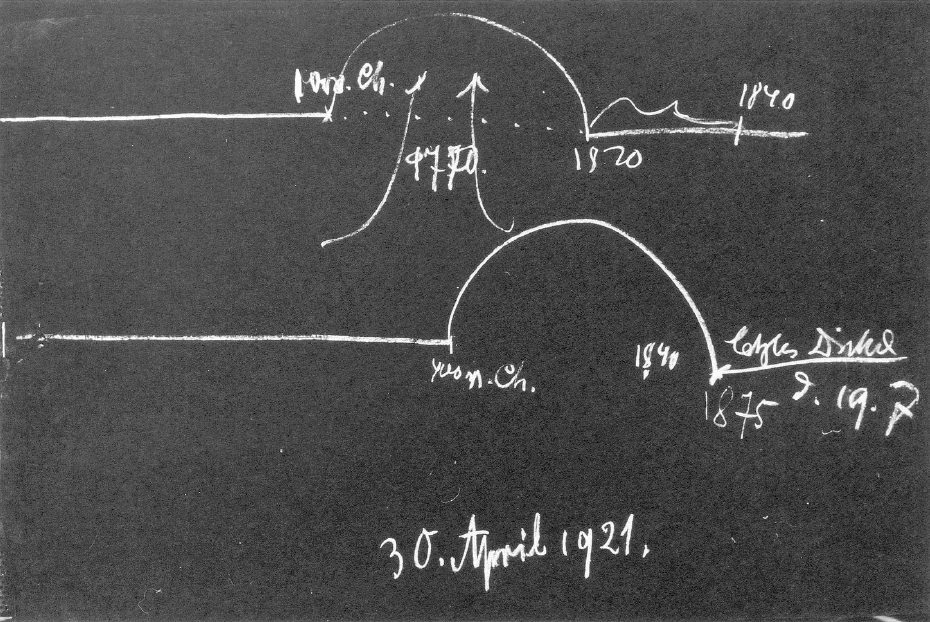
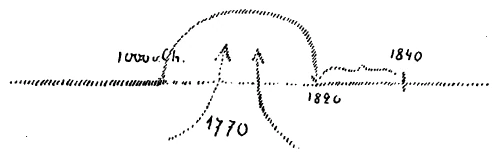
[ 14 ] Man kann geradezu, wenn man es graphisch darstellen will, sagen, es entwickelt sich dieses Leben in der Form, wie es in Griechenland bis etwa um das Jahr 1000 vor Christus war (siehe Zeichnung). Dann macht es einen kühnen Sprung, und wir stehen plötzlich im Jahr 1820. Innerlich ist das Leben im Jahre 1000 vor Christus stehengeblieben; aber äußerlich sind wir im 18. Jahrhundert, sagen wit 1770 (Pfeile). Da wälzt sich hinein alles dasjenige, was dann im modernen Leben, ja in der Jetztzeit dasteht. Aber den Anschluß, die Notwendigkeit findet dieses englische Leben erst 1820 (siehe Zeichnung); da sind ja solche Dinge überhaupt erst spruchreif geworden, wie die Abschaffung der Todesstrafe für einen kleinlichen Diebstahl und dergleichen. So kann man sagen: Es ist durchaus hier zusammengeflossen ein Uraltes mit dem Allerallermodernsten; und so trifft dann die Weiterentwickelung hinein in das Jahr 1840.
[ 14 ] If one were to illustrate this graphically, one could say that this life develops in the same way it did in Greece up until around 1000 B.C. (see drawing). Then it takes a bold leap, and we suddenly find ourselves in the year 1820. Inwardly, life has remained stagnant at the year 1000 B.C.; but outwardly, we are in the 18th century—let’s say 1770 (arrows). Everything that then characterizes modern life—indeed, life in the present day—flows into this period. But this English way of life does not find its connection, its necessity, until 1820 (see illustration); it was only then that issues such as the abolition of the death penalty for petty theft and the like became a topic of serious discussion. So one can say: something ancient has indeed converged here with the very, very modern; and thus further development then extends into the year 1840.
[ 15 ] Was hatte nun in diesem Zeitalter hier, in der ersten Hälfte des 19. Jahrhunderts, gerade bei dem anglo-amerikanischen Volke zu geschehen? Wir müssen bedenken, daß erst nach dem Jahre 1820, sogar erst nach 1830 Gesetze notwendig geworden sind in England, wodurch Kinder unter zwölf Jahren nicht zu längerer Fabrikarbeit angehalten werden durften als zu achtstündiger, Kinder von dreizehn bis zu achtzehn Jahren höchstens zu zwölfstündiger Tagesarbeit. Bitte, vergleichen Sie das mit den heutigen Verhältnissen! Bedenken Sie, was heute als Achtstundentag von der breiten Masse des Proletariats gefordert wird! Im Jahre 1820 noch wurden in England Knaben länger als acht Stunden beschäftigt in Bergwerken und Fabriken, und erst in diesem Jahre wurde für diese der Achtstundentag angesetzt; aber für Kinder vom zwölften bis achtzehnten Lebensjahre herrschte noch der Zwölfstundentag.
[ 15 ] What, then, was to happen during this era—the first half of the 19th century—particularly among the Anglo-American people? We must bear in mind that it was not until after 1820—indeed, not until after 1830—that laws became necessary in England prohibiting children under the age of twelve from working in factories for more than eight hours a day, and limiting children aged thirteen to eighteen to a maximum of twelve hours of work per day. Please compare this with conditions today! Consider what the broad masses of the proletariat are demanding today as an eight-hour workday! As late as 1820, boys in England were still being employed for more than eight hours in mines and factories, and it was not until that year that the eight-hour workday was established for them; but for children between the ages of twelve and eighteen, the twelve-hour workday still prevailed.
[ 16 ] Man muß diese Dinge durchaus ins Auge fassen, wenn man sehen will, was da eigentlich zusammengestoßen ist, und im Grunde genommen könnte man sagen, erst im zweiten Drittel des 19. Jahrhunderts wandte sich England heraus aus dem Patriarchalischen und sah sich genötigt, zu rechnen mit dem, was sich langsam durch die Maschinentechnik hineingeschoben hat in dieses Alte. So traf dasjenige Volk, welches vorzugsweise berufen ist, die Bewußtseinsseele sozusagen auszubilden, so traf dieses Volk der Zeitpunkt von 1840.
[ 16 ] One must certainly take these things into account if one wants to see what actually came into conflict there, and, strictly speaking, one could say that it was not until the second third of the 19th century that England finally turned away from the patriarchal system and found itself compelled to reckon with what had slowly crept into this old order through mechanical technology. Thus, the people who are, so to speak, primarily called upon to develop the soul of consciousness—this is the people whom the year 1840 found.
[ 17 ] Nehmen Sie jetzt andere Völker der modernen Zivilisation; nehmen Sie dasjenige, was vom lateinisch-romanischen Elemente geblieben ist, was also das Romanisch-Lateinische vom vierten nachatlantischen Zeitraum herübergetragen hat, was gewissermaßen als Erbgut herübergebracht hat die alte Verstandesseelenkultur im Zeitalter der Bewußtseinsseele. Seine Kulmination, seinen Höhepunkt hat ja das, was da noch vorhanden war an Leben der Verstandesseele, in der Französischen Revolution am Ende des 18. Jahrhunderts gefunden. Wir sehen, wie da plötzlich in äußerster Abstraktion auftauchen die Ideale von «Freiheit», «Gleichheit», «Brüderlichkeit». Wir sehen, wie sie ergriffen werden von solchen Skeptikern wie Voltaire, von solchen Enthusiasten wie Rousseau, wir sehen, wie sie überhaupt auftauchen aus der breiten Masse des Volkes; wir sehen, wie die Abstraktion, die vollberechtigt ist auf diesem Gebiete, hier eingreift in das Gefüge der sozialen Struktur — eine ganz andere Entwickelung als drüben in England. In England die Überreste des altgermanischen patriatchalischen Lebens, durchsetzt von dem, was die moderne Technik, was das moderne materialistische wissenschaftliche Leben in die soziale Struktur hineinsenden konnte, in Frankreich alles Überlieferung, alles Tradition. Man möchte sagen: Mit demselben Duktus, mit dem einstmals ein Brutus oder Cäsar in Rom in den verschiedensten Schattierungen gewirkt haben, mit demselben Duktus wird jetzt die Französische Revolution in Szene gesetzt. So taucht wiederum auf in abstrakten Formen das, was Freiheit, Gleichheit und Brüderlichkeit ist. Und nicht von außen herein wird da zersprengt, wie in England, dasjenige, was als altes patriarchalisches Element vorhanden ist, sondern das romanisch-juristische Festsetzen, das Festhalten an dem alten Eigentumsbegriff, an den Grundbesitzerverhältnissen und so weiter, an den Erbschaftsverhältnissen namentlich, das, was römisch-juristisch festgesetzt ist, wird von der Abstraktion her zersetzt, wird von der Abstraktion her auseinandergetrieben.
[ 17 ] Now consider other peoples of modern civilization; consider what remains of the Latin-Romance elements—that is, what the Romance-Latin tradition carried over from the fourth post-Atlantean epoch, what, in a sense, was passed down as a legacy by the ancient culture of the intellectual soul into the age of the conscious soul. What remained of the life of the intellectual soul reached its culmination, its high point, in the French Revolution at the end of the 18th century. We see how the ideals of “liberty,” “equality,” and “fraternity” suddenly emerge there in the most extreme abstraction. We see how they are taken up by skeptics such as Voltaire and enthusiasts such as Rousseau; we see how they emerge at all from the broad masses of the people; we see how abstraction—which is fully justified in this realm—intervenes here in the fabric of the social structure—a development quite different from that over in England. In England, the remnants of the old Germanic patriarchal way of life, interwoven with what modern technology and modern materialistic, scientific life were able to inject into the social structure; in France, everything is based on tradition. One might say: With the same style with which a Brutus or Caesar once operated in Rome in the most varied shades, with that same style the French Revolution is now being staged. Thus, what constitutes liberty, equality, and fraternity reemerges in abstract forms. And it is not from the outside, as in England, that the old patriarchal element is shattered, but rather the Roman-legal codification— the adherence to the old concept of property, to landownership relations and so on—specifically, to inheritance relations—that which is established under Roman law is decomposed by abstraction, is driven apart by abstraction.
[ 18 ] Man braucht nur zu denken, welchen ungeheuren Einschnitt in das ganze europäische Leben die Französische Revolution brachte. Man braucht ja nur daran zu erinnern, daß vor der Französischen Revolution diejenigen, die, ich möchte sagen, herausgesondert waren aus der Masse des Volkes, auch Rechtsvorteile hatten. Nur gewisse Leute konnten, sagen wir, zu gewissen Staatsstellungen kommen. Da Breschen hineinzuschlagen, das zu durchlöchern, das war dasjenige, was aus der Abstraktion heraus, aus dem schattenhaften Verstande heraus die Französische Revolution forderte. Aber sie trug eben durchaus in sich das Gepräge des schattenhaften Verstandes, der Abstraktion, und es blieb im Grunde genommen das, was da gefordert wurde, eine Art Ideologie. Daher, könnte man sagen, schlägt dasjenige, was schattenhafter Verstand ist, sogleich um in sein Gegenteil.
[ 18 ] One need only consider what a tremendous upheaval the French Revolution brought to European life as a whole. One need only recall that before the French Revolution, those who—I would say—were set apart from the masses of the people also enjoyed legal privileges. Only certain people could, let’s say, attain certain positions of state. To break through those barriers, to pierce through that system—that was what the French Revolution demanded, arising from abstraction, from a shadowy intellect. But it bore within itself the very stamp of shadowy reason, of abstraction, and what was demanded there remained, in essence, a kind of ideology. Therefore, one might say, what is shadowy reason immediately turns into its opposite.
[ 19 ] Wir sehen dann den Napoleonismus und wir sehen das staatlich-soziale Experimentieren im Laufe des 19. Jahrhunderts. Die erste Hälfte des 19. Jahrhunderts ist ja in Frankreich ein Experimentieren ohne Ziel. Wie sind die Ereignisse, durch welche so ein Louis-Philippe zum Beispiel König von Frankreich wird und dergleichen, wie wird da experimentiert? — Es wird so experimentiert, daß man sieht, der schattenhafte Verstand vermag nicht wirklich in die realen Verhältnisse einzugreifen. Es bleibt alles ungetan im Grunde genommen, es bleibt alles unvollendet, es bleibt alles Erbschaft des alten Romanismus. Man könnte sagen: Heute ist noch immer nicht das Verhältnis, das die Französische Revolution im Abstrakten ganz klar hatte, das Verhältnis, sagen wir zur katholischen Kirche, in der äußeren konkreten Wirklichkeit in Frankreich geklärt. Und wie unklar war es von Zeit zu Zeit immer wiederum im Laufe des 19. Jahrhunderts. Der abstrakte Verstand hatte sich zu einer gewissen Höhe heraufgerungen in der Revolution, und dann ein Experimentieren, ein Nicht-Gewachsensein den äußeren Verhältnissen. Und so traf diese Nation das Jahr 1840.
[ 19 ] We then see Napoleonicism and we see state-led social experimentation throughout the 19th century. The first half of the 19th century in France was, after all, a period of aimless experimentation. How did the events unfold—such as those that led to Louis-Philippe becoming King of France, for example—and how was experimentation carried out in such cases? — It was carried out in such a way that one sees the shadowy intellect is unable to truly intervene in real circumstances. Essentially, everything remains undone; everything remains unfinished; everything remains a legacy of the old Romanism. One could say: Even today, the relationship—which the French Revolution had quite clearly defined in the abstract, the relationship, let us say, to the Catholic Church—has still not been clarified in the external, concrete reality of France. And how unclear it was, time and again, throughout the 19th century. Abstract reason had struggled to reach a certain height during the Revolution, followed by a period of experimentation—a state of not having matured in relation to external circumstances. And so this nation entered the year 1840.
[ 20 ] Wir könnten auch andere Nationen in Betracht ziehen. Sehen wit zum Beispiel Italien an, das noch, ich möchte sagen, ein Stück Empfindungsseele mitbehielt beim Durchgang durch die Verstandeskultur, das dieses Stück Empfindungsseele in die neuere Zeit heraufbrachte, und es daher nicht bis zu den abstrakten Begriffen von Freiheit, Gleichheit und Brüderlichkeit brachte, bis zu denen man es in der Französischen Revolution gebracht hatte, das aber doch den Übergang suchte von einem gewissen alten Gruppenbewußtsein der Menschen zu dem individuellen Menschheitsbewußtsein. Italien traf das Jahr 1840 so, daß man sagen kann: Was sich da in Italien heraufarbeiten will an individuellem Menschheitsbewußtsein, wird eigentlich immerfort niedergehalten von demjenigen, was.nun im übrigen Europa ist. Wir sehen ja, wie die Habsburgische Tyrannei in einer furchtbaren Weise lastet gerade auf dem, was sich in Italien an individuellem Menschheitsbewußtsein heraufarbeiten will. Wir sehen ja jenen merkwürdigen Kongreß von Verona, der in den zwanziger Jahren des 19. Jahrhunderts eigentlich ausmachen wollte, wie man sich auflehnen kann gegen den ganzen Sinn der modernen Zivilisation. Wir sehen, wie da von Rußland, Österreich ausging, ich möchte sagen eine Art von Verschwörung gegen dasjenige, was das moderne Menschheitsbewußtsein bringen sollte. Es ist kaum etwas so interessant, wie dieser Veroneser Kongreß, der im Grunde genommen die Frage beantworten wollte: Wie schlägt man alles das tot, was sich als modernes Menschheitsbewußtsein heraufentwickeln will?
[ 20 ] We could also consider other nations. Let us look, for example, at Italy, which, I would say, retained a fragment of its emotional soul as it passed through the culture of the intellect, bringing this fragment of emotional soul into the modern era, and therefore did not progress as far as the abstract concepts of liberty, equality, and fraternity—the level to which the French Revolution had advanced—but which nevertheless sought the transition from a certain old group consciousness of humanity to an individual consciousness of humanity. Italy found itself in 1840 in such a situation that one can say: What is striving to emerge in Italy as an individual consciousness of humanity is, in fact, constantly being suppressed by what is now prevalent in the rest of Europe. We see, after all, how the Habsburg tyranny weighs down in a terrible way precisely upon that which is striving to emerge in Italy as an individual consciousness of humanity. We see, after all, that remarkable Congress of Verona, which in the 1820s actually sought to determine how one might rebel against the very essence of modern civilization. We see how, from Russia and Austria, there emerged—I would say—a kind of conspiracy against what modern human consciousness was meant to bring about. There is hardly anything as interesting as this Verona Congress, which, in essence, sought to answer the question: How does one destroy everything that is striving to develop into modern human consciousness?
[ 21 ] Und dann sehen wir, wie nun die Menschheit im übrigen Europa ringt, so ringt, daß in Mitteleuropa ja überhaupt nur immer ein kleiner Teil der Menschheit sich heraufringen kann zu einem gewissen Bewußtsein, sozusagen in einer gewissen Weise erlebt, daß jetzt das Ich eintreten soll in die Bewußtseinsseele. Wir sehen, wie das in einer gewissen geistigen Höhe erreicht werden soll. Wir sehen es in jener merkwürdigen Kulturhöhe des Goetheschen Zeitalters, in der ein Fichte gewirkt hat, wir sehen, wie sich da das Ich vordrücken will zur Bewußtseinsseele herein. Aber wir sehen, wie die ganze GoetheKultur etwas bleibt, was im Grunde genommen nur bei ganz wenigen lebt. Ich glaube, die Menschen studieren allzuwenig, was selbst noch in der jüngsten Vergangenheit war. Die Menschen denken zum Beispiel einfach: Goethe hat gelebt von 1749 bis 1832; er hat den «Faust» und alles Mögliche geschrieben. — Das ist das, was man weiß von Goethe, und das war seither da.
[ 21 ] And then we see how humanity in the rest of Europe is now struggling—struggling in such a way that, in Central Europe, only a small portion of humanity can ever bring itself to a certain level of consciousness, experienced, so to speak, in a certain way, such that the “I” is now to enter the conscious soul. We see how this is to be achieved at a certain spiritual height. We see it in that remarkable cultural height of the Goethean era, in which a figure like Fichte was active; we see how the “I” seeks to push its way into the soul of consciousness there. But we also see how the entire Goethean culture remains something that, fundamentally speaking, lives on only among a very few. I believe people study far too little of what even the recent past entailed. People simply think, for example: Goethe lived from 1749 to 1832; he wrote Faust and all sorts of other things. — That is what people know about Goethe, and that has been the case ever since.
[ 22 ] Bis zum Jahre 1862, also dreißig Jahre nach Goethes Tode, war ja überhaupt für die wenigsten Menschen ein Exemplar von Goethe zu beschaffen. Goethe war nicht frei; nur ganz wenige Menschen besaßen irgendwie ein Exemplar von Goethes Schriften. Es war also dasjenige, was Goetheanismus ist, etwas, was ganz wenigen eigen geworden war. Erst in den sechziger Jahren konnte eine größere Anzahl von Menschen überhaupt Kunde erlangen von dem, was in Goethe lebte, und da war im Grunde genommen schon das Verständnis, die Verständnisfähigkeit wiederum hinuntergeschwunden. Es ist zu einem richtigen Verständnis Goethes im Grunde genommen gar nicht gekommen. Und das letzte Drittel des 19. Jahrhunderts war überhaupt gar nicht geeignet, ein rechtes Verständnis für Goethe hervorzurufen.
[ 22 ] Until 1862—that is, thirty years after Goethe’s death—very few people were able to obtain a copy of Goethe’s works at all. Goethe was not freely available; only a very small number of people owned a copy of his writings in any form. So what Goetheanism is—that was something that had become the preserve of only a very few. It was not until the 1860s that a larger number of people were able to gain any knowledge at all of what lived within Goethe, and by then, in essence, the understanding—the capacity for understanding—had already dwindled once again. In essence, a true understanding of Goethe never really emerged. And the last third of the 19th century was not at all conducive to fostering a proper understanding of Goethe.
[ 23 ] Ich habe es ja öfters erwähnt, wie Herman Grimm in den siebziger Jahren zunächst seine «Vorlesungen über Goethe» an der Berliner Universität gehalten hat. Das war ein Ereignis, und das Buch, das vorhanden ist als der «Goethe» Herman Grimms, ist eine bedeutende Erscheinung innerhalb der mitteleuropäischen Literatur. Aber wenn man jetzt dieses Buch nimmt, was bedeutet es denn? Ja, alle Gestalten, die mit Goethe im Zusammenhange lebten, kommen darinnen vor, aber sie haben immer nur Ausdehnungen nach zwei Dimensionen; sie sind Schattenfiguren. Alles das, was da Porträts sind, sind Schattenfiguren. Goethe selber ist bei Herman Grimm eine zweidimensionale Wesenheit. Es ist gar nicht der Goethe selber. Ich will gar nicht sprechen von dem Goethe, den man in Weimar in den Nachmittags-Kaffeekränzchen den «dicken Geheimrat mit dem Doppelkinn» nannte; von dem will ich gar nicht sprechen; aber er hat überhaupt keine «Dicke» in Herman Grimms «Goethe», sondern er ist dort ein zweidimensionales Wesen, er ist der Schatten, der an eine Wand hingeworfen ist. Und ebenso all die anderen, die da auftreten; Herder, ein Schatten, der an eine Wand hingemalt ist. Etwas mehr Greifbarkeit tritt uns gerade bei Herman Grimm bei denjenigen Persönlichkeiten entgegen, die aus dem Volke heraufsteigen zu Goethe, wie Friederike von Sesenheim, die so wunderschön da geschildert ist, oder wie die Frankfurterin Lili Schönemann, also gerade dasjenige, was heraufsteigt nun nicht aus der Atmosphäre, in der Goethe eigentlich geistig lebte. Das ist mit einer gewissen «Dicke» geschildert. Aber so ein Jacobi, so eine Gestalt wie Lavater — alles Schattenbilder an der Wand. Man kommt nicht in das eigentliche Wesen der Sachen hinein, man sieht, ich möchte sagen, handgreiflich, wie die Abstraktion wirkt. Die Abstraktion kann ja auch durchaus anmutig sein, was das Herman Grimmsche Buch durchaus ist; aber schattenhaft ist das Ganze. Es sind Silhouetten, zweidimensionale Wesenheiten, die uns da entgegentreten.
[ 23 ] I have often mentioned how Herman Grimm first delivered his “Lectures on Goethe” at the University of Berlin in the 1870s. That was a major event, and the book—known as Herman Grimm’s Goethe—is a significant work in Central European literature. But if one picks up this book today, what does it actually mean? Yes, all the figures who were connected to Goethe appear in it, but they are always limited to two dimensions; they are shadow figures. All the so-called portraits in there are shadow figures. Goethe himself is a two-dimensional entity in Herman Grimm’s work. It is not Goethe himself at all. I don’t even want to speak of the Goethe whom people in Weimar, during their afternoon coffee gatherings, called the “fat Privy Councilor with the double chin”; I don’t want to speak of him at all; but he has absolutely no “fatness” in Herman Grimm’s Goethe—rather, he is a two-dimensional being there; he is the shadow cast upon a wall. And the same goes for all the others who appear there; Herder, a shadow painted on a wall. We encounter a bit more tangibility in Herman Grimm’s work precisely in those figures who rise up from the people to Goethe, such as Friederike von Sesenheim, who is so beautifully portrayed there, or Lili Schönemann from Frankfurt—that is, precisely those who rise not from the atmosphere in which Goethe actually lived spiritually. These are portrayed with a certain “depth.” But a figure like Jacobi, or a figure like Lavater—they are all mere silhouettes on the wall. One does not penetrate to the very essence of things; one sees, I might say, quite tangibly, how abstraction takes effect. Abstraction can, of course, be quite graceful—which Herman Grimm’s book certainly is—but the whole thing remains shadowy. They are silhouettes, two-dimensional entities that confront us there.
[ 24 ] Und das konnte auch nicht anders sein. Denn es ist wirklich so: Deutscher durfte man sich ja in Deutschland überhaupt nicht nennen in der Zeit, in der zum Beispiel Herman Grimm noch jung war. Die Art und Weise, wie man von Deutschen gesprochen hat in der ersten Hälfte des 19. Jahrhunderts, die wird ja insbesondere in der Gegenwart mißverstanden. Wie «gruselt» es die Leute des Westens, die Ententeleute, wenn sie heute anfangen Fichtes «Reden an die deutsche Nation» zu lesen und da finden: «Ich spreche zu Deutschen schlechtweg, von Deutschen schlechtweg.» Geradeso wird das unschuldige Lied «Deutschland, Deutschland über alles», töricht interpretiert, indem ja dieses Lied nichts anderes heißen soll als, man will Deutscher sein, nicht Schwabe, nicht Bayer, nicht Österreicher, nicht Franke, nicht Thüringer. Wie dieses Lied sich nur auf die Deutschen stellt allseitig, so wollte Fichte nur sprechen «zu Deutschen schlechtweg», nicht zu Österreichern, zu Bayern, zu Badensern, zu Württembergern oder zu Franken, oder zu Preußen gar; er wollte «zu Deutschen» sprechen. Das versteht man natürlich zum Beispiel in einem Lande nicht, wo es längst selbstverständlich geworden ist, daß man sich einen Franzosen nennen kann. In Deutschland wurde man in gewissen Zeiten eingesperrt, wenn man sich einen Deutschen nannte. Man konnte sich einen Österreicher, einen Schwaben, einen Bayer nennen; aber Deutscher sich zu nennen, war hochverräterisch. Wer in Bayern sich einen Deutschen nannte, der bekundete damit, daß er nicht nur hinaufschauen wollte zum bayerischen Throne, der seine Grenze da und dort hat, sondern daß er hinausschauen wollte über die Grenze von Bayern hinaus. Das war aber Hochverrat! Man durfte sich nicht einen Deutschen nennen. Daß diese Dinge, die von Deutschen und über Deutschland gesagt worden sind, eben Bezug haben auf dieses Zusammendrängen desjenigen, was deutsch ist, das wird heute gar nicht verstanden, und man stellt das törichte Zeug hin, als wenn so etwas wie das Hoffmannsche Lied sich darauf beziehen würde, daß Deutschland herrschen soll über alle Nationen der Welt; während es nichts anderes heißen soll als: nicht Schwaben, nicht Österreich, nicht Baden über alles in der Welt, sondern Deutschland über alles in der Welt, gerade wie der Franzose sagt: Frankreich über alles in der Welt. Aber gerade da in Mitteleuropa war dieses Eigentümliche, daß man im Grunde genommen eine Stammeskultur hatte. Sie können ja heute noch diese Stammeskultur in Deutschland überall sehen. Der Württemberger ist verschieden vom Franken, er ist verschieden bis in die Begriffs- und Wortformen, bis in die Gedankenformen hinein, die sich in der Literatur ausbreiten. Es ist ja auch durchaus, sagen wir, ein grandioser Unterschied, wenn Sie einen Franken nehmen, wie zum Beispiel den klotzigen Michael Conrad — wenn ich die neuere Literatur hernehme —, und ihn vergleichen mit irgend etwas, was etwa von einem Württemberger, also im Nachbarlande, in derselben Zeit geschrieben worden ist. Bis in die ganze Konfiguration der Gedanken spielt ja das bis in die neueste Zeit hinein. Aber all das, was sich da ausbreitet, was da in den Stammeseigentümlichkeiten lebt, das bleibt ja unberührt von dem, was nun eigentlich erreicht wird von den repräsentativen Trägern der Nationen. Man hat doch, sagen wir, in dem Gebiete, das man Deutschland nennt, so etwas erreicht, wie den Goetheanismus mit alledem, was dazugehört. Aber das ist ja nur von wenigen intellektuellen Menschen erreicht worden, davon ist die große Masse der Menschheit gar nicht berührt. Die große Masse der Menschheit bleibt ungefähr auf dem Standpunkte, der eigenommen worden ist in Mitteleuropa etwa um das Jahr 300 oder 400 nach Christus. Geradeso wie man im angelsächsischen Volke stehengeblieben ist bei dem Jahre 1000 vor Christus, so bleibt man in Mitteleuropa stehen bei dem Jahre 400 nach Christus. Das bitte ich nicht so zu nehmen, daß jetzt wiederum ein furchtbarer Hochmut aufkommen könnte, indem man sagt: Die Angelsachsen, die sind im homerischen Zeitalter zurückgeblieben, und wir waren schon im Jahre 400 nach Christus! — So sind die Dinge nicht zu bewerten, sondern es wird eben nur auf gewisse Eigentümlichkeiten hingewiesen.
[ 24 ] And it couldn’t have been any other way. Because it’s really true: Back when Herman Grimm, for example, was still young, you weren’t even allowed to call yourself a “German” in Germany. The way people spoke of “Germans” in the first half of the 19th century is, after all, particularly misunderstood today. How “creeped out” are people in the West—the Entente folks—when they start reading Fichte’s “Addresses to the German Nation” today and find: “I speak to Germans, pure and simple; of Germans, pure and simple.” In exactly the same way, the innocent song “Deutschland, Deutschland über alles” is foolishly misinterpreted, since this song means nothing other than that one wants to be a German—not a Swabian, not a Bavarian, not an Austrian, not a Franconian, not a Thuringian. Just as this song refers exclusively to Germans in every respect, so Fichte wanted to speak only “to Germans, and nothing else”—not to Austrians, Bavarians, people from Baden, people from Württemberg, or Franconians, or even Prussians; he wanted to speak “to Germans.” Of course, this is not understood, for example, in a country where it has long since become a matter of course that one can call oneself a Frenchman. In Germany, at certain times, one was imprisoned for calling oneself a German. One could call oneself an Austrian, a Swabian, or a Bavarian; but to call oneself a German was an act of high treason. Anyone in Bavaria who called himself a German was thereby declaring not only that he wanted to look up to the Bavarian throne—which has its borders here and there—but that he wanted to look beyond the borders of Bavaria. But that was high treason! One was not allowed to call oneself a German. The fact that these things—which have been said by Germans and about Germany—refer precisely to this convergence of all that is German is not understood at all today, and people present this foolish nonsense as if something like Hoffmann’s song were referring to the idea that Germany should rule over all the nations of the world; whereas it means nothing other than: not Swabia, not Austria, not Baden above all else in the world, but Germany above all else in the world—just as the French say: “France above all else in the world.” But it was precisely there in Central Europe that this peculiarity existed: that, fundamentally speaking, there was a tribal culture. You can still see this tribal culture everywhere in Germany today. The Württemberger is different from the Franconian; he is different right down to the forms of concepts and words, right down to the forms of thought that are expressed in literature. It is, after all, a truly—let’s say—staggering difference when you take a Franconian, such as the burly Michael Conrad—if I draw on more recent literature—and compare him with something written by, say, a Württemberger, that is, in the neighboring region, during the same period. This extends right down to the very configuration of thought, right up to the present day. But everything that is spreading there, everything that lives in these tribal peculiarities, remains untouched by what is actually being achieved by the representative figures of the nations. In the region we call Germany, for example, something like Goetheanism—with all that it entails—has been achieved. But this has been achieved by only a few intellectuals; the vast majority of humanity remains completely untouched by it. The vast majority of humanity remains roughly at the stage that was reached in Central Europe around the year 300 or 400 A.D. Just as the Anglo-Saxon peoples have remained stuck at the year 1000 B.C., so too has Central Europe remained stuck at the year 400 A.D. Please do not take this to mean that a terrible arrogance might now arise, leading one to say: “The Anglo-Saxons are stuck in the Homeric age, while we were already in the year 400 A.D.!” — That is not how these things should be judged; rather, the point is simply to highlight certain peculiarities.
[ 25 ] Nun ergeben aber wiederum die geographischen Verhältnisse, daß dieser Stand der allgemeinen Seelenbildung in Deutschland viel länger dauert als in England drüben. England hat in sein altes patriarchalisches Leben schnell hineinfließen lassen müssen dasjenige, was zunächst bei ihm auf dem Gebiete der Textilindustrie, aber später auch auf dem Gebiete anderer Techniken aus dem modernen materialistisch-wissenschaftlich-technischen Leben die soziale Struktur gestaltet hat. Was deutsches Gebiet war, und was überhaupt Mitteleuropa war, das hat sich dem zunächst entgegengestellt, das hat die alten Eigentümlichkeiten viel länger behalten, bis, ich möchte sagen, zu einem Zeitpunkte, wo schon über die ganze Welt in voller Geltung war, was durch die moderne Technik gekommen ist. England hat noch den Anschluß gefunden mit der Umgestaltung der sozialen Struktur bis zu einem gewissen Grade in der ersten Hälfte des 19. Jahrhunderts. Das alles, was da errungen worden ist, das ging durchaus vorüber an Mitteleuropa.
[ 25 ] However, geographical conditions mean that this stage of general cultural development in Germany takes much longer than it does in England. England had to quickly integrate into its old patriarchal way of life the elements—which initially shaped its social structure in the field of the textile industry, but later also in other technical fields—derived from modern materialistic, scientific, and technical life. What was German territory—and what Central Europe was in general—initially resisted this; it retained its old characteristics for much longer, until, I would say, a point in time when what had come about through modern technology was already fully established throughout the world. England still managed to keep pace with the transformation of the social structure to a certain extent in the first half of the 19th century. All that had been achieved there passed Central Europe by entirely.
[ 26 ] Mitteleuropa nahm zwar etwas von abstrakten Revolutionsideen auf. Das kam in den vierziger Jahren, in der Mitte des 19. Jahrhunderts, dann in verschiedenen Wogen und Wellen zum Durchbruch; aber es wartete gewissermaßen ab, bis die Technik die ganze Welt erfüllte, und dann trug sich ja das Eigentümliche zu, daß solch ein Mensch — wir könnnten auch andere Repräsentanten nehmen —, der in Deutschland denken gelernt hat vom Hegelismus, wie Karl Marx , dann hinübergegangen ist nach England und dort sich das soziale Leben angeschaut und daraus die sozialistischen Doktrinen gebildet hat. Für diese sozialen Doktrinen war dann am Ende des 19. Jahrhunderts Mitteleuropa reif. Diese sozialen Doktrinen wurden dann von Mitteleuropa angenommen, so daß also, wenn man in einer etwa ähnlichen Weise nun aufzeichnen wollte, was sich in Mitteleuropa entwickelt hat, man sagen müßte: Es ging die Entwickelung elementarer fort, wenn auch durch Schrift und Druck Mannigfaltiges von außen aufgenommen worden ist. Es ging dasjenige, was wie vierhundert Jahre nach Christus war, weiter, machte dann einen Sprung und fand erst im Grunde genommen im letzten Drittel des 19. Jahrhunderts den Anschluß, etwa im Jahre 1875. So daß, während das Jahr 1840 von der angelsächsischen Nation schon mit einer Umwandlung der Verhältnisse angetroffen wird, schon mit der Notwendigkeit, die Bewußtseinsseele aufzunehmen, das deutsche Volk fortträumte, und im Traume erlebte es noch das Jahr 1840 und verschlief dann die Zeit, die da gewesen wäre, um eine Brücke zu bauen zwischen den führenden Persönlichkeiten und dem, was aus der Masse des Volkes als Proletariat aufstieg und was sich dann der sozialistischen Doktrin bemächtigte und eben dadurch einen gewaltsamen, radikalen Zwangsdruck ausübte hin zu der Bewußtseinsseele, etwa von 1875 an. Aber auch dies ist eigentlich nicht bemerkt worden, jedenfalls nicht in irgendwelche Kanäle gebracht worden, und wird ja im Grunde genommen heute noch immer in der schiefsten Weise beurteilt.
[ 26 ] Central Europe did, admittedly, absorb some abstract revolutionary ideas. These came to the fore in the 1840s, in the middle of the 19th century, in various waves and surges; but it waited, so to speak, until technology had permeated the entire world, and then the peculiar thing happened that such a person—we could also cite other examples—who had learned to think in Germany through Hegelianism, like Karl Marx, then went over to England, observed social life there, and formulated socialist doctrines based on that. By the end of the 19th century, Central Europe was ripe for these social doctrines. These social doctrines were then adopted by Central Europe, so that if one were to trace, in a somewhat similar manner, what developed in Central Europe, one would have to say: The development continued in a more fundamental way, even though a great deal was absorbed from the outside through writing and printing. What had existed as it was around the year 400 A.D. continued, then took a leap forward, and only truly caught up, essentially, in the last third of the 19th century—around the year 1875. So that, while the year 1840 was already met by the Anglo-Saxon nations with a transformation of conditions—and with the necessity of embracing the soul of consciousness—the German people continued to dream, and in their dream they still experienced the year 1840 and then slept through the time that would have been available to build a bridge between the leading figures and that which rose from the masses of the people as the proletariat—and which then seized upon the socialist doctrine and, precisely through this, exerted a violent, radical coercive pressure toward the soul of consciousness, beginning around 1875. But even this has not really been noticed—at any rate, it has not been channeled into any form of discourse—and is, in fact, still being judged in the most distorted way even today.
[ 27 ] Um aufall die Anomalien zu kommen, welche da zugrundeliegen, braucht man ja nur daran zu erinnern, daß Oswald Spengler, der das bedeutende Buch geschrieben hat über den «Untergang des Abendlandes», ja auch ein Büchelchen, das, wie ich glaube, schon in 60 000 Exemplaren verbreitet ist, oder vielleicht in noch mehr, geschrieben hat über den Sozialismus. Spengler hat ja ungefähr die Anschauung, daß diese europäische, diese abendländische Zivilisation überhaupt sich ihr Grab gräbt. Wenn das Jahr 2200 geschrieben sein wird, so wird man nach Spengler auf dem Boden der Barbarei leben. Man muß Spengler Recht geben in bezug auf gewisse Seiten seiner Ausführungen; denn wenn die europäische Welt dabei bleibt, sich so weiter entwickeln zu wollen, wie sie es jetzt tut, so wird, wenn das dritte Jahrtausend beginnt, alles barbarisiert sein. In dieser Beziehung hat Spengler vollständig recht; nur sieht Spengler nicht und will nicht sehen, wie aus dem Inneren des Menschen der schattenhafte Verstand zu Imaginationen und damit die ganze Menschheit des Abendlandes zu einer neuen Kultur erhoben werden kann. Diese Belebung der Kultur durch das, was anthroposophische Geisteswissenschaft will, das sieht nämlich ein Mensch wie Oswald Spengler nicht. Aber er hat den Gedanken, der Sozialismus — der richtige Sozialismus, wie er meint, dieser Sozialismus, der wirklich ein soziales Leben herbeiführt —, der müsse noch vor diesem Untergange entstehen; es habe noch die Menschheit des Abendlandes die Mission, den Sozialismus zu verwirklichen. Aber, sagt Oswald Spengler, die einzigen Menschen, die berufen sind, den Sozialismus zu verwirklichen, das sind die Preußen. Daher hat er das Büchelchen geschrieben «Preußentum und Sozialismus». Jeder andere Sozialismus ist nach Spengler falsch, lediglich derjenige, der im Wilhelminischen Zeitalter seine ersten rosigen Strahlen gezeitigt hat, lediglich dieser Sozialismus müsse die Welt erobern; dann werde die Welt den wahren, den richtigen Sozialismus erleben. So spricht heute ein Mensch, den ich zu den genialsten Menschen der Gegenwart zu zählen habe. Es kommt nicht darauf an, die Menschen zu beurteilen nach dem Inhalte dessen, was sie sagen, sondern es kommt darauf an, die Menschen nach ihrer geistigen Kapazität zu beurteilen. Dieser Oswald Spengler, der fünfzehn Wissenschaften beherrscht, ist natürlich «gescheiter als alle die Schreiber, Doktoren, Magister und Pfaffen» und so weiter, und man kann schon sagen, er hat mit seinem Buch über den Untergang des Abendlandes etwas hingestellt, was Berücksichtigung verdient, was ja übrigens auch namentlich in der Jugend Mitteleuropas einen ungeheuer tiefen Eindruck macht. Aber daneben steht die Idee, die ich nunmehr jetzt ausgeführt habe, und Sie sehen, wie heute gerade genialische Menschen zu den ausgefallensten Ideen kommen können. Man ergreift Verstand, der heute wirkt, und der ist schattenhaft. Die Schatten huschen hin, man ist in einem Schatten drinnen, dann huscht man den anderen nach, nichts lebt. Es ist ja auch in der Silhouette, in dem Schattenbild einer Frau, das auf die Wand geworfen wird, ihre Schönheit gar nicht zu erkennen, und so ist es, wenn die Sachen in Schattenbildern betrachtet werden, auch. Das Preußentum im Schattenbilde ist durchaus zu verwechseln mit dem Sozialismus. Wenn eine Frau der Wand den Rücken zuwendet und ihr Schatten auf die Wand fällt, dann kann man die Häßlichste für schön halten; in gleicher Art kann man auch das Preußentum für den Sozialismus halten, wenn der schattenhafte Verstand dasjenige, was die Genialität ist, innerlich durchsetzt.
[ 27 ] To get to the root of all the underlying anomalies, one need only recall that Oswald Spengler, who wrote the important book on the “Decline of the West,” also wrote a little book—which, I believe, has already sold 60,000 copies, or perhaps even more—on socialism. Spengler holds, in essence, the view that this European, this Western civilization is digging its own grave. By the year 2200, according to Spengler, people will be living in a state of barbarism. One must agree with Spengler regarding certain aspects of his arguments; for if the European world persists in wanting to develop as it is doing now, then by the time the third millennium begins, everything will have become barbarized. In this respect, Spengler is entirely correct; yet Spengler does not see—and does not wish to see—how the shadowy intellect within the human being can be raised to the level of imagination, and thereby elevate the entire Western world to a new culture. This revitalization of culture through what anthroposophical spiritual science seeks—that is precisely what a person like Oswald Spengler fails to see. But he holds the view that socialism—true socialism, as he sees it, the kind of socialism that truly brings about a social life—must emerge before this decline sets in; he believes Western civilization still has the mission to bring socialism to fruition. Yet, says Oswald Spengler, the only people called upon to realize socialism are the Prussians. That is why he wrote the little book Prussianism and Socialism. According to Spengler, every other form of socialism is false; only the one that cast its first rosy rays during the Wilhelmine era—only this socialism—must conquer the world; then the world will experience true, genuine socialism. Such are the words of a man whom I must count among the most brilliant minds of our time. What matters is not judging people by the content of what they say, but judging them by their intellectual capacity. This Oswald Spengler, who has mastered fifteen fields of scholarship, is of course “smarter than all the writers, doctors, masters, and priests” and so on, and one can certainly say that with his book on the Decline of the West, he has produced something that deserves consideration—something that, incidentally, is making an immensely deep impression, particularly among the youth of Central Europe. But alongside this stands the idea I have just outlined, and you can see how, today, even geniuses can arrive at the most outlandish ideas. One grasps the intellect that is at work today, and it is shadowy. The shadows flit by; one is inside one shadow, then one flits after another—nothing is alive. After all, it is impossible to recognize a woman’s beauty in her silhouette, in the shadow cast on the wall, and so it is when things are viewed as shadows. Prussianism, as a shadow image, can easily be mistaken for socialism. When a woman turns her back to the wall and her shadow falls upon it, even the ugliest woman can be taken for beautiful; in the same way, Prussianism can be mistaken for socialism when the shadowy intellect permeates what is actually genius from within.
[ 28 ] So muß man heute diese Dinge ansehen. Man darf heute nicht auf die Inhalte gehen, sondern man muß auf die Kapazitäten gehen, das ist das Wichtige. Und so muß man anerkennen, daß so ein Mensch wie Spengler ein genialer Mensch ist, wenn man auch eine große Anzahl seiner Ideen für eine Narretei halten muß. Wir leben in einem Zeitalter, wo ursprüngliche, elementare Urteilsbegründungen auftreten müssen; denn aus gewissen elementaren Untergründen heraus muß zu einem Verständnis der Gegenwart und damit zu Impulsen für Wirklichkeiten für die Zukunft gekommen werden.
[ 28 ] That is how one must view these things today. Today, one must not focus on the content, but rather on the capabilities; that is what is important. And so one must acknowledge that a man like Spengler is a genius, even if one must regard a large number of his ideas as folly. We live in an age in which original, fundamental rationales for judgment must emerge; for it is from certain fundamental foundations that we must arrive at an understanding of the present and, thereby, at impulses for realities for the future.
[ 29 ] Vollkommen verschlafen natürlich hat der Osten dasjenige, was sich im Jahre 1840 ergeben hat. Denken Sie doch nur an die Handvoll Intellektueller in der großen Masse der durch die orthodoxe Religion, namentlich durch den orthodoxen Kultus noch tief im Orientalismus steckenden Angehörigen des russischen Volkes. Und denken Sie an die einschläfernde Wirkung eines Alexanders I., Nikolaus I. und aller derjenigen «I.», die nachgefolgt sind! Was heute gekommen ist, war also dasjenige, was hin wollte nach diesem Punkte, an dem die Bewußtseinsseele ihren Einschlag haben sollte in das europäische Leben.
[ 29 ] The East, of course, completely missed what transpired in 1840. Just think of the handful of intellectuals among the vast masses of the Russian people, who—due to the Orthodox religion, and particularly the Orthodox liturgy—remain deeply entrenched in Orientalism. And think of the soporific effect of Alexander I, Nicholas I, and all those “I”s who followed them! What has come about today, then, was what was bound to lead to this point, at which the soul of consciousness was to make its impact on European life.
[ 30 ] Davon wollen wir dann morgen weiterreden.
[ 30 ] Let's talk more about that tomorrow.