Perspectives on Human Evolution
The Materialistic Impulse toward Knowledge
and the Task of Anthroposophy
GA 204
30 April 1921, Dornach
Translated by Steiner Online Library
Eleventh Lecture
[ 1 ] In the course of these reflections, we have seen what an important juncture the mid-19th century represents in the development of Western civilization. We have drawn attention to how, in the mid-19th century, materialistic thinking and a materialistic view of life reached, so to speak, their peak; but we have also had to point out how what has been struggling to emerge within human beings since the beginning of the 15th century is in fact a spiritual reality, so that one could say: What was characteristic of this stage in the development of modern humanity was that, as human beings became most spiritual, they were unable to grasp this spirituality, but instead filled themselves only with materialistic thinking, materialistic feeling, and also materialistic willing and acting. And the present is still under the aftereffects of what took place—I would say—unnoticed by many people and which, after all, reached a climax within the development of humanity. What was the purpose of this climax? — It was there because something decisive was to happen with regard to modern humanity’s attainment of the level of the consciousness soul.
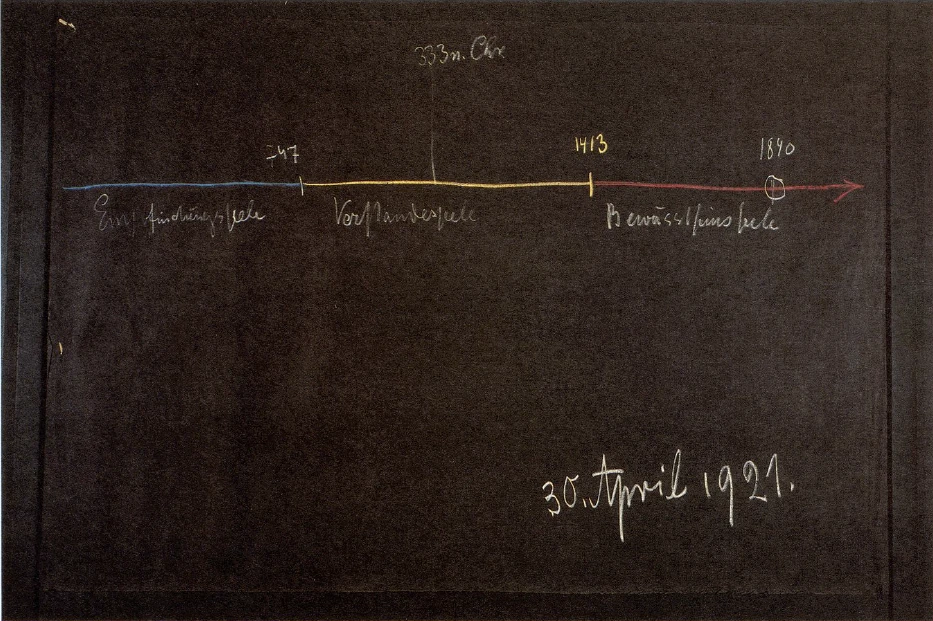
[ 2 ] If we take a look at how human evolution has unfolded, we must say: Beginning with the third post-Atlantean epoch, roughly up to, let’s say, the year 747 (see diagram) before the Mystery of Golgotha, we have what we can describe as the development of the feeling soul in humanity. Then begins the age of the intellectual or emotional soul, which lasts roughly until the year 1413 and reaches its peak at a point about which external history reveals little, but which must be taken into account if one is to understand European development at all. This is approximately the year 333 A.D. Since the year 1413, we have been dealing with the development of the conscious soul—a development in which we are still immersed—and which experienced a decisive event around the year 1850, or rather 1840.
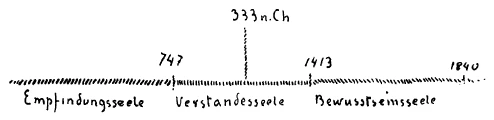
[ 3 ] Around the year 1840, the situation was such that if we consider humanity as a whole—we will begin to examine the attitudes of individual nations at that time shortly— we can say that, insofar as we look to representative figures of the nations, they stood in this year of 1840 at the point where the intellect had already become, for the most part, a shadow entity. The intellect had taken on its shadow character. I did, after all, try to characterize this shadow character of the intellect for you yesterday. Humanity on the civilized earth had progressed to such an extent that, from that point on, it became possible—even without initiation—to gain the following insight from general culture: We have the intellect; the intellect has developed to this level; but this intellect no longer has any content of its own. We have concepts, but these concepts are empty; we must fill them with something. — That is the call that goes out, so to speak, through humanity—albeit still darkly and inaudibly. But in the deep, subterranean, subconscious longings of human beings, the call lives on to find fulfillment for the shadow-like aspect of intellectual thought. It is precisely this call that leads to spiritual science. But we can also grasp this call in concrete terms.
[ 4 ] In the mid-19th century, human organization—in whose physical aspect this shadowy intellect is exercised—had developed to such an extent that it was able to train the intellect, the empty, shadowy intellect, well. Now, this shadowy intellect needed to be filled with something; it had to be filled with something. It can only be filled if the human being becomes aware: I must take in something of what does not present itself to me on Earth itself, what does not live on Earth itself, what I cannot experience in the life between birth and death. I must truly take into this mind something that was indeed erased when I descended from the spiritual worlds of the soul—with the results of my previous earthly lives—into a physical body; something that has indeed been obscured, but which rests in the depths of my soul. I must bring it up from there; I must reflect on something that is within me simply by virtue of being a person of the 19th century.
[ 5 ] It was not previously the case that people could have practiced self-reflection in the same way. Therefore, they first had to develop their humanity to the point where the physical body became increasingly mature in order to fully develop and fully exercise the shadow-like intellect. Now the physical bodies—at least in the case of the most advanced human beings—had reached a stage where one could have said—or rather, one can say since then: “I want to reflect on what I am seeking to bring up from the depths of my soul life in order to pour something into this shadowy intellect.” — Through this, this shadow-like intellect would then have been imbued with something, and through this, the consciousness soul would have dawned. So, in a sense, the opportunity was present at this point for the consciousness soul to have dawned.
[ 6 ] Now you will say: Yes, but the Age of the Consciousness Soul had already been in progress all that time before, since the year 1413. — Certainly, but it was initially a preparatory phase, and you need only consider what fundamental conditions for such preparation existed in this particular age, as opposed to all earlier ages. This age, for example, saw the invention of the printing press and the spread of writing. Since the fifteenth century, people have been gradually absorbing a great deal of spiritual content through the art of printing and through writing. But they absorb it externally; and the essential feature of this era is, after all, that an immense amount of spiritual content has been absorbed externally. The peoples of the civilized world have, in a sense, absorbed externally what they had previously been able to absorb—for the most part—only through spoken language. In the age of intellectual development, and even more so in the age of the feeling soul, the dissemination of education was, in essence, based on spoken language. Through language, something of the spiritual-soul aspect still resonates. Especially in earlier times, what might be called the “genius of language” was very much alive in words. This came to an end when the content of human education began to be absorbed in abstract form, through writing and printing. The printed and written word has the peculiarity of, in a certain way, erasing what a person receives at birth from their supersensible existence.
[ 7 ] Of course, this does not mean that you should now stop reading or writing; rather, it means that a stronger force is necessary today to raise up what lies deep within the human being. But this stronger force must also be attained. We must turn to self-reflection, even as we read and write; we must develop this greater power in contrast to what we had before. That is the task in the age of the development of the conscious soul.
[ 8 ] Before we take a closer look at how, in a certain sense, the spiritual world has indeed begun to influence the physical-sensory world, let us consider the following question today: How did the nations of modern civilization actually experience this turning point in 1840?
[ 9 ] We know from earlier lectures that the Anglo-Saxon people are the people most suited to the development of the consciousness soul—that is, to what is of particular importance in this age. This Anglo-Saxon people is the people whose entire organization is geared toward the special development of the consciousness soul. The special position of the Anglo-Saxon people—the Anglo-American people—in our age is based precisely on the fact that they are particularly predisposed to the development of the consciousness soul. But now let us ask ourselves, from a purely external perspective: How, in fact, has this Anglo-Saxon people arrived at this point in time, which is the most important in the development of modern culture?
[ 10 ] One could say: The Anglo-Saxon people, in particular, have for a long time lived in a state that can perhaps best be described—of course with the corresponding variations and transformations—by saying: With regard to their inner spiritual constitution, the Anglo-Saxon people retained, well into the 19th century, those inner impulses that had already given way to other forms in Greek civilization. — One could say that what is characteristic of the 11th and 10th centuries B.C. is that nations go through the same experiences at different times, so that, in a sense, the eras overlap. However, it is extremely difficult to observe such things, simply because, of course, by the 19th century everything was already in place—writing, reading—and because the conditions of life in Scotland and England were different from those that existed in the Homeric era.
[ 11 ] And yet, when one considers the spiritual disposition of the people as a nation, it is true that this spiritual disposition from the Homeric era—which had been overcome in Greece during the tragic age and had given way to Sophoclean thought—has persisted. This mindset persisted in the Anglo-Saxon world well into the 19th century—a kind of patriarchal outlook on life, a kind of patriarchal way of life. In particular, this patriarchal way of life, rooted in that state of mind, spread into Scotland, and it is for this reason that the influence emanating from the initiatory sites of Ireland did not take hold among the Anglo-Saxon people. As we have heard on other occasions, this influence was felt primarily in continental Europe. On the British Isles themselves, the main influence came from the north—from Scotland—in the form of initiatory truths, and these initiatory truths then permeated everything else. But there is something in the entire conception of the human personality that has, in a sense, remained ancient. And this continues to have an effect; it is evident even in the way, let us say, the relationship between Whigs and Tories unfolded in the English Parliament. The fact is that we are not originally dealing with the opposition between liberal and conservative, but rather with two shades of political opinion for which people today actually have no feelings at all.
[ 12 ] The Whigs are, in essence, the continuation of what one might call a humanist movement—rooted in universal love for humanity—that originated in Scotland. The Tories were originally, according to legend (which does, however, have a certain historical basis), even Catholic horse thieves from Ireland. This contrast, which is then expressed in their distinct political will, reflects a certain patriarchal way of being; and this patriarchal way of being has retained certain elemental forces. One can see this in the way the owners of large estates treated the people who lived on those estates as subjects. This relationship of subjection lasted well into the 19th century; until the 19th century, it was essentially the case that no one was elected to Parliament who did not hold a certain amount of power through such a landowning relationship. One need only consider what that means. Such things are not properly weighed. One need only consider what it means, for example, that it was not until 1820 that the English Parliament repealed the law under which a person who stole a watch or poached game was punished by death. Until then, it was a perfectly legal provision that anyone who had stolen a pocket watch or engaged in poaching was punished by death. This clearly shows just how entrenched certain old, primitive conditions remained. Today, people see only what exists in their immediate present, and they project, so to speak, the most essential elements of contemporary civilization backward in time, failing to see how brief the period actually was during which these things first emerged from entirely primitive conditions in the most important regions of Europe.
[ 13 ] Thus we can say that these patriarchal conditions have persisted as the foundation upon which the very most modern developments took root—developments that would be inconceivable in the social structure without the evolution of the conscious soul. Just consider the complete upheaval that had already taken place in the social structure by the 18th century as a result of the technical metamorphosis in the textile industry and so on. Consider how the mechanical element, the technical element, was drawn into this patriarchal framework, and form a vivid picture of how, on the foundation of the patriarchal system—this feudal lord-like relationship to the subjects—the emergence of the modern proletariat was thrust in through the transformation of the textile industry. Imagine the chaos that is unfolding, how cities are emerging from the old rural landscapes, how the patriarchal system—I would say—leaps boldly into modern socialist, proletarian life.
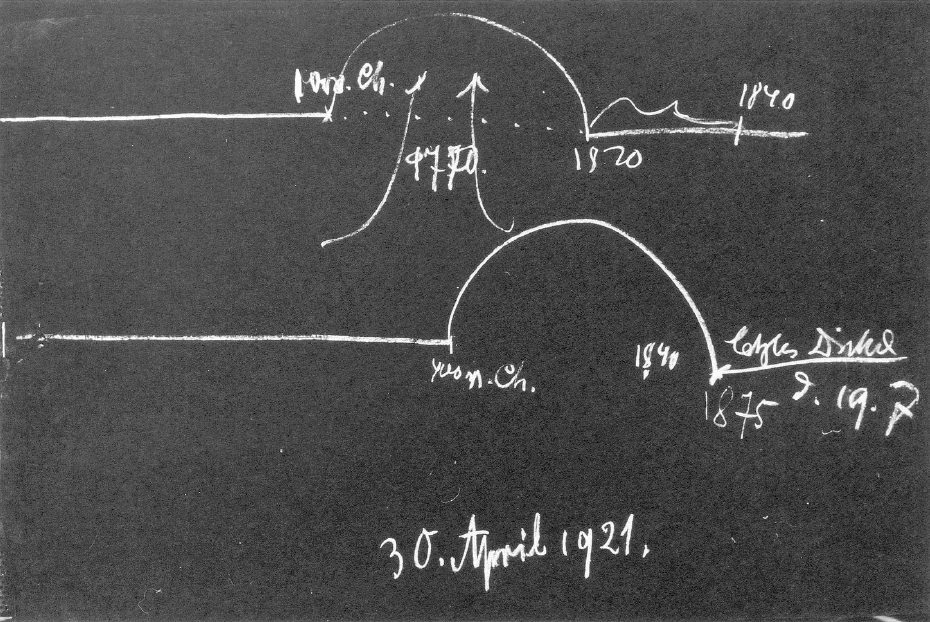
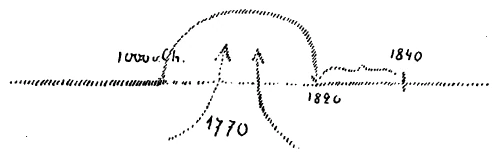
[ 14 ] If one were to illustrate this graphically, one could say that this life develops in the same way it did in Greece up until around 1000 B.C. (see drawing). Then it takes a bold leap, and we suddenly find ourselves in the year 1820. Inwardly, life has remained stagnant at the year 1000 B.C.; but outwardly, we are in the 18th century—let’s say 1770 (arrows). Everything that then characterizes modern life—indeed, life in the present day—flows into this period. But this English way of life does not find its connection, its necessity, until 1820 (see illustration); it was only then that issues such as the abolition of the death penalty for petty theft and the like became a topic of serious discussion. So one can say: something ancient has indeed converged here with the very, very modern; and thus further development then extends into the year 1840.
[ 15 ] What, then, was to happen during this era—the first half of the 19th century—particularly among the Anglo-American people? We must bear in mind that it was not until after 1820—indeed, not until after 1830—that laws became necessary in England prohibiting children under the age of twelve from working in factories for more than eight hours a day, and limiting children aged thirteen to eighteen to a maximum of twelve hours of work per day. Please compare this with conditions today! Consider what the broad masses of the proletariat are demanding today as an eight-hour workday! As late as 1820, boys in England were still being employed for more than eight hours in mines and factories, and it was not until that year that the eight-hour workday was established for them; but for children between the ages of twelve and eighteen, the twelve-hour workday still prevailed.
[ 16 ] One must certainly take these things into account if one wants to see what actually came into conflict there, and, strictly speaking, one could say that it was not until the second third of the 19th century that England finally turned away from the patriarchal system and found itself compelled to reckon with what had slowly crept into this old order through mechanical technology. Thus, the people who are, so to speak, primarily called upon to develop the soul of consciousness—this is the people whom the year 1840 found.
[ 17 ] Now consider other peoples of modern civilization; consider what remains of the Latin-Romance elements—that is, what the Romance-Latin tradition carried over from the fourth post-Atlantean epoch, what, in a sense, was passed down as a legacy by the ancient culture of the intellectual soul into the age of the conscious soul. What remained of the life of the intellectual soul reached its culmination, its high point, in the French Revolution at the end of the 18th century. We see how the ideals of “liberty,” “equality,” and “fraternity” suddenly emerge there in the most extreme abstraction. We see how they are taken up by skeptics such as Voltaire and enthusiasts such as Rousseau; we see how they emerge at all from the broad masses of the people; we see how abstraction—which is fully justified in this realm—intervenes here in the fabric of the social structure—a development quite different from that over in England. In England, the remnants of the old Germanic patriarchal way of life, interwoven with what modern technology and modern materialistic, scientific life were able to inject into the social structure; in France, everything is based on tradition. One might say: With the same style with which a Brutus or Caesar once operated in Rome in the most varied shades, with that same style the French Revolution is now being staged. Thus, what constitutes liberty, equality, and fraternity reemerges in abstract forms. And it is not from the outside, as in England, that the old patriarchal element is shattered, but rather the Roman-legal codification— the adherence to the old concept of property, to landownership relations and so on—specifically, to inheritance relations—that which is established under Roman law is decomposed by abstraction, is driven apart by abstraction.
[ 18 ] One need only consider what a tremendous upheaval the French Revolution brought to European life as a whole. One need only recall that before the French Revolution, those who—I would say—were set apart from the masses of the people also enjoyed legal privileges. Only certain people could, let’s say, attain certain positions of state. To break through those barriers, to pierce through that system—that was what the French Revolution demanded, arising from abstraction, from a shadowy intellect. But it bore within itself the very stamp of shadowy reason, of abstraction, and what was demanded there remained, in essence, a kind of ideology. Therefore, one might say, what is shadowy reason immediately turns into its opposite.
[ 19 ] We then see Napoleonicism and we see state-led social experimentation throughout the 19th century. The first half of the 19th century in France was, after all, a period of aimless experimentation. How did the events unfold—such as those that led to Louis-Philippe becoming King of France, for example—and how was experimentation carried out in such cases? — It was carried out in such a way that one sees the shadowy intellect is unable to truly intervene in real circumstances. Essentially, everything remains undone; everything remains unfinished; everything remains a legacy of the old Romanism. One could say: Even today, the relationship—which the French Revolution had quite clearly defined in the abstract, the relationship, let us say, to the Catholic Church—has still not been clarified in the external, concrete reality of France. And how unclear it was, time and again, throughout the 19th century. Abstract reason had struggled to reach a certain height during the Revolution, followed by a period of experimentation—a state of not having matured in relation to external circumstances. And so this nation entered the year 1840.
[ 20 ] We could also consider other nations. Let us look, for example, at Italy, which, I would say, retained a fragment of its emotional soul as it passed through the culture of the intellect, bringing this fragment of emotional soul into the modern era, and therefore did not progress as far as the abstract concepts of liberty, equality, and fraternity—the level to which the French Revolution had advanced—but which nevertheless sought the transition from a certain old group consciousness of humanity to an individual consciousness of humanity. Italy found itself in 1840 in such a situation that one can say: What is striving to emerge in Italy as an individual consciousness of humanity is, in fact, constantly being suppressed by what is now prevalent in the rest of Europe. We see, after all, how the Habsburg tyranny weighs down in a terrible way precisely upon that which is striving to emerge in Italy as an individual consciousness of humanity. We see, after all, that remarkable Congress of Verona, which in the 1820s actually sought to determine how one might rebel against the very essence of modern civilization. We see how, from Russia and Austria, there emerged—I would say—a kind of conspiracy against what modern human consciousness was meant to bring about. There is hardly anything as interesting as this Verona Congress, which, in essence, sought to answer the question: How does one destroy everything that is striving to develop into modern human consciousness?
[ 21 ] And then we see how humanity in the rest of Europe is now struggling—struggling in such a way that, in Central Europe, only a small portion of humanity can ever bring itself to a certain level of consciousness, experienced, so to speak, in a certain way, such that the “I” is now to enter the conscious soul. We see how this is to be achieved at a certain spiritual height. We see it in that remarkable cultural height of the Goethean era, in which a figure like Fichte was active; we see how the “I” seeks to push its way into the soul of consciousness there. But we also see how the entire Goethean culture remains something that, fundamentally speaking, lives on only among a very few. I believe people study far too little of what even the recent past entailed. People simply think, for example: Goethe lived from 1749 to 1832; he wrote Faust and all sorts of other things. — That is what people know about Goethe, and that has been the case ever since.
[ 22 ] Until 1862—that is, thirty years after Goethe’s death—very few people were able to obtain a copy of Goethe’s works at all. Goethe was not freely available; only a very small number of people owned a copy of his writings in any form. So what Goetheanism is—that was something that had become the preserve of only a very few. It was not until the 1860s that a larger number of people were able to gain any knowledge at all of what lived within Goethe, and by then, in essence, the understanding—the capacity for understanding—had already dwindled once again. In essence, a true understanding of Goethe never really emerged. And the last third of the 19th century was not at all conducive to fostering a proper understanding of Goethe.
[ 23 ] I have often mentioned how Herman Grimm first delivered his “Lectures on Goethe” at the University of Berlin in the 1870s. That was a major event, and the book—known as Herman Grimm’s Goethe—is a significant work in Central European literature. But if one picks up this book today, what does it actually mean? Yes, all the figures who were connected to Goethe appear in it, but they are always limited to two dimensions; they are shadow figures. All the so-called portraits in there are shadow figures. Goethe himself is a two-dimensional entity in Herman Grimm’s work. It is not Goethe himself at all. I don’t even want to speak of the Goethe whom people in Weimar, during their afternoon coffee gatherings, called the “fat Privy Councilor with the double chin”; I don’t want to speak of him at all; but he has absolutely no “fatness” in Herman Grimm’s Goethe—rather, he is a two-dimensional being there; he is the shadow cast upon a wall. And the same goes for all the others who appear there; Herder, a shadow painted on a wall. We encounter a bit more tangibility in Herman Grimm’s work precisely in those figures who rise up from the people to Goethe, such as Friederike von Sesenheim, who is so beautifully portrayed there, or Lili Schönemann from Frankfurt—that is, precisely those who rise not from the atmosphere in which Goethe actually lived spiritually. These are portrayed with a certain “depth.” But a figure like Jacobi, or a figure like Lavater—they are all mere silhouettes on the wall. One does not penetrate to the very essence of things; one sees, I might say, quite tangibly, how abstraction takes effect. Abstraction can, of course, be quite graceful—which Herman Grimm’s book certainly is—but the whole thing remains shadowy. They are silhouettes, two-dimensional entities that confront us there.
[ 24 ] And it couldn’t have been any other way. Because it’s really true: Back when Herman Grimm, for example, was still young, you weren’t even allowed to call yourself a “German” in Germany. The way people spoke of “Germans” in the first half of the 19th century is, after all, particularly misunderstood today. How “creeped out” are people in the West—the Entente folks—when they start reading Fichte’s “Addresses to the German Nation” today and find: “I speak to Germans, pure and simple; of Germans, pure and simple.” In exactly the same way, the innocent song “Deutschland, Deutschland über alles” is foolishly misinterpreted, since this song means nothing other than that one wants to be a German—not a Swabian, not a Bavarian, not an Austrian, not a Franconian, not a Thuringian. Just as this song refers exclusively to Germans in every respect, so Fichte wanted to speak only “to Germans, and nothing else”—not to Austrians, Bavarians, people from Baden, people from Württemberg, or Franconians, or even Prussians; he wanted to speak “to Germans.” Of course, this is not understood, for example, in a country where it has long since become a matter of course that one can call oneself a Frenchman. In Germany, at certain times, one was imprisoned for calling oneself a German. One could call oneself an Austrian, a Swabian, or a Bavarian; but to call oneself a German was an act of high treason. Anyone in Bavaria who called himself a German was thereby declaring not only that he wanted to look up to the Bavarian throne—which has its borders here and there—but that he wanted to look beyond the borders of Bavaria. But that was high treason! One was not allowed to call oneself a German. The fact that these things—which have been said by Germans and about Germany—refer precisely to this convergence of all that is German is not understood at all today, and people present this foolish nonsense as if something like Hoffmann’s song were referring to the idea that Germany should rule over all the nations of the world; whereas it means nothing other than: not Swabia, not Austria, not Baden above all else in the world, but Germany above all else in the world—just as the French say: “France above all else in the world.” But it was precisely there in Central Europe that this peculiarity existed: that, fundamentally speaking, there was a tribal culture. You can still see this tribal culture everywhere in Germany today. The Württemberger is different from the Franconian; he is different right down to the forms of concepts and words, right down to the forms of thought that are expressed in literature. It is, after all, a truly—let’s say—staggering difference when you take a Franconian, such as the burly Michael Conrad—if I draw on more recent literature—and compare him with something written by, say, a Württemberger, that is, in the neighboring region, during the same period. This extends right down to the very configuration of thought, right up to the present day. But everything that is spreading there, everything that lives in these tribal peculiarities, remains untouched by what is actually being achieved by the representative figures of the nations. In the region we call Germany, for example, something like Goetheanism—with all that it entails—has been achieved. But this has been achieved by only a few intellectuals; the vast majority of humanity remains completely untouched by it. The vast majority of humanity remains roughly at the stage that was reached in Central Europe around the year 300 or 400 A.D. Just as the Anglo-Saxon peoples have remained stuck at the year 1000 B.C., so too has Central Europe remained stuck at the year 400 A.D. Please do not take this to mean that a terrible arrogance might now arise, leading one to say: “The Anglo-Saxons are stuck in the Homeric age, while we were already in the year 400 A.D.!” — That is not how these things should be judged; rather, the point is simply to highlight certain peculiarities.
[ 25 ] However, geographical conditions mean that this stage of general cultural development in Germany takes much longer than it does in England. England had to quickly integrate into its old patriarchal way of life the elements—which initially shaped its social structure in the field of the textile industry, but later also in other technical fields—derived from modern materialistic, scientific, and technical life. What was German territory—and what Central Europe was in general—initially resisted this; it retained its old characteristics for much longer, until, I would say, a point in time when what had come about through modern technology was already fully established throughout the world. England still managed to keep pace with the transformation of the social structure to a certain extent in the first half of the 19th century. All that had been achieved there passed Central Europe by entirely.
[ 26 ] Central Europe did, admittedly, absorb some abstract revolutionary ideas. These came to the fore in the 1840s, in the middle of the 19th century, in various waves and surges; but it waited, so to speak, until technology had permeated the entire world, and then the peculiar thing happened that such a person—we could also cite other examples—who had learned to think in Germany through Hegelianism, like Karl Marx, then went over to England, observed social life there, and formulated socialist doctrines based on that. By the end of the 19th century, Central Europe was ripe for these social doctrines. These social doctrines were then adopted by Central Europe, so that if one were to trace, in a somewhat similar manner, what developed in Central Europe, one would have to say: The development continued in a more fundamental way, even though a great deal was absorbed from the outside through writing and printing. What had existed as it was around the year 400 A.D. continued, then took a leap forward, and only truly caught up, essentially, in the last third of the 19th century—around the year 1875. So that, while the year 1840 was already met by the Anglo-Saxon nations with a transformation of conditions—and with the necessity of embracing the soul of consciousness—the German people continued to dream, and in their dream they still experienced the year 1840 and then slept through the time that would have been available to build a bridge between the leading figures and that which rose from the masses of the people as the proletariat—and which then seized upon the socialist doctrine and, precisely through this, exerted a violent, radical coercive pressure toward the soul of consciousness, beginning around 1875. But even this has not really been noticed—at any rate, it has not been channeled into any form of discourse—and is, in fact, still being judged in the most distorted way even today.
[ 27 ] To get to the root of all the underlying anomalies, one need only recall that Oswald Spengler, who wrote the important book on the “Decline of the West,” also wrote a little book—which, I believe, has already sold 60,000 copies, or perhaps even more—on socialism. Spengler holds, in essence, the view that this European, this Western civilization is digging its own grave. By the year 2200, according to Spengler, people will be living in a state of barbarism. One must agree with Spengler regarding certain aspects of his arguments; for if the European world persists in wanting to develop as it is doing now, then by the time the third millennium begins, everything will have become barbarized. In this respect, Spengler is entirely correct; yet Spengler does not see—and does not wish to see—how the shadowy intellect within the human being can be raised to the level of imagination, and thereby elevate the entire Western world to a new culture. This revitalization of culture through what anthroposophical spiritual science seeks—that is precisely what a person like Oswald Spengler fails to see. But he holds the view that socialism—true socialism, as he sees it, the kind of socialism that truly brings about a social life—must emerge before this decline sets in; he believes Western civilization still has the mission to bring socialism to fruition. Yet, says Oswald Spengler, the only people called upon to realize socialism are the Prussians. That is why he wrote the little book Prussianism and Socialism. According to Spengler, every other form of socialism is false; only the one that cast its first rosy rays during the Wilhelmine era—only this socialism—must conquer the world; then the world will experience true, genuine socialism. Such are the words of a man whom I must count among the most brilliant minds of our time. What matters is not judging people by the content of what they say, but judging them by their intellectual capacity. This Oswald Spengler, who has mastered fifteen fields of scholarship, is of course “smarter than all the writers, doctors, masters, and priests” and so on, and one can certainly say that with his book on the Decline of the West, he has produced something that deserves consideration—something that, incidentally, is making an immensely deep impression, particularly among the youth of Central Europe. But alongside this stands the idea I have just outlined, and you can see how, today, even geniuses can arrive at the most outlandish ideas. One grasps the intellect that is at work today, and it is shadowy. The shadows flit by; one is inside one shadow, then one flits after another—nothing is alive. After all, it is impossible to recognize a woman’s beauty in her silhouette, in the shadow cast on the wall, and so it is when things are viewed as shadows. Prussianism, as a shadow image, can easily be mistaken for socialism. When a woman turns her back to the wall and her shadow falls upon it, even the ugliest woman can be taken for beautiful; in the same way, Prussianism can be mistaken for socialism when the shadowy intellect permeates what is actually genius from within.
[ 28 ] That is how one must view these things today. Today, one must not focus on the content, but rather on the capabilities; that is what is important. And so one must acknowledge that a man like Spengler is a genius, even if one must regard a large number of his ideas as folly. We live in an age in which original, fundamental rationales for judgment must emerge; for it is from certain fundamental foundations that we must arrive at an understanding of the present and, thereby, at impulses for realities for the future.
[ 29 ] The East, of course, completely missed what transpired in 1840. Just think of the handful of intellectuals among the vast masses of the Russian people, who—due to the Orthodox religion, and particularly the Orthodox liturgy—remain deeply entrenched in Orientalism. And think of the soporific effect of Alexander I, Nicholas I, and all those “I”s who followed them! What has come about today, then, was what was bound to lead to this point, at which the soul of consciousness was to make its impact on European life.
[ 30 ] Let's talk more about that tomorrow.