

Perspectives on Human Evolution
The Materialistic Impulse toward Knowledge
and the Task of Anthroposophy
GA 204
29 April 1921, Dornach
Translated by Steiner Online Library
Tenth Lecture
[ 1 ] We have been examining the development of European civilization during this period, and we will attempt to add a few points to what has been said, always with the intention of fostering an understanding of what is currently influencing human life from a wide variety of perspectives and what leads us to address the challenges of the present. If you consider the life of a single human being, this can indeed give you a picture of the development of humanity. However, you must of course take into account what we have said regarding the differences between individual human development and the overall development of humanity. I have, after all, repeatedly pointed out that while the individual human being grows older and older, for humanity as a whole the situation is actually such that it grows younger and younger, advancing, as it were, toward experiencing younger stages. But if we take into account that, in this respect, the life of humanity as a whole and the life of the individual human being are, so to speak, polar opposites, then we can still—at least for the sake of clarification—speak of how the life of an individual human being can serve as an illustration of the life of humanity as a whole. And if we then view the life of the individual human being in this way, we find that each stage of life, so to speak, involves something quite specific as the sum of experiences. We cannot, for example, teach a six-year-old child what we can teach a twelve-year-old, nor can we assume that the twelve-year-old, in turn, will approach with the same understanding those things that only a twenty-year-old can grasp. A person must, so to speak, grow into what is appropriate for the various stages of their life. The same is true of humanity as a whole. It is certainly the case that these individual cultural epochs—which we must identify based on our understanding of human development—the Proto-Indian, Proto-Persian, Egyptian-Chaldean, and Greco-Latin eras, and then the era to which we ourselves belong—that these eras possess very specific civilizational content, and that humanity as a whole must grow into these elements of civilization. But just as the individual human being can, in a sense, lag behind themselves, behind their own potential for development, so too can certain parts of humanity as a whole. This is a phenomenon that must certainly be taken into account, particularly in our time, because humanity is now entering the stage of development characterized by freedom, and it is therefore up to humanity itself to find its way into what has been set before it for this and the next epoch. It is, in a sense, a matter of human choice to lag behind what is set before them. When an individual lags behind in relation to what is set before him, he is contrasted with others who are finding their way into their proper developmental content; these others then, in a sense, carry him along with them. But in a certain sense, it also means a fate that is often not exactly comfortable for him when he must feel how, in a certain sense, he is falling behind the others who are reaching the corresponding developmental goal.
[ 2 ] The same can happen in the broader context of human life; it can happen that some nations reach their goal while others fall behind. As we have seen, the goals of different nations are, after all, different from one another. Now, if a certain people achieves its goal while others fall short of theirs, then, on the one hand, something is lost that could only have been achieved by that people that has fallen behind; on the other hand, however, the people that has fallen behind will adopt many things that are not actually appropriate for it—things that it, I might say, imitates from other peoples who have achieved their goals.
[ 3 ] Such things simply happen in the course of human evolution; taking them into account is of particular importance today. Now, today we will first summarize a few points and examine, from a specific perspective, what we already know from other sources. We know that the period from the 8th century B.C. to the 15th century A.D. is the period of the development of the intellectual or emotional soul among the truly civilized portion of humanity. This development of the intellectual or emotional soul began in the 8th century B.C. in Southern Europe and the Near East, and we can trace it by looking at the beginnings of the historical development of the Greek people. The Greek people, after all, still possess within themselves a great deal of what might be called the development of the feeling soul, which was particularly suited to the third post-Atlantean epoch, the Egyptian-Chaldean epoch. Back then, everything was a development of the feeling soul. People surrendered themselves to the impressions of the outer world, and in those impressions they simultaneously received everything they then valued as their insights—which they allowed to flow into their impulses of will. The whole person was, so to speak, such that they felt themselves to be a part of the entire cosmos. They consulted the stars and their movements when it came to deciding what to do and so on. This shared experience of the external world, this perception of the spiritual in every detail of the external world—that was precisely what distinguished the Egyptians during the heyday of their culture, what flourished in the Near East, and what experienced a certain revival among the Greeks. The ancient Greeks certainly possessed this free surrender of the soul to the external environment, and linked to this free surrender of the soul to the external environment was a perception of the elemental-spiritual in external phenomena. But what then developed among the Greeks was what the Greek philosophers called “Nus”—a general world intellect—which actually remained the fundamental characteristic of human soul development right up into the 15th century, reached a sort of peak in the 4th century A.D., and then began to wane again. But this entire development, from the 8th century B.C. to the 15th century A.D., actually gives rise to what we call “intellect.” However, when we speak of “intellect” in that era, we must distinguish it from what we actually refer to as intellect in our own time. For us, reason is something we carry within ourselves, something we develop within ourselves, and through which we comprehend the world. This was not the case for the Greeks, nor was it yet the case in the 11th, 12th, and 13th centuries when people spoke of reason. Reason was an objective reality; reason was something that permeated the world. Reason organized the individual phenomena of the world. People observed the world and its phenomena and said to themselves: That which causes one phenomenon to follow another, that which places the individual phenomena within a larger whole, and so on—that is the work of the world’s intellect. — The human mind was merely said to participate in this universal world intellect.
[ 4 ] When we speak of light today—if we want to engage with modern physics and physiology—we say: The light is within us. But with a naive consciousness, no one would believe that the light is only in their head. Just as today’s naive consciousness would not say, “It is completely dark out there; the light is only in my head”—neither would the Greeks, nor would people of the 11th or 12th centuries A.D., have said, “The mind is only in my head.” — They said: “Reason is out there; it fills the world; it orders everything there.” Just as a person becomes aware of light through their perception, so, they told themselves, do they become aware of reason. Reason, so to speak, shines within them.
[ 5 ] Something important was connected with this emergence of world-consciousness in the development of human culture. Previously, when cultural development was characterized by the emotional soul, people did not speak of such a unifying principle encompassing the entire world; instead, they spoke of spirits of plants, of spirits that govern the animal world, of spirits of liquids, of spirits of the air, and so on. People spoke of a multitude of spiritual beings. It was not only polytheism—the folk religion—that spoke of this multitude; rather, even among the initiates, there was a distinct awareness that they were dealing with an essential multiplicity in the outer world. With the advent of the Age of Reason, a kind of monism developed. The intellect was regarded as a single entity encompassing the entire world; and it was through this that the monotheistic character of religion actually began to develop, although it had already had its precursor in the third post-Atlantean epoch. But what we should note scientifically about this era—from the 8th century B.C. to the 15th century A.D.—is the fact that it is the era of the development of the world intellect, and that people thought about the intellect in a completely different way than we do today.
[ 6 ] So why did people come to think differently about reason? They thought differently about reason because, even as they were rational—even as they sought to grasp things through reason—they felt differently. People went through the world, perceiving things through their senses; but whenever they reflected, they always felt, as it were, a certain jolt. It was as if, when they reflected, they experienced a state of greater wakefulness than they did in ordinary wakefulness. Reflection was still something that was perceived as distinct from ordinary life. Above all, when thinking, one still sensed that one was immersed in something that was objective, not merely subjective. That is why, up until the 15th century—and in its aftereffects even into later times—people had a certain feeling toward deeper reflection on things, a feeling that people today no longer have at all. Today, people no longer have the sense that reflection should be undertaken in a certain state of mind. Up until the 15th century, people felt that they were actually only causing harm in the world if they were not good and yet still engaged in reflection. They reproached themselves, so to speak, when they reflected while in a state of moral fail. This is something people no longer truly feel in such a profound way. Today, people think: I can be as bad as I want in my soul; I’ll just reflect anyway. People did not think this way until the 15th century. They actually perceived it as a kind of insult to the divine world-mind when they reflected while in a bad state of mind; thus, they saw something real in the very act of reflection—they saw themselves, as it were, with their souls floating within the universal world-mind. Where does this come from?
[ 7 ] This stems from the fact that people in this era—from the 8th century B.C. to the 15th century A.D., and especially in the 4th century A.D.—made extensive use of their etheric body when they were thinking. It wasn’t as if they said to themselves, “Now, now I’m going to put the etheric body into action.” But what they felt—the entire mood of the soul—was set in motion by the etheric body whenever they thought. One could even say: People in that era thought with their etheric bodies. — And what is characteristic is that in the 15th century, people began to think with the physical body. We think with the forces that the etheric body sends into the physical body when we think. This, then, is the great difference that emerges when one considers thinking before the 15th century and after the 15th century. When we consider thinking before the 15th century, it takes place in the etheric body (see diagram, light hatching); in a sense, it gives the etheric body a certain structure. When we consider thinking now, it takes place in the physical body (dark). Each such line in the etheric body evokes an image of itself, and this image is then present in the physical body; it is, so to speak, an imprint of etheric activity in the physical body—a process that has been taking place in humanity ever since that time whenever thought occurs. This was essentially the development from the 15th century through the 19th and into the 20th century: that human beings have increasingly withdrawn their thinking from the etheric body and have come to rely on this shadow image, which they receive in the physical body from the actual source of thought in the etheric body. So it is indeed the case that in this fifth post-Atlantean epoch, thinking actually takes place with the physical body; but fundamentally, this is only a shadow image of what world-thinking once was—meaning that since that time, only a shadow image of world-thinking has lived on within humanity.
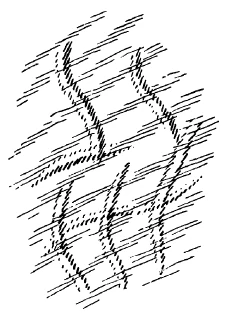
[ 8 ] You see, essentially, everything that has emerged since the 15th century—what has developed as modern mathematics, modern natural science, and so on—is a shadow, a specter of earlier thought; it no longer has any life. People today actually have no concept of just how much more vibrant an element thinking used to be. In those earlier times, people felt refreshed by thinking; they were happy when they could think, for thinking was a refreshing drink for the soul. The idea that thinking could also be tiring was not a view held in those days. People could, so to speak, become weary from other things; but when they were truly able to think, they experienced it as a refreshment, as a tonic for the soul, and they always felt a sense of grace bestowed upon them when they could live in thought.
[ 9 ] Once this shift in the state of the soul has taken place, what appears today as modern thought is thoroughly shadow-like. Hence the great difficulty of—if I may put it this way—using thought to get people moving at all. From the perspective of thinking, one can say all sorts of things to modern people, but they do not gain momentum. Yet this is precisely what they must learn. People must become aware that their modern thinking is a shadow image, and that this shadow image must not remain a shadow image; that this shadow image, which is modern thinking, must be enlivened so that it can become imagination. It is always an attempt to transform modern thinking into imagination—something that becomes evident, for example, in a book such as my Theosophy or my Outline of Esoteric Science, where images are woven throughout the thinking so that thinking may be called upon to become imagination—and thus, in turn, to come to life. Otherwise, humanity would become completely desolate. We could spread parched scholarship far and wide, but this parched scholarship would not be able to rouse itself to will nor ignite itself if imaginative life were not to flow once more into this shadowy thinking, into this specter of thought that has entered humanity in recent times.
[ 10 ] This is, I would say, the great question of destiny for modern civilization: to recognize how thinking, on the one hand, tends to become a shadow-like entity, how people withdraw more and more into this thinking, encapsulating themselves within it, and how, alongside this, that which passes into volition actually becomes merely a kind of surrender to human instincts. The less thinking is able to incorporate imagination, the more the full interest in what lives in external social life will shift toward the instincts. Ancient humanity, at least in the eras that bore civilization—as you may have gathered from the previous lectures—derived something spiritual from its entire organism. Modern human beings derive something spiritual only from their heads; therefore, in matters of the will, they surrender to their drives and instincts. This is the great danger: that people are becoming more and more mere intellectual beings and, when it comes to their will in the external world, are surrendering to their instincts—which then, of course, leads to the social conditions that are now taking hold in Eastern Europe and are also spreading like a contagion everywhere here as well. This arises precisely because thinking has become a mere shadow. One cannot emphasize these things often enough. It is precisely from such underlying causes that one will come to understand the significance of what anthroposophically oriented spiritual science actually aims for. It aims for the shadow image to become a living being once more, for that which grips the whole human being to circulate among people once more. But this cannot happen if thinking remains a shadow image, if imaginations do not flow back into this thinking, if, for example, numbers are not brought to life as I have shown by pointing to the sevenfold human being, who is actually a ninefold being, though the second and third, and sixth and seventh members, unite in such a way that they each become a unity, so that, in a sense, seven results when one adds up the nine members. This inner intervention of that which was once given to the human being from within—that is what must be strived for. In this regard, one must take very seriously what is characterized by anthroposophically oriented spiritual science precisely from this perspective.
[ 11 ] From another perspective, it has been observed how thinking becomes shadowy, and for this reason, a method has been developed within the Jesuit Order that, in a certain sense, breathes life into this thinking. The Jesuit spiritual exercises aim to breathe life into this thinking. But they do so by renewing old life; above all, they do not work toward or through the imagination, but rather through the will, which plays a particularly significant role in the Jesuit spiritual exercises. People today should understand—and yet understand far too little—how, in a community such as the Jesuit Order, the entire life of the soul becomes something radically different from what it is for other people. Other people today are, at the core, in a different state of mind than those who become Jesuits. The Jesuits act out of a “world will”—that cannot be denied. They therefore perceive certain connections that exist, and at most, such connections are still perceived by some other orders, which in turn are fought tooth and nail by the Jesuits. But this significance—through which reality enters into shadowy thinking—is what makes the Jesuit a different kind of human being than the people of modern civilization, who think only in shadows and are therefore, in essence, asleep, because thinking does not take hold of their organism, because it does not vibrate in their blood, because it does not truly flow through their nervous system.
[ 12 ] I don’t think anyone has ever seen a gifted Jesuit get nervous, whereas modern scholarship and modern education are becoming increasingly nervous. When does one become nervous? When the physical nerves make themselves felt. Then something asserts itself that, physically speaking, has no right to assert itself at all, because it is there merely to convey the spiritual. These matters are intimately connected with the perversity of our modern educational system, and Jesuitism is certainly, from a standpoint that we must resolutely combat—but precisely from the standpoint of invigorating thought—something that moves with the world, even if it retreats like a cancer. But it is moving forward; it is not standing still, whereas our science, as it is commonly practiced today, fundamentally fails to engage people.
[ 13 ] If I may point something out to you here, I must say: I have, after all, often expressed how it actually causes one pain, time and again, that this modern person—who is capable of thinking all sorts of things, who is so terribly clever, yet is not, with every fiber of his being, truly present in the here and now—does not see what is happening around him; he does not see what is happening around him, and he does not want to participate. It’s different with the Jesuit. The Jesuit, who brings the whole person to life, sees what is vibrating through the world today. To illustrate this, I’d like to read a few words from a contemporary Jesuit pamphlet, from which you can see what kind of life pulsates within it:
[ 14 ] “For all those who take Christian principles seriously, for whom the welfare of the people is truly a matter close to their hearts, for whom the Savior’s words ‘Misereor super turbam’ have once penetrated deeply into their souls—for all of them, the time has now come when, carried by the underlying currents of the Bolshevik storm surge, they can work with the people and for the people with far greater success. And do not be too timid. Thus, a fundamental and comprehensive fight against ‘capitalism, the exploitation and oppression of the people,’ a stronger emphasis on the duty to work—even for the upper classes— the provision of decent housing for millions of our fellow citizens—even if this requires the use of palaces and larger residences—the utilization of mineral resources, water, and air power not for trusts and syndicates but for the common good, the uplift and education of the masses; the participation of all segments of the population in state administration and governance; and the use of the idea of the council system to develop a representative system of the estates—equal in status and operating alongside parliamentary mass representation—in order to prevent the “isolation of the masses from the state apparatus,” which Lenin rightly criticized. ... “God has given the earth’s goods to all people, not so that a few may revel in lavish abundance while millions languish in poverty that is equally destructive both physically and morally. ...”
[ 15 ] You see, this is the fire that does, in fact, sense something of what is going on. This is a man who, in the rest of his book, fiercely opposes Bolshevism—who, of course, wants nothing to do with Bolshevism—but who does not sit like just anyone who has comfortably settled into a chair today, oblivious to the fire raging all around him; rather, he is aware of it and knows what he wants, because he sees.
[ 16 ] People have come to merely think about the things of the world and, for the rest, let them run their course. This is what must be pointed out again and again: that human beings have something else within them besides mere thoughts, through which they simply reflect without actually caring about the nature of the world. One need only point to what, for example, the Theosophical Society is. The Theosophical Society points to the great Initiates who sit somewhere; certainly, it is justified in doing so. But the point is not that they sit there, but rather how those who speak of them point to them. The Theosophists imagine that the great Initiates rule the world; then they sit down themselves and have good thoughts, which they let radiate everywhere, and then they speak of world government, of world epochs, of world impulses. But when it actually comes to the point where a real thing, such as anthroposophy, must necessarily—because it cannot be otherwise—live within the real course of the world, then people find this uncomfortable, because they could no longer simply remain seated in their chairs but would have to experience firsthand what is happening in the world.
[ 17 ] It must be strongly emphasized how what constitutes the intellect has become a shadow within human beings, because it was formerly experienced in the etheric body and has now, so to speak, slipped down into the physical body, where it leads only a subjective existence. But it can be brought to life through imagination. Then it leads to the consciousness soul, and this consciousness soul can only be grasped as something real when it feels the “I” as the eternal within itself, and when one perceives how this “I” descends from the spiritual-soul worlds into embodiment, and how it passes through the gate of death back into the spiritual-soul worlds. When this inner spiritual-soul entity of the “I” is grasped, then the shadow image of the intellect can indeed be filled with reality. For it is from the “I” that this shadow image of the intellect must be filled with reality.
[ 18 ] It is necessary to recognize that there is such a thing as living thought. For what has humanity known since the 15th century? — It knows only logical thought; it does not know living thought. I have repeatedly drawn attention to this as well. What is living thought? — I will take an obvious example. I wrote The Philosophy of Freedom in 1892. This The Philosophy of Freedom has a specific content. In 1903, I wrote Theosophy, which in turn has a specific content. Theosophy speaks of the etheric body, the astral body, and so on. There is no mention of these in The Philosophy of Freedom. Then along come those people who know only what is logically dead, who know only the corpse of thought, and say: “Yes, I read The Philosophy of Freedom, but I cannot ‘extract’ any concept from it—I cannot take out any concept of the etheric body or the astral body; that’s not possible; I can’t extract that from the concepts that are there.” — But that would be the same process as if I had a little five-year-old boy and wanted to turn him into a sixty-year-old man, and I took him and pulled him upward and tried to stretch him out in width! I must not substitute a mechanical, lifeless process for the living one. But imagine The Philosophy of Freedom as something living, which it truly is; imagine that it grows; then what grows out of it is precisely what only someone who wants to “squeeze out” something from the concepts cannot extract. This is precisely what all the objections based on contradictions rest upon: that one cannot understand what living thought is, in contrast to the dead thought that today dominates the entire world, the entire civilization. In the world of the living, things develop from within. Someone who has white hair—if they used to have black hair—did not get it because it was painted white, but rather it came from within. What rises and falls develops from within, and so it is with living thought. Today, however, people sit down and merely want to draw conclusions; they merely want to perceive external logic. What is logic? — Logic is the anatomy of thought, and anatomy is studied on corpses; logic is studied on the corpse of thought. It is certainly legitimate to study anatomy on corpses. It is just as legitimate to study logic on the corpses of thought! But one can never understand life through what has been studied on a corpse. This is what matters, what truly matters, if one wishes today to participate vividly, with one’s whole soul, in what is actually surging and weaving through the world. One must always and again point to this aspect of the matter, because—in the interest of the world’s healthy development, in the interest of the healthy development of the Merian—we need a revitalization of thought, which has become shadowy. This shadowing of thought reached its peak in the middle of the 19th century. That is why it is precisely those things that, I would say, have most enchanted humanity that fall within this middle of the 19th century. Even if these things were not great in and of themselves, when they are placed in their proper context, they appear great.
[ 19 ] Let us consider the late 1950s. This was when Darwin’s On the Origin of Species, Karl Marx’s Principles of Political Economy, and Gustav Theodor Fechner’s Psychophysics were published; the latter sought to uncover the psychological and mental realms through external experimentation. In the same year, humanity was presented with the captivating discovery of Kirchhoff and Bunsen’s spectral analysis, which demonstrated, so to speak, that wherever one looks in the universe, one finds the same material substance. In a sense, everything was done in the mid-19th century to captivate people with the idea that thought must remain subjective here, must remain merely shadowy, and must not interfere with the external world, so that one must not even imagine that there is intellect, nus, or anything living within the cosmos itself.
[ 20 ] That is what made this second half of the 19th century so unphilosophical, yet also, at its core, so passive—and what caused the fact that, while economic conditions became increasingly complex, world trade expanded into a global economy—so that the entire Earth effectively became a single economic sphere—that this very shadowy way of thinking was unable to grasp the ever-more-overwhelming reality. That is the tragedy of the most modern of all ages. Economic conditions have become ever more overwhelming and brutal, yet human thought has remained shadowy, and these shadows could certainly no longer penetrate what was unfolding externally in the brutal economic reality.
[ 21 ] That is what constitutes our current plight. If a person truly believes that he is more finely organized and has a need for the spiritual, then he may get into the habit of putting on a long face, speaking in a high-pitched voice, and talking about how one must rise above brutal reality, for only in the mystical can the spiritual truly be grasped. Thinking has become so refined that it must turn away from reality; in its shadowy existence, it would perish immediately if it were to penetrate brutal reality. Reality develops according to the instincts beneath it, which crush and brutalize. We see the fat eggs of mysticism, worldviews, and theosophies floating above, while life unfolds brutally below. This is something that, for the sake of humanity, simply must come to an end. Thought must be revitalized, and the idea must become so powerful that it need not retreat from brutal reality, but can instead immerse itself in this brutal reality, can live as spirit within this brutal reality; then reality will no longer be brutal. This must be understood.
[ 22 ] What is not understood from every possible perspective is that, when the essence of the world dwells within it, thought cannot help but pour out its power over everything possible. This is, after all, something quite self-evident. But modern thought regards it as sacrilege if something like a form of thinking were to arise—one that simply cannot help but extend its threads into various fields. What is supposed to constitute the seriousness of life today is the realization that we have, quite rightly, had a shadow image in our thinking; but the age has now arrived that must breathe life into this shadow image of thought, so that external, physical-sensory life can receive its social inspiration from this life of thought, from this inner spiritual life.
[ 23 ] Let's talk more about that tomorrow.