Perspectives on Human Evolution
The Materialistic Impulse toward Knowledge
and the Task of Anthroposophy
GA 204
24 April 1921, Dornach
Translated by Steiner Online Library
Ninth Lecture
[ 1 ] Over the course of the past week, we have presented a series of reflections that shed light on the spiritual state of the present and the near future. Recently, we have placed particular emphasis on that pivotal moment in the development of European humanity during the 4th century A.D., which marks a profound turning point. Previously, at least in southern Europe, the mystery of Golgotha was understood to a certain extent through the lens of Eastern wisdom traditions. People still had a certain understanding of what is today viewed with such antipathy by certain quarters: so-called Gnosticism. Gnosticism was, after all, the last remnant of primordial Eastern wisdom—that primordial wisdom which arose from humanity’s instinctive powers of insight but which had penetrated deeply into the very essence of the world order. What took place in the Mystery of Golgotha could be understood with the help of the concepts and feelings derived from this Gnostic insight. But the very force that was working toward the demise of this Gnostic knowledge was that Christian current which increasingly merged into the Roman state system, which more and more took on the form of the Roman state system. This Christian current eradicated, down to only very minor remnants from which little can be gained, everything that once existed as Gnosis. And as we have seen, nothing remained of the ancient Oriental primordial wisdom in the living European consciousness of humanity except the simple narratives—cloaked in material events—about what took place in Palestine at the time of the Mystery of Golgotha.
[ 2 ] These stories were initially clothed in a form that originated in ancient paganism, as you can see in the Heliand. They became part of European civilization. Yet people felt less and less that they should penetrate them with a certain power of insight. People felt less and less that a profound cosmic enigma and mystery lay within the mystery of Golgotha; for regarding that which, as Christ, was connected to Jesus, formulas established by council decrees had been imposed. Belief in these established formulas had been demanded, and gradually everything that still remained of living knowledge up to the time of the 4th century A.D. was absorbed into the rigid system of formulas of the Roman state church.
[ 3 ] And when one surveys—I would say—the entire system of this Western Christian-ecclesiastical current, one sees that what was the Mystery of Golgotha was clothed in certain fixed, rigid, and increasingly incomprehensible formulas, while a living spiritual knowledge was, in fact, eradicated.
[ 4 ] Here we have a peculiar fact of European development. One might say: What was once fruitful, living, primordial Eastern knowledge flowed into the formulas and froze within the formulas adopted by the Roman Church. And in these formulas, it continued to take root throughout the following centuries. These formulas were there. There were, of course, people who still knew how to make something of these formulas; but it had become impossible for the general consciousness of humanity to perceive anything other than a dead form. Certainly, we have a number of truly outstanding minds. We need only recall some of those who emerged from the Irish centers of learning; we need only recall Scotus Erigena, who lived at the court of Charles the Bald. In such figures we find people who took up the formulas and, within them, still sensed the spirit—or, to a greater or lesser extent, discovered it. Then we have Scholasticism, which we have often discussed in a certain context, and which, in a more abstract form, attempted to penetrate the formulas through understanding. The fact remains that a widely spread system of religious content existed, frozen in formulas, which was passed down from generation to generation over the centuries and continued to live on as a system of formulas. On the one hand, then, there were the theological formulas; on the other, the narratives about the events in Palestine, clothed in materialistic imagery.
[ 5 ] If one wishes to understand the present age, one must by no means forget what these Roman Catholic formulas—cloaked in Roman concepts of state—are really all about. These are formulas of great significance, magnificent formulas. First and foremost is the formula of the Trinity—that is, the formula which, in the terminology of later times, refers to the Father, the Son, and the Holy Spirit. In this formula, however, an ancient, profound primordial wisdom was crystallized—something great and mighty that once instinctively possessed human understanding. But at most, only the brilliantly inspired vision of a few individuals could sense what lay within such a formula.
[ 6 ] There was what had ultimately crystallized through the various council decrees in the formula concerning the two natures of Christ and Jesus in one person. There were formulas concerning the birth, the essence of Christ Jesus, his death, resurrection, and ascension. Finally, there were formulas that established the various feasts, and all of this was, in essence, the framework, the shadow of a wondrous, ancient wisdom. And this shadow, this framework, persisted through the centuries. It was able to persist, in particular, by taking on a certain form of ancient cults, and that which was clothed in formulas—in the highest formulas—such as the formula for the transformation of bread and wine into the Body and Blood of Christ—was able to endure because it was clothed in an ancient, sacred ritual form like the Mass, which was merely slightly adapted but continued as such. Thus the various metamorphoses of the Christian feasts lived on throughout the entire church year. Those things that you know as the sacraments lived on—which, in a sense, were intended by the Church to lift people out of ordinary material life and raise them into a higher spiritual sphere. Through all of this, and through its connection with the impulse of Christianity, this tradition lived on throughout the centuries of European development. Alongside this, as I said, was the simple narrative—cloaked in materialistic formulas—of the events in Palestine.
[ 7 ] All of this, however, had a significant impact—because, after all, there was essentially nothing else with which to establish a connection to the supersensible worlds—on those spirits who were striving for such knowledge; but it was also able to exert that kind of influence through worship and through the simple telling of the Gospel stories, which had won over the vast majority of the European population.
[ 8 ] Alongside this, another system of worship took root as a distinct entity—one that had less to do with Christianity as such, one that often incorporated elements of Christianity but was not, fundamentally speaking, organically connected to it, and one that emerged more from even older forms of worship. What took root was that which eventually flowed into the ritual system of modern Freemasonry—a system that had, and continues to have, only an external relationship to Christianity. And as you know, what took the form of Roman Catholic dogma and the Roman Catholic cult, and that which, in a Masonic manner, draws upon other forms of worship and other symbolism, have been locked in a bitter struggle right up to the present day.
[ 9 ] This development can, after all, be traced to a greater or lesser extent if one simply takes in the available historical facts with some insight through the eye of the soul. But one can truly understand what is before us only if one can look back at that turning point in European development that took place in the 4th century A.D. and which, I would say, plunged what was ancient spiritual wisdom and its echoes into an abyss; so that, in Europe, little was actually known throughout the following centuries about what constituted ancient Eastern wisdom.
[ 10 ] Gradually, humanity had lost the inner capacities that, as I hinted at yesterday, had enabled people in ancient times to experience weight, number, and measure within their very being. Measure, number, and weight became abstractions, and as abstractions they were then used in the fifth post-Atlantean epoch to establish what is today our scientific worldview—a worldview that could not incorporate human beings into its realm, that stopped short of human beings, that did not comprehend human beings at all, but which, precisely through the abstractions of weight, number, and measure—encompassed the external phenomena of nature, apart from human beings, with a certain grandeur, and which then reached a kind of climax in the 19th century.
[ 11 ] People today still lack sufficient perspective on these matters; they do not yet see how the mid-19th century was, in fact, a very special moment in European development. Intellectual striving—the pursuit of pure reason—reached its fullest, its highest flowering in the mid-19th century. This was the very striving that had arisen from the same sources from which modern scientific views had been flowing since the first third of the 15th century. At the same time, however, it was the very same striving that ultimately could no longer come to terms with—and, in essence, had long since been unable to come to terms with—the religious tradition that had persisted, and that had long since been unable to come to terms with the dogmatic formulas established by the councils. Only a few remnants remained, a few heresies, such as the heresy of the Council of 869, where it had been decided that man does not consist of body, soul, and spirit, but only of body and soul, and that the soul possesses certain spiritual qualities. This heresy had persisted, and it lives on in modern philosophical views that believe themselves to be impartial but which, in essence, merely parrot what stems from this Catholic dogma.
[ 12 ] Out of all these currents, the modern spirit of European civilization took shape, tending more and more toward a purely intellectual, rational conception of the universe. And this spirit, which had already been developing for centuries, reached its peak in the mid-19th century. And how can we, when we look at human beings from a psychological and spiritual perspective, understand this peak? To do so, we must first take a look at human nature—how it was in ancient times and how it has gradually evolved. We have already done this from various perspectives; today we will do so again from a particular perspective.
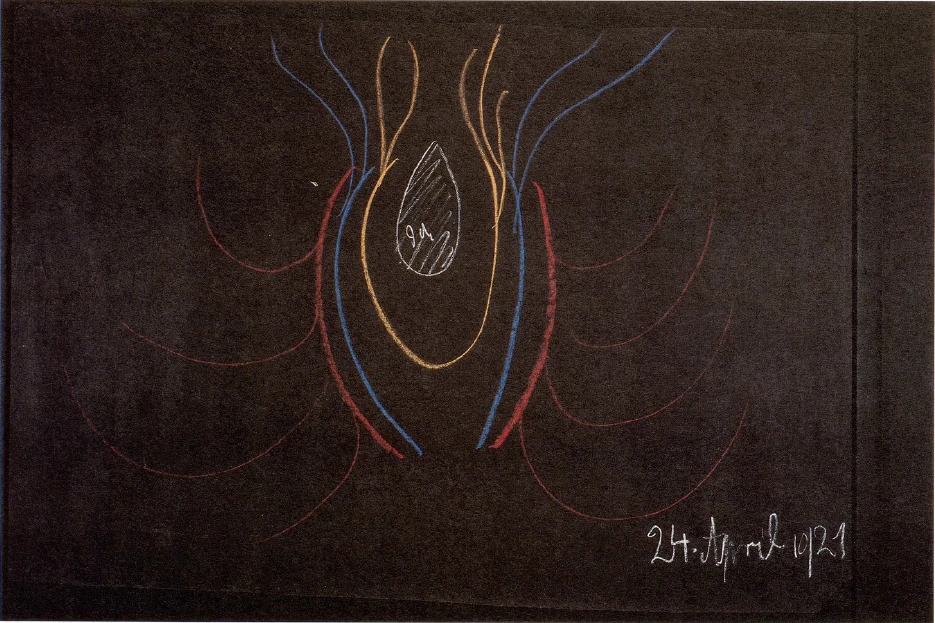
[ 13 ] Let us visualize the human being schematically. Let us first consider the human physical body (see drawing, red). As I said, I am drawing this schematically.
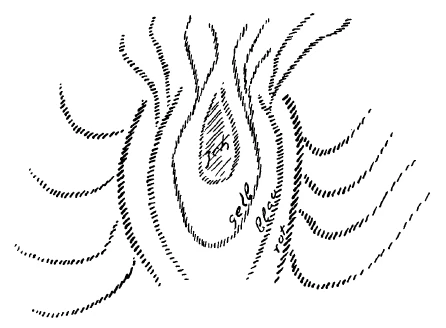
[ 14 ] Let us consider the human etheric body (blue); let us consider the human astral body (yellow); and let us consider the human “I.” Let us now first consider this human being as it was in ancient times, in those ancient times when instinctive clairvoyance still existed, which then faded, withered, and gradually disappeared. The “I,” after all, is essentially a product of the Earth; we need not dwell on that. But we must be clear that, in essence, the entire world lives within the human physical body, etheric body, and astral body. We can say: Within this physical body lives that which is the entire world. It is born from it and is still nourished by it through the intake of food. The entire world lives within the etheric body; constantly, through the most varied paths, those things enter it that act upon the human being in a superphysical way—forces that manifest in his growth processes, that manifest, for example, in the circulation of his blood, that live in his breath, and so on—and which are not the same as the forces that live in the intake of food and in digestion. Then we have everything that lives in the astral body—which, after all, also takes in impressions from the world, which penetrate through the senses, and so on. This was the case, and it is still so today, when human beings lived with their old instinctive clairvoyance; but during that time of ancient instinctive clairvoyance, human beings were more intimately connected with their physical body, their etheric body, and their astral body than they are today. When they awoke in the morning, they would plunge—with their “I” and their astral body—into their physical body and their etheric body. An intimate connection was formed between their I, their astral body, their etheric body, and their physical body. And they did not merely live in their physical body; they lived within the forces that were at work within it.
[ 15 ] I would like to describe this to you very vividly. Suppose a person from the era of ancient clairvoyance ate a plum. It seems almost grotesque to people today when something like this is described, but it is profoundly true. Let’s suppose a person from the era of ancient clairvoyance ate a plum; that plum contains ethereal forces. When a person today eats a plum, they have no idea what is happening inside it. A person of the ancient clairvoyant era ate a plum, had it in their stomach, digested it, and experienced how the ethereal life within the plum passed into their body; they experienced it on a cosmic level. And only when they made an inner comparison between the various things they had taken into their stomachs did all the relationships that existed in the outside world continue to live within them; they perceived this inwardly. From the moment he awoke in the morning until he fell asleep at night, he filled himself with an inner, living contemplation of what the plums were living as outside, what the apples were living as, and what many other things he consumed were also living as. Through the process of breathing, he knew inwardly the spiritual essence of the air. Through what took place in his circulatory processes—when warmth circulated within him—he perceived the heat forces present in the cosmos around him. He did not stop at merely sensing the light in his eyes; rather, he felt how the light radiated through his optic nerves, met the physical limbs within his own etheric body, and lived within the physical limbs; he experienced himself quite concretely within the cosmic realm. This was, admittedly, a dim consciousness, but it was indeed present. During the day, however, it was drowned out by what people at that time already perceived externally. But even in the earliest days of Greek civilization, people still retained an echo of what today is possessed only by other beings. I have pointed out once before—or perhaps even more often—that it is extraordinarily interesting to look with a spiritual eye at a pasture where cows lie and ruminate. This whole process of rumination is a cosmic experience for the cows, and even more so for snakes; when they lie and ruminate, they are in fact experiencing world events. There, something that is the world blossoms and sprouts from their organism—for them, for their perception. Something rises from within them that is far more beautiful than anything a human being can ever see with their external eyes. And something like this, I would say, was present as an undertone in people who possessed the ancient, instinctive gift of clairvoyance. For the most part, however, it was dampened by external observation. But when these people fell asleep, they carried what they had experienced and absorbed into their astral body and into their “I”; when their “I” was alone with its astral body, it rose powerfully in the form of real dreams; then, in the form of real dreams, they relived what they had only dimly experienced during the day.
[ 16 ] You see, I am referring here to the inner spiritual-somatic-physical experience of people in earlier times, who—precisely because they experienced things in this spiritual-somatic-physical way—experienced the cosmos, and it was precisely in this that they found their cosmic-supersensible vision. And when people in the East drank the Soma, they knew what the Spirit of the Heights is. This Soma, which permeated, stirred, and interwove their inner being, lived through their blood. And when they then fell asleep and took with them—along with what had been woven into their blood as the “I” and the astral body—the forms that had arisen through the digestion of the Soma drink, their being expanded into the vastness of space, and they sensed the spiritual forces of the cosmos in their nocturnal experience.
[ 17 ] Such an experience could still certainly be found among those who listened favorably to the ancient Zarathustra during the early Persian period. One cannot understand what ultimately resonates with us from the surviving Oriental documents unless one is aware of such things. But this living cosmic vision gradually faded away. It is already scarce in the historical Egyptian period, yet its echoes still linger, and it dwindles away by the 4th century A.D. to its very last remnants—remnants that have, after all, always been preserved among primitive peoples. And from that point on, what is now entirely bound to the mere physical body in its isolation from the world—the intellect, the rational—increasingly forced its way out of the human being. When one has a pictorial imagination and dives down into one’s body, one cannot help but sense something cosmic as well.
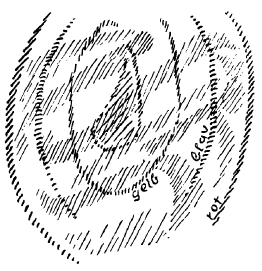
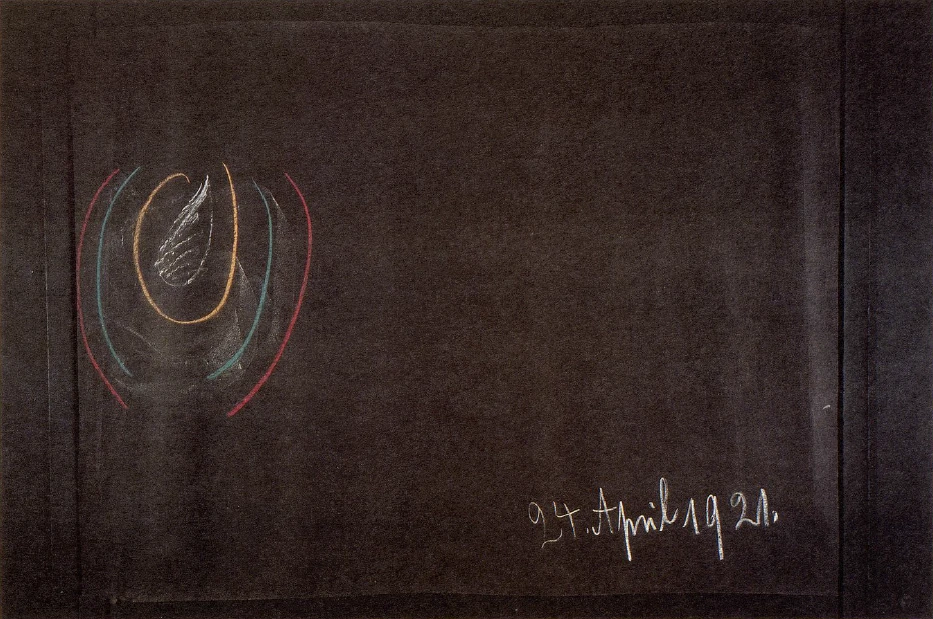
[ 18 ] If one still possesses some sense of the inner nature of numbers and then delves into one’s own body, one cannot help but experience the numerical order of the cosmos. And the same is true of weight ratios. But when one uses the power of the “I”—which acts as a purely rational, purely intellectual force—to descend into the human organism upon waking, one thereby enters only the isolated human body, that which the human body is in and of itself, what it is without its connection to the cosmos. One plunges into the earthly human body in complete isolation, so that if one were to depict this rationally, one would have to say: Although the etheric body, the astral body, and the “I” are indeed present (see diagram: blue, yellow, center), the “I” no longer experiences anything of the cosmic within the human being. It merely experiences its existence in a dull way, its immersion in the isolated human organism. Therefore, when this purely intellectual “I” goes out into the environment while asleep, it takes nothing with it. And this failure to take anything with it means that, at most, reminiscence dreams or dream images of an unreal nature may arise in the human being, but that this “I” is not permeated by anything cosmic in any way. So, fundamentally speaking, from the moment of falling asleep until waking up, a person experiences nothing of substance, because their entire experience is geared toward the isolated human organism—which, however, now acts upon this “I” with forces that have nothing to do with the cosmos. That is why the “I” becomes dull from the moment of falling asleep until waking up. It must be that way. The ancient, instinctively clairvoyant people did indeed possess their cosmic vision; they lived through instinctive intuitions, instinctive inspirations, and instinctive imaginations; but they did not possess independent rational thought, for this independent rational thought—this truly intellectual thinking—must make use of the instrument of the isolated human body if it is to develop. This must lie in a state between sleep and waking; therefore, it brings nothing with it upon waking, whereas the ancient human being brought with him what he had experienced—after having carried the experience from within the body out into the cosmos—in the encounter of these echoes, these cosmic echoes, with the truly spiritual-cosmic events taking place outside. From what he experienced there, he brought back echoes; through this, he had a living connection with the cosmos. What is attained by human intellectual thinking is attained from waking until falling asleep; it becomes dull after falling asleep. Human beings are now dependent on the waking state.
[ 19 ] You see, there is a curious relationship here: in ancient times, human beings were more bound to their bodies than they are today, but it was precisely through their bodies that they experienced the spiritual essence of the cosmos. Modern human beings have lost this experience within the body. Modern man is spiritual, but his spirit is the most diluted; he lives in the intellect and can only live in the spirit from the moment he wakes up until he falls asleep, and he becomes dull when he enters the spiritual world with his highly diluted, intellectual spirit.
[ 20 ] Why did we actually end up with materialism? And why didn’t people in the past have materialism? — Ancient people did not have materialism because they lived within the physical body; modern people have materialism because they live only in the spirit, because they are completely free from a cosmic coexistence with their bodies. Materialism arises precisely because human beings have become spiritual—but in a diluted form. Human beings were at their most spiritual in the mid-19th century; but he deceived himself in an Ahrimanic way by failing to recognize that what he lives in is the diluted spirit, and he incorporated into the most spiritual state he could attain only the concept of materiality. Human beings had become entirely spiritual vessels; yet they allowed only thoughts of material existence to flow into these spiritual vessels. That is the secret of materialism: that human beings, because of their spirituality, turned toward matter. This is modern humanity’s denial of its own spirituality. The culmination of spiritual existence was reached in the mid-19th century; but human beings did not grasp this spiritual existence.
[ 21 ] But, as I said, this developed slowly over the centuries. The old, instinctive spirituality had faded away in the 4th century A.D., and the new spirituality emerged in the first third of the 15th century; in between lies, so to speak, an episode in human experience. But now, after that point—after the first third of the 15th century, after the 15th century as a whole—this dependence of human beings on their isolated, earthly, physical body began to assert itself. Now they simply began to lose all connection to what had been frozen in the dogmatic formulas of the councils—formulas that were indeed frozen, yet still possessed magnificent content. And, in essence, he could no longer find a connection to the simple narratives of Palestine either. For some time, he still forced himself to find meaning in them. But one can only find meaning in them if one penetrates them with understanding. In particular, however, this modern human being could no longer find any meaning in them—finding less and less meaning in the forms of worship, in the worship itself. The Mass, an act of the highest cosmic significance, became an external symbol because it was not understood; the sacrament of transubstantiation, which had been preserved throughout the Middle Ages and which has a profound cosmic significance, was thrown into the purely intellectual discourse of human beings. It was only natural that, when people began to ask, using their isolated intellect, in what way Christ was present in the sacrament of the altar, they could not comprehend it; for these things are simply not suited to intellectual understanding. Now people began to try to grasp them with their intellect.
[ 22 ] This then led to the emergence of those discussions of such great significance in world history, known as the “Communion Controversy,” which are associated with names such as Has and others. And the most advanced people of European civilization—those most advanced in their rational understanding of the world—ultimately found their way into the various forms of Protestantism. It is the intellect’s reaction against that which had emerged from a much broader, much more intense power of cognition than the intellect itself. How alien were the forces that had formed within the modern soul as intellectual forces, and that which lived in the frozen formulas—yet which, in itself, encompassed something great, something mighty! Protestant confessions of the most diverse kinds emerged—compromises between the intellect and the old traditions—and the 16th, 17th, 18th, and 19th centuries passed; and in the middle of the 19th century, humanity stood at the pinnacle of its intellectual development; it became a thoroughly spiritual being. Through this spiritual nature, he could comprehend what exists in the external sensory world; but he did not conceive of himself as spirit. People barely had any inkling left of what a statement like Leibniz’s meant, when he said: “Nothing lives in the intellect that has not first lived in the senses, except the intellect itself.” Modern man had completely omitted this latter phrase and adhered only to the statement: Nothing lives in the intellect that has not first lived in the senses—while Leibniz fully understood that the intellect is thoroughly spiritual, something that works within the human being, entirely independent of all physical corporeality.
[ 23 ] As I said, the intellect was at work, but it did not recognize itself. And so we have observed that human beings are now at the threshold of a new phase of development in their lives, and, in a sense, they carry nothing with them into the night. For what is worked out intellectually is worked out through the body and has no connection to the extra-physical realm. Now human beings must once again work their way into the spiritual world. The possibility arises for them to look into this spiritual world; it is clearly there. What human beings once drew from their physical body, their etheric body, and their astral body in the form of instinctive insights into the cosmos can be regained today. We can arrive at imaginations and depict the development of the world through Saturn, the Sun, the Moon, the Earth, and so on in these imaginations. We can look into the living essence of the nature of numbers, into the being of numbers, and thereby receive inspiration as to how the world is shaped from the world spirit through the laws of numbers. It is certainly possible, at first, that what can be attained in this way—through imagination, inspiration, and intuition—regarding the world actually exists.
[ 24 ] Most people will say: If we have not become clairvoyant ourselves, then the most we can do is study it. — Well, one can study it, and it has been said time and again that the ordinary intellect can understand it. Today we shall add why the ordinary intellect can understand it. Suppose you are reading something like Outlines of Esoteric Science. Suppose you try to grasp these things with your ordinary intellect—you approach them with the intellect that is bound solely to the isolated human body. But you are taking in something that you cannot grasp through this intellect, because this intellect has not understood itself over the course of the centuries. Now you are taking in something that is incomprehensible to the concepts the intellect borrows solely from the external sensory world—but which becomes comprehensible when the intellect rouses itself to understand something from within itself, not initially to affirm or deny, but simply to understand. That is, after all, what is said: one should understand these things. — At first, one simply needs to understand them. If one understands them, then with what the “I” has attained as understanding, one now creates into the night. There, one no longer remains dull, as in the case of a mere intellectual attitude toward the world; there, from falling asleep until waking up, one lives with a different content within the finely filtered spirituality. And then one wakes up and has—albeit only a small possibility—of inner assimilation added to what one has strived to understand intellectually. But I would like to say that with every night, with every sleep, something is added from an inner relationship; the person develops an inner relationship. What one carries out into the external world as an echo of one’s understanding of the day is brought back in again upon falling asleep, and through this one gains a relationship—a relationship drawn entirely from reality—with the spiritual world, provided one does not ruin this relationship through the very things by which one so often ruins it today; I have, after all, often cited these means of ruining spirituality. You know that many people are very keen on attaining, before falling asleep, what they call “sleepiness”; they drink so many glasses of beer until they have the necessary sleepiness. This is a very common expression that is widespread today, especially among the “intelligentsia.” However, the forces I have just spoken of cannot develop within such a state.
[ 25 ] But spirituality must be explored. Spirituality can also be experienced in the way just described. Human beings have outgrown spirituality. They can, however, grow back into it. Today we stand at the beginning of this process of growing back into spirituality. What has developed over the past centuries—from the 15th century through the 19th century, when the intellect reached its highest level—and what has developed particularly among the most advanced people in Europe, is indeed a certain form of spirituality; yet it is initially devoid of content. For it is only when one turns once more to the imagination that this spirituality acquires its first content. That which is highly refined spirituality must be given its content. For the time being, it is still rejected by the broadest circles of the world. The world wants to remain with this refined spirituality and provide only content borrowed from the outer material world. It does not want to make the effort, with this intellect, to understand what is given through the vision of the spiritual world. The Gospel creeds are, after all, compromises between the intellect and the old traditions; they have lost their unity. Worship means nothing to them, which is why worship has gradually ceased within these creeds. It has come to rely on abstract concepts instead of a living grasp of something like transubstantiation. At best, the simple stories can be told, but one cannot attach any other meaning to them than what one can attach to a materialistic theology: namely, that one is dealing with events that can be linked to the simple man from Nazareth and so on. This is something that cannot lead to any substance; it is something that loses all connection with the spiritual.
[ 26 ] And so today we have a global situation in which what initially rejected the intellect—what did not enter into such compromises—has remained standing, thereby preserving, in broad circles of the population, a connection—albeit a completely instinctive one—to the formulas that live on in dogmas, whose content is no longer accessible to people, but which has nonetheless flowed into these formulas. These circles have also retained their living relationship to worship and ceremony, their connection to the sacramental. However much all of this has been squeezed out, the old spirituality—the very spirituality to which a connection still exists through the formulas—once lived within what has now become a skeleton, a shadow. In the more recent Protestant-style confessions, in which an attempt is made at compromise, such a connection does not exist. — And then there are those who call themselves thoroughly enlightened, who live solely in the intellect—which is, admittedly, spiritual—but which refuses to grasp the spiritual.
[ 27 ] These are the three currents we have, and we certainly cannot count on such currents as fruitful in the future—those that are willing to enter into only an external compromise; we cannot count on mere intellectualism, which cannot arrive at any substance and must therefore lose itself because it refuses to recognize itself. We can only count on what these currents are gradually converging toward—they are converging more and more clearly— we can count on what has taken shape in old formulas—namely, the enduring Roman Catholic Church—and on that which takes the new intellectualism seriously, deepening it imaginatively, inspiringly, and intuitively, and arriving at a new spirituality. The modern world is tearing itself apart between these two opposites. On the one hand, there are people who rely on their intellect. They are inwardly sluggish; they do not want to apply this intellect, yet they need substance. They fall back on dead formulas. Precisely among intelligent people who are, however, inwardly sluggish—who are, in a certain sense, intellectually Dadaist—a Young Catholic movement is gaining ground today that seeks to revive the old, which has solidified into formulas; a movement that desires to imbue these formulas with content from the outside, yet remains frozen in historical manifestations. It strains its intellect to ascribe meaning to the old content, and we are witnessing such intellectualistic struggles, in which they now seek to adapt their rigid formulas—based on that old content—for human use.
[ 28 ] For example, we see an intellectually rigid tendency to cling to rigid formulas on many pages of the new Tat issue. After all, the publisher Diederichs does everything—he categorizes everything and puts it on paper—and so he has now dedicated an entire “Tat” issue—from which one can see how people think in a rigid manner today, how they develop an inwardly rigid way of thinking in order to avoid rousing themselves internally, to remain inwardly sluggish, and to use the intellect—which is already there—to grasp only what moves most sluggishly forward. People are doing all this in order to be able to reject this lively striving—arising from the newer intellectuality—toward the spirituality that can be grasped and that must be grasped. And more and more, things will come to a head so that a powerful movement will sweep through the world, one that has a fascinating, suggestive, and hypnotic effect on all those who wish to remain intellectually sluggish. A Catholic wave is sweeping through the world, even among intelligent people who wish to remain intellectually complacent. The slumbering souls simply do not realize it. But striving for what Oswald Spengler so vividly described in his The Decline of the West must remain fruitless. One can make the West Catholic, but in doing so one kills its civilization. This West must turn toward awakening, toward becoming inwardly active, toward not remaining intellectually sluggish; for this intellect can rouse itself, it can fill itself inwardly with an understanding of the new spiritual perspective.
[ 29 ] This struggle is brewing; it is already here, and it is the main issue. In the future, everything else will fall by the wayside between these two currents when it comes to questions of worldview. Our attention must be focused on this, for what is unfolding there is concealed within various formulas and forms. And anyone who believes they can make progress by clinging to what may have been a dream at the beginning of this century is not living the life of the present. Only those who develop an eye for what is alive in these two described currents are truly living the life of the present. We must observe this with watchful eyes. For everything I spoke of eight days ago—that today numerous people love evil and, out of a mere inclination toward evil, slander in the manner that has been described to you—must come before our very souls. That inner insincerity must come to the forefront of our souls—that, as I mentioned to you, people who are supposed to be strengthened in their Catholic faith are sent to the Catholic Church in Stuttgart to hear a lecture by General von Gleich, and that this Catholic general concludes with a Lutheran hymn! — Here we see the convergence of those who do not adhere to the creed, but who seek only to come together in the flattery of lies.
[ 30 ] We must pay attention to these things today. If we do not pay attention, we are asleep; we are not participating in what, after all, is the only thing that can make a person truly human today.