Perspectives on Human Evolution
The Materialistic Impulse toward Knowledge
and the Task of Anthroposophy
GA 204
23 April 1921, Dornach
Translated by Steiner Online Library
Eighth Lecture
[ 1 ] Today I will be presenting a chapter that may seem somewhat more remote, but which will nevertheless come together with what was said yesterday and what will be said tomorrow to form a whole. I have often mentioned that, when surveying the development of humanity, people tend to assume that the overall structure of human spiritual life has essentially remained the same for as long as human development—whether historical or prehistoric—has existed. But what is believed here does not at all correspond to the facts. Admittedly, it is difficult to ascertain what the successive metamorphoses of human soul development have been like if one is only able to look at the facts historically transmitted through documents. If, however, one can look further back than these facts extend, then what has been historically handed down also appears in a different light, and it becomes evident that the nature of the human soul has not always been as it is today, or as it was in times that can still be grasped through external evidence. Above all, people believe: Well, for example, today human beings have something like geometry; they have something like arithmetic, which is essentially the science of counting; and they have the art of weighing, of determining weight. People form ideas about what measurement is, what a measure is. People form ideas about how we count today and how we weigh things, and they think to themselves: Certainly, in the time when—according to our current view—people were still quite childlike, they simply did not yet know how to measure, count, and calculate. But ever since people have been able to do these things, they have been practiced in roughly the same way as they are today.
[ 2 ] That is certainly not the case, and even if—as I said—it leads us into a more remote area, we must first form a somewhat more precise understanding of measure, number, and weight before delving into the history of humanity. As you know, even according to external tradition, the Pythagorean school held somewhat different views on numbers than those held today. The Pythagoreans, as you all know, associated certain concepts with numbers—one, two, three, four, and so on—and they associated very specific concepts with even numbers and with odd numbers. In short, they spoke of numbers in a certain qualitative sense, not merely in a quantitative sense.
[ 3 ] If one examines the underlying principles from a spiritual-scientific perspective, one comes to realize that what existed in the Pythagorean school—which, after all, was still a kind of secret school—was essentially nothing more than the final echo of a much older wisdom of numbers dating back to ancient times, of which only traditions have survived. And what we are told about Pythagoras is, in essence, already something that was in the process of decline from an ancient doctrine of numbers. When one approaches these matters from a spiritual-scientific perspective, one arrives at concepts of measure, number, and weight that are fundamentally different from those we have today. But as I said, we need to be able to clarify for ourselves—even if this may cause some of you difficulty—what the state of these concepts of measuring, counting, and weighing is today.
[ 4 ] Measuring—how do we measure? We can only have one unit of measurement, and this unit must be assumed in some way. We cannot say that this unit of measurement—let us take the meter as an example today—is in any way absolutely defined. It is adopted; it is defined as a specific part of the northern meridian quadrant that passes through Paris, and it is not even that specific part—the ten-millionth part—that is precisely contained within that, so to speak, immutable standard measure located in Paris, the original meter bar. But it is adopted. People say they want to start from a certain unit of measurement, and then they use it to measure other lengths or even areas by converting the unit of length into a unit of area. But what one obtains in this way regarding the object being measured is ultimately reduced to something purely arbitrary, to something that was simply assumed at the outset. It is important that we realize this—that we are actually basing our measurements on an arbitrary standard—so that when we measure, we always have only the ratio of some quantity to this arbitrarily assumed standard. The situation is somewhat different with numbers.
[ 5 ] Just as we live today in our abstract existence, we count “one,” “two,” “three”; we count “one,” “two,” “three” when we count apples, when we count people, when we count horses, when we count chairs. For whatever is to be determined by the number, it makes no difference what we call “one.” We have our own particular way of counting for all things that we count and that, as units, form something self-contained.
[ 6 ] Note that when we measure, we start with an arbitrary unit of measurement; but we then relate everything to this arbitrary unit. This unit of measurement is, in a sense, something; it exists; it is even conceivable—I would say—in a thing-like way, in a concrete way. The unit as a number, however, is not conceivable in a concrete way. What the unit as a number is, is a complete abstraction; it is something that is applicable to everything. It does not matter whether we count years or people or stars; we are led into the completely abstract, into that which cannot signify any reality at all, because all realities can be meant by it and yet no reality can be meant. When we take the unit as the basis in arithmetic, we lose that little bit of concreteness, of materiality, that we still have when we measure. And especially when weighing—when weighing, we are dealing with the fact that we do not overlook what we are taking as the basis. There, we lose that concreteness even more than with numbers. With numbers, at least—when we count chairs, for example, and say “one,” “two,” “three”—we conclude with the third chair, and it stands before us as a unit. But when we have a scale, we place a weight on one side—the weight is, after all, nothing in and of itself unless it is drawn down by the earth, as we say—and what we are weighing is equal to the weight of the weight itself. But we’re no longer standing there alone; we’re essentially standing there with the entire Earth. What we’re referring to lies completely, in a sense, outside the realm we can grasp. We enter into a completely abstract concept when we say: Something weighs five kilos. — Just think about what you actually have in mind when you say something weighs five kilos: you place a five-kilo weight on one pan of a scale, yes, but a five-kilo weight—that’s nothing in and of itself! It’s not a property of the thing itself. When I say, “A chair”—at least that “one” is contained within the chair; but these five kilos—they have to relate to the Earth. There you have only something that is a relationship to something you can’t even grasp: to the entire body of the Earth. And when you then have to weigh the other thing on the scale pan to balance out the five kilos, you again have something that completely eludes you, something that belongs to a whole, something that is less than an abstraction.
[ 7 ] Let us start with the concept of number. In earlier times—and this actually takes us back to the second post-Atlantean epoch—during the second post-Atlantean epoch, the entire concept of number was approached quite differently than it is today in the outer world. Back then, people truly had concepts of “one,” “two,” and “three.” For us, “two” is nothing other than the presence of the unit twice; “three” is the presence of the unit three times; and “four” is simply the presence of the unit four times. And so we continue counting by always adding just “one”—that is, by repeating the same act of thought. We can repeat it ad infinitum, into infinity.
[ 8 ] It was not like that in the second post-Atlantic period. Back then, let’s say between “two” and “three,” one sensed a difference of the kind that today one feels only between objects. In “three,” one sensed something fundamentally different from “two”—not merely that unity had been added, but rather one sensed in “three” something closed, something in which the three things relate to one another, whereas in “two” one sensed something open, something in which the two things lie indifferently side by side. It was this indifference of their side-by-side existence that came to mind when one said “two.” In the number three, one did not sense things lying indifferently side by side; rather, one could only imagine the number three as something that belongs together, in which each element relates to the others. With the number two, one could imagine that one element slips away to the left and the other to the right. With the number three, one could not imagine that. With “three,” one always imagined: If one slips away, then the other two are no longer what they were, for then they are merely indifferent entities existing side by side. The number three, so to speak, united the two into a totality, into a whole. The kind of arithmetic we have today—elementary arithmetic, the repetition of the same act—did not exist at all in those earlier times. And only today, through spiritual science, are we once again being led, in a certain way, into the qualitative aspect of number.
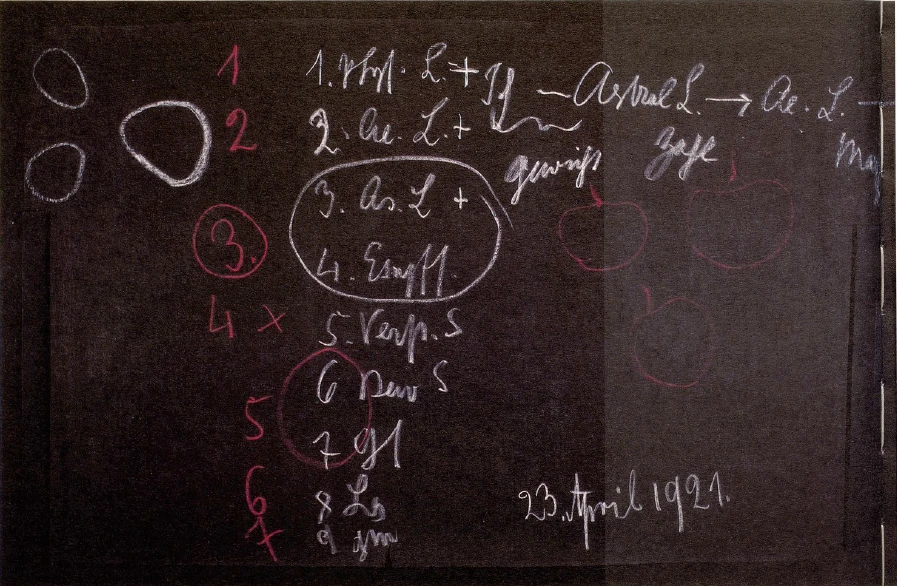
[ 9 ] I can illustrate this to you using an example you’ve known for a long time, so that you will see: one is compelled not merely to add one plus one plus one and so on, but to use the number to truly immerse oneself in existence. To give you—I would say—the most elementary idea of the matter, please work through the following with me. In my Theosophy, you will find the individual parts of the human being described; these parts of the human being are described as follows:
1. Physical Body
2. Etheric Body
3. Astral Body
4. Sensitive Soul
5. Intellectual or Emotional Soul
6. Consciousness Soul
7. Spiritual Self
8. Life Spirit
9. Spiritual Human Being
[ 10 ] But to list these aspects of the human being side by side—that is, to enumerate them abstractly one after the other—does not mean to immerse oneself in reality. For these nine here do not even exist; one cannot count them this way at all: 1. Physical body, 2. Etheric body, 3. Astral body, 4. Sensitive soul; one cannot count them this way at all if one wants to understand human nature clearly, if one looks at human beings today in their reality. In fact, one must say it this way: the physical body—well, it is defined as a self-contained entity; the etheric body as well. But the astral body—as we move on to the third—is not a self-contained entity, and we cannot simply add the soul of sensation to it in the case of a real human being; rather, we must absolutely combine these two, the astral body and the feeling soul, must absolutely be grouped together; and by moving in reality from one to two to three, we can, so to speak, count them off in a real sense—we cannot find in the number three a mere addition.
[ 11 ] What develops within the human being as the “astral body” and the “feeling soul,” which interact with one another, is, in the abstract, simply a third entity; but because we transition to this third entity within this reality, we can no longer simply add a third to the first two; rather, we must be clear that this third entity is, in itself, something different from the first two.
[ 12 ] Then we come to count the fourth, which is actually the fifth, and then we must, in essence, add the sixth and seventh together in modern human beings, so that we actually have—as you will also find recorded in my Theosophy—three, four, five, six, seven. We end up with seven actual members, but when listed abstractly, they amount to nine members:
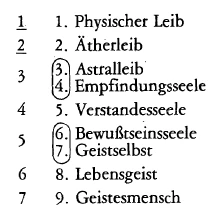
[ 13 ] We learn from reality to say: When we proceed according to the rule of number, one thing is not indifferent to another. Simply because this is the third (see table, 3), it is something different. Certainly, since we are accustomed to thinking about numbers abstractly, we must illustrate this a little today, because it lies far removed from ordinary consciousness. But in ancient times—that is, in the first and second periods of the post-Atlantean era—it never occurred to anyone to imagine the indifferent addition of one to another as the numbers progressed; rather, one experienced something when moving, say, from two to three, just as one experiences something here when moving from two to three (see compilation). Today one can barely sense it through such an example; one does not yet feel it in the number itself. In those ancient times, people felt it in the numbers themselves. People spoke of numbers in terms of their relationships to one another. For example, they perceived it this way: everything that exists as a two has something open to the world; it is not something complete; that which exists as a three—as a true three—is something complete. Now you might say that one must make a distinction depending on what one was counting. When one counted: one man, one woman, one child, then “man” and “woman” represent duality, open to the world; in the child, it closes off, forming a whole. If one counted apples, then of course one could not say that three apples are more closed off than two apples. Yes, that was how one perceived the external reality, but one did not perceive the number that way; in fact, one perceived the number quite differently.
[ 14 ] You will recall that certain tribes, which still belong to the indigenous population, count using their ten fingers by comparing the number of objects present with the number of their fingers; thus, one could say that if there are three apples lying there, that is equal to three fingers.
[ 15 ] But then one would not have said: one, two, three—of course in the corresponding language: thumb, index finger, middle finger. — Out there in the world, one has nothing specific; but in what was internally represented as corresponding to what is out there, there was something very specific, for the three fingers are distinct from one another. Well, we as humanity have come so wonderfully far now in the fifth period of the post-Atlantean era—it was essentially already the case in the fourth—that we no longer need to say: thumb, index finger, middle finger—but instead we say: one, two, three. — The genius of language is no longer taken into account. For if you were to listen closely to language, you would say to yourself, purely intuitively: one, two—that is, apart. It is still present in language. But when you say: “Three”—and have a feel for the sounds—then you have the sense of wholeness. “Three” can actually only be conceived—if one thinks of it correctly—as belonging together in a circle. “Two”: apart; “three”: self-contained. The genius of language still possesses this.
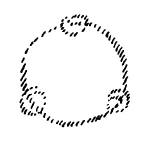
[ 16 ] Yes, so as I said, we’ve “come so far” that we can abstractly add one unit to another, and then we perceive, well: that’s two, that’s one; with three, there’s still one more, and so on. But why are we able to count at all? Well, in reality, we do it no differently than primitive peoples; it’s just that they did it with their five fingers—their five physical fingers. We count too, only we count with the fingers of our etheric body and are no longer aware of it. This takes place in the subconscious; that is where we abstract. For what we use to count is actually the etheric body, and a number is, in reality, nothing other than a comparison with what is within us. All of arithmetic is within us, and we were born with it through our astral body, so that it actually emanates from our astral body, and our ten fingers are merely the imprint of this. Astral and etheric. And these two are utilized only by these external fingers, whereas when we calculate, we express in the etheric body that which is brought about by the astral body—the inspiration of the number—and then count through the etheric body, with which we think in the first place. So that we can say: Externally, counting is something quite abstract for us today; internally, it is connected to this—and it is very interesting to trace the various methods of counting based on the number ten, the decimal system, or the number twelve among different peoples, and how this relates to the different constitutions of their etheric and astral bodies— inwardly, it is connected to the fact that we count because we ourselves have first been counted; we have been counted out of the world’s being and ordered according to number. Number is innate to us, interwoven with the whole of the world. Outwardly, numbers gradually become indifferent to us; within us, they are not indifferent; within us, every number has its own specific quality. “Just try for a moment to remove the numbers from the universe, and see what would be formed according to the numbers if one were simply added to the other; see what your hand would look like if there were a thumb, and then the next one were simply added as the same unit, and then again, and again: You’d have five thumbs on one hand, and five thumbs on the other hand as well! — That would then correspond to abstract counting.
[ 17 ] That is not how the spirits of the universe count. The spirits of the universe shape according to number, and they shape in the sense that was formerly associated with number—as I said, both in the first and in the second period of the post-Atlantean era. The development of the abstract number out of the very concrete conception of the numerical, of the numerical principle, only took shape in the course of human evolution. And one must be clear about this: it has a profound significance when the ancient mysteries teach us that the gods formed human beings according to number. — The world is full of number; that is to say, everything is formed according to number, and human beings are shaped according to number, so that counting as we know it did not exist in those ancient times; but a pictorial thinking in terms of the qualities of number—that did exist.
[ 18 ] This takes us back to ancient times, as I said, to the first and second post-Atlantean periods, to the primordial Indian and primordial Persian eras, when counting as we understand it was by no means possible—when the number two was associated with something entirely different from twice one, and the number three with something entirely different from two and one, and so on.
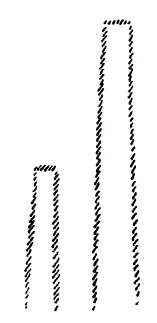
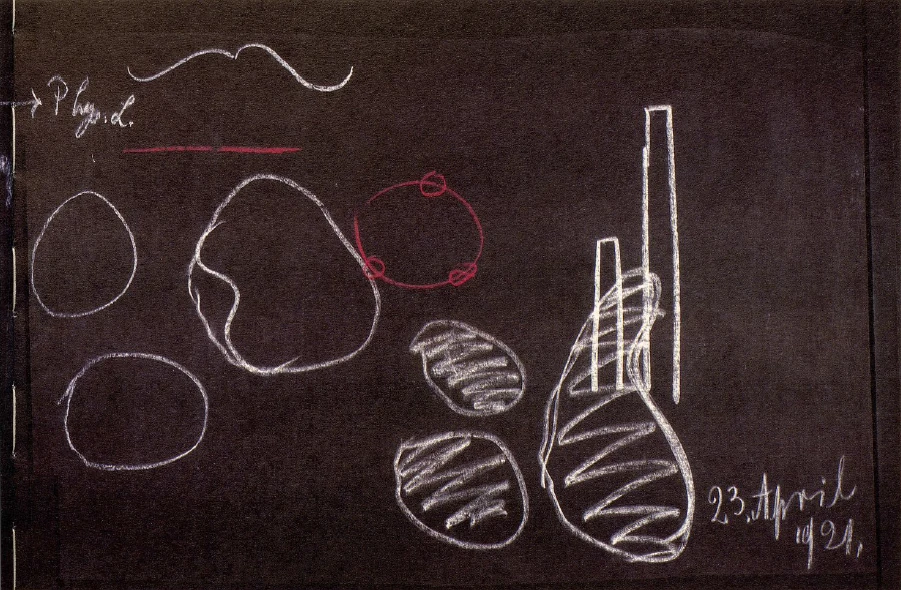
[ 19 ] As you can see, the human state of mind has already changed quite considerably over the course of time. And if we now consider the somewhat later period, which is the third period of the post-Atlantean era, the concept of measurement turns out to be something entirely different. Today we measure by adopting an arbitrary unit of measurement. But in the third post-Atlantean period, for example, people did not really think in terms of such an arbitrary unit of measurement; rather, they had something quite pictorial in mind when it came to measuring. They had in mind what may become clear to you if we say: We see this, for example, as a pillar and then regard that as a pillar (see drawing); we look at these two pillars. When we think abstractly, we say that the second column is twice as large as the first; we have measured it against the first. — But that is a very abstract conception. Concretely, it can be interpreted roughly as follows: When we stand facing the first column, we perceive it as small compared to the second; we feel that it must grow, and as it grows and grows, we feel that once it has grown to this point, it is something special. It has expended so much energy on this growth that it now possesses a strength whereby its two parts can relate to one another in such a way that both are equally strong. One can sense something qualitative here. One can go further. One can say: I have a form here; I measure it against the other and thus discern the symmetry; my concept of measure expands, it enters into the image.
[ 20 ] In this way, one gradually begins to grasp that “measure” actually has something to do with what we still sense only vaguely today when we speak of “moderate” and “moderation”—even though we do not think of measuring in those contexts. Let’s take this example: When someone eats a certain dish in a certain quantity, we sometimes find that to be moderate without actually measuring it. We consider something else to be excessive. But we aren’t measuring anything here; we aren’t comparing the stomach to what goes into it or anything of the sort. Nor are we measuring out a piece of meat and then eating it; we aren’t gauging it by the person’s size, but rather we are referring to something qualitative, something characteristic, when we speak of “moderate” or “excessive” and the like. — This brings us to something that, while not so very different from what we today call “measure,” nevertheless shows that today we understand “measure” to be something abstract—namely, “the inclusion of the unit of measurement within a certain quantity”—whereas in the past it was understood as something qualitatively connected to things themselves. Above all, each individual part of the human body was perceived as moderate in relation to the whole person, without any thought of a single unit. Something of this has remained with us: namely, that it repulses us when, as artists, we are supposed to measure something; if, as artists, we are to measure with a real ruler so that the nose is not too long or too short, that is actually unartistic. It is artistic only when, in contemplation, a thing has the size it must have within an organism. So this, too, is not an abstract process, but something connected to the pictorial. And if you finally consider that proportional relationship which still plays a certain role today—the so-called Golden Ratio—it is not related to measurement, but to something that is purely qualitative: the small relates to the medium as the medium relates to the large. The small may be as large as it pleases; it must simply always relate to the medium as the medium relates to the large. We are not thinking of a unit of measurement, but rather of something that relates to itself in the act of perception, and yet we speak of proportion and moderation, which find expression in the Golden Ratio. We cannot in any way base the Golden Ratio on what would be a unit of measurement in the abstract sense, as we otherwise can. We can therefore say: With regard to measurement, as we survey the course of human development through the ages, we see that in the fourth post-Atlantean epoch—the Greco-Latin period—this intuitive sense of proportion gradually transforms into abstract measurement. This actually only occurs in the fourth post-Atlantean epoch. In the third period, people still perceived proportional relationships much more in the way we only perceive them today when we experience the Golden Ratio. And our abstract counting, as we go back in time, stems from an experience of the inner nature of numbers.
[ 21 ] Well, when it comes to weight, people today are already very far removed—terribly far removed—from what the experience of weight was like during the first post-Atlantean epoch. You need only recall a very familiar phenomenon that most of you have certainly experienced: when an athlete comes along carrying those terribly “heavy weights” labeled “200 kilos”; and he hauls them and hauls them, and he’s sweating, and you’re almost sweating along with him: And then, once he’s made you sweat long enough, he suddenly picks them up and runs off. The whole thing has no weight at all—it was merely an illusion. But you actually perceive it according to the abstract concept written on them: “200 kilos.” The experience of weight is, in fact, completely beyond our reach today. That is why it is one of the greatest experiences when, in clairvoyant consciousness—as is indeed the case—the experience of absolute weight arises in relation to natural phenomena. It is certainly true that in that first post-Atlantean epoch, which we call the Proto-Indian, human beings still sensed something of weight relationships within themselves. I have often spoken to you about the fact that our brain actually floats in cerebrospinal fluid and, according to the well-known law that a floating body appears to be as much lighter as the weight of the displaced water, the brain loses a significant portion of its weight; otherwise, it would constantly crush the veins lying beneath it. The brain floats in cerebrospinal fluid; but today, in their abstract experience, people no longer notice this. Nor do they notice anything of these other relationships within themselves. They no longer experience weight; they pay no attention to this experience of weight. It is fundamentally different to experience the weight of one’s body when one is twelve years old than when one has, say, reached five times that age; but most people have forgotten how heavy they felt in their twelfth year of life and therefore cannot make a good comparison. But let us, for the sake of argument, assume two ages at which one weighs the same on the scale; then it does not matter—what matters is the experience of heaviness. This experience of weight, which today exists for human beings only in relation to the Earth, was an absolute in the first post-Atlantean epoch.
[ ] Today we sense only a remnant of this in art—though in art it is very strong. I need only draw your attention to the following. Suppose I draw two figures: From my perspective, there is actually something unclear, something unresolved, something that is not supposed to be there. These two things side by side prompt me to add a third. But I can only create that third element in such a way that it is larger and holds the other two together in a certain way. Then I have the feeling that the three are floating in the air and can support one another.
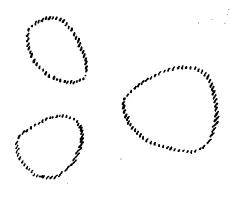
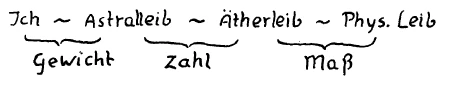
[ 22 ] When a painter working in a compositional style paints three angels today—who, of course, do not possess a sense of gravity—he arranges them in space so that they support one another, so that one is supported by the other. Simply painting three angels side by side on a surface is, of course, the worst thing one can do artistically; it shows a lack of true artistic feeling for such things. One must have a sense of their mutual weight—how one supports the other—and in artistic sensibility there is still a faint trace of what was experienced, above all inwardly within human beings during the post-Atlantean era, as that which gives weight. The experience of weight, number, and measure developed throughout the first three post-Atlantean epochs exactly as it had to, as human beings felt themselves to be within the cosmos. And based on that from which they had been formed out of the cosmos, they then judged other things—namely, what they brought forth from within themselves. When he looked at what his astral body projected into the etheric body, he had to say: The astral body counts, but it counts in a differentiating way; it counts the etheric body. It shapes it through counting. — Between the astral body and the etheric body lies number, and number is a living force, something active within us. Between the etheric body and the physical body lies something else. From the etheric body, through inner relationships, that which we then see is formed; after all, according to the Golden Ratio, we are essentially structured organically: the forehead to a certain extent, and in turn this other part in relation to the entire length of the head, and so on. The etheric body imprints all of this upon our physical body from the cosmos, from cosmic relationships. The measure and the sense of proportion that are within us represent the transition from the etheric body to the physical body. And finally, in the transition from the “I” to the astral body lies that which can be experienced inwardly as weight. I have often told you that the “I” was actually only born in the course of human evolution. The ancient Indian of the primordial Indian era did not experience such an “I.” But he did experience inwardly the sense of weight and form, so that he felt both his heaviness—his being pulled downward—and his buoyancy—his rising upward. Within himself he felt that which is overcome when a child transitions from crawling to walking; that is what he felt. He did not perceive an “I,” but he sensed how he was bound to the earth by the Ahrimanic forces, “weighted down,” and how he was buoyed up by the Luciferic forces, lifted upward; and he perceived this as his state of equilibrium. If we were to study the ancient words that existed for the “I,” we would find that this very thing is inherent in the formation of the words themselves. Just as the words were combined in the verbs according to their inner configuration, so the balance between floating and falling was inherent within them.
[ 23 ] Our seemingly abstract concepts: weight—which, in fact, is no longer abstract at all, since we are faced with something completely unknown; number, which is completely abstract because it is entirely indifferent to what is being counted; and measure, which has also become increasingly abstract for us—all of this, in fact, is projected by human beings from their inner world onto the external world. Humans transfer what has real significance within them—because they are constructed and structured according to measure, number, and weight—onto the indifferent external things; in this process of abstraction, they dehumanize themselves, so that one can say: Human development tends toward losing the inner experiences of weight, number, and measure, retaining only a final vestige of them in the artistic realm, but then no longer experiencing them in such a way that human beings themselves feel they are shaped by the cosmos according to weight, number, and measure. What we have today as abstract geometry—where we compare congruent and similar figures, where we say that an ellipse is formed when the sum of the distances of each of its points from two given points is a constant quantity—is something abstract to us. There, we are essentially measuring the distances and find their sum always equal to the major axis of the ellipse. But in this peculiar relationship between two different quantities, people in the third post-Atlantean epoch still experienced the ellipse, even if they could not visualize it in any way. They already sensed the elliptical quality in the ratio of one to the other, just as they sensed the circle during the same period. And in this way, they also sensed the essence of number. Thus humanity developed from concrete experience toward the abstract and formed geometry from the ancient experience of measurement, arithmetic from the ancient experience of numbers, and—as human beings completely lost the experience of weight and became entirely dehumanized, reduced to mere external observation—from the ancient experience of weight.
[ 24 ] Yes, all of this was already slowly taking shape—what would then develop into its full culmination in the 19th century—the gradual abstraction of inner human experience: humanity was lost to human perception. Human beings can no longer access their own nature; they no longer suspect that they embody geometry, because they are formed according to the measure of the cosmos, or that they count in and of themselves. He is surprised when primitive peoples use their fingers to compare external objects; but he does not know that he has been shaped by the cosmos according to number, and that, in this respect, he essentially remains a primitive; nor does he realize that in his etheric body—which, in accordance with the inner properties of numbers, has itself formed the numbers within his astral body—he has subsequently experienced these numbers externally, and so on. Geometry, arithmetic, and the science of weights and measures—weighing—are things that have certainly entered the sphere of the abstract in the course of human development and have contributed to the fact that human beings could henceforth entrust themselves solely to such a science, to such scientific research, which observes these things externally.
[ 25 ] What do we do today when we conduct scientific research? We measure, we count, we weigh. You can already read some strange definitions of being today. There are already thinkers today who say: That which exists is that which can be measured. — But of course, this refers only to measurement using an arbitrary standard, and it is strange that being is now reduced to something that is, in fact, based on arbitrariness. We thus live within something that humanity has entirely created of its own accord, with regard to which it has completely lost its connection to itself. Under such influences, what I have emphasized from various angles throughout this course came to pass: that in modern knowledge, human beings have lost themselves. They have lost themselves, as I have often said, in their knowledge, in that they actually stand there merely as the final link in the animal chain; he has lost himself in social life, in which we have indeed developed extraordinarily good machines, yet we are unable to incorporate into our social life what the people operating the machines actually represent. We must learn to look deeply into the development of humanity; we must, in particular, observe in this way how the process of humanity’s intellectualization has taken shape. Just think for a moment what a different state of mind it was when, in the first post-Atlantean epoch, human beings—by stepping forward with one leg—constantly experienced a different sense of balance, constantly experienced the sensation of becoming weighty, of falling and floating, when they felt how the number had shot into their own form, how they were built according to that measure. Think how different that was from when we merely measure, count, and weigh externally, leaving the human being entirely out of the picture. It is true that today, at most—as I have already indicated—for those with a finer sensibility for language, something of the essence of number may still become apparent from the numeral words, for there is already something of the essence of number contained within them; or through artistic contemplation, when someone, for example, senses that this is possible:
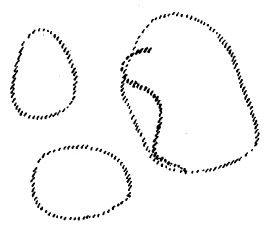
But this one is impossible in that regard:
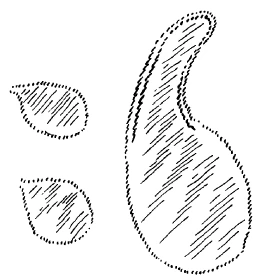
[ 26 ] Then it has a hint of what it means to sense inner weight, inner balance. If I can follow a certain relationship in another person through the line, then I have a mutual holding. But if I draw a horn where there cannot be one, then I have no sense of this mutual holding. Just look at how humanity struggles, I would say, to project from within the external measure, the external perception, in relation to inner experience. Look at Raphael’s painting—actually, at all of Raphael’s paintings, but especially at the one depicting the “Betrothal of Mary and Joseph”—look at how the figures stand there, how everything is arranged so that the elements support one another, so that one loses the sense that they are being pulled downward. Look in particular at how, when truly older painters depict a flying figure, this is motivated; how, when you look closely at this figure, you see that it is not weighed down, but rather that it somehow sustains itself through the other relationships. There you have this transition from inner weight to the outwardly defined nature of weight, and there you have the course of humanity in the post-Atlantean era from inner experience to intellectualism, this striving toward the intellect, where everything experienced by a person in the imagination is detached from the person, where the person no longer experiences the tearing apart, the “splitting in two,” when he or she says “two.”
[ 27 ] This happens subtly. When one then applies this word further, when one says, “to doubt,” one senses the resonance with “to split in two.” Those who doubt say: Perhaps this is right, perhaps it is not. — This is open to both possibilities; the act of “dividing into two” is inherent in the act of thinking. But this is already inherent in the number two.
[ 28 ] Three—you cannot perceive it in the same way when you apply it to something. Apply it to a judgment, and you have the major premise, the minor premise, and the conclusion: a triad, a self-contained whole. Take the most famous figure in logic, Cajus: “All humans are mortal; Cajus is a human, therefore Cajus is mortal.” The elements belong together: major premise, minor premise, and conclusion. But take only the major premise and the minor premise—and it remains open.
[ 29 ] So, I wanted to use this to illustrate how humanity’s path leads toward abstraction, and how, in fact, humanity—having lost itself—has incorporated the intellect into its development.
[ 30 ] We’ll talk more about that tomorrow. Today’s discussion was meant to be a single episode; but you’ll see how it ties in with the broader considerations.