Perspectives on Human Evolution
The Materialistic Impulse toward Knowledge
and the Task of Anthroposophy
GA 204
2 June 1921, Dornach
Translated by Steiner Online Library
Fifteenth Lecture
[ 1 ] I have spoken repeatedly over the past few weeks about the great upheaval that took place in Western civilization during the 4th century A.D. When discussing such a matter, one must repeatedly point out something that has indeed often been the subject of consideration here, but which it is always necessary to keep in mind; I am referring to the metamorphoses of human development, which differ greatly from one another in a spiritual sense. When speaking of such a pivotal point in human development as that which occurred in the 4th century A.D., one must be mindful that human spiritual life changed, so to speak, in a single leap. This is not the view held today. Today, the prevailing view is this: Well, the human race has gone through a history that, if traced back according to the latest records, extends roughly to the third or fourth millennium; then, if one goes back further, there is a long period of nothing until one reaches conditions that are still entirely animal-like and human. But as for the period of historical development, it is thought that people have essentially always thought and felt the same way they do today—at most, they were previously at a childlike stage of scientific life, and that they finally struggled their way to what we today describe as the marvelous progress we have made in our understanding of the world. Well, a reasonably unbiased observation of human life certainly suggests the opposite, and I had to describe to you how there was a tremendous upheaval in the 4th century A.D., how there was then another upheaval in the entire life of the human soul at the beginning of the 15th century, and how a turning point in the life of the human soul also took place in the 19th century.
[ 2 ] Today, I would like to examine, so to speak, one aspect of this entire development. To begin with, I would like to introduce you to a figure who truly illustrates how people in relatively recent times thought quite differently from the way we think today. This figure, who has already been mentioned in earlier lectures, is Johannes Scotus Erigena, who lived at the court of Charles the Bald in France during the 9th century A.D. Johannes Scotus Erigena, who was born around the year 815 across the Channel and lived well into the second half of the 9th century, he is a figure who truly embodies the more intimate Christian way of thinking of the 9th century A.D.—but a way of thinking that was still entirely shaped by the aftereffects of the first Christian centuries. Johannes Scotus Erigena had evidently been quite diligent in immersing himself in what constituted the standard scholarly and theological education of his time. After all, both—scholarly and theological education—coincided in his time. And the best way to acquire this scholarly and theological education was across the Channel, specifically in Irish institutions, where Christianity was cultivated in a certain esoteric manner. The Frankish kings then understood how to attract such figures to their courts, and the Christian education that subsequently permeated the Frankish Empire—and indeed spread from the Frankish Empire further east into western Germany—was essentially influenced by those figures whom the Frankish kings had brought over from across the Channel. Johannes Scotus Erigena, however, also delved deeply into everything that was particularly characteristic of the Greek Church Fathers, and he immersed himself in those writings that are inherently problematic within Western civilization—the writings of Dionysius the Areopagite. This Dionysius the Areopagite is, after all, regarded by some as a direct disciple of Paul. However, the writings did not appear until the 6th century, and some therefore speak of pseudo-Dionysian writings, which were composed by someone in the 6th century and then attributed to the disciple of Paul.
[ 3 ] Anyone who speaks this way does not understand the full nature of how spiritual knowledge was passed down in those earlier centuries. A school such as the one in which Paul himself had taught in Athens possessed knowledge that was initially taught only orally, that was then passed down from generation to generation, and that was not written down until much, much later. What was later written down therefore need not be inauthentic at all, but can, with a certain degree of accuracy, reflect what is centuries old. And the kind of value we place on personality today—such value was certainly not placed on personality in those earliest times. And perhaps today, in particular, we will be able to gain insight into a circumstance—which we will discuss in connection with Johannes Scotus Erigena—as to why this was the case, why so little value was placed on the individual at that time.
[ 4 ] But one thing is certain beyond a doubt: the teachings attributed to Dionysius the Areopagite were considered particularly worthy of recording in the 6th century. They were regarded as what had been preserved from the earliest Christian times, and as something that needed to be recorded specifically at that time. This fact in and of itself should be seen as something special. In the period before the 4th century A.D., people simply had more confidence in the memory passed down from generation to generation than they did in later times. In those earlier times, people were simply not as eager to put things in writing. But people saw the time approaching when it was becoming more and more necessary to record things that had previously been easily passed down orally, for what is recorded in the writings of Dionysius is indeed something subtle. And what Johannes Scotus Erigena was able to study in these writings was certainly capable of making an extraordinarily deep impression on him. For the line of thought found in Dionysius was roughly as follows: We humans can, through the concepts we form and the insights we gain, comprehend the sensory-physical world. We can then use our intellect to draw conclusions from the facts and entities of this physical, sensory world. We develop, so to speak, upward toward a content of the intellect that is no longer perceptible through the senses, that is experienced in ideas and concepts; and once we have formed our concepts and ideas from sensory facts and entities, we feel the urge to move upward with these ideas toward the supersensible, the spiritual, and the divine.
[ 5 ] But Dionysius does not proceed in such a way as to say, for example, that we learn this or that from sensory objects, that our intellect derives its concepts from them, and that he then infers the existence of a deity or a spiritual world—he does not say that; rather, he says: The concepts we derive from sensory objects are all unsuitable for expressing the divine. No matter how subtle the concepts we form of sensory objects may be, we simply cannot use them to express the very essence of the Divine. We must therefore turn away from positive concepts and toward negative concepts. For example, when we encounter our fellow human beings, we speak of “personality.” According to Dionysius’s view, when we speak of the Divine, we should not speak of “personality,” because the concept of personality is far too limited, far too lowly, to describe the Divine. Rather, we should speak of “super-personality.” Nor should we, when speaking of the Divine, speak of “being.” We say that a human being is, an animal is, a plant is. We should not attribute “being” to God in the same sense as we do to a human being, an animal, or a plant; rather, we should attribute “super-being” to Him. And so, according to Dionysius, we should strive to elevate ourselves from the sensory world to certain concepts, but then we should, so to speak, overturn these concepts entirely, allowing them to transition into the negative. We should, so to speak, rise from the sensory world to positive theology, but then overturn it and establish negative theology, which is actually so lofty, so permeated by God and divine thought, that it can only express itself in negative predicates—in negations of whatever one can conceive of from the sensory world. |
[ 6 ] And so Dionysius the Areopagite believed he could penetrate the divine-spiritual world by, as it were, leaving behind everything that can be held in the intellect and living his way into a world beyond the intellect.
[ 7 ] You see, if we consider Dionysius to be a disciple of Paul, then he lived at the end of the 1st Christian century and into the 2nd Christian century, and thus lived a few centuries before the decisive 4th century A.D. He senses what is approaching: the pinnacle of human intellectual development. In a sense, he looks back with part of his being to ancient times. As you know, before the 8th century B.C., people did not yet speak of the intellect in the same way as they have since the 8th century B.C. Intellect—or the intellectual soul—was, after all, first born in the 8th century B.C., and from this birth of the intellectual soul emerged Greek and Latin culture. These cultures then reached their peak in the 4th century A.D. Before the 8th century B.C., people did not perceive the world through the intellect at all; they perceived it through intuition. The ancient Egyptian and Chaldean insights were gained through intuition, in the same way that we gain our external sensory perceptions, even though these pre-Christian insights were spiritual insights. The spirit was perceived just as we perceive the sensory world today and just as the Greeks had already perceived the sensory world. Thus, in a sense, there is in Dionysius the Areopagite something like a yearning for a form of perception that lies beyond the intellect.
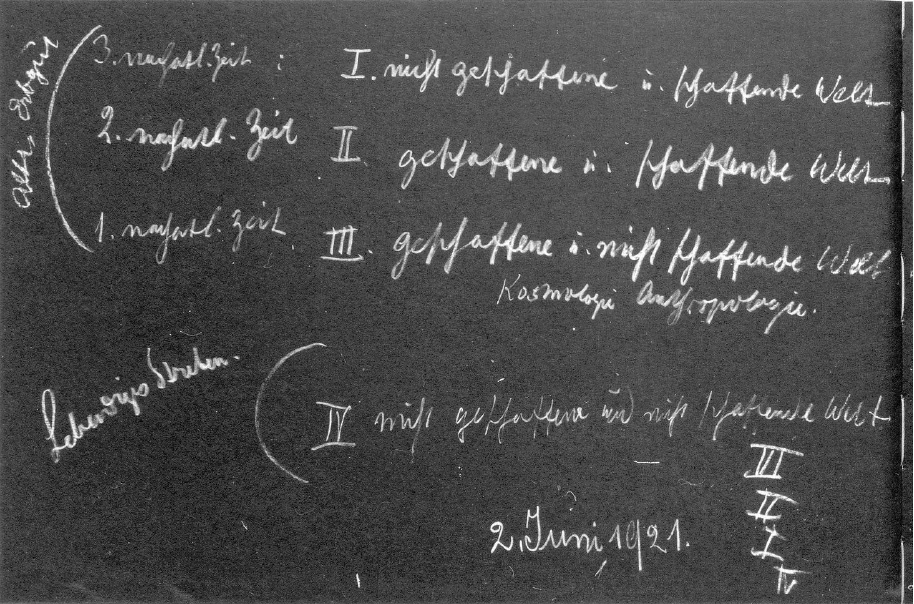
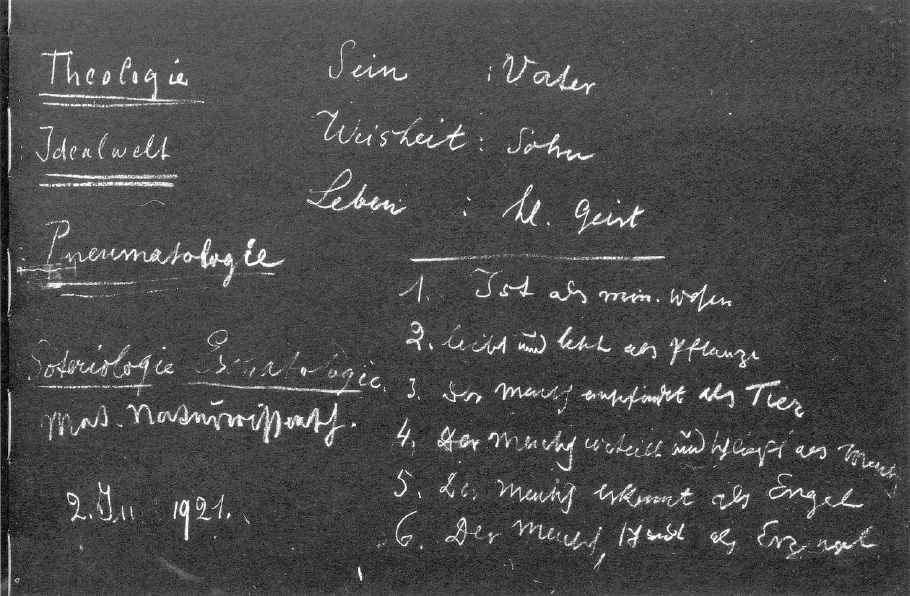
[ 8 ] Now the great Mystery of Golgotha stood before Dionysius. He lived within the intellectual culture of his time. Anyone who delves into Dionysius’s writings can see—regardless of who he was—how deeply this man was immersed in all that the intellectual culture of his time had produced. A highly educated Greek, yet at the same time a man whose entire personality was filled with the grandeur of the Mystery of Golgotha, and who told himself: No matter how hard we strain our intellect, we cannot grasp the Mystery of Golgotha and what lies behind it. We must go beyond the intellect. We must evolve from positive theology to negative theology.
[ 9 ] This made a great impression on John Scotus Erigena when he read the writings of Dionysius the Areopagite as early as the 9th century; for what followed the 4th century A.D.—which was more Augustinian in character—developed only slowly in the manner I have described in previous lectures. Such a spirit—precisely that of those who had been educated in the schools of wisdom over in Ireland—still lived on in the early Christian centuries; such a spirit could still cling with every fiber of its soul to what is written by Dionysius the Areopagite. And yet, at the same time, there was a very strong urge in John Scotus Eriugena to use reason—that is, what human beings can attain through their intellect—to establish a kind of positive theology that was at the same time philosophy for him; and Scotus Eriugena studied the Greek Church Fathers with great diligence. We find in his work, for example, a detailed knowledge of Origen, who lived from the 2nd to the 3rd century A.D.
[ 10 ] When we study this Origen, we indeed find a view quite different from the Christian one—that is, from the view that later came to be known as the Christian view. Origen is still firmly of the opinion that one must penetrate theology through philosophy, that one can only study human beings in their entirety if one regards them as an emanation of the Godhead—if one views them as having once originated from the Godhead, then descending further and further, but through the mystery of Golgotha has received the possibility of ascending once more to the Godhead, in order to be reunited with the Godhead. From God into the world and back to God—this is roughly how one might describe the path that Origen recognized as his own. And, fundamentally speaking, this is also the basis of the Dionysian writings, and it was then carried on by figures such as John Scotus Erigena. But there were many others like him.
[ 11 ] One might say that it is something of a historical miracle how future generations actually came to know the writings of Johannes Scotus Erigena. Unlike other similar writings from the early centuries, which have been completely lost, these survived into the 11th and 12th centuries, with a few even lasting into the 13th. At that time, they had been declared heretical by the Pope, and an order had been issued that all copies must be sought out and burned. It was not until much later, in a long-abandoned monastery, that manuscripts from the 11th and 13th centuries were rediscovered. In the 14th, 15th, 16th, and 17th centuries, nothing was known about Johannes Scotus Erigena. The writings had been burned along with similar works from the same period that contained comparable ideas—works regarding which Rome had been more successful: all other copies had been consigned to the flames! Only a few of Scotus Erigena’s works survived.
[ 12 ] If we now consider the 9th century A.D., and if we take into account that Johannes Scotus Erigena was a scholar with a deep understanding of the wisdom of the early Christian centuries, then we must conclude: He is a characteristic representative of what carried over from earlier times—from the period before the 4th century A.D.—into later eras. In these later eras, one might say, everything has become ossified in the dead Latin language. What was once alive as wisdom from the supersensible world has become ossified, dogmatized, rigid, and intellectualized. But in people such as Scotus Erigena, something of the old vitality of direct spiritual knowledge still lived on—as it had existed in the early Christian era and as it had been used by the most enlightened minds precisely to understand the Mystery of Golgotha.
[ 13 ] This wisdom had to die out for a time so that, from the first third of the 15th century down to the present day, human reason could be cultivated. Reason as such is indeed a spiritual quality of human beings, but it initially turned toward the material world. The ancient heritage of wisdom had to disappear so that the intellect could be born in its shadowy form. If we do not delve into his writings in a pedantic, academic manner, but rather with our whole being, we realize that in Scotus Erigena, something speaks from different spiritual depths than those from which it was spoken later. In a sense, the human being still speaks from depths that could no longer be reached by spiritual life in later times. Everything is more spiritual, and when the human being spoke at all in terms of knowledge, he spoke of things that take place in the spiritual realm.
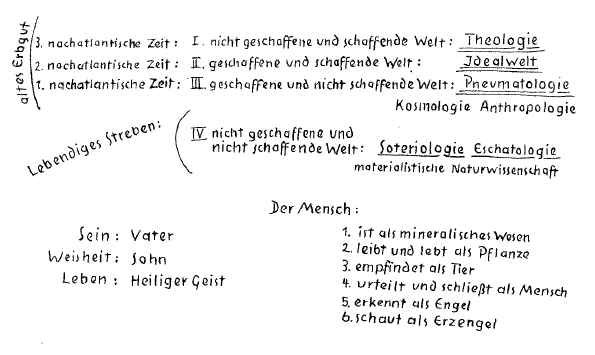
[ 14 ] It is extremely important to take a close look at how Johannes Scotus Erigena structured his philosophy. In his major work on the structure of nature—which has been handed down to posterity in the manner just described—he divides what he has to say about the world into four chapters, and in the first chapter he speaks of the uncreated and creative world (see discussion on p. 262). This is the first chapter, which—in the manner in which Johannes Scotus Erigena believes he can do so—describes, as it were, God as He was before He undertook anything that constitutes the creation of the world. Johannes Scotus Erigena describes this exactly as he, I might say, learned to do through the writings of Dionysius, and he does so by developing the highest intellectual concepts, while at the same time being aware that these concepts can only take one so far—beyond which lies negative theology. Thus, one can only approach what is actually the true essence of the spiritual, of the divine. In this chapter, we find, among other things, the beautiful treatise on the divine Trinity, which is still instructive for our time. He says that when we look at the things around us, we first find Being as an all-spiritual attribute (see § 262). This Being is, in a sense, that which encompasses everything. We should not ascribe to God the Being that things possess, but we can—only in a certain sense, by looking up to that which is Transcendent Being—speak of the Being of the Deity only in a summary way. Likewise, we find that the things in the world are permeated and imbued with wisdom. We should not attribute to God mere wisdom, but rather super-wisdom. Yet, when we proceed from things themselves, we reach the limit of what is wise. But it is not only wisdom in all things: all things live; there is life in all things. Thus, when John Scotus Erigena contemplates the world, he says: “I see in the world Being, Wisdom, and Life.” In a sense, the world appears to me in these three aspects: as a world of Being, as a world of wisdom, and as a living world. As it were, these are three veils that the mind forms when it looks upon things. One would have to see through these veils; then one would look into the divine-spiritual. But he first describes the veils and says: “When I look at Being, it represents the Father to me; when I look at Wisdom, it represents the Son in the universe to me; when I look at Life, it represents the Holy Spirit in the universe to me.”
[ 15 ] As you can see, Johannes Scotus Erigena certainly starts from philosophical concepts and rises to the level of what the Christian Trinity is. He thus continues the inner journey, beginning with understanding, into what is called the “incomprehensible.” This is also his firm conviction. But he speaks in such a way that one can see from the manner in which he presents things that he has learned from Dionysius. At the very moment when he arrives at Being, Wisdom, and Life—which are represented to him by the Father, the Son, and the Holy Spirit—he actually wishes to let these concepts dissolve into a general spiritual realm, into which human beings would then have to rise beyond concepts. But he does not attribute to human beings the ability to attain such a transcendent, supra-conceptual realm.
[ 16 ] Johannes Scotus Erigena is thus a son of his age, an age that cultivated reason, and which—if it truly understood itself—had to admit that it could not penetrate the transcendent.
[ 17 ] The second chapter then describes, so to speak, a second layer of worldly existence: the created and creating world (see p. 262). This is the world of spiritual beings, in which we must seek out angels, archangels, archai, and so on. This world of spiritual beings—which we also find described by Dionysius the Areopagite—creates throughout the world, yet it is itself created; it was initiated, and thus created, by the highest Being, and it creates in every detail of the existence that surrounds us.
[ 18 ] As the third world in the third chapter, he then describes the created and non-creating world. This is the world we perceive around us with our senses. It is the world of animals, plants, and minerals, of the stars, and so on. In this chapter, he covers roughly everything we would call cosmology, anthropology, and so on—what we today refer to as the scope of science.
[ 19 ] In the fourth chapter, he discusses the uncreated and non-creating world. This, too, is the Godhead, but as it will be when all beings—namely, all human beings—have returned to it, when it will no longer be creating, when it has taken into itself, in blissful peace—as Johannes Scotus Erigena imagines it—all those beings that have just emerged from it.
[ 20 ] Well, if we survey these four chapters, we actually find in them—I would say—something like a compendium of all that had been handed down, as it existed in the schools of wisdom from which John Scotus Erigena emerged. If we take what he describes in the first chapter, we have, so to speak, what was called “theology” in his sense—theology, the actual doctrine of the divine.
[ 21 ] If one takes the second chapter, one finds in it what he calls the “ideal world”—roughly, in our modern language, the “ideal”—but conceived as substantial. After all, he does not describe abstract ideas, but rather angels, archangels, and so on; he describes the entire intelligible world, as it was called—though this was not an intelligible world like ours, but rather a world of living beings, of living intelligible beings.
[ 22 ] In the third chapter, as mentioned, he describes what we would today call science, though in a different way. Since the time of Galileo and Copernicus—which, of course, came later—we no longer have what was called cosmology or anthropology in the time of Scotus Erigena. What is called “cosmology” is still very much something described from a spiritual perspective; it is described in such a way that spiritual beings guide the stars, that spiritual beings also dwell within the stars, and that the elements—fire, water, air, and earth—are permeated by spiritual beings. So what is described there as “cosmology” is something else entirely. That materialistic worldview, which emerged in the mid-15th century, simply did not exist back then, and what he refers to as “anthropology,” for example, is also something entirely different from what we today call “anthropology” in our materialistic age.
[ 23 ] I can tell you something here that is exceptionally characteristic of Johannes Scotus’s anthropology. He looks at human beings and says: Human beings first and foremost carry Being within themselves. They are therefore mineral beings; they possess a mineral nature within themselves. So, first: human beings are mineral beings (see p. 262). Second: human beings exist and live like plants. Third: human beings feel like animals. Fourth: human beings judge and reason, drawing conclusions as human beings. Fifth: human beings perceive like angels.
[ 24 ] Well, that is, of course, something utterly extraordinary in our time! When Johannes Scotus Erigena speaks of judgments and conclusions—which is, after all, what one does, for example, in a courtroom when one wants to pass judgment on someone—then human beings judge and conclude as human beings. But when he cognizes—when he penetrates the world through cognition—then the human being behaves not as a human being, but as an angel! I want to say this first and foremost to show you that anthropology was something different in that era than it is today; for, wouldn’t you agree, it would be almost unthinkable anywhere today—not even in a theological faculty—to hear that the human being cognizes as an angel. So one must say: What Johannes Scotus Erigena describes in the third chapter is no longer part of our science. It has become something else for us. If we wanted to name it with a term that is not currently applied to anything specific, we would have to say, for example: Spiritual doctrine of the universe and humanity, pneumatology.
[ 25 ] And then the fourth chapter. In Johannes Scotus Erigena’s work, this fourth chapter contains, first, the doctrine of the Mystery of Golgotha and the doctrine of what man has to expect in the future—namely, his passage into the divine-spiritual world—that is, what one might call, according to modern usage, soteriology, since “Soter” is, of course, the Savior, the Redeemer, and the doctrine of the future, eschatology. We find discussed there the concepts of crucifixion, resurrection, the outpouring of divine grace, man’s passage into the divine-spiritual world, and so on.
[ 26 ] One thing should strike you here—and it really does stand out if you approach it with an open mind—when you read attentively a work such as De divisione naturae by Johannes Scotus Erigena, which deals with the division of nature. There, the world is spoken of entirely as something that is recognized through spiritual qualities. One speaks of the spiritual when observing the world. And what is not contained within it? One must also be mindful of what is not included in such a universal science as Johannes Scotus Erigena seeks to establish here.
[ 27 ] You will find virtually nothing in the works of Johannes Scotus Erigena that corresponds to what we today call sociology, social science, and the like. One might almost say that it seems as if Johannes Scotus Erigena did not want to provide the human beings he envisioned with a social science any more than, say, any animal species—such as lions, tigers, or any species of bird—would produce a sociology. For a lion would not discuss how it should live together with other lions, or how it should obtain its food, and so on; that is instinctively given to it. Nor can we conceive of a sociology of sparrows. Sparrows could certainly produce all sorts of highly interesting insights into the mysteries of the world from their own perspective, but they would never produce an economics or a theory of economics, for the sparrows would regard it as entirely self-evident that they do exactly what their instinct tells them to do. This is what is peculiar: since we do not yet find such a thing in John Scotus Erigena, we realize that he still viewed human society as if it derived its social nature from its instincts. In his particular mode of insight, he points precisely to what still lived in human beings as instinct—to the drives and impulses of social togetherness. What he describes lies above this social togetherness. He describes how human beings emerged from the divine, and which entities lie above the sensory world. He then describes how the spirit permeates the sensory world—in a sort of pneumatology—and in his fourth chapter, within the context of soteriology and eschatology, he describes what has penetrated the sensory world as the spiritual. But nowhere does he describe how human beings are to live together. I would say that everything is elevated above the sensory world. That was, in fact, a defining characteristic of this older science: that everything was elevated above the sensory world.
[ 28 ] And if one delves into something like the teachings of Johannes Scotus Erigena from a spiritual-scientific perspective, one sees that he did not think at all with the same faculties that humanity uses today. One simply cannot understand him if one tries to do so using the kind of thinking that humanity employs today. One can only understand him if, through spiritual science, one has gained an insight into how one thinks with the etheric body—that body which, as a finer body, underlies the gross physical body.
[ 29 ] Thus, Johannes Scotus Erigena did not think with his brain, but with his etheric body. In him, we simply have a spirit that has not yet thought with the brain. And everything he writes down comes about as the result of thinking with the etheric body. Essentially, it was not until after his time that people began to think with the physical body—and, strictly speaking, not until the 15th century. What is usually overlooked is that human life, as a life of the soul, truly changed during this period; that if one goes back to the 13th, 12th, 11th centuries, one encounters a way of thinking like that of Johannes Scotus Erigena—a way of thinking that was not yet carried out with the physical body, but with the etheric body. This thinking with the etheric body was not meant to extend into the later period, when people engaged in scholastic dialectics over abstract concepts; for this older way of thinking through the etheric body—which was, after all, also the way of thinking in the early Christian centuries—was simply condemned as heretical. Hence the burning of Johannes Scotus Erigena’s writings. And one will now come to understand what the spiritual disposition of such a thinker was actually like at that time
[ 30 ] If we go back to earlier times, we find that all people possessed a certain degree of clairvoyance. In those days, people did not think at all with their physical bodies; rather, they thought with their etheric bodies—and even with their astral bodies—or, more precisely, they lived their spiritual lives through them. We should not speak of “thinking” at all in this context, since, as I said, the intellect did not emerge until the 8th century B.C.E. But remnants of this ancient clairvoyance had been preserved, and it is precisely among the most outstanding minds that one seeks, through the intellect—which has now already emerged—to penetrate into that which has been handed down through tradition from earlier times. They tried to comprehend what had been perceived in a completely different way in earlier times. They tried to comprehend, but now had to rely on abstract concepts: Being, Wisdom, Life. So, I would say, they still knew something of an earlier, more spiritual form of knowledge and already felt themselves fully immersed in purely intellectual knowledge.
[ 31 ] This was no longer felt at all later on, once intellectualistic knowledge had become a mere shadow; but back then, people sensed that in ancient times there was something that people experienced vividly from the higher worlds—something they did not merely think about. In the case of John Scotus, he lives within this conflict. He can only think; but when this thinking becomes knowledge, he senses that there is still something left of the ancient powers that permeated human beings in the old way of knowing. He senses the angel, the Angelos, within himself. That is why he says that human beings know as angels. It was a legacy from ancient times that, in this age of intellectual cognition, a thinker such as Scotus Erigena could still say that human beings know as angels do. In the times of the Egyptians and the Chaldeans, in the earlier periods of Hebrew civilization, no one would have said anything other than: “The angel knows within me, and I, as a human being, participate in the angel’s knowledge.” The angel dwells within me, perceiving, and I share in what the angel perceives. That was in the time when reason did not yet exist. When reason then emerged, one had to penetrate this with the intellect; but in Scotus Erigena there was still an awareness of this being permeated by the angelic nature.
[ 32 ] But one feels quite peculiar when one delves into this work by Scotus Erigena and seeks to understand it fully. In the end, one does get the sense that one has read something very significant—something that is still very much alive in spiritual realms, something that speaks of the world as a spiritual matter. But then again, one has the feeling: Yes, basically everything is all jumbled up. And then one tells oneself: We are, after all, dealing with this text in the 9th century A.D.; the intellect has already thrown many things into disarray. And that is indeed the case. For when one reads the first chapter, one is dealing with theology—but with a theology that is already quite secondary for John Scotus, one that clearly points back to something greater and more immediate. There must have been something there at one time—I am speaking now as if these were hypotheses, but spiritual science can certainly establish as fact what I am now developing as a hypothesis—one looks back, as it were, to a time when this theology was not yet approached in such an intellectual manner, but was approached as something one had lived oneself into. And it is undoubtedly this kind of theology that those Egyptians spoke of, about whom the Greeks I have mentioned reported that Egyptian sages had said to them: “You Greeks are like children; you have no knowledge of the origin of the world; we possess this sacred knowledge of the origin of the world.”—Here, the Greeks were evidently pointed toward an ancient, living theology. And so one must say: In what we have always called the third post-Atlantean epoch—which begins in the 4th millennium B.C. and ends in the 1st millennium B.C., specifically in the 8th century B.C., approximately in the year 747—there existed a living theology that now seeks to be understood through the intellect of Scotus Erigena. It was evidently even more vibrant before the figure recognized as Dionysius the Areopagite, and this Dionysius felt even more intensely toward this ancient theology. He sensed that there was something that had once existed but could no longer be approached—something that becomes negative the very moment one attempts to approach it. We can only, he believed, arrive at positive theology through reason. But by “negative theology,” he actually meant an ancient form that has vanished.
[ 34 ] And again, if one examines what appears here in the second chapter as the ideal world, one might think it is something more recent. But that is not the case. It actually corresponds to a true conception of what occurred in the primordial Persian era—as described in my Occult Science—that is, in the second post-Atlantean epoch. For Plato and the Platonists, this primordial Persian world of living angels—the world of the Amshaspands and so on—had already faded into the world of ideals, the world of ideas. This is precisely attributable to a later development. But what is actually contained in this ideal world—and what is still quite transparent in Scotus Erigena—leads back to this second primordial Persian era.
[ 35 ] And when we come to what appears here as pneumatology—which is, in a sense, a form of pantheism, but not the vague, nebulous kind often regarded as such today, rather a pantheism of a living, spiritual nature, even if it has faded in the work of John Scotus Eriugena—this is the last remnant, I would say, the thoroughly sifted remnant of the first post-Atlantean, the primordial Indian era.
[ 36 ] And what, then, is the fourth? Indeed, in Scotus Erigena it appears as a living understanding of the Mystery of Golgotha, of humanity’s future. We don’t really speak of these things anymore today. Theologians still speak of it as an old legacy, but they have enshrined it in rigid dogmas. They even deny that human beings can attain it through living knowledge. But it arose from what had been cultivated as soteriology and eschatology. You see, what used to be theology was, so to speak, handed over to the councils; it was frozen into dogmas and incorporated into Christology. It was no longer to be touched. It was regarded as something inaccessible to knowledge. It was, so to speak, removed from what had been pursued through knowledge in the schools. The exoteric teachings had, in any case, already been preserved as misty remnants from ancient times. But what was pursued in the schools was at least meant to connect with the ideas that had just emerged in the Age of Thought; it was at least meant to connect with the Mystery of Golgotha and with the future of humanity. People spoke there of the reign of the Christ Being among humanity; they spoke of a future Last Judgment; they used whatever concepts they could muster.
[ 37 ] And so we see, in fact, that Scotus Erigena lists the first three chapters precisely as something he has, so to speak, inherited. He then applies his own intellect to the fourth chapter, but in such a way that he speaks of something that is elevated above the sensory-physical world, yet still has some connection to it. One can see how hard he worked to apply his intellect to eschatology and soteriology, and one can also see the scholarly disputes and discussions in which Erigena was embroiled. He was involved in discussions such as whether, in the Lord’s Supper—that is, in something connected to the Mystery of Golgotha—human beings have before them the actual blood and the actual body of Christ. He was involved in all those discussions concerning the freedom and lack of freedom of the human will in connection with divine grace. Thus, regarding everything that was the subject of his fourth chapter, he sharpened his mind and trained his intellect. These were the topics of discussion at that time.
[ 38 ] One could say: The content of the first three chapters was ancient heritage. Not much was changed; rather, it was simply passed on. The fourth chapter, however, was a living pursuit; there, one turned to the mind, which had been trained.
[ 39 ] What, then, became of what was cultivated as “reason”—what was viewed in soteriology and eschatology by people like Scotus Erigena in the 9th century? Yes, you see, my dear friends, since the mid-15th century, this has become the science that underlies our understanding of nature. The intellect that was used to ponder whether, in the sacrament of the altar, bread and wine are transformed into the body and blood of Christ, or whether grace flows to human beings in this or that way—that very same intellect was later used to ponder whether a molecule consists of atoms, whether the sun is this or that body, and so on. It is the further development of the theologian’s intellect that lives on in the natural sciences today. The very same intellect that animated Scotus and those who debated with him in the Eucharistic controversy—and the debates were very lively at the time—lived on in the teachings of Galileo and Copernicus, lived on in Darwinism, and lived on in, let us say, Straussian materialism. That is the straight line. You know, of course, that the older always remains alongside the newer. But the same intellect that, in David Friedrich Strauss, gave birth to the book The Old and the New Faith—in which, in a sense, complete atheism is taught—that very same intellect was, in those days, engaged with soteriology and eschatology; that is the straight line.
[ 40 ] And one might say: If this book were to be written today, and if it were written in the same way as Scotus Erigena wrote it—based on the circumstances of his time—then, since complete atheism would naturally contradict the first chapter, complete atheism would not appear here; rather, our natural science would appear here. In the 9th century, soteriology and eschatology were still prominent. The intellect was directed toward something else. Here, however (see p. 262), materialistic science would appear today. History tells us nothing other than this. And now we may see what emerges from the overall conception of this work.
[ 41 ] Strictly speaking, what is written here (see p. 262) should actually appear in a different order; the third chapter should be titled “Worldview of the First Post-Atlantean Epoch,” the second chapter “Worldview of the Second,” and the first chapter “Worldview of the Third.” The last chapter will initially be as Scotus Erigena intended—who lived during the fourth post-Atlantean epoch, which did not come to an end until the 15th century—and this will apply to the fourth post-Atlantean epoch. So the order should be: III, I, I, IV. That is what I meant when I said earlier that it seems as if things are actually jumbled up. Scotus Erigena simply had the ancient traditions; but he did not trace them back to their time of origin—rather, they were present in the cultural context of his own time—and he presented them in the order in which they were closest to him: he presented what was closest to him as the highest; the others were so vague to him that he regarded them as something lower.
[ 42 ] But the fourth chapter is indeed something very peculiar. Let us try to understand, from a certain perspective, what it might actually be. Let us now transport ourselves back to pre-Christian times. If we were to look for a representative thinker—such as Scotus Erigena was for the 9th century—among the Egyptians, for example, such a thinker would still possess a very vivid understanding of theology. He would still have much more vivid concepts of the ideal or angelic world, of that which permeates and spiritualizes the entire world. He would know all of this, and he would say: There once existed, in the earliest times, a human perception that saw the spirit in all things. Then the spirit was abstracted and raised to the heights. It became the ideal world, then the divine world. And then comes the fourth age. This was supposed to be even more spiritualized than the theological age. This Greco-Latin period, in which Scotus Erigena lived, was thus actually supposed to be more spiritualized than the third period. And especially the fifth, which follows it—our own—should be an even more spiritual period, for it would either have to be listed as the fourth, with materialistic science in place of soteriology or eschatology, or a fifth would have to be added to it with our natural science, and that would have to be the most spiritual of all.
[ 43 ] But in fact, my dear friends, things are merely obscured. When one hears, as Scotus Erigena says, that human beings are mineral beings, grow and live like plants, feel like animals, judge and reason like humans, and perceive like angels—which Scotus Erigena still knew from the tradition of ancient times—then we, who are striving toward spiritual knowledge, must indeed go further. We would even have to say now: Well, the human being is a mineral being; the human being lives and grows like a plant; the human being feels like an animal; the human being judges and reasons like a human being; the human being knows like an angel; and sixthly: the human being beholds—namely, imaginatively, the spiritual world—like an archangel. And from now on, when we speak of human beings since the first third of the 19th century, we must attribute to ourselves: we perceive as angels and develop the consciousness soul through the soul forces of vision—unconsciously at first, but nonetheless as a consciousness soul—as archangels.
[ 44 ] And so we would have the paradox that, in this materialistic age, people actually live in the spiritual world—and live on a higher spiritual plane than they did in the past. We could say, for example: Yes, Scotus Erigena is right—the experience of angels lives on in human beings; but the experience of archangels has also been alive since the first third of the 15th century. So we are actually in a spiritual world.
[ 45 ] When we come to this, we might as well look back at something that is always interpreted in a very trivial way in the Gospels, where it is said: “The end of the world is near, and the kingdoms of heaven are beginning.” Yes, my dear friends, if we must say that the Archangel looks within us so that we may receive a conscious soul, then a rather peculiar conception of this “coming of the heavens” arises, and it will likely be necessary to reexamine such New Testament concepts from this spiritual-scientific perspective. These ideas are indeed very much in need of revision, and we have two tasks before us: First of all, to understand whether our age is not in fact meant to be different from what it was in the time when Christ walked the earth—whether we have not already left behind that end of the world of which Christ spoke? That is the first task we face. And if we have left this so-called end of the world behind us—if, so to speak, we already have the spiritual world here—how can we explain that it appears so unspiritual, that it has become so material, that it has ultimately given rise to that terrible, monstrous existence that characterized the first third of the 20th century? Two immense, overwhelming questions, one might say, stand before our souls. We will continue discussing this tomorrow.