

Human-Becoming, World-Soul and World-Spirit I
Human Beings as Physical and Spiritual Entities
in Their Relationship to the World
GA 205
17 July 1921, Dornach
Translate the original German text into any language:
Versions Available:
Human-Becoming, World-Soul and World-Spirit I, tr. SOL
Dreizehnter Vortrag
Thirteenth Lecture
[ 1 ] Es ist in der Tat sehr vieles von den Gesetzmäßigkeiten, von den Geheimnissen des Weltendaseins in dem Bewußtsein der Menschheit dadurch verdeckt worden, daß jene Mißverständnisse eingetreten sind, die ich gestern und vorgestern auseinandergesetzt habe in bezug auf die Auffassung der polarischen Gegensätze des Ormuzd und Ahriman. Vor allen Dingen ist eigentlich nur dadurch der neuzeitliche Materialismus möglich geworden, der die Menschheit erfüllt mit dem Bewußtsein: Es gibt um uns herum Gegensätze, welche durch die heutige gebräuchliche Wissenschaft erforscht werden und aus denen heraus man das Weltenall wird allmählich begreifen können. — Eine einfache Erwägung kann lehren, daß auf diesem Wege ein Begreifen des Weltenalls niemals möglich sein kann. Denn denken Sie einmal zurück an einiges, das ich ja vor ein paar Wochen hier ausgeführt habe, und setzen Sie es für sich selbst ins rechte Licht, denken Sie daran, wie ja diejenigen Menschen, die heute als naturwissenschaftliche gelten, sich auf den Menschen eigentlich nur beziehen, insofern der Mensch nach seinem Tode Leichnam ist. Dasjenige, was von den übrigen Naturgesetzen, von dem übrigen Naturgeschehen den Menschen durchzieht, nachdem er Leichnam geworden ist, das kann zunächst erklärt werden nach den gebräuchlichen Naturgesetzen. Was aber im Menschen lebt schon zwischen der Geburt und dem Tode, das widerstrebt diesen Naturgesetzen, das widersetzt sich diesen Naturgesetzen. Und man müßte, wenn man nur einigermaßen heute nicht nach Vorurteilen, sondern nach wirklichen Urteilen sich richten würde, sich sagen: Der Mensch kämpft zwischen der Geburt und dem Tode, eigentlich schon von seiner ersten Embryonalanlage an, gegen das, was von Naturgesetzen, wie wir sie heute in unserer Wissenschaft erfassen, beherrscht ist.
[ 1 ] Indeed, much of the laws and mysteries of existence in the world has been obscured in human consciousness by the misunderstandings I explained yesterday and the day before regarding the concept of the polar opposites of Ormuzd and Ahriman. Above all, it is really only through this that modern materialism has become possible—a materialism that fills humanity with the conviction that there are opposites all around us, which are being investigated by contemporary science and from which we will gradually be able to understand the universe. — A simple consideration can show that understanding the universe in this way can never be possible. For think back to some of what I explained here a few weeks ago, and put it into the proper perspective for yourselves; remember how those people who are considered natural scientists today actually relate to the human being only insofar as the human being is a corpse after death. That which, through the rest of the laws of nature and the rest of natural processes, permeates the human being after he has become a corpse can, at first, be explained according to the customary laws of nature. But what lives within the human being between birth and death defies these laws of nature; it resists them. And if people today were to guide themselves—even to some extent—not by prejudices but by genuine judgments, they would have to say to themselves: Between birth and death—in fact, from the very first embryonic stage onward—human beings struggle against that which is governed by the laws of nature as we understand them today in our science.
[ 2 ] Nehmen Sie die umliegende Natur und alles das, was Physik, Chemie, Physiologie, Biologie und so weiter heute über diese Natur sagen, vergegenwärtigen Sie sich das alles, was so über die Natur gesagt wird und denken Sie dann an den Menschen, wie er lebt zwischen Geburt und Tod, dann werden Sie sich sagen: Dieses ganze Leben ist ein Kampf gegen dasjenige Reich, das von diesen Naturgesetzen beherrscht wird. Nur dadurch, daß gewissermaßen die menschliche Organisation von diesen Naturgesetzen nichts wissen will, sie bekämpft, gerade dadurch ist der Mensch Mensch zwischen der Geburt und dem Tode.
[ 2 ] Consider the natural world around us and everything that physics, chemistry, physiology, biology, and so on have to say about it today; bring to mind all that is said about nature, and then think of human beings as they live between birth and death—and you will say to yourself: This whole life is a struggle against the realm governed by these laws of nature. It is precisely because the human organism, so to speak, refuses to acknowledge these laws of nature and fights against them that human beings are human between birth and death.
[ 3 ] Daraus aber können Sie schon ersehen, daß, wenn das menschliche Werden hineingestellt werden soll in das Weltenall, in den Kosmos, es nötig ist, für das Weltenall dann andere Gesetzmäßigkeiten, eine andere Art von Werden anzunehmen. Also mit unseren heutigen Naturgesetzen stellen wir eine Welt vor, in der der Mensch, ja eigentlich auch schon die Pflanze und das Tier gar nicht drinnen sind. Wir wollen aber heute nur den Menschen im Verhältnis zu der übrigen Natur betrachten. Der Mensch ist nicht in derjenigen Natur darinnen, welche die heutige Wissenschaft beherrscht. Ja, der Mensch lehnt sich auf mit jedem Atemzuge gegen diese Natur, von der diese Wissenschaft spricht.
[ 3 ] From this, however, you can already see that if human development is to be placed within the universe, within the cosmos, it is necessary to assume different laws for the universe—a different kind of development. Thus, with our current laws of nature, we envision a world in which human beings—and indeed, even plants and animals—do not actually exist at all. Today, however, we wish to consider only human beings in relation to the rest of nature. Human beings are not part of the nature that dominates modern science. Indeed, with every breath, human beings rebel against this very nature of which modern science speaks.
[ 4 ] Man kann aber dennoch sprechen von dem Kosmos, von dem All, denn aus dem Schoße dieses Kosmos geht ja auch der Mensch hervor, so wie er als physischer Mensch zunächst vor uns steht. Dann müssen wir aber diesen Kosmos eben von anderer Wesenheit denken als das, was wir zum Seeleninhalt haben, wenn wir im Sinne der heutigen Wissenschaft reden. Wir werden uns einen Begriff machen können von dem, was mit dem Angedeuteten eigentlich gemeint ist, wenn wir uns folgende, durch geistige Wissenschaft konstatierte Tatsache vor die Seele rücken.
[ 4 ] Nevertheless, we can still speak of the cosmos, of the universe, for it is from the bosom of this cosmos that human beings emerge, just as they first appear before us as physical human beings. But then we must conceive of this cosmos as having a different nature than what we hold within our souls, if we are speaking in the sense of modern science. We will be able to form a concept of what is actually meant by what has been hinted at if we bring to mind the following fact, established by spiritual science.
[ 5 ] Betrachten wir einmal den Moment, in dem der Mensch stirbt, jugendlich stirbt, oder nach Erreichung eines normalen Alters stirbt. Der Leichnam bleibt zurück. Wir können diesen Vorgang vergleichen, und es ist das mehr als ein Vergleich, sagen wir mit dem Häuten der Schlange oder auch mit dem Abwerfen der Schale des jungen Vogelgetiers. Es wird der Leichnam abgeworfen, und dasjenige, was da abgeworfen wird, wird ebenso von den Naturgesetzen, die wir mit der heutigen Wissenschaft im Sinne haben, aufgenommen, wie zum Beispiel die Schlangenhaut, wenn sie abgeworfen wird, aufgenommen wird von den äußeren Naturgesetzen und sich nicht mehr nach den Wachstumsgesetzen der Schlange richtet. Dasjenige also, was Leichnam wird vom Menschen, das wird aufgenommen von den Erdengesetzen. Aber man hat ja als Mensch zwischen Geburt und Tod die menschliche Form, die menschliche Gestalt. Die löst sich auf, die hört auf zu bestehen. Der Leichnam hat in einem gewissen Sinne noch diese Gestalt, aber er hat sie gewissermaßen nur aus Nachahmung, er ahmt diese Gestalt noch nach. Es ist die Gestalt, die der Leichnam hat, nicht mehr dieselbe, die wir während unseres Lebens zwischen Geburt und Tod haben. Denn dieser Gestalt ist eigen, daß sich der Mensch in ihr erfühlt, daß sich der Mensch mit ihr bewegen kann; dieser Gestalt ist eigen eine gewisse Kräftesumme, die sich entfaltet, wenn sich der Mensch bewegt. Das alles ist ja fort, wenn nur der Leichnam noch vorliegt. Das also, was eigentlich dem Leichnam seine Gestalt gibt, das ist vom Leichnam fort, das verschwindet aber schon, wenn der Mensch eben gestorben ist. Der Mensch nimmt das nicht mit. Er nimmt seinen Ätherleib einige Zeit mit — von dem wollen wir zunächst absehen —, aber jedenfalls das, was seine physische Form, seine physische Gestalt ist, nimmt er nicht mit. Er verliert gewissermaßen diese physische Gestalt. Genauer kann man das etwa so ausdrücken: Würde man die Bewegungen, die Regsamkeiten des Menschen verfolgen, nachdem er seinen Leib verlassen hat, nachdem er durch die Todespforte gegangen ist, so würde man andere Bewegungen und Regungen finden, als diejenigen sind, die die physische Form macht.
[ 5 ] Let us consider the moment when a human being dies—whether in youth or after reaching a normal age. The corpse remains behind. We can compare this process—and it is more than just a comparison—to, say, a snake shedding its skin or a young bird shedding its shell. The corpse is shed, and what is shed is absorbed by the laws of nature—as we understand them through modern science—just as, for example, a snake’s skin, when shed, is absorbed by the external laws of nature and is no longer governed by the snake’s laws of growth. Thus, what becomes the corpse of a human being is absorbed by the laws of the Earth. But as human beings, between birth and death, we have the human form, the human shape. That dissolves; it ceases to exist. In a certain sense, the corpse still has this shape, but it has it, so to speak, only by imitation; it still mimics this shape. The form that the corpse possesses is no longer the same as the one we have during our life between birth and death. For it is characteristic of this form that the human being feels themselves within it, that the human being can move with it; this form possesses a certain sum of forces that unfolds when the human being moves. All of that is gone once only the corpse remains. So what actually gives the corpse its form is gone from the corpse, but it disappears as soon as the human being has died. The human being does not take it with them. They take their etheric body with them for a time—let us set that aside for now—but in any case, they do not take with them what constitutes their physical form, their physical shape. They lose this physical form, so to speak. To put it more precisely: If one were to observe the movements and activities of a human being after they have left their body, after they have passed through the gate of death, one would find movements and activities different from those that the physical form produces.
[ 6 ] Also das, was eigentlich in der physischen Form da ist, das hört für den äußeren Anblick auf, wenn der Mensch durch des Todes Pforte gegangen ist. Der Leichnam hat nur diese Form gehabt, und er behält sie noch. Er verliert sie nach und nach, sie ist ihm nicht mehr eigen. So wie wenn Sie — falls ich einen groben Vergleich gebrauchen darf eine Topfform haben, und diese über den Teig des Kuchens stülpen: es hat der Kuchen dann auch die Form, aber er hat nichts von der Topfform, und man kann nicht sagen, daß der Kuchen, den Sie dann haben, diese Form durch seine eigene Materie hat; nein, er hat sie von dem Topf bekommen, der darübergestülpt war. Und so wie dieser Kuchen die Form des Topfes beibehält, wenn Sie den Topf wegnehmen, so behält auch der Leichnam die Form des Menschen bei, wenn diese Form weggenommen wird. Aber diese Form selbst, die eigentlich die Form ist, mit der wir herumgehen, die hört auf, wenn der Mensch durch die Pforte des Todes tritt. Daß wir diese Form haben, daß diese Form sich herausbilden kann aus den Weltengesetzen, wie sich ein Kristall aus den Weltengesetzen herausbildet, das liegt jedoch in den Weltengesetzen drinnen. So daß wir uns fragen dürfen: Was wird denn aus dieser Form? Und da bekommen wir durch geisteswissenschaftliche Untersuchung die Antwort: Aus dieser Form ernährt sich weiter, erhält sich weiter dasjenige, was Geist ist von der Hierarchie, die wir die Archai nennen, die Urgründe. So daß wir sagen können: Aus der menschlichen Form geht etwas über in das Reich der Archai.
[ 6 ] So what actually exists in physical form ceases to be visible to the outside world once a person has passed through the gate of death. The corpse merely had this form, and it still retains it. It gradually loses it; it no longer belongs to it. It is as if—if I may use a crude comparison—you had a pot and placed it over the cake batter: the cake then takes on that shape, but it has nothing of the pot’s form, and you cannot say that the cake you end up with has that shape because of its own substance; no, it acquired it from the pot that was placed over it. And just as this cake retains the shape of the pot when you remove the pot, so too does the corpse retain the shape of the human being when that shape is removed. But this form itself—which is actually the form we walk around in—ceases to exist when a person passes through the gate of death. The fact that we have this form, that this form can take shape from the laws of the universe—just as a crystal takes shape from the laws of the universe—is, however, inherent in the laws of the universe. So we may ask ourselves: What becomes of this form? And through spiritual scientific investigation, we receive the answer: From this form, that which is spirit—from the hierarchy we call the Archai, the Primordial Principles—continues to be nourished and sustained. Thus we can say: Something passes from the human form into the realm of the Archai.
[ 7 ] Es ist in der Tat so, daß die physische Form, die wir durch die Geburt erhalten und die wir ablegen mit dem Tode, aus dem Reich der Archai, der Urgründe, der Urkräfte herausgeht, daß wir also eigentlich unsere physische Form dadurch haben, daß wir umfangen werden von einem Geiste aus dem Reiche der Archai. Wir stecken in einem Geiste drinnen, der aus dem Reiche der Archai war, der nun wiederum zurückzieht dasjenige, was er uns geliehen hat während unseres Lebens.
[ 7 ] It is indeed the case that the physical form we receive at birth and shed at death originates from the realm of the Archai, the primordial principles and forces; thus, we actually possess our physical form because we are enveloped by a spirit from the realm of the Archai. We are enveloped by a spirit that came from the realm of the Archai, which now in turn withdraws what it has lent us during our lifetime.
[ 8 ] Sehen Sie, es ist wiederum so etwas, wodurch man erkennt, wie man eigentlich dem ganzen Kosmos angehört. Es ist schon so, daß gewissermaßen die Archai ihre Fühlhörner vorstrecken. Wenn das einer der Archai ist, so streckt er sein Gebilde vor: das bildet die menschliche Form, dadrinnen ist dann erst der Mensch. Sie können sich Ihr Dasein innerhalb des Kosmos nur richtig vorstellen, wenn Sie sich gewissermaßen umkleidet vorstellen mit einem Auswuchs der Archai. Wenn Sie sich nun vorstellen, daß der Mensch wie ich das in diesen Tagen ja auch auseinandergesetzt habe — in der lemurischen Zeit als solch ein Wesen, wie es der Erdenmensch ist, erst entsteht und erst allmählich diese Form annimmt, dann bekommen Sie in dem, was man als Beschreibung liefern kann, wie ich sie in der «Geheimwissenschaft im Umriß» gegeben habe von der Umgestaltung der menschlichen Form — erinnern Sie sich nur, wie das von mir in der Schilderung der atlantischen Welt beschrieben worden ist —, dann bekommen Sie dasjenige, was eigentlich die Archai tun; dann bekommt man eine Schilderung, wie die Archai aus ihrem Reiche herunter in das Erdenreich arbeiten, wie sie die menschliche Gestalt metamorphosieren. Dieses Metamorphosieren der menschlichen Gestalt von der lemurischen Zeit bis zu derjenigen Zeit, wo die menschliche Gestalt von der Erde verschwinden wird, ist durohaus etwas, was aus dem Reiche der Archai herunter konstituiert, gestaltet wird. Und indem in einer solchen Weise die Archai an dem Menschen arbeiten, bringen sie zu gleicher Zeit dasjenige hervor, was im wahren Sinne des Wortes der Zeitgeist ist. Denn dieser Zeitgeist hängt innig zusammen mit der Gestaltung der Menschen, indem gewissermaßen ihre Haut in eine gewisse Form gebracht wird. Der Zeitgeist ist im wesentlichen in der alleräußersten Empfindungssphäre der Menschen sitzend. Und versteht man das Arbeiten dieser Archai, dann versteht man auch, wie sich nicht nur die menschlichen Gestalten wandeln, sondern wie sich im Laufe des Erdenseins auch die Zeitgeister wandeln.
[ 8 ] You see, this is yet another way of recognizing how we actually belong to the entire cosmos. It is indeed true that, in a sense, the Archai extend their antennae. If one of the Archai is present, it extends its form: this takes on the human shape, and only within that is the human being. You can only truly imagine your existence within the cosmos if you picture yourself, as it were, clothed in an outgrowth of the Archai. If you now imagine that human beings—as I have explained in recent days—in the Lemurian era were beings such as the Earth human, first came into being and only gradually assumed this form—then, in what can be provided as a description—as I have given it in Outlines of Esoteric Science regarding the transformation of the human form—just recall how I described this in my account of the Atlantean world—then you will grasp what the Archai actually do; then one obtains a description of how the Archai work down from their realm into the earthly realm, how they metamorphose the human form. This metamorphosis of the human form from the Lemurian epoch up to the time when the human form will disappear from the Earth is, without a doubt, something that is constituted and shaped from the realm of the Archai. And as the Archai work on human beings in this way, they simultaneously bring forth what is, in the true sense of the word, the spirit of the age. For this spirit of the age is intimately connected with the shaping of human beings, in that, so to speak, their skin is molded into a certain form. The spirit of the age is essentially situated in the outermost sphere of human sensation. And if one understands the workings of these Archai, then one also understands not only how human forms change, but also how the spirits of the age change in the course of earthly existence.
[ 9 ] Nun wissen Sie, daß in der Ordnung der Hierarchien hinter den Archai die Geister der Form liegen, die Exusiai (siehe Aufstellung Seite 236). Wenn Sie aufschauen im Erdendasein von dem, was den Menschen konstituiert zu seiner Form, zu dem, was nun dem ganzen Erdenplaneten von seinem Anfang bis zu seinem Ende eigen ist, dann bekommen Sie etwas Umfassenderes an äußerer kosmischer Gesetzmäßigkeit als dasjenige, worin schon die menschliche Form ist. Denn, nicht wahr, wir haben ja, indem wir die Erdenentwickelung beschreiben, zuerst einen Nachklang der alten Saturnzeit, wir nennen das die polarische Epoche; wir haben einen Nachklang der alten Sonnenzeit, die hyperboräische Epoche, einen Nachklang der alten Mondenzeit, die lemurische Epoche. Dann kommt erst die eigentliche Erdenzeit, die erste Erdenzeit, die atlantische Epoche, und jetzt leben wir in der nachatlantischen Epoche. Der Mensch hat sich in seiner Form erst herausgebildet. Die Erde muß umfassendere Gesetze haben, als sie sich bloß in dem Stück der Erdenentwickelung ausdrücken, in welchem der Mensch mit seiner heutigen Form beziehungsweise mit den Metamorphosen seiner heutigen Form möglich ist. Wir müssen zurückschauen auf den ersten Erdenbeginn, wo der Mensch noch nicht seine Form erlangt hatte, wo er noch als geistig-ätherisches Wesen da war, und wir müssen hinblicken auf dasjenige, was ja auch noch geschehen wird auf der Erde, wenn nach einer Reihe von Jahrtausenden die Menschen von der Erde als physische Wesen verschwunden sein werden. Dann wird ja eine Zeitlang noch die physische Erde weiterbestehen, ja, es werden sie sogar Menschen bewohnen, aber nicht mehr in sichtbaren Menschengestalten, sondern als ätherische Wesen.
[ 9 ] Now you know that in the order of the hierarchies, behind the Archai lie the Spirits of Form, the Exusiai (see list on page 236). If you look up from what constitutes the human being in earthly existence—from the human form—to what is inherent in the entire Earth from its beginning to its end, then you will perceive a more comprehensive outer cosmic law than that which is already contained within the human form. For, is it not true that, as we describe Earth’s evolution, we first encounter an echo of the ancient Saturn era—which we call the Polar Epoch; we encounter an echo of the ancient Sun era—the Hyperborean Epoch; and an echo of the ancient Moon era—the Lemurian Epoch. Only then does the actual Earth era begin—the first Earth era, the Atlantean epoch—and now we are living in the post-Atlantean epoch. It is only now that human beings have taken on their present form. The Earth must have more comprehensive laws than those expressed merely in that phase of Earth’s development in which human beings, in their present form—or rather, through the metamorphoses of their present form—are possible. We must look back to the very beginning of the Earth, when human beings had not yet attained their form, when they still existed as spiritual-etheric beings, and we must look ahead to what will indeed still happen on Earth when, after a series of millennia, human beings have disappeared from the Earth as physical beings. Then the physical Earth will continue to exist for a time; indeed, it will even be inhabited by human beings, but no longer in visible human forms, rather as ethereal beings.
[ 10 ] Nehmen wir diese ganze Gestaltung der Erde einschließlich des Menschen, aber hinausgehend über den Menschen: wenn wir die Gesetze, von denen ja wirklich unsere heutigen Naturgesetze nur der allerkleinste Teil sind, mit dem geistigen Blick umfassen, dann haben wir darinnen dasjenige, was in das Reich der Exusiai gehört. Aus dem Reich der Exusiai hat sich ebenso herausgestaltet das Irdische, wie sich das Menschliche aus dem Reich der Urkräfte herausgestaltet hat, das Menschliche zusammen mit alldem, was in der Erde sein muß, damit der Mensch überhaupt entstehen kann. So daß wir sagen können: Die irdische Form geht über, wenn sie einmal sich auflösen wird, in das Reich der Exusiai.
[ 10 ] Let us consider the entire structure of the Earth, including human beings but extending beyond them: when we take in, with our spiritual gaze, the laws of which our present-day natural laws are, after all, only the tiniest part, we find within them that which belongs to the realm of the Exusiai. Just as the human realm emerged from the realm of the primal forces—along with everything that must exist within the Earth for humanity to arise at all—so, too, has the earthly realm emerged from the realm of the Exusiai. Thus, we can say: Once the earthly form dissolves, it will pass into the realm of the Exusiai.
[ 11 ] Wenn wir nun das zweite Glied der menschlichen Wesenheit betrachten, den menschlichen ätherischen Leib, so ist es auch so, daß wir ihn durchaus nicht als unser völliges Eigentum ansprechen dürfen, sondern geradeso wie die physische Form eigentlich dem Reich der Archai angehört und wir eingekleidet sind in eine Ausstülpung des Reiches der Archai, so sind wir in bezug auf unseren ätherischen Leib eingekleidet in eine Ausstülpung des Reiches der Erzengel, der Archangeloi. So daß wir sagen können: Wenn wir durch des Todes Pforte gehen, behalten wir noch kurze Zeit diesen ätherischen Leib. Wir wissen, daß er sich dann auflöst, aber seine Auflösung bedeutet nicht, daß er ins Nichts verschwindet, sondern er geht zurück ins Reich der Archangeloi. Die machen wiederum Anspruch auf ihn; die senken gleichsam einen Teil ihres Wesens nach dem irdischen Menschenreich hin und konstituieren dadurch den menschlichen Atherleib Zeit seines Lebens. Wir können also sagen: Aus dem menschlichen Ätherleib geht etwas über in das Reich der Archangeloi.
[ 11 ] When we now consider the second member of the human being—the human etheric body—it is also the case that we must by no means regard it as entirely our own; rather, just as the physical form actually belongs to the realm of the Archai and we are clothed in an outgrowth of the realm of the Archai, so, with regard to our etheric body, we are clothed in a protrusion from the realm of the Archangels, the Archangeloi. So we can say: When we pass through the gate of death, we retain this etheric body for a short time. We know that it then dissolves, but its dissolution does not mean that it vanishes into nothingness; rather, it returns to the realm of the Archangeloi. They, in turn, lay claim to it; they, as it were, lower a part of their being toward the earthly human realm and thereby constitute the human etheric body throughout its lifetime. We can therefore say: Something passes from the human etheric body into the realm of the archangels.
[ 12 ] Und in bezug auf den astralischen Leib, da ist es allerdings so, daß ja nun ein ähnliches Verhältnis zu dem Reich der Angeloi, der Engel besteht wie in bezug auf die physische Form zum Reich der Archai und in bezug auf den Atherleib zum Reich der Archangeloi. Unseren astralischen Leib haben wir auch nicht ganz eigen. Er ist eine Ausstülpung der Engelwesen. So daß wir sagen können: Aus dem menschlichen astralischen Leib geht mit dem Tode etwas über in das Reich der Angeloi. Wir haben unseren astralischen Leib auch wie eine Einkleidung unseres Wesens aus dem Reich der Angeloi. Also Sie sehen, wie wir eigentlich dadurch, daß wir eine physische Menschenform haben, einen Ätherleib, einen astralischen Leib haben, eingefaßt sind in die Reiche der nächsthöheren Hierarchien. Und dadurch, daß wir an den Erdengesetzen teilnehmen, daß wir als Menschen auf der Erde herumgehen, ein Wollen entwickeln können, Handlungen entwickeln können auf der Erde, kurz, teilnehmen an den Erdengesetzen, dadurch nehmen wir auch teil an dem Reiche der Exusiai, der Geister der Form, der Elohim.
[ 12 ] And with regard to the astral body, it is indeed the case that there is a relationship to the realm of the Angeloi, the angels, similar to that of the physical form to the realm of the Archai and of the etheric body to the realm of the Archangeloi. Our astral body is not entirely our own either. It is an outgrowth of the angelic beings. So we can say: With death, something from the human astral body passes over into the realm of the Angeloi. We also have our astral body as a kind of garment for our being from the realm of the Angeloi. So you see how, by virtue of having a physical human form, an etheric body, and an astral body, we are actually enveloped within the realms of the next higher hierarchies. And by participating in the laws of the Earth—by walking the Earth as human beings, by being able to develop a will, by being able to carry out actions on Earth, in short, by participating in the laws of the Earth—we also participate in the realm of the Exusiai, the spirits of form, the Elohim.
[ 13 ] Aber hier tritt ein bedeutsames Moment auf. Wenn Sie Ihre physische Form betrachten in dem Zustande, in welchem Sie schlafend sind: wenn Ihr Leib im Bette liegt, da hat er seine Form; Sie finden diese Form wieder am Morgen. Diese Form ist ja durchaus noch nicht aufgelöst, und da kann man nicht sagen, daß der physische Leib Leichnam ist, daß der bloß wie beim Topf die Abformung hat, sondern da ist die Form wirklich da. So daß die Archai, indem sie teilnehmen an dieser Form mit dem, was vom Menschen auf der Erde nun einmal als physisches Wesen vorhanden ist, immerfort verbunden sind. Ebenso sind die Archangeloi verbunden mit dem menschlichen Ätherleib. Aber anders liegt die Sache mit Bezug auf den menschlichen astralischen Leib. Dieser menschliche astralische Leib ist ja vom Einschlafen bis zum Aufwachen keineswegs verbunden mit der physischen Menschenform; dieser astralische Leib ist gewissermaßen in einer ganz andern Umgebung vom Einschlafen bis zum Aufwachen als vom Aufwachen bis zum Einschlafen. Und da handelt es sich darum, daß, während unweigerlich verbunden ist von der Geburt bis zum Tode das Archaiprinzip mit der physischen Form, das Archangeloiprinzip mit der ätherischen Wesenheit, es mit dem Angeloiprinzip, mit dem Engelprinzip so ist, daß es gewissermaßen den Menschen begleiten muß von einem Zustand zum andern und wieder zurück. Es muß gewissermaßen dieses Prinzip der Angeloi, diese Wesenhaftigkeit der Angeloi mitmachen den Weg in den Schlafzustand hinein und wieder vom Schlafzustande zurück.
[ 13 ] But here a significant point arises. When you consider your physical form in the state in which you are asleep—when your body lies in bed—it has its form; you find this form again in the morning. This form has by no means dissolved, and so one cannot say that the physical body is a corpse, that it merely has a mold like that of a pot; rather, the form is truly there. Thus, the Archai, by participating in this form, are constantly connected to what exists on Earth as the physical being of the human being. Likewise, the Archangels are connected to the human etheric body. But the situation is different with regard to the human astral body. This human astral body is, after all, in no way connected to the physical human form from the moment of falling asleep until waking up; this astral body is, so to speak, in a completely different environment from the moment of falling asleep until waking up than from waking up until falling asleep. And the point here is that, while the Archaic principle is inevitably connected to the physical form from birth to death, and the Archangelic principle to the etheric being, the Angelic principle—the principle of the angels—must, so to speak, accompany the human being from one state to another and back again. In a sense, this principle of the Angeloi—this essence of the Angeloi—must accompany the human being on the journey into the state of sleep and back again from that state.
[ 14 ] Sie sehen, da tritt ein neues Element auf, wenn wir von dem Angelos reden. Und in der Tat, da handelt es sich darum, daß es von dem Menschen selbst abhängt — von seiner Gesinnung, von seiner Hinlenkung seiner ganzen Gefühlswelt zur geistigen Welt —, ob der Engel mitgeht, wenn er aus dem physischen Leib und aus dem Ätherleib herausgeht in den Schlafzustand hinüber. Bei Kindern geht er mit, aber bei dem Menschen, der eine gewisse Reife erlangt hat, hängt das tatsächlich von der Gesinnung des Menschen ab, hängt davon ab, ob der Mensch innerlich in seiner Seele eine Verwandtschaft hat mit dem Engel. Und wenn diese Verwandtschaft nicht vorhanden ist, wenn der Mensch nur an das Materielle glaubt, wenn der Mensch nur Gedanken des Materiellen hegt, da geht der Engel nicht mit.
[ 14 ] You see, a new element comes into play when we speak of the Angelos. And in fact, it is a matter of the person themselves—their attitude, the way they direct their entire emotional life toward the spiritual world—that determines whether the angel accompanies them when they pass out of the physical body and the etheric body into the state of sleep. In the case of children, the angel accompanies them, but for a person who has attained a certain maturity, this actually depends on the person’s disposition; it depends on whether the person has an inner kinship with the angel in their soul. And if this kinship is not present—if the person believes only in the material, if the person harbors only material thoughts—then the angel does not accompany them.
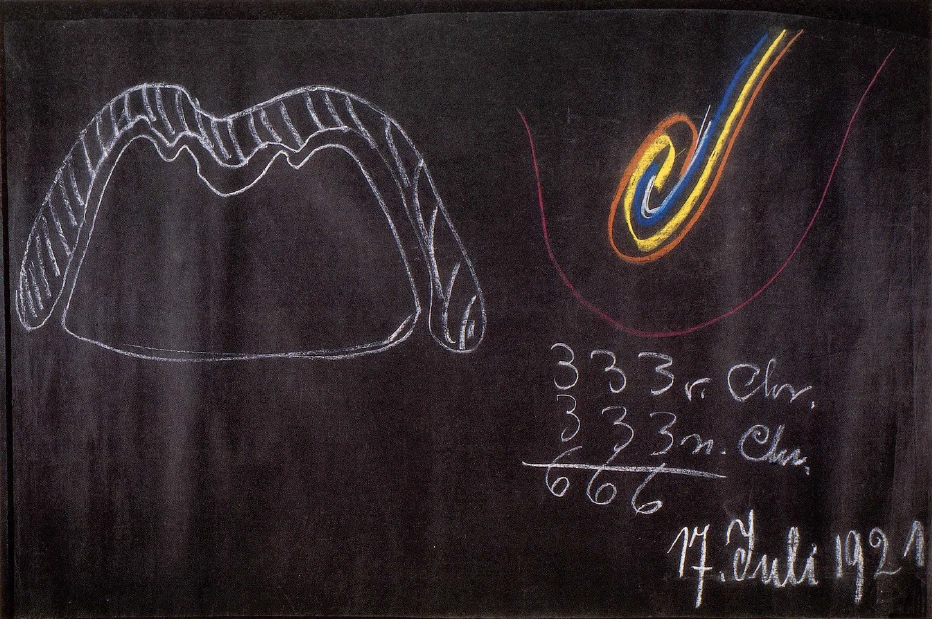
[ 15 ] Denn, wenn Sie sich den Vollmenschen denken (siehe Zeichnung Seite 234), die Erde als Ergebnis der Exusiai (rot außen), den menschlichen physischen Leib als Ergebnis der Archai (rot innen), den menschlichen Ätherleib als Ergebnis der Archangeloi (gelb), jetzt den menschlichen astralischen Leib als Ergebnis des Wirkens der Angeloi (blau), wenn Sie sich das alles vorstellen, so können Sie sagen: Solange der Mensch wacht, ist der Engel im Schoße der Erzengel, der Archai, der Exusiai, kurz, der höheren geistigen Wesenheiten. Wenn der Mensch herausgeht aus seinem physischen Leib und aus seinem Ätherleib und er mit materialistischer Gesinnung herausgeht, dann würde ja der Engel sein Gebiet, die Zugehörigkeit zu den Erzengeln, zu den Archai, zu den Exusiai, verleugnen, wenn er mitginge. Sie sehen, hier kommen wir in ein Gebiet, wo die menschliche Gesinnung maßgebend ist für ein wichtigstes Ereignis, für eine wichtigste Tatsache innerhalb des Menschenlebens, für die Tatsache, ob der Mensch während seines Schlafes teilhaftig ist der Gegenwart des Engels oder nicht.
[ 15 ] For if you imagine the Complete Human Being (see illustration on page 234), the Earth as the result of the Exusiai (red on the outside), the human physical body as the result of the Archai (red on the inside), the human etheric body as the result of the Archangeloi (yellow), and now the human astral body as the result of the work of the Angeloi (blue)—if you imagine all of this, you can say: As long as the human being is awake, the angel is in the bosom of the Archangels, the Archai, the Exusiai—in short, the higher spiritual beings. If a human being steps out of his physical body and his etheric body—and does so with a materialistic mindset—then the angel would indeed be denying his own realm, his affiliation with the Archangels, the Archai, and the Exusiai, were he to accompany that person. You see, here we enter a realm where the human mindset is decisive for a most important event, for a most important fact within human life—namely, whether or not a person partakes in the presence of the angel during sleep.
[ 16 ] Man kann heute nicht sagen: Nun, wenn es Engel gibt, so brauchen wir ja im wachen Zustand nicht an sie zu glauben, denn wenn wir schlafen, werden sie sich schon um uns annehmen. — Nein, sie gehen dann nicht mit, wenn sie bei Tag verleugnet werden! Das ist etwas, was sehr tief in die Geheimnisse des Menschendaseins hineinführt und was Ihnen zugleich zeigt, wie des Menschen Gesinnung sich durchaus ebenso hineinstellt in die ganze kosmische Gesetzmäßigkeit, wie, sagen wir, des Menschen Blutkreislauf sich hineinstellt in dasjenige, was die äußere Naturwissenschaft überblickt oder eigentlich auch nicht überblickt.
[ 16 ] Today, one cannot say: “Well, if angels exist, we don’t need to believe in them while we’re awake, because when we sleep, they’ll take care of us anyway.” — No, they won’t accompany us if they are denied during the day! This is something that leads very deeply into the mysteries of human existence and that at the same time shows you how the human spirit is just as much a part of the entire cosmic order as, let’s say, the human blood circulation is a part of what external natural science surveys—or, in fact, does not survey.
[ 17 ] Der Mensch selbst ist dann ja mit seinem Ich und der Anwartschaft auf ein selbständiges Wesen in dem Ganzen eingeschlossen. Aber zu diesem Ich-Bewußtsein kam ja der Mensch erst im Verlauf des Erdendaseins. Und langsam kam er dazu. Und gehen wir zurück in die alten Zeiten, wo es die sogenannte instinktive Hellsehergabe der Menschheit gab, da hatten noch die Menschen dieses Ich-Bewußtsein vollständig nicht. Wenn diese alten Bewohner der Erde ihre besonderen Schauungen hatten, diese instinktiven Schauungen, dann waren das eigentlich nicht ihre eigenen Schauungen, denn dieses Ich war noch gar nicht erweckt. Das gab sich hin dem, was der Engel dachte, dem, was der Erzengel fühlte, dem, was der Arche wollte. Das lebte im Schoße dieser Wesenheiten. Wir blicken heute auf die wunderbare alte Urweisheit zurück. Aber die ist gar keine menschliche Weisheit im Grunde genommen, sondern sie ist eine Weisheit, die dadurch auf die Erde gekommen ist, daß Archai, Archangeloi, Angeloi die Menschen umkleideten und in die Menschenseelen hereinkamen durch diese Urweisheit, die viel höhere Wesenheiten eigentlich besessen und sich angeeignet haben, bevor die Erde Erde geworden ist. Und der Mensch muß mit Hilfe seines Engels, dem er in der Gesinnung verbunden sein soll, sich erwerben seine eigene Weisheit. Dieser Zeit gehen wir eben entgegen. Und jetzt in diesem Zeitraum, der nun eingetreten ist, wo der Mensch schon immer mehr das Ich erweckt hat, da war der Mensch, wenn er sich nicht durch eigenen Entschluß dazu aufraffte, gewissermaßen verlassen von dem, was der Engel, der Erzengel in ihm dachte.
[ 17 ] Human beings themselves, with their “I” and their potential to become independent beings, are thus included in the whole. But human beings only came to possess this sense of self in the course of their earthly existence. And they arrived at it gradually. If we go back to ancient times, when humanity possessed what is called the instinctive gift of clairvoyance, people did not yet fully possess this sense of self. When these ancient inhabitants of the Earth had their special visions—these instinctive visions—they were not actually their own visions, for this “I” had not yet been awakened at all. They surrendered themselves to what the angel thought, to what the archangel felt, to what the Archai willed. This lived within the very being of these entities. Today we look back on this wondrous ancient primordial wisdom. But in essence, it is not human wisdom at all; rather, it is a wisdom that came to Earth because the Archai, Archangeloi, and Angeloi clothed themselves in human form and entered human souls through this primordial wisdom—a wisdom that much higher beings had actually possessed and made their own before the Earth became the Earth. And human beings must, with the help of their angel—with whom they are meant to be connected in spirit—acquire their own wisdom. We are now moving toward this era. And now, in this period that has now begun—in which human beings have increasingly awakened the “I”—human beings were, so to speak, abandoned by the thoughts of the angel or archangel within them, unless they roused themselves to do so through their own resolve.
[ 18 ] Dadurch aber, daß der Mensch verlassen wurde von diesen Engeln, kam er so recht erst in Verbindung mit dem irdischen Dasein. Und dieses In-Verbindung-Kommen mit dem irdischen Dasein, das ist es, was den Menschen auf der einen Seite frei macht, das ist aber auch dasjenige, was die Notwendigkeit für den Menschen hervorruft, nun aus seiner Kraft wiederum hinaufzustreben zu dem, was den höheren Hierarchien möglich macht, mit dem Menschen, in seinem Bewußtsein zu leben. Dem muß entgegengestrebt werden, daß wir wiederum solche Gedanken bekommen, daß die Engel mit uns leben können. Das sind die Gedanken, die wir nur bekommen können aus der Imagination der Geisteswissenschaft heraus. Und wenn wir dadurch unser ganzes Fühlen zur Welt wiederum orientieren, daß wir solche Gedanken bekommen, dann können wir wiederum hinaufreichen in das Reich der Archangeloi. Der Mensch steht ja jetzt vor der Gefahr, wenn er aufwachend wiederum zurückkehrt in seinen physischen Leib, überhaupt gar nicht zu ahnen, daß er da einen Atherleib hat, und daß in diesem Atherleib die Substanz der Archangeloi drinnen waltet. Er muß das erst wieder lernen. Und er muß lernen, daß die Urkräfte, die Archai walten in seiner physischen Form. Er muß verstehen lernen den Moment des Einschlafens und den Moment des Aufwachens.
[ 18 ] But it was precisely because human beings were left behind by these angels that they truly came into contact with earthly existence. And this coming into contact with earthly existence is, on the one hand, what sets human beings free; but it is also what creates the necessity for human beings to strive upward once more, out of their own strength, toward that which makes it possible for the higher hierarchies to live with human beings in their consciousness. We must strive to counter this by once again cultivating thoughts that allow the angels to live with us. These are the thoughts we can only gain through the imagination of spiritual science. And if, through this, we reorient our entire feeling toward the world in such a way that we cultivate these thoughts, then we can once again reach up into the realm of the Archangels. After all, human beings now face the danger that, when they wake up and return to their physical body, they may not even suspect that they possess an etheric body, and that the substance of the Archangels reigns within this etheric body. They must learn this anew. And they must learn that the primal forces, the Archai, are at work within their physical form. They must learn to understand the moment of falling asleep and the moment of waking up.
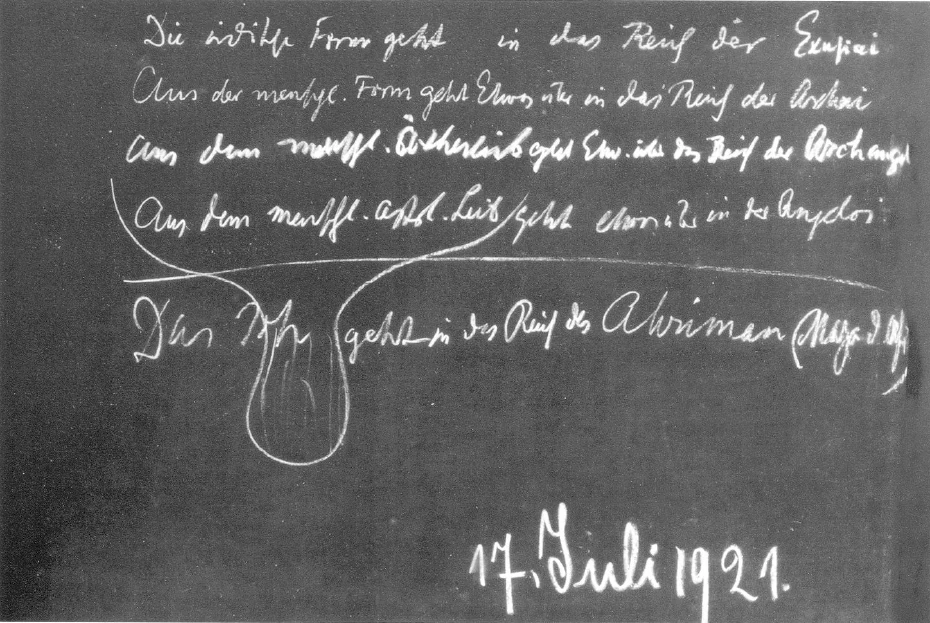
[ 19 ] Denn der Mensch kam, indem er zu seinem Ich vorrückte, indem dieses Ich erlebt wurde, aus dem Reiche der höheren Hierarchien heraus. Er wurde ein selbständiges Wesen. Dadurch aber kam er in ein anderes Reich, in das Reich des Ahrimanischen hinein. Das Ich geht, und zwar jetzt namentlich wachend, in das Reich des Ahriman.
[ 19 ] For as human beings advanced toward their “I” and experienced this “I,” they emerged from the realm of the higher hierarchies. They became independent beings. But in doing so, they entered another realm—the realm of Ahriman. The “I” enters—and now specifically in a waking state—into the realm of Ahriman.
Die irdische Form geht in das Reich der Exusiai
Aus der menschlichen Form geht etwas über in das Reich der Archai
Aus dem menschlichen Atherleib geht etwas über in das Reich der Archangeloi
Aus dem menschlichen astralischen Leib geht etwas über in das Reich der Angeloi
Das Ich geht in das Reich des Ahriman (Maja des Ahriman)
The earthly form passes into the realm of the Exusiai
Something from the human form passes into the realm of the Archai
Something from the human etheric body passes into the realm of the Archangeloi
Something passes from the human astral body into the realm of the Angeloi
The “I” passes into the realm of Ahriman (Maya of Ahriman)
[ 20 ] Am stärksten wurde die Gefahr, in das Reich des Ahriman hineinzuverfallen, etwa im Jahre 333 vor dem Mysterium von Golgatha. Das ist die Zeit, in der man zum bloßen Intellekt, zu der bloßen Logik übergegangen ist. Dann trat das Mysterium von Golgatha ein, lebte sich alsbald in die Menschheit hinein. Und vom Jahre 333 ab nach dem Mysterium von Golgatha, da begann die Zeit, seit welcher der Mensch bewußt hineinstreben muß in das Reich der höheren Hierarchien.
[ 20 ] The danger of falling into the realm of Ahriman reached its peak around the year 333 before the Mystery of Golgotha. This was the time when humanity turned to mere intellect, to mere logic. Then the Mystery of Golgotha took place and immediately took root in humanity. And from the year 333 onward, following the Mystery of Golgotha, the era began in which human beings must consciously strive toward the realm of the higher hierarchies.
[ 21 ] Allerdings, er hat sich bis jetzt, weil seit dem 15. Jahrhundert andererseits der Intellektualismus erst recht eingetreten ist, noch nicht wieder erhoben aus dem ahrimanischen Reiche. Aber dadurch, daß er in dem Intellekt, also nicht in einer Wirklichkeit lebt, lebt er ja eigentlich im Bilde, er lebt in der Maja. Und das ist sein Glück. Er lebt nicht im wirklichen Reich des Ahriman, sondern er lebt in der Maja des Ahriman, in dem bloßen Schein, in dem Sinne, wie ich das in diesen Tagen ausgeführt habe. Dadurch kann er wiederum heraus und kann wiederum die Umkehr machen. Aber er kann sie eben nur aus Freiheit machen. Denn es ist Maja, es sind Bilder, in denen wir leben; die ganze intellektualistische Kultur ist nur Bild. Seit jener Zeit, seit 333 wurde es in die Freiheit des Menschen gestellt, hinaufzustreben. Die katholische Kirche gab sich alle Mühe, das zu verhindern; sie muß nach dieser Richtung endlich überwunden werden. Der Mensch muß hinaufstreben nach den geistigen Welten.
[ 21 ] However, because intellectualism has, on the other hand, become even more prevalent since the 15th century, he has not yet risen again from the Ahrimanic realm. But because he lives in the intellect—that is, not in reality—he actually lives in the image; he lives in Maya. And that is his good fortune. He does not live in the actual realm of Ahriman, but rather in the Maya of Ahriman—in mere illusion, in the sense I have been explaining these past few days. Through this, he can break free again and turn back. But he can do so only out of freedom. For it is Maya; it is images in which we live; the entire intellectualistic culture is nothing but image. Since that time, since 333, it has been placed within human freedom to strive upward. The Catholic Church went to great lengths to prevent this; it must finally be overcome in this regard. Human beings must strive upward toward the spiritual worlds.
333 v.Chr.
333 n.Chr.
= 666
333 B.C.
333 A.D.
= 666
[ 22 ] Wenn Sie sich diese zwei Zahlen zusammenaddieren, bekommen Sie 666. Das ist die «Zahl des Tieres», wo der Mensch am meisten ausgesetzt war, wirklich hinunterzusinken in das Reich der Tiere. Aber er bleibt natürlich dem ausgesetzt, auch nach dem Jahre 333, wenn er, nachdem die Maja des Ahriman eingetreten ist, nicht hinaufstrebt. So handelt es sich darum, daß dadurch, daß wir hineingesegelt sind in das Reich des Ahriman bis zu dessen Maja, wir dadurch freie Wesen geworden sind. Das konnte keine Vorsehung, das konnte uns keine Weltenweisheit vorenthalten, in das Reich des Ahriman hineinzusegeln, sonst hätte sie uns unfrei gelassen.
[ 22 ] If you add these two numbers together, you get 666. This is the “number of the beast,” when human beings were most at risk of truly sinking into the realm of the animals. But of course, he remains vulnerable to this even after the year 333, if, after Ahriman’s Maya has set in, he does not strive upward. So the point is that by sailing into the realm of Ahriman up to his Maya, we have thereby become free beings. No providence, no cosmic wisdom could have prevented us from sailing into the realm of Ahriman; otherwise, it would have left us unfree.
[ 23 ] Aber bedenken Sie, es ist etwas anderes, ob der Mensch sich eine geistige Gesinnung aneignet und dadurch sein astralischer Leib mit dem Angelos verbunden bleibt, wenn er schlafend ist, oder aber, wenn sich der Mensch keine geistige Gesinnung aneignet, der Angelos nicht mitgeht mit dem schlafenden Menschen, denn dann bringt sich der Mensch aus dem Schlafe dasjenige mit, was Inspiration des Ahriman ist. Und in der Tat, so ist es: Die ganze materialistische Denkweise, dieses ganze Angefülltsein des Menschen mit materialistischen Gedanken, sie taucht in der gegenwärtigen Epoche mit immer größerer und größerer Schnelligkeit aus dem Schlafzustande der Menschen auf. Sich schützen kann der Mensch gegen die Tatsache, daß er immer wiederum sich aus dem Schlafe dasjenige mitbringt, was ihn zum Materialismus, das heißt zum Verbundensein mit der Erde, zum Übergehen in die Materie, zur Sterblichkeit in seiner Seele verurteilt, verhüten kann er es nur dadurch, daß er sich mit der Gesinnung durchdringt, die ihn erfüllt, wenn er geisteswissenschaftliche Begriffe aufnimmt. Der Schlafzustand ist also an sich etwas, was langsam den Materialismus heraufbringt. Aber Ahriman macht auch sonst Anstrengungen, den Menschen von seinem Engel zu entfernen, und immer mehr und mehr häufen sich diese Zustände. 1914 waren sie besonders arg, wo aus ahrimanischen Kräften heraus die Menschen betäubt worden sind, wo ihr Bewußtsein, ihr gerades Bewußtsein ihnen genommen worden ist, so daß sie in Zustände gekommen sind, wo der Engel nicht mittat und wo daher die ahrimanischen Einflüsse groß wurden. Aus diesem Grunde war es, warum ich 1914 so vielen Leuten sagte: Man solle nicht glauben, daß zum Beispiel die richtige Ansicht über die Kriegsentstehung 1914 jemals aus äußeren Dokumenten ersichtlich werden könne. Früher konnte man aus den Dokumenten, die in den Archiven waren, irgend etwas erforschen. Was diesmal geschah, geschah tatsächlich mehr geistig, aus der geistigen Welt her, und ein großer Teil derjenigen Menschen, die mitgetan haben dazumal, taten das nicht mit ihrem vollen Bewußtsein, sondern waren hinübergeführt durch ahrimanische Kräfte in Lähmungen des Bewußtseins, wo also das Reich der Angeloi nicht mitgetan hat. Es ist die Notwendigkeit vorhanden, wenn man unsere Zeit begreifen will, hinzuschauen auf das Hereinwirken der geistigen Welt in diese unsere Zeit. Es ist durchaus diese Notwendigkeit vorhanden.
[ 23 ] But consider this: it is one thing if a person cultivates a spiritual attitude and thereby keeps their astral body connected to the Angelos while they are asleep; it is quite another if a person does not cultivate a spiritual attitude, in which case the Angelos does not accompany the sleeping person—for then the person brings back from sleep that which is the inspiration of Ahriman. And indeed, this is the case: the entire materialistic way of thinking—this whole state of the human being being filled with materialistic thoughts—is emerging from the state of sleep in people at an ever-increasing pace in the present epoch. Human beings can protect themselves against the fact that they repeatedly bring with them from sleep that which condemns them to materialism—that is, to being bound to the earth, to passing into matter, to mortality in their souls—and they can prevent this only by imbuing themselves with the attitude that fills them when they take in concepts of spiritual science. The state of sleep is thus, in and of itself, something that gradually brings about materialism. But Ahriman also makes other efforts to separate human beings from their angel, and these states are becoming more and more frequent. In 1914 they were particularly severe, when Ahrimanic forces numbed people, robbing them of their consciousness—their right-minded consciousness—so that they entered states in which the angel did not intervene, and where, consequently, Ahrimanic influences grew strong. This was why, in 1914, I told so many people: One should not believe that, for example, the correct view of the origins of the 1914 war could ever be gleaned from external documents. In the past, it was possible to uncover something from the documents in the archives. What happened this time, however, took place more on a spiritual level, originating from the spiritual world, and a large portion of the people who were involved at that time did not act with full consciousness; rather, they were led astray by Ahrimanic forces into a state of paralysis of consciousness, in which the realm of the angels did not intervene. If one wishes to understand our time, it is necessary to look at the influence of the spiritual world on our present age. This necessity certainly exists.
[ 24 ] Aber es ist noch in vieler anderer Beziehung heute das Bestreben vorhanden, das aus ahrimanischen Untergründen herauskommt, den Menschen gewissermaßen loszulösen von seiner Verbindung mit dem Reiche der Angeloi, Archangeloi, Archai, Exusiai und so weiter, den Menschen an das Ahrimanische heranzuziehen, die ganze Kultur an das Ahrimanische heranzuziehen. Denken Sie nur, wie oft man heute hört — ich habe das ja immer wieder gesagt, seit vielen Jahren erwähnt —, wenn irgendeiner wieder einmal gelogen hat, tüchtig knüppeldick gelogen hat: Aber er hat das geglaubt, was er gesagt hat, er hat das aus bestem Wissen und Gewissen gesagt. — Ja, das ändert ebensowenig etwas an der objektiven Tatsächlichkeit, wie es etwas ändert, wenn Sie mit bestem Wissen und Gewissen Ihren Finger in die Flamme stecken; da wird Ihnen keine Vorsehung helfen, daß Sie Ihren Finger nicht verbrennen, wenn Sie ihn auch mit bestem Wissen und Gewissen hineinstecken. Ebensowenig hilft im Weltenzusammenhange — und es wäre auch traurig, wenn es anders wäre — die Berufung auf das beste Wissen und Gewissen. Der Mensch hat nicht etwa die Freiheit, aus bestem Wissen und Gewissen heraus die Unwahrheit zu sagen, sondern der Mensch hat die Verpflichtung, sich darum zu kümmern, daß dasjenige wahr ist, was er sagt. Er hat so mit der Welt in Zusammenhang zu stehen, daß dasjenige, was er als Gedanken hegt, aus der Welt heraus geboren ist, daß es nicht in Abschnürung von der Welt einzig und allein bei ihm lebt. Man kann von dem, was man mit bestem Wissen und Gewissen sagt, wenn es nicht wahr ist, nur feststellen, daß man es mit Abschnürung von der Welt sagt. Denn wenn irgendeiner schreibt: Da im Bau steht eine Gruppe, die hat oben luziferische Merkmale und unten ahrimanische Züge — und wenn dann die andern behaupten, was immer wieder geschieht, er habe es mit bestem Wissen und Gewissen gesagt, so bedeutet dies, daß durch eine solche Gesinnung Ahriman zum Herrscher der Welt erklärt wird. Denn derjenige, der so etwas behauptet, hat die Verpflichtung, sich davon zu überzeugen, ob das stimmt, was er sagt, oder nicht! Und es ist ein ahrimanischer Einfluß, wenn das heute selbst in die Jurisprudenz übergegangen ist, wenn man etwas nicht streng verfolgt, was so als Lüge behauptet wird, und sagt, er habe es im guten Glauben, in diesem oder jenem guten Glauben getan. Dieser gute Glaube ist etwas, was eben gerade im schlimmsten Sinne Verführung und Versuchung des Ahrimanischen ist. Es gibt im Grunde genommen kein versucherischeres und verführerischeres Wort als dieses vom guten Glauben. Denn dieser gute Glaube, der ist das Faulbert für die im eminentesten Sinne träge Menschheit, die nicht die Verpflichtung fühlt, wenn sie etwas behauptet, sich erst davon zu überzeugen, ob es wahr ist oder nicht, ob etwas den Tatsachen entspricht oder nicht.
[ 24 ] But even today, in many other respects, there is still a striving—arising from Ahrimanic depths—to detach human beings, as it were, from their connection with the realm of the Angeloi, Archangeloi, Archai, Exusiai, and so on, to draw human beings toward the Ahrimanic, to draw the entire culture toward the Ahrimanic. Just think how often one hears today—I have said this time and again, mentioned it for many years—that when someone has lied once again, told a blatant, out-and-out lie: “But he believed what he said; he said it to the best of his knowledge and belief.” — Yes, that changes the objective reality just as little as it changes anything when you stick your finger into a flame to the best of your knowledge and belief; no providence will help you avoid burning your finger, even if you stick it in to the best of your knowledge and belief. Nor does invoking one’s best knowledge and conscience help in the context of the world—and it would be sad if it were otherwise. Human beings do not have the freedom to speak untruths based on their best knowledge and conscience; rather, they have an obligation to ensure that what they say is true. One must relate to the world in such a way that the thoughts one harbors are born out of the world itself, so that they do not exist solely within oneself, cut off from the world. If what one says to the best of one’s knowledge and belief is not true, one can only conclude that one is saying it while cut off from the world. For if someone writes: “There is a group within the movement that exhibits Luciferic characteristics at the top and Ahrimanic traits at the bottom”—and if others then claim, as happens time and again, that he said it to the best of his knowledge and belief—this means that such an attitude declares Ahriman to be the ruler of the world. For the person who makes such a claim has an obligation to ascertain whether what he says is true or not! And it is an Ahrimanic influence when this has even found its way into jurisprudence today—when one does not rigorously pursue something that is claimed to be a lie, and says that he did so in good faith, in this or that good faith. This “good faith” is precisely, in the worst sense, a seduction and temptation of the Ahrimanic. There is, in essence, no word more tempting and seductive than this one: “good faith.” For this “good faith” is the crutch for humanity, which is, in the most eminent sense, sluggish—a humanity that does not feel the obligation, when making a claim, to first convince itself whether it is true or not, whether something corresponds to the facts or not.
[ 25 ] Und derjenige, der gegen das Überhandnehmen des Ahriman wirklich im Ernste kämpfen will, im Konkreten kämpfen will, der muß gegen dieses: Irgend etwas ist im guten Glauben gesagt worden — in erster Linie kämpfen; denn durch dieses Berufen auf den guten Glauben schnürt sich der Mensch ab von dem objektiven Weltenzusammenhang. Dasjenige, was in uns so lebt, daß wir uns für befugt halten, es zu behaupten, das muß auch mit dem Weltenzusammenhang übereinstimmen, das darf nicht bloß uns entsprechen; denn was sonst noch in der Außenwelt ist, ist von Engeln verlassen, ist dem Ahriman ausgeliefert. Und alles das, was als Unwahrheit im guten Glauben behauptet wird, ist etwas, was am stärksten die Menschen in das Ahrimanische treibt, was sie am starken Strick in das Ahrimanische hineinzieht. Und die Berufung auf den guten Glauben bei Unwahrheiten ist heute das beste Mittel, die Weltzivilisation der ahrimanischen Wesenheit auszuliefern.
[ 25 ] And anyone who truly wants to fight against the rise of Ahriman—who wants to fight in a concrete way—must first and foremost fight against this notion: “Something was said in good faith”; for by invoking good faith, a person cuts themselves off from the objective context of the world. That which lives within us in such a way that we consider ourselves authorized to assert it must also be in harmony with the context of the world; it must not merely correspond to us; for whatever else exists in the external world has been abandoned by the angels and is at the mercy of Ahriman. And everything that is asserted as untruth in good faith is something that drives people most strongly into the Ahrimanic realm, pulling them into it with a strong rope. And invoking good faith in the face of untruths is today the best means of delivering world civilization into the hands of the Ahrimanic entity.
[ 26 ] Sie sehen, wenn man hineinschaut in dasjenige, was eigentlich die Welt konstituiert, dann muß man so etwas begreifen. Man muß aber nicht nur im allgemeinen phantasieren wie die bloße nebulose Mystik von Angeloi, Archangeloi, Archai und so weiter und bei Theorien bleiben, sondern man muß die Welt da haben, wo sie konkret ist. Denn es ist in der Tat so, daß die Menschen den Beistand der Welt der Angeloi verlieren, indem sie sich aufs Faulbett des guten Glaubens legen für dasjenige, was sie nicht geprüft haben und was sie dann trotzdem behaupten.
[ 26 ] You see, when one looks into what actually constitutes the world, one must understand such things. But one must not merely indulge in general speculation—such as the vague mysticism surrounding Angeloi, Archangeloi, Archai, and so on—and remain stuck in theories; rather, one must engage with the world where it is concrete. For it is indeed the case that people lose the support of the world of the Angeloi by resting on the lazy bed of good faith regarding that which they have not examined and which they nevertheless assert.
[ 27 ] Diese Dinge zeigen, wie mit dem wirklichen Leben, mit dem unmittelbar wirklichen Leben dasjenige zusammenhängt, was herausfließt als eine Gesinnung, uns zu durchdringen mit geisteswissenschaftlichen Wahrheiten und Erkenntnissen. Und diese geisteswissenschaftlichen Wahrheiten und Erkenntnisse, sie müssen bis in die Einzelheiten des Lebens herunter ihre Kraft schicken.
[ 27 ] These things show how real life—immediate, concrete life—is connected to that which flows forth as a disposition to imbue us with spiritual scientific truths and insights. And these spiritual scientific truths and insights must extend their power down into the very details of life.
[ 28 ] Gerade dieses ist es, was viele Leute so erbost macht auf das, was Geisteswissenschaft ist: daß Geisteswissenschaft nicht auch eine Theorie ist wie die andern Weltanschauungen, sondern daß sie etwas Lebendiges ist, daß sie von den Menschen fordert, vor allen Dingen solch eine Faulheit zu überwinden — Faulheit im doppelten Sinne — wie diese, die in dem Geltendmachen des guten Glaubens beim Vertreten der Unwahrheit liegt. Das mögen die Menschen nicht gerne und überall sind die Ausreden rege: Der oder jener hat irgend etwas im guten Glauben behauptet. — Dadurch ist unsere Wissenschaft, vor allen Dingen die historische Wissenschaft, gründlich verdorben. Denn Sie können sich leicht denken, daß solche Leute, die in dieser Weise mit bloßen Behauptungen von dem Kaliber, wie ich es Ihnen erzählt habe, vor die Welt hintreten, keinen Glauben verdienen, auch wenn sie irgend etwas anderes behaupten, wenn sie zum Beispiel irgendwie äußere Wissenschaft vertreten; dann muß man erst nachprüfen, ob der das von einem andern abgeschrieben hat, der noch zu der besseren Generation gehörte, wo man sich noch innerlich verpflichtet fühlte zu dem, was man hinschrieb. Und wenn Sie sehen, wie heute Menschen offiziell nachahmen diese Frohnmeyers, dann werden Sie sehen, wie groß das Vertrauen zur offiziellen Wissenschaftlichkeit und ihren Vertretern sein kann! Das ist aber das Wichtigste, daß hingeschaut werde auf diese Dinge. Und wünschen möchte man sich, recht sehr wünschen möchte man für die Geisteswissenschaft eine solche Anhängerschaft, die wirklich tief durchdrungen davon wäre, daß heute ein ernstes Sich-Bekennen notwendig ist zu Erkenntnissen, die einen starken Weltumschwung bewirken. Denn es geht heute mit kleinen Dingen nicht ab.
[ 28 ] This, precisely, is what makes so many people so angry about what spiritual science is: that spiritual science is not just another theory like other worldviews, but that it is something alive, that it demands of people, above all, that they overcome such laziness — laziness in two senses — such as that which lies in claiming good faith while advocating untruth. People do not like this, and excuses abound everywhere: “So-and-so claimed something in good faith.” — This has thoroughly corrupted our scholarship, above all historical scholarship. For you can easily imagine that such people, who present themselves to the world in this way with mere assertions of the caliber I have described to you, do not deserve any credence, even if they claim something else—for example, if they somehow represent external scholarship; then one must first verify whether they copied it from someone else who belonged to a better generation, when people still felt an inner commitment to what they wrote down. And when you see how people today officially imitate these Frohnmeyers, you will see just how great the trust in official scholarship and its representatives can be! But that is the most important thing—that attention be paid to these matters. And one would wish—one would very much wish—for spiritual science to have a following that is truly and deeply imbued with the conviction that today a serious commitment is necessary to insights that bring about a profound transformation of the world. For today, small things are no longer enough.
[ 29 ] Das ist dasjenige, wovon man wünschen möchte, daß es denn doch Platz griffe: daß Anthroposophie sich eine enthusiastische Anhängerschaft erwerben könnte, die glühend wäre für Realisierung dieser Anthroposophie. Ich habe drüben im Bau erwähnt, daß uns heute wiederum von jener Seite her, wo die Lügen nach Dutzenden gezählt werden können, eine neue, wie man es nennt: sensationelle, das heißt eine Skandalbroschüre angekündigt wird. Die Leute sind am Werk. Warum? Weil die aus ihren schlechten Seelenempfindungen heraus stark enthusiastisch empfinden können. Sie können stark enthusiastisch lügen. Man muß sich angewöhnen, ebenso stark enthusiastisch die Wahrheit vertreten zu können, sonst werden wir mit der Zivilisation nicht weiterkommen können, meine lieben Freunde!
[ 29 ] This is precisely what one would hope would take hold: that anthroposophy might gain an enthusiastic following that would be passionately committed to bringing this anthroposophy to fruition. I mentioned over at the Bau that today, once again, from that side where lies can be counted by the dozen, a new—as they call it—“sensational,” that is, scandalous, pamphlet has been announced. These people are at work. Why? Because, out of their base emotional impulses, they are capable of intense enthusiasm. They can lie with great enthusiasm. We must get into the habit of being able to defend the truth with equal fervor; otherwise, we will not be able to make any progress with civilization, my dear friends!
[ 30 ] Wer heute in der Welt sich umblickt, der muß sich klar darüber sein, daß ernsthaftig der Weg zurück zu den Hierarchien gesucht werden muß, heraus aus der ahrimanischen Umklammerung. Dazu gehört aber, daß man in den Einzelheiten an die Dinge geht. Immer wiederum tauchen die Dinge auf, daß, wenn irgendein ruchloser Gegner kommt und das oder jenes hineinschmeißt in die Welt, selbst unsere eigenen Anhänger noch kommen und sagen: Das muß man noch prüfen, ob der oder jener es nicht aus dieser oder jener Schwäche begangen hat. — In der Anthroposophischen Gesellschaft ist leider immer die Sehnsucht vorhanden, viel mehr dasjenige anzuklagen, was aus der Wahrheit heraus spricht, als solche Gegner anzuklagen, die aus ihren Seelenuntergründen heraus alle Wahrheit in den Kot treten möchten. Solange es noch in der Anthroposophischen Gesellschaft selber Usus ist, immer wieder Mitleid zu haben mit der Lüge, so lange kommen wir nicht vorwärts.
[ 30 ] Anyone who looks around at the world today must realize that we must earnestly seek the path back to the hierarchies, out of the Ahrimanic stranglehold. But this requires that we address matters in detail. Time and again, the same situation arises: when some unscrupulous opponent comes along and throws this or that into the world, even our own followers come and say, “We still need to examine whether this or that person did it out of this or that weakness.” — Unfortunately, there is always a tendency within the Anthroposophical Society to be far more inclined to condemn that which speaks from the truth than to condemn those opponents who, from the depths of their souls, would like to trample all truth into the mud. As long as it remains customary within the Anthroposophical Society itself to repeatedly show sympathy for the lie, we will not make any progress.
[ 31 ] Es muß das immer wiederum von Zeit zu Zeit gesagt werden, daß wir die Lüge als Lüge erkennen müssen; denn die Lüge ist es, in die Ahriman sich verschlüpft, und die Lüge ist es zumeist, die, wenn sie gelogen hat, sich auf den guten Glauben, auf das beste Wissen und Gewissen beruft. Ich habe Ihnen Beispiele genug angeführt, wo man auf diesen guten Glauben, auf dieses beste Wissen und Gewissen sich beruft: prüfen Sie aber die Tatsachen und sehen Sie diesen ahrimanischen Einfluß des sogenannten guten Glaubens, der sogar bis in unsere Jurisprudenz hinein unentwegt spielt, so daß man sagen kann, daß bis in die Jurisprudenz die Menschheit von Ahriman ergriffen worden ist. Das sind die Dinge, die ernsthaft ins Auge gefaßt werden müssen. Soll die Anthroposophische Gesellschaft das sein, was sie sein will, dann muß sie von einem glühenden Wahrheitsgefühl durchdrungen werden, denn das ist heute identisch mit einem glühenden Gefühl für den Fortschritt der Menschheit. Alles übrige ist nur erfüllt von dem Willen, der in die Niedergangskräfte hineinführt und immer weiter hineintreibt.
[ 31 ] It must be said again and again from time to time that we must recognize a lie as a lie; for it is into the lie that Ahriman slips, and it is usually the lie that, once told, invokes good faith and the best of one’s knowledge and conscience. I have given you enough examples of where people invoke this good faith, this best of knowledge and conscience: but examine the facts and see this Ahrimanic influence of so-called good faith, which is constantly at work even within our jurisprudence, so that one can say that humanity has been seized by Ahriman even within jurisprudence. These are the things that must be taken seriously. If the Anthroposophical Society is to be what it aspires to be, then it must be imbued with a fervent sense of truth, for today this is synonymous with a fervent sense of humanity’s progress. Everything else is merely filled with the will that leads into the forces of decline and drives us ever deeper into them.
[ 32 ] Was ich heute sage, sage ich nicht, um wieder einmal so etwas vorzubringen, sondern weil die Zeichen der Zeit dazu drängen, daß einzelne Menschen solches wissen.
[ 32 ] What I am saying today, I am not saying simply to bring up this topic yet again, but because the signs of the times urge individuals to know such things.