

Human-Becoming, World-Soul and World-Spirit I
Human Beings as Physical and Spiritual Entities
in Their Relationship to the World
GA 205
17 July 1921, Dornach
Translated by Steiner Online Library
Thirteenth Lecture
[ 1 ] Indeed, much of the laws and mysteries of existence in the world has been obscured in human consciousness by the misunderstandings I explained yesterday and the day before regarding the concept of the polar opposites of Ormuzd and Ahriman. Above all, it is really only through this that modern materialism has become possible—a materialism that fills humanity with the conviction that there are opposites all around us, which are being investigated by contemporary science and from which we will gradually be able to understand the universe. — A simple consideration can show that understanding the universe in this way can never be possible. For think back to some of what I explained here a few weeks ago, and put it into the proper perspective for yourselves; remember how those people who are considered natural scientists today actually relate to the human being only insofar as the human being is a corpse after death. That which, through the rest of the laws of nature and the rest of natural processes, permeates the human being after he has become a corpse can, at first, be explained according to the customary laws of nature. But what lives within the human being between birth and death defies these laws of nature; it resists them. And if people today were to guide themselves—even to some extent—not by prejudices but by genuine judgments, they would have to say to themselves: Between birth and death—in fact, from the very first embryonic stage onward—human beings struggle against that which is governed by the laws of nature as we understand them today in our science.
[ 2 ] Consider the natural world around us and everything that physics, chemistry, physiology, biology, and so on have to say about it today; bring to mind all that is said about nature, and then think of human beings as they live between birth and death—and you will say to yourself: This whole life is a struggle against the realm governed by these laws of nature. It is precisely because the human organism, so to speak, refuses to acknowledge these laws of nature and fights against them that human beings are human between birth and death.
[ 3 ] From this, however, you can already see that if human development is to be placed within the universe, within the cosmos, it is necessary to assume different laws for the universe—a different kind of development. Thus, with our current laws of nature, we envision a world in which human beings—and indeed, even plants and animals—do not actually exist at all. Today, however, we wish to consider only human beings in relation to the rest of nature. Human beings are not part of the nature that dominates modern science. Indeed, with every breath, human beings rebel against this very nature of which modern science speaks.
[ 4 ] Nevertheless, we can still speak of the cosmos, of the universe, for it is from the bosom of this cosmos that human beings emerge, just as they first appear before us as physical human beings. But then we must conceive of this cosmos as having a different nature than what we hold within our souls, if we are speaking in the sense of modern science. We will be able to form a concept of what is actually meant by what has been hinted at if we bring to mind the following fact, established by spiritual science.
[ 5 ] Let us consider the moment when a human being dies—whether in youth or after reaching a normal age. The corpse remains behind. We can compare this process—and it is more than just a comparison—to, say, a snake shedding its skin or a young bird shedding its shell. The corpse is shed, and what is shed is absorbed by the laws of nature—as we understand them through modern science—just as, for example, a snake’s skin, when shed, is absorbed by the external laws of nature and is no longer governed by the snake’s laws of growth. Thus, what becomes the corpse of a human being is absorbed by the laws of the Earth. But as human beings, between birth and death, we have the human form, the human shape. That dissolves; it ceases to exist. In a certain sense, the corpse still has this shape, but it has it, so to speak, only by imitation; it still mimics this shape. The form that the corpse possesses is no longer the same as the one we have during our life between birth and death. For it is characteristic of this form that the human being feels themselves within it, that the human being can move with it; this form possesses a certain sum of forces that unfolds when the human being moves. All of that is gone once only the corpse remains. So what actually gives the corpse its form is gone from the corpse, but it disappears as soon as the human being has died. The human being does not take it with them. They take their etheric body with them for a time—let us set that aside for now—but in any case, they do not take with them what constitutes their physical form, their physical shape. They lose this physical form, so to speak. To put it more precisely: If one were to observe the movements and activities of a human being after they have left their body, after they have passed through the gate of death, one would find movements and activities different from those that the physical form produces.
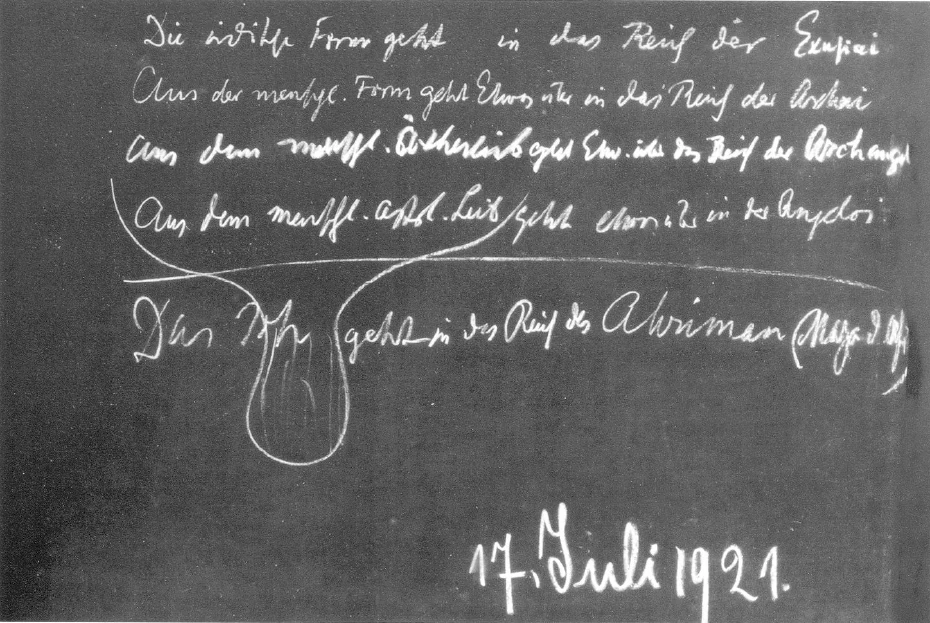
[ 6 ] So what actually exists in physical form ceases to be visible to the outside world once a person has passed through the gate of death. The corpse merely had this form, and it still retains it. It gradually loses it; it no longer belongs to it. It is as if—if I may use a crude comparison—you had a pot and placed it over the cake batter: the cake then takes on that shape, but it has nothing of the pot’s form, and you cannot say that the cake you end up with has that shape because of its own substance; no, it acquired it from the pot that was placed over it. And just as this cake retains the shape of the pot when you remove the pot, so too does the corpse retain the shape of the human being when that shape is removed. But this form itself—which is actually the form we walk around in—ceases to exist when a person passes through the gate of death. The fact that we have this form, that this form can take shape from the laws of the universe—just as a crystal takes shape from the laws of the universe—is, however, inherent in the laws of the universe. So we may ask ourselves: What becomes of this form? And through spiritual scientific investigation, we receive the answer: From this form, that which is spirit—from the hierarchy we call the Archai, the Primordial Principles—continues to be nourished and sustained. Thus we can say: Something passes from the human form into the realm of the Archai.
[ 7 ] It is indeed the case that the physical form we receive at birth and shed at death originates from the realm of the Archai, the primordial principles and forces; thus, we actually possess our physical form because we are enveloped by a spirit from the realm of the Archai. We are enveloped by a spirit that came from the realm of the Archai, which now in turn withdraws what it has lent us during our lifetime.
[ 8 ] You see, this is yet another way of recognizing how we actually belong to the entire cosmos. It is indeed true that, in a sense, the Archai extend their antennae. If one of the Archai is present, it extends its form: this takes on the human shape, and only within that is the human being. You can only truly imagine your existence within the cosmos if you picture yourself, as it were, clothed in an outgrowth of the Archai. If you now imagine that human beings—as I have explained in recent days—in the Lemurian era were beings such as the Earth human, first came into being and only gradually assumed this form—then, in what can be provided as a description—as I have given it in Outlines of Esoteric Science regarding the transformation of the human form—just recall how I described this in my account of the Atlantean world—then you will grasp what the Archai actually do; then one obtains a description of how the Archai work down from their realm into the earthly realm, how they metamorphose the human form. This metamorphosis of the human form from the Lemurian epoch up to the time when the human form will disappear from the Earth is, without a doubt, something that is constituted and shaped from the realm of the Archai. And as the Archai work on human beings in this way, they simultaneously bring forth what is, in the true sense of the word, the spirit of the age. For this spirit of the age is intimately connected with the shaping of human beings, in that, so to speak, their skin is molded into a certain form. The spirit of the age is essentially situated in the outermost sphere of human sensation. And if one understands the workings of these Archai, then one also understands not only how human forms change, but also how the spirits of the age change in the course of earthly existence.
[ 9 ] Now you know that in the order of the hierarchies, behind the Archai lie the Spirits of Form, the Exusiai (see list on page 236). If you look up from what constitutes the human being in earthly existence—from the human form—to what is inherent in the entire Earth from its beginning to its end, then you will perceive a more comprehensive outer cosmic law than that which is already contained within the human form. For, is it not true that, as we describe Earth’s evolution, we first encounter an echo of the ancient Saturn era—which we call the Polar Epoch; we encounter an echo of the ancient Sun era—the Hyperborean Epoch; and an echo of the ancient Moon era—the Lemurian Epoch. Only then does the actual Earth era begin—the first Earth era, the Atlantean epoch—and now we are living in the post-Atlantean epoch. It is only now that human beings have taken on their present form. The Earth must have more comprehensive laws than those expressed merely in that phase of Earth’s development in which human beings, in their present form—or rather, through the metamorphoses of their present form—are possible. We must look back to the very beginning of the Earth, when human beings had not yet attained their form, when they still existed as spiritual-etheric beings, and we must look ahead to what will indeed still happen on Earth when, after a series of millennia, human beings have disappeared from the Earth as physical beings. Then the physical Earth will continue to exist for a time; indeed, it will even be inhabited by human beings, but no longer in visible human forms, rather as ethereal beings.
[ 10 ] Let us consider the entire structure of the Earth, including human beings but extending beyond them: when we take in, with our spiritual gaze, the laws of which our present-day natural laws are, after all, only the tiniest part, we find within them that which belongs to the realm of the Exusiai. Just as the human realm emerged from the realm of the primal forces—along with everything that must exist within the Earth for humanity to arise at all—so, too, has the earthly realm emerged from the realm of the Exusiai. Thus, we can say: Once the earthly form dissolves, it will pass into the realm of the Exusiai.
[ 11 ] When we now consider the second member of the human being—the human etheric body—it is also the case that we must by no means regard it as entirely our own; rather, just as the physical form actually belongs to the realm of the Archai and we are clothed in an outgrowth of the realm of the Archai, so, with regard to our etheric body, we are clothed in a protrusion from the realm of the Archangels, the Archangeloi. So we can say: When we pass through the gate of death, we retain this etheric body for a short time. We know that it then dissolves, but its dissolution does not mean that it vanishes into nothingness; rather, it returns to the realm of the Archangeloi. They, in turn, lay claim to it; they, as it were, lower a part of their being toward the earthly human realm and thereby constitute the human etheric body throughout its lifetime. We can therefore say: Something passes from the human etheric body into the realm of the archangels.
[ 12 ] And with regard to the astral body, it is indeed the case that there is a relationship to the realm of the Angeloi, the angels, similar to that of the physical form to the realm of the Archai and of the etheric body to the realm of the Archangeloi. Our astral body is not entirely our own either. It is an outgrowth of the angelic beings. So we can say: With death, something from the human astral body passes over into the realm of the Angeloi. We also have our astral body as a kind of garment for our being from the realm of the Angeloi. So you see how, by virtue of having a physical human form, an etheric body, and an astral body, we are actually enveloped within the realms of the next higher hierarchies. And by participating in the laws of the Earth—by walking the Earth as human beings, by being able to develop a will, by being able to carry out actions on Earth, in short, by participating in the laws of the Earth—we also participate in the realm of the Exusiai, the spirits of form, the Elohim.
[ 13 ] But here a significant point arises. When you consider your physical form in the state in which you are asleep—when your body lies in bed—it has its form; you find this form again in the morning. This form has by no means dissolved, and so one cannot say that the physical body is a corpse, that it merely has a mold like that of a pot; rather, the form is truly there. Thus, the Archai, by participating in this form, are constantly connected to what exists on Earth as the physical being of the human being. Likewise, the Archangels are connected to the human etheric body. But the situation is different with regard to the human astral body. This human astral body is, after all, in no way connected to the physical human form from the moment of falling asleep until waking up; this astral body is, so to speak, in a completely different environment from the moment of falling asleep until waking up than from waking up until falling asleep. And the point here is that, while the Archaic principle is inevitably connected to the physical form from birth to death, and the Archangelic principle to the etheric being, the Angelic principle—the principle of the angels—must, so to speak, accompany the human being from one state to another and back again. In a sense, this principle of the Angeloi—this essence of the Angeloi—must accompany the human being on the journey into the state of sleep and back again from that state.
[ 14 ] You see, a new element comes into play when we speak of the Angelos. And in fact, it is a matter of the person themselves—their attitude, the way they direct their entire emotional life toward the spiritual world—that determines whether the angel accompanies them when they pass out of the physical body and the etheric body into the state of sleep. In the case of children, the angel accompanies them, but for a person who has attained a certain maturity, this actually depends on the person’s disposition; it depends on whether the person has an inner kinship with the angel in their soul. And if this kinship is not present—if the person believes only in the material, if the person harbors only material thoughts—then the angel does not accompany them.
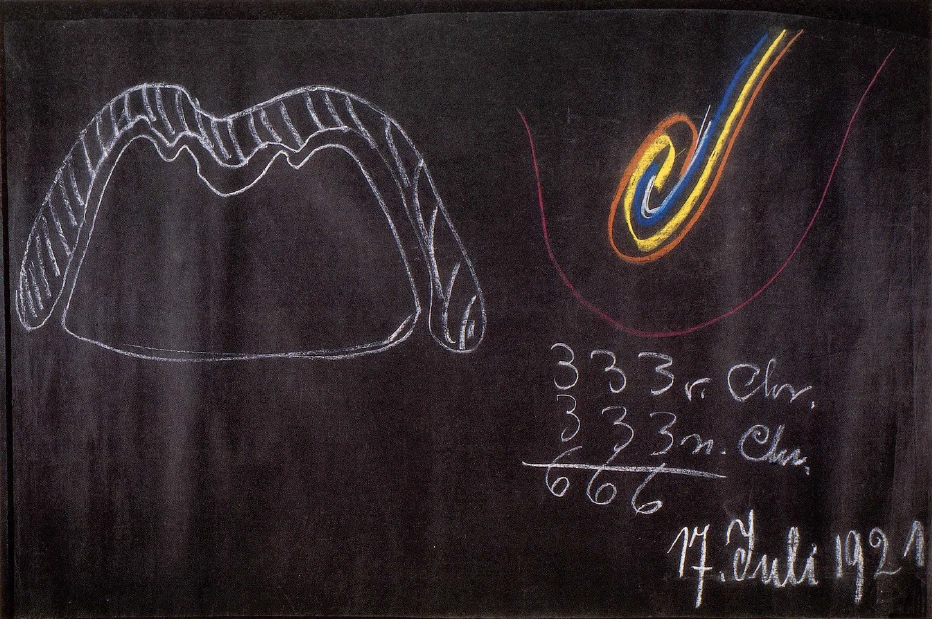
[ 15 ] For if you imagine the Complete Human Being (see illustration on page 234), the Earth as the result of the Exusiai (red on the outside), the human physical body as the result of the Archai (red on the inside), the human etheric body as the result of the Archangeloi (yellow), and now the human astral body as the result of the work of the Angeloi (blue)—if you imagine all of this, you can say: As long as the human being is awake, the angel is in the bosom of the Archangels, the Archai, the Exusiai—in short, the higher spiritual beings. If a human being steps out of his physical body and his etheric body—and does so with a materialistic mindset—then the angel would indeed be denying his own realm, his affiliation with the Archangels, the Archai, and the Exusiai, were he to accompany that person. You see, here we enter a realm where the human mindset is decisive for a most important event, for a most important fact within human life—namely, whether or not a person partakes in the presence of the angel during sleep.
[ 16 ] Today, one cannot say: “Well, if angels exist, we don’t need to believe in them while we’re awake, because when we sleep, they’ll take care of us anyway.” — No, they won’t accompany us if they are denied during the day! This is something that leads very deeply into the mysteries of human existence and that at the same time shows you how the human spirit is just as much a part of the entire cosmic order as, let’s say, the human blood circulation is a part of what external natural science surveys—or, in fact, does not survey.
[ 17 ] Human beings themselves, with their “I” and their potential to become independent beings, are thus included in the whole. But human beings only came to possess this sense of self in the course of their earthly existence. And they arrived at it gradually. If we go back to ancient times, when humanity possessed what is called the instinctive gift of clairvoyance, people did not yet fully possess this sense of self. When these ancient inhabitants of the Earth had their special visions—these instinctive visions—they were not actually their own visions, for this “I” had not yet been awakened at all. They surrendered themselves to what the angel thought, to what the archangel felt, to what the Archai willed. This lived within the very being of these entities. Today we look back on this wondrous ancient primordial wisdom. But in essence, it is not human wisdom at all; rather, it is a wisdom that came to Earth because the Archai, Archangeloi, and Angeloi clothed themselves in human form and entered human souls through this primordial wisdom—a wisdom that much higher beings had actually possessed and made their own before the Earth became the Earth. And human beings must, with the help of their angel—with whom they are meant to be connected in spirit—acquire their own wisdom. We are now moving toward this era. And now, in this period that has now begun—in which human beings have increasingly awakened the “I”—human beings were, so to speak, abandoned by the thoughts of the angel or archangel within them, unless they roused themselves to do so through their own resolve.
[ 18 ] But it was precisely because human beings were left behind by these angels that they truly came into contact with earthly existence. And this coming into contact with earthly existence is, on the one hand, what sets human beings free; but it is also what creates the necessity for human beings to strive upward once more, out of their own strength, toward that which makes it possible for the higher hierarchies to live with human beings in their consciousness. We must strive to counter this by once again cultivating thoughts that allow the angels to live with us. These are the thoughts we can only gain through the imagination of spiritual science. And if, through this, we reorient our entire feeling toward the world in such a way that we cultivate these thoughts, then we can once again reach up into the realm of the Archangels. After all, human beings now face the danger that, when they wake up and return to their physical body, they may not even suspect that they possess an etheric body, and that the substance of the Archangels reigns within this etheric body. They must learn this anew. And they must learn that the primal forces, the Archai, are at work within their physical form. They must learn to understand the moment of falling asleep and the moment of waking up.
[ 19 ] For as human beings advanced toward their “I” and experienced this “I,” they emerged from the realm of the higher hierarchies. They became independent beings. But in doing so, they entered another realm—the realm of Ahriman. The “I” enters—and now specifically in a waking state—into the realm of Ahriman.
The earthly form passes into the realm of the Exusiai
Something from the human form passes into the realm of the Archai
Something from the human etheric body passes into the realm of the Archangeloi
Something passes from the human astral body into the realm of the Angeloi
The “I” passes into the realm of Ahriman (Maya of Ahriman)
[ 20 ] The danger of falling into the realm of Ahriman reached its peak around the year 333 before the Mystery of Golgotha. This was the time when humanity turned to mere intellect, to mere logic. Then the Mystery of Golgotha took place and immediately took root in humanity. And from the year 333 onward, following the Mystery of Golgotha, the era began in which human beings must consciously strive toward the realm of the higher hierarchies.
[ 21 ] However, because intellectualism has, on the other hand, become even more prevalent since the 15th century, he has not yet risen again from the Ahrimanic realm. But because he lives in the intellect—that is, not in reality—he actually lives in the image; he lives in Maya. And that is his good fortune. He does not live in the actual realm of Ahriman, but rather in the Maya of Ahriman—in mere illusion, in the sense I have been explaining these past few days. Through this, he can break free again and turn back. But he can do so only out of freedom. For it is Maya; it is images in which we live; the entire intellectualistic culture is nothing but image. Since that time, since 333, it has been placed within human freedom to strive upward. The Catholic Church went to great lengths to prevent this; it must finally be overcome in this regard. Human beings must strive upward toward the spiritual worlds.
333 B.C.
333 A.D.
= 666
[ 22 ] If you add these two numbers together, you get 666. This is the “number of the beast,” when human beings were most at risk of truly sinking into the realm of the animals. But of course, he remains vulnerable to this even after the year 333, if, after Ahriman’s Maya has set in, he does not strive upward. So the point is that by sailing into the realm of Ahriman up to his Maya, we have thereby become free beings. No providence, no cosmic wisdom could have prevented us from sailing into the realm of Ahriman; otherwise, it would have left us unfree.
[ 23 ] But consider this: it is one thing if a person cultivates a spiritual attitude and thereby keeps their astral body connected to the Angelos while they are asleep; it is quite another if a person does not cultivate a spiritual attitude, in which case the Angelos does not accompany the sleeping person—for then the person brings back from sleep that which is the inspiration of Ahriman. And indeed, this is the case: the entire materialistic way of thinking—this whole state of the human being being filled with materialistic thoughts—is emerging from the state of sleep in people at an ever-increasing pace in the present epoch. Human beings can protect themselves against the fact that they repeatedly bring with them from sleep that which condemns them to materialism—that is, to being bound to the earth, to passing into matter, to mortality in their souls—and they can prevent this only by imbuing themselves with the attitude that fills them when they take in concepts of spiritual science. The state of sleep is thus, in and of itself, something that gradually brings about materialism. But Ahriman also makes other efforts to separate human beings from their angel, and these states are becoming more and more frequent. In 1914 they were particularly severe, when Ahrimanic forces numbed people, robbing them of their consciousness—their right-minded consciousness—so that they entered states in which the angel did not intervene, and where, consequently, Ahrimanic influences grew strong. This was why, in 1914, I told so many people: One should not believe that, for example, the correct view of the origins of the 1914 war could ever be gleaned from external documents. In the past, it was possible to uncover something from the documents in the archives. What happened this time, however, took place more on a spiritual level, originating from the spiritual world, and a large portion of the people who were involved at that time did not act with full consciousness; rather, they were led astray by Ahrimanic forces into a state of paralysis of consciousness, in which the realm of the angels did not intervene. If one wishes to understand our time, it is necessary to look at the influence of the spiritual world on our present age. This necessity certainly exists.
[ 24 ] But even today, in many other respects, there is still a striving—arising from Ahrimanic depths—to detach human beings, as it were, from their connection with the realm of the Angeloi, Archangeloi, Archai, Exusiai, and so on, to draw human beings toward the Ahrimanic, to draw the entire culture toward the Ahrimanic. Just think how often one hears today—I have said this time and again, mentioned it for many years—that when someone has lied once again, told a blatant, out-and-out lie: “But he believed what he said; he said it to the best of his knowledge and belief.” — Yes, that changes the objective reality just as little as it changes anything when you stick your finger into a flame to the best of your knowledge and belief; no providence will help you avoid burning your finger, even if you stick it in to the best of your knowledge and belief. Nor does invoking one’s best knowledge and conscience help in the context of the world—and it would be sad if it were otherwise. Human beings do not have the freedom to speak untruths based on their best knowledge and conscience; rather, they have an obligation to ensure that what they say is true. One must relate to the world in such a way that the thoughts one harbors are born out of the world itself, so that they do not exist solely within oneself, cut off from the world. If what one says to the best of one’s knowledge and belief is not true, one can only conclude that one is saying it while cut off from the world. For if someone writes: “There is a group within the movement that exhibits Luciferic characteristics at the top and Ahrimanic traits at the bottom”—and if others then claim, as happens time and again, that he said it to the best of his knowledge and belief—this means that such an attitude declares Ahriman to be the ruler of the world. For the person who makes such a claim has an obligation to ascertain whether what he says is true or not! And it is an Ahrimanic influence when this has even found its way into jurisprudence today—when one does not rigorously pursue something that is claimed to be a lie, and says that he did so in good faith, in this or that good faith. This “good faith” is precisely, in the worst sense, a seduction and temptation of the Ahrimanic. There is, in essence, no word more tempting and seductive than this one: “good faith.” For this “good faith” is the crutch for humanity, which is, in the most eminent sense, sluggish—a humanity that does not feel the obligation, when making a claim, to first convince itself whether it is true or not, whether something corresponds to the facts or not.
[ 25 ] And anyone who truly wants to fight against the rise of Ahriman—who wants to fight in a concrete way—must first and foremost fight against this notion: “Something was said in good faith”; for by invoking good faith, a person cuts themselves off from the objective context of the world. That which lives within us in such a way that we consider ourselves authorized to assert it must also be in harmony with the context of the world; it must not merely correspond to us; for whatever else exists in the external world has been abandoned by the angels and is at the mercy of Ahriman. And everything that is asserted as untruth in good faith is something that drives people most strongly into the Ahrimanic realm, pulling them into it with a strong rope. And invoking good faith in the face of untruths is today the best means of delivering world civilization into the hands of the Ahrimanic entity.
[ 26 ] You see, when one looks into what actually constitutes the world, one must understand such things. But one must not merely indulge in general speculation—such as the vague mysticism surrounding Angeloi, Archangeloi, Archai, and so on—and remain stuck in theories; rather, one must engage with the world where it is concrete. For it is indeed the case that people lose the support of the world of the Angeloi by resting on the lazy bed of good faith regarding that which they have not examined and which they nevertheless assert.
[ 27 ] These things show how real life—immediate, concrete life—is connected to that which flows forth as a disposition to imbue us with spiritual scientific truths and insights. And these spiritual scientific truths and insights must extend their power down into the very details of life.
[ 28 ] This, precisely, is what makes so many people so angry about what spiritual science is: that spiritual science is not just another theory like other worldviews, but that it is something alive, that it demands of people, above all, that they overcome such laziness — laziness in two senses — such as that which lies in claiming good faith while advocating untruth. People do not like this, and excuses abound everywhere: “So-and-so claimed something in good faith.” — This has thoroughly corrupted our scholarship, above all historical scholarship. For you can easily imagine that such people, who present themselves to the world in this way with mere assertions of the caliber I have described to you, do not deserve any credence, even if they claim something else—for example, if they somehow represent external scholarship; then one must first verify whether they copied it from someone else who belonged to a better generation, when people still felt an inner commitment to what they wrote down. And when you see how people today officially imitate these Frohnmeyers, you will see just how great the trust in official scholarship and its representatives can be! But that is the most important thing—that attention be paid to these matters. And one would wish—one would very much wish—for spiritual science to have a following that is truly and deeply imbued with the conviction that today a serious commitment is necessary to insights that bring about a profound transformation of the world. For today, small things are no longer enough.
[ 29 ] This is precisely what one would hope would take hold: that anthroposophy might gain an enthusiastic following that would be passionately committed to bringing this anthroposophy to fruition. I mentioned over at the Bau that today, once again, from that side where lies can be counted by the dozen, a new—as they call it—“sensational,” that is, scandalous, pamphlet has been announced. These people are at work. Why? Because, out of their base emotional impulses, they are capable of intense enthusiasm. They can lie with great enthusiasm. We must get into the habit of being able to defend the truth with equal fervor; otherwise, we will not be able to make any progress with civilization, my dear friends!
[ 30 ] Anyone who looks around at the world today must realize that we must earnestly seek the path back to the hierarchies, out of the Ahrimanic stranglehold. But this requires that we address matters in detail. Time and again, the same situation arises: when some unscrupulous opponent comes along and throws this or that into the world, even our own followers come and say, “We still need to examine whether this or that person did it out of this or that weakness.” — Unfortunately, there is always a tendency within the Anthroposophical Society to be far more inclined to condemn that which speaks from the truth than to condemn those opponents who, from the depths of their souls, would like to trample all truth into the mud. As long as it remains customary within the Anthroposophical Society itself to repeatedly show sympathy for the lie, we will not make any progress.
[ 31 ] It must be said again and again from time to time that we must recognize a lie as a lie; for it is into the lie that Ahriman slips, and it is usually the lie that, once told, invokes good faith and the best of one’s knowledge and conscience. I have given you enough examples of where people invoke this good faith, this best of knowledge and conscience: but examine the facts and see this Ahrimanic influence of so-called good faith, which is constantly at work even within our jurisprudence, so that one can say that humanity has been seized by Ahriman even within jurisprudence. These are the things that must be taken seriously. If the Anthroposophical Society is to be what it aspires to be, then it must be imbued with a fervent sense of truth, for today this is synonymous with a fervent sense of humanity’s progress. Everything else is merely filled with the will that leads into the forces of decline and drives us ever deeper into them.
[ 32 ] What I am saying today, I am not saying simply to bring up this topic yet again, but because the signs of the times urge individuals to know such things.