

Human-Becoming, World-Soul and World-Spirit I
Human Beings as Physical and Spiritual Entities
in Their Relationship to the World
GA 205
16 July 1921, Dornach
Translated by Steiner Online Library
Twelfth Lecture
[ 1 ] Yesterday I concluded here by noting that, in recent times, confusion has arisen regarding the understanding of what Ormuzd-Ahriman—who manifests himself in the Persian duality—actually is. I also pointed out how one can return to the older European-Germanic views, such as in the poem known as the “Muspilli” poem—the poem about the firmament and the earth—in which the contrast between an upper, Luciferic principle and a lower, Ahrimanic principle is expressed in a thoroughly Christian form. I say “in a thoroughly Christian form” because it has not been tainted by that state of mind from which the contrast between above and below, as expressed in the “Muspilli” poem, has vanished. It has not been assumed that the Christ principle, so to speak, belongs to the upper spirituality; rather, the Elijah principle has been elevated to the upper spirituality, and it is Elijah who fights there with his blood dripping down against the Antichrist, which is nothing other than the Ahrimanic principle expressed in a Christian form. Thus, in these older European-Germanic conceptions, there is still a clear awareness that one must distinguish between a higher principle and a lower principle, higher forces and lower forces, and that, in a sense, the balancing and harmonization of the two principles is to be found in the Christ principle. One can also easily see that, once the Elias principle has been placed above and the Antichrist principle below, the upper principle embodies, so to speak, that which follows the moral impulse of the world order, while the Ahrimanic principle embodies that which follows the intellectual impulse of world development.
[ 2 ] In this understanding of “above” and “below,” people have generally perceived a polarity that exists within the order of the world. When we speak of “above” and “below,” this is, of course, projected onto human beings in a certain way. And we know, of course, that human beings define “up” and “down” by orienting the most essential axis of their spine vertically. This is what gives rise to “up” and “down.” So this is meant to be entirely relative. But what is being pointed to today—quite apart from “up” and “down”—is a certain polar opposition. This polar opposition presents itself to us in human beings in an extraordinarily complex way. But one can study this polar opposition—I would say, in a more externalized form—in the world as well, and it is extremely useful to view the world order, so to speak, in such a way that it reveals to us, through very special phenomena in which certain forces manifest themselves radically, what secrets actually govern it.
[ 3 ] Well, in human beings a certain contrast is expressed less clearly, but it can become very evident to you if you simply take a comprehensive look at the organism. Just as with human beings, the bird kingdom has, of course, also grown out of the entire world order. But this bird kingdom reveals to us the mysteries at work in the world in a certain direction much more clearly than we can initially see in human beings, where we must then apply this understanding in a more complex way.
[ 4 ] What, then, is the defining characteristic of the bird kingdom? The defining characteristic of the bird kingdom is that, within our world order—as it is given to us in the physical sphere—the bird first appears to the outside world in the form of an egg, if I may put it that way. The bird appears to the world in the form of an egg. Then the egg must be broken. The bird develops from within the egg, and as you are no doubt aware—for surely you have already seen what a chick looks like when it has just hatched from the egg—you will have noticed how the growth of feathers and so on only truly comes to life once the chick hatches from the egg. Well, this contrast—if I may put it that way—between existence within the egg and external existence with feathers, we do not initially find it expressed so clearly in human beings. After all, a human being is not brought into the world inside an egg, and later on, they are spared the need to enter this world with such preparation that feathers grow on them. But what kind of contrast do we see in the bird kingdom with regard to the egg form and the later form of life?
[ 5 ] If you look at the egg from the outside, the first thing you notice, of course, is the calcareous shell. This calcareous shell has a certain shape. But strictly speaking, you cannot consider this calcareous shell to be an essential part of the bird, because otherwise it could not be shed. It cannot be an essential part of the bird. To put it simply, one could call it a protective covering for the young creature. But in any case, nothing specifically localized within the calcareous shell actually influences the bird’s form. So we have this secretion of matter in the outer shell. We see this secretion of matter as something that is expelled from the bird’s organism, as something that is cast off, something that the bird, so to speak, no longer needs for its later development; it is therefore something that is cast out. There must therefore be forces within the being that secrete what is inside the egg and expel it from itself.
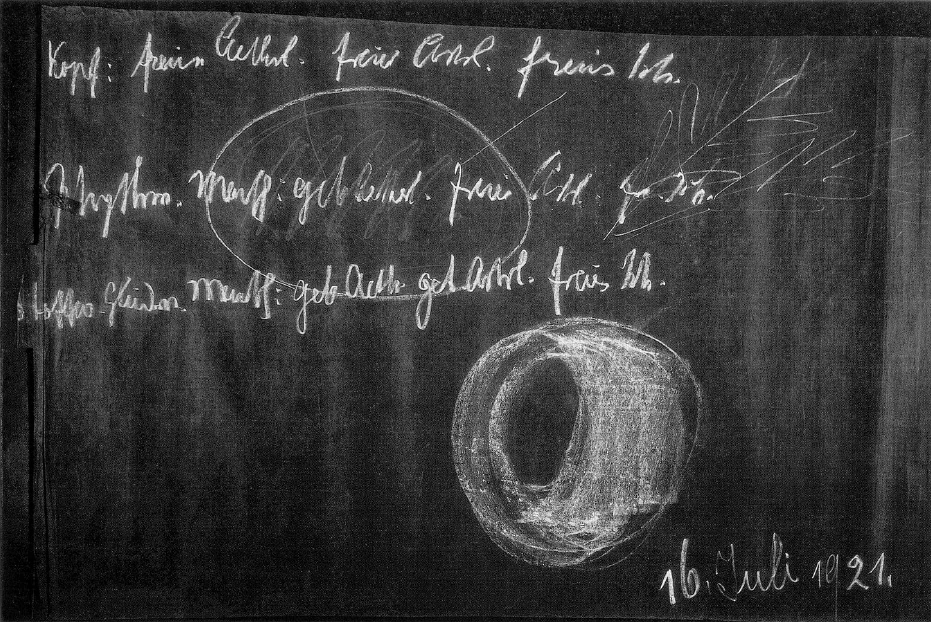
[ 6 ] When one considers this whole matter, one cannot actually come to terms with it within the framework of the natural laws that apply to the earthly realm. One must draw upon what is stated in Outline of Esoteric Science. In Esoteric Science, you will find a reference to how, during a certain epoch in the development of our Earth, the Moon separated from the Earth—how the Moon’s matter was separated from the Earth. What is taking place here actually mimics that process in a certain way. Just as the formative forces of the entire Earth cosmos once separated the lunar forces from themselves, so the bird’s matter secretes this calcareous shell as something one might call “super-mineral.” And what, then, was it that was initially contained within this calcareous shell? (See drawing, red.)
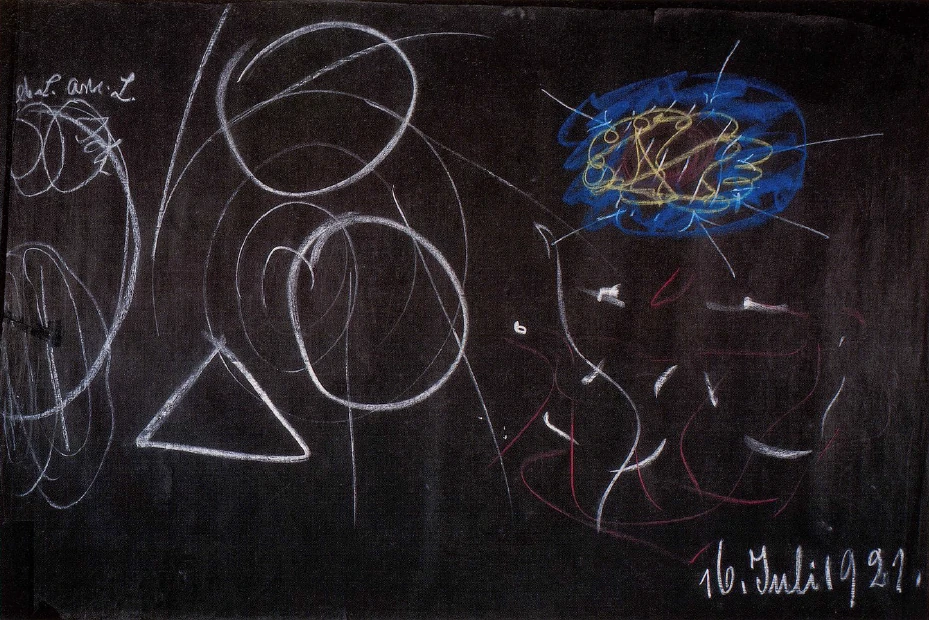
[ 7 ] What was initially inside this calcareous shell was, of course, protected by that shell from the forces acting in the Earth’s atmosphere. If the chick were exposed to these forces too early—say, exposed to the sun too early—it would, of course, die. It would not be able to withstand the forces surrounding the Earth. The point, then, is that the being protected by the calcareous shell lives in a world that is not actually the earthly one.
[ 8 ] What kind of world is this in which this being, protected by the calcareous shell, lives? This world is the one we have passed through—the Saturn, Sun, and Moon stages of development—and which has ceased to exist; it is no longer present as the Earth’s development. Indeed, the past is still very much present within the present. And when we say to ourselves: Everything outside an eggshell belongs to the Earth—then within the eggshell we have everything that does not belong to the Earth, that has nothing to do with the Earth itself, that, so to speak, does not wish to participate in Earth’s evolution. For it must first mature, break through the shell, and then be ready for Earth’s evolution.
[ 9 ] This is also the point where one may draw attention to something else. One may point out the following: After all, not all beings that are conceived in an egg are actually born. A great many bird eggs perish, and as for the eggs of fish and the like, for example—well, they all perish. And besides—I don’t know if it’s always appropriate to analyze things so dispassionately; after all, humanity likes to leave many things in the unconscious—but in view of the times to come, humanity needs a certain body of knowledge, and we simply must not continue to shut ourselves off from this knowledge—besides, a large number of bird eggs are also lost because people eat them. They never reach their destination. And now the question is: What happens to all of this—that is, including the latter fact, what develops from the contents of the egg without becoming a mature chicken, bird, or fish on Earth—what happens to all of this? — The typical materialist will say: Well, nature is simply creating aimlessly, at random, and so much of what nature creates simply perishes. — But that is not correct; rather, those essential substances that are contained within the eggshell in some way simply do not mature for earthly existence, but they are mature in their powers for pre-earthly existence—for the existence that we ourselves, that earthly beings, have undergone during the Saturn, Sun, and Moon eras. And that is the Luciferic existence. They become substances from which the Luciferic existence continues to draw nourishment. Everything that perishes in the eggs provides nourishment for certain spiritual beings. But now let us consider what pertains to the Earth.
[ 10 ] So, when we consider the bird kingdom, we first find the Luciferic element within the contents of the egg—that which, as such, wants nothing to do with the Earth, that which does not want to be here on Earth, that which, I might say, surrounds itself with a wall against the laws of the Earth, which only intervene once that which otherwise acts on Earth—heat, light—has burst open the shell.
[ 11 ] And what comes into play here? The opposing forces come into play. If you place a bird’s egg before you, you can say to yourself: Inside it sits Lucifer in his essence. If you pluck a bird’s feathers, then you can say: Here I have the purest image of the Ahrimanic forces of direction. The Ahrimanic forces of direction are at work there, even in the fine, downy feathers that you find on a hatchling as it crawls out of its shell. There, the Ahrimanic forces have already worked their way through the shell. They were already in conflict with that which absolutely refuses to be permeated by feathers. So when you look at the bird’s plumage, you have the purest image of the Ahrimanic.
[ 12 ] Therefore, you can say: When I look at an egg, Lucifer conceals himself from me. He reveals himself to me only through the outer form that he sheds, through that which is, in a certain sense, cast off as matter. — So whatever is shed—whether it is a bird’s eggshell, a snake’s skin that is shed, and so on—is cast off from the Luciferic principle, from the Luciferic forces. In what is shed there, one can still see something of the actual form of the Luciferic forces. When they act purely, they actually work in spirals. And in what you have as plumage, or whatever you have that extends from the outside into the physical body, there you have the Ahrimanic. This acts tangentially in its directional forces. Take a peacock’s tail and look at it very closely, and think to yourself: This is the purest image of Ahrimanic directional forces.
[ 13 ] Well, of course you must realize that Lucifer and Ahriman are constantly interacting and intermingling everywhere, so that we have only images of them. But these images are indeed most beautifully represented in the bird kingdom; for we need only view the bird kingdom as I have just described it.
[ 14 ] But of course, the forces that are within the eggshell remain active inside the bird as well. So the bird has these forces that were inside the eggshell (red), surrounded by the Ahrimanic forces (blue) in its plumage. With the bird, you also have the opportunity to pinpoint the ethereal and the physical. For if you take everything the bird retains of the Luciferic—which was originally inside the eggshell—and the growth forces it retains there, then you have what underlies the etheric body. So what I have marked in red are these forces, and they are specifically subject to the activity of the etheric forces. Thus, with regard to the bird, one can also say: Whatever the bird inherits from the egg remains, throughout its entire life—the bird’s entire lifespan—under the influence of the life forces, the etheric forces. And what it develops as its plumage remains under the influence of the physical forces (arrows) throughout its life. And what lies in between—its flesh, muscles, and so on—remains under the influence of the astral forces (yellow) throughout its life. In the case of the bird, we thus have a way of localizing these aspects, so to speak: the astral in the flesh and muscles, the physical in the plumage, and the etheric in what remains to it as growth forces from the contents of the egg.
[ 15 ] In humans, this is much more complicated. Humans do not live externally within an egg. They develop their Luciferic nature within the mother’s womb, whereas birds still carry it outward. That is why Ahriman does not yet come upon them while they are still in the mother’s womb. In the case of birds, they demonstrate, as it were, how they carry the Luciferic nature out into the world without it actually going astray, and how they, in turn, also take on the Ahrimanic nature. In humans, you can see these individual aspects take shape with particular clarity through examples. Between humans and the bird kingdom, we can then insert the mammalian kingdom.
[ 16 ] In humans, you first notice a very peculiar difference compared to birds. Take the bird’s legs. Compared to human legs, a bird’s legs are, as a rule, actually quite stunted organs. Why is it that birds have exactly the kind of legs they do? Take a sparrow’s legs: what pitiful little sticks they are compared to the proud legs that humans have, aren’t they! So take these stunted bird legs—indeed, when you consider the bird’s entire stunted form, you’ll say to yourself: The bird is, after all, designed first and foremost for flight; it lifts itself off the ground, which explains the shape of its legs. In a sense, they are merely hints of its connection to the earth. Humans do not lift their legs off the ground. Human beings cannot fly. They plant both legs on the earth like proud pillars. As these legs are formed, they are essentially a gift from the earth. The bird does not receive this gift from the earth because it is not bound to the earth in this way at all; because it is separated from the earth. And by receiving this gift of the earth, human beings are, through this very gift, more bound to the Ahrimanic forces than the bird. In a sense, the bird does not receive its Ahrimanic forces from the earth in such a ready-made form as human beings do. In human beings, Ahriman shoots up, sprouts, into the legs and from there into the rest of the organism. In the bird, Ahriman sprouts into the feathers.
[ 17 ] Well, if you look at human beings—who are, as evidenced by their legs, built more for the earth—then you will be able to ask yourself: Why don’t human beings have feathers? — Human beings do not have feathers because they are simply not built for the Earth as birds are. If human beings were to fly through the air, they would indeed have feathers, because then the Ahrimanic forces would act upon them from entirely different directions. Thus, humans have only these few traces of the Ahrimanic, which are present in their hair. These are the Ahrimanic traces that humans possess. They are strongest in the head, which is already proof that the human head contains a great deal of the Ahrimanic, something we have already deduced from other insights.
[ 18 ] If you look at mammals, you will say to yourself: They are even more bound to the earth than humans are. These mammals are also bound to the earth in ways that humans are not—for example, through their front limbs; for even monkeys walk upright only rarely, and even dogs do so when they’re waiting to be fed, but it is not natural to them. It is not even natural for a gorilla to walk upright—it climbs; these front limbs are true grasping organs; they are meant for locomotion. Human beings are thus half-raised above the earth; birds are completely raised above the earth; mammals are bound to the earth by their front limbs just as they are by their hind limbs. In a certain sense, therefore, they are entirely earthly beings. Humans free themselves from the earth again through the upright position of their spine; the mammal is entirely bound to the earth. The entire rest of the mammal’s form is structured accordingly. In the region where the bird has feathers, the mammal has, so to speak, only its hair, which is actually incorporated into the organism from the outside.
[ 19 ] If you take all of this into account, you will say to yourself: It is possible—when you consider the relationships of a being—a mammal, a bird, a human, and you could now also turn to other beings— one can—if one considers the relationship of these beings to their environment and has a complete overview—derive the form of the being from an understanding of its relationship to the environment. — You can construct the form for yourself. You can say to yourself: The bird possesses within itself the Luciferic principle, which does not like the Earth at all; therefore, the bird isolates itself from the Earth as long as possible while still in its egg; then it manages to ensure that the Earth exerts as little influence on it as possible. Its legs remain stunted, and the forces surrounding the Earth—the forces closest to the Earth, those that surround it in the heat shield—then act upon the bird. It will therefore have to take on the form it actually has: stunted legs and so on. Human beings are bound to the earth through their lower limbs; they free themselves. The mammal stands right in the middle, resting on the earth with four pillars: it is formed from the earth itself. It is therefore the forces acting directly from the earth that primarily affect the mammal.
[ 20 ] An older, instinctive science understood such things very well. That is why, in what develops in humans most independently of the Earth—because it is, in fact, merely a metamorphosis of earlier earthly life—an earlier worldview saw a bird, an eagle, in the human head. In the human being whose metabolism is entirely oriented toward the earth, an earlier worldview saw an ox, a bull, or a cow, because this is an animal that is now entirely oriented toward the earth. In the middle part of the human being—which is, so to speak, the connecting link between the eagle and the cow or calf—in this middle part of the human being, people saw that which, in a certain sense, detaches itself from the earthly realm precisely through metabolism; you can see this, can’t you, in the fact that the lion has a very short intestine. Its metabolic system is extraordinarily primitive, whereas its chest system—its heart system—is developed in a very special way. Hence its passion, its rage, and so on. The older, instinctive view saw the lion in the middle part of the human being. These were certainly views that were based on something.
[ 21 ] Now we must return to these matters in a different—I would say, much more conscious—way. We must, for example, realize that we humans differ from all animals in our “I.” For the vast majority of people today, our “I” is still a very dormant faculty. If one believes that the “I” is very much awake, one is actually mistaken. For in the will—as I have already explained to you—human beings are actually also asleep; and when the “I” acts of its own volition, we are not dealing with something that stands before us as the “I,” but rather with something that stands before us just as night actually stands before us. Even though the night is dark, we do indeed reckon with the night in our lives. If you truly look back on your life, it consists not only of what was as bright as day, but also of the nights. Yet, in a sense, they are always erased from the flow of time. It is similar with our “I.” Our “I” is actually perceptible to ordinary consciousness precisely because it is not there for consciousness; it is already there, but for consciousness it is not there. Something is missing in that spot, and that is why one sees the “I.” It is really like having a white wall where one spot has not been painted white; then one sees the black. And so, in ordinary consciousness, we actually perceive our “I” as that which has been erased. And this is also the case during wakefulness: the “I” is actually always asleep at first; but it shines through as something asleep through thoughts, ideas, and feelings, and that is why the “I” is also perceived in ordinary consciousness—that is to say, it is assumed to be perceived. We can therefore say: Our “I” is not, in fact, immediately perceived at first.
[ 22 ] Now, a prejudiced psychology—the study of the soul—believes that this “I” is actually located inside the human being; that where the muscles, flesh, and bones are, the “I” is also there. If one were to take even a brief look at life, one would very soon realize that this is not the case. But it is difficult to convey such a line of thought to people today. I already attempted to do so in 1911 in my lecture at the Philosophers’ Congress in Bologna. But to this day, no one has yet understood that lecture. There I tried to show what the “I” is really like. This “I” actually lies in every perception; it actually lies in everything that makes an impression on us. The “I” does not lie inside my flesh and bones, but rather in that which I can perceive through my eyes. When you see a red flower somewhere: in your “I,” in your entire experience—which you have precisely because you are absorbed in the red—you cannot separate the red from the flower. With all of that, you have simultaneously given the “I”; the “I” is, after all, connected to the content of your soul. But the content of your soul—that is certainly not in your bones! The content of your soul—you spread it out throughout the entire space. So this “I”—it is even less than the air inside you that you are just now inhaling, even less than the air that was inside you before. This “I” is, after all, connected to every perception and to everything that is, in essence, outside of you. It is active only within because it sends forces inward from perception. And furthermore, the “I” is connected to something else: you need only to walk—that is, to exercise your will. But when you do that, your “I” goes along with you—or rather, the “I” participates in the movement—and whether you’re creeping slowly, running, moving in a lark-like step, or turning in some way or the like, whether you’re dancing or jumping, the “I” does all of that along with you. Everything that emanates from you as an action, the “I” does along with you. But that, too, is not within you. Think about it—it carries you along. When you dance a round dance—do you believe the round dance is inside you? It wouldn’t even have room inside you! How could it fit? But the “I” is there; the “I” participates in the round dance. So in your perceptions and in your actions, that’s where the “I” resides. But it’s actually never inside you in the full sense of the word—not in the same way that your stomach is inside you—but rather, this “I” is actually always something that is, fundamentally, outside of you. It is just as much outside the head as it is outside the legs, except that when walking, it is very strongly involved in the movements the legs make. The “I” is indeed very much involved in the movements the legs make. The head, however, is less involved with the “I.”
[ 23 ] But how, furthermore, do the legs—or the limbs in general—differ from the head in terms of metabolism? In the head, the etheric body and the astral body are also relatively independent; the head is the most physical of all the bodies. This head, which is already such an old fellow that it dates back to the previous incarnation, has become the most physical; it is truly the worst inhabitant of the earth. In contrast, with the legs—or rather, the limbs—and the metabolism, the etheric body and the astral body are intimately connected with the physical body. So we can say: In the case of the legs, the etheric body and the astral body are connected to the physical body; only the “I” is relatively free from the legs and carries them along only when the legs move. And the same is true of metabolism: the metabolic organs are essentially connected to the etheric and astral bodies.
[ 24 ] We can now ask: How does the human head differ from “the metabolic-limb human”? — In that the human head actually has a free etheric body, a free astral body, and a free “I”; the “limb-metabolic human,” on the other hand, has only a free “I,” while the etheric body and the astral body in the “limb-metabolic human” are bound to the physical body; they are not free from it.
[ 25 ] Perhaps the matter will become even clearer to you if I tell you the following. Imagine if your astral body or your etheric body—the part responsible for supplying your physical, metabolic, limb-bearing human form—were to suddenly decide to behave just as the etheric body and astral body of the head do: it, too, would want to become free. Imagine if it had this strange idea: it, too, wanted to become free. Let’s say, for example, that the astral body of your metabolic human wanted to behave the way its counterpart—the astral body of the head—is allowed to behave—it is just another part, so I say: its counterpart. What happens then? What arises—which must not be at all, because it contradicts the human form—is that our lower abdomen wants to become a head, that it wants to become similar to the head. And the peculiar thing is that what is healthy for the head makes the lower abdomen sick. Basically, it is a general characteristic of all diseases of the lower abdomen that the lower abdomen takes on the configuration of the head.
[ 26 ] This is, of course, only a special case—one that I discussed, for example, regarding carcinoma in a lecture in Stuttgart or Zurich, where I demonstrated that the formation of carcinoma is based on the fact that in a part of the human body where no sensory organs are supposed to develop inwardly, the astral body suddenly begins to attempt to form sensory organs. A carcinoma is, after all, nothing more than an ear or an eye that wants to be in the wrong place. It grows inward. An ear or an eye wants to form there. So when this astral body—or even the etheric body—of the lower abdomen tries to behave the way the astral or etheric body in the head behaves, then the disease of the lower abdomen arises.
[ 27 ] And conversely, when the head also begins—it starts subtly with migraine-like states—to want to live like the lower abdomen, drawing its astral body or its etheric body into its affairs, then the head becomes ill. When it draws in its etheric body, migraine-like conditions arise. When it draws in its astral body, something even worse arises.
[ 28 ] These are the things that show you just how complex human nature is. You cannot study human nature the way today’s trivial science does; rather, you must study it in such a way that you consider it in all its complexity—that is, you must tell yourself: The head cannot be like the abdomen, for if the head were like the abdomen, it could only be sick. So, for example, if the cerebrum begins to develop its metabolism too vigorously, if it begins to develop secretory processes too vigorously, then diseases arise. And these intense secretory processes stem precisely from the fact that the head places too great a demand on its etheric body. But as soon as our lower body is left to its own devices—that is, when it becomes, so to speak, head-like, acquiring the capacity to develop sensory organs, for example—then its own diseases develop. So you can say: The human head has a free etheric body, a free astral body, and a free “I.” The metabolic-limb human has a bound etheric body—that is, an etheric body bound to physical matter—a bound astral body, and only a free ego. And the middle human, the rhythmic human, has a bound etheric body, a free astral body, and a free ego.
[ 29 ] Head: free etheric body, free astral body, free I
Rhythmic Human: bound etheric body, free astral body, free ego
Metabolic-Limb Human: bound etheric body, bound astral body, free ego
[ 30 ] Here you have an overview of the human constitution from a perspective that is extraordinarily important, for it gives you an impression of how the “I” actually possesses a certain freedom in relation to the whole human being, how the “I” actually influences the human being—from waking to falling asleep— yet how it remains, relatively speaking, always free from the human being; how it is actually connected to both external perception and to the human being’s external movements; and yet how it does not actually merge completely with the human body. In what does the human ego live? Is it possible to see, in some way, in what the human ego lives?
[ 31 ] Well, we can already see something of this in the development of birds’ feathers. Human beings do not grow feathers, but their “I” lives in the forces that exist in our environment and that serve as the guiding forces for a bird’s feathers. The “I” lives outwardly within these forces. And we can see these guiding forces even more clearly. In the birds’ feathers, we see them, as it were, held in place by the bird’s body; but at the same time, these forces form the guiding principles for freely moving beings: namely, insects. When you see the insects flitting about and grasp them imaginatively, you have in this a picture of what your “I” lives in. Just imagine insects flitting about in your surroundings: beetles, flies, beautiful butterflies, ugly horseflies and bumblebees, and all sorts of creatures; imagine all of this, floating around you in the most varied patterns: there, what your “I” actually lives within becomes outwardly visible. And it is more than just a metaphor when one says: Ugly thoughts live there, like bumblebees or horseflies; beautiful thoughts, like butterflies; some people’s thoughts bite you like vicious flies, and so on. It’s just that one is spiritual, the other physical. The human “I” truly lives within its surroundings.
[ 32 ] This has extraordinarily far-reaching implications, and much of true knowledge of the world depends on correctly assessing what one sees—not merely rambling and babbling in general terms about a “spirit,” but being able to see in the external world the very thing one experiences within one’s own “I” in an abstract, spiritual form. For everything that exists spiritually also exists in the world as an image. Somewhere, what exists purely spiritually also exists as an image. One must simply know how to assess the image correctly. And when the Ahrimanic enters our “I”—as the “I” finds itself in the butterflies and bird feathers out there, that is, in the formative forces out there—then our “I” in turn has the ability to form all manner of shapes from within. After all, we construct the circle for ourselves, we construct the egg shape, the triangle; we also build a world for ourselves from within. And if we investigate this, we will find: These are precisely the forces that are cast out of the Luciferic principle.
[ 33 ] I said the other day: When mathematicians study space, they should consider the relationship between the dimensions of space and a chicken egg; something very interesting would come of it. This is the contrast: We live with the “I” both in the forms we can construct into the world in this way and in that which is constructed out of the world. On the one hand, we live in that which is separated from the world by the shell of the chicken egg—in the Luciferic; we experience, with our “I,” the perception and participation in our movements in that which takes shape in the bird’s body through its feathers and in what flutters about in butterflies and insects in general.
[ 34 ] Indeed, whoever understands the various wonderful nuances of the bird world also understands something of the nature of the human soul in its relationship to the world. For what the bird reveals outwardly through its plumage—what it allows to shimmer toward us—shimmers through our “I” in the flickering, shimmering, glittering perception from the outside in.
[ 35 ] So we must try to understand the world with the help of images. Our modern abstract science grasps only the very least of the real world.