Human-Becoming, World-Soul and World-Spirit I
Human Beings as Physical and Spiritual Entities
in Their Relationship to the World
GA 205
3 July 1921, Dornach
Translated by Steiner Online Library
Seventh Lecture
[ 1 ] Based on the reflections we have made, a fundamental fact of human life and nature will now come clearly to the forefront of our minds. Indeed, it is precisely when one engages in a closer examination of the relationship between human beings and their environment that it always remains something of a mystery why one cannot glimpse the true nature of the external world. This external world presents itself to us through its phenomena and events, and even if we have only a faint desire for knowledge, we must assume that behind these phenomena—which appear to us as a world of color, sound, warmth, and so on—lies the true nature of reality. In a sense, there is a veil, and only behind this veil lies the true nature of reality. On the other hand, there is a similar mystery concerning what the human inner world is. I have, after all, pointed out in recent days how this human inner world reveals its organ-related mysteries once one truly penetrates into it. But for ordinary consciousness, the fact remains that one cannot look deep enough into one’s own inner being to truly comprehend the nature of the lungs, the liver, and so on, as we discussed yesterday. Now, this fact of the existence of two mysteries—the mystery of the unknowability of the outer world and the mystery of the unknowability of the inner world— this fact is understood through an insight into the whole being of the human being, when one allows oneself to take in the entirety of human nature—which, after all, shows us only one side here, between birth and death, while the other side lies between death and a new birth.
[ 2 ] But let us first consider the human being as he presents himself to us here, between birth and death. To begin with, we need an inner psychological reality that is connected to our entire normal daily life; we need the inner reality of memory. Yesterday I spoke about how this memory is actually based on a reflection on the outer surfaces of the internal organs. But we do, of course, need this memory for our soul life. I have often pointed to facts that show how a disturbance of this memory can undermine our entire normal life here between birth and death. This was an example that showed how a person’s ability to remember can be erased. Such cases are, of course, well known. You can read about numerous such cases in psychological works. It is, after all, a well-known fact that this can happen, and on a smaller scale, this phenomenon occurs much more frequently than one might actually think. And you need not imagine anything other than that, for such people, these processes—without them being aware of them in the usual sense of the word—are simply the same as they are for you every night from falling asleep to waking up: consciousness is extinguished. But such an abnormal discontinuity of consciousness exerts an extraordinarily significant influence on one’s entire sense of self. A person can no longer cope with themselves after going through something like this; in retrospect, it is actually a terrible experience for them. From this, however, you can see how important it is to maintain the continuity of consciousness in ordinary life between birth and death—with the exception of states of sleep.
[ 3 ] The continuity of consciousness is, after all, linked to our memory. We therefore need memory to maintain ordinary life as usual. Now, when one undergoes occult development, a different reality emerges. The reality is that one must develop certain soul powers that, during moments of spiritual vision, actually erase this ordinary memory. For as long as one possesses this ordinary memory, one cannot, in essence, look into the spiritual world. And for students of occult development, this usually manifests as an experience: at first, when they begin working on their development, they have certain visions, and later they complain that they no longer have these visions, that they have ceased to occur. This is because, for such visions—if they are genuine, true visions, and not hallucinations—there is actually no memory. It is not possible to recall a vision, for the vision is something real. If you look at a piece of chalk and then look away, you are left with the mental image. But if you want to have the chalk in front of you—the real chalk—then you must return to the act of perception; you must once again have the real thing before you. Memory is of no help at all for this reality. If you touch a hot iron, you’ll burn yourself. No matter how much of the heat you may retain in your memory, you won’t burn yourself in the process. Because the vision connects you to something real and is not merely an image, you must return to it once more. The point is to return to the vision itself, not merely to remember it, for true seeing is a genuine occult experience and cannot become a memory; rather, one can only return to it indirectly. One might say to oneself: Before the vision occurred, I went through this or that in ordinary consciousness. One can then recall that, and one must retrace that stage back to the point where the vision occurred; then one arrives at that point. It cannot occur directly again, but one must, so to speak, retrace the path. Many do not take this into account; they believe one can remember a vision in the ordinary sense. So, in a certain sense, even in occult development, one must undermine one’s memory. This is absolutely necessary; it cannot be prevented at all. Therefore, one must say: Anyone who strives for such occult development must, above all, be certain that they are a sensible person in ordinary life—that is, that they possess a sound mind and a sound memory, free from any pseudo-mystical tendencies. Anyone who is already somewhat unfocused or unfocused in everyday life is not suited to undergo occult development. One must definitely be able to recall the events of the day with complete certainty; only then can one venture to advance to the visions for which such recollection does not exist. The precautions recommended for occult development are entirely grounded in the nature of the matter itself. Thus, you may say: Memory exists for ordinary consciousness, and this memory is part of a normal life between birth and death.
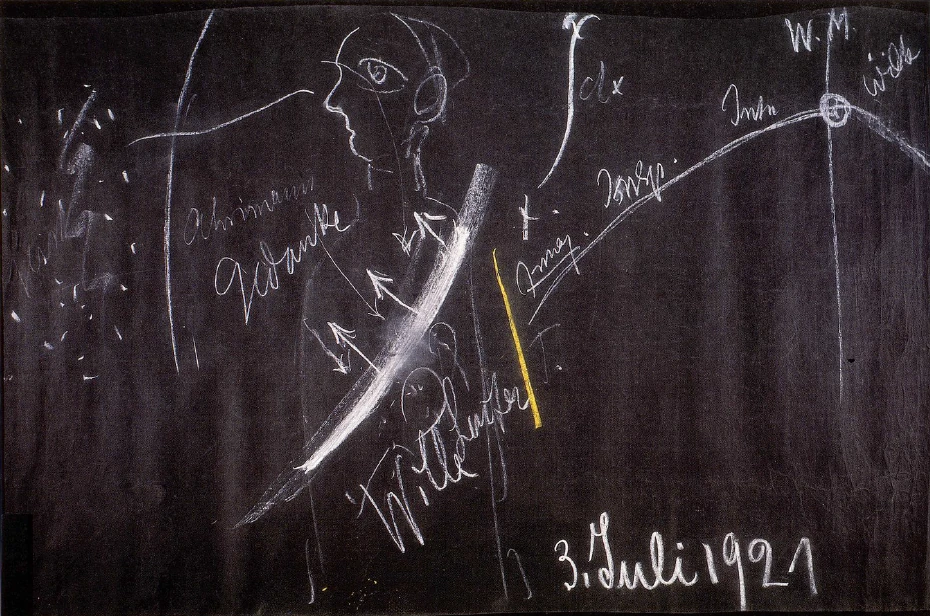
[ 4 ] Now I can sketch for you how the human being behaves when in possession of this memory. I will sketch it for you something like this (see drawing on page 128). What I am now sketching does not exist as such, but it can be perceived in the etheric body. I am schematically drawing this line to represent what is actually extended throughout the entire body, and you should then imagine that from the head—that is, from the sensory perceptions and sensory organs—up to this line lies that which is outside the organs. This line is meant to be the schematic boundary for the human organs: here, the image is reflected back, and beyond this line lie the heart, lungs, liver, and so on. Here (arrows), the image is reflected back. Symbolically, this is the line of human memory. You can literally imagine it this way: We have a thin membrane within us; it is actually the boundary membrane between the etheric body and the astral body, only in reality it is not spatial—it is merely drawn schematically. What is perceived is reflected back by the power of the organs that lie behind it; it is thus reflected, but it is nevertheless reflected here, and we cannot see through it in ordinary consciousness; we cannot look through the membrane of memory into the inner being of the human being. Memory veils the inner being of the human being from us. It must veil the inner being of the human being; otherwise, the human being would not be normal in ordinary life between birth and death. Memory is what our ordinary consciousness uses to shut us off from the inner self. As soon as this memory is interrupted—that is, as soon as a breach occurs somewhere, as happens through occult development—we see into our organs, just as I described yesterday.
[ 5 ] Now we have the answer to the mystery of why we cannot look inward. This inner self must be concealed; otherwise, we would not be able to function normally in life between birth and death, because we need this memory. So the inner self is veiled from us by the reflection of our memory. That is what you must accept as the solution to this mystery.
[ 6 ] On the other side—the side of the external world—we see, as it were, the veil of the senses spread out before us, and we cannot see beyond it. Let us consider the matter this way: What if we could see beyond it—that is, what if, when looking outward, we did not have the veil of the senses behind which the essence of the world lies, but instead if that veil were pierced everywhere, so that we could see right through it everywhere—what would it be like then? — We would constantly flow into things with our perception, with our intuition. We would merge with things. We could not distinguish ourselves from things. And what would be the consequence? If we could not distinguish ourselves from things, we could never develop feelings of love, for love is based on the fact that one does not flow over into the other, but rather remains an individual, is separate, and yet feels across to the other. We are organized in such a way that we are capable of love between birth and death. And in occult development, this capacity for love must in turn be replaced by imagination, inspiration, and intuition. We must, so to speak, break through this capacity for love. It would completely ruin our lives; we would become cold-hearted if we did not have love in ordinary life. Therefore, it is once again necessary that the person undergoing occult development in this direction, above all else, develop the capacity for love to the highest degree. If he has developed it to such an extent that he cannot lose it through occult development—that he retains it despite this development—then he can dare to penetrate the veil of the senses and look out into true objectivity. You see the second riddle set before your soul. Human beings must be constituted in such a way that they are capable of memory and capable of love. Because they must be capable of love, they cannot look beyond the veil of the senses with ordinary consciousness; and because they must be capable of memory, they cannot look into their own inner being.
[ 7 ] This is what actually constitutes the truth of Kant’s philosophy, which is so flawed. Kant wanted to examine human subjectivity and established some entirely abstract concepts that actually mean nothing. In reality, we must understand human beings, between birth and death, as beings capable of memory and love. It is through these that a person comes to know what lives in sensation and what lives in love. And this is what they must carry through the gate of death. But that is why we are on earth—so that we may perfect ourselves in these two capacities.
[ 8 ] When a human being must, through memory, distinguish between his perceiving and thinking nature—which, moreover, encounters the veil of the senses here—he develops, primarily through the head—though the human being is, after all, head from head to toe—the life we call the life of consciousness. This life of consciousness comes to a halt at the thought. The thought becomes a memory image. But we do not proceed any further than to the memory image. There the thought is held back; it is only because it is held back there that it can always return as a memory. There the thought is held back, and our normal life between birth and death actually rests on the fact that we do not let the thought descend into the organs. Its forces descend, as I described yesterday, but the thought as such—as it lives within us as an image—we cannot allow to descend. At the moment we die, the thought becomes what it is not meant to become in ordinary consciousness: there, the thought becomes imagination. This imagination, which is striven for with great effort in occult development, occurs when a person passes through death. All of their thoughts become images. The person then lives entirely in images. One can therefore understand the dead only if one has become familiar with this language of images. Immediately after death, thoughts are transformed into images. With these images, the person lives for some time between death and a new birth. Then, little by little, the images become inspiration. In this way, the soul truly continues to grow. The images become inspiration. Then the human being begins to perceive the music of the spheres. For him, the music of the spheres becomes something real. He lives in the world of cosmic sounds. And finally, he merges with the objective-spiritual universe. His soul becomes entirely intuition. He becomes, so to speak, one with the universe.
[ 9 ] This is also the point at which, for a time, this intuition was present—the point at which the “midnight of the world” sets in, which I spoke of again yesterday. Now the return journey begins, and the intuition is now capable of taking in something that the human being has gradually left behind by living here on Earth. For when the human being has passed through the gate of death, he lives through forces other than those we call “will” here on Earth. He attunes himself to more cosmic forces. The will is, I might say, absorbed; the will gradually fades away. But when a person has reached the Midnight of the Worlds—that is, after passing through the imaginative state, the inspirational state, and the intuitive state, and has, so to speak, arrived at the height of life between death and new birth—then intuition is once again filled with will. Thought once again becomes will-driven, and this will increasingly permeates the soul, which now strives anew toward inspiration, and then toward imagination. Once it has reached the stage of imagination and has passed through it for a time, it is once again ready to be embodied here. From the image, in the manner I have described, there emerges what then appears as the transformed human being of the previous incarnation, characterized by the metabolism of the limbs. So you see, through the stages that are sought in occult development, the human being ascends to the “midnight of the worlds,” and then takes the reverse path back down to the level of imagination, arriving at the formation of thought when he incarnates.
[ 10 ] Throughout this entire period, the human being absorbs the will. And now, as the human being returns to physical existence, we see how what is working in from the cosmos—what the human being has absorbed from the previous incarnation—is embodied in the image, and the will is still present within that image. So what we have here now is an imagination imbued with will.
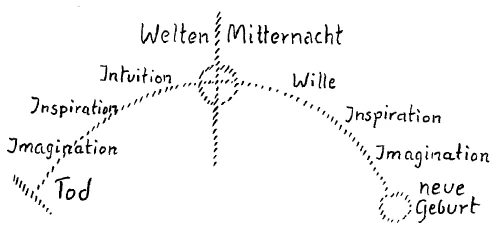
[ 11 ] So when a human being arrives at a new physical life before conception, he does indeed have an imagination, but one that is imbued with the will. From the imagination—which is essentially what was already there as an image—the head and its immediate components arise, and the will takes hold of the new limbs and the metabolism. So that this force is distributed between the head and the rest of the human being. The head is, in essence, I would say, crystallized, solidified thought; what lives in the rest of the human being is organized will. In fact, a person can truly awaken only in the head. Isn’t that so? You are aware of your thoughts; your ideas are present in ordinary consciousness—this can be said of all people today; but what goes on in the will, as I have often mentioned, is just as unknown to people as what happens during sleep. For how does one know, in ordinary consciousness, what is happening when one raises an arm! One perceives that the arm is being raised; one has the mental image, but the act of will as such remains in a state of sleep, much as sleeping is a state between falling asleep and waking up. So one can say: With regard to the “limb-metabolism human,” a person sleeps even during the day; they actually awaken only in relation to their “head human.” — All of this, in turn, works together.
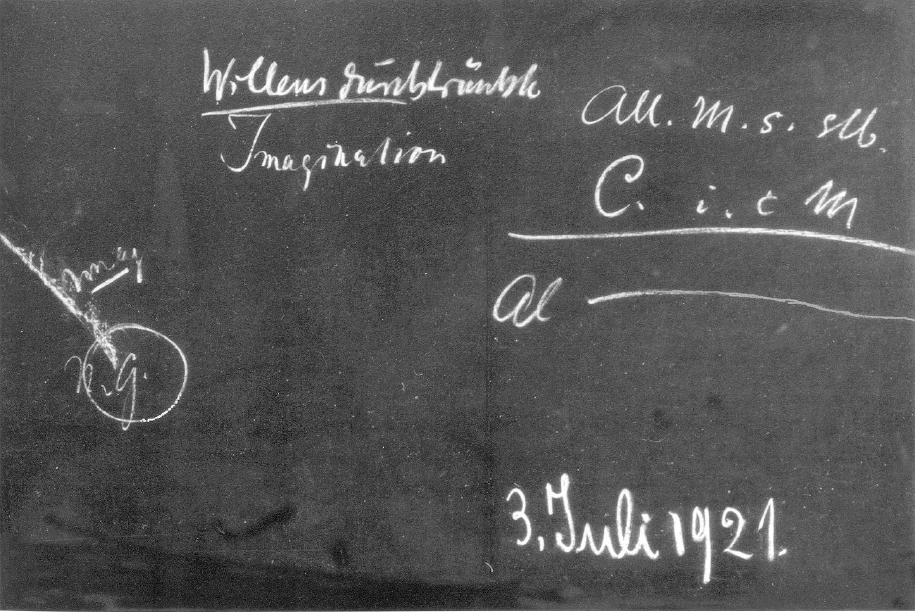
[ 12 ] Official science today speaks of a certain logic. In logic, it speaks of concepts, judgments, and inferences. Yes, let’s consider such an inference. The well-known inference found in all logics refers, after all, to the famous logical figure. So: All men are mortal; Caesar is a man; therefore, Caesar is mortal. — That is the syllogism. Each term of the syllogism is a judgment: “All men are mortal” is a judgment; “Caesar is a man” is a judgment; “therefore, Caesar is mortal” is a judgment. The whole is a syllogism. “Human” and “Caesar” are concepts.
[ 13 ] If you ask someone today who happens to be among the very intelligent—we must always look to the very intelligent, for they set the tone—then they will say: All of this takes place within the nervous system. The nervous system is the mediator of imagination, judgment, reasoning, and even of feeling and will. — But even when it comes to imagining, judging, and reasoning, it is not as today’s official thinking assumes. For imagination as such is actually a matter of the head. When you make a judgment, however, you must feel—through the mediation of the etheric body—how you are standing on your feet. For you do not judge with your head at all; you judge with your legs—though with the legs of the etheric body. The person who judges, even when lying down, stretches out their etheric legs. Judging does not rest on the head; judging rests on the legs. Of course, no one believes that today, but it is nevertheless true. And reasoning—that is based on the arms and hands, indeed on what distinguishes humans from animals. The animal stands on its legs; the animal is itself a judgment, but it does not reason. The human being reasons. For this purpose, his arms have been freed; that is what his arms are for—not for walking. The human being has his arms free so that he may be a being capable of reasoning. And what takes place when one steps onto one’s etheric legs, and what takes place when one moves one’s astral arm—that is judgment, that is reasoning—is merely reflected in the head as a concept and then becomes a concept itself. Thus, the whole human being is needed—not merely the nervous-sensory human—for judgment and reasoning to come about.
[ 14 ] Well, if you consider this, you will say to yourself: Human beings actually derive judgment and conclusion from their system of limbs. These are, in fact, acts of the will at their core, and they arise from a state that is more indeterminate than imagination. Just as we wake up in the morning, so, in essence, do we experience it when we have reached a conclusion. We have drawn it forth from the very depths of our being. That which has grown old from the previous life into this one, which plays out in the mind, enables us to form concepts through the mind. In relation to the cosmos, we are old when we are born. And the fact that our will has been renewed is because we have become young in relation to the cosmos. It is always that which we carry within us as our head, a reminder of the previous incarnation. It is the old. What the human being of limb metabolism is, the will has conquered by entering into this incarnation. This is actually conveyed to it through the womb. For the rest—one need only study external empirical embryology to confirm this—is actually constructed from the cosmos into the mother. The head is precisely an image of the cosmos, brought about by external forces. Anyone who wishes to deny this should simply say that it is nonsense that the Earth’s magnetism aligns the magnetic needle. When a physicist seeks to explain the magnetic needle, he proceeds from the magnetic needle itself; the physiologist, the embryologist, and the biologist, when seeking to explain the embryo, remain within the womb. This is just as nonsensical as trying to explain the magnetic needle solely from within itself. One must go out into the entire cosmos. We have, first and foremost, the head in the entire process of development, and only then is the rest of the body attached—a body conquered by the will, which has engaged with the imagination during the passage through life between death and new birth, beginning at the midnight hour of existence.
[ 15 ] Now, when we look at this person here (see drawing on page 128), we find that everything related to thinking and perception is located above the “memory cap,” and everything related to the will is located below it. This force acts upward, rising from the unconscious—which can only be discovered in the way we discussed yesterday. It is the will that acts upward. With regard to the will, we are asleep. And so, in reality, we truly experience the human being as a duality in life between birth and death. The human being is indeed a monad, but so is the entire world, and the human being must bring this monadic quality into being. He must renew it again and again. But in reality, the human being is dualistic between birth and death: thought, so to speak, with perception on one side, and the will with the soul on the other.
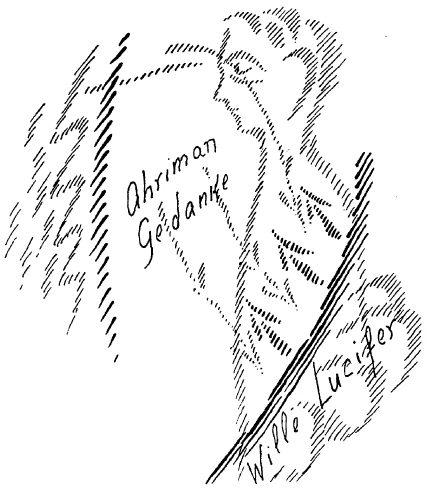
[ 16 ] But this actually makes a person, I would say, the average of two worlds. Because, please, be honest and ask yourself: what is in your consciousness at every moment of your life? Your memories—what you have experienced since the age of two, three, five, or six—that is the content of your consciousness. And what comes up from below, what wells up from the will, that is love, the capacity for love. And in reality, the human being is nothing other than what appears there, on average, as images of memory and love. Fundamentally, the human being is like this: above is a world that is cosmic thought; below is a world that is cosmic will. And constantly, the human being is the point of attack for Lucifer from the side of the will and the point of attack for Ahriman on the side of thought (see drawing). Ahriman constantly seeks to turn human beings entirely into heads. Lucifer constantly seeks to cut off the head of the human being so that he cannot think at all, so that everything flows out indirectly through the heart as warmth, so that he overflows entirely with love for the world and flows out into the world as love for the world, flowing out as a cosmically rapturous being.
[ 17 ] In our age, in our much-praised culture, Ahrimanic influences are predominantly at work. More sensitive people have always sensed these Ahrimanic influences. When I was still a very young man, I once spoke with an Austrian poet who was very well-known at the time; he had a keen sense of what was emerging in culture, and he expressed it in a semi-figurative way, but this semi-figurative quality was a reality for him. He said to me—it seems to me as if it had happened today: What we people of today have become is actually a terrible fate; a terrible fate that will befall humanity if things continue as they are now. For human beings will gradually lose the dexterity of their limbs; they will no longer be able to walk properly; they will constantly ride bicycles and move about mechanically; they will also lose the direct dexterity of their hands—everything will become technical. Just as a muscle atrophies when it is not used, so will all of this gradually atrophy, and humans will become nothing but a head. The head will grow ever larger, and eventually humans will roll along like this with the rest of their bodies completely crippled.
[ 18 ] This image loomed, I might say, like a nightmare before this Austrian poet—his name was Hermann Rollett—and he described it very vividly, for he was deeply troubled by the idea that people would one day become “rolling heads” as a result of our culture. But there is a great deal of truth underlying this. The underlying reality is that, in our time, the forces seeking to develop our heads more and more are indeed extraordinarily strong. They are not particularly successful with the physical head, but they are more successful with the etheric head. So it is indeed the case that in our time the Ahrimanic forces want to turn us into people who are entirely head-oriented, that they want to completely transform us into mere thinkers.
[ 19 ] But for human beings in their healthy development, there is the other pole—the pole of the will—which always works against this when we die, so that the will has taken hold of the thought. The thought must not yet be left alone. When we are born, we have gathered new will, but the thought separates itself, finds its way into our head; the will takes possession of the other body. While we live on Earth, there is a constant interplay between will and thought within us. The will takes possession of the thought, and we must carry this composite of will and thought through death once again. Ahriman would like to prevent us from doing so. He would like the will to remain separate, for the thought to be developed within us in a special way. Then we would lose our individuality if, in the end, what Ahriman actually wants were to come to pass. We would completely lose our individuality. We would arrive at the moment of death with a thought that is downright exaggerated and instinctively formed. But we humans could not hold on to this thought, and Ahriman could take possession of it and incorporate it into the rest of the world, so that this thought would continue to have an effect in the rest of the world. This is indeed the fate that threatens humanity if it continues on the current path of materialism: that the Ahrimanic forces will become so strong that Ahriman can steal people’s thoughts and incorporate them into the Earth through their effects, so that the Earth—which was actually meant to perish—is consolidated. Ahriman works toward the consolidation of the Earth, so that the Earth may continue to exist as the Earth. Ahriman works against the words: “Heaven and Earth will pass away, but my words will not pass away.” He wants the words to be cast aside and for heaven and Earth to remain. This can only be achieved if people’s thoughts are stolen from them, if people are de-individualized.
[ 20 ] If Ahriman were able to continue his influence—as he has been particularly adept at doing since 1845—then, to begin with, human brains would become increasingly rigid, and people would live as if under the influence of obsessive thoughts, under materialized thoughts, as I explained yesterday. This would be particularly evident in the fact that people would be guided—even in their education—in such a way that they would not have flexible thoughts, but rather, once they reached a certain age, would have completely fixed thoughts. Now I ask you: ask yourselves whether this is not already being achieved to a high degree in many cases! Just think how fixed the thoughts of many people are today. Can one still teach people much today? Their thoughts are so rigid, so fixed, that one cannot teach them much. This is already being exploited by Ahriman. And Ahriman strives to intensify this ever more, to turn thoughts more and more into compulsive thoughts. And one such effective product of these compulsive thoughts in the scientific realm is atomism. There, behind the veil of the senses, no spirit is suspected, but only atoms—atoms vibrating everywhere, swirling, vibrating atoms. Of course, you cannot penetrate this veil of the senses with anything other than thoughts. But Ahriman has already confused people to such an extent that they have materialized their thoughts. They no longer believe that they are actually constructing only a world of thought-atoms there, but they regard it as reality; thus, they project their thoughts out into the world. This is a thoroughly Ahrimanized world. Today we have an Ahrimanized science, a science that is Ahrimanized through and through.
[ 21 ] The fact that this exists sometimes confronts you in a terrible way in life. For example, once—it’s been maybe thirty-five years now—I received a manuscript. It was a very scholarly manuscript. It was supposed to establish the “human differential”—I’m telling you a true story—that is, the differential such that, when you integrate it, you get a human being. So if you integrate from foot to head, you get a human being. It was a very scholarly treatise. And the doctor who brought it to me said, “You can also meet the author”—because he had been at the clinic with him. And when I met the man, he said, “Yes, that’s true; I’ve experienced it myself. I consist entirely of differential atoms; there are differentials everywhere; I am merely an integral.” — He had imagined himself as entirely differentiated into nothing but atoms; that was an intellectual-Ahrimanic mode of consciousness. But ultimately, I would say, it is merely the system of atomism that has become rigid. For when this manuscript was brought to me, I was reminded that there is, after all, a Laplacian formula for the universe: it is said to be possible, through integration of atomic processes—not integrating from bottom to top, but simply integrating from the beginning of the world to its end—to calculate, by substituting a specific value, well, let’s say, when Caesar crossed the Rubicon and the like! Isn’t that right? Simply by introducing the atoms into the world formula and treating them in the appropriate manner. This whole way of thinking was, to the point of despair, similar to the treatise written by that man who viewed himself entirely as an integral enclosed between the boundaries of foot and head. If one looks at things correctly, one can indeed glimpse the Ahrimanic transformation of our culture here.
[ 22 ] Of course, this must be counteracted, and that can only be done by restoring our concepts to their visual nature—that is, by not merely working with abstract concepts, but by making our concepts visual. Then, when we pass through the gate of death, we will already bring images with us, and we will find a connection to what the world demands. Otherwise, humanity faces the danger of losing itself, and what should actually be individualized through the inflow of the will into thought will instead be mineralized, turned into the universal earth; and the earth would become a cosmic being, but humanity would, spiritually speaking, flow into a vast cemetery.
[ 23 ] One must occasionally take such a broad view of culture. In our time, it is absolutely necessary to take such a broad view of culture. For anyone who is able to gain a clearer overview of current developments today knows how rapidly we are, in essence, approaching this ossification of our culture. I would also like to take this opportunity to mention that, up until the year 869—the Eighth Ecumenical Council in Constantinople—the human being was understood to consist of body, soul, and spirit. Now, as I have often mentioned, at this Eighth Ecumenical Council the formula was established for the West: One must not believe that human beings consist of body, soul, and spirit, but only of body and soul, and that the soul possesses certain spiritual qualities. This view then became widely accepted. In the Middle Ages, it was considered heretical to believe that human beings consisted of body, soul, and spirit. Today, philosophy professors, through “unbiased science,” conclude that human beings consist only of body and soul. This “unbiased science” is nothing other than a resolution of the Eighth Ecumenical Council. But this trend is leading in another direction. One could say: Through this Eighth Ecumenical Council, humanity has lost its awareness of the spirit, which must be regained. But if we continue down the path I have just described to you, humanity will also lose its awareness of the soul.
[ 24 ] Among the materialists of the 19th century, this awareness of the soul had already disappeared to such an extent that it was said: “The brain secretes thoughts just as the liver secretes bile.” Thus, they were essentially left with only an awareness of physical processes. And in fact, even today—without people realizing it—there are certain underground movements, where all manner of groups are working toward such ends, that are pushing for something similar to what happened at the Council of Constantinople in 869, namely, to declare: Human beings do not consist of body and soul; rather, human beings consist of the body, and the soul is merely something that develops out of the body. It is therefore impossible to educate human beings spiritually; one must therefore find a means—a material means—by which to “vaccinate” human beings at a certain age, and then they will develop their talents through this “vaccination.” — This tendency certainly exists. It lies in the direct line of Ahrimanic development: no longer founding schools to teach, but rather “vaccinating” people with certain substances. For this is indeed possible. It is not as if it were impossible. It is possible; but it turns people into automatons. It would vastly accelerate what is otherwise achieved through the imposition of thought—through an education that works toward the imposition of thought. There are indeed substances that can be extracted, whereby a person—if, for example, vaccinated at the age of seven—could easily do without elementary school; for he would become a thinking automaton. He would become extraordinarily clever, but he would have no awareness of it. That is how this intelligence would manifest. But what does it matter to many people today whether a person has an inner life or not, as long as they go about outwardly doing this or that! Those people who today prefer to surrender to Ahrimanic culture—and such people do exist—are certainly striving toward such ideals. After all, what could be more appealing to a mindset that is becoming increasingly widespread today than finding a vaccine, rather than toiling with children for years on end! One must present these things in stark terms. For as long as they are not presented in stark terms, present-day humanity does not realize what goals it is striving toward. Such a vaccine would simply serve to loosen the etheric body within the physical body. As soon as the etheric body is loosened, the interplay between the universe and the etheric body becomes extraordinarily lively, and the human being would become an automaton. For the human physical body must be educated here on Earth through spiritual will.
[ 25 ] The methods for the Waldorf school—the pedagogical methods for the Waldorf school—have been developed out of a full awareness of the automation of human beings. In this regard, they are intended to serve as a driving force for culture, which in turn leads to spiritualization. For, fundamentally speaking—and one can certainly say this—it is necessary today, above all else, that spiritual life among human beings be particularly nurtured as spiritual life. Therefore, we should also look closely at everything that emerges as a sign of improvement in individual people. I have often emphasized on other occasions how humanity today strives to replace genuine lived experience with routine—routine, which is, after all, the mechanization of life.
[ 26 ] I was very pleased the other day when I read that there are still people who, beyond the usual routine of daily life, have always regarded a genuine way of life—even in practical matters—as something important. In fact, news recently spread around the world about how Edison tested the people he wanted to train as practitioners. He wasn’t at all interested in whether a businessman could keep good books. That, he said, is something anyone can learn in three weeks if they’re otherwise a capable, sensible person. — All those specialized skills don’t interest him at all; those can be mastered easily. And that’s true. But Edison posed questions to the people he wanted to assess to see if they were any good in practical life—questions of this sort, for example: How big is Siberia? — So if he wanted to test someone to see if they were a good bookkeeper, he didn’t ask if they could draw up a balance sheet correctly, but rather: How big is Siberia? — Or: “If a room is five meters long, three meters wide, and four meters high, how many cubic meters of air does it hold?” — and similar questions. He asked questions like: “What is located at the spot where Caesar crossed the Rubicon?” — and so on, very general questions, and depending on how well a person could answer such general questions, Edison would hire him as an accountant or something similar. So whether or not someone was good at bookkeeping didn’t interest him at all, because he knew this: If someone could answer such a question, it proved that they hadn’t wasted their school years, that they had developed as a child with a flexible mind; and that was what he demanded.
[ 27 ] This is how clinical practice should actually be structured, whereas recently we have been heading in exactly the opposite direction and have become increasingly mired in specialization, to the point where it was truly exasperating to find the people needed for clinical practice. They could no longer be won over to anything outside the box into which they wanted to be crammed. It must be said: In this way, too, one must work to cultivate the flexibility of thought. If one works to cultivate the flexibility of thought in this way, then these thoughts will not harden, and Ahriman will have a hard time. But you will see for yourselves, when you look at life, how few Edisons there are who hold precisely such practical principles. What matters is to work toward the imagery of concepts; whoever works toward the imagery of concepts will no longer be able to say that they do not understand spiritual science. For it is precisely the effort a person makes to derive the imagery of concepts from the abstract that, on the one hand, opens the possibility of grasping such things as: The Earth developed from the Moon, the Sun, and Saturn. On the other hand, it brings the emotional life into the inner world, into the pictorial representations and imaginations. The fully developed human being truly emerges.
[ 28 ] It was recently reported here that a critic of anthroposophy said that anthroposophy is not a science because it draws what it arrives at from the whole human being; a science, however, may draw only from the intellect. So you see, first one defines what a science is—that it must not draw from the whole human being—and then one says: It is wrong to draw from the whole human being. — In this way, of course, one can tear everything to shreds. The point is precisely that we must expand this one-sided culture of the head back into a culture of the whole human being. And it is really only false consciousness that leads to this culture of the head and then manifests itself in practical life. For the false belief that we judge and draw conclusions with our heads is what leads people to this culture of the head. We judge with our legs and draw conclusions with our arms. Once we realize that the whole person is already necessary for a judgment and a conclusion, we will no longer resist the principle: True truth must come from the whole, from the full human being. That is what I wanted to point out to you today.