

Human-Becoming, World-Soul and World-Spirit I
Human Beings as Physical and Spiritual Entities
in Their Relationship to the World
GA 205
9 July 1921, Dornach
Translated by Steiner Online Library
Ninth Lecture
[ 1 ] To place human beings within the cosmos through knowledge—that has been the task set forth here in these reflections over the past few weeks. Now, yesterday I attempted to suggest how human beings, on the one hand, are situated within the cosmic world of thought—from which their entire constitution is also formed—so that, on the one hand, by looking toward that which is not grasped by ordinary consciousness through their sensory perception or their ordinary experience of themselves, with regard to this organization of his, he must conceive of himself as belonging to the cosmos, and must, so to speak, conceive of himself as belonging to his own self only in relation to the ordinary life of imagination, which, as I have shown, interposes itself on the one hand between cosmic thinking and that thinking which I have described as an undercurrent of ordinary consciousness. The latter would now also belong to what a person must, in a sense, regard as belonging to his own self. With this, we attempted yesterday to shed some light on the human being insofar as he has a thought experience or is situated within the world of thought.
[ 2 ] The more one rises to this perspective, the more one will learn to place the human being within the entire process of the world’s becoming—within everything that causes him to appear as a part of cosmic becoming. And when one becomes so attentive to that part of the human being that is now composed of ordinary thought life and the undercurrent I characterized yesterday, it is precisely then that one will also understand how the human being, by possessing this part—which is, so to speak, set apart from the cosmos—is a free, self-standing being.
[ 3 ] This view of human beings can be taken even further, and today we will try to place human beings within the context of the other kingdoms of nature. I need only point out that I have often said how incorrect it is to view the relationship of human beings—say, to the animal kingdom—solely in terms of modern anatomy and physiology. Certainly, if one first considers the human being in terms of its overall form—how this overall form is composed of the individual organs—one will notice that the human being has roughly the same number of bones, muscles, and so on as the higher animals, and that these organs or organ systems have been transformed, metamorphosed. One could thus place the human being within the animal kingdom. But something quite different emerges—and I have often elaborated on this—when one considers what places human beings in the cosmos in a very special way. Here it must be noted: the animal’s spinal column lies essentially horizontal, parallel to the Earth’s surface; the human spinal column stands vertically to the Earth’s surface. Now, if one does not hold the view that everything is based on the grossly material, but instead brings oneself to the perspective that what exists is, in its very essence, grounded in being fully integrated into a coherent world system, then one will naturally attribute corresponding significance to this particular position of the human spine. This also places the human head in a completely different position within the entire organism. And once one has risen to the perspective that the cosmos is interwoven and permeated by thoughts—then, insofar as the cosmos is to be regarded as spatial, see something essential in the streams of thought that flow through the cosmos, and one will be able to observe that it is not a matter of indifference whether the stream that runs along the human spine aligns itself with the Earth’s radial direction, or whether, as in animals, it runs parallel to the Earth’s surface.
[ 4 ] This way in which human beings are, in a certain sense, situated within the cosmos must be considered in relation to the overall organization—and thus also in relation to the individual organs. After all, the relationship of every organ and every organ system to the cosmos is different in humans than in animals. This is not affected by the fact that, for example, someone might say that when sleeping, the human spine also lies horizontally; for what matters is not the chance position of an individual part, but rather how the entire growth process is structured—how, so to speak, an organ system is integrated into the whole organism. And once we take this into account—that is, that we have the animal spine, which is parallel to the Earth’s surface, and the human spine, which is perpendicular to the Earth’s surface—then we will also be able to properly appreciate other processes that can be observed in human beings. And here I would first like to draw your attention to a different psychological system than the one we considered yesterday. Yesterday we examined the system of thought; today we will examine the system of will.
[ 5 ] We can also view this system of the will in such a way that we become aware: A person’s life, in its rhythmic succession, breaks down into the states of sleep and wakefulness. When awake, a person is wholly immersed in their physicality; during sleep, the “I” and the astral body are outside of physicality—both the physical and the etheric aspects of it. As I told you yesterday, when we wake up in the morning, we bring with us, at most, a faint memory of the thoughts of the universe. So that we can become aware: During the entire time from falling asleep to waking up, we were immersed in a surging sea of cosmic thoughts. But what we bring with us upon waking—and what then determines us throughout the day while we are awake—is the will; it is the emergence from this nocturnal sea of cosmic thoughts—or, shall we say, the sea of thoughts that constitutes our element during sleep. We emerge with the will, which, as I have described to you, brings logic into our inner soul life. As we wake up, we may still notice—in the dreams that press upon us—what our soul life would be like if this will, which we bring with us upon waking, did not logically penetrate it.
[ 6 ] This will, so to speak, strikes into what is surging and swirling within the human organism. Let us take a very close look at this impact of the will. Let us become aware of what the will is penetrating: it is precisely the chaotic swirling of dream images and also of those dream fabrics that we have as undercurrents of ordinary consciousness. So we can say: While we sleep, this web of thoughts—which is completely drowned out by the logic-interwoven web of thoughts of the waking state, from waking up to falling asleep—is released from the organic machinery within us. It is, therefore, this chaotic surging of dream images and dream concepts into which the will—which we bring into our organism from the cosmos upon waking—intervenes. Let us see what this will initially brings with it.
[ 7 ] This will, which breaks into that state, first of all prevents thoughts from arising as they do in this dreamlike chaos. We would fare poorly in life if thoughts arose as they do in this dreamlike chaos. What, then, must thoughts be like when they arise in normal soul life? They must be connected in some way to our lives. They must be able to recall things in some way. This is, so to speak, the first thing—or what occurs at the first stage—that this intervening will does with our thoughts. It arranges them so that we carry the correct mental image within us. So we can say: We have, as it were, this chaotic web of thoughts (see drawing, red) swirling up from within our organism. — This is something that is particularly strong in dreamy personalities, who are often not at all content to simply indulge in the normal memories of life, but who take joy and pleasure in it when, after all sorts of echoes and connections, thoughts come together and then separate again. Dreamy personalities are overwhelmed by this chaotic web of thoughts. But even the person who is quite self-aware will always notice—if they let go just a little while awake, so to speak—that this swirling confusion of thoughts is present in the background as an undercurrent. The will that takes hold upon waking encounters this web of thoughts. Where does it come from?
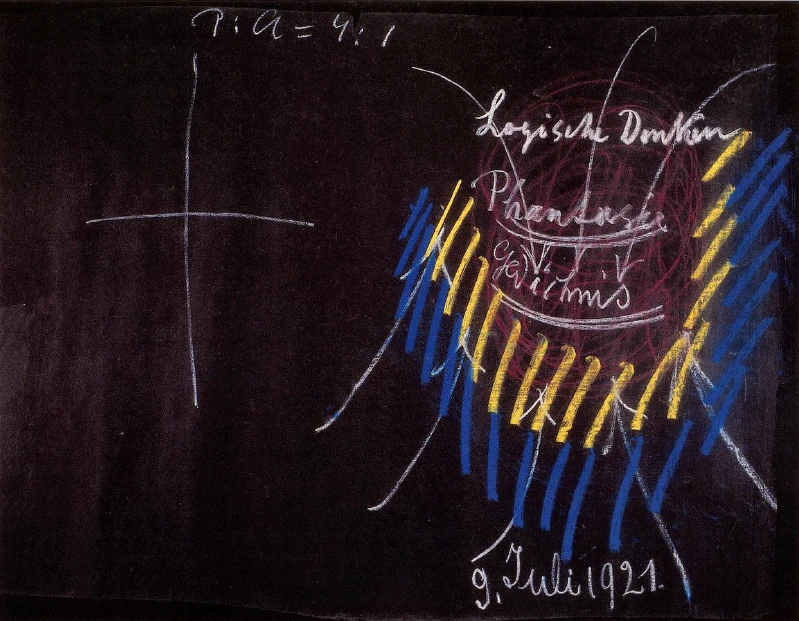
[ 8 ] Well, lying in bed were the physical body (blue) and the etheric body (yellow). What I have drawn here schematically on the board is, essentially, what we leave behind in bed at night when we fall asleep, and find again in the morning. We allow our will to penetrate into it. I want to characterize this penetrating will with these lines here (see drawing, arrows from above). So the first thing the will has to do there is to transform this chaotic web of thoughts into our normal memory. We can therefore say that, first of all, this penetrating will reshapes the web of thoughts into normal memory. One might say: What we encounter in the morning—the etheric body, the physical body—is still very powerful in our memory. These thoughts reflect back to us. — But it is, after all, the will that intervenes there and that truly has a task to perform by intervening. One can already notice this. Just try once to really grasp how, when you wake up in the morning, everything surges up from the soul like swirling currents—an event you experienced in the fifth, in the seventh year, again in the sixth year, again in the fifteenth year, for all I care in the sixty-fifth year, then in the twenty-first, seventeenth year, again in the eighth year—how it all swirls and churns in a colorful jumble. This is where the will must intervene. Then, in a sense, it reorganizes all of this so that it becomes an orderly memory—so that an event that took place in the ninth year does not jostle its way to the front ahead of what happened in the eighth year, and so on. So the will intervenes, and it shapes memory out of this chaotic web of dreams. In memory, you are still barely aware of the will. Most people do not even want to perceive the will in their memory at all. But it is there; it is just that this intervention of the will—insofar as it shapes memory—is much more unconscious.
[ 9 ] The second element is something through which a person can already perceive how their will is at work within them. This is what the will—which we bring with us upon waking—creates from this wave of thoughts: it is the power of imagination, it is the fantasy (see drawing). That is the second element. Here you already realize that you can move within it using your will. Since memory is already formed, you must still be guided by your organism; the physical body and the etheric body exert a strong influence here; in the imagination, this influence is less strong, and you can move within it using your will. But there is, after all, a tremendous difference between a person who is imaginative and a dreamer who simply surrenders to this surging tide of arbitrary thought. A person who lets their imagination run free knows how their will governs these intermingling images, and they shape them according to their will.
[ 10 ] But now for the third. The third is something that, on the one hand, is truly and completely surrendered to the will, yet on the other hand, the will does not move as freely as it does in the imagination. It is logical thinking, on which we depend in life and in science. There, in this logical thinking, our will is certainly active; but it relinquishes its own freedom and submits to the laws of logic. Yet it is the will’s own act to submit to the laws of logic. So this is the third: logical thinking.
[ 11 ] Why is logical thinking, on the one hand, entirely subject to the will? If we did not shape our logical thinking out of our own will, it would consist of obsessive thoughts. We must indeed form our logical thoughts through our will. But we form them in such a way that we orient ourselves toward the external world, which is, after all, essentially the great teacher of logic in the first place. We imbue the chaotic world of images with the laws of logic. We thus surrender ourselves through the will to these laws of logic; in a certain sense, we submit to their arbitrary rule. On the one hand, the will is free in thinking; on the other hand, it relinquishes its freedom in favor of logic itself. But in these three stages—memory, imagination, and logical thinking—the will is active; that will which, from falling asleep until waking, does not act within the human physical and etheric organism, and which, upon waking in the morning, strikes into the physical and etheric organism, and which structures this—I might say—indeterminate fire of the etheric and physical body, which flares up in the surge of thought, into memory, imagination, and logical thinking.
[ 12 ] In logical thinking, it is indeed the case that we are no longer fully in control of ourselves through our will. We are not. When we let our imagination run free—in which we clearly perceive our will—then we know how we are within ourselves; when we let our logical thinking take over, we are no longer fully within ourselves. We know that we are adapting ourselves completely to the cosmos—but not just to the non-human cosmos, but to the entire cosmos, which encompasses human beings as well. For, of course, logic applies not only to the non-human cosmos, but also to the cosmos including human beings. Logic is neither subjective nor objective; rather, logic is both at the same time.
[ 13 ] So, in a sense, we can see the role played by what we bring with us into our inner life each morning from the world of sleep. And we can also surmise that when that which has entered as will withdraws back into the cosmic world of thought, only that which rises from the physical body and the etheric body reigns within us once more.
[ 14 ] Now this is one aspect of the will that reigns within us. It is, so to speak, the cosmic aspect of the will—the aspect that we take out of ourselves in the evening and bring back into ourselves in the morning. But self-reflection will teach us that it is not only this will—of which I have just spoken—that is present within us, for this will essentially manifests itself in what is called the life of the soul: in memory, imagination, and logical thinking. But when we walk, when we grasp something, when we use an instrument in any way, the will is also at work there. There, this will is not merely active in the soul, as I have just described; there, this will encompasses our physical organization and our etheric organization. I must therefore not merely characterize the will within these arrows here, but I must also depict the will as permeating the physical and etheric bodies (see drawing on page 157, arrows from below). So I must say: The will is also present in what remains in bed while we sleep. — The will that must be characterized in this latter sense, so to speak, comes to meet the other will, which is not in the human physical body during sleep. And this latter will essentially becomes an outward activity. So this will, which lives in the organs, which lives in the physical and etheric organization, is called forth by the fact that the other will comes to meet it. But when we are active as waking human beings, we can clearly distinguish between these two spheres of the will.
[ 15 ] Note that on one side there is a will at work that counteracts the will coming from the other side. In a sense, we have the interaction of two streams of will. One current of will swirls through the human organism, and the entire context shows you that you must regard it as swirling from the bottom up. The other current swirls from the top down. Here the directions in the cosmos come into play; here we realize that it must be different in animals, in that the main direction of their physical organization is precisely perpendicular to the main direction of the human physical organization. The directions of the will are integrated into the cosmos in a different way. So even when we—I would say—examine the distinctions of the human being, when we make clear to ourselves how this human being is composed of individual currents, we realize the importance of the human being’s place within the cosmos.
[ 16 ] Now let us examine these two currents of the will in a little more detail. As with many aspects of spiritual science, you will not be able to proceed in such a way that—I might say—you derive one from the other, as in a mathematical derivation; rather, in spiritual science, the way one arrives at truths is as follows: one truth stands alongside another, and one must subsequently seek the connection between them. For superficial fools, this very easily leads to the objection that one does not “prove” anything. It is just as if someone, upon seeing a horse and a cow standing side by side in a field—and they are certainly standing there side by side for some reason—were to demand that one prove, based on the horse alone, that the cow is standing next to it. Of course, one cannot prove from the nature of the horse that the cow is standing next to it. This is roughly the substance of the objection that many people raise regarding proof in spiritual science.
[ 17 ] I would now like to present another fact alongside the one I just mentioned, and you will need to gradually try to place it in the proper context in light of what I have just explained.
[ 18 ] Everything that is spiritual in a human being is also expressed in the physical realm and imprints itself upon it. Human beings are organized in such a way that, upon waking, they stir into action their memory, imagination, and logical thinking, and then, in a sense, allow these faculties to rest within them again during sleep. This is a kind of rhythm. This rhythm stands in contrast to another: the flow of the will, which I have described here as residing in the organs. What stands in opposition to one another as two flows—you can, I would say, find it reflected in the human being: you can find it by looking at that system which is given by the human respiratory rhythm. I pointed out a few days ago how the breathing rhythm can truly be understood in connection with falling asleep and waking up. Even though breathing naturally continues beyond sleep, one nevertheless notices the connection in everything that, for example, somehow disrupts peaceful breathing during sleep. This connection between breathing and the rhythm of waking up, falling asleep, waking up, and falling asleep is not immediately obvious, but this connection, this relationship, is indeed there. And when we consider human beings in relation to their striving upward, we must focus on the breathing rhythm—the entire respiratory system, including as it is expressed in the speech system—as something essential connected to this upward striving. As human beings, we essentially breathe and speak upward, even if this is transformed into speaking forward due to the position of our throat. There we have a single rhythm, a unified rhythm.
[ 19 ] We have a different rhythm; we have the rhythm of circulation, the rhythm given to us by our pulse, and we know, of course, that the pulse rhythm is roughly four to one compared to the respiratory rhythm. You need only reflect a little on the anatomical and physiological aspects, and you will say to yourself: In the pulse rhythm, in the rhythm of circulation, we have that which is intimately connected, at a deeper level, with the human metabolic-limb system. The actual rhythmic system, I would say, is distinct and set apart in the respiratory system. The more one delves into the characteristics of the respiratory system on the one hand and the characteristics of the pulse system on the other, the more one realizes that everything that exists there as an organ for the formation of memory, imagination, and even logical thinking, may be related to the respiratory rhythm, and that everything else connected with the will—which flows through the organs—may be related to the pulse rhythm, as it manifests itself upward. Just as the will that is within our organs merges with the will we bring with us from the cosmos upon waking, so the respiratory rhythm merges with the pulse rhythm, with the circulatory rhythm. And there, in the interplay of the respiratory rhythm and the pulse rhythm, we have—in a very physical sense—that which surges up in the human being from below and that which beats down from above, but in such a way that what beats down from above is four times slower than what surges up from below. If I were to draw this line to represent the time interval for the respiratory rhythm, I would have to assume a value of four for the pulse rhythm.
[ 20 ] In fact, everything that human beings develop in the realm of art—particularly rhythmic art—is based on this relationship between the pulse rhythm and the breathing rhythm. I have already mentioned this in the context of the discussion on the art of recitation. You can go into even greater detail. You can think of it this way: if you base your rhythm more on the pulse, you get short syllables and long syllables. If you combine the breathing rhythm with the pulse rhythm, you get, for example, the meter of the hexameter, and so on. All meters are based on this relationship between the rhythms that exist within human beings themselves.
[ 21 ] Now, when one focuses on the blood rhythm, one is, in a sense, focusing more on the physical; when one focuses more on the breathing rhythm, one is focusing on the soul. The respiratory rhythm is much more closely related to the soul than the blood rhythm. The respiratory rhythm also opens outward, just as logic and logical thinking open outward. Well, irregularities in these rhythms are the basis for irregularities in human life. You can imagine that if such a four-to-one or one-to-four ratio of rhythms truly exists, then it must mean something if, say, the breathing rhythm becomes too long or the pulse rhythm too short. And yet this can be the case in human beings. It can even be the case in a very insignificant way; in that case, it manifests itself immediately.
[ 22 ] Now let me describe the most extreme cases. Imagine a person getting worked up. He begins to get carried away. He starts ranting about something. This can escalate to the point of raging. Or a person enters a state that is described as follows: the thoughts—they won’t cooperate, they come to a standstill; one cannot think properly, they fail to come. Just as the raging mentioned earlier was the most extreme example—how becoming passionate through ranting and snarling leads to raging—so too, when thoughts come to a standstill, a kind of fainting gradually sets in. The former—becoming passionate, becoming emotional—is based on the pulse rate becoming too fast. The halting of thoughts, the loss of consciousness, is based on the breathing rhythm becoming too slow.
[ 23 ] So you see, human beings themselves are woven into the entire rhythm of the world, and the way they are situated within this rhythm determines how they present themselves to us physically and emotionally. Emotions are, after all, also expressed physically: the current that flows through the organism from bottom to top becomes too fast, it shakes the organs, and when it reaches a frenzy, you can see how the organs are being shaken. The current flowing from top to bottom becomes too slow; thoughts refuse to flow from top to bottom. Here, too, you can see how crucial it is that we be able to form a conception of how the human being is situated within the entire cosmic context, how they integrate into it—and how it is merely a childish notion to count the bones, muscles, and so on and say: “Human beings are merely a higher form of animal”—without taking into account that what matters is this placement within the entire cosmic context.
[ 24 ] Now I am going to tell you something that seems very far removed from what I have just explained, but which will nevertheless, in tomorrow’s lecture, come together with what I have just explained to form a whole. Let us now move from human being to human becoming. You know that we are now living in what is called the fifth post-Atlantean epoch, which began around 1415 or 1413 and will continue from there. It is preceded by the fourth, which began around 747 before the Mystery of Golgotha, and that by the third, which in turn goes back even further to the 4th millennium.
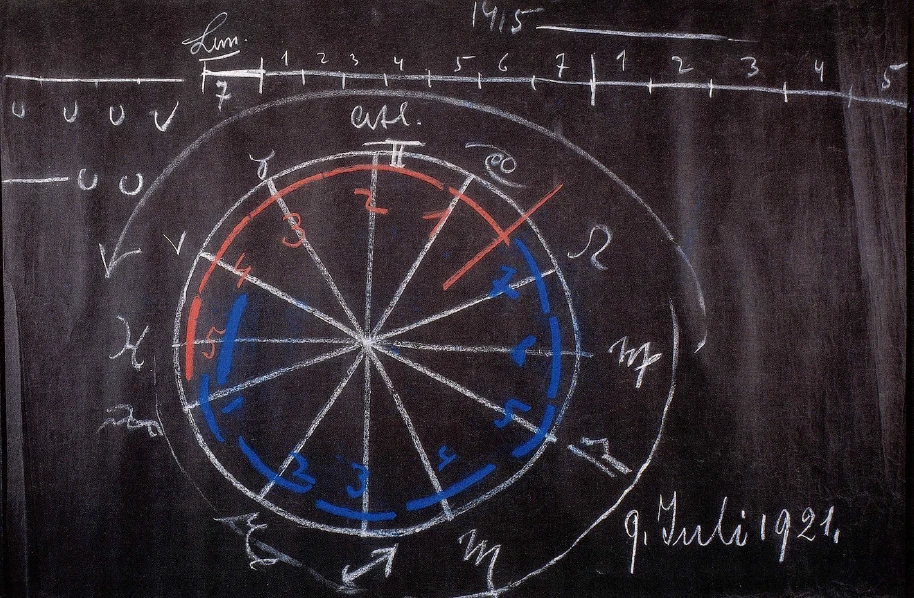
[ 25 ] Now, when we consider these periods, we can form the following schematic picture of their sequence. Please imagine that the Atlantean period was preceded by the one I called the Lemurian period in my Outline of the Occult Science. I will consider here only the final phases of this Lemurian epoch and will now outline the seven successive cultural stages of the Atlantean era: and following that, we have the Proto-Indian, Proto-Persian, Egyptian-Chaldean, Greek-Latin, and now our fifth era; that would be the most recent epoch. I have presented the successive periods to you schematically here.
[ 26 ] You now know from my Occult Science and from other explanations I have given that such a period lasts approximately as long as it takes for the vernal equinox to complete its entire passage through the zodiac. This is only an approximation, but for the purpose we now wish to consider, this approximation will serve its purpose well. In 747 B.C., the vernal equinox entered the zodiac sign of Aries. It remained in this sign until the 15th century. Then it moved on and is now in the zodiac sign of Pisces. Before 747, the vernal equinox was in the sign of Taurus; thus, throughout the entire Egyptian-Chaldean cultural period, the Sun rose in the constellation of Taurus in the spring—hence the cult of Taurus. Then came the Proto-Persian period, during which the Sun rose in the constellation of Gemini. During the ancient Indian period, the sun rose in the constellation of Cancer. Then we return to the Atlantean period, which comprises the seven cultural epochs of that era. Now I ask you to consider the following and to hold it before your soul as a question that we must first address today.
[ 27 ] Let’s take a look at the sequence of zodiac signs. So here we have: Aries, Taurus, Gemini, Cancer, Leo, Virgo, Libra, Scorpio, Sagittarius, Capricorn, Aquarius, Pisces. We will now sketch out schematically how this relates to the successive cultural periods. We know that we are currently in the sign of Pisces at the vernal equinox, in the fifth post-Atlantean cultural epoch. Let’s go back (see diagram, page 165, darkly hatched): Aries—the fourth post-Atlantean cultural epoch; Taurus—the third post-Atlantean cultural epoch; Gemini—the second post-Atlantean cultural epoch; Cancer—the first post-Atlantean cultural epoch. We are now returning to the Atlantean era. The seven periods of the Atlantean era (light hatching): Leo—the seventh, Virgo—the sixth, Libra—the fifth, Scorpio—the fourth, Sagittarius—the third, Capricorn—the second, Aquarius—the first; and now we return to the Lemurian era and find ourselves once again in Pisces.
[ 28 ] You see, when you consider the significant period of the last culture—the last cultural epoch of the Lemurian era—and when you read through what I have described about this important period in the development of humanity on Earth in my Occult Science, you will be faced with a major question. If you take what I have described in my Outline of Esoteric Science, particularly in the sections that were later published separately as Our Atlantean Ancestors, you will see that one can actually speak of humanity—insofar as it is humanity today—only from this period onward, and this period is the one in which the vernal equinox was in the same zodiac sign in which it is now once again. As humanity, we have completed a full cycle around the heavens and, in a certain sense, have returned to the starting point.
[ 29 ] What I have just said refers to human development. We have often attempted to describe how human soul life changed in the period leading up to the Atlantean era. We know how different this entire human soul life was in the Proto-Indian era, for example, and how it was still different in the Atlantean era. But if you read my work on the Atlantean ancestors, you will see that even in the Atlantean era we are already returning to a time when the human physical form also manifested itself in a way that corresponded to the state of the human soul at that time. While in the post-Atlantean era the life of the soul operates in a fundamentally different way, during the Atlantean era the entire body undergoes a metamorphic transformation. So we are moving more and more—I would say—back from the region I have characterized above as the soul region to the one below, which is the physical region, permeated by the other current of will. And as we go further back in time in Atlantis, we return to the metamorphoses relating to physical form. So that we can say: during the vernal equinox’s passage through Pisces, human beings had only just begun to take on their present physical form (light hatched area). Here, the physical form takes shape more and more. And here it begins to take shape in the soul, only to return to the point from which they once set out in terms of their physical form. So you can say that the zodiac signs from Pisces, Aquarius, Capricorn, Sagittarius, Scorpio, Libra, up to Virgo here (light hatched) correspond to the transformation of the human physical form; and only these upper zodiac signs correspond, for us, to the transformation of the human soul.
[ 30 ] One must first consider these things from the perspective of spiritual science, and one will see that it is only then that one actually reaches the point where one can form concepts and ideas about the essential nature of the human being. On the other hand, however, at least a glimmer of insight may now be shed on what I have often said here: that we are living in an important age. For while we as humanity have developed on Earth, the vernal equinox of the Sun has traveled throughout the entire cosmos and has returned in our age. We must therefore fulfill tasks that, in a sense, arise from the fact that humanity has returned to its starting point—that it must undertake something in its spiritual life that corresponds to this return to the starting point. Today I simply wanted to point out what such a reflection on the importance of the present era in human history might evoke in our feelings. Admittedly, what I have said applies to the most advanced members of civilized humanity; but, after all, it is they who are truly crucial for the development of humanity.
[ 31 ] We'll talk more tomorrow about how these things relate specifically to the latter.