

Human-Becoming, World-Soul and World-Spirit I
Human Beings as Physical and Spiritual Entities
in Their Relationship to the World
GA 205
10 July 1921, Dornach
Translated by Steiner Online Library
Tenth Lecture
[ 1 ] Yesterday, at the end of my lecture, I pointed out that the vernal equinox has completed a full cycle from Pisces to Pisces since the time from which, according to the spiritual-scientific view, we must date the development of humanity on Earth. When I have spoken in this context of the development of humanity on Earth, this must of course be understood correctly. We speak of the overall development of humanity in such a way that we trace its origins back to the ancient Saturn era; therefore, when we speak here of the development of humanity on Earth, we are naturally referring only to a partial phase of that development. But one can, of course, picture the matter this way: Human beings naturally had a fundamentally different form during their own Saturn, Sun, and Moon periods—a form that cannot be compared at all to the form of human beings today. And when we speak here of the form of humanity on Earth, it means that the preparations for this physical human form began back then at the end of the Lemurian epoch, and that they took shape, as I have described in my writings, during the Atlantean epoch—that is, precisely during the period that represents one full cycle of the spring vernal equinox.
[ 2 ] Today, let us take a closer look at the conditions to which human beings were actually subject during this period, in which they have, so to speak, returned to their starting point. I would like to present a schematic overview so that you have a complete picture of what I actually mean by these remarks. We cannot say that human evolution has proceeded in such a way since the last Lemurian epoch—when the spring vernal equinox was also in Pisces—that we can depict this evolution as a cycle that simply loops back on itself. That would be incorrect. We must conceive of this cycle—for, of course, I am merely presenting an image of evolution—as spiral-shaped. We must therefore imagine that, if the starting point of evolution in the ancient Lemurian era lies here, this evolution returns in such a way that humanity has naturally ascended to a higher stage of its being, but at this higher stage—in terms of its relationship to the cosmos—has, in a sense, returned to its starting point in the present age. And how human beings had to live within these conditions—let us bring that to mind today.
[ 3 ] Some time ago, I gave lectures to a small group in Stuttgart on a possible astronomical worldview. I pointed out how, over long periods of time, the so-called Ptolemaic worldview had been regarded by humanity as correct. This Ptolemaic worldview is thoroughly ingenious; indeed, I would say that, in certain geometric lines and forms, it summarizes what must be summarized if we wish to express, through visual representations, the view we have of the stars, their positions, and their orbits. Then, due to certain circumstances—which I have, in fact, described on several occasions—this Ptolemaic system of the world was replaced by the one that, in essence—albeit with significant modifications—is still regarded today as the correct one: the Copernican system. I have now shown in Stuttgart that this Copernican system of the world is, in fact, nothing other than a summary—achieved through lines—of what we actually see when we direct our eyes, telescopes, or other instruments out into the cosmos, and I have shown that one cannot by any means say that this Copernican system of the world is, say, that much more correct than the Ptolemaic system of the world; it is merely a different way of summarizing the phenomena. And I then attempted to summarize these phenomena myself, drawing on what human beings—who, after all, must participate in a movement if, for example, the Earth is in motion—can experience within themselves. Today I wish only to present the result to you; the rest is not important for us today.
[ 4 ] For when one begins to summarize these phenomena not in a one-sided manner—as is done in both the Ptolemaic and Copernican world systems—but rather takes into account everything that is available, one comes to the conclusion that this summary ultimately becomes so complicated that one can no longer make do with a simple world system depicted by pen or on a planisphere. It is, in fact, not at all possible to summarize things in such a simple way as one would usually like to. And one can indeed arrive at something very remarkable in this way, which I would simply like to present to you, because—as paradoxical as they may seem to people today—these things must be discussed.
[ 5 ] People believe, after all, that modern science is the most intelligent thing that has ever existed, and that, fundamentally, there could be nothing more intelligent. And based on this belief, humanity is indeed heading toward a terrible cultural fate. But the truth must also be presented in a certain way. For when one takes more and more circumstances into account, one ultimately arrives at a state of mind—in the face of the complexity of the world system—that is very similar to the one one experiences when one has just awakened and encounters the chaotic mental images that I spoke of yesterday and the day before, which lie within us as an undercurrent. I have outlined the human organism schematically for you, distinguishing between the etheric body and the physical body, and I said: These chaotic images emerge from it—images that are actually always present, even during the day. They can be observed very clearly in people with a dreamy disposition, but everyone perceives them in the depths of their soul. And they can be perceived particularly strongly when, in the morning, a person immerses their ego and astral body into their physical body and etheric body. — Now I do not mean these images themselves—these images are, of course, in people of a certain disposition, depending on their perfection or imperfection, either very poetic and imaginative, or they are primal chaos, the latter being the case in most instances— but I am referring to the state of mind one enters when, as a reasonably logical thinker accustomed to thinking in logical terms, one now finds oneself transported into this world of images. What is meant is the state of mind into which one enters who does not approach the matter with all the prejudices and simplistic nonsense that prevail when constructing worldviews, but who approaches it entirely without prejudice. Then, in the face of what one has most recently attained—in the face of its complexity, in the face of its intricate interweaving—one enters a similar state of mind.
[ 6 ] Certainly, our age has brought it to the point—and this is actually a great boon, even given the disposition of most people’s souls—that every schoolboy knows exactly: The sun is at the focus of an ellipse; the planets revolve around it; the fixed stars stand still; and so on. — Every schoolboy knows this, and it is incredibly simple. But if one approaches these things without prejudice and without theoretical nonsense, one does not find this simplicity; rather, things become immensely complicated, and one ultimately arrives at a state of mind such as I have described, in which one says to oneself: One must move toward something that transitions from the definite to the indefinite, from clearly drawn lines to lines drawn in a problematic way. — One simply enters a state of mind that tells one: What you’re taking into your head there is, at the root of it, an image—an image that is woven and that you can, of course, simplify, as if you were, say, drawing a schematic of Raphael’s Madonna. But just as you would not have the whole of Raphael’s Madonna in that sketch—the whole that stands before you in the actual painting—so too, in the Copernican system, you do not have before you what actually stands before us in the universe in the form of an image that encompasses an infinity of details and particulars. It is precisely when you make such a consideration that you will understand: If, in the face of the phenomena of the universe, one ultimately has to say something like this to oneself, then one cannot actually face reality as such; for one faces what presents itself to us in a state of mind akin to the world of images we encounter when we enter our bodies from the cosmos in the morning. Thus, there can be no question of one actually facing reality.
[ 7 ] These are the kinds of considerations that must be made if one wishes to have, in the fullest sense of the word, an understanding of what it actually means: We live with our consciousness in the world of illusion, of Maya. We also live within Maya in relation to the image we form of the universe and its phenomena. And finally, we can also observe the phenomena that the sensory world weaves around us, and we arrive at something similar. We do not, however, arrive at what a—I might say—clumsy theory of knowledge arrived at at the end of the 18th century and throughout the 19th century, which, after all, repeats over and over again: “Yes, out there are the phenomena—wave oscillations to be understood through mechanical and dynamic laws, or, as they say these days, electrons—and these exert an impression on our senses; and what we then perceive is merely an effect of what is out there; but that is precisely just the phenomenon as it appears to us.” — To speak of “phenomena for us” in this sense is, in fact, a thoroughly clumsy theory of knowledge. With such a view, one can indeed have some rather strange experiences.
[ 8 ] All it takes is a few lines here and there today to speak out against this theory of knowledge, and then someone pops up and says, “But Kant said…!” — People have become so entangled in Kantianism that they regard it as a kind of Bible; many of them, at least. They may change this or that, but on the whole they regard it as a kind of Bible. That’s where one can have some curious experiences. I once gave a series of lectures on such topics in Berlin; it was in the winter of 1900–1901, the very same winter about which Mr. von Gleich later claimed that a certain “Winter” had taught me about theosophy—he confused the winter of 1900–1901 with a Mr. Winter who was supposedly supposed to have taught me about theosophy! I don’t know whether he read about it or was told that I once gave these lectures in the winter—which were later published; they were held in Berlin during the winter of 1900–1901—and that the word “Winter” was taken to refer to Mr. Winter’s name. Yes, this argument is no more sensible than General von Gleich’s other foolish and mendacious arguments. But you see, there was also a die-hard Kantian sitting in on those lectures in Berlin. I can’t say he was listening, because he was asleep most of the time, and I don’t know how many people can listen while sleeping, but I was able to observe at the time that the gentleman only woke up when he could somehow bring Kant into the discussion. And it happened once that I repeated an argument—it wasn’t even mine—which goes like this: If one really speaks of the thing-in-itself as Kant does, in the sense that it is completely unknown, then it could consist of pins, so that behind the sensory phenomena there could be nothing but pins everywhere. — But when I said this, the man in question jumped up as if stung by a tarantula and said: “There is no space or time behind the phenomena. Pins are in space, after all, so the thing-in-itself cannot consist of pins!” — It is just one of the examples one so often encounters when people believe that their Bible—their Kantian Bible—is somehow being tampered with.
[ 9 ] Well, it’s not as if, so to speak, certain “things-in-themselves” were to project effects into us that then merely trigger sensory qualities, so that we would actually be trapped within our sensory qualities; that’s not how it is. But something else is true. Please, just consider the following: Stand out there, let’s say, at eleven o’clock in the morning, and look at the surrounding area—but look at it closely, not the way some people draw it, because what’s drawn there is just nonsense; of course, it doesn’t reflect sensory appearance—but look at it at eleven o’clock, at twelve o’clock, with all its lighting effects. The entire tapestry of sensory impressions has completely changed by twelve o’clock, by five o’clock, by eight o’clock—completely changed. The image around you is constantly changing. You are never dealing with anything other than interwoven effects. A tree—what do you see of the tree? You see the reflected light; you may see the leaves moving in the wind, and so on; in short, you never see anything permanent. You simply see an objective phenomenon. While clumsy epistemology speaks of a subjective phenomenon, you see an objective phenomenon, and this objective phenomenon naturally reveals itself to the eye as well. Just as the tree captures and reflects the rays of light in a certain way, so too does the eye stand in a certain relationship to the rays of light, and we can say: The phenomenal, the apparent, the illusory—the nature of Maya that is spread out in the sensory world around us—is, of course, also present in our subjective image; but because it is objectively changeable, it is also changeable in the subjective image.
[ 10 ] That is precisely what I sought to demonstrate, for example, in the first section of my Philosophy of Freedom or in my little book Truth and Science, and so on. So even when we face the world, we are not dealing with a permanent, enduring reality; we are dealing with something—one might say—that arises and passes in the very moment. We are dealing with phenomena. And if we were to construct this image theoretically, we would once again arrive at nothing other than those few lines in the Sistine Madonna. And so it is in everything we are immersed in. We are immersed in the world of phenomena, in Maya, but even though we are immersed in this world of Maya with all our powers of perception, we are not dependent on this world. For it is perfectly clear to us when, in the morning, we emerge from the cosmos with our “I” and our astral body and immerse ourselves in our etheric body and our physical body, that that into which we immerse ourselves contains something objective, something true. Certainly, what swirls toward us there as chaotic images is merely an appearance; but that into which we immerse ourselves contains a Truth. And at the very moment we immerse ourselves in this way—whether through the thought, “I want to move my limbs,” or through the thought, “I want to transform my ideas into imaginative forms,” or, let us say, through the thought: “I want to organize my ideas into logical thought structures”—in whatever arises within us as we immerse ourselves in our body, we know that we have something that does not depend on us, something we receive, something that receives us. And the moment of waking is the one that imparts to us our sense of being.
[ 11 ] This sense of being is, in a sense, something that ripples through and permeates our entire imagination. But our imagination itself operates more in the world of phenomena, of appearances, of Maya. And if we extend what I have described here based on ordinary experiences—if we extend that to the whole human being.
[ 12 ] Anyone who, with the help of such insights—which can be gained on the basis of my explanations in How Does One Attain Insights into the Higher Worlds?— can view the whole human being, will soon understand how that part of the human being—which, as a soul-spiritual being, passes through the state between death and a new birth—enters the physical world, incarnates, in order to pass through the state between birth and death, and then once again a state between death and a new birth. I have, in fact, elaborated on some important details regarding these very processes in my recent lectures here. When the moment of insight arrives when one can look back into the world that lies before birth or before conception, one realizes: The world from which that which actually constitutes our sense of being is built—this world—is the one we have passed through between death and a new birth. The true sense of being—a sense of being that is not subject to any doubt or skepticism—is attained only when one looks back into this world of existence that lies before conception.
[ 13 ] But now something significant is becoming apparent—you can already glean this from my Vienna lectures in the spring of 1914—and I would like to present it to your soul in a different form. For there is something that confronts us before the human being descends into physical embodiment from the state between death and a new birth. During this time, the human being’s desire to be, the desire for existence, gradually fades away more and more. As the human being develops between death and a new birth, I would say they pass through a state of absolute saturation with the sense of being. This is one of the achievements that a person attains between death and a new birth: that, after passing through the first stages following death, they increasingly arrive—through their relationship to the world into which they then enter—at a deeply penetrating sense of being, at—if I may use the expression—a sense of being anchored in the world’s existence. And this becomes stronger and stronger until a kind of oversaturation with the sense of being sets in, and then, toward the end of the period between death and rebirth, there occurs—I would say—a true oversaturation with the sense of being. I could also call it something else. I could say that a true hunger for non-being arises within the human being. Those spiritual-soul entities that descend to Earth as human beings actually display, before they descend to Earth, a strong hunger for non-being. And from this state of the soul or spirit, we might say: Because the human being is hungry for non-being, in this state he plunges into Maya—into that world we have before us, both in relation to the world of the stars and to the earthly phenomenal world. It is a longing for this non-existent world, for this world toward which one’s soul dispositions are akin to chaotic images when one delves to their very core—this world that actually presents a different aspect to us at every moment. After all, as we immerse ourselves in this world, we are entirely within an illusory world, within a world of Maya. It is into this world of Maya that the spiritual-soul aspect seeks to plunge, and this is what we are actually dealing with. The rest are, more or less, side effects. This is the strongest impulse that lives within the spiritual-soul human being as he approaches earthly existence: this longing for Maya, this longing to live within the soft, pervasive phenomenon, rather than within the saturated, intense being. And that which then envelops the human being as the etheric body and the physical body—that is born out of the cosmos; with it, the human being is clothed. I have, after all, described in recent days how the embryo is formed out of the cosmos within the mother’s womb.
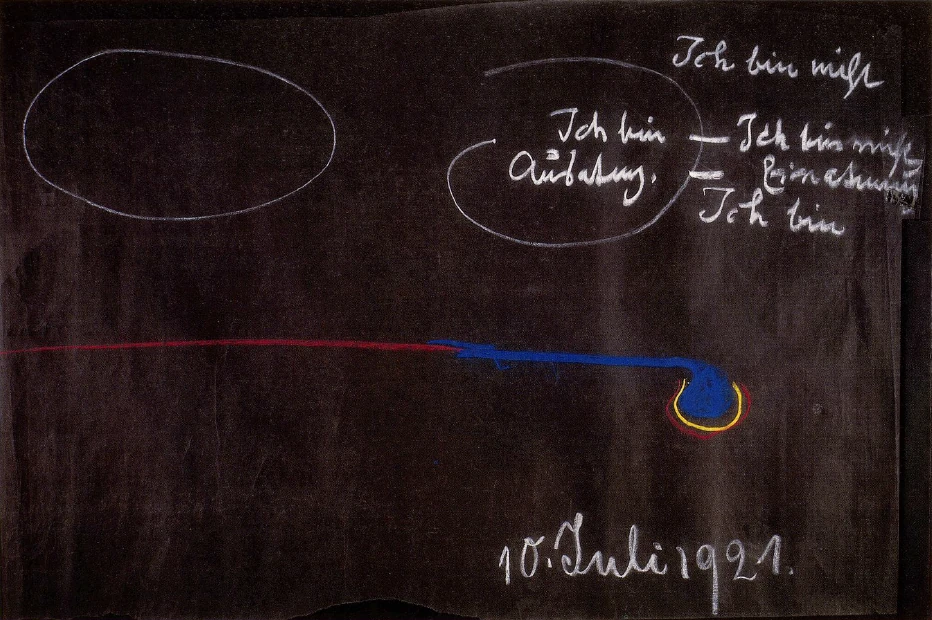
[ 14 ] So we must imagine: Human beings essentially come from a completely different world. In that world, he develops this longing for non-existence, for life in Maya, as he approaches physical existence on Earth, and he is drawn in as he plunges into Maya with his ego and his astral body (see diagram, red, blue), along with his etheric body and his physical body (yellow, red); but these are formed in the mother’s womb through fertilization as his garment from the cosmos. The human being comes from a world that is not the one of space and time, one that cannot be found in space, but he is clothed in space with that which is formed in the mother’s womb. He then immerges into it every time he wakes up. When falling asleep, he emerges from it again. Thus a rhythm is formed of immersing oneself in physicality and drawing oneself out of this physicality.
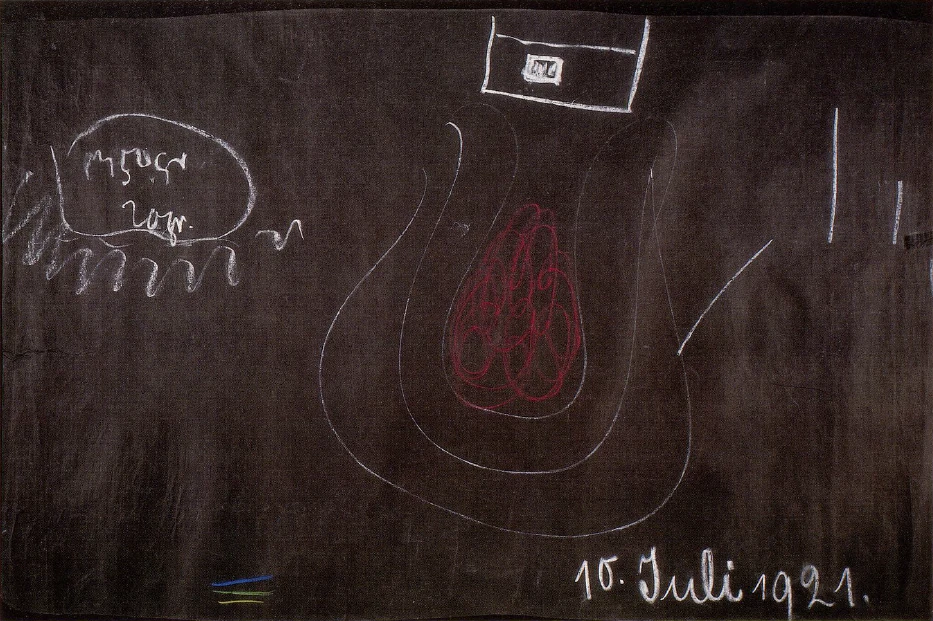
[ 15 ] Today’s conceptions are indeed such that they pose great difficulties in relation to reality. This convergence, for example, of a completely different current that a human being undergoes before reaching the stage of embodiment, and the external world that then envelops him—which, after all, previously had no essential connection to him—how this actually comes about, I have described on other occasions— this interplay—modern science can hardly describe it accurately because it lacks the necessary concepts.
[ 16 ] The same thing can be observed in another field. When a physiologist today speaks of light or color, his primary concern is to describe and uncover something that the eye does. But in reality, this is actually just as if someone wanted to describe any of the people sitting here and, above all, were to describe this carpenter’s shop here simply because you walked in. Basically, the light that enters the eye and makes its presence felt there has no more to do with the eye than you have with the carpentry shop once you’ve walked in and the shop now surrounds you as well. If someone describes the carpentry shop and you, they naturally describe it as a whole. But that’s not the case. It’s just difficult to find the truth in the face of today’s convoluted ideas.
[ 17 ] And so we can say: That which constitutes the spiritual-soul aspect of the human being enters this earthly world, above all, out of a longing for non-existence. And every waking state—that is, every state experienced from waking up until falling asleep—is a new education in being, a renewed imbuing of consciousness with being.
[ 18 ] Human beings, in the state they are in between death and a new birth—I would say they are so happy when they can arrive at their physical embodiment; they are that happy. — I have often described to you how the brain floats in cerebrospinal fluid. If its entire weight—one thousand three hundred fifty grams or so—were to press down on the veins beneath the brain, those veins would be crushed and could not survive; but the brain exerts a pressure of only about twenty grams. Why? Because the brain floats in cerebrospinal fluid. And you’re familiar with Archimedes’ principle. Isn’t that right? It was discovered by Archimedes. He was once in a bathtub taking a bath when he felt himself becoming lighter and lighter in the water, and he was so delighted by this discovery that he immediately ran naked through the streets—which was more acceptable in ancient times than it is today if you were a scientific researcher—and shouted: “I’ve got it, I’ve got it!”—namely, that every object in a liquid loses as much of its weight as the weight of the volume of water it displaces. So if you have a container of water and you place a solid object inside it, it becomes lighter than it actually is outside the water, and indeed it becomes lighter by the weight of the volume of water it displaces—that is, by its own weight, if you imagine it as a cube of water. So if, for example, there were a cube here and you imagined it as a cube of water and weighed it, the actual cube would be lighter by the weight of the water cube. And so the brain becomes lighter by up to twenty grams; it exerts a force of only twenty grams because it floats in the cerebrospinal fluid. The brain, therefore, does not follow its full weight. It is driven upward. This force that drives it upward is also called buoyancy. People look forward to entering something that actually pulls them upward—that truly pulls them upward. And through those twenty grams, they learn to be heavy again, and through that heaviness, we learn the sense of being. Between birth and death, a person is once again permeated with a sense of being. And this is then developed and enhanced in the process of evolution after death.
[ 19 ] This is precisely what, I would say, has so vanished from the consciousness of modern humanity that the greatest philosopher of the early modern era, Cartesius or Descartes, coined the phrase: Cogito ergo sum — I think, therefore I am. — It is the most nonsensical formula one can imagine, for it is precisely when one thinks that one does not exist. One is precisely outside of being. “Cogito ergo non sum”—that is the real truth. We are so far removed from the real truth today that even the greatest modern philosopher has substituted the opposite for the truth. We acquire the sense of being precisely when thinking feels itself within the organism, when thinking feels embedded in that which is heavy. This is not merely a popular image; it is reality as opposed to appearances.
[ 20 ] But this can teach us how human beings, as they initially understand themselves, descend to Earth in a state of self-awareness—in fact, immerse themselves in Maya—and within Maya learn what they will need after death: the sense of being.
[ 21 ] Well, when one describes what I have just described to you, one has something that is specifically human in human development. This—I would say—rhythmic movement between a sense of being and a sense of non-being—you can visualize it for meditation in the following way. You can say, when living in mere thought: “I am not.” — When living in relation to the will, which physically rests in the metabolic-limb human, then one says: “I am.” — And between the two—between the metabolic human and the purely cerebral human, who says, “I am not”—if one understands oneself, for what lives in the brain are merely images; what lies in between is the rhythmic alternation between “I am” and “I am not.” — The external physical counterpart to this is breathing. Exhalation fills the breathing process with what comes from metabolism—with carbon dioxide. “I am”—is exhalation. “I am not”—is inhalation. “I am not
[ 22 ] I am not
I am — I am notExhale — Inhale
I am
[ 23 ] Inhalation is related to the thought: “I am not.” Inhalation works in such a way that we draw air into our ribs, pushing the fluid in the arachnoid space upward and thereby pushing the cerebrospinal fluid upward as well. We bring the vibration of the breathing process into the brain. This is the organ of thought. Transmitting the inhalation process to the brain: “I am not.” Then exhalation: the cerebrospinal fluid—through the arachnoid space—presses on the diaphragm; exhalation of the air saturated with carbon, now turned into carbon dioxide: “I am”—out of will. Exhalation: out of will.
[ 24 ] Viewed in this way, all of this is a purely human process, for anyone who wishes to apply this to animals—say, because animals also breathe—is like a person who takes a razor to cut up meat simply because it is a knife. Certainly, animals breathe as well, but animal respiration is simply something different from human respiration, just as a razor is something different from a table knife. Anyone who bases their definitions on the outward appearance of a thing will never arrive at any useful explanation of the world. Death is one thing in humans, another in animals, and yet another in plants. Anyone who starts from a definition of death will arrive at no more of a useful explanation than someone who starts from the definition of a knife and says, for example: “A knife is something that is so sharp on one side that it cuts through other objects.” — Of course, that provides a nice general concept, but one cannot understand anything about what really is. So these are specifically human processes that I have described to you. They are the human processes that humanity has undergone while the vernal equinox has completed its cycle from Pisces to Pisces. This is precisely the period in the Earth’s evolution when humanity, in the leading segments of the peoples, essentially went through everything I have just described to you—and all of this points to an understanding of how things actually unfold: how human beings, by descending into the physical world through birth, plunge into Maya, and is reborn out of Maya through death, enriched by the sense of being that he needs for his further life after death. This is a most important fact—this being reborn through death with the sense of being—whereas being born is the plunging of the human being’s spiritual-soul entity into Maya. It is precisely because we plunge into Maya—that is, into a world of images—that we are free. We could never be free if our consciousness were situated in a world of facts between birth and death. We are free only because we are in a world of images. Images reflected in a mirror do not determine us causally. A world of facts would causally determine us. What you bring to the image hanging before you must come from within you. The phenomena of the world do not determine us as human beings in what I have called, in my Philosophy of Freedom, “pure thinking”—that which does not arise from the organism. What emerges from the organism, as you have seen, is imbued with the sense of being, even though this sense of being is present in the brain in such a small percentage—roughly twenty to one thousand three hundred and fifty. We must keep returning to this point again and again: how human beings actually develop a longing for Maya by being born into earthly life, and how earthly life educates them in the sense of being. This is what we have gone through during the period from the last Lemurian epoch into our own epoch—a period spanning a solar cycle of 25,920 years, during which a great world cycle has been completed. But now we find ourselves precisely in that time when evolution has returned to its starting point; however, I have depicted it as follows: We must schematically depict it as a spiral (see diagram on page 170). — The evolution of humanity has indeed arrived at its starting point, but at a higher level. What, however, does this higher level mean? This higher level means that, as humanity, we have until now always plunged into Maya upon being born and then attained the sense of being from within physical existence. But the Earth, too, has undergone a transformation in the meantime; the Earth today is no longer the same organism it was in the Lemurian or Atlantean eras. As I have often explained, the Earth is already in the process of dissolution.
[ 25 ] Geology confirms this as well. You can read about it in Eduard Sueß’s beautiful geological treatise, The Face of the Earth: The Earth is undergoing a process of disintegration; the Earth is undergoing a process of dissolution. — As a result, we no longer have all the opportunities we need to sufficiently reclaim our sense of being. And now that a cycle has come to an end—as I explained just now and yesterday—humanity faces the danger of undergoing deaths in which it has developed too weak a sense of being, simply because our Earth no longer provides the necessary intensity of that sense of being. With this new period—which I have now described to you as a period affecting the entire cosmos—the prospect opens up for humanity to pass through death with, if I may put it this way, an excessive sense of lightness. Humanity may become more and more materialistic; the consequence of this increasing materialism will be that it carries an insufficient sense of gravity or being through the gate of death.
[ 26 ] This is something that is already quite clear to those familiar with the state of the world today: Souls today pass through the gate of death, carried upward, as it were, by their own sense of non-existence, so that they experience the opposite of what a person who falls into water and cannot swim experiences—that person sinks. As they pass through the gate of death, these souls rise upward because of their light weight. The way the term “weight” is used in the spiritual world is mentioned at a key point in my Mysteries. They rise upward and lose themselves. This can only be counteracted if people rise from the concepts that can be acquired quite naturally today—and which feature throughout our entire lives—to that which must be attained through a certain effort in physical life: namely, those concepts that physical life alone does not provide, but which are acquired through spiritual science.
[ 27 ] What do people who are determined to remain stuck in today’s way of thinking say about spiritual science? They say: “Yes, what is described, for example, in Steiner’s Occult Science—that’s just fantastical, it’s arbitrary, you can’t even imagine it!” — Why do people say that? People can see chalk, see tables, see legs, and they can only imagine what has once appeared before their soul in this way; they do not want to imagine anything other than what they have absorbed from the leading figure of external physical reality. They do not want to develop any inner activity in their imagination. Anyone who wants to study Outlines of Esoteric Science must make an effort themselves. When they stare at an ox, they certainly have a reality before them; they don’t need to make an effort, but only need to stare at it and then form a so-called concept that isn’t a concept at all. The point is that the very concepts indicated by spiritual science—for example, by my Occult Science or Theosophy or by other books—demand this inner activity. A large portion of humanity—which is all the more materialistic today because it seeks to construct the spiritual world in materialistic terms—the spiritualists, in particular, have no desire to engage in this thorough thinking through and working through of Occult Science; they would rather have something conjured up for them by Schrenck-Notzing or others, where such lumps—shaped like humans or the like—appear before their souls in such a way that they can remain completely passive; they do not need to exert themselves at all.
[ 28 ] But in doing so, one becomes increasingly light, and one works against one’s continued existence after death. However, by immersing oneself in the activity necessary to penetrate spiritual science, one must exert the physical aspect more strongly and connect more closely with the physical than is the case today under so-called normal circumstances. One must give greater weight to concepts. In this way, one carries one’s sense of being through death and is then prepared for life after death.
[ 29 ] That’s something, isn’t it, that people today are so fond of: not adding anything to what comes their way in life. If they’re supposed to add something, to be active, it immediately makes them uncomfortable. Outwardly, in social life, we’ve always strived to learn as much as the state prescribes and to learn according to its templates; so that when we’ve happily reached the age of twenty-five or twenty-six and are ready for our legal clerkship, we’re then slipped into some kind of system and are entitled to retirement after so many decades; now we’re secure. We are, of course, only in our twenties, but we are insured for our entire lives. We let our bodies “retire”—this is guaranteed to us from the outset—and then there is the church, the creed, which demands nothing more than that we passively submit to what is offered to us. And the church then “retires” our souls when we are dead; it assures us of this without our having to do anything, other than live in faith, just as our body was retired before. This is something that must be broken with if culture is not to reach its decline. Inner activity, active inner participation in what a person makes of himself—even what he makes of himself as an immortal being—that is necessary. Human beings must work on their immortality. This is precisely what most people would gladly have swept away. They believe that knowledge can only teach one something that is true anyway; at most, it can teach one that human beings are immortal. There are those who say:
[ 30 ] Yes, this is where I live, just as life is here; as for what will be after death, I’ll see well enough then.
[ 31 ] He will see nothing, absolutely nothing! For the argument is about as ingenious as that of Anzengruber’s character: As surely as there is a God in heaven, I am an atheist! — These things follow the same logic. The fact is that, with regard to the spiritual-soul aspect, by incorporating it into our understanding, we prepare the spirit so that after death it does not undergo the opposite state of one who is sinking while floating—that is, of one who is rising without substance. We must work on our being so that it can pass through death in the proper way. And the acquisition of spiritual knowledge is not merely the acquisition of abstract knowledge; it is the permeation of the human spiritual-soul with the forces that conquer death.
[ 32 ] This is, in fact, the essence of Christian doctrine. Therefore, a person should not merely have faith in Christ, as a more recent creed certainly insists, but should take Paul’s words to heart: “Not I, but Christ in me.” The power of Christ within me—it must be willing to develop, and it must be cultivated! Faith as such cannot save a person at all; rather, it is solely and exclusively the inner cooperation with Christ, the inner working out of the power of Christ—which is always there if one is willing to work for it, but which must be worked out. Initiative and activity—that is what humanity will have to fill itself with. And humanity will have to realize that merely passive faith makes life too easy for people, so that immortality on earth would gradually die out. That is Ahriman’s aim. And to what extent this is Ahriman’s aim, we shall then bring to mind in a future lecture, for today we stand in the midst of the struggle between the Ahrimanic and the Luciferic forces. And just as we have, in a certain sense, protected our unconsciousness by the vernal equinox completing a cycle, we will have to enter the next cycle in such a way that, with full consciousness
[ 33 ] In 1987, we were drawn into that which permeates the world: the struggle between the Luciferic and Ahrimanic spirits. Spiritual science leads us into reality, not merely into abstract knowledge. More on this next time.