Human-Becoming, World-Soul and World-Spirit II
Human Beings as Physical and Spiritual Entities
in the Course of History
GA 206
24 July 1921, Dornach
Translate the original German text into any language:
Versions Available:
Human-Becoming, World-Soul and World-Spirit II, tr. SOL
Sechzehnter Vortrag
Sixteenth Lecture
[ 1 ] Jenen Schnitt durch das Wesen des Menschen, von dem ich gesprochen habe, Sie finden ihn auch im alltäglichen menschlichen Gesamtleben zum Ausdruck kommend. Sie finden ihn vor allen Dingen, wenn Sie sachgemäß das Verhältnis zweier menschlicher Fähigkeiten untersuchen, die durch ihre eigene Beschaffenheit auch bei oberflächlicher Betrachtung sich als sowohl dem seelischen Leben wie auch dem körperlich-leiblichen Leben angehörig erweisen. Sie finden auf der einen Seite als eine wichtige, sagen wir, Tatsache des Seelenlebens im menschlichen Leben eben mit dem körperlichen Leben verbunden die Fähigkeit des Gedächtnisses, der Erinnerung, und Sie finden auf der andern Seite, sagen wir, eine Kraft im menschlichen Leben, deren Wesenheit weniger ins Auge gefaßt wird, weil sie mehr eine Fähigkeit ist, der man sich naiv hingibt, ohne sie näher zu prüfen oder gar zu analysieren: das ist die Kraft der menschlichen Liebe. Es muß von vornherein gesagt werden, daß, wenn man über solche Dinge erstens mit Bezug auf die Wesenheit des Menschen, dann aber auch mit Bezug auf das Verhältnis des Menschen zur Welt spricht, man sich darüber klar sein muß, daß man von der Wirklichkeit, nicht von irgendeiner Vorstellung auszugehen hat. Ich habe öfter den zwar banalen Vergleich für das Ausgehen von Vorstellungen-statt von der Wirklichkeit gebraucht: Jemand sieht ein Rasiermesser, und er sagt, das sei ein Messer, ein Messer gehöre zum Schneiden der Speisen; also nimmt er das Rasiermesser zum Schneiden der Speisen, weil es ein Messer ist.
[ 1 ] That aspect of human nature I have spoken of is also expressed in everyday human life as a whole. You find it above all when you properly examine the relationship between two human faculties which, by their very nature, prove—even upon superficial observation—to belong to both the soul life and the physical-bodily life. On the one hand, you find—as an important, let us say, fact of the soul life in human existence, closely linked to physical life—the faculty of memory; and on the other hand, you find, let us say, a force in human life whose nature is less readily grasped, because it is more of a faculty to which one naively surrenders without examining it more closely or even analyzing it: that is the power of human love. It must be stated from the outset that when one speaks of such things—first in relation to the nature of the human being, and then also in relation to the human being’s relationship to the world—one must be clear that one must proceed from reality, not from some mere conception. I have often used the admittedly banal comparison to illustrate the mistake of starting from ideas rather than reality: Someone sees a razor and says it is a knife, and that a knife is used for cutting food; so he uses the razor to cut food because it is a knife.
[ 2 ] So ungefähr, obwohl man es gewöhnlich nicht glaubt, weil man die Sache für sehr gelehrt hält, sind die Auffassungen, die, sagen wir, zum Beispiel wissenschaftlich denkende Menschen über den Tod oder über die Geburt haben mit Bezug auf Menschen und Tiere. Manchmal dehnt man sogar dann solche Vorstellungen auch auf Pflanzen aus. Man macht sich eine Vorstellung darüber, wie man sich eine Vorstellung darüber macht, was ein Messer ist, und geht dann von dieser Vorstellung, die natürlich der Repräsentant einer gewissen Tatsachenreihe ist, aus und untersucht in gleicher Weise, sagen wir, den Tod beim Menschen, bei Tieren und eventuell sogar bei den Pflanzen, ohne zu berücksichtigen, daß vielleicht dasjenige, was man im allgemeinen in der Vorstellung des Todes zusammenfaßt, etwas ganz anderes sein könnte bei den Menschen und bei den Tieren. Man hat von der Wirklichkeit des Tieres und von der Wirklichkeit des Menschen auszugehen, nicht von der Erscheinung des Todes, die man repräsentiert sein läßt durch irgendeine Vorstellung.
[ 2 ] Roughly speaking—although people usually don’t believe it because they consider the subject very scholarly—these are the views that, let’s say, scientifically minded people hold regarding death or birth as they pertain to humans and animals. Sometimes such ideas are even extended to plants. People form a concept of it in the same way they form a concept of what a knife is, and then, starting from this concept—which is, of course, a representation of a certain series of facts—they examine, in the same way, let’s say, death in humans, in animals, and possibly even in plants—without taking into account that what is generally summarized in the concept of death might be something entirely different in humans and in animals. One must start from the reality of the animal and the reality of the human being, not from the phenomenon of death, which one allows to be represented by some concept.
[ 3 ] In einer ähnlichen Weise sind dann die Vorstellungen geschmiedet, die man zum Beispiel mit Bezug auf das Gedächtnis hat. Mit Bezug auf das Gedächtnis zeigt sich das ganz besonders dort, wo in der Absicht, ein Gleiches bei Menschen und bei Tieren zu finden, der Gedächtnisbegriff in einer undifferenzierten Weise auf beide angewendet wird. Man macht darauf aufmerksam — es ist das sogar sehr berühmten Professoren passiert wie Otto Liebmann —, daß zum Beispiel ein Elefant, der auf seinem Wege zur Schwemme ist, wo er Wasser zu trinken hat, irgend etwas von einem Insult durch einen vorübergehenden Menschen bekommt; der tut ihm etwas. Der Elefant geht vorüber. Aber als er wieder zurückgeht und der Mensch dann wieder dasteht, da spritzt ihn der Elefant aus seinem Rüssel mit Wasser an. Weil der Elefant — so sagt der Erkenntnistheoretiker — sich selbstverständlich gemerkt hat, in seinem Gedächtnis aufbewahrt hat dasjenige, was ihm der Mensch getan hat.
[ 3 ] In a similar way, the concepts we have—for example, regarding memory—are formed. With regard to memory, this is particularly evident when, in an effort to find a commonality between humans and animals, the concept of memory is applied to both in an undifferentiated manner. It has been pointed out—and this has even happened to very famous professors such as Otto Liebmann—that, for example, an elephant on its way to a watering hole to drink water is subjected to some sort of provocation by a passerby; the person does something to it. The elephant walks on. But when it returns and the person is standing there again, the elephant sprays water at him from its trunk. Because the elephant—so says the epistemologist—has naturally remembered and stored in its memory what the person did to it.
[ 4 ] Das äußere Aussehen der Sache ist natürlich durchaus für eine solche erkenntnistheoretische Betrachtung, man möchte sagen, sehr verführerisch, aber eben nicht verführerischer als das Unterfangen, mit einem Rasiermesser das Fleisch bei Tisch zu zerschneiden. Es handelt sich eben durchaus darum, daß man überall von der Wirklichkeit ausgeht und nicht von Vorstellungen, die man an irgendeiner Erscheinungsreihe gewonnen hat und die man dann in beliebiger Weise wesenhaft auf eine andere Erscheinungsreihe überträgt. Man macht sich gewöhnlich gar nicht klar, wie weitverbreitet der eben angeführte methodologische Fehler in unseren heutigen wissenschaftlichen Untersuchungen eigentlich ist.
[ 4 ] The outward appearance of the matter is, of course, quite—one might say—very seductive for such an epistemological consideration, but it is no more seductive than the endeavor to cut up meat at the table with a razor. The point is precisely that one must always start from reality itself, and not from ideas derived from one series of phenomena or another, which are then arbitrarily transferred in an essentialist manner to a different series of phenomena. People usually do not realize just how widespread the methodological error just mentioned actually is in our scientific investigations today.
[ 5 ] Dasjenige, was als Gedächtnis, als Erinnerungsvermögen beim Menschen vorliegt, muß durchaus aus der menschlichen Natur heraus selbst begriffen werden. Und da handelt es sich darum, daß man sich zunächst eine Möglichkeit schafft, zu beobachten, wie das Gedächtnis im Verlauf der menschlichen Entwickelung selber wird. Derjenige, der so etwas beobachten kann, der wird bemerken können, daß sich das Gedächtnis bei dem Kinde noch in einer ganz andern Weise äußert als beim Menschen etwa vom sechsten, siebenten, achten Jahre an. Das Gedächtnis bekommt in den letztangeführten Jahren vielmehr einen seelischen Charakter, während man deutlich merken kann, wie sehr in den ersten Kinderjahren dieses Gedächtnis gebunden ist an die organischen Zustände, wie es sich herauswindet aus diesen organischen Zuständen. Und derjenige, der das Verhältnis der Erinnerungen zu der kindlichen Begriffsbildung ins Auge faßt, der wird merken, wie sich die Begriffsbildung in der Tat stark anlehnt an dasjenige, was das Kind aus seiner Umgebung durch seine Sinneswahrnehmung, durch alle die zwölf angeführten Sinneswahrnehmungen erlebt. Es ist außerordentlich reizvoll, aber auch außerordentlich bedeutsam, zu sehen, wie die Begriffe, die sich das Kind bildet, ganz und gar abhängen von der Erfahrung, der das Kind unterworfen wird, namentlich von dem Verhalten der Umgebung. Das Kind ist ja in den Jahren, die hier in Betracht kommen, ein Nachahmer, und auch in bezug auf seine Begriffsbildung ein Nachahmer. Dagegen wird man leicht bemerken können, wie die Fähigkeit der Erinnerung mehr aus dem Inneren der kindlichen Entwickelung aufsteigt, wie sie mehr zusammenhängt mit der ganzen körperlichen Konstitution, sogar sehr wenig mit der Konstitution der Sinne und dadurch der Konstitution des menschlichen Hauptes. Dagegen wird man einen innigen Zusammenhang verspüren können zwischen der Art, wie das Kind mehr oder weniger, wenn man so sagen könnte, normal oder unnormal zum Beispiel in bezug auf seine Blutbildung, in bezug auf seine Bluternährung beschaffen ist. Man wird leicht bemerken, daß bei Kindern, die nach dem Anämischen hinneigen, die Gedächtnisbildung Schwierigkeiten hat. Dagegen wird man bemerken, daß in einem solchen Falle die Begriffsbildung, die Vorstellungsbildung weniger Schwierigkeiten hat.
[ 5 ] What exists in humans as memory, as the capacity to recall, must be understood entirely on the basis of human nature itself. And this involves first creating an opportunity to observe how memory develops in the course of human development. Anyone who is able to observe this will notice that memory manifests itself quite differently in a child than it does in a person from about the sixth, seventh, or eighth year onward. In the years mentioned last, memory takes on a more psychological character, whereas one can clearly see how closely this memory is bound to organic conditions in the early childhood years, and how it gradually emerges from these organic conditions. And anyone who considers the relationship between memories and a child’s concept formation will notice how concept formation in fact relies heavily on what the child experiences from its surroundings through its sensory perceptions—through all twelve of the sensory perceptions mentioned. It is extraordinarily fascinating, but also extraordinarily significant, to see how the concepts the child forms depend entirely on the experiences to which the child is subjected, namely on the behavior of the environment. After all, during the years under consideration here, the child is an imitator—and an imitator also with regard to concept formation. In contrast, one can easily observe how the capacity for memory arises more from within the child’s development, how it is more closely connected to the child’s overall physical constitution, and even very little to the constitution of the senses and, consequently, to the constitution of the human head. In contrast, one can sense a close connection between the way the child is constituted—to a greater or lesser extent, so to speak, normal or abnormal—for example, with regard to blood formation and blood nutrition. One will easily notice that in children who tend toward anemia, memory formation is difficult. In contrast, one will notice that in such cases, the formation of concepts and the formation of mental images encounter fewer difficulties.
[ 6 ] Ich kann auf diese Dinge nur hindeuten, denn im Grunde genommen muß jeder, wenn er die Richtlinien zu einer solchen Beobachtung empfangen hat, aus dem Leben heraus sich die Daten suchen, und er wird sie finden. Er wird dann finden, daß in der Tat beim Kinde von der Hauptesorganisation, das heißt von der Nerven-Sinnesorganisation, also von den Erlebnissen, von der Wahrnehmung aus die Begriffsbildung erfolgt; daß aber dasjenige, was, ich möchte sagen, die Begriffsbildung durchwebt als Erinnerungsvermögen, sich herausentwickelt aus dem übrigen Organismus außer dem Hauptesorganismus. Und setzt man diese Beobachtung fort, versucht man, namentlich dahinterzukommen, wie eigentümlich sich verhält die Art, namentlich der Gedächtnisbildung bei Kindern, welche etwa neigen zu einer kurzen, kleinen, gedrungenen Gestalt und bei Kindern, die dazu neigen, hoch aufzuschießen, so wird man finden, daß da tatsächlich sich deutlich ausspricht ein Zusammenhang zwischen den Wachstumserscheinungen im ganzen und zwischen dem, was als Gedächtniskraft sich im Menschen ausbildet.
[ 6 ] I can only point these things out, for ultimately, once one has received the guidelines for such an observation, one must seek out the data from life itself—and one will find them. They will then discover that, in fact, in children, concept formation arises from the primary organization—that is, from the nervous-sensory organization—and thus from experiences and perception; but that what, I might say, interweaves concept formation—namely, the capacity for memory—develops from the rest of the organism outside the primary organization. And if one continues this observation, attempting in particular to uncover how differently the process—namely, the formation of memory—behaves in children who tend toward a short, small, stocky build and in children who tend to shoot up tall, one will find that there is indeed a clear connection between growth patterns as a whole and what develops as memory capacity in humans.
[ 7 ] Nun habe ich bei früheren Gelegenheiten gesagt: Die menschliche Hauptesbildung als solche stellt sich ja dar als eine Metamorphose der organischen Bildung des Menschen des früheren Erdenlebens, aber abgesehen von der Hauptesbildung. Also was wir in einem gewissen Erdenleben als unser Haupt an uns tragen, das ist der umgestaltete Körper außer dem Haupte, namentlich aber der Gliedmaßen-Stoffwechselmensch des früheren Erdenlebens. Man darf sich das natürlich nicht materialistisch vorstellen. Mit der materiellen Ausfüllung hat das nichts zu tun, sondern mit der Form und mit dem Kräftezusammenhang. Dasjenige, was heute der Gliedmaßen-Stoffwechselorganismus ist bei einem Menschen, das ist im nächsten Erdenleben, metamorphosisch umgewandelt durch das Leben zwischen Tod und neuer Geburt, die Hauptesbildung.
[ 7 ] Now, I have said on previous occasions: The formation of the human head as such presents itself as a metamorphosis of the organic formation of the human being from a previous earthly life, but apart from the formation of the head. So what we carry within us as our head in a certain earthly life is the transformed body apart from the head—namely, the limb-metabolic human being of the earlier earthly life. Of course, one must not imagine this in materialistic terms. It has nothing to do with material substance, but rather with form and the interplay of forces. What is today the limb-metabolic organism in a human being becomes, in the next earthly life—metamorphically transformed through the life between death and new birth—the formation of the head.
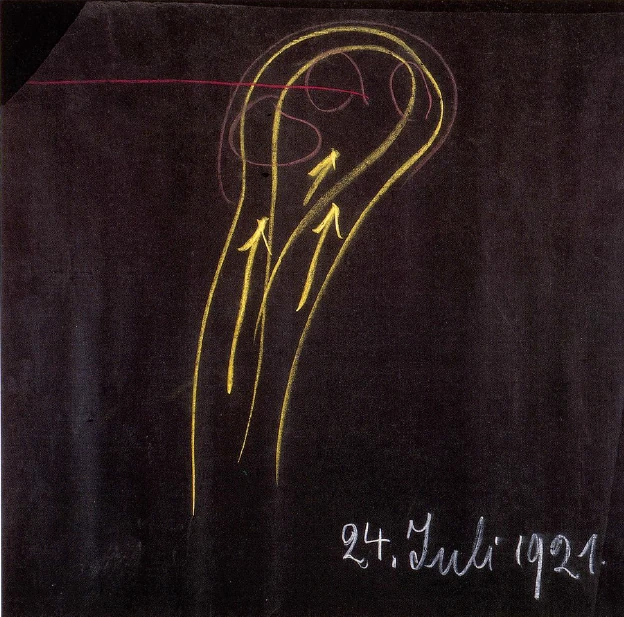
[ 8 ] So können wir uns ja auch sagen, wenn wir sehen, wie beim Kinde abhängt sein Begriffsvermögen, sein Vorstellungsvermögen von dieser Hauptesbildung, daß gewissermaßen die Vorstellungsfähigkeit zusammenhängt mit dem früheren Erdenleben (siehe Zeichnung, rot). Dagegen das, was sich uns als Erinnerungsvermögen eingliedert, steigt auf aus demjenigen, was wir zunächst in diesem Erdenleben als unseren Stoffwechsel-Gliedmaßenmenschen eben anorganisiert erhalten (blau). Es schließen sich da zwei Dinge zusammen: das eine, was der Mensch sich mitbringt aus früheren Erdenleben, und das andere, die Erinnerungsfähigkeit, was er sich dadurch erwirbt, daß er einen neuen Organismus angegliedert erhält.
[ 8 ] We can say the same thing when we see how a child’s capacity for understanding and imagination depends on the development of the head—that, in a sense, the power of imagination is connected to a previous earthly life (see diagram, red). In contrast, what manifests itself to us as the power of memory arises from what we initially receive in this earthly life as our metabolic, limb-bearing human form (blue). Two things come together here: on the one hand, what the human being brings with them from previous earthly lives, and on the other, the capacity for memory, which they acquire by being endowed with a new organism.
[ 9 ] Sie werden daher begreifen, daß dasjenige Gedächtnis, das man zunächst für den Gebrauch zwischen Geburt und Tod hat und das man ja angegliedert erhält in diesem Erdenleben, zunächst nicht ausreicht, um zurückzuschauen in das vorgeburtliche Leben, in das präexistente Leben. Da ist notwendig, was ich immer betone, wenn ich das Methodologische der Sache auseinandersetze, daß man hinter dieses Gedächtnis mit seinen Fähigkeiten kommt und daß man deutlich einsehen lernt, daß das Gedächtnis etwas ist, was uns dient zwischen Geburt und Tod, daß man aber eine höhere Fähigkeit entwickeln muß, die ganz nach Gedächtnisweise zurückverfolgt das, was sich in uns als Begriffsvermögen ausgestaltet. Der abstrakte Erkenntnistheoretiker, der setzt an die Stelle einer Tatsache ein Wort. Er sagt zum Beispiel: Mathematische Begriffe, weil sie nicht durch Erfahrung erworben zu werden brauchen, beziehungsweise weil ihre Gewißheit nicht aus der Erfahrung belegt zu werden braucht, seien a priori. — Das ist ein Wort: sie sind vor der Erfahrung gelegen, a priori. Und man kann ja dieses Wort bei Kantianern heute immer wieder und wiederum hören. Aber dieses a priori bedeutet eben nichts anderes, als daß wir diese Begriffe in den früheren Erdenleben erfahren haben; aber sie sind nicht minder eben Erfahrungen, von der Menschheit angeeignet im Laufe ihrer Entwickelung. Nur ist die Menschheit gegenwärtig in einem Stadium ihrer Entwickelung, wo sich eben die meisten Menschen, wenigstens die zivilisierten Menschen, diese mathematischen Begriffe schon mitbringen und man sie nur aufzuwecken braucht.
[ 9 ] You will therefore understand that the memory we initially possess for use between birth and death—and which we are, after all, endowed with during this earthly life—is not, at first, sufficient to look back into our pre-birth life, into our pre-existing life. What is necessary—and this is what I always emphasize when I discuss the methodological aspects of the matter—is to go beyond this memory and its capacities and to learn to clearly recognize that memory is something that serves us between birth and death, but that we must develop a higher capacity that traces back, entirely in the manner of memory, to what takes shape within us as conceptual faculty. The abstract epistemologist substitutes a word for a fact. He says, for example: Mathematical concepts, because they need not be acquired through experience—or rather, because their certainty need not be substantiated by experience—are a priori. — That is a word: they lie prior to experience, a priori. And one can indeed hear this word time and again among Kantians today. But this “a priori” means nothing other than that we have experienced these concepts in previous earthly lives; yet they are no less experiences, acquired by humanity in the course of its development. It is just that humanity is currently at a stage of its development where most people—at least civilized people—already possess these mathematical concepts and they merely need to be awakened.
[ 10 ] Es ist natürlich ein bedeutsamer pädagogisch-didaktischer Unterschied im Aufwecken der mathematischen Begriffe und im Beibringen von solchen Vorstellungen und Begriffen, die aus der äußeren Erfahrung gewonnen werden müssen und bei denen das Erinnerungsvermögen eine wesentliche Rolle spielt. Man kann auch, namentlich wenn man sich ein gewisses Anschauungsvermögen aneignet für die menschliche Entwickelung in ihren Besonderheiten, deutlich zwei Typen von aufwachsenden Kindern unterscheiden: solche, die sich viel mitbringen aus früheren Erdenleben und denen daher leicht Begriffe beizubringen sind; dagegen kann man andere finden, die weniger sicher sind in ihren Begriffsbildungen, die sich aber leicht die Eigenschaften äußerer Dinge merken und daher leicht dasjenige aufnehmen, was sie durch eigene Beobachtung aufnehmen können. Da hinein spielt aber das Erinnerungsvermögen, denn man kann äußere Dinge nicht leicht in der Weise lernen, wie es dann schulmäßig gelehrt werden muß. Man kann dann natürlich einen Begriff bilden, aber man kann sie nicht so lernen, daß man an ihnen das Gelernte wiederzugeben vermag, wenn nicht ein deutliches Erinnerungsvermögen vorliegt. Kurz, man kann da das Zusammenfließen zweier Strömungen in der menschlichen Entwickelung sehr genau wahrnehmen.
[ 10 ] There is, of course, a significant pedagogical and didactic difference between awakening mathematical concepts and teaching those ideas and concepts that must be derived from external experience and in which memory plays an essential role. One can also—especially when one acquires a certain ability to visualize the particularities of human development—clearly distinguish between two types of growing children: those who bring much with them from previous earthly lives and to whom concepts can therefore be easily taught; in contrast, there are others who are less confident in forming concepts, but who easily memorize the characteristics of external things and therefore readily absorb what they can perceive through their own observation. Memory plays a role here, however, because one cannot easily learn about external things in the way they must then be taught in school. One can, of course, form a concept, but one cannot learn them in such a way as to be able to reproduce what has been learned through them unless one possesses a clear memory. In short, one can perceive very clearly the convergence of two currents in human development.
[ 11 ] Nun, was liegt denn da eigentlich zugrunde? Bedenken Sie, auf der einen Seite ist der Mensch aus seiner Hauptesorganisation heraus das Begriffsbildungsvermögen gestaltend. Warum tut er das? Sie brauchen nur mit Verständnis die menschliche Hauptesorganisation zu betrachten, so werden Sie sich sagen können, warum. Diese menschliche Hauptesorganisation, sie tritt schon im embryonalen Leben verhältnismäßig früh auf, bevor die andere Organisation, gerade ihrem Wesentlichen nach, angegliedert ist. Die Embryologie ist ja durchaus ein Beleg für das, was Anthroposophie in bezug auf die Menschheitsentwickelung zu sagen hat. Aber Sie brauchen nicht so weit zu gehen, Sie brauchen bloß gewissermaßen den ausgewachsenen Menschen ins Auge zu fassen. Sehen Sie sich diese Hauptesorganisation an. Sie ist erstens darauf angelegt, daß man’ im Haupte relativ das Vollkommenste der ganzen menschlichen Organisation hat. Nun, diese Vorstellung könnte man anfechten. Dagegen eine andere ist nicht anzufechten, wenn sie nur in der richtigen Weise angeschaut wird. Das ist diese, daß wir in unserem Erleben uns ja ganz anders zu unserem Haupte stellen als zu unserem übrigen Organismus. Unseren übrigen Organismus verspüren wir in einer ganz andern Weise als unser Haupt. Unser Haupt löscht sich ja in unserem eigenen Seelenleben im Grunde genommen aus. Wir haben viel mehr organisches Bewußtsein von unserem gesamten übrigen Organismus als von unserem Haupte. Unser Haupt ist eigentlich dasjenige, was sich innerhalb unserer Organisation auslöscht.
[ 11 ] Well, what is actually underlying this? Consider this: on the one hand, human beings, through their head organization, shape their ability to form concepts. Why do they do this? You need only look at the human head organization with understanding, and you will be able to tell yourself why. This human head organization appears relatively early in embryonic life, before the other organization—in its very essence—is integrated into it. Embryology is, after all, clear evidence of what anthroposophy has to say regarding human evolution. But you need not go that far; you need only, so to speak, consider the fully grown human being. Look at this organization of the head. First of all, it is designed such that, relatively speaking, the head contains the most perfect part of the entire human organism. Now, one might challenge this idea. However, another idea cannot be challenged, provided it is viewed in the right way. This is the idea that, in our experience, we relate to our head quite differently than we do to the rest of our organism. We perceive the rest of our organism in a completely different way than we do our head. In our own inner life, our head essentially fades into the background. We have much greater organic awareness of the rest of our organism as a whole than of our head. Our head is actually that which fades into the background within our organism.
[ 12 ] Dieses Haupt hebt sich auch heraus aus unserem übrigen Zusammenhange mit der Welt, erstens innerlich schon durch unsere Gehirnorganisation. Ich habe die Tatsache oftmals hervorgehoben: das Gehirn hat eine so große Schwere, daß es alles, was darunterliegt, zerdrücken würde, wenn es nicht im Gehirnwasser schwimmen würde und dadurch das ganze Gewicht verliert, das ein Körper haben würde, der aus Gehirnwasser besteht und ebenso groß wäre wie das Gehirn; so daß das Gehirn, sagen wir etwa in dem Verhältnis von eintausenddreihundert bis eintausendvierhundert Gramm zu zwanzig Gramm an Gewicht verliert. Das heißt aber, da der Mensch, insofern er auf der Erde steht, durchaus sein natürliches Gewicht hat, ist das Gehirn herausgehoben aus diesen Schwereverhältnissen, in denen es im Menschen natürlich sitzt, nicht in seiner Absolutheit, aber indem es im Menschen sitzt. Aber selbst wenn Sie nicht auf dieses Innerliche gehen, wenn Sie auf das Außerliche gehen, man möchte sagen, die ganze Art, wie Sie Ihre Köpfe tragen, ist ja eigentlich so, daß dieser Kopf, indem man ihn durch die Welt trägt, sich verhält wie ein Herr oder eine Dame, die in einer Droschke sitzen. Die Droschke, die muß sich weiterbewegen, aber indem sich die Droschke weiterbewegt, strengt sich der Herr oder die Dame in der Droschke gar nicht an, um weiterzukommen. Ungefähr in demselben Verhältnis ist auch unser Haupt zu unserem Organismus. Dazu ließen sich viele Dinge noch anführen. Auch unser Haupt ist in einem gewissen Sinne herausgehoben aus unserem übrigen Verhältnis zur Welt. Das ist eben aus dem Grunde, weil wir in unserem Haupte gewissermaßen in physischer Umgestaltung dasjenige haben, was unsere Seele zusammen mit unserem übrigen Organismus erlebte in einem früheren Erdenleben.
[ 12 ] This head also stands out from our rest of our connection to the world, first of all internally, simply because of the way our brain is organized. I have often emphasized this fact: the brain is so heavy that it would crush everything beneath it if it were not floating in cerebrospinal fluid, thereby losing all the weight that a body consisting of cerebrospinal fluid and of the same size as the brain would have; so that the brain loses weight, say, in a ratio of about one thousand three hundred to one thousand four hundred grams to twenty grams. But this means that since the human being, insofar as he stands on the earth, certainly has his natural weight, the brain is set apart from these gravitational conditions in which it naturally resides within the human being—not in its absoluteness, but insofar as it resides within the human being. But even if you do not focus on this inner aspect, if you focus on the outer aspect, one might say that the very way you carry your heads is such that, as you carry this head through the world, it behaves like a gentleman or a lady sitting in a horse-drawn carriage. The carriage must keep moving, but as the carriage moves on, the gentleman or lady in the carriage does not exert any effort at all to get anywhere. Our head stands in roughly the same relationship to our organism. Many other examples could be cited to support this. In a certain sense, our head, too, is set apart from our rest of our relationship to the world. This is precisely because, in our head, we have—in a sense, through physical transformation—that which our soul experienced together with the rest of our organism in a previous earthly life.
[ 13 ] Wenn Sie beim Haupte die vier Hauptglieder der menschlichen Organisation betrachten, physischen Leib, Atherleib, astralischen Leib und Ich, so ist für das Haupt eigentlich nur das Ich dasjenige, was eine gewisse Selbständigkeit hat. Die andern Glieder haben sich eigentlich ihr Abbild geschaffen in diesem menschlichen Haupte, in der physischen Gestaltung des menschlichen Hauptes. Ich habe auch dafür einmal einen ganz schlagenden Beleg angeführt, ich will ihn hier anführen mehr durch das Wiedergeben einer Geschichte als rein theoretisch. Aber ich habe schon einmal die Sache angeführt.
[ 13 ] If you consider the four main members of the human organism—the physical body, the etheric body, the astral body, and the I—then, as far as the head is concerned, only the I actually possesses a certain degree of independence. The other members have, in fact, created their own image within this human head, in the physical form of the human head. I have also cited a very striking example of this before; I would like to present it here more as a retelling of a story than as a purely theoretical explanation. But I have already mentioned this point before.
[ 14 ] Ich sagte Ihnen: Ich nahm einmal teil — viele Jahre sind es jetzt her —, als man aus gewissen Voraussetzungen heraus die Giordano Bruno-Gesellschaft gegründet hatte, an einem Vortrage, den ein richtiger, waschechter Materialist gehalten hat über das menschliche Gehirn. Er hat als waschechter Materialist selbstverständlich die Struktur des Gehirnes gezeichnet und nachgewiesen, wie diese Struktur des Gehirnes im Grunde genommen das Seelenleben ausdrückt. Man kann das auch sehr gut.
[ 14 ] I told you: Many years ago now, when the Giordano Bruno Society had been founded under certain circumstances, I once attended a lecture on the human brain given by a true, die-hard materialist. As a true materialist, he naturally sketched the structure of the brain and demonstrated how this structure of the brain essentially expresses the life of the soul. That can be done very well, too.
[ 15 ] Vorsitzender jenes Vereines war nun ein Gymnasialdirektor, der nicht Materialist war, aber dafür ein waschechter philosophischer Herbartianer. Für den gab es nur Herbartsche Philosophie. Der sagte: Eigentlich könne er als Herbartianer ganz zufrieden sein mit den Darstellungen; nur sagte er, dasjenige, was der andere aufgezeichnet hat aus seinem waschechten Materialismus heraus, nehme er nicht als die Materie des Gehirnes. Wenn der also, nicht wahr, aufgezeichnet hat Gehirnpartien, Verbindungsfasern und so weiter, so nahm der Herbartianer die Zeichnung ganz willig hin. Die Zeichnung, die gefiel ihm ganz gut, dem Herbartianer, der kein Materialist war, denn er sagte, er brauche ja nur dafür, wofür der andere Gehirnpartien hinzeichnete, Vorstellungskomplexe hinzuzeichnen, und statt der Gehirnfasern zeichne er Assoziationsfasern; dann zeichne er etwas Seelisches, Vorstellungskomplexe, wo der andere Gehirnpartien zeichne. Und wo der andere Gehirnfasern gezeichnet hat, da zeichne er Assoziationsfasern; zum Beispiel diejenigen Gebilde, die John Stuart Mill so wunderbar herausphantasiert hat, die von Vorstellung zu Vorstellung gehen. Nicht wahr, ganz willenlos, automatisch spinnt da die Seele allerlei Dinge zwischen den Vorstellungskomplexen. Man findet das ja auch bei Herbart ganz schön.
[ 15 ] The chairman of that association was a high school principal who was not a materialist, but rather a true-blue philosophical Herbartian. For him, there was only Herbartian philosophy. He said: As a Herbartian, he could actually be quite satisfied with the illustrations; however, he added that he did not accept as the substance of the brain what the other person had drawn based on his die-hard materialism. So when the other person drew parts of the brain, connecting fibers, and so on, the Herbartian readily accepted the drawing. The drawing pleased him quite well, the Herbartian—who was no materialist—because he said that all he needed to do was to add complexes of ideas to what the other person had drawn as parts of the brain, and instead of brain fibers, he would draw association fibers; then he would draw something psychological—complexes of ideas—where the other person had drawn parts of the brain. And where the other person had drawn brain fibers, he drew association fibers; for example, those structures that John Stuart Mill so wonderfully imagined, which move from one idea to another. Isn’t it true that, quite involuntarily, automatically, the soul weaves all sorts of things between these complexes of ideas? One finds this quite beautiful in Herbart as well.
[ 16 ] Aber in der Zeichnung konnten beide ganz gut zusammentreffen. Warum? Aus dem einfachen Grunde, weil in der Tat in bezug darauf das menschliche Gehirn ein außerordentlich guter Abdruck ist des Seelisch-Geistigen. Das Seelisch-Geistige drückt sich einfach im Gehirn sehr gut ab. Es hat ja auch Zeit gehabt, dieses Seelisch-Geistige, durch die ganze Zeit zwischen dem Tod und der neuen Geburt diese Konfiguration hervorzurufen, die dann in der äußeren Plastik des Gehirnes das Seelenleben wunderbar ausdrückt.
[ 16 ] But in the drawing, the two were able to come together quite well. Why? For the simple reason that, in this regard, the human brain is, in fact, an exceptionally good reflection of the soul-spiritual. The soul-spiritual is simply very well reflected in the brain. After all, this soul-spiritual has had time—through the entire period between death and the new birth—to bring about this configuration, which then wonderfully expresses the life of the soul in the brain’s external structure.
[ 17 ] Gehen wir von dieser Geschichte nun etwa zu der Darstellung der Psychologie, wie sie Theodor Ziehen gibt, da finden wir, daß Theodor Ziehen auch so materialistisch die Gehirnpartien und so weiter beschreibt, und das Ganze macht einen außerordentlich glaubwürdigen Eindruck. Es ist auch außerordentlich gewissenhaft. Man kann in der Tat das tun. Man kann, wenn man das menschliche intellektualistische Leben, das Vorstellungsleben ins Auge faßt, einen sehr genauen Abdruck im Gehirn finden. Aber man kommt mit einer solchen Psychologie nur nicht bis zum Fühlen, und am wenigsten bis zum Wollen. Schauen Sie sich an solch eine Psychologie, wie die von Ziehen ist, so werden Sie finden: das Fühlen ist für ihn überhaupt nichts als eine Gefühlsbetonung der Vorstellung, und das eigentliche Wollen fällt ganz heraus aus der psychologischen Betrachtungsweise. Das ist gar nicht drinnen, weil in der Tat das Fühlen und das Wollen nicht in derselben Weise zusammenhängen mit demjenigen, was schon gestaltet ist. Das Fühlen hängt zusammen mit dem rhythmischen System des Menschen; das ist noch in voller Bewegung. Das hat seine Bildlichkeit in Bewegungen. Und das Wollen, das überhaupt mit plastisch Entstehendem und Vergehendem im Stoffwechsel zusammenhängt, das kann nicht eine solche Abbildlichkeit aufweisen, wie das für das Vorstellen möglich ist. Kurz, wir haben im Vorstellungsleben beziehungsweise in der Vorstellungsfähigkeit etwas in bezug auf Seelisches, was sich plastisch-bildhaft im Haupte ausdrückt: da stehen wir aber innerhalb des menschlichen astralischen Leibes. Denn indem wir vorstellen, gehört diese ganze Tätigkeit des Vorstellens dem menschlichen astralischen Leibe an. So daß also schon der menschliche astralische Leib sein Abbild sich schafft im menschlichen Haupte. Nur das Ich, das bleibt noch etwas Bewegliches. Der ätherische Leib hat nun sein ganz genaues Abbild im menschlichen Haupte, und der physische Leib erst recht. Dagegen ist in dem übrigen Organismus, zum Beispiel im rhythmischen Organismus, der astralische Leib als solcher durchaus nicht abgebildet, sondern nur der ätherische Leib und der physische Leib. Und im Stoffwechselorganismus ist gar nur der physische Leib abgebilder.
[ 17 ] If we now turn from this story to Theodor Ziehen’s account of psychology, we find that Theodor Ziehen also describes the parts of the brain and so on in such a materialistic way, and the whole thing makes an extraordinarily credible impression. It is also extraordinarily thorough. One can indeed do that. If one considers human intellectual life—the life of the imagination—one can find a very precise imprint in the brain. But such a psychology simply does not extend to feeling, and least of all to volition. If you look at a psychology such as Ziehen’s, you will find that, for him, feeling is nothing more than an emotional emphasis on the imagination, and volition itself falls entirely outside the scope of his psychological approach. It is not included at all, because, in fact, feeling and volition are not connected in the same way to what has already been formed. Feeling is connected to the human rhythmic system; it is still in full motion. Its imagery is expressed in movements. And volition—which is fundamentally connected to the plastic processes of formation and dissolution in metabolism—cannot exhibit the same kind of representational quality as is possible for imagination. In short, in the life of imagination—or rather, in the capacity for imagination—we have something pertaining to the soul that expresses itself in a plastic, pictorial way in the head; but there we are within the human astral body. For when we imagine, this entire activity of imagination belongs to the human astral body. Thus, the human astral body itself creates its own image in the human head. Only the “I” remains something that is still in motion. The etheric body now has its exact image in the human head, and the physical body even more so. In contrast, in the rest of the organism—for example, in the rhythmic organism—the astral body as such is not represented at all, but only the etheric body and the physical body. And in the metabolic organism, only the physical body is represented.
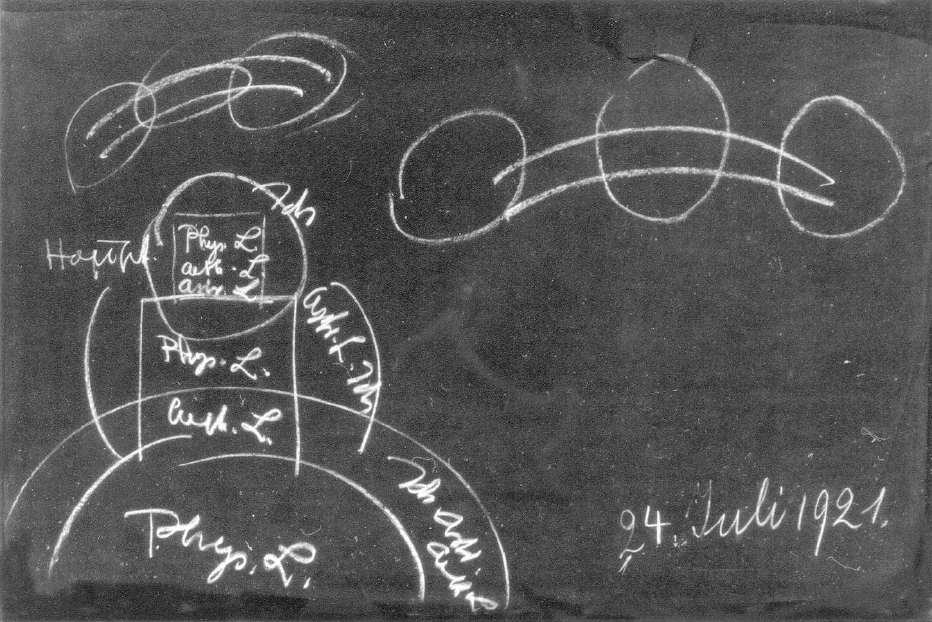
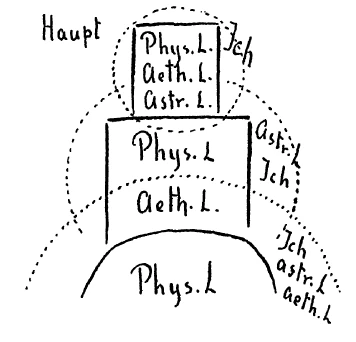
[ 18 ] Zusammengefaßt können Sie sich die Sache so vorstellen: Wenn Sie das Haupt haben, so haben Sie im Haupte physischen Leib, ätherischen Leib, astralischen Leib, so daß diese im Physischen ihre Abbildung haben, daß Sie tatsächlich in den physischen Formen die Abbildungen nachweisen können. Sie verstehen das menschliche Haupt gar nicht anders, als daß Sie tatsächlich diese drei Formen in dem menschlichen Haupte sehen. Noch in einem freien Verhältnis ist dasjenige, was das Ich ist (siehe Zeichnung).
[ 18 ] To summarize, you can think of it this way: If you have a head, then within that head you have a physical body, an etheric body, and an astral body, such that these have their corresponding images in the physical realm—that is, you can actually identify these images in the physical forms. You cannot understand the human head in any other way than by actually seeing these three forms within the human head. What constitutes the “I” still exists in a free relationship (see drawing).
[ 19 ] Gehen wir über zu der übrigen Organisation des Menschen, also zu der Atmungsorganisation zum Beispiel, dann haben wir den physischen Leib und den ätherischen Leib, die ihre Abbilder darinnen haben. Aber der astralische Leib und das Ich haben nicht ihre Abbilder, die sind gewissermaßen frei. Und im menschlichen Stoffwechsel-Gliedmaßenmenschen haben wir den physischen Leib als solchen, und frei haben wir Ich, astralischen Leib und ätherischen Leib. Sie müssen unterscheiden zwischen dem Vorhandensein und dem Frei- oder Gebundensein. Natürlich ist es nicht so, als ob dem menschlichen Haupte nicht auch ein astralischer Leib und ein Ätherleib zugrunde läge. Die durchsetzen natürlich auch das menschliche Haupt; aber sie sind nicht frei dadrinnen, sondern sie haben in der Organisation ihr Abbild. Dagegen ist der astralische Leib zum Beispiel in der ganzen rhythmischen, namentlich in der Atmungsorganisation frei. Er betätigt sich als solcher. Er füllt das nicht bloß aus, sondern er ist gegenwärtig drinnen tätig.
[ 19 ] If we turn to the rest of the human organism—the respiratory system, for example—we find the physical body and the etheric body, which have their corresponding images within it. But the astral body and the “I” do not have their corresponding images; they are, so to speak, free. And in the human being as a metabolic-limb being, we have the physical body as such, and the “I,” the astral body, and the etheric body are free. You must distinguish between existence and being free or bound. Of course, it is not as though the human head were not also based on an astral body and an etheric body. These, of course, also permeate the human head; but they are not free within it—rather, they have their reflection in the organism. In contrast, the astral body, for example, is free throughout the entire rhythmic system, particularly in the respiratory system. It acts as such. It does not merely fill it out, but is actively present within it.
[ 20 ] Nun, nehmen wir zwei Dinge zusammen. Das eine ist dieses, daß wir konstatieren können eine Beziehung des menschlichen Erinnerungsvermögens zu der Organisation außerhalb des Hauptes, und daß wir die menschliche Gefühls- und Willensorganisation auch außerhalb des Hauptes suchen müssen. Sie sehen, jetzt gliedern sich zusammen die Gefühlswelt der Seele und die Gedächtniswelt. Und wenn Sie nun empirisch, wirklich erfahrungsgemäß den Zusammenhang zwischen Gefühlsleben und Erinnerungsvermögen ins Auge fassen, so werden Sie diesen Zusammenhang als einen sehr engen konstatieren können.
[ 20 ] Well, let’s consider two things together. The first is that we can observe a relationship between human memory and the organization outside the head, and that we must also seek the human organization of feeling and will outside the head. You see, the emotional world of the soul and the world of memory are now coming together. And if you now consider the connection between emotional life and memory empirically—that is, based on actual experience—you will be able to observe that this connection is very close.
[ 21 ] Die Art und Weise, wie wir uns erinnern können, hängt im wesentlichen davon ab, wie wir vermöge unserer außerhauptlichen Organisation teilnehmen können an den Dingen, wie weit wir drinnenstehen können in den Dingen. Wenn wir starke Kopfmenschen sind, werden wir vieles begreifen, aber an weniges uns so erinnern, daß wir mit ihm zusammengewachsen sind. Es gibt, ich möchte sagen, einen bedeutsamen Bezug zwischen dem Gefühlsvermögen und dem Erinnerungsvermögen. Aber zugleich sehen wir, daß die menschliche außerhauptliche Organisation sich ja im Beginne der Entwickelung der hauptlichen nähert. Wenn Sie das Embryonalleben nehmen, so ist der Mensch ganz im Anfange fast nur Haupt. Das andere sind Ansätze. Wenn das Kind geboren ist: denken Sie nur, wie unvollkommen im Verhältnis zum Haupte eigentlich die übrige Organisation ist! Aber sie gliedert sich ihm an. Die übrige Organisation, sie wird schon im Leben zwischen Geburt und Tod der Hauptesorganisation immer ähnlicher, und namentlich prägt sich dieses Ähnlichwerden aus in dem Hervorschießen der zweiten Zähne. Dasjenige, was der Mensch als erste Zahnung hat, die sogenannten Milchzähne — und das wird, wenn nur die entsprechenden Methoden angewendet werden, sich leicht auch anatomischphysiologisch nachweisen lassen, geisteswissenschaftlich ist es ohne Frage —, die ersten Zähne, die Milchzähne sind in der Tat mehr aus der Hauptesorganisation heraus. An der andern Zahnung beteiligt sich der volle Mensch. Diejenigen Zähne, die mehr aus der Hauptesorganisation heraus sind, werden ausgestoßen. Der übrige Mensch betätigt sich an der zweiten Zahnung.
[ 21 ] The way we are able to remember depends essentially on how we, through our extracerebral organization, can participate in things—how deeply we can immerse ourselves in them. If we are highly intellectual people, we will understand many things, but we will remember few of them in such a way that we have become one with them. There is, I would say, a significant connection between the capacity for feeling and the capacity for memory. But at the same time, we see that the human non-head organization does, in fact, approach the head organization at the beginning of development. If you consider embryonic life, the human being is, at the very beginning, almost entirely head. The rest are merely rudiments. Once the child is born—just think how imperfect the rest of the organism actually is in relation to the head! But it becomes integrated with it. The rest of the organism becomes increasingly similar to the head organization during the period between birth and death, and this growing similarity is particularly evident in the eruption of the second set of teeth. What a human being has as their first set of teeth—the so-called baby teeth—and this can easily be demonstrated anatomically and physiologically if the appropriate methods are applied (and from a spiritual scientific perspective, it is beyond question)—these first teeth, the baby teeth, are in fact derived more from the head organization. The whole human being is involved in the second set of teeth. Those teeth that originate more from the head organization are shed. The rest of the human being is active in the development of the second set of teeth.
[ 22 ] Man hat in der Tat mit Bezug auf das Physische eine Art Abbild in den ersten Zähnen und in den zweiten Zähnen mit Bezug auf Begriffsbildung und Gedächtnis. Man möchte sagen, die Milchzähne werden mehr aus der Hauptesorganisation heraus gebildet, so wie die Begriffe, bloß daß die Begriffe natürlich ins Intellektualistisch-Geistige heraufgesetzt sind; und die zweiten Zähne, die sind mehr so aus der ganzen menschlichen Organisation herausgeholt wie das Erinnerungsvermögen. Man muß nur auf solche feinen Unterschiede in der menschlichen Organisation eingehen können.
[ 22 ] In fact, with regard to the physical realm, there is a kind of reflection in the first set of teeth, and in the second set of teeth with regard to concept formation and memory. One might say that the baby teeth are formed more from the organization of the head, just as concepts are—except that concepts, of course, are elevated to the intellectual-spiritual realm; and the permanent teeth are drawn more from the entire human organism, much like the faculty of memory. One must simply be able to discern such subtle differences in the human organism.
[ 23 ] Wenn Sie solch eine Sache ins Auge fassen, dann werden Sie ja einsehen, wie man eigentlich das Materielle in seiner Formung, in seiner Gestaltung — namentlich, wenn man ins Organische heraufkommt — nur erfassen kann, wenn man es erfaßt aus der geistigen Gestaltung heraus. Nicht wahr, der waschechte Materialist sieht sich den materiellen Menschen an, studiert den materiellen Menschen. Und derjenige, der auf die Wirklichkeit geht, nicht auf seine materialistischen Vorurteile, der sieht zunächst einmal dieses menschliche Haupt beim Kinde aus dem Übersinnlichen herausgestaltet, allerdings durch Metamorphose des früheren Erdenlebens herausgestaltet, und er sieht dann angegliedert aus der Welt, in die dieses Kind jetzt in diesem Erdenleben versetzt ist, das andere, aber auch aus dem Geistigen, aus dem Übersinnlichen dieser Welt herausgestaltet.
[ 23 ] If you consider such a thing, you will surely realize that the material world—in its formation, in its structure—especially when one ascends to the organic realm—can only be grasped by approaching it from the perspective of spiritual structure. Isn’t it true that the true materialist looks at the material human being and studies the material human being? But the one who approaches reality—rather than his materialistic prejudices—sees, first of all, this human head in the child as shaped from the supersensible, admittedly shaped through the metamorphosis of the child’s previous earthly life, and then sees, emerging from the world into which this child has now been placed in this earthly life, the other aspect—which is also shaped from the spiritual, from the supersensible realm of this world.
[ 24 ] Es ist wichtig, gerade auf solch eine Anschauung seine Aufmerksamkeit zu wenden; denn darauf kommt es an, daß jemand nicht in einer abstrakten Weise spricht von materieller Welt und von geistiger Welt, sondern daß er eine Anschauung gewinnt von dem Hervorgehen der materiellen Welt aus der geistigen Welt, gewissermaßen von der Abbildlichkeit der geistigen Welt in der materiellen Welt. Nur darf man dabei nicht im Abstrakten stehenbleiben, sondern muß in das Konkrete gehen. Man muß eine Anschauung sich verschaffen können von dem Unterschiede des menschlichen Hauptes vom übrigen Organismus. Dann sieht man in den Formen des menschlichen Hauptes eben etwas anderes, auch in seinem Hervorgehen aus der geistigen Welt, als man im übrigen Organismus sieht. Denn der übrige Organismus ist eben durchaus uns angegliedert in einem entsprechenden Erdenleben, während wir die Hauptesbildung bis in seine Formung hinein als Ergebnis früherer Erdenleben mitnehmen. Wer das bedenkt, wird sehen, wie töricht zum Beispiel solch ein Einwand gegen Anthroposophie ist, wie er neulich wiederum — Sie können das in einem Bericht der gegenwärtigen Nummer der Dreigliederungszeitung nachlesen — in einer Münchner Diskussion, die hervorgerufen worden ist über Anthroposophie von dem, von so vielen Leuten trotz seiner feuilletonistischen Philisterei hochgeehrten Eucken, gemacht worden ist. Eucken erhob den Einwand gegen Anthroposophie, daß sie materialistisch sei, indem er hinpfahlte den törichten Begriff: Dasjenige, was man wahrnehmen kann, das ist materiell. — Selbstverständlich, wenn man solch eine Definition macht, dann kann man beweisen, was man mag; nur ist man eben schlecht bekannt mit der Methode des Beweisens überhaupt. Es handelt sich durchaus darum, das zu fassen, wie das Materielle in seinem Hervorgehen aus dem Geistigen gerade als ein Zeuge für die geistige Welt angeschaut werden kann. Wenn Sie aber wiederum — und nur bis zu diesem Punkte möchte ich zunächst heute gehen — ins Auge fassen, wie man dieses Werden des Gedächtnisses erschauen kann in seiner Verwandtschaft mit den übrigen Wachstumskräften des Menschen, so werden Sie ein Ineinanderspielen bemerken desjenigen, was man sonst materiell nennt und desjenigen, was da namentlich im späteren Leben, vom siebenten, achten Jahre an, sich als geistig-seelisches Leben entwickelt.
[ 24 ] It is important to focus one’s attention precisely on such a perspective; for what matters is that one does not speak in an abstract way about the material world and the spiritual world, but rather that one gains an understanding of how the material world emerges from the spiritual world—in a sense, of how the spiritual world is reflected in the material world. However, one must not remain at the abstract level but must move into the concrete. One must be able to form a conception of the difference between the human head and the rest of the organism. Then one sees in the forms of the human head—and also in its emergence from the spiritual world—something different from what one sees in the rest of the organism. For the rest of the organism is, after all, entirely connected to us in a corresponding earthly life, whereas we carry the formation of the head, right down to its shape, with us as the result of earlier earthly lives. Anyone who considers this will see how foolish, for example, is such an objection to anthroposophy as was recently raised once again—you can read about this in a report in the current issue of the Dreigliederungszeitung—in a Munich discussion on anthroposophy sparked by Eucken, who is highly esteemed by so many people despite his feuilletonistic philistinism. Eucken raised the objection against anthroposophy that it is materialistic, by bandying about the foolish notion: “That which can be perceived is material.”—Of course, if one makes such a definition, one can prove whatever one likes; it’s just that one is poorly acquainted with the method of proof in general. The point is precisely to grasp how the material, in its emergence from the spiritual, can be viewed as a witness to the spiritual world. But if you, in turn—and I would like to go only as far as this point for now today — consider how this development of memory can be viewed in relation to the other growth forces of the human being, you will notice an interplay between what is otherwise called the material and what, especially in later life—from the seventh or eighth year onward—develops as spiritual-soul life.
[ 25 ] Es ist wirklich so, daß dasjenige, was später mehr in der abstrakt-intellektualistischen Form in der Erinnerungskraft zutage tritt, zuerst sich mitbeteiligt an dem Wachstum. Es ist wirklich dieselbe Kraft. Es muß da dieselbe Betrachtungsweise angewendet werden, die angewendet wird, sagen wir, wenn von gebundener und freier Wärme gesprochen wird. Wärme, die frei wird, die aus ihrem latenten Zustand in Freiheit übergeht, verhält sich äußerlich in der physischen Welt wie jene Kraft, die dann anschaulich für das innere Leben als Erinnerungskraft zutage tritt und in den ersten Kindheitsjahren den Wachstumserscheinungen zugrunde liegt. Es ist dasselbe, was den Wachstumserscheinungen zugrunde liegt in den ersten Kindheitsjahren und was dann als die Kraft der Erinnerungsfähigkeit mehr in seiner ureigenen Gestalt erscheint.
[ 25 ] It is indeed the case that what later emerges in the power of memory in a more abstract, intellectual form is initially involved in the process of growth. It is truly the same force. The same approach must be applied here as is applied, let us say, when speaking of bound and free heat. Heat that is released—that passes from its latent state into freedom—behaves outwardly in the physical world like that force which then manifests itself vividly in inner life as the power of memory and underlies the phenomena of growth in the early years of childhood. It is the same force that underlies the growth processes in the early years of childhood and that then appears more in its true form as the power of memory.
[ 26 ] Ich habe das im Herbstkurse hier im Goetheanum noch des genaueren entwickelt. Aber Sie sehen daraus, wie man gerade auf diesem Wege einen intimen Bezug zwischen dem Seelisch-Geistigen und Leiblich-Physischen finden kann, wie wir also in der Gedächtniskraft etwas haben, was auf der einen Seite uns seelisch-geistig erscheint, auf der andern Seite uns erscheint, indem es in anderem Weltenzusammenhange auftritt, als Wachstumskraft.
[ 26 ] I elaborated on this in more detail during the fall course here at the Goetheanum. But you can see from this how, precisely in this way, an intimate connection can be found between the soul-spiritual and the bodily-physical—how, in other words, we have in the power of memory something that, on the one hand, appears to us as soul-spiritual, and on the other hand, appears to us—as it occurs in a different worldly context—as a force of growth.
[ 27 ] Genau den entgegengesetzten Fall haben Sie, wenn Sie die Liebefähigkeit des Menschen ins Auge fassen. Die Liebefähigkeit, die auf der einen Seite durchaus sich erweist als an die Körperlichkeit gebunden, die können Sie wiederum als die seelischeste Funktion ins Auge fassen, genauso wie die Gedächtniskraft. So daß Sie in der Tat — das letztere werde ich in späteren Vorträgen noch genauer ausführen — in Gedächtnis und Liebe etwas haben, wo Sie, ich möchte sagen, das Zusammenspiel des Geistigen und des Leiblichen ganz erfahrungsgemäß sehen können und es auch beziehen können auf das ganze Verhältnis des Menschen zur Welt.
[ 27 ] You have exactly the opposite case when you consider the human capacity for love. This capacity for love, which on the one hand is clearly bound to physicality, can in turn be regarded as the most spiritual function, just like the power of memory. So that, in fact—and I will elaborate on the latter in more detail in later lectures—in memory and love you have something where, I would say, you can see the interplay of the spiritual and the physical entirely through experience, and you can also relate it to the whole relationship of the human being to the world.
[ 28 ] Beim Gedächtnis haben wir das schon getan, indem wir zurückbezogen haben das Vorstellungsbild auf frühere Erdenleben, die Kraft des Gedächtnisses aber auf das gegenwärtige Erdenleben. Wir werden sehen in späteren Vorträgen, daß man mit der Liebekraft ebenso verfahren kann. Man kann zeigen, wie sie sich entwickelt in dem gegenwärtigen Erdenleben, aber durchgeht durch das Leben zwischen Tod und neuer Geburt in das nächste Erdenleben hinüber, wie sie es gerade ist, die an der Metamorphosierung des übrigen außerhauptlichen menschlichen Organismus in das nächste Erdenleben hinüberarbeitet.
[ 28 ] We have already done this with regard to memory by relating the mental image to earlier earthly lives, but the power of memory to the present earthly life. We will see in later lectures that one can proceed in the same way with the power of love. One can show how it develops in the present earthly life, yet carries over through the life between death and rebirth into the next earthly life, just as it is, working to transform the rest of the non-physical human organism into the next earthly life.
[ 29 ] Warum stellen wir diese ganze Betrachtung an? Wir stellen sie an, weil man heute eine Möglichkeit braucht, von dem Geistig-Seelischen hinüberzukommen zu dem Leiblich-Physischen. Innerhalb des GeistigSeelischen erleben wir das Moralische, innerhalb des Physisch-Leiblichen erleben wir die Naturnotwendigkeit. Zwischen beiden besteht für die heutige Anschauung, wenn man ehrlich auf beiden Gebieten ist, eben keine Brücke. Und ich habe gestern darauf aufmerksam gemacht, daß, weil eine solche Brücke nicht besteht, die Leute ja sogar unterscheiden zwischen dem sogenannten echten Wissen, das sich auf die Naturkausalität bezieht, und dem bloßen Glaubensinhalt, der sich auf die moralische Welt beziehen soll, weil unzusammenhängend nebeneinanderstehen auf der einen Seite die Naturkausalität, auf der andern Seite das seelisch-geistige Leben. Aber es handelt sich durchaus darum, daß wir, um zu einem vollen Menschenbewußtsein wiederum zu kommen, dieses Brückenschlagen zwischen dem einen und dem andern brauchen.
[ 29 ] Why are we undertaking this entire line of thought? We are doing so because today we need a way to bridge the gap between the spiritual-soul realm and the physical-bodily realm. Within the spiritual-soul realm, we experience morality; within the physical-bodily realm, we experience natural necessity. From today’s perspective, if one is honest in both realms, there is simply no bridge between the two. And I pointed out yesterday that, because such a bridge does not exist, people even distinguish between so-called genuine knowledge—which relates to natural causality—and mere matters of faith—which are supposed to relate to the moral world—because natural causality stands on one side and the spiritual-soul life on the other, completely disconnected from one another. But the point is certainly that, in order to return to a full human consciousness, we need to build this bridge between the one and the other.
[ 30 ] Da ist vor allen Dingen notwendig zu berücksichtigen, daß die moralische Welt ohne die Statuierung der Freiheit nicht bestehen kann, die natürliche Welt nicht bestehen kann ohne die Notwendigkeit, nach welcher das eine aus dem andern hervorgeht. Es könnte im Grunde gar keine Wissenschaft geben, wenn es diese Notwendigkeit nicht geben würde. Würde nicht notwendig eine Erscheinung aus der andern hervorgehen im Naturzusammenhang, würde da alles willkürlich sein, so könnte es ja keine Wissenschaft geben. Es könnte nun ja alles dasjenige, was man eben nicht wissen kann, aus dem andern hervorgehen, nicht wahr! Also es ist klar: Wissenschaft ist zunächst da, wenn man in ihr nur sehen will, wie eines aus dem andern hervorgeht, daß eines aus dem andern hervorgeht. Aber wenn diese Naturkausalität ganz allgemein ist, dann ist eine moralische Freiheit unmöglich, dann kann sie nicht da sein. Aber das Bewußtsein dieser moralischen Freiheit innerhalb des Seelisch-Geistigen, das ist als eine unmittelbar erfahrbare Tatsache in jedem Menschen vorhanden.
[ 30 ] Above all, it is necessary to bear in mind that the moral world cannot exist without the establishment of freedom, and the natural world cannot exist without the necessity by which one thing arises from another. In fact, there could be no science at all if this necessity did not exist. If one phenomenon did not necessarily arise from another in the natural order, everything would be arbitrary, and thus there could be no science. After all, anything that one simply cannot know could arise from something else, couldn’t it! So it is clear: science exists, first and foremost, when one is willing to see in it how one thing arises from another—that one thing arises from another. But if this natural causality is universal, then moral freedom is impossible; it cannot exist. Yet the awareness of this moral freedom within the soul-spiritual realm is present in every human being as a fact that can be experienced directly.
[ 31 ] Der Widerspruch zwischen dem, was der Mensch erlebt in seiner moralischen Seelenkonstitution und in der Naturkausalität, ist nicht ein logischer, sondern ein Lebenswiderspruch. Wir gehen fortwährend mit diesem Widerspruch durch die Welt. Er gehört zum Leben. Es ist in der Tat so, daß, wenn wir uns ehrlich gestehen, was da vorliegt, wir uns sagen müssen: Naturkausalität, Notwendigkeit, sie muß es geben, und wir gehen selber als Menschen durch diese Notwendigkeit. Aber unser inneres, seelisch-geistiges Leben widerspricht dem. Wir sind uns bewußt: Wir können Entschlüsse fassen, wir können moralischen Idealen folgen, die uns nicht innerhalb der Naturkausalität gegeben sind. Es ist dieses ein Widerspruch, der ein Lebenswiderspruch ist. Und derjenige, der nicht zugeben kann, daß solche Widersprüche im Leben drinnenstehen, der faßt einfach das Leben nicht in seiner Allseitigkeit. Aber wenn wir das so ausdrücken, ist es recht abstrakt. Es ist eigentlich im Grunde genommen stets nur eine Art von Auffassung, die wir dem Leben entgegenbringen. Wir gehen durch das Leben und fühlen uns eigentlich fortwährend mit der äußeren Natur im Widerspruch. Es scheint, als ob wir machtlos wären, als ob wir uns eben im Widerspruch fühlen müßten.
[ 31 ] The contradiction between what a person experiences in the moral constitution of the soul and in natural causality is not a logical contradiction, but a contradiction of life. We constantly navigate the world with this contradiction. It is part of life. In fact, if we honestly admit to ourselves what is at hand, we must say: natural causality, necessity—it must exist, and we ourselves, as human beings, live within this necessity. But our inner, soul-spiritual life contradicts this. We are aware that we can make decisions; we can follow moral ideals that are not given to us within the framework of natural causality. This is a contradiction that is a contradiction of life itself. And anyone who cannot admit that such contradictions are inherent in life simply does not grasp life in its entirety. But when we express it this way, it is quite abstract. At the very core, it is really always just a certain perspective that we bring to life. We go through life and actually feel constantly at odds with the external natural world. It seems as if we were powerless, as if we were simply destined to feel this contradiction.
[ 32 ] Man kann diese Widersprüche zum Beispiel heute bei manchen Menschen gerade in einer recht tragischen Weise erleben. Ich habe zum Beispiel einen Menschen gekannt, der tatsächlich ganz erfüllt war davon, daß es eine Notwendigkeit in der Welt gibt, der auch der Mensch eingegliedert ist. Man kann natürlich theoretisch eine solche Notwendigkeit zugeben und sich mit seinem ganzen Menschen nicht viel darum kümmern; dann geht man eben als Trivialling durch die Welt und wird nicht von einer inneren Tragik erfüllt. Aber wie gesagt, ich kannte immerhin einen Menschen, der sagte: Es ist ja überall Notwendigkeit, und wir Menschen sind hineingestellt in diese Notwendigkeit. Es ist nicht anders, denn die Wissenschaft zwingt uns zur Anerkennung dieser Notwendigkeit. Aber diese Notwendigkeit läßt zu gleicher Zeit Blasen in uns aufsteigen, Blasen, die Schaum sind und die uns vorgaukeln ein freies Seelenleben. Das müssen wir durchschauen, als Blasen ansehen. Das ist auch eine Notwendigkeit.
[ 32 ] One can see these contradictions today, for example, in some people in a rather tragic way. I knew, for instance, a person who was truly fulfilled by the fact that there is a necessity in the world into which human beings are also integrated. Of course, one can theoretically acknowledge such a necessity and, as a whole person, not concern oneself much with it; then one simply goes through life as a trivial person and is not filled with an inner sense of tragedy. But as I said, I did at least know one person who said: “There is necessity everywhere, and we humans are placed within this necessity.” It cannot be otherwise, for science compels us to acknowledge this necessity. But at the same time, this necessity causes bubbles to rise within us—bubbles that are mere foam and that lead us to believe we have a free inner life. We must see through this and recognize these bubbles for what they are. That, too, is a necessity.
[ 33 ] Das ist die furchtbare Illusion des Menschen. Das ist dieBegründung des Pessimismus in der menschlichen Natur. Wer wenig Idee davon hat, wie tief so etwas in der Seele eines Menschen wirken kann, der wird nicht nachfühlen können, wie hier der durchaus reale Lebenswiderspruch die ganze menschliche Seele durchwühlen kann und selbst zu der Anschauung führen kann, daß zu leben durch seine eigene Wesenheit ein Unglück ist. Es ist nur die Gedankenlosigkeit und die Empfindungslosigkeit gegenüber demjenigen, was uns heute auf der einen Seite wissenschaftliche Gewißheit und auf der andern Seite Glaubensgewißheit geben wollen, die die Menschen nicht kommen lassen zu solcher inneren Lebenstragik. Denn eigentlich wäre gegenüber der heutigen möglichen Seelenverfassung der Menschheit diese Lebenstragik die gegebene Seelenverfassung.
[ 33 ] That is the terrible illusion of humankind. That is the root of pessimism in human nature. Anyone who has little idea of how deeply such a thing can affect a person’s soul will be unable to comprehend how this very real contradiction of life can tear through the entire human soul and even lead to the belief that to live through one’s own being is a misfortune. It is only thoughtlessness and insensitivity toward what today seeks to offer us, on the one hand, scientific certainty and, on the other, the certainty of faith, that prevent people from recognizing such an inner tragedy of life. For, in fact, given the current possible state of humanity’s soul, this tragedy of life would be the natural state of the soul.
[ 34 ] Aber woher rührt denn das Unvermögen, das zu solcher Lebenstragik führt? Es rührt daher, daß wir uns seit Jahrhunderten eben eingesponnen haben als zivilisierte Menschheit in gewisse Abstraktionen, in einen Intellektualismus. Dieser Intellektualismus kann sich höchstens sagen: Es gaukelt uns die Naturnotwendigkeit durch merkwürdige Richtungen ein Freiheitsgefühl vor. Das ist aber nicht vorhanden. Es ist nur in unseren Ideen vorhanden. Wir sind ohnmächtig gegenüber der Naturnotwendigkeit.
[ 34 ] But where does this inability—which leads to such tragedy in life—stem from? It stems from the fact that, for centuries, we as civilized humanity have entangled ourselves in certain abstractions, in a form of intellectualism. At best, this intellectualism can say: Natural necessity deceives us into a sense of freedom through strange channels. But that freedom does not exist. It exists only in our ideas. We are powerless in the face of natural necessity.
[ 35 ] Die große Frage entsteht: Sind wir das nun wirklich? — Und nun merken Sie, wie die Vorträge, die ich nun seit Wochen hier gehalten habe, eigentlich alle auf die Frage hintendieren: Sind wir es in Wirklichkeit? Sind wir in Wirklichkeit so ohnmächtig mit diesem Widerspruch? — Erinnern Sie sich, wie ich gesagt habe, daß wir im menschlichen Leben nicht nur eine aufsteigende, sondern auch eine absteigende Entwickelung haben, daß unser intellektuelles Leben nicht gebunden ist an die Wachstums-, sondern an die Absterbekräfte, an die absterbende Entwickelung, daß wir das Sterben brauchen, gerade um die Intelligenz zu entwickeln. Erinnern Sie sich daran, wie ich vor einigen Wochen hier gezeigt habe, was es für eine Bedeutung hat, daß mit bestimmten Affinitäten und Wertigkeitskräften in der Welt bestehende Elemente, meinetwillen Kohlenstoff, Sauerstoff, Wasserstoff, Stickstoff, Schwefel sich verbinden zu dem Eiweißstoff; wie ich Ihnen gezeigt habe, worauf dieses Verbinden beruht, wie es gerade nicht auf dem Chemisieren, sondern auf dem Chaotischwerden beruht, und Sie werden sehen, alle diese Betrachtungen tendieren dahin, das, was ich angedeutet habe, nicht nur als einen theoretischen Widerspruch aufzudecken, sondern als einen Prozeß in der menschlichen Natur. Wir sind nicht nur, indem wir als Menschen leben, dazu da, einen solchen Widerspruch zu empfinden, sondern unser inneres Leben ist ein fortwährender Zerstörungsprozeß desjenigen, was außen in der Natur als Naturkausalität sich entwickelt. Wir lösen in uns Menschen die Naturkausalität in Wirklichkeit auf. Dasjenige, was außen die physikalischen Vorgänge, die chemischen Vorgänge vorstellen, in uns wird es rückgängig entwickelt, wird es nach der andern Seite entwickelt. Natürlich wird uns das nur dann klar, wenn wir den unteren und den oberen Menschen ins Auge fassen, wenn wir dasjenige, was im unteren Menschen vom Stoffwechsel heraufkommt, in seiner Entmechanisierung, Entphysizierung, Entchemisierung durch den oberen Menschen ins Auge fassen. Wenn wir die Entstofflichung im Menschen ins Auge zu fassen suchen, dann haben wir nicht nur einen logischen, theoretischen Widerspruch in uns, sondern wir haben den realen Prozeß: wir haben den Menschenwerde- und Menschenentwickelungsprozeß als denjenigen in uns, der selber kämpft gegen die Naturkausalität, und das Menschenleben als ein solches, welches darinnen besteht, daß es ein Kampf ist gegen die Naturkausalität. Und der Ausdruck dieses Kampfes, der Ausdruck desjenigen, was in uns fortwährend die physische Synthese, die chemische Synthese löst, wiederum analysiert, der Ausdruck des analytischen Lebens in uns faßt sich zusammen in der Empfindung: Ich bin frei.
[ 35 ] The big question arises: Is that really who we are? — And now you realize how the lectures I’ve been giving here for weeks all ultimately boil down to this question: Is that who we really are? Are we really so powerless in the face of this contradiction? — Remember how I said that in human life we have not only an ascending but also a descending development, that our intellectual life is not bound to the forces of growth but to the forces of decay, to the process of decay, that we need dying precisely in order to develop intelligence. Do you remember how, a few weeks ago, I demonstrated here the significance of the fact that elements existing in the world—carbon, oxygen, hydrogen, nitrogen, and sulfur, for example—combine with certain affinities and valence forces to form protein; how I showed you what this combination is based on—how it is based not on chemical synthesis but on becoming chaotic—and you will see that all these considerations tend to reveal what I have hinted at, not merely as a theoretical contradiction, but as a process within human nature. Not only are we, by living as human beings, meant to perceive such a contradiction, but our inner life is a continuous process of destroying that which develops externally in nature as natural causality. We, as human beings, are in fact dissolving natural causality within ourselves. What manifests externally as physical and chemical processes is reversed within us; it is developed in the opposite direction. Of course, this becomes clear to us only when we consider the lower and the higher human being, when we consider what arises in the lower human being from metabolism—in its demechanization, de-physicalization, and de-chemicalization—through the higher human being. When we seek to contemplate the process of dematerialization within the human being, we find not merely a logical, theoretical contradiction within us, but a real process: we find the process of becoming human and human development as that which struggles within us against natural causality, and human life as a life that consists precisely in this struggle against natural causality. And the expression of this struggle—the expression of that which within us continually dissolves and then reanalyzes physical and chemical synthesis, the expression of analytical life within us—is summed up in the feeling: I am free.
[ 36 ] Dasjenige, was ich Ihnen jetzt in ein paar Worten hingestellt habe, also die Betrachtung des Menschen in seinem Werdeprozesse als einem Kampfprozesse gegen die Naturkausalität, als eine umgekehrte Naturkausalität, das wollen wir in den nächsten Vorträgen nun hier betrachten.
[ 36 ] What I have just outlined for you in a few words—namely, the view of human beings in their process of becoming as a struggle against natural causality, as a reversal of natural causality—is what we will now examine in the upcoming lectures.