Human-Becoming, World-Soul and World-Spirit I
Human Beings as Physical and Spiritual Entities
in Their Relationship to the World
GA 206
24 July 1921, Dornach
Translated by Steiner Online Library
Sixteenth Lecture
[ 1 ] That aspect of human nature I have spoken of is also expressed in everyday human life as a whole. You find it above all when you properly examine the relationship between two human faculties which, by their very nature, prove—even upon superficial observation—to belong to both the soul life and the physical-bodily life. On the one hand, you find—as an important, let us say, fact of the soul life in human existence, closely linked to physical life—the faculty of memory; and on the other hand, you find, let us say, a force in human life whose nature is less readily grasped, because it is more of a faculty to which one naively surrenders without examining it more closely or even analyzing it: that is the power of human love. It must be stated from the outset that when one speaks of such things—first in relation to the nature of the human being, and then also in relation to the human being’s relationship to the world—one must be clear that one must proceed from reality, not from some mere conception. I have often used the admittedly banal comparison to illustrate the mistake of starting from ideas rather than reality: Someone sees a razor and says it is a knife, and that a knife is used for cutting food; so he uses the razor to cut food because it is a knife.
[ 2 ] Roughly speaking—although people usually don’t believe it because they consider the subject very scholarly—these are the views that, let’s say, scientifically minded people hold regarding death or birth as they pertain to humans and animals. Sometimes such ideas are even extended to plants. People form a concept of it in the same way they form a concept of what a knife is, and then, starting from this concept—which is, of course, a representation of a certain series of facts—they examine, in the same way, let’s say, death in humans, in animals, and possibly even in plants—without taking into account that what is generally summarized in the concept of death might be something entirely different in humans and in animals. One must start from the reality of the animal and the reality of the human being, not from the phenomenon of death, which one allows to be represented by some concept.
[ 3 ] In a similar way, the concepts we have—for example, regarding memory—are formed. With regard to memory, this is particularly evident when, in an effort to find a commonality between humans and animals, the concept of memory is applied to both in an undifferentiated manner. It has been pointed out—and this has even happened to very famous professors such as Otto Liebmann—that, for example, an elephant on its way to a watering hole to drink water is subjected to some sort of provocation by a passerby; the person does something to it. The elephant walks on. But when it returns and the person is standing there again, the elephant sprays water at him from its trunk. Because the elephant—so says the epistemologist—has naturally remembered and stored in its memory what the person did to it.
[ 4 ] The outward appearance of the matter is, of course, quite—one might say—very seductive for such an epistemological consideration, but it is no more seductive than the endeavor to cut up meat at the table with a razor. The point is precisely that one must always start from reality itself, and not from ideas derived from one series of phenomena or another, which are then arbitrarily transferred in an essentialist manner to a different series of phenomena. People usually do not realize just how widespread the methodological error just mentioned actually is in our scientific investigations today.
[ 5 ] What exists in humans as memory, as the capacity to recall, must be understood entirely on the basis of human nature itself. And this involves first creating an opportunity to observe how memory develops in the course of human development. Anyone who is able to observe this will notice that memory manifests itself quite differently in a child than it does in a person from about the sixth, seventh, or eighth year onward. In the years mentioned last, memory takes on a more psychological character, whereas one can clearly see how closely this memory is bound to organic conditions in the early childhood years, and how it gradually emerges from these organic conditions. And anyone who considers the relationship between memories and a child’s concept formation will notice how concept formation in fact relies heavily on what the child experiences from its surroundings through its sensory perceptions—through all twelve of the sensory perceptions mentioned. It is extraordinarily fascinating, but also extraordinarily significant, to see how the concepts the child forms depend entirely on the experiences to which the child is subjected, namely on the behavior of the environment. After all, during the years under consideration here, the child is an imitator—and an imitator also with regard to concept formation. In contrast, one can easily observe how the capacity for memory arises more from within the child’s development, how it is more closely connected to the child’s overall physical constitution, and even very little to the constitution of the senses and, consequently, to the constitution of the human head. In contrast, one can sense a close connection between the way the child is constituted—to a greater or lesser extent, so to speak, normal or abnormal—for example, with regard to blood formation and blood nutrition. One will easily notice that in children who tend toward anemia, memory formation is difficult. In contrast, one will notice that in such cases, the formation of concepts and the formation of mental images encounter fewer difficulties.
[ 6 ] I can only point these things out, for ultimately, once one has received the guidelines for such an observation, one must seek out the data from life itself—and one will find them. They will then discover that, in fact, in children, concept formation arises from the primary organization—that is, from the nervous-sensory organization—and thus from experiences and perception; but that what, I might say, interweaves concept formation—namely, the capacity for memory—develops from the rest of the organism outside the primary organization. And if one continues this observation, attempting in particular to uncover how differently the process—namely, the formation of memory—behaves in children who tend toward a short, small, stocky build and in children who tend to shoot up tall, one will find that there is indeed a clear connection between growth patterns as a whole and what develops as memory capacity in humans.
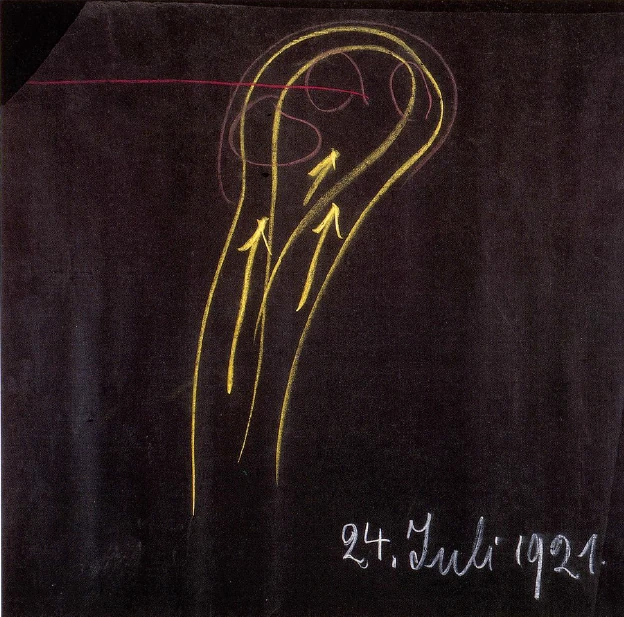
[ 7 ] Now, I have said on previous occasions: The formation of the human head as such presents itself as a metamorphosis of the organic formation of the human being from a previous earthly life, but apart from the formation of the head. So what we carry within us as our head in a certain earthly life is the transformed body apart from the head—namely, the limb-metabolic human being of the earlier earthly life. Of course, one must not imagine this in materialistic terms. It has nothing to do with material substance, but rather with form and the interplay of forces. What is today the limb-metabolic organism in a human being becomes, in the next earthly life—metamorphically transformed through the life between death and new birth—the formation of the head.
[ 8 ] We can say the same thing when we see how a child’s capacity for understanding and imagination depends on the development of the head—that, in a sense, the power of imagination is connected to a previous earthly life (see diagram, red). In contrast, what manifests itself to us as the power of memory arises from what we initially receive in this earthly life as our metabolic, limb-bearing human form (blue). Two things come together here: on the one hand, what the human being brings with them from previous earthly lives, and on the other, the capacity for memory, which they acquire by being endowed with a new organism.
[ 9 ] You will therefore understand that the memory we initially possess for use between birth and death—and which we are, after all, endowed with during this earthly life—is not, at first, sufficient to look back into our pre-birth life, into our pre-existing life. What is necessary—and this is what I always emphasize when I discuss the methodological aspects of the matter—is to go beyond this memory and its capacities and to learn to clearly recognize that memory is something that serves us between birth and death, but that we must develop a higher capacity that traces back, entirely in the manner of memory, to what takes shape within us as conceptual faculty. The abstract epistemologist substitutes a word for a fact. He says, for example: Mathematical concepts, because they need not be acquired through experience—or rather, because their certainty need not be substantiated by experience—are a priori. — That is a word: they lie prior to experience, a priori. And one can indeed hear this word time and again among Kantians today. But this “a priori” means nothing other than that we have experienced these concepts in previous earthly lives; yet they are no less experiences, acquired by humanity in the course of its development. It is just that humanity is currently at a stage of its development where most people—at least civilized people—already possess these mathematical concepts and they merely need to be awakened.
[ 10 ] There is, of course, a significant pedagogical and didactic difference between awakening mathematical concepts and teaching those ideas and concepts that must be derived from external experience and in which memory plays an essential role. One can also—especially when one acquires a certain ability to visualize the particularities of human development—clearly distinguish between two types of growing children: those who bring much with them from previous earthly lives and to whom concepts can therefore be easily taught; in contrast, there are others who are less confident in forming concepts, but who easily memorize the characteristics of external things and therefore readily absorb what they can perceive through their own observation. Memory plays a role here, however, because one cannot easily learn about external things in the way they must then be taught in school. One can, of course, form a concept, but one cannot learn them in such a way as to be able to reproduce what has been learned through them unless one possesses a clear memory. In short, one can perceive very clearly the convergence of two currents in human development.
[ 11 ] Well, what is actually underlying this? Consider this: on the one hand, human beings, through their head organization, shape their ability to form concepts. Why do they do this? You need only look at the human head organization with understanding, and you will be able to tell yourself why. This human head organization appears relatively early in embryonic life, before the other organization—in its very essence—is integrated into it. Embryology is, after all, clear evidence of what anthroposophy has to say regarding human evolution. But you need not go that far; you need only, so to speak, consider the fully grown human being. Look at this organization of the head. First of all, it is designed such that, relatively speaking, the head contains the most perfect part of the entire human organism. Now, one might challenge this idea. However, another idea cannot be challenged, provided it is viewed in the right way. This is the idea that, in our experience, we relate to our head quite differently than we do to the rest of our organism. We perceive the rest of our organism in a completely different way than we do our head. In our own inner life, our head essentially fades into the background. We have much greater organic awareness of the rest of our organism as a whole than of our head. Our head is actually that which fades into the background within our organism.
[ 12 ] This head also stands out from our rest of our connection to the world, first of all internally, simply because of the way our brain is organized. I have often emphasized this fact: the brain is so heavy that it would crush everything beneath it if it were not floating in cerebrospinal fluid, thereby losing all the weight that a body consisting of cerebrospinal fluid and of the same size as the brain would have; so that the brain loses weight, say, in a ratio of about one thousand three hundred to one thousand four hundred grams to twenty grams. But this means that since the human being, insofar as he stands on the earth, certainly has his natural weight, the brain is set apart from these gravitational conditions in which it naturally resides within the human being—not in its absoluteness, but insofar as it resides within the human being. But even if you do not focus on this inner aspect, if you focus on the outer aspect, one might say that the very way you carry your heads is such that, as you carry this head through the world, it behaves like a gentleman or a lady sitting in a horse-drawn carriage. The carriage must keep moving, but as the carriage moves on, the gentleman or lady in the carriage does not exert any effort at all to get anywhere. Our head stands in roughly the same relationship to our organism. Many other examples could be cited to support this. In a certain sense, our head, too, is set apart from our rest of our relationship to the world. This is precisely because, in our head, we have—in a sense, through physical transformation—that which our soul experienced together with the rest of our organism in a previous earthly life.
[ 13 ] If you consider the four main members of the human organism—the physical body, the etheric body, the astral body, and the I—then, as far as the head is concerned, only the I actually possesses a certain degree of independence. The other members have, in fact, created their own image within this human head, in the physical form of the human head. I have also cited a very striking example of this before; I would like to present it here more as a retelling of a story than as a purely theoretical explanation. But I have already mentioned this point before.
[ 14 ] I told you: Many years ago now, when the Giordano Bruno Society had been founded under certain circumstances, I once attended a lecture on the human brain given by a true, die-hard materialist. As a true materialist, he naturally sketched the structure of the brain and demonstrated how this structure of the brain essentially expresses the life of the soul. That can be done very well, too.
[ 15 ] The chairman of that association was a high school principal who was not a materialist, but rather a true-blue philosophical Herbartian. For him, there was only Herbartian philosophy. He said: As a Herbartian, he could actually be quite satisfied with the illustrations; however, he added that he did not accept as the substance of the brain what the other person had drawn based on his die-hard materialism. So when the other person drew parts of the brain, connecting fibers, and so on, the Herbartian readily accepted the drawing. The drawing pleased him quite well, the Herbartian—who was no materialist—because he said that all he needed to do was to add complexes of ideas to what the other person had drawn as parts of the brain, and instead of brain fibers, he would draw association fibers; then he would draw something psychological—complexes of ideas—where the other person had drawn parts of the brain. And where the other person had drawn brain fibers, he drew association fibers; for example, those structures that John Stuart Mill so wonderfully imagined, which move from one idea to another. Isn’t it true that, quite involuntarily, automatically, the soul weaves all sorts of things between these complexes of ideas? One finds this quite beautiful in Herbart as well.
[ 16 ] But in the drawing, the two were able to come together quite well. Why? For the simple reason that, in this regard, the human brain is, in fact, an exceptionally good reflection of the soul-spiritual. The soul-spiritual is simply very well reflected in the brain. After all, this soul-spiritual has had time—through the entire period between death and the new birth—to bring about this configuration, which then wonderfully expresses the life of the soul in the brain’s external structure.
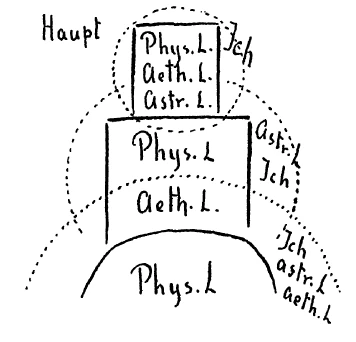
[ 17 ] If we now turn from this story to Theodor Ziehen’s account of psychology, we find that Theodor Ziehen also describes the parts of the brain and so on in such a materialistic way, and the whole thing makes an extraordinarily credible impression. It is also extraordinarily thorough. One can indeed do that. If one considers human intellectual life—the life of the imagination—one can find a very precise imprint in the brain. But such a psychology simply does not extend to feeling, and least of all to volition. If you look at a psychology such as Ziehen’s, you will find that, for him, feeling is nothing more than an emotional emphasis on the imagination, and volition itself falls entirely outside the scope of his psychological approach. It is not included at all, because, in fact, feeling and volition are not connected in the same way to what has already been formed. Feeling is connected to the human rhythmic system; it is still in full motion. Its imagery is expressed in movements. And volition—which is fundamentally connected to the plastic processes of formation and dissolution in metabolism—cannot exhibit the same kind of representational quality as is possible for imagination. In short, in the life of imagination—or rather, in the capacity for imagination—we have something pertaining to the soul that expresses itself in a plastic, pictorial way in the head; but there we are within the human astral body. For when we imagine, this entire activity of imagination belongs to the human astral body. Thus, the human astral body itself creates its own image in the human head. Only the “I” remains something that is still in motion. The etheric body now has its exact image in the human head, and the physical body even more so. In contrast, in the rest of the organism—for example, in the rhythmic organism—the astral body as such is not represented at all, but only the etheric body and the physical body. And in the metabolic organism, only the physical body is represented.
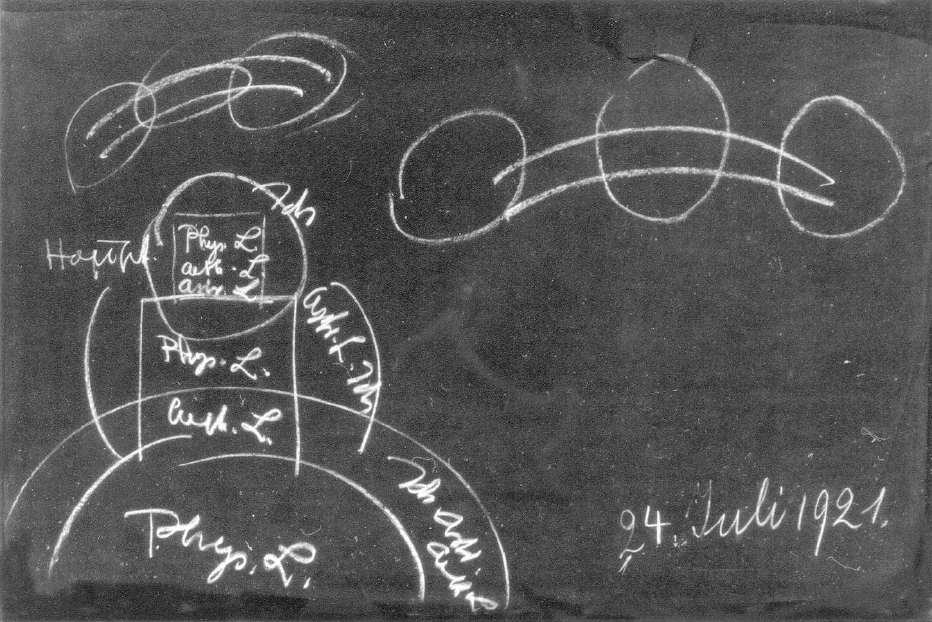
[ 18 ] To summarize, you can think of it this way: If you have a head, then within that head you have a physical body, an etheric body, and an astral body, such that these have their corresponding images in the physical realm—that is, you can actually identify these images in the physical forms. You cannot understand the human head in any other way than by actually seeing these three forms within the human head. What constitutes the “I” still exists in a free relationship (see drawing).
[ 19 ] If we turn to the rest of the human organism—the respiratory system, for example—we find the physical body and the etheric body, which have their corresponding images within it. But the astral body and the “I” do not have their corresponding images; they are, so to speak, free. And in the human being as a metabolic-limb being, we have the physical body as such, and the “I,” the astral body, and the etheric body are free. You must distinguish between existence and being free or bound. Of course, it is not as though the human head were not also based on an astral body and an etheric body. These, of course, also permeate the human head; but they are not free within it—rather, they have their reflection in the organism. In contrast, the astral body, for example, is free throughout the entire rhythmic system, particularly in the respiratory system. It acts as such. It does not merely fill it out, but is actively present within it.
[ 20 ] Well, let’s consider two things together. The first is that we can observe a relationship between human memory and the organization outside the head, and that we must also seek the human organization of feeling and will outside the head. You see, the emotional world of the soul and the world of memory are now coming together. And if you now consider the connection between emotional life and memory empirically—that is, based on actual experience—you will be able to observe that this connection is very close.
[ 21 ] The way we are able to remember depends essentially on how we, through our extracerebral organization, can participate in things—how deeply we can immerse ourselves in them. If we are highly intellectual people, we will understand many things, but we will remember few of them in such a way that we have become one with them. There is, I would say, a significant connection between the capacity for feeling and the capacity for memory. But at the same time, we see that the human non-head organization does, in fact, approach the head organization at the beginning of development. If you consider embryonic life, the human being is, at the very beginning, almost entirely head. The rest are merely rudiments. Once the child is born—just think how imperfect the rest of the organism actually is in relation to the head! But it becomes integrated with it. The rest of the organism becomes increasingly similar to the head organization during the period between birth and death, and this growing similarity is particularly evident in the eruption of the second set of teeth. What a human being has as their first set of teeth—the so-called baby teeth—and this can easily be demonstrated anatomically and physiologically if the appropriate methods are applied (and from a spiritual scientific perspective, it is beyond question)—these first teeth, the baby teeth, are in fact derived more from the head organization. The whole human being is involved in the second set of teeth. Those teeth that originate more from the head organization are shed. The rest of the human being is active in the development of the second set of teeth.
[ 22 ] In fact, with regard to the physical realm, there is a kind of reflection in the first set of teeth, and in the second set of teeth with regard to concept formation and memory. One might say that the baby teeth are formed more from the organization of the head, just as concepts are—except that concepts, of course, are elevated to the intellectual-spiritual realm; and the permanent teeth are drawn more from the entire human organism, much like the faculty of memory. One must simply be able to discern such subtle differences in the human organism.
[ 23 ] If you consider such a thing, you will surely realize that the material world—in its formation, in its structure—especially when one ascends to the organic realm—can only be grasped by approaching it from the perspective of spiritual structure. Isn’t it true that the true materialist looks at the material human being and studies the material human being? But the one who approaches reality—rather than his materialistic prejudices—sees, first of all, this human head in the child as shaped from the supersensible, admittedly shaped through the metamorphosis of the child’s previous earthly life, and then sees, emerging from the world into which this child has now been placed in this earthly life, the other aspect—which is also shaped from the spiritual, from the supersensible realm of this world.
[ 24 ] It is important to focus one’s attention precisely on such a perspective; for what matters is that one does not speak in an abstract way about the material world and the spiritual world, but rather that one gains an understanding of how the material world emerges from the spiritual world—in a sense, of how the spiritual world is reflected in the material world. However, one must not remain at the abstract level but must move into the concrete. One must be able to form a conception of the difference between the human head and the rest of the organism. Then one sees in the forms of the human head—and also in its emergence from the spiritual world—something different from what one sees in the rest of the organism. For the rest of the organism is, after all, entirely connected to us in a corresponding earthly life, whereas we carry the formation of the head, right down to its shape, with us as the result of earlier earthly lives. Anyone who considers this will see how foolish, for example, is such an objection to anthroposophy as was recently raised once again—you can read about this in a report in the current issue of the Dreigliederungszeitung—in a Munich discussion on anthroposophy sparked by Eucken, who is highly esteemed by so many people despite his feuilletonistic philistinism. Eucken raised the objection against anthroposophy that it is materialistic, by bandying about the foolish notion: “That which can be perceived is material.”—Of course, if one makes such a definition, one can prove whatever one likes; it’s just that one is poorly acquainted with the method of proof in general. The point is precisely to grasp how the material, in its emergence from the spiritual, can be viewed as a witness to the spiritual world. But if you, in turn—and I would like to go only as far as this point for now today — consider how this development of memory can be viewed in relation to the other growth forces of the human being, you will notice an interplay between what is otherwise called the material and what, especially in later life—from the seventh or eighth year onward—develops as spiritual-soul life.
[ 25 ] It is indeed the case that what later emerges in the power of memory in a more abstract, intellectual form is initially involved in the process of growth. It is truly the same force. The same approach must be applied here as is applied, let us say, when speaking of bound and free heat. Heat that is released—that passes from its latent state into freedom—behaves outwardly in the physical world like that force which then manifests itself vividly in inner life as the power of memory and underlies the phenomena of growth in the early years of childhood. It is the same force that underlies the growth processes in the early years of childhood and that then appears more in its true form as the power of memory.
[ 26 ] I elaborated on this in more detail during the fall course here at the Goetheanum. But you can see from this how, precisely in this way, an intimate connection can be found between the soul-spiritual and the bodily-physical—how, in other words, we have in the power of memory something that, on the one hand, appears to us as soul-spiritual, and on the other hand, appears to us—as it occurs in a different worldly context—as a force of growth.
[ 27 ] You have exactly the opposite case when you consider the human capacity for love. This capacity for love, which on the one hand is clearly bound to physicality, can in turn be regarded as the most spiritual function, just like the power of memory. So that, in fact—and I will elaborate on the latter in more detail in later lectures—in memory and love you have something where, I would say, you can see the interplay of the spiritual and the physical entirely through experience, and you can also relate it to the whole relationship of the human being to the world.
[ 28 ] We have already done this with regard to memory by relating the mental image to earlier earthly lives, but the power of memory to the present earthly life. We will see in later lectures that one can proceed in the same way with the power of love. One can show how it develops in the present earthly life, yet carries over through the life between death and rebirth into the next earthly life, just as it is, working to transform the rest of the non-physical human organism into the next earthly life.
[ 29 ] Why are we undertaking this entire line of thought? We are doing so because today we need a way to bridge the gap between the spiritual-soul realm and the physical-bodily realm. Within the spiritual-soul realm, we experience morality; within the physical-bodily realm, we experience natural necessity. From today’s perspective, if one is honest in both realms, there is simply no bridge between the two. And I pointed out yesterday that, because such a bridge does not exist, people even distinguish between so-called genuine knowledge—which relates to natural causality—and mere matters of faith—which are supposed to relate to the moral world—because natural causality stands on one side and the spiritual-soul life on the other, completely disconnected from one another. But the point is certainly that, in order to return to a full human consciousness, we need to build this bridge between the one and the other.
[ 30 ] Above all, it is necessary to bear in mind that the moral world cannot exist without the establishment of freedom, and the natural world cannot exist without the necessity by which one thing arises from another. In fact, there could be no science at all if this necessity did not exist. If one phenomenon did not necessarily arise from another in the natural order, everything would be arbitrary, and thus there could be no science. After all, anything that one simply cannot know could arise from something else, couldn’t it! So it is clear: science exists, first and foremost, when one is willing to see in it how one thing arises from another—that one thing arises from another. But if this natural causality is universal, then moral freedom is impossible; it cannot exist. Yet the awareness of this moral freedom within the soul-spiritual realm is present in every human being as a fact that can be experienced directly.
[ 31 ] The contradiction between what a person experiences in the moral constitution of the soul and in natural causality is not a logical contradiction, but a contradiction of life. We constantly navigate the world with this contradiction. It is part of life. In fact, if we honestly admit to ourselves what is at hand, we must say: natural causality, necessity—it must exist, and we ourselves, as human beings, live within this necessity. But our inner, soul-spiritual life contradicts this. We are aware that we can make decisions; we can follow moral ideals that are not given to us within the framework of natural causality. This is a contradiction that is a contradiction of life itself. And anyone who cannot admit that such contradictions are inherent in life simply does not grasp life in its entirety. But when we express it this way, it is quite abstract. At the very core, it is really always just a certain perspective that we bring to life. We go through life and actually feel constantly at odds with the external natural world. It seems as if we were powerless, as if we were simply destined to feel this contradiction.
[ 32 ] One can see these contradictions today, for example, in some people in a rather tragic way. I knew, for instance, a person who was truly fulfilled by the fact that there is a necessity in the world into which human beings are also integrated. Of course, one can theoretically acknowledge such a necessity and, as a whole person, not concern oneself much with it; then one simply goes through life as a trivial person and is not filled with an inner sense of tragedy. But as I said, I did at least know one person who said: “There is necessity everywhere, and we humans are placed within this necessity.” It cannot be otherwise, for science compels us to acknowledge this necessity. But at the same time, this necessity causes bubbles to rise within us—bubbles that are mere foam and that lead us to believe we have a free inner life. We must see through this and recognize these bubbles for what they are. That, too, is a necessity.
[ 33 ] That is the terrible illusion of humankind. That is the root of pessimism in human nature. Anyone who has little idea of how deeply such a thing can affect a person’s soul will be unable to comprehend how this very real contradiction of life can tear through the entire human soul and even lead to the belief that to live through one’s own being is a misfortune. It is only thoughtlessness and insensitivity toward what today seeks to offer us, on the one hand, scientific certainty and, on the other, the certainty of faith, that prevent people from recognizing such an inner tragedy of life. For, in fact, given the current possible state of humanity’s soul, this tragedy of life would be the natural state of the soul.
[ 34 ] But where does this inability—which leads to such tragedy in life—stem from? It stems from the fact that, for centuries, we as civilized humanity have entangled ourselves in certain abstractions, in a form of intellectualism. At best, this intellectualism can say: Natural necessity deceives us into a sense of freedom through strange channels. But that freedom does not exist. It exists only in our ideas. We are powerless in the face of natural necessity.
[ 35 ] The big question arises: Is that really who we are? — And now you realize how the lectures I’ve been giving here for weeks all ultimately boil down to this question: Is that who we really are? Are we really so powerless in the face of this contradiction? — Remember how I said that in human life we have not only an ascending but also a descending development, that our intellectual life is not bound to the forces of growth but to the forces of decay, to the process of decay, that we need dying precisely in order to develop intelligence. Do you remember how, a few weeks ago, I demonstrated here the significance of the fact that elements existing in the world—carbon, oxygen, hydrogen, nitrogen, and sulfur, for example—combine with certain affinities and valence forces to form protein; how I showed you what this combination is based on—how it is based not on chemical synthesis but on becoming chaotic—and you will see that all these considerations tend to reveal what I have hinted at, not merely as a theoretical contradiction, but as a process within human nature. Not only are we, by living as human beings, meant to perceive such a contradiction, but our inner life is a continuous process of destroying that which develops externally in nature as natural causality. We, as human beings, are in fact dissolving natural causality within ourselves. What manifests externally as physical and chemical processes is reversed within us; it is developed in the opposite direction. Of course, this becomes clear to us only when we consider the lower and the higher human being, when we consider what arises in the lower human being from metabolism—in its demechanization, de-physicalization, and de-chemicalization—through the higher human being. When we seek to contemplate the process of dematerialization within the human being, we find not merely a logical, theoretical contradiction within us, but a real process: we find the process of becoming human and human development as that which struggles within us against natural causality, and human life as a life that consists precisely in this struggle against natural causality. And the expression of this struggle—the expression of that which within us continually dissolves and then reanalyzes physical and chemical synthesis, the expression of analytical life within us—is summed up in the feeling: I am free.
[ 36 ] What I have just outlined for you in a few words—namely, the view of human beings in their process of becoming as a struggle against natural causality, as a reversal of natural causality—is what we will now examine in the upcoming lectures.