Human-Becoming, World-Soul and World-Spirit I
Human Beings as Physical and Spiritual Entities
in Their Relationship to the World
GA 206
23 July 1921, Dornach
Translated by Steiner Online Library
Fifteenth Lecture
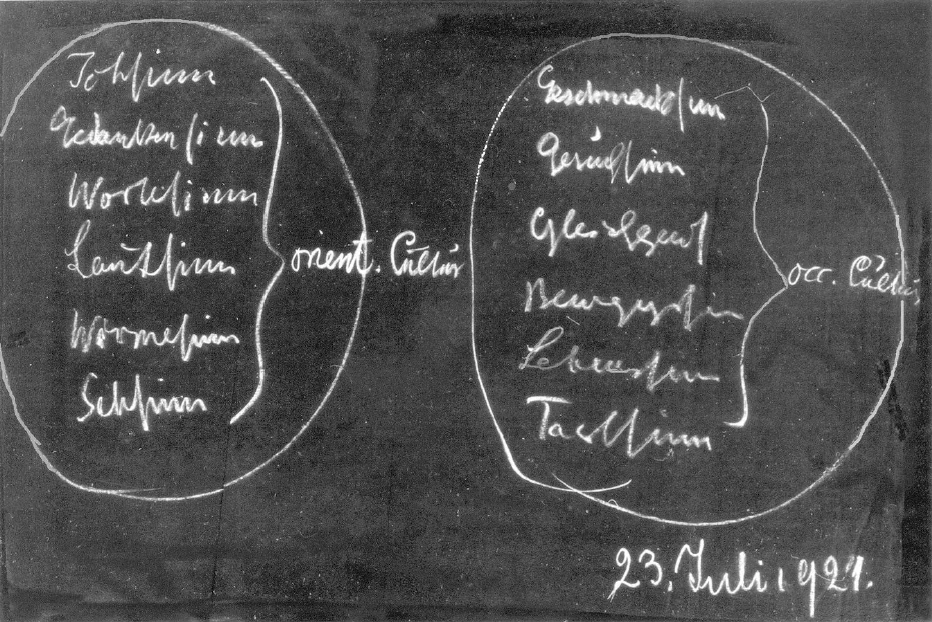
[ 1 ] Yesterday I tried, so to speak, to draw a line between those sensory experiences that belong, if I may put it that way, to the higher human being—those that constitute the actual inner life of the human soul— and those sensory experiences that belong more to a “lower human being,” whose content, so to speak, stands in opposition to human consciousness in much the same way as external experiences do, except that they take place within the human being. We have seen that the sensory experiences of the former kind include those of the sense of the “I,” the sense of thought, the sense of speech, the sense of hearing, the sense of warmth, and the sense of sight, and we have seen that we enter two realms in which a person essentially experiences inner sensations in a manner analogous to external sensations in consciousness, namely through the sense of taste, the sense of smell, and the other so-called inner senses. You can already see, when discussing such a topic, how difficult it is to use those coarser terms that are quite applicable for characterizing the external world but which, of course, immediately fail when one considers the human being itself and the inner structure of the world.
[ 2 ] In any case, however, anyone who fully grasps this distinction between the higher and the lower human being—both of which, in a certain sense, represent world events—can also come to understand how a dividing line runs through our experience, and how, in a very different way, we contrast, as it were, one pole of our experience with the other. Without conscientiously engaging with this structure of human nature, one will not be able to gain sufficient clarity regarding the most important problem of the present and the near future, namely the problem: What is the actual relationship between the moral world—within which we live with our higher human nature, and within which our human and global responsibility exists—and that world into which we are now also drawn, the world of natural necessity?
[ 3 ] We know, of course, that in recent centuries—since the mid-15th century—human progress has been based primarily on the development of concepts relating to natural necessity. During these centuries, humanity has devoted less attention to the other realm of human experience—the realm of the moral order of the world. Today, it is immediately clear to anyone who understands even a little how to interpret the signs of the times and who knows how to familiarize themselves with the great tasks of our age that there is a deep divide between what is called moral necessity and what is called natural necessity.
[ 4 ] This divide has arisen, in particular, because a large number of people who believe they are fully immersed in today’s spiritual life draw a distinction between a certain realm of experience that can be encompassed by knowledge and understanding, and another realm of experience that is to be encompassed solely by faith. And as you know, in certain circles, only that which can be expressed in strict—as they call them—laws of nature is considered truly scientific; they seek to establish an entirely different kind of certainty for everything pertaining to the moral life, and for this certainty they rely solely on a kind of certainty based on faith. There are detailed theories regarding the necessary distinction that must be made between truly scientific certainty and certainty based on faith.
[ 5 ] All these distinctions, all these theories are, after all, based on the fact that people today have very little historical awareness, that they pay very little attention to the conditions under which our current mental states came into being. I have, after all, often cited the classic example of this. I have told you, for example, how philosophers today believe that by distinguishing between the human body and soul, they are saying something based on some kind of original observation or the like, whereas what people think about the two realms of body and soul is merely the result of a council decree—the decree of 869, the Eighth Council—which elevated to the status of dogma the doctrine that human beings should not be regarded as consisting of body, soul, and spirit, but only of body and soul, and that the soul may be attributed certain spiritual qualities.
[ 6 ] This dogma became increasingly entrenched over the following centuries. The philosophers of the Middle Ages, in particular, lived by this dogma. And when modern philosophy emerged from medieval philosophy, people believed they were judging based on their own experiences. But they judged only according to the habit they had acquired, in accordance with what had become a centuries-old custom: to assume that human beings consist solely of body and soul.
[ 7 ] This is a classic example of one of the situations in which humanity finds itself today: believing it to have an unbiased judgment, while the judgment it expresses is nothing more than the result of a historical process. Nor is it easy to arrive at a truly authoritative judgment except by surveying ever-wider historical time periods.
[ 8 ] For example, anyone who is familiar only with contemporary scientific thinking will naturally regard it as the sole authoritative standard and will be completely unable to conceive that any other kind of knowledge could exist. Anyone who, let us say, in addition to this contemporary scientific view—which has been firmly established since about the middle of the 15th century—is also somewhat familiar with what prevailed in the early Middle Ages, going back as far as the 4th century A.D., will judge matters much as the better neo-Scholastics of today judge the relationship of human beings to the intellectual world; but they will by no means be able to form a judgment about anything other than, at most, the relationship of human beings to intellectuality—not, however, a judgment about the relationship of human beings to spirituality. For he does not know that, if one goes back—say, beyond Aristotle, who died in 322 B.C.—in order to gain any understanding at all of the way people thought back then, one must place oneself within a completely different mental framework than the one we have today. To try to understand Plato, or even Heraclitus or Thales, with the same mental disposition one has today is impossible. One does not even understand Aristotle. And anyone familiar with the discussions that have taken place in recent times regarding Aristotelian philosophy knows how, through the constant rewriting of the concepts and ideas still found in Aristotle, countless ambiguities have arisen, simply because one has failed to take into account that the moment one turns, for example, to Plato—who was Aristotle’s teacher—one must already adopt an entirely different mental framework. Then, when one approaches Aristotle by proceeding forward from Plato, one will also see how one assesses Aristotle’s logic differently than when one views it, so to speak, only in retrospect through the lens of what one can derive today as a state of mind from contemporary culture.
[ 9 ] Aristotle, even when he was formulating his logic—which is, after all, already abstract enough and sufficiently intellectualized—still possessed at least a superficial knowledge, even if not his own direct insight—which must have been very scarce in Aristotle’s case— but he still had a clear awareness that one could, even if only instinctively, glimpse into the spiritual world. And for him, the logical rules were the ultimate expression, if I may put it that way, from above, from the spiritual world. So for Aristotle, what he established as logical rules or basic logical concepts was, in a sense, the shadow cast down from the spiritual world, which for Plato, for example, was still a given world, a world to be experienced, a factual world, a world of conscious experience.
[ 10 ] There is one thing that is usually overlooked. People fail to see the great, the enormous differences that exist between the various epochs of human history. If you take the years, say, from the death of Aristotle in 322 B.C. to the Council of Nicaea, 325 A.D., you have a period that is, admittedly, very difficult to understand from an external perspective, because the Church has made it a point to destroy all documents that would provide a reasonably accurate picture of the state of mind during these three pre-Christian and three post-Christian centuries.
[ 11 ] One need only consider that, for example, a large number of people today simply talk about Gnosticism. How do they know about Gnosticism? They know it from the writings of its opponents. With the exception of very few and exceptionally uncharacteristic Gnostic writings, everything Gnostic has been eradicated, and all that remains is what has been included as quotations in the writings of opponents—writings intended to refute Gnosticism. Our understanding of Gnosticism is roughly the same as our understanding of anthroposophy would be if we were to learn about it from the writings of Pastor Kully; that is the extent of our knowledge of Gnosticism. And yet people speak about Gnosticism based on this superficial understanding.
[ 12 ] Now, this Gnosis was an essential element of the actual spiritual life of precisely those centuries I have been speaking of. Of course, we cannot simply turn back to Gnosis today. But this Gnosis was something extraordinarily important, particularly for European development during the period mentioned.
[ 13 ] How, in fact, might one characterize this Gnosis? Just as one could speak of Gnosis in the 4th century A.D., so, of course, one could not have spoken of it, say, half a millennium earlier. For half a millennium earlier, there were still instinctive, ancient visions—insights into the supersensible world—and one had to speak of these insights in such a way as to describe them. In a sense, the real spiritual world, which was present in consciousness, was always in the background of such a description. That came to an end.
[ 14 ] Aristotle, for example, is characterized precisely by the fact that, for him, this world was now nothing more than a tradition. Perhaps, as I have already said, he knew something about it, but essentially it was a tradition for him. But the distinctive character that these concepts had derived from those spiritual worlds was still present, and it did not actually disappear until the 3rd or 4th century A.D.
[ 15 ] Augustine had nothing left of Gnosticism. It had already disappeared by then. Gnosticism is thus essentially, shall we say, the abstract residue of a former spiritual insight—the abstract residue, the mere concepts. These were abstractions that had taken on a life of their own. One can already recognize them as abstractions in Philo. One can also recognize them as abstractions among the Gnostics themselves. But they were abstractions derived from a spiritual world that had once been perceived. For the people of the 4th century A.D., the situation was already such that they no longer knew what to make of the concepts that constituted the content of Gnosticism. Hence the dispute between Arianism and Athanasianism, which, at its core, cannot be reduced to a formula at all. Isn’t it true that the way they argued and debated—whether the Son is of the same nature and essence as the Father or of a different nature and essence from the Father—takes place in a realm where the actual content of the old concepts had already been lost? In a sense, they were merely discussing with words, no longer with concepts.
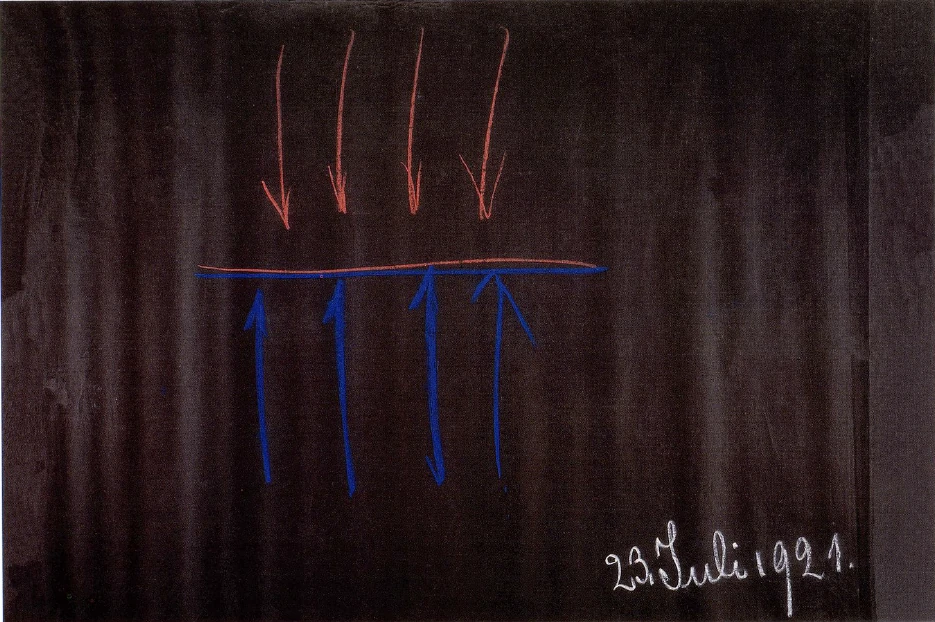
[ 16 ] This marked the transition toward the increasing development of pure intellectualism, which then reached Western civilization in the middle of the 15th century. When this intellectualism emerged, logic was something quite different from what it had been in Aristotle. For Aristotle, logic was, in a sense, the dregs of spiritual insights. He had gathered what people had previously experienced from the spiritual world. All consciousness of this had now vanished, and only the intellectual element itself remained—an intellectual element that no longer presented itself as the dregs of spiritual worlds, but rather as an abstraction from the sensory world. In a sense, what had been, in Aristotle’s thought, a result of the worlds above (red) was now taken as an abstraction of the worlds below (blue). And it was essentially with this intellectualism that people like Copernicus, Galileo, and Kepler now approached their work—though Kepler still had some intuitions—and attempted to apply that which had lost its spiritual origin; they tried to apply it to the external natural world, to the purely natural world. So that one can say: The development from the 4th century A.D. to the middle of the 15th century is essentially a kind of gestation period for civilized humanity with this intellectualism, which comes only from below, and which then fully emerges in the 15th century and increasingly focuses on the application of reason to the observation of external nature, until it reached its peak in this regard in the 19th century.
[ 17 ] Well, if you take everything I said yesterday about the sense of the “I,” the sense of thought, the sense of words, and so on, you will say to yourself: Just as we have these senses now, just as we experience the result of these senses in ordinary human consciousness, we are, after all, essentially dealing only with images; otherwise, those discussions that must arise from the peculiarities of the present time could not arise at all. A true understanding of the actual life of the soul has, in fact, been lost for the time being. Empirical proof of this, as I have often demonstrated to you, is the way in which Brentano failed in his attempt to write a psychology—a doctrine of the soul—which he had sincerely intended to do. Others, of course, write treatises on the soul because they are less sincere, less honest; but he wanted, in all sincerity, to write a treatise on the soul with substance, and he arrived at no substance because the content could only have come from spiritual science, which he rejected. Thus, it remained a work in progress, in which he presented less than he had actually intended to present. This—Brentano’s failure with his psychology—is a profoundly significant historical fact. For all the juggling of all sorts of concepts and ideas that our psychological science engages in today was, of course, something empty to Brentano.
[ 18 ] Well, that which constitutes the life of the soul—as the result of the six higher senses, from the sense of the “I” up to the sense of sight—was once filled with spiritual life. And when we look back to ancient times in Europe, all the way back to Plato, what is now becoming increasingly devoid of spirituality—and increasingly intellectualistic—was once filled with spirituality. And on the one hand, we come to all that was, so to speak, given to humanity in its development in earlier times, in the era when the East set the tone for human civilization on Earth. Back then, there was a civilization that was rooted in this soul life, this true soul life. So that we can say:
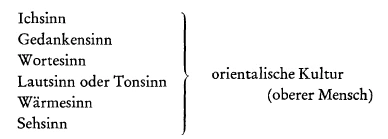
[ 19 ] All these senses provide results that, if there is spiritual life within the soul, nourish that spiritual life. And whatever humanity has developed, it has developed within ancient Eastern culture. And you will understand this Eastern culture in its entirety best if you understand it as I have just explained.
[ 20 ] But this is, in a sense, rooted in the very foundations of the development of civilization. Spiritual life was first—and this began, as I said, in the 4th century B.C.—de-spiritualized and intellectualized. The formulation of Aristotle’s abstract logic was the first milestone in this de-spiritualization of human inner life; the development of gnosis marked the complete suppression of this inner life. Now there remains the other human being:

[ 21 ] And so began a civilization that was essentially based on these senses. Even if it does not admit it at first, it is based on these senses. For take, for example, that scientific spirit that has emerged, which seeks to apply mathematics everywhere. Mathematics, however—as I characterized it yesterday—arises from the sense of movement and balance. So even that which our modern scientific approach presents as the most intellectual originates from the lower human being. In particular, however, the sense of touch is employed, for even the other senses are characterized by the fact that their properties are essentially based on those of the sense of touch. You can conduct interesting studies in this area today if you delve into the field of physiology.
[ 22 ] Certainly, people speak, for example, of seeing, or of the eye, or of the sense of sight; but for those who see through things, all the concepts that are applied have actually been slipped into the sense of sight from the sense of touch. People work with concepts borrowed from the sense of touch. These are slipped in. People do not notice this; but they characterize the sense of sight by applying to vision the categories and concepts used to understand the sense of touch. What is called “seeing” in science today is actually nothing more than a somewhat more complicated form of touching. Occasionally, categories and concepts such as tasting, smelling, and so on are then called upon. We can certainly point to the very foundation of our present-day conceptions—the way in which we summarize external phenomena—in the same sense; for it is already a finding of external anatomy and physiology—or at least a well-founded hypothesis—that our present-day thinking is actually rooted in a metamorphosis of the sense of smell, insofar as thinking is bound to the brain—that is, not at all to the higher senses, but to a metamorphosis of the sense of smell. This peculiar way in which we relate to the external world in our understanding—which is quite different from, say, how Plato related to the external world—is not a result of the higher senses; it is a result of the sense of smell, if I may put it somewhat trivially. I would like to say that we have not attained our fulfillment as human beings today by developing our higher senses, but precisely by acquiring a somewhat transformed, metamorphosed, and refined dog’s snout. This particular way of relating to the external world is quite different from that which corresponds to a spiritual age.
[ 23 ] Well, if what was first revealed in ancient times through humanity’s higher senses must be called Oriental culture, then what we are living within—and which I have just characterized—must be regarded as the essence of Western culture. This Western culture has essentially been drawn out of the lower human being.
[ 24 ] When it comes to matters such as those I am now discussing, I must emphasize again and again: These are truly not value judgments, but historical developments. I certainly do not mean to imply, by referring to “higher” and “lower,” that one is more valuable and the other less so. One is simply a immersion in the world; the other is a non-immersion in the world. And it does no good to mix in any personal sympathies or antipathies. One simply cannot arrive at an objective understanding that way. Anyone who wishes to grasp what is contained in Vedic culture, in Vedanta culture, and in yoga culture must proceed from an understanding of these things in this way (see the table on page 33, “the higher human being”). And anyone who wants to understand what is actually still in its infancy—what must be developed more and more for certain types of human behavior, though it had already reached a certain peak in the 19th century—must know that the lower human being is particularly eager to break free, and that this emergence of the lower human being is especially characteristic of Anglo-American nature, of Western culture.
[ 25 ] A particularly characteristic figure for the emergence of this culture is, of course, Bacon, Bacon of Verulam, who is especially characteristic because, in what he asserts in his Novum Organum, he actually makes very flippant claims—saying things that, fundamentally, can only mean anything substantial to superficial people. And yet they are extraordinarily characteristic. Bacon is, after all, both ignorant and foolish in a certain respect, and superficial—extraordinarily superficial. He is ignorant because as soon as he speaks of older cultures, he talks nonsense; he knows nothing about them. He is superficial because this can be demonstrated from his writings. For example, when he speaks of heat—he is an empiricist—he compiles everything that can be said about heat; but one can see that he has taken all these notes from the laboratory journals. What he has compiled on the subject of heat, he did not compile himself, but had a scribe cobble together, for it is an incredibly slapdash piece of work. Nevertheless, he is a milestone in recent development. One might say that one could be completely indifferent to his personality, but through all that sloppiness and all the nonsense he often spouts, something always shines through that is particularly characteristic of the emergence of precisely such a culture, one that corresponds to what I have described here (page 34). And it is impossible for humanity to emerge from the misery in which it currently lives unless it understands that, while—for reasons that should be sufficiently evident from the lectures so far—it was possible to live with the culture of the higher human being, it will not be possible to live with the culture of the lower human being. For ultimately, with every new incarnation, a person brings along their soul, which harbors unconscious reminiscences of previous earthly lives. A person is always drawn back to what has been left behind. Today, in many cases, they do not know what it is that draws them there. This pull manifests as a very vague longing, often something indefinable, but it is there. And it is there above all because people are slowly coming to regard that which belongs to this realm (page 34, lower human)—by framing it in laws—as something objective. Everything that is actually more traditionally present and belongs to this realm (page 33, the higher human), has, in terms of its character of being, evaporated into faith, and people still try to hold on to it by being reluctant to attribute a character of being to that which belongs to the soul along with its moral content, and by actually granting it, in terms of its cognition, only a certainty of faith.
[ 26 ] But it is not possible for humanity to continue living in the present with this inner conflict. One can still convince oneself that the Protestant opposition between faith and knowledge—which is constructed particularly within the Protestant denominations—must be defended in theory. It can be defended in theory, but it cannot be applied to life; one cannot live by it. Human life itself contradicts the establishment of such an opposition. A way must be found to reconcile the moral with that which is acknowledged to have existence; otherwise, one will always end up telling oneself: From mere natural necessities, one forms ideas about the beginning of the earth and its end; but as for what is to become of that which we actually regard as having human value—that which human beings inwardly and morally appropriate as value—once this scientifically determined end of the Earth has arrived, what is to become of it, and how it is to be saved from the perishing Earth into other worlds—on these matters, one wishes only to surrender to the certainty of faith.
[ 27 ] And it is interesting to note how, from this very perspective, anthroposophy, for example, is opposed. I feel I should mention this opposition simply because it is typical—because it does not stem from a single individual, but from a whole group of people. They believe that anthroposophy claims to have content that constitutes knowledge, and can therefore be treated in the same way as, for example, the content of scientific knowledge. Skeptics, of course, say that it does not correspond to the content of scientific knowledge; it is something else—well, that goes without saying and need not be specifically mentioned—but it can be treated in the same way as the content of scientific knowledge. Some also say that it cannot be proven. They have simply never familiarized themselves with the logical nature of proof. But the point is this: it is said that the things anthroposophy deals with must not become the object of knowledge at all, for they would be stripped of their essential character if they were to become the object of knowledge; they must be the object of a certainty of faith. For it is precisely because one knows nothing about God or an immortal life—but merely believes in these things—that the value of these things rests. And it is even held up as a reproach that anthroposophy strives for knowledge of these things; indeed, this knowledge is contested from the standpoint that it is said: After all, the religious character of these truths is undermined there, for the religious character rests precisely on the fact that one believes in something about which one knows nothing. Trust is expressed precisely by the fact that one knows nothing about it. — I would indeed like to know how people would manage in ordinary life with such a concept of trust! One would therefore have to have the same trust in those about whom one knows nothing as in those about whom one knows something. One would thus be unable to have any trust in the divine-spiritual beings once one comes to know them. So the religious character must consist precisely in the fact that one does not know them, for the sanctity of religious matters is compromised when they are made known.
[ 28 ] Yes, that’s exactly how it is: If one pays a little attention to the conceptual ramblings that occur there, one will see that what is printed week after week essentially contains things that simply degenerate into nonsense when broken down to their original, elementary components. One must not overlook such things today—this must be mentioned again and again, and even if I repeat myself on such matters, I do not shy away from such repetitions—one must pay attention to such things. One must, for example, be able to say to oneself: If today a respected newspaper in Württemberg commissions a university professor to write an essay on anthroposophy, and he then writes: Yes, this anthroposophy, which claims that there is a spiritual world in which spiritual beings move about like tables and chairs in physical space—yes, if a university lecturer today is in a position to write such a sentence, then it is unthinkable; everything must actually be done to render him harmless, for nonsense must not be written in positions of responsibility. Only when someone is drunk do tables and chairs move for him—but even then, only subjectively. And since Professor Traub will neither admit the hypothesis that he wrote his authoritative article while intoxicated, nor that he is a spiritualist—for tables and chairs do move for spiritualists as well, even if not entirely of their own accord—one has every right to say: Here, nonsense is being written in the most thoughtless manner. And anyone capable of writing such nonsense deserves to have his entire body of scholarship dismissed as untrustworthy.
[ 29 ] Today, it is necessary to make the strictest possible discipline a duty in these matters. And we sink ever deeper into the forces of decline if this utmost rigor is not made a duty. In this regard, the most unbelievable things are being experienced today, and the most unbelievable things are getting away with it because people keep coming up with excuse after excuse for the devious acts committed in such matters by those who claim to be authoritative. It is indeed absolutely necessary today to insist on arriving at clear, substantive concepts in all fields. And once one arrives at clear, substantive concepts, the theory of the separation of knowledge and belief simply cannot be sustained. For then it would have to be traced back to precisely what I have just traced it back to.
[ 30 ] But even this separation between knowledge and faith is merely historically conditioned. It is partly historically conditioned by what I have already mentioned, and partly by other factors. Above all, the following must be taken into account in this matter. For example, within Western Christianity, we first have what emerged in the early centuries of Christianity through the fusion of Gnosticism with the monotheistic teachings of the Gospels, and we have the fusion of Christianity with what emerged in this way during the Scholastic period—albeit in a very spirited manner, yet merely as a historical reminiscence—with Aristotelianism. And the doctrine of the simultaneous formation of the human body and the human soul through birth—or, let us say, the conception of a human being—is a thoroughly Aristotelian doctrine. With the casting aside of the old spirituality and the rise of mere intellectualism, Aristotle himself had already discarded the doctrine of pre-existence—the view of the life of the human soul before birth, before conception. This denial of the doctrine of pre-existence is not Christian, but Aristotelian. Essentially, this rejection of the doctrine of pre-existence only became a dogmatic constraint through the incorporation of Aristotelianism into Christian theology.
[ 31 ] But now a significant question arises here—a question for which some of the elements are already present in the lectures I have given here over the past few weeks. If you recall some of what I have said here in recent weeks, you will say to yourselves: In a certain sense—as I have always emphasized—19th-century materialism was not entirely without foundation. Why? Because what we encounter in human beings, for example—insofar as human beings are physically and materially organized beings—is a reflection of spiritual development since the last death. This is, in fact, not the purely spiritual-soul aspect; it is the physical-soul aspect; it is a reflection of what develops between birth and death. From what a human being experiences between birth and death, it is indeed never possible to derive any basis for a scientific conception of a life after death. There is nothing that provides possible proof of immortality if one considers only human life between birth and death.
[ 32 ] Traditional Christianity, however, initially considers only this life between birth and death, since it posits that the soul is created at birth or conception. No knowledge can be gained from this about life after death. If one refuses to acknowledge pre-existing life—about which, as you know, knowledge can be gained—then one can never gain knowledge about life after death. Hence the division between knowledge and faith regarding the question of immortality, stemming, for example, from the dogma of opposing pre-birth life. Because people wanted to discard the understanding of prenatal life, it became necessary to establish a special certainty of faith. For if, while opposing prenatal life, one still wishes to speak of life after death, one cannot speak of scientific knowledge regarding it.
[ 33 ] You can see how systematically organized—I would say—this set of dogmas is. The aim is to spread darkness among humanity regarding spiritual science. How is this done? On the one hand, the doctrine of pre-existence is combated; then there is no knowledge of life after death, so people must believe in life after death on the basis of dogma. Belief in dogma is enforced by combating the recognition of pre-birth life.
[ 34 ] Oh, there is an extraordinary amount of systematic thought in how dogmatics has developed since the 4th century A.D., and how modern scientific views have emerged entirely from this dogmatics. For their origins can all be traced back to it—merely applied to the external observation of nature—and it can be demonstrated how this paved the way for humanity’s attachment to mere faith. Because human beings naturally want to know something about immortality, their knowledge is taken away from them—and indeed, it has been taken away—making them susceptible to dogmatic faith, which can then choose its own spheres of influence.
[ 35 ] This is at once a social issue, a question of human development, and an issue that must be faced with complete clarity today. And this issue determines, first of all, the value of contemporary culture—and in particular, the value of the current scientific spirit—and, secondly, humanity’s prospects for regaining the forces of ascent and renewal.
[ 36 ] We'll talk more about that tomorrow.