Human-Becoming, World-Soul and World-Spirit I
Human Beings as Physical and Spiritual Entities
in Their Relationship to the World
GA 206
22 July 1921, Dornach
Translated by Steiner Online Library
Fourteenth Lecture
[ 1 ] We continue our examination of the relationship between the human being and the world, and in order to link the reflections of the coming days to what I have presented recently, I would like to begin today by returning to a chapter of our anthroposophical view that I addressed some time ago, namely the theory of the senses as understood in the anthroposophical sense. I said some time ago—and have said repeatedly—that external science considers only those of our senses for which, in the broader sense, organs are present, such as the sense of sight, the sense of hearing, and so on. This approach cannot be satisfying in a deeper sense because the realm encompassed, for example, by the experience of seeing—our entire experience of seeing—is just as distinct within the totality of our experiences as, say, the perception of another person’s “I” or the perception of the meaning of words. After all, today—when, in a certain sense, everything is being turned upside down—it has become quite common to say: When we face another person, we first see the human form. We know that we ourselves possess this human form, that this human form houses a “self” within us, and so we conclude that the human form of the other person, which appears similar to our own, must also contain a “self.” — There is not the slightest real awareness of what lies in the full immediacy of the perception of the other “I” when one bases one’s reasoning on such a conclusion. It is completely meaningless. For just as we face the external world directly and encompass a certain realm of it through our sense of sight, so too does the other “I” penetrate directly into our realm of experience. If we attribute a sense of sight to ourselves, we must also attribute a sense of “I” to ourselves.
[ 2 ] Above all, it must be noted that this sense of self is something entirely different from the development of awareness of one’s own self. This becoming aware of one’s own “I”—which is not actually a form of perception—is a completely different process from the one that takes place when we perceive another person’s “I” as such. Similarly, something entirely different underlies our listening to words and perceiving meaning in them than when we perceive merely the sound, the mere tone. Although it is initially more difficult to identify a human organ for the sense of words than it is to identify the organ of hearing for the sense of sound, anyone who is truly able to analyze our entire field of experience must realize that, within this field of experience, we must distinguish, on the one hand, the sense of sound and speech—the sense of tone—and, on the other hand, the sense of words. And yet another matter is perceiving the thoughts of others within words, specifically within word forms and word contexts. And again, we must distinguish between perceiving the thoughts of others and actual thinking. It is precisely the crude way in which soul phenomena are regarded today that fails to analyze, in this more subtle manner, the distinction between thinking—which we develop as an inner activity of our soul life—and the outward-directed activity that lies in perceiving another’s thoughts. Certainly, when we perceive another person’s thought, we must think in order to understand that thought and to relate it to other thoughts we have already held. But this thinking is something entirely different from the perception of another person’s thought.
[ 3 ] But then, when we classify and analyze everything that is present within the scope of our total experience into areas that are truly distinct from one another and yet share a certain inner kinship such that we can designate them as senses, we arrive at the twelve human senses that I have often mentioned. Today, one of the weakest areas of our current science is the one that deals with the senses from a physiological or psychological standpoint, for, strictly speaking, the discussion generally focuses on the senses in the abstract.
[ 4 ] Now, of course, within the realm of the senses, the sense of hearing, for example, is—let’s say—radically different from the sense of sight or the sense of taste. And again, if one arrives at a clear understanding of the sense of hearing or the sense of sight, then one must also distinguish between a sense of language, a sense of thought, and a sense of the self. Most of the terms in common use today when science speaks of the senses are actually derived from the sense of touch. And our philosophy has already gotten into the habit of basing an entire theory of knowledge on this, a theory that consists of nothing more than the transfer of certain perceptions relating to the sense of touch to the entire realm of perceptual capacity.
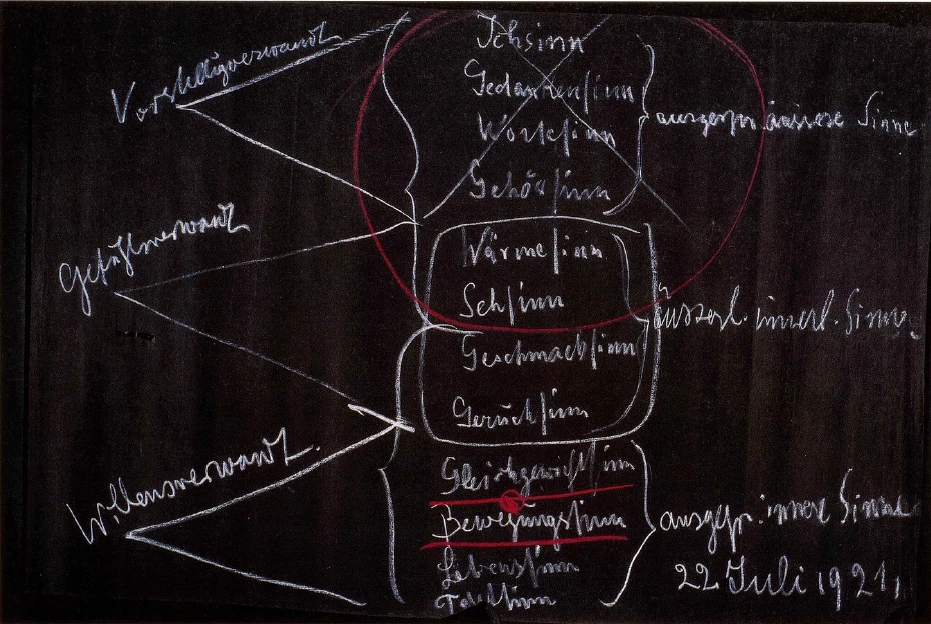
[ 5 ] If we now actually analyze the entire realm—the scope of our external experiences—which we perceive in similar ways, say, as visual experiences, tactile experiences, or thermal experiences, then we arrive at twelve clearly distinguishable senses, which I have listed on previous occasions as follows: first, the sense of “I,” which, as I said, must be distinguished from the consciousness of one’s own “I”; the sense of “I” refers to nothing other than the ability to perceive the “I” of another. The second is the sense of thought, the third is the sense of language, the fourth is the sense of hearing, the fifth is the sense of warmth, the sixth is the sense of sight, the seventh is the sense of taste, the eighth is the sense of smell, and the ninth is the sense of balance. Anyone who can truly analyze this area knows that there is a very limited realm of perception—just as there is a limited realm of sight—a limited realm that simply conveys to us the sensation that we, as human beings, are in a certain state of equilibrium. Without a sense to convey to us this state of balance—or this floating and dancing in balance—we would certainly not be able to fully develop our consciousness.
[ 6 ] Next is the sense of movement. The sense of movement is the perception of whether we are at rest or in motion. We must experience this perception within ourselves just as we experience our sense of sight. Eleventh is the sense of life, and twelfth is the sense of touch (see illustration on page 25).
I-sense
Thought-sense
Word-sense
Hearing-senseSense of heat
Sense of sight
Sense of taste
Sense of smellSense of balance
Sense of movement
Sense of life
Sense of touch
[ 7 ] These areas, which I have listed here as sensory domains, can be clearly distinguished from one another, and at the same time, one can find in them the commonality that we interact with the outside world through these senses. It is our interaction with the external world—our cognitive interaction with the external world—that these senses mediate for us; though in very different ways with regard to the external world. We have, first of all, four senses that connect us to the external world in an unquestionable way—if I may use the word “unquestionable” in this context—namely: the sense of the “I,” the sense of thought, the sense of speech, and the sense of hearing. It will readily be clear to you that, in a sense, our entire experience is situated in the external world when we perceive another person’s sense of self, just as when we perceive another person’s thoughts or words. This might not be quite as obvious with regard to the sense of hearing; but that is only because, in a kind of abstract contemplation of all the senses, a common conceptual nuance has been applied—one that is meant to be a common concept, a common idea of sensory life—and one does not actually take into account the specific characteristics of the individual senses. Of course, one cannot—I would say—reduce these things to their concepts through external experimentation; rather, it is necessary to possess the very capacity to intuit these experiences.
[ 8 ] Ordinary thinking, for example, does not concern itself at all with how hearing—because the medium of hearing is moving air, that is, a physical entity—essentially takes us directly out into the external world. And if you simply consider how external the sense of hearing actually is in relation to our entire organic inner experience, you will soon realize that you must understand the sense of hearing differently in this respect than, for example, the sense of sight. With the sense of sight, simply by observing the organ—the eye—one can soon see how what is conveyed there is, to a high degree, an inner process, or at least a relatively inner process. We close our eyes when we sleep; we do not close our ears when we sleep. Yet in such things—which are seemingly trivial, simple facts—something deeply significant for the whole of human life is expressed. And while we are compelled to shut off our inner world when we sleep, because we are not meant to perceive through sight, we are not compelled to shut off our ears, because the ear exists within the external world in a completely different way than the eye does. The eye is much more an integral part of our inner being. Visual perception is directed much more inward than auditory perception. Not the sensation of what is heard—that is something else entirely. The sensation of what is heard, which underlies music, is something different from the actual process of hearing.
[ 9 ] These senses, which essentially—I would say—mediate between the external and the internal, are distinctly external senses (see diagram on page 25). The senses that, so to speak, straddle the line between the external and the internal—which are experiences that are both external and internal—are the next four senses: the sense of warmth, the sense of sight, the sense of taste, and the sense of smell. Just try for a moment to visualize the full range of experiences provided by any one of these senses, and you will see how, on the one hand, all these senses involve a shared experience with the external world, but at the same time an experience within one’s own inner self. When you drink vinegar—that is, when your sense of taste comes into play—you certainly have, on the one hand, an inner experience of the vinegar and, on the other hand, an experience directed outward, which can be compared to the experience of an external “I,” for example, or of words. But it would be very problematic if one were to add a subjective, inner experience—let’s say—to the act of listening to words in the same way. Just imagine: when you drink vinegar, you grimace; this clearly indicates to you that you are having an inner experience alongside the external experience—that the external and inner experiences are intertwined. If the same were true of words—if, for example, someone were giving you a speech and you had to experience it internally in the same way as when drinking vinegar or Moselle wine or the like—then you would never be able to form a clear, objective understanding of the words the other person is saying to you. To the same extent that you have an unpleasant inner experience with vinegar and a pleasant one with Moselle wine, to that same extent do you color an external experience. You must not color this external experience when you perceive, let’s say, the other person’s words. One might say: Here one sees the moral aspect coming into play at the very moment when one sees things in their proper light. — For there are indeed people who, particularly with regard to the sense of the “I,” but also with regard to the sense of thought, behave in such a way that one can say these people are so deeply immersed in their middle senses—the sense of warmth, the sense of sight, the sense of taste, and the sense of smell—that they judge other people or their thoughts in the same way. But then they do not hear the other person’s thoughts or words at all; rather, they perceive them in the same way that, for example, let’s say, Mosel wine or vinegar or any other beverage or food is perceived.
[ 10 ] Here we see how something moral can simply arise from an otherwise entirely amoral perspective. Take, for example, a person whose sense of hearing—and especially whose sense of language, thought, and self—is poorly developed. Such a person lives, so to speak, without a head; that is, he uses his mental faculties in a manner similar to the senses that are more inclined toward the animal realm. An animal cannot perceive objectively in this way, as it can perceive objectively and subjectively through the sense of warmth, the sense of sight, the sense of taste, and the sense of smell. An animal smells: You can imagine that an animal can, to a very limited extent, objectively objectify what it encounters—let’s say, for example, through the sense of smell. It is, to a high degree, a subjective experience. Now, of course, all human beings also have the sense of hearing, the sense of language, the sense of thought, and the sense of self; but those who immerse themselves more fully—with their entire being—in the sense of warmth and the sense of sight, and especially in the sense of taste or even the sense of smell, alter everything according to their subjective taste or their subjective perception of the environment through smell. Isn’t that right? You can observe such things every day in life. If you want an example, you need only consider how there are people who cannot perceive anything objectively, but instead perceive everything in the way one would otherwise only perceive through the senses of taste and smell. You can see this in Pastor Kully’s latest brochure. He is completely incapable of grasping the words or thoughts of others; he interprets everything as one might drink wine, or drink vinegar, or eat any kind of food. Everything becomes a subjective experience. In the same sense, it becomes immoral when one reduces the higher senses to the level of the lower senses. There is, in fact, every possibility of bringing morality into connection with the entire worldview, whereas at present the destructive force—the force that undermines our entire civilization—lies in the fact that we do not know how to build a bridge between what is called the laws of nature and what is called morality.
[ 11 ] When we now turn to the next four senses—the sense of balance, the sense of movement, the sense of life, and the sense of touch—we are dealing with distinctly internal senses. We are dealing here, first and foremost, with distinctly internal senses. For what the sense of balance conveys to us is our own balance; what the sense of movement conveys is the state of movement in which we find ourselves. Our vital state is this general perception of how our organs function, whether they are beneficial or detrimental to our life, and so on. The sense of touch might be misleading; nevertheless, when you touch something, what you experience is an inner experience. In a sense, you do not feel the chalk, but rather you feel the skin being pushed back, if I may put it bluntly; the process, of course, can be described in much finer terms. It is the reaction of your own inner self to an external process that is present in the experience—a reaction that is not present in any other sensory experience in the same way as it is in the tactile experience.
[ 12 ] Now, however, this latter group of senses is modified by something else. You must recall something I said here a few weeks ago. Consider human beings in relation to what is perceived through these last four senses; even though we perceive things—our own movement, our own balance—and even though we perceive what we perceive in a decidedly subjective, inward manner, these are nevertheless processes that are entirely objective. That is what makes this so interesting. We perceive these things inwardly, but what we perceive there are entirely objective things, for it is, in essence, physically irrelevant whether, say, a block of wood is moving or a human being, whether a block of wood is in balance or a human being. As far as the external physical world and its motion are concerned, a moving human being is to be regarded in exactly the same way as a block of wood; the same applies with regard to equilibrium. And if you consider the sense of life, it is true that at first glance it does not relate to the external world—though this is only apparent—but the fact is that what our sense of life conveys are entirely objective processes. Imagine a process taking place in a retort: it proceeds according to certain laws and can be described objectively. What the sense of life perceives is such a process, one that is internal. If this process is in order—as a purely objective process—the sense of life conveys this to you; or if it is not in order, the sense of life conveys that to you as well. Even if the process is enclosed within your skin, the sense of life conveys it. After all, an objective process is not something that initially has any particular connection to the content of your inner life. And the same applies to the sense of touch; when we truly touch, it is always a change in the entire organic structure. Our reaction is an organic change within us. So in what we have described with these four senses, we have in fact described something objective—something that places us as human beings in the world exactly as we fundamentally are: objective beings who can also be perceived externally in the sensory world.
[ 13 ] So we can say that these are distinctly internal senses, but what we perceive through them is just as much a part of us as what we perceive externally in the world. Whether we set a block of wood in motion or whether a person is moving externally makes no difference to the physical course of events. The sense of motion exists solely so that what happens in the external world can also reach our subjective consciousness and be perceived.
[ 14 ] So you see, it is precisely the purely external senses that are truly subjective. They must bring what is perceived through them into our humanity in the truest sense. I would say that the middle group of senses represents a back-and-forth oscillation between the outer and inner worlds, and that a profound experience of something that we are—in that we belong to the world, not to ourselves—is conveyed to us through the last group of senses.
[ 15 ] This line of thought could be expanded considerably. One would find many things that are characteristic of one sense or the other. One simply has to become familiar with the idea that the study of the senses must not be approached by describing the senses solely in terms of the grosser sensory organs, but rather through an analysis of the field of experience. For it is not at all correct to say, for example, that there is no separate organ for the sense of language; it is simply that contemporary materialistic physiology has not investigated its boundaries in the same way as, say, the organ of hearing. Or take the sense of thought—it is also there, but it has not been investigated in the same manner as, say, the sense of sight or the like.
[ 16 ] If we look at human beings in this way, it must become strikingly clear to us how the life that we commonly call “soul life” is actually connected to, let us say, the higher senses. We can hardly go beyond the sense of “I” to the sense of sight if we want to grasp the content of what is commonly called “soul life.” Imagine everything you experience through the sense of “I,” the sense of thought, the sense of speech, the sense of sound, the sense of warmth, and the sense of sight—then you will have roughly the scope of what you call “soul life.” It is precisely from these distinctly external senses—and from the qualities of these distinctly external senses—that something extends into the sense of warmth, on which we depend far more in our soul life than we usually realize. The sense of sight, after all, has an immensely broad significance for the entire soul life. But we already descend into the animal realm with the sense of taste and the sense of smell, and we descend completely into our physicality with the sense of balance, the sense of movement, the sense of life, and so on. In a sense, these perceive things entirely inwardly, as that which no longer belongs to our soul life.
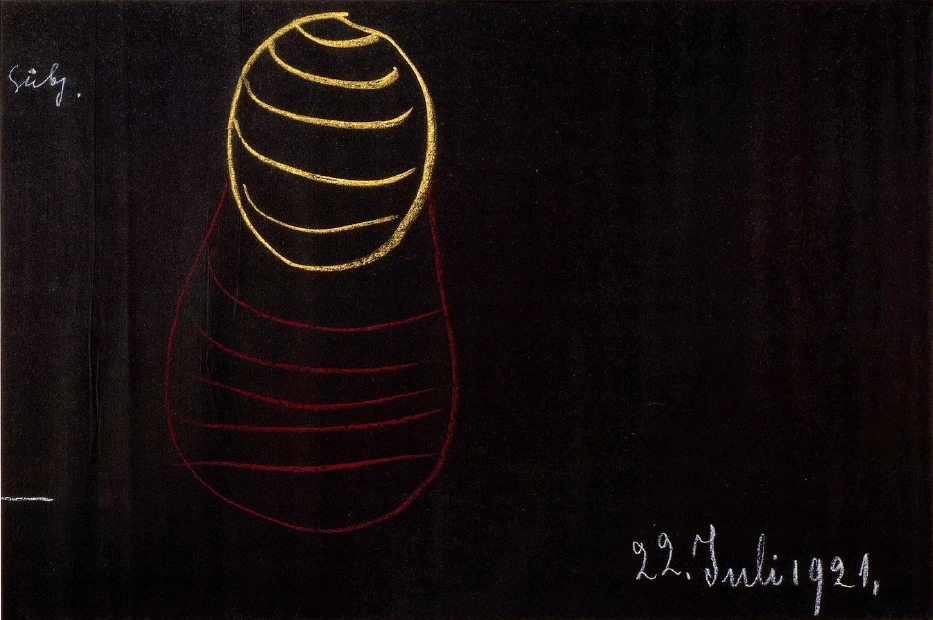
[ 17 ] If we were to sketch our human nature schematically, we would have to draw it this way: We would have to say that we encompass the upper region, and within that upper region lies our actual inner life (yellow). This inner life could not possibly exist if we did not have these very external senses. What would we be as human beings if we had no other “selves” beside us? What would we be as human beings if we had never heard words, thoughts, and so on? Just imagine that. In contrast, that which lies below the sense of taste perceives inwardly; it first conveys processes inward (red). But these perceptions become increasingly unclear. Certainly, a person must have a very clear perception of their own balance; otherwise, they would faint and fall over. Fainting and falling over means nothing other than becoming blind to the eyes for the sense of balance. But now, what these senses convey becomes unclear. The sense of taste—which develops, I would say, still to a certain extent on the surface—is accompanied by a clear awareness of this sense of taste. But although our entire body—at least with the exception of the limbs, though actually even they—tastes, very few people are still able to taste different foods once they are in the stomach, because in this regard today, well, how shall I put it, civilization or culture—or should I say gourmet culture—has not developed that far. Very few people can still taste the various foods in their stomachs. They can barely taste them in the other organs. But once they are in the stomach, most people don’t care at all what they taste like, even though the sense of taste continues very distinctly throughout the entire digestive tract on a subconscious level. Essentially, the whole person tastes what they consume, but this sense dulls very quickly once what has been eaten is assimilated by the body. The whole person develops, throughout their organism, the sense of smell—the passive response to scented substances. This, in turn, focuses only—I would say—on the most superficial aspects, whereas in reality the whole person is captivated by a fragrant flower or any other scented substance, and so on. Precisely when one knows this—how the senses of taste and smell permeate the whole human being—then one also knows what is contained in this experience of smelling and tasting, how it extends into the inner being of the human being, and one moves entirely away from any kind of materialistic conception when one knows what tasting, for example, means. And once one is clear that this process of tasting permeates the entire organism, one is no longer able to describe the subsequent digestive process in such a purely chemical manner as it is described by today’s materialistic science.
[ 18 ] But on the other hand, there is no denying that there is a huge difference between what I have marked in yellow here and what I have schematically marked in red here: a tremendous difference between the content we experience in our inner life through the sense of the “I,” the sense of language, and so on, and the experiences we have through the senses of taste, smell, movement, life, and so on. It is a tremendous, a radical difference. And you will best understand this difference when you realize how you perceive what you experience within yourself when, say, you listen to another person’s words, or when you listen to a sound; what you experience within yourself in that moment has, at first, no meaning at all—that is, in and of itself, it has no meaning for the external process. What does the bell care that you hear it! There is simply a connection between your inner experience and the process taking place within the bell, insofar as you are listening.
[ 19 ] You cannot say the same thing when you consider the objective process of tasting, or of smelling, or even, let’s say, of touching. There is certainly a cosmic process at work there. What is happening within your organism cannot be separated from what is taking place in your soul. In this case, you cannot say—as you might with a bell: “What does the ringing bell care whether you’re listening to it!” — So you cannot say: “What does what is happening on your tongue when you drink vinegar have to do with what you are experiencing?” — You cannot say that, because there is an intimate connection. What is an objective process is one and the same as the subjective process.
[ 20 ] The errors committed in this area by modern physiology border on the outrageous, precisely because such a process as, for example, tasting is treated in a manner similar to that of, say, seeing or hearing. And there are philosophical treatises that speak simply and generally about sensory qualities and their relationship to the soul. Locke, and even Kant, speak generally of a relationship between the external sensory world and human subjectivity, whereas something entirely different applies to everything that extends upward from the sense of sight and to everything that extends downward from the sense of taste. It is impossible to encompass these two domains with a single theory. And since this has been attempted, this immense confusion has arisen in the theory of knowledge, which—beginning with Hume or Locke, or even earlier—has virtually devastated modern concepts all the way up to modern physiology. For one cannot arrive at the nature and essence of these processes—and thus also not at the essence of human beings—if one pursues these matters in this way, guided by preconceived notions and without unbiased observation.
[ 21 ] We must therefore be clear that, by placing the human being in this way before us, we have, on the one hand, a distinctly inward-directed life that the human being lives for himself, simply by perceiving and relating to the external world. On the other hand, however, the person also perceives; but through what he perceives, he places himself within the world. To put it somewhat radically, in the end one must say: What takes place on my tongue as I taste is entirely an objective process within me; in that it unfolds within me, it is a worldly process. Whereas I cannot say that what arises within me as an image through seeing is, in the first place, a worldly process. It could be absent, and the whole world would still be as it is. This distinction between the higher human being and the lower human being must absolutely be maintained. If one does not maintain it, then one will not be able to arrive at certain lines of thought at all.
[ 22 ] We have mathematical truths, geometric truths. A superficial observer of human beings might think: Well, people just pull mathematics out of their heads or from somewhere—after all, the ideas they form aren’t that precise, are they? — But that’s not the case. This mathematics comes from entirely different realms. And if you observe human beings, you’ll see that the realms from which mathematics arises are already present: it is the sense of balance, it is the sense of movement. Mathematical thinking rises from such depths—depths we cannot reach or descend to with our ordinary soul life. Beneath our ordinary life of the soul lies that which lifts us up, that which we unfold in mathematical structures. And so we see that the mathematical actually has its roots in that which is at the same time cosmic within us. We are, after all, truly subjective only with regard to what lies above the sense of sight; with what lies below it, we are rooted in the world. We are within the world in that respect; but with what lies beneath it, we are like a block of wood, just like the rest of the external world. We can therefore never say that, for example, the theory of space could have anything subjective about it, for it springs from that within us in which we ourselves are objective. It is precisely the same space that we traverse when we walk and that our movements convey to us—precisely the same space that we then, once we have brought it out of ourselves in the form of an image, apply to what we are looking at. Nor can it be said of space that it could in any way be something subjective, for it does not arise from that realm from which the subjective arises.
[ 23 ] An approach such as the one I have just taken is simply very far removed from all forms of Kantianism, because Kantianism does not recognize this radical distinction between these two spheres of human life. It does not recognize that space cannot be anything subjective, because space arises from that realm within the human being that is objective in itself, toward which we behave objectively. We are connected to it differently than we are to the external world, but it is the external world—the true external world—and, above all, it becomes the external world every night when we withdraw into sleep with our subjectivity, the “I,” and the astral body.
[ 24 ] It is necessary to realize that it is of no use to compile as many external facts as possible into a so-called science—which is then supposed to further promote culture—if there are completely confused concepts within our imagination and understanding of the world, if there are no clear concepts regarding the most important things. And this is the task that now lies before us as an absolute necessity if we are to counteract the forces of decline and work toward forces of ascent: that we recognize how essential it is, above all else, to arrive at clear concepts—not vague ones, but clear ones. One must certainly realize that relying on concepts or definitions means nothing at all; rather, it is the unbiased observation of the realms of facts.
[ 25 ] No one has the right, for example, to define the visual field as something that he then characterizes as a sensory field unless he simultaneously, let’s say, sets aside the field of word perception as a field of the same kind. Just try once to structure the realm of all experience in the way I have done on several occasions, and you will see that you cannot say to yourself: We have eyes, so we have a sense of sight, and we are considering the sense of sight. — Instead, you will have to say to yourself: Certainly, the fact that vision has such distinctly physical-sensory organs is connected to something; but that does not justify limiting the realm of the senses to that in which clearly perceptible physical organs are present. — Yet this does not bring us anywhere near any higher perspective; rather, it brings us only to what takes place in ordinary human life. We arrive at the important point that we must truly distinguish between what is subjective in the human being, what is the inner life of the soul, and that in which the human being is actually asleep. For example, the human being is a cosmic being in relation to everything conveyed by the senses; in that respect, he is a cosmic being. You are unaware of what is happening there in your ordinary soul life—at least not without a higher perspective—when you move your arm. This is the development of the will. It is a process that lies just as much outside of you as any other external process. Nevertheless, it is intimately connected with you. But it lies outside your soul life. On the other hand, no conception of it can exist without our consciousness being present. Therefore, when you structure these three realms, you also gain another one.
[ 26 ] In everything that your sense of self, your sense of thought, your sense of speech, and your sense of hearing convey to you—as these conveyances become part of your soul life—you receive, in the most eminent sense, everything that is related to the imagination. In exactly the same sense, everything pertaining to the sense of warmth, the sense of sight, and the senses of taste and smell is related to feeling. In some cases, this is not entirely obvious, as with the sense of sight. With the senses of taste, smell, and warmth, it is obvious, but with the sense of sight, anyone who examines it more closely will find this to be true as well. In contrast, everything related to the sense of balance, the sense of movement, the sense of life, and also the sense of touch—although this is harder to notice because the sense of touch withdraws inward—all of this is related to the will. In human life, everything is interconnected, and yet everything is constantly undergoing metamorphosis.
[ 27 ] So today I have tried to summarize and reiterate what I have discussed on various occasions, so that we can then move on to tomorrow’s and the day after tomorrow’s reflections.