

Anthroposophy as Cosmosophy I
GA 207
8 October 1921, Dornach
Translate the original German text into any language:
Versions Available:
Anthroposophy as Cosmosophy I, tr. SOL
Siebenter Vortrag
Seventh Lecture
[ 1 ] Die Betrachtung, die wir seit einiger Zeit angestellt haben, hat uns dazu geführt, die Beziehung des Menschen zur geistigen Welt ins Auge zu fassen, und diese Beziehung wiederum hat es notwendig gemacht, den Blick zu werfen auf diejenige Entwickelung, die der Mensch durchmacht zwischen dem Tod und einer neuen Geburt. An diesem Punkte wollen wir heute einsetzen. Wir haben gestern gesagt, daß der Mensch durch die Pforte des Todes trägt ein, ich nannte es mineralisches Bewußtsein. Es kann so genannt werden, weil es im wesentlichen zu seinem Inhalte hat die mineralische Welt mit ihren Gesetzen. Tingiert, also durchtränkt ist dieses Bewußtsein mit alldem, was aus den moralischen Gefühlen und Empfindungen des Menschen kommt. Mit demjenigen, was sich nun von diesen beiden Seiten her zusammensetzt, tritt der Mensch seinen Weg an durch die Welt, die er durchläuft zwischen dem Tod und einer neuen Geburt. Wenn wir das, was so der Mensch ist nach dem Tode, betrachten, so stellt sich uns das Folgende dar: Es hat sich entrungen demjenigen, was gewissermaßen wie eine Art von Schale war, dem physischen Leibe und dem ätherischen Leibe, der astralische Leib und das Ich.
[ 1 ] The reflections we have been engaging in for some time have led us to consider humanity’s relationship to the spiritual world, and this relationship, in turn, has made it necessary to examine the development that a human being undergoes between death and a new birth. This is where we will begin today. We said yesterday that when a human being passes through the gate of death, they carry with them what I called “mineral consciousness.” It can be called this because its content essentially consists of the mineral world and its laws. This consciousness is imbued—that is, permeated—with everything that arises from the human being’s moral feelings and sensibilities. With what is now composed of these two aspects, the human being sets out on their journey through the world they traverse between death and a new birth. When we consider what a human being is like after death, the following picture emerges: the astral body and the “I” have broken free from what was, in a sense, a kind of shell—the physical body and the etheric body.
[ 2 ] Nun, wenn wir uns die kosmische Entwickelung der Menschheit vorstellen mit den zu ihr gehörigen kosmisch-planetarischen Körpern, dann wissen wir ja aus der Darstellung in meiner «Geheimwissenschaft im Umriß», wie diese kosmische Entwickelung in der Vergangenheit durchgeht durch die Saturnentwickelung, Sonnenentwickelung, Mondenentwickelung, und wie dann der Mensch in der Erdenentwickelung ankommt, in der er eben noch drinnensteht. Wir wissen auch, daß im wesentlichen die Saturnentwickelung den physischen Leib in seiner ersten Anlage bildet als eine Art universellen Sinnesorganes, das sich dann durch Sonnen-, Monden- und Erdenentwickelung weiterbildet. Wir wissen, daß der ätherische Leib während der Sonnenentwickelung dazukommt, der astralische Leib in der ersten Anlage während der Mondenentwickelung, und daß die Erdenentwickelung die eigentliche Ich-Entwickelung für den Menschen ist.
[ 2 ] Well, when we imagine the cosmic evolution of humanity along with the associated cosmic-planetary bodies, we know from the description in my *Outline of Esoteric Science* how this cosmic evolution has unfolded in the past through the Saturn, Sun, and Moon phases, and how humanity then arrived at the Earth phase, in which it is still currently situated. We also know that, essentially, the Saturn evolution forms the first rudiment of the physical body as a kind of universal sense organ, which is then further developed through the Solar, Lunar, and Earth evolutions. We know that the etheric body is added during the Solar stage, the astral body takes on its initial form during the Lunar stage, and that the Earth stage is the actual development of the “I” for human beings.
[ 3 ] Wenn wir das Menschenwesen im ganzen auffassen, so hat es sein Ich durch die Verbindung des Menschen mit der Erde; denn durch diejenigen Kräfte, die in der Erde vorhanden sind, wird das Ich gestaltet, gebildet. Wenn wir also sagen: Der Mensch tritt durch die 'Todespforte, indem er sein Ich durch sie durchträgt —, so bringt er ja eigentlich dasjenige durch die Todespforte hindurch, was er aus seiner irdischen Entwickelung hat, was er sich also innerhalb der irdischen Entwickelung aneignet. Wir tragen geradezu durch den Tod hindurch, was der irdischen Entwickelung angehört. Während der irdischen Entwickelung ist eben zu den anderen Reichen — das können Sie wiederum aus meiner «Geheimwissenschaft» entnehmen — die mineralische Welt dazugekommen. Also das Außere, die mineralische Welt, gehört gewissermaßen mit der Ich-Entwickelung zusammen. Daß das Ich mit einem mineralischen Bewußtsein durch des Todes Pforte tritt, das hängt im wesentlichen also mit dem zusammen, was der Mensch eigentlich von der Erde hat. Nun aber ist ja die Erde nur unvollständig aufgefaßt, wenn wir sie bloß so auffassen, wie sie uns zunächst als Weltkörper entgegentritt. Die Erde ist gewissermaßen als Weltkörper ein Wesen, das sich vergleichen läßt mit einem großen Tropfen im unendlichen Meere des Raumes. Aber dieser Tropfen ist ja gerade dadurch konstituiert, daß er in sich stofflich differenziert ist, daß er Stoffe enthält von verschiedener Schwere, verschiedener Dichte.
[ 3 ] If we consider the human being as a whole, the “I” arises from the human being’s connection to the earth; for the “I” is shaped and formed by the forces present in the earth. So when we say that the human being passes through the “gate of death” by carrying his “I” through it—he is in fact bringing through the gate of death that which he has gained from his earthly development, that which he has acquired within the course of his earthly development. We literally carry through death what belongs to earthly development. During earthly development, the mineral world has been added to the other realms—as you can see from my *The Secret Science*. So the outer world, the mineral world, is, in a sense, connected to the development of the “I.” The fact that the “I” passes through the gate of death with a mineral consciousness is essentially connected to what the human being actually derives from the Earth. But the Earth is only incompletely understood if we view it merely as it first appears to us as a celestial body. As a celestial body, the Earth is, in a sense, a being that can be compared to a large drop in the infinite ocean of space. But this drop is constituted precisely by the fact that it is materially differentiated within itself, that it contains substances of varying weight and density.
[ 4 ] Wir brauchen nur die Metalle, die in der Erde sind, ins Auge zu fassen. Wir finden Metalle verschiedener Dichte. Was der Mensch also in sich eingegliedert erhält von der Erde mit dem mineralischen Bewußtsein, das rührt von der ganzen Erde her, das rührt einfach davon her, daß die Erde eben dieser Gesamtplanet im Kosmos ist. Das nach den verschiedenen Mineralsubstanzen hin Differenzierte, das wirkt dann so, daß der Mensch nicht nur mitnimmt durch die Pforte des Todes, was sein Ich geworden ist, sondern daß er auch für einige Zeit mitnimmt, was sein astralischer Leib war, was ja auch beschrieben ist in der «Geheimwissenschaft» und im Buch «Theosophie» als der Durchgang des Menschen durch die Seelenwelt. (Während der folgenden Ausführungen wird an die Tafel gezeichnet, Zeichnung S. 129.) So daß wir sagen können: Wenn der Mensch die Erde verläßt, dann entwickelt er das mineralische Bewußtsein. Aber dieses mineralische Bewußtsein, es wird zunächst durchdrungen von demjenigen, was der Mensch von der differenzierten Erde mitnimmt, von der Erde, insofern sie aus verschiedenen Substanzen besteht. Das bildet dann die Zeit seines Durchganges durch die Seelenwelt. Und wir können sagen: Da nimmt der Mensch etwas mit, was zunächst nicht nur sein Ich ist, das dann weitergeht, sondern was in gewisser Weise eine astralische Erdenfrucht ist.
[ 4 ] We need only consider the metals found in the Earth. We find metals of varying densities. What the human being thus incorporates from the Earth—along with the mineral consciousness—originates from the Earth as a whole; it simply stems from the fact that the Earth is this very planet within the cosmos. What is differentiated according to the various mineral substances then works in such a way that the human being not only takes with them through the gate of death what has become their “I,” but also, for a certain time, takes with them what was their astral body—which is also described in *The Secret Science* and in the book *Theosophy* as the human being’s passage through the world of souls. (During the following explanation, a diagram is drawn on the blackboard; see p. 129.) So we can say: When a human being leaves the Earth, they develop mineral consciousness. But this mineral consciousness is initially permeated by what the human being takes with them from the differentiated Earth—from the Earth insofar as it consists of various substances. This then constitutes the period of their passage through the soul world. And we can say: There, the human being takes with them something that is not merely their “I,” which then continues on, but which is, in a certain sense, an astral fruit of the Earth.
[ 5 ] Wenn wir dann den Menschen weiter verfolgen, wenn er diese astralische Erdenfrucht abgelegt hat in dem Sinne, wie ich das beschrieben habe in meinem Buche «Theosophie», wo gezeigt ist, wie er einige Zeit nach dem Tode seinen Durchgang durch die Seelenwelt vollendet hat, dann wandert sein Ich weiter. Aber es ist zunächst durchdrungen von mineralischem Bewußtsein. Richten wir den geistigen Blick da hinauf, wo der Mensch ist, so gewahren wir das mineralische Bewußtsein des verstorbenen Menschen, das heißt die Gedankenwelt, die sich auf das Mineralische bezieht. Und es ist in der Tat so: An demjenigen, was nun mineralisches Reich ist auf der Erde und auch im Kosmos, arbeitet mit diese von dem Menschen durch den Tod getragene Gedankenwelt.
[ 5 ] If we then follow the human being further, once he has shed this astral earthly form in the sense I described in my book *Theosophy*—where it is shown how, some time after death, he has completed his passage through the world of souls—then his “I” continues on its journey. But at first it is permeated by mineral consciousness. If we direct our spiritual gaze upward to where the human being is, we perceive the mineral consciousness of the deceased person—that is, the world of thought that relates to the mineral realm. And it is indeed the case that this world of thought, carried by the human being through death, works upon what is now the mineral kingdom on Earth and also in the cosmos.
[ 6 ] Das ist ein außerordentlich bemerkenswerter und bedeutsamer Zusammenhang. Wenn wir hier auf der Erde unsere Mineralien überschauen, wenn wir das mineralische Reich, das ja auch in den Wolken ist, denn das sind ja auch mineralische Wirkungen, überschauen und uns fragen: Was für geistige Essenzen wirken denn da drinnen? — so müssen wir uns zur Antwort geben: In diesen mineralischen Gebilden, die uns gewissermaßen, wenn wir als Menschen auf der Erde mit physischen Sinnen stehen, ihre Außenseite zeigen, in allen mineralischen Wirkungen leben die Gedanken, zu denen die Menschengedanken nach dem Tode werden. Wir können also geradezu, wenn wir verständnisvoll hinblicken auf das mineralische Reich, unseren Blick schweifen lassen über dieses mineralische Reich und können uns sagen: In der mineralischen Tätigkeit arbeitet innerlich dasjenige, was das Bewußtsein der Toten ist im Beginne ihrer überirdischen Laufbahn. — Wir müssen also das mineralische Reich nicht nur aus äußeren Gründen hier ein totes, unlebendiges Reich nennen, sondern wir müssen es auch in dem Sinne ein totes Reich nennen, als zunächst die Menschengedanken, die wesenhaften Menschengedanken, die der Mensch zu hegen hat nach dem Tode, hineinwirken in dieses mineralische Reich.
[ 6 ] This is an extraordinarily remarkable and significant connection. When we survey our minerals here on Earth, when we survey the mineral kingdom—which is, after all, also present in the clouds, for those too are mineral effects—and ask ourselves: What kinds of spiritual essences are at work there? — then we must answer: Within these mineral formations—which, in a sense, reveal their outer aspect to us as human beings standing on Earth with physical senses—and within all mineral processes, there live the thoughts that human thoughts become after death. So when we look at the mineral kingdom with understanding, letting our gaze wander over it, we can say to ourselves: At work within the mineral activity is that which constitutes the consciousness of the dead at the beginning of their super-earthly journey. — We must therefore not only call the mineral kingdom a dead, lifeless realm here for external reasons, but we must also call it a dead realm in the sense that, initially, human thoughts—the essential human thoughts that a person must cherish after death—work their way into this mineral kingdom.
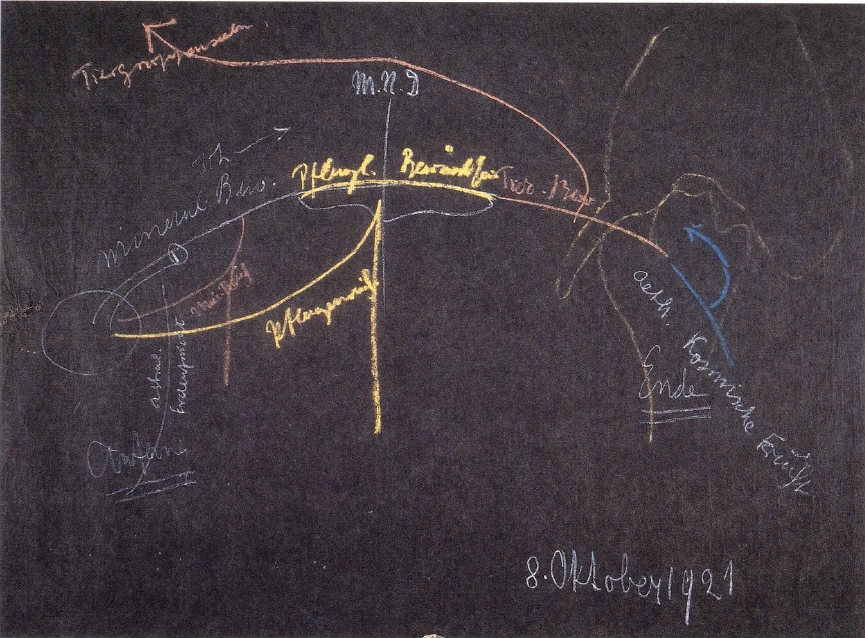
[ 7 ] Wenn der Mensch dann seine Wanderung fortsetzt, so kommt er ja immer mehr in die Nähe der Mitternachtsstunde des Daseins. Vorund nachher entwickelt er in dem Sinne, wie ich das gestern auseinandergesetzt habe, ein Bewußtsein, das mehr pflanzenhafter Natur ist, das also nicht das mineralische Bewußtsein ist von vorher, sondern ein Bewußtsein, das dadurch entsteht, daß die menschliche Wesenheit durchdrungen wird von den pflanzenschaffenden Kräften. Der Mensch nimmt ja etwas anderes auf aus dem außerirdischen Reiche, als die Erde als solche ihm geben kann. Der Mensch nimmt auf zu dem, was die Erde ihm geben kann, dasjenige, was eine Art höheren Bewußtseins ist, und es kann uns das dadurch anschaulich sein, daß wir sagen: Es entwickelt dann der Mensch ein pflanzliches Bewußtsein. Und während dieser Zeit arbeitet er sowohl auf der Erde wie auch im Kosmos mit an dem Pflanzenreich (siehe Zeichnung Seite 129).
[ 7 ] As a person continues on this journey, they draw ever closer to the midnight hour of existence. Before and after that, as I explained yesterday, they develop a consciousness that is more plant-like in nature—that is, not the mineral consciousness of before, but a consciousness that arises when the human being is permeated by the plant-forming forces. After all, human beings absorb something different from the extraterrestrial realm than what the Earth itself can provide. In addition to what the Earth can give him, the human being absorbs what is a kind of higher consciousness, and we can visualize this by saying: The human being then develops a plant-like consciousness. And during this time, he contributes to the plant kingdom both on Earth and in the cosmos (see drawing on page 129).
[ 8 ] Das gehört zu den Geheimnissen des Daseins, daß, wenn wir die Pflanzendecke der Erde, wenn wir alles im vegetabilischen Dasein Befindliche betrachten, daß uns das dann ja natürlich auch nur die Außenseite zeigt; es hat auch eine Innenseite. Nur müssen wir natürlich die Innenseite nicht unter den Wurzeln suchen, sondern über den Blüten. Wenn wir die Pflanze uns vorstellen, die da blüht, so ist sie in dem, was sich so astralisch zur Pflanze niederneigt, was gewissermaßen astralisch lebt und seinen äußeren Ausdruck in der Pflanzendecke in dem Befruchtungsvorgange hat; das also, was nicht gesehen wird. Man möchte sagen: Die Außenseite wäre diese, wenn man die Pflanze selber rein von der Wurzel nach der Blüte anschaut, und das Innere wäre dann das, was über der Blüte ist. Wenn wir also das, was die Pflanzendecke äußerlich sinnlich ist, als eine Außenseite betrachten, so ist die Innenseite davon das Gebiet derjenigen Kräfte, welche zum Teil ihren Ausgangspunkt haben von dem Bewußtsein derjenigen Menschen, die in der Mitte zwischen dem Tod und einer neuen Geburt leben, die vor und nach der Mitternachtsstunde des Daseins leben. Also auch in der Pflanzendecke der Erde haben wir etwas zu sehen, demgegenüber wir sagen können: Es ist in seinem kosmischen Dasein etwas, was zusammenhängt mit der ganzen menschlichen Entwickelung.
[ 8 ] One of the mysteries of existence is that when we look at the Earth’s vegetation—when we observe everything in the plant kingdom—we naturally see only the outer side; there is also an inner side. Of course, we need not look for the inner side beneath the roots, but rather above the flowers. When we imagine the plant that is blooming there, it exists in that which bends down astral-like toward the plant—that which, in a sense, lives astral-like and finds its outward expression in the plant cover during the process of fertilization; that is, what is not seen. One might say: The outer side would be this, if one looks at the plant itself purely from the root to the flower, and the inner side would then be what lies above the flower. So if we regard what the plant cover is externally in a sensory sense as an “outside,” then the “inside” of it is the realm of those forces that have their point of origin, in part, in the consciousness of those human beings who live in the middle between death and a new birth—who live before and after the midnight hour of existence. Thus, even in the Earth’s plant cover, we see something about which we can say: In its cosmic existence, there is something connected with the entire course of human development.
[ 9 ] Wenn wir gegenüber dem mineralischen Reiche sagen können: In diesem toten Reiche leben die webenden Gedanken der Menschen, die in der ersten Hälfte, im Anfange ihrer Laufbahn zwischen dem Tod und einer neuen Geburt sind —, dann müssen wir sagen: In dem Pflanzenwachstum der Erde enthüllt sich uns auf eine äußerliche Weise, was innerlich im Weltenall lebt, so daß es auch ausmacht die Bewußtseinswelt der Menschen in der Mitte zwischen dem Tod und einer neuen Geburt.
[ 9 ] If we can say of the mineral kingdom: “In this dead kingdom live the weaving thoughts of human beings who, in the first half—at the beginning of their journey—are between death and a new birth,” then we must say: In the plant life of the Earth, what lives inwardly in the universe is revealed to us in an outward way, so that it also constitutes the world of human consciousness in the middle between death and a new birth.
[ 10 ] Jene innigen Beziehungen zwischen dem Menschen und der Welt, von denen wir gestern gesprochen haben und die es möglich machten, daß die gestrige Betrachtung schloß mit den Worten: Welterkenntnis ist Menschenerkenntnis und Menschenerkenntnis ist Welterkenntnis — diese Beziehungen enthüllen sich da noch auf eine ganz besondere Weise. Es zeigt sich uns, daß wir tatsächlich auch schon hier auf der Erde etwas anschauen von dem, was der Mensch ist zwischen dem Tod und einer neuen Geburt. Schauen wir die Mineralien an, so enthüllen sie uns — etwa so, wie eine Art äußeren Bildes irgendeinen Vorgang enthüllt —, was Menschen innerlich bewußt tun in der Zeit, die gleich nach dem Tode folgt. Und indem wir die Pflanzenwelt anblicken, enthüllt sich das, was der Mensch innerlich tut in der Mitte seines Entwickelungsganges zwischen dem Tod und einer neuen Geburt.
[ 10 ] Those intimate relationships between human beings and the world—which we spoke of yesterday and which made it possible for yesterday’s reflection to conclude with the words: “Knowledge of the world is knowledge of humanity, and knowledge of humanity is knowledge of the world”—these relationships reveal themselves there in a very special way. It becomes clear to us that even here on Earth we are already catching a glimpse of what a human being is between death and a new birth. When we look at minerals, they reveal to us—much as a kind of external image reveals a certain process—what human beings consciously do inwardly in the time immediately following death. And as we gaze upon the plant world, what the human being does inwardly in the midst of their developmental journey between death and a new birth is revealed.
[ 11 ] Solche Dinge lassen sich für den unbefangenen Blick auch in einer gewissen äußerlichen Weise beobachten. Man wird, ich glaube, jedesmal aufs neue überrascht, wenn man die eigentümliche Natur Goethes sie ist eben nur ein hervorragendes Beispiel — betrachtet. Diese eigentümliche Natur Goethes, worin besteht sie denn? Sie besteht darin, daß Goethe zum Beispiel immer wieder und wiederum den Ansatz dazu gemacht hat, Zeichner oder Maler zu werden. Er ist niemals dazu gekommen, wirklich Zeichner oder Maler zu werden; aber was er hinterlassen hat von seiner Zeichnerei, von seiner Malerei, das frappiert in einer gewissen Beziehung durch das Treffsichere. Und wenn man dann Goethes Dichtungen, namentlich manche in dieser Beziehung außerordentlich charakteristische, ins Auge faßt, dann sagt man sich: Goethe hat zwar kein Maler werden können, aber seine Dichtungen zeigen, daß sie gewissermaßen sich ausgelebt haben wie eine verschlagene Malerei. — Goethe malt viel in seinen Dichtungen. Man könnte sagen, wenn man das zum Beispiel nach den Talenten mancher modernen Kritiker ausdrücken möchte — aber ich will nicht behaupten, daß es sehr gut ist, das zu sagen —: Goethe hat die Anlage gehabt, ein schlechter Maler zu werden, und er hat die malerischen Anlagen in die Dichtung hineingetragen und ist deshalb eine Art bloß malender Dichter geworden.
[ 11 ] To the unbiased observer, such things can also be observed in a certain outward way. I believe one is surprised anew every time one considers Goethe’s peculiar nature—which is, after all, merely an outstanding example. What, then, does this peculiar nature of Goethe’s consist of? It consists in the fact that Goethe, for example, time and again made attempts to become a draftsman or painter. He never actually became a draftsman or painter; but what he left behind of his drawings and paintings is, in a certain sense, striking for its precision. And when one then considers Goethe’s poetry—particularly some works that are exceptionally characteristic in this regard—one says to oneself: Goethe may not have been able to become a painter, but his poems show that they have, in a sense, lived out their potential like a surreptitious form of painting. — Goethe paints a great deal in his poetry. One could say—if one were to express this, for example, in terms of the talents of some modern critics, though I do not wish to claim that it is very good to say so—that Goethe had the potential to become a poor painter, and he carried those painterly inclinations into his poetry, thereby becoming a sort of poet who merely paints.
[ 12 ] Weiter kann man wiederum sagen: Etwas recht haben doch diejenigen Menschen gehabt, die manche Dichtungen Goethes, schon in einem gewissen Sinne «Iphigenie» und «Tasso», aber noch mehr «Die natürliche Tochter», marmorglatt und marmorkalt genannt haben. Goethe hat so dramatische Dichtungen gegeben, in denen eigentlich ein Bildhauer lebt, und so sind sie als dramatische Dichtungen in gewisser Beziehung nicht von jenem inneren Leben durchhaucht, von denen die Shakespearschen Dichtungen durchsetzt sind; sie sind in einer gewissen Beziehung Dichtungen, die steckengeblieben sind und die sich ausgelebt haben in gewissen plastischen Formen. Kurz, Goethe kann einem gerade vielleicht deshalb als ein besonderes Genie erscheinen, weil er eigentlich niemals richtig ganz zur Welt gekommen ist. Er ist zur Welt gekommen als Maler, ist es aber nicht geworden. Da hat er sich wiederum zurückgewandt zur Dichtung und hat in einer Dichtung, die halb malerisch ist, die Sache zum Ausdrucke gebracht. Er hat nicht vollständig die dramatische Dichtung herausgesetzt; er war dazu dichterisch veranlagt, ist aber niemals eigentlich ein wirklich dramatischer Dichter geworden, sondern ist vorher steckengeblieben, hat sich wiederum zurückgewendet und hat das in einer plastischen Weise zum Ausdrucke gebracht. Man könnte sagen, und das ist wirklich etwas, was Goethe charakterisiert, was einem kommt, wenn man ihn so recht betrachtet: Goethe ist ein Mensch, der eigentlich nie so recht geboren worden ist. — Er hat eine Farbenlehre verfaßt und war doch nicht im wirklichen Sinne ein Physiker. Er hat sich mit Naturwissenschaft befaßt, aber er hat es nicht in das vollständig Fachliche hineingebracht. Kurz, er ist eigentlich nirgends ganz in die Welt herausgetreten. Er ist nicht ordentlich zur Welt gekommen.
[ 12 ] Furthermore, one might say: Those who have described some of Goethe’s plays—in a certain sense, *Iphigenia* and *Tasso*, but even more so *The Natural Daughter*—as smooth as marble and cold as marble were, after all, right. Goethe has produced dramatic works in which a sculptor actually lives, and so, in a certain sense, they are not imbued with that inner life that pervades Shakespeare’s plays; in a certain sense, they are works that have become stuck and have exhausted themselves in certain sculptural forms. In short, Goethe may appear to us as a unique genius precisely because he never truly came fully into the world. He was born a painter but did not become one. So he turned back to poetry and gave expression to his vision in a form of poetry that is half-pictorial. He did not fully develop dramatic poetry; he had a poetic inclination for it, but never actually became a truly dramatic poet—instead, he got stuck along the way, turned back, and expressed this in a visual manner. One could say—and this is truly something that characterizes Goethe, something that strikes one when one really considers him—that Goethe is a person who was never really fully born. — He wrote a treatise on color theory, yet he was not a physicist in the true sense. He engaged with the natural sciences, but he never delved fully into the technical details. In short, he never truly stepped out into the world in any one area. He was not properly born into the world.
[ 13 ] Man könnte sogar noch weiter gehen, könnte zum Beispiel seine Beziehungen zu den Frauen ins Auge fassen. Die haben sich gewöhnlich auch nur bis zu einem gewissen Grade entwickelt und niemals bis zu demjenigen Punkt hin, bis zu dem sie sich bei ordentlichen Weltmenschen, die so recht ins physische Leben hereingeboren werden, entwickeln. Überall könnte man das bewahrheitet finden, wenn man nur diese Dinge fühlt und empfindet, wenn man nur nicht ein Hindernis hat für das Fühlen und Empfinden solcher Dinge an dem gewöhnlichen pedantisch-philiströsen Vorstellen, das ja natürlich all das einwenden kann, was ich Ihnen nicht zu nennen brauche. Man kann ja selbstverständlich gegen die These, Goethe sei nicht ganz geboren worden, einwenden: Ja, er ist am soundsovielten in Frankfurt geboren. Nicht wahr, das kann man in allen Biographien verzeichnet finden. Aber ich mache Sie darauf aufmerksam, daß auch da die Sache wiederum einen Haken hat. Er ist nämlich halbtot zur Welt gekommen und ganz schwarz am Körper. Also auch da liegt nicht ein so robustes Hereingehen in die Welt vor, sondern eine Art halbtotes Hereinkommen in die Welt.
[ 13 ] One could even go further, for example, by considering one’s relationships with women. These, too, have usually developed only to a certain degree and never to the extent that they do in the case of proper, worldly people who are truly born into physical life. One could find this to be true everywhere, if only one feels and senses these things—if only one’s ability to feel and sense such things were not hindered by the usual pedantic, philistine notions, which, of course, can raise all sorts of objections that I need not mention to you. One can, of course, object to the thesis that Goethe was not fully born by saying: “Yes, he was born on such-and-such a date in Frankfurt.” Isn’t that right? You can find that recorded in all the biographies. But I would like to point out to you that even there, the matter has a catch. For he was born half-dead and with a completely black body. So even there, we are not dealing with a robust entry into the world, but rather a kind of half-dead arrival into the world.
[ 14 ] Und wiederum, verfolgen Sie sein Leben, wie er überall nicht ankommt, zurückgeschleudert wird bis zum Erkranktsein. Alles ist so — ich möchte sagen, bis zu der Art und Weise, wie er in Weimar herumging: unnahbar in einer gewissen Beziehung —, daß man sagen kann: Er ist nicht ganz herausgetreten zur Welt. Und das rührte doch davon her, daß er besonders viel mitbekommen hat von demjenigen, was da um die Mitternachtsstunde des Daseins an pflanzlichem Bewußtsein sich entwickelt. Daher auch sein Hindrängen zur Metamorphose der Pflanzen, wo er sein Allergrößtes geleistet hat: dieses wunderbare Anschauen der Pflanzenwelt.
[ 14 ] And again, if you follow the course of his life, you see how he never quite arrives anywhere, how he is cast back until he falls ill. Everything is such—I would say, right down to the way he walked around Weimar: unapproachable in a certain sense—that one can say: He has not fully stepped out into the world. And this stemmed from the fact that he was particularly attuned to what develops in terms of plant consciousness around the midnight hour of existence. Hence, too, his drive toward the metamorphosis of plants, where he achieved his greatest feats: this marvelous contemplation of the plant world.
[ 15 ] Ich kann mir wirklich vorstellen, daß es etwas Groteskes hat, wenn man wie im Ernst davon spricht, Goethe sei nicht ganz zur Welt herausgetreten. Aber es gibt eben viele Leute, die sprechen lieber davon, daß die äußere Welt eine Art Maja sei im Allgemeinen, im Abstrakten. Wenn man dann aber im besonderen darauf eingeht, wie sich die einzelnen Majastufen differenzieren, dann ist es zum Beispiel durchaus eine Maja, wenn man Goethe so ganz äußerlich nimmt, wie ihn etwa Mr. Lewes oder der Professor Bielschowsky und so weiter genommen haben! So ist er ganz sicherlich nicht, sondern er ist eben ganz anders. Er ist so, daß man wirklich an ihm das Urständen merkt in diesem Gebiete, das gerade hier in der Mitte dieses Lebenslaufes des Menschen zwischen dem Tod und einer neuen Geburt liegt.
[ 15 ] I can really imagine that there is something grotesque about speaking in all seriousness as if Goethe had not fully emerged into the world. But there are simply many people who prefer to speak of the external world as a kind of Maya in general, in the abstract. However, when one then goes into detail about how the individual levels of Maya differ, it is certainly a Maya, for example, if one takes Goethe entirely from an external perspective, as Mr. Lewes or Professor Bielschowsky and others have done! He is certainly not like that at all; rather, he is quite different. He is such that one can truly perceive in him the primordial state in this realm, which lies precisely here in the middle of the human life course, between death and a new birth.
[ 16 ] Wir kommen dann zu dem dritten Gliede in dieser Entwickelung, wo es schon zugeht der neuen Verkörperung, dem neuen Erdenleben. Da entwickelt der Mensch, wie Sie sich jetzt sehr leicht denken können, eine Art tierischen Bewußtseins (siehe Zeichnung Seite 129, rot). Er hat äußerlich ein solches Bewußtsein, wie ich es Ihnen gestern beschrieben habe, aber er arbeitet mit dem, was jetzt in seinem Bewußtsein lebt, vor allen Dingen mit in alldem auch, was sich als tierische Welt auf der Erde hier entwickelt. Nur können wir jetzt nicht gut sagen: wenn wir die Tierwelt äußerlich anschauen, dann bedeute sie uns die Außenseite; das Innere führe uns zu den Menschengedanken hinauf, die der Mensch hat, oder zu dem menschlichen Bewußtseinsinhalte hinauf, den der Mensch hat, wenn er schon im dritten Teile seines Lebenslaufes zwischen dem Tod und einer neuen Geburt ist. So können wir eigentlich nicht sagen, sondern wir können etwa so sagen: Wenn wir die tierische Welt anschauen, dann liefert uns diese tierische Welt gewissermaßen eine Art Inneres. Also: Das mineralische und das pflanzliche Reich — beim Pflanzlichen stimmt es nicht mehr so ganz, aber man kann es doch so nehmen — zeigen uns gewissermaßen die Außenseite; die Innenseite bietet uns neben anderem der Bewußtseinszustand derjenigen, die durch die Pforte des Todes gegangen sind und auf dem Wege zu einem neuen Erdenleben sind. Aber indem wir das tierische Reich ansehen, müssen wir eigentlich sagen: Das bietet uns die Innenseite, und die Außenseite sind die Gruppenseelen der Tiere, die hinaufgehen bis ins Schaffen überirdischer Hierarchien. Und da, beim tierischen Reiche, können wir jetzt nicht in den Tieren selbst das finden, was vom Menschen aus, vom menschlichen Bewußtsein aus arbeitet, sondern wir können sagen: In demjenigen, was tierische Gruppenseele ist, was da in der Gesamtheit der tierischen Gruppenseelenwelt sich entwickelt, in dem weben und leben die menschlichen Gedanken mit. In der Tat durchlebt der Mensch in dieser Zeit alle die feinen und komplizierten Konfigurationen der tierischen Gruppenseelenwelt. Das wird jetzt des Menschen Welt, diese tierische Gruppenseelenwelt. Und aus dem, was der Mensch da anschaut in der tierischen Gruppenseelenwelt, aus dem, was von da aus- und eingeht in seinem Bewußtsein, konstituiert er seine eigenen Organe. Er zieht gewissermaßen das, was er da in den Weltenweiten sieht, allmählich ganz zusammen in das tätige Anschauen seines eigenen Wesens. Aus der Summe der tierischen Gruppenseelen heraus formt sich der Mensch seinen eigenen inneren organhaft gegliederten Organismus.
[ 16 ] We then come to the third stage in this development, where the process is already leading toward the new incarnation, the new earthly life. As you can now very easily imagine, the human being develops a kind of animal consciousness (see illustration on page 129, red). Outwardly, they possess the kind of consciousness I described to you yesterday, but they work with what now lives within their consciousness—above all, with everything that develops here on Earth as the animal world. However, we cannot simply say: when we look at the animal world from the outside, it represents the outer aspect to us; the inner aspect leads us up to the human thoughts that a person has, or to the contents of human consciousness that a person possesses when they are already in the third phase of their life’s journey, between death and a new birth. We cannot actually say it that way, but we can say something like this: When we look at the animal world, this animal world provides us, so to speak, with a kind of inner aspect. So: The mineral and plant kingdoms—in the case of plants, this is no longer entirely accurate, but we can still take it this way—show us, so to speak, the outer aspect; the inner aspect offers us, among other things, the state of consciousness of those who have passed through the gate of death and are on their way to a new earthly life. But when we look at the animal kingdom, we must actually say: This offers us the inner aspect, and the outer aspect consists of the group souls of the animals, which ascend to the work of the superterrestrial hierarchies. And there, in the animal kingdom, we cannot now find within the animals themselves that which works from the human being, from human consciousness; rather, we can say: within what constitutes the animal group soul—what develops within the totality of the animal group soul world—human thoughts are woven in and live on. In fact, during this time, the human being experiences all the subtle and complex configurations of the world of animal group souls. This world of animal group souls now becomes the human being’s world. And from what the human being observes in the world of animal group souls—from what flows out of and into his consciousness from there—he constitutes his own organs. In a sense, they gradually draw together everything they see there in the vastness of the worlds into the active contemplation of their own being. From the sum of the animal group souls, human beings form their own inner, organically structured organism.
[ 17 ] Man möchte sagen: Der Mensch bildet da, sagen wir, die Hauptformen seines Gehirns — natürlich zunächst als Kräfte, nicht daß da solche Klumpen von Materie gebildet werden —, zunächst als Kräfte: Lunge, Herz mit Blutgefäßen und so weiter. Die einzelnen Organe bildet der Mensch aus dem ganzen Zusammenhang des tierischen Gruppenwesens heraus. Während also der Mensch eigentlich im ersten Teil seines übersinnlichen Lebensweges an der äußeren Welt baut, kommt er jetzt immer mehr und mehr in sich zurück und baut endlich aus der Gesamtheit der tierischen Gruppenseelenwelt die einzelnen Organe seines inneren Organismus auf.
[ 17 ] One might say: There, the human being forms, so to speak, the main structures of his brain—of course, initially as forces, not in the sense that such lumps of matter are formed—initially as forces: the lungs, the heart with blood vessels, and so on. Human beings form the individual organs out of the entire context of the animal group soul. So while human beings are actually building upon the external world in the first part of their supersensible life journey, they now turn more and more inward and finally build up the individual organs of their inner organism out of the totality of the animal group soul world.
[ 18 ] Und dann tritt ja der Mensch im letzten Stadium seines Werdens so auf, daß er, wie ich Ihnen gestern gesagt habe, in den Bereich der planetarischen Kräfte kommt. Das ist jetzt gewissermaßen eine spätere Stufe, die der Mensch durchmacht. Nachdem er durchgemacht hat das Wirken aus und in dem tierischen Gruppenseelensystem, wird der Mensch abhängig von dem in der Außenwelt, was in den Bewegungen, in den Konstellationen der Planeten lebt. Dadurch aber wird vorbereitet des Menschen Ätherleib. Der Mensch neigt sich hin zum Wiedergeborenwerden. Sein Ätherleib wird ausgebildet. Sichtbar werden jetzt in diesem Ätherleib die Gedankengewebe, von denen ich Ihnen gesprochen habe, die dann im Menschen anzutreffen sind zwischen dem Ätherleib und dem physischen Leib. So daß der Mensch jetzt gewissermaßen einspinnt hier in seinem Organsystem das, was er mehr aus Gefühlen heraus gearbeitet hat, aus Gefühlen heraus, die aber durchaus schon durchsetzt sind von Gedanken. Da bildet er dann das Gedankengewebe herum. Dieses Gedankengewebe ist also ein Ergebnis dessen, was der Mensch aus der Wirkung der planetarischen Welt auf sein Wesen, das sich der Wiedergeburt nähert, erfahren hat. Dadurch aber wird der Mensch reif, einzutreten in die Hülle, die ihm jetzt hergegeben wird von demjenigen, was sich in der Reihenfolge der Generationen vollzieht.
[ 18 ] And then, in the final stage of his development, the human being enters—as I told you yesterday—the realm of planetary forces. This is, so to speak, a later stage that the human being goes through. After having undergone the influence of the animal group soul system, the human being becomes dependent on what lives in the outer world—in the movements and constellations of the planets. Through this, however, the human being’s etheric body is prepared. The human being is moving toward rebirth. His etheric body is being formed. Now visible within this etheric body are the thought-fabrics I have spoken to you about, which are then found within the human being between the etheric body and the physical body. So that the human being now, in a sense, weaves into his organ system that which he has developed more out of feelings—feelings that are, however, already thoroughly interwoven with thoughts. He then forms the thought fabric around it. This thought fabric is thus a result of what the human being has experienced from the influence of the planetary world on his being as it approaches rebirth. Through this, however, the human being becomes ready to enter the shell that is now given to him by the process unfolding through the succession of generations.
[ 19 ] Was ist denn da der Mensch, der da herunterkommt? Der Mensch, der da herunterkommt, ist so, daß er ausgegossen hat unmittelbar nach dem Tode das Gedankliche, das Mineralisch-Gedankliche, das er mitgenommen hat, in die mineralische Welt des Außeren. Dadurch, daß er die Gedanken ausgegossen hat, drängen sich allmählich Willensimpulse herauf, Gefühlsinhalte. Das alles durchsetzt ihn dann mit dem Inhalte des pflanzlichen Bewußtseins. Der Mensch kommt zuerst dazu, am Pflanzenreich der Außenwelt mitzuarbeiten, zieht sich dann in sich selbst zurück, arbeitet mit dem tierischen Bewußtsein aus der Gruppenseelenhaftigkeit der Tiere heraus und bildet sich da seine Organe, die er in gewissem Maße umgibt mit jener Hülle, die aus Gedankenstoffen gewoben ist. Das ist es, was nun hinunter will in das physische Dasein.
[ 19 ] Who, then, is this person coming down? The human being coming down there is such that, immediately after death, he has poured out the mental, the mineral-mental, that he brought with him, into the mineral world of the external. Because he has poured out these thoughts, impulses of will and emotional contents gradually well up within him. All of this then permeates him with the content of plant consciousness. The human being first comes to participate in the plant kingdom of the external world, then withdraws into himself, works with animal consciousness from within the group soul of the animals, and forms his organs there, which he surrounds to a certain extent with that sheath woven from thought substances. This is what now seeks to descend into physical existence.
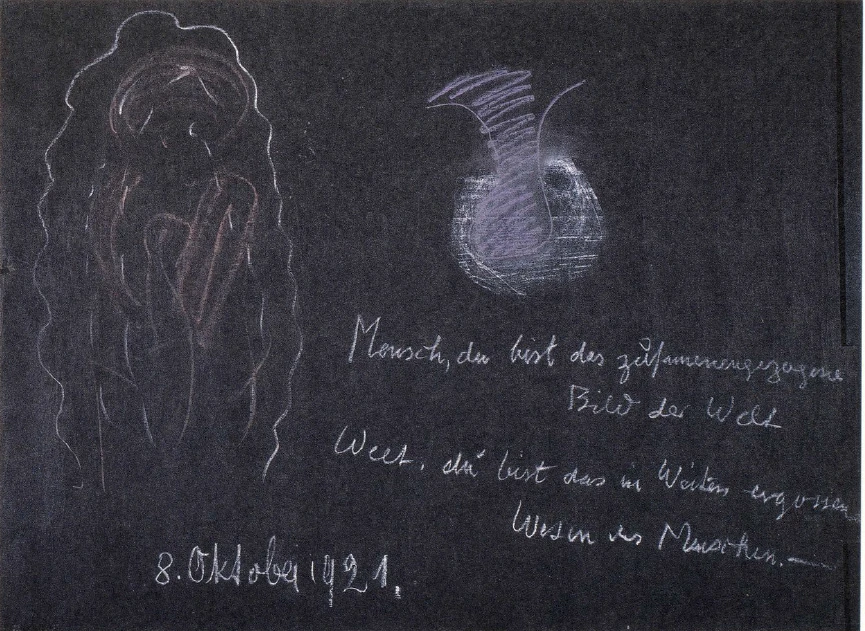
[ 20 ] Wie kommt nun diese Eingliederung in das physische Dasein zustande? Nun, ich habe schon früher und auch wieder gestern darauf aufmerksam gemacht, daß man in der heutigen Wissenschaft vielfach erwartet, es werde sich einstmals ergeben, daß die Zellen eine sehr komplizierte chemische Struktur haben, so daß wir gewissermaßen die komplizierteste chemische Formel finden würden für das, was in der Zelle sich darbietet. Das ist aber ein vollständig unrichtiger Gedanke. In der Zelle, schon in der gewöhnlichen organischen Zelle ist es so (siehe Zeichnung, hell), daß das chemische Zusammenhalten darinnen nicht etwa stärker ist als in einer gewöhnlichen komplizierten chemischen Verbindung, sondern im Gegenteil: chaotisch werden die chemischen Wahlverwandtschaften gerade, und am allerchaotischsten sind sie in der befruchteten Keimzelle. Die befruchtete Keimzelle ist in bezug auf das Materielle direkt Chaos, Chaos, das zerfällt, Chaos, das wirklich zerfällt. In dieses verfallende Chaos ergießt sich das, was ich Ihnen als den Menschen geschildert habe, der sich eben in der Weise, wie ich es beschrieben habe, gebildet hat (lila). Und nicht durch den Keim selber, sondern durch die Prozesse, die im mütterlichen Leibe zwischen dem Embryo und der Umgebung vor sich gehen, bildet sich dann das eigentlich Physische aus. Es wird also tatsächlich dasjenige, was da aus der geistigen Welt herunterkommt, in das Leere hineingelegt und nur durchtränkt mit mineralischer Substanz. Es ist, wie Sie sehen können, ein durchaus durchsichtiger Vorgang, der hier geschildert wird.
[ 20 ] How, then, does this integration into physical existence come about? Well, I have pointed this out before, and again yesterday, that in modern science it is widely expected that it will one day be discovered that cells have a very complex chemical structure, so that we would, as it were, find the most complex chemical formula for what is present within the cell. But this is a completely erroneous idea. In the cell—even in an ordinary organic cell (see illustration, light-colored)—the chemical cohesion within it is not stronger than in an ordinary complex chemical compound; on the contrary, the chemical affinities become chaotic, and they are most chaotic of all in the fertilized germ cell. The fertilized germ cell, in material terms, is pure chaos—chaos that is disintegrating, chaos that is truly disintegrating. Into this disintegrating chaos pours that which I have described to you as the human being, who has just formed in the manner I have described (purple). And it is not through the germ itself, but through the processes taking place in the mother’s womb between the embryo and its environment, that the actual physical form then develops. So what actually descends from the spiritual world is placed into this void and simply imbued with mineral substance. As you can see, the process described here is entirely transparent.
[ 21 ] Das tierische Bewußtsein können wir nicht so sehen, daß es zurückwirkt, sondern wir müssen sagen, es wirkt hinauf in das Gruppenseelenhafte, in die Tiergruppenseelen (siehe Zeichnung Seite 129, roter Pfeil). Und dann, wenn der Mensch angekommen ist im planetarischen Bereich, dann bildet er den Menschen selber aus und gliedert sich in dieser Weise ein in das, was ihm Platz macht, wie ich eben davon gesprochen habe.
[ 21 ] We cannot view animal consciousness as having a downward effect; rather, we must say that it acts upward into the realm of group souls, into the animal group souls (see diagram on page 129, red arrow). And then, once the human being has arrived in the planetary realm, he develops into a human being himself and in this way integrates into that which makes room for him, as I have just described.
[ 22 ] Wenn Sie aber jetzt den Anfang und das Ende des Lebensweges zwischen dem Tod und einer neuen Geburt ins Auge fassen, dann werden Sie sich sagen müssen: Da tritt etwas auf, was durchaus aufeinander bezogen werden kann. In dem, was wir nennen können den Durchgang der Menschenseele durch die Seelenwelt nach dem Tode, tritt etwas auf, was noch auf das Irdische einen Bezug hat, was den Menschen zurück weist auf das Irdische. Wir wissen ja, daß der Mensch da zurücklaufend in ungefähr einem Drittel seines Lebenslaufes sein Erdenleben durchwandert, durchwandert eben in der Weise, wie ich Ihnen das beschrieben habe. Gewissermaßen das polarisch Entgegengesetzte ist das, was dann der Mensch im Durchgang durch das Planetensystem vor der Geburt erlebt. Es teilt sich ihm da als Mensch etwas mit, was er noch aus den Himmeln mit auf die Erde bringt. Geradeso wie er für die Seelenwelt noch etwas hinausträgt, was in seinem astralischen Leibe ist, wodurch er in einer Rückwärtswanderung sein Erdenleben durchlebt, so bringt der Mensch etwas mit sich aus dem Kosmos, was dann seinen ätherischen Leib durchsetzt, was jetzt ebenso etwas zu tun hat mit seinem ätherischen Leibe, wie das, was ich genannt habe die astralische Erdenfrucht mit seinem astralischen Leibe. Mit seinem ätherischen Leib hat das, was er sich aus dem Kosmos bringt, zu tun, ebenso wie das, was er als die astralische Erdenfrucht hinausträgt, mit seinem astralischen Leibe zu tun hat.
[ 22 ] But if you now consider the beginning and the end of the life journey between death and a new birth, you will have to admit to yourself: Something occurs there that can certainly be related to one another. In what we might call the human soul’s passage through the soul world after death, something occurs that still has a connection to the earthly realm—something that points the human being back to the earthly realm. We know, after all, that as the human being travels backward through this process, they retrace their earthly life over roughly one-third of their life’s course—precisely in the way I have described to you. In a sense, the polar opposite of this is what a human being then experiences during the passage through the planetary system before birth. There, as a human being, something is communicated to them that they bring with them from the heavens to Earth. Just as they carry something out into the soul world that is within their astral body—through which they relive their earthly life in a backward journey— so the human being brings with them something from the cosmos that then permeates their etheric body; this now has just as much to do with their etheric body as what I have called the “astral fruit of the Earth” has to do with their astral body. What a person brings with them from the cosmos has to do with their etheric body, just as what they carry out as the “astral fruit of the Earth” has to do with their astral body.
[ 23 ] Ich kann also sagen: Der Mensch bringt sich aus dem Kosmos herein die ätherische kosmische Frucht. Diese ätherische kosmische Frucht, die sich da der Mensch hereinbringt, die lebt tatsächlich in seinem ätherischen Leibe weiter. Der Mensch hat von der ersten Stunde, von dem ersten Augenblicke seiner Geburt an in seinem Ätherleibe etwas wie eine kosmische Stoßkraft nach vorwärts, die durchwirkt durch das ganze Leben. Mit dieser kosmischen Stoßkraft verbindet sich das, was als die karmischen Tendenzen zurückgeblieben ist. In dieser kosmischen Stoßkraft wirken die karmischen Tendenzen.
[ 23 ] So I can say: Human beings bring the ethereal cosmic fruit into themselves from the cosmos. This ethereal cosmic fruit that human beings bring into themselves actually continues to live on in their etheric body. From the very first hour, from the very first moment of birth, the human being possesses in their etheric body something like a cosmic propulsive force that propels them forward and permeates their entire life. This cosmic propulsive force is connected to what remains of their karmic tendencies. The karmic tendencies are at work within this cosmic propulsive force.
[ 24 ] Man kann also in gewissem Sinne sagen: Man ist selbst imstande, ganz anschaulich darauf hinzuweisen, wie das Karma sich zum wirklichen Menschen verhält. Während wir uns sagen, der Mensch hat ein präexistentes Leben, er kommt herein aus geistigen Höhen in das physisch-irdische Dasein, gliedert sich seinem physischen Leib, Ätherleib ein mit seinem Ich und seinem astralischen Leib —, kann man sagen, daß sein Karma, das er mitbringt aus dem früheren Erdenleben, sich eingliedert in diejenige ätherische Stoßkraft, die er mit hereinnimmt aus den Wirkungen des planetarischen Systems, die vorangehen seiner Erdeneingliederung.
[ 24 ] So, in a certain sense, one can say: One is able to point out quite vividly how karma relates to the actual human being. While we tell ourselves that a human being has a pre-existing life, that he enters from spiritual heights into physical-earthly existence, uniting his physical body, etheric body—one can say that the karma they bring with them from their previous earthly life becomes integrated into the etheric impulse they bring with them from the effects of the planetary system that precede their incarnation on Earth.
[ 25 ] Und nun, ich möchte sagen, jetzt können Sie fast mit Händen greifen, wie man aus den planetarischen Beziehungen das, was im Menschen drängt und stößt, wenn man es sachgemäß macht, herausrechnen kann. In dieser Weise kann man intim in all das hineinschauen, was im Menschen so wirkt, daß es aus seinem physisch-sinnlichen Wirken in die geistig-seelische Welt hinausgeht und daß es von ihm aus der geistig-seelischen Welt hereingetragen wird und sich wiederum in sein physisch-leibliches Erdendasein gewissermaßen einhüllt und in demselben wirkt. Man kann diese Dinge durchaus im einzelnen angeben.
[ 25 ] And now, I would like to say, you can almost grasp with your own hands how, if done properly, one can deduce from planetary relationships what drives and impels a person. In this way, one can look intimately into everything that works within a human being in such a way that it extends from their physical-sensory activity into the spiritual-soul world, and that it is carried from them into the spiritual-soul world and, in turn, envelops itself, as it were, in their physical-bodily earthly existence and works within it. These things can certainly be described in detail.
[ 26 ] Der Mensch kann sich erfüllen mit solchen Vorstellungen, wie sie durch diese Erkenntnisse kommen, und er wird sich dann sagen: Ich trete als physische Menschengestalt in dieses irdische Dasein, bin scheinbar abgeschlossen von der übrigen Welt. Diese Bewußtheit des Abgeschlossenwerdens, sie wird mir gegeben da, wo sich mein Übersinnliches hineinlegt in das Lager, das ihm zubereitet wird vom irdisch-physischen Dasein aus. Aber indem ich mich in diese Hülle eingliedere, wachse ich immer mehr und mehr wiederum in den Kosmos hinein durch mein Wahrnehmen, durch meine Erfahrungen. Und ich wachse insbesondere hinein, wenn ich mir solche Vorstellungen bilde vom Zusammenhang des Menschen mit der Welt.
[ 26 ] A person can become filled with the kinds of ideas that arise from these insights, and will then say to themselves: I enter this earthly existence as a physical human being, seemingly cut off from the rest of the world. This awareness of being set apart is given to me where my supersensible self settles into the receptacle prepared for it by earthly-physical existence. But as I integrate myself into this shell, I grow more and more into the cosmos again through my perceptions and experiences. And I grow into it especially when I form such ideas about the connection between the human being and the world.
[ 27 ] So lernt der Mensch, gerade durch anthroposophische Geisteswissenschaft, sich als eins zu fühlen mit dem Weltenall. Er fühlt die Welt in sich, sich in der Welt. Er fühlt das Leben des Makrokosmos pulsieren in seinem eigenen Inneren, und er empfindet, wie das, was er im Inneren erlebt, wiederum hinauspulst in den ganzen Kosmos. Das Atmen wird ihm nur ein Symbolum für ein umfassendes Dasein: Die eingezogene Atemluft nimmt die Gestalt des menschlichen Leibes an, wird Innenleben; die den Organismus verlassende Atemluft zerstreut sich wieder in die Welt. So ist es aber auch mit dem Geistig-Seelischen: Der ganze Kosmos wird gewissermaßen geistig-seelisch eingeatmet, wird zum Menschen; das, was da im Menschen wird, wird wiederum geistig-seelisch ausgeatmet und zerstreut sich im Kosmos, bis es gewissermaßen an der Peripherie des Kosmos ankommt, um wiederum zurückzukommen und den Menschen zu bilden. Man kann schon im Menschen das Abbild der Welt sehen, und in der Welt das fein aufgelöste menschliche Wesen. So daß man eine umfassende Welt- und Menschenkenntnis zusammenfassen kann in die beiden Sätze:
[ 27 ] It is precisely through anthroposophical spiritual science that human beings learn to feel at one with the universe. They feel the world within themselves, and themselves within the world. They feel the life of the macrocosm pulsating within themselves, and they sense how what they experience within themselves in turn pulses out into the entire cosmos. Breathing becomes for them merely a symbol of a comprehensive existence: the air inhaled takes on the form of the human body, becoming inner life; the air exhaled from the organism disperses back into the world. But the same is true of the spiritual-soul aspect: the entire cosmos is, so to speak, inhaled spiritually and soulfully, becoming human; what is formed within the human being is in turn exhaled spiritually and soulfully and disperses into the cosmos, until it reaches, so to speak, the periphery of the cosmos, only to return once more and form the human being. One can already see the image of the world in the human being, and the human being, finely dissolved, in the world. Thus, a comprehensive understanding of the world and of the human being can be summarized in these two sentences:
Mensch, du bist das zusammengezogene Bild der Welt.
Welt, du bist das in Weiten ergossene Wesen des Menschen.
Oh, you are the condensed image of the world.
World, you are the essence of humanity poured out into the vastness.
[ 28 ] Der Mensch soll sich, damit die Zukunft für ihn eine Aufgangs-, nicht eine Niedergangsentwickelung ist, ein solches Bewußtsein aneignen, das wirklich seine Wesenheit mit dem Kosmos zusammen schließt.
[ 28 ] In order for the future to be a path of ascent rather than decline, human beings must develop a consciousness that truly unites their essence with the cosmos.
[ 29 ] Morgen wollen wir davon weiter sprechen.
[ 29 ] We'll talk more about this tomorrow.