

Anthroposophy as Cosmosophy I
Human Traits in the Earthly and Cosmic Realms
GA 207
8 October 1921, Dornach
Translated by Steiner Online Library
Seventh Lecture
[ 1 ] The reflections we have been engaging in for some time have led us to consider humanity’s relationship to the spiritual world, and this relationship, in turn, has made it necessary to examine the development that a human being undergoes between death and a new birth. This is where we will begin today. We said yesterday that when a human being passes through the gate of death, they carry with them what I called “mineral consciousness.” It can be called this because its content essentially consists of the mineral world and its laws. This consciousness is imbued—that is, permeated—with everything that arises from the human being’s moral feelings and sensibilities. With what is now composed of these two aspects, the human being sets out on their journey through the world they traverse between death and a new birth. When we consider what a human being is like after death, the following picture emerges: the astral body and the “I” have broken free from what was, in a sense, a kind of shell—the physical body and the etheric body.
[ 2 ] Well, when we imagine the cosmic evolution of humanity along with the associated cosmic-planetary bodies, we know from the description in my *Outline of Esoteric Science* how this cosmic evolution has unfolded in the past through the Saturn, Sun, and Moon phases, and how humanity then arrived at the Earth phase, in which it is still currently situated. We also know that, essentially, the Saturn evolution forms the first rudiment of the physical body as a kind of universal sense organ, which is then further developed through the Solar, Lunar, and Earth evolutions. We know that the etheric body is added during the Solar stage, the astral body takes on its initial form during the Lunar stage, and that the Earth stage is the actual development of the “I” for human beings.
[ 3 ] If we consider the human being as a whole, the “I” arises from the human being’s connection to the earth; for the “I” is shaped and formed by the forces present in the earth. So when we say that the human being passes through the “gate of death” by carrying his “I” through it—he is in fact bringing through the gate of death that which he has gained from his earthly development, that which he has acquired within the course of his earthly development. We literally carry through death what belongs to earthly development. During earthly development, the mineral world has been added to the other realms—as you can see from my *The Secret Science*. So the outer world, the mineral world, is, in a sense, connected to the development of the “I.” The fact that the “I” passes through the gate of death with a mineral consciousness is essentially connected to what the human being actually derives from the Earth. But the Earth is only incompletely understood if we view it merely as it first appears to us as a celestial body. As a celestial body, the Earth is, in a sense, a being that can be compared to a large drop in the infinite ocean of space. But this drop is constituted precisely by the fact that it is materially differentiated within itself, that it contains substances of varying weight and density.
[ 4 ] We need only consider the metals found in the Earth. We find metals of varying densities. What the human being thus incorporates from the Earth—along with the mineral consciousness—originates from the Earth as a whole; it simply stems from the fact that the Earth is this very planet within the cosmos. What is differentiated according to the various mineral substances then works in such a way that the human being not only takes with them through the gate of death what has become their “I,” but also, for a certain time, takes with them what was their astral body—which is also described in *The Secret Science* and in the book *Theosophy* as the human being’s passage through the world of souls. (During the following explanation, a diagram is drawn on the blackboard; see p. 129.) So we can say: When a human being leaves the Earth, they develop mineral consciousness. But this mineral consciousness is initially permeated by what the human being takes with them from the differentiated Earth—from the Earth insofar as it consists of various substances. This then constitutes the period of their passage through the soul world. And we can say: There, the human being takes with them something that is not merely their “I,” which then continues on, but which is, in a certain sense, an astral fruit of the Earth.
[ 5 ] If we then follow the human being further, once he has shed this astral earthly form in the sense I described in my book *Theosophy*—where it is shown how, some time after death, he has completed his passage through the world of souls—then his “I” continues on its journey. But at first it is permeated by mineral consciousness. If we direct our spiritual gaze upward to where the human being is, we perceive the mineral consciousness of the deceased person—that is, the world of thought that relates to the mineral realm. And it is indeed the case that this world of thought, carried by the human being through death, works upon what is now the mineral kingdom on Earth and also in the cosmos.
[ 6 ] This is an extraordinarily remarkable and significant connection. When we survey our minerals here on Earth, when we survey the mineral kingdom—which is, after all, also present in the clouds, for those too are mineral effects—and ask ourselves: What kinds of spiritual essences are at work there? — then we must answer: Within these mineral formations—which, in a sense, reveal their outer aspect to us as human beings standing on Earth with physical senses—and within all mineral processes, there live the thoughts that human thoughts become after death. So when we look at the mineral kingdom with understanding, letting our gaze wander over it, we can say to ourselves: At work within the mineral activity is that which constitutes the consciousness of the dead at the beginning of their super-earthly journey. — We must therefore not only call the mineral kingdom a dead, lifeless realm here for external reasons, but we must also call it a dead realm in the sense that, initially, human thoughts—the essential human thoughts that a person must cherish after death—work their way into this mineral kingdom.
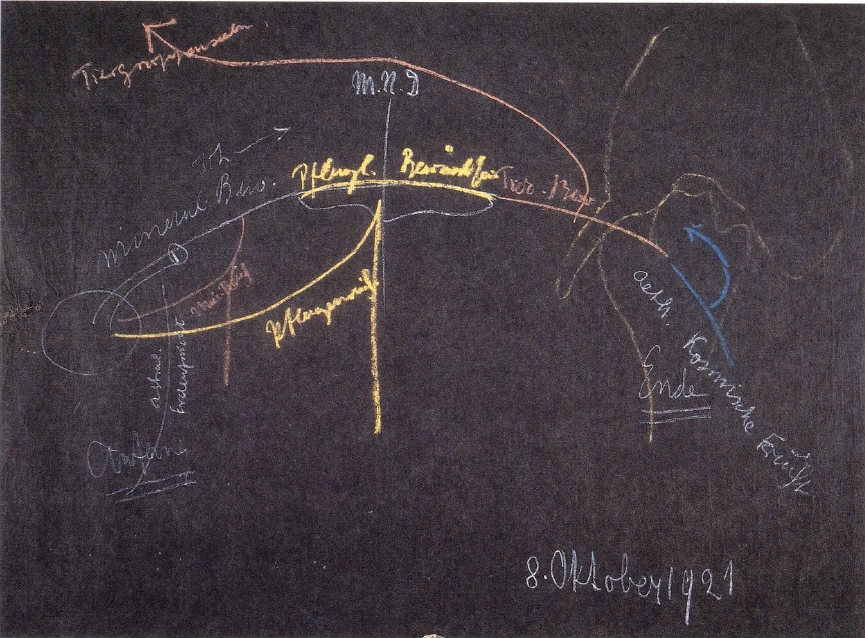
[ 7 ] As a person continues on this journey, they draw ever closer to the midnight hour of existence. Before and after that, as I explained yesterday, they develop a consciousness that is more plant-like in nature—that is, not the mineral consciousness of before, but a consciousness that arises when the human being is permeated by the plant-forming forces. After all, human beings absorb something different from the extraterrestrial realm than what the Earth itself can provide. In addition to what the Earth can give him, the human being absorbs what is a kind of higher consciousness, and we can visualize this by saying: The human being then develops a plant-like consciousness. And during this time, he contributes to the plant kingdom both on Earth and in the cosmos (see drawing on page 129).
[ 8 ] One of the mysteries of existence is that when we look at the Earth’s vegetation—when we observe everything in the plant kingdom—we naturally see only the outer side; there is also an inner side. Of course, we need not look for the inner side beneath the roots, but rather above the flowers. When we imagine the plant that is blooming there, it exists in that which bends down astral-like toward the plant—that which, in a sense, lives astral-like and finds its outward expression in the plant cover during the process of fertilization; that is, what is not seen. One might say: The outer side would be this, if one looks at the plant itself purely from the root to the flower, and the inner side would then be what lies above the flower. So if we regard what the plant cover is externally in a sensory sense as an “outside,” then the “inside” of it is the realm of those forces that have their point of origin, in part, in the consciousness of those human beings who live in the middle between death and a new birth—who live before and after the midnight hour of existence. Thus, even in the Earth’s plant cover, we see something about which we can say: In its cosmic existence, there is something connected with the entire course of human development.
[ 9 ] If we can say of the mineral kingdom: “In this dead kingdom live the weaving thoughts of human beings who, in the first half—at the beginning of their journey—are between death and a new birth,” then we must say: In the plant life of the Earth, what lives inwardly in the universe is revealed to us in an outward way, so that it also constitutes the world of human consciousness in the middle between death and a new birth.
[ 10 ] Those intimate relationships between human beings and the world—which we spoke of yesterday and which made it possible for yesterday’s reflection to conclude with the words: “Knowledge of the world is knowledge of humanity, and knowledge of humanity is knowledge of the world”—these relationships reveal themselves there in a very special way. It becomes clear to us that even here on Earth we are already catching a glimpse of what a human being is between death and a new birth. When we look at minerals, they reveal to us—much as a kind of external image reveals a certain process—what human beings consciously do inwardly in the time immediately following death. And as we gaze upon the plant world, what the human being does inwardly in the midst of their developmental journey between death and a new birth is revealed.
[ 11 ] To the unbiased observer, such things can also be observed in a certain outward way. I believe one is surprised anew every time one considers Goethe’s peculiar nature—which is, after all, merely an outstanding example. What, then, does this peculiar nature of Goethe’s consist of? It consists in the fact that Goethe, for example, time and again made attempts to become a draftsman or painter. He never actually became a draftsman or painter; but what he left behind of his drawings and paintings is, in a certain sense, striking for its precision. And when one then considers Goethe’s poetry—particularly some works that are exceptionally characteristic in this regard—one says to oneself: Goethe may not have been able to become a painter, but his poems show that they have, in a sense, lived out their potential like a surreptitious form of painting. — Goethe paints a great deal in his poetry. One could say—if one were to express this, for example, in terms of the talents of some modern critics, though I do not wish to claim that it is very good to say so—that Goethe had the potential to become a poor painter, and he carried those painterly inclinations into his poetry, thereby becoming a sort of poet who merely paints.
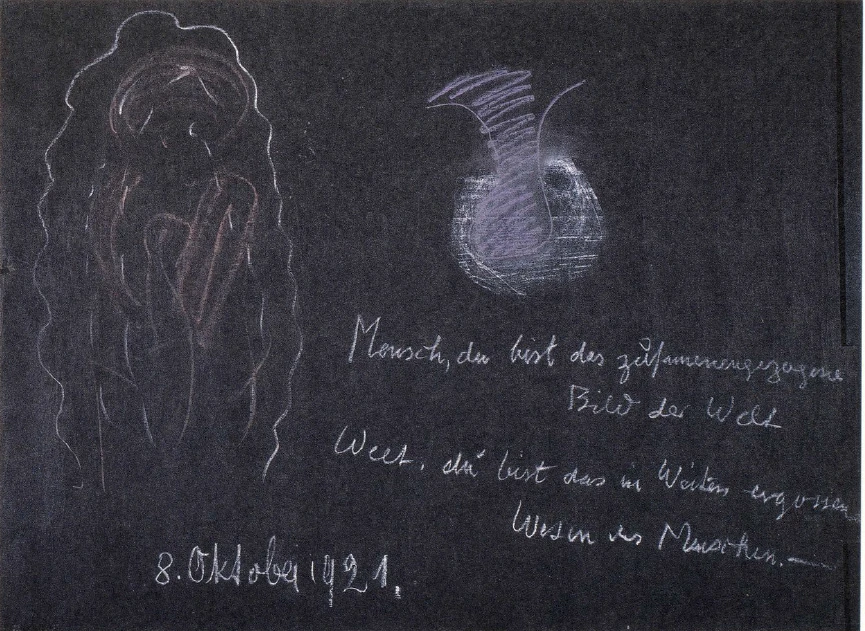
[ 12 ] Furthermore, one might say: Those who have described some of Goethe’s plays—in a certain sense, *Iphigenia* and *Tasso*, but even more so *The Natural Daughter*—as smooth as marble and cold as marble were, after all, right. Goethe has produced dramatic works in which a sculptor actually lives, and so, in a certain sense, they are not imbued with that inner life that pervades Shakespeare’s plays; in a certain sense, they are works that have become stuck and have exhausted themselves in certain sculptural forms. In short, Goethe may appear to us as a unique genius precisely because he never truly came fully into the world. He was born a painter but did not become one. So he turned back to poetry and gave expression to his vision in a form of poetry that is half-pictorial. He did not fully develop dramatic poetry; he had a poetic inclination for it, but never actually became a truly dramatic poet—instead, he got stuck along the way, turned back, and expressed this in a visual manner. One could say—and this is truly something that characterizes Goethe, something that strikes one when one really considers him—that Goethe is a person who was never really fully born. — He wrote a treatise on color theory, yet he was not a physicist in the true sense. He engaged with the natural sciences, but he never delved fully into the technical details. In short, he never truly stepped out into the world in any one area. He was not properly born into the world.
[ 13 ] One could even go further, for example, by considering one’s relationships with women. These, too, have usually developed only to a certain degree and never to the extent that they do in the case of proper, worldly people who are truly born into physical life. One could find this to be true everywhere, if only one feels and senses these things—if only one’s ability to feel and sense such things were not hindered by the usual pedantic, philistine notions, which, of course, can raise all sorts of objections that I need not mention to you. One can, of course, object to the thesis that Goethe was not fully born by saying: “Yes, he was born on such-and-such a date in Frankfurt.” Isn’t that right? You can find that recorded in all the biographies. But I would like to point out to you that even there, the matter has a catch. For he was born half-dead and with a completely black body. So even there, we are not dealing with a robust entry into the world, but rather a kind of half-dead arrival into the world.
[ 14 ] And again, if you follow the course of his life, you see how he never quite arrives anywhere, how he is cast back until he falls ill. Everything is such—I would say, right down to the way he walked around Weimar: unapproachable in a certain sense—that one can say: He has not fully stepped out into the world. And this stemmed from the fact that he was particularly attuned to what develops in terms of plant consciousness around the midnight hour of existence. Hence, too, his drive toward the metamorphosis of plants, where he achieved his greatest feats: this marvelous contemplation of the plant world.
[ 15 ] I can really imagine that there is something grotesque about speaking in all seriousness as if Goethe had not fully emerged into the world. But there are simply many people who prefer to speak of the external world as a kind of Maya in general, in the abstract. However, when one then goes into detail about how the individual levels of Maya differ, it is certainly a Maya, for example, if one takes Goethe entirely from an external perspective, as Mr. Lewes or Professor Bielschowsky and others have done! He is certainly not like that at all; rather, he is quite different. He is such that one can truly perceive in him the primordial state in this realm, which lies precisely here in the middle of the human life course, between death and a new birth.
[ 16 ] We then come to the third stage in this development, where the process is already leading toward the new incarnation, the new earthly life. As you can now very easily imagine, the human being develops a kind of animal consciousness (see illustration on page 129, red). Outwardly, they possess the kind of consciousness I described to you yesterday, but they work with what now lives within their consciousness—above all, with everything that develops here on Earth as the animal world. However, we cannot simply say: when we look at the animal world from the outside, it represents the outer aspect to us; the inner aspect leads us up to the human thoughts that a person has, or to the contents of human consciousness that a person possesses when they are already in the third phase of their life’s journey, between death and a new birth. We cannot actually say it that way, but we can say something like this: When we look at the animal world, this animal world provides us, so to speak, with a kind of inner aspect. So: The mineral and plant kingdoms—in the case of plants, this is no longer entirely accurate, but we can still take it this way—show us, so to speak, the outer aspect; the inner aspect offers us, among other things, the state of consciousness of those who have passed through the gate of death and are on their way to a new earthly life. But when we look at the animal kingdom, we must actually say: This offers us the inner aspect, and the outer aspect consists of the group souls of the animals, which ascend to the work of the superterrestrial hierarchies. And there, in the animal kingdom, we cannot now find within the animals themselves that which works from the human being, from human consciousness; rather, we can say: within what constitutes the animal group soul—what develops within the totality of the animal group soul world—human thoughts are woven in and live on. In fact, during this time, the human being experiences all the subtle and complex configurations of the world of animal group souls. This world of animal group souls now becomes the human being’s world. And from what the human being observes in the world of animal group souls—from what flows out of and into his consciousness from there—he constitutes his own organs. In a sense, they gradually draw together everything they see there in the vastness of the worlds into the active contemplation of their own being. From the sum of the animal group souls, human beings form their own inner, organically structured organism.
[ 17 ] One might say: There, the human being forms, so to speak, the main structures of his brain—of course, initially as forces, not in the sense that such lumps of matter are formed—initially as forces: the lungs, the heart with blood vessels, and so on. Human beings form the individual organs out of the entire context of the animal group soul. So while human beings are actually building upon the external world in the first part of their supersensible life journey, they now turn more and more inward and finally build up the individual organs of their inner organism out of the totality of the animal group soul world.
[ 18 ] And then, in the final stage of his development, the human being enters—as I told you yesterday—the realm of planetary forces. This is, so to speak, a later stage that the human being goes through. After having undergone the influence of the animal group soul system, the human being becomes dependent on what lives in the outer world—in the movements and constellations of the planets. Through this, however, the human being’s etheric body is prepared. The human being is moving toward rebirth. His etheric body is being formed. Now visible within this etheric body are the thought-fabrics I have spoken to you about, which are then found within the human being between the etheric body and the physical body. So that the human being now, in a sense, weaves into his organ system that which he has developed more out of feelings—feelings that are, however, already thoroughly interwoven with thoughts. He then forms the thought fabric around it. This thought fabric is thus a result of what the human being has experienced from the influence of the planetary world on his being as it approaches rebirth. Through this, however, the human being becomes ready to enter the shell that is now given to him by the process unfolding through the succession of generations.
[ 19 ] Who, then, is this person coming down? The human being coming down there is such that, immediately after death, he has poured out the mental, the mineral-mental, that he brought with him, into the mineral world of the external. Because he has poured out these thoughts, impulses of will and emotional contents gradually well up within him. All of this then permeates him with the content of plant consciousness. The human being first comes to participate in the plant kingdom of the external world, then withdraws into himself, works with animal consciousness from within the group soul of the animals, and forms his organs there, which he surrounds to a certain extent with that sheath woven from thought substances. This is what now seeks to descend into physical existence.
[ 20 ] How, then, does this integration into physical existence come about? Well, I have pointed this out before, and again yesterday, that in modern science it is widely expected that it will one day be discovered that cells have a very complex chemical structure, so that we would, as it were, find the most complex chemical formula for what is present within the cell. But this is a completely erroneous idea. In the cell—even in an ordinary organic cell (see illustration, light-colored)—the chemical cohesion within it is not stronger than in an ordinary complex chemical compound; on the contrary, the chemical affinities become chaotic, and they are most chaotic of all in the fertilized germ cell. The fertilized germ cell, in material terms, is pure chaos—chaos that is disintegrating, chaos that is truly disintegrating. Into this disintegrating chaos pours that which I have described to you as the human being, who has just formed in the manner I have described (purple). And it is not through the germ itself, but through the processes taking place in the mother’s womb between the embryo and its environment, that the actual physical form then develops. So what actually descends from the spiritual world is placed into this void and simply imbued with mineral substance. As you can see, the process described here is entirely transparent.
[ 21 ] We cannot view animal consciousness as having a downward effect; rather, we must say that it acts upward into the realm of group souls, into the animal group souls (see diagram on page 129, red arrow). And then, once the human being has arrived in the planetary realm, he develops into a human being himself and in this way integrates into that which makes room for him, as I have just described.
[ 22 ] But if you now consider the beginning and the end of the life journey between death and a new birth, you will have to admit to yourself: Something occurs there that can certainly be related to one another. In what we might call the human soul’s passage through the soul world after death, something occurs that still has a connection to the earthly realm—something that points the human being back to the earthly realm. We know, after all, that as the human being travels backward through this process, they retrace their earthly life over roughly one-third of their life’s course—precisely in the way I have described to you. In a sense, the polar opposite of this is what a human being then experiences during the passage through the planetary system before birth. There, as a human being, something is communicated to them that they bring with them from the heavens to Earth. Just as they carry something out into the soul world that is within their astral body—through which they relive their earthly life in a backward journey— so the human being brings with them something from the cosmos that then permeates their etheric body; this now has just as much to do with their etheric body as what I have called the “astral fruit of the Earth” has to do with their astral body. What a person brings with them from the cosmos has to do with their etheric body, just as what they carry out as the “astral fruit of the Earth” has to do with their astral body.
[ 23 ] So I can say: Human beings bring the ethereal cosmic fruit into themselves from the cosmos. This ethereal cosmic fruit that human beings bring into themselves actually continues to live on in their etheric body. From the very first hour, from the very first moment of birth, the human being possesses in their etheric body something like a cosmic propulsive force that propels them forward and permeates their entire life. This cosmic propulsive force is connected to what remains of their karmic tendencies. The karmic tendencies are at work within this cosmic propulsive force.
[ 24 ] So, in a certain sense, one can say: One is able to point out quite vividly how karma relates to the actual human being. While we tell ourselves that a human being has a pre-existing life, that he enters from spiritual heights into physical-earthly existence, uniting his physical body, etheric body—one can say that the karma they bring with them from their previous earthly life becomes integrated into the etheric impulse they bring with them from the effects of the planetary system that precede their incarnation on Earth.
[ 25 ] And now, I would like to say, you can almost grasp with your own hands how, if done properly, one can deduce from planetary relationships what drives and impels a person. In this way, one can look intimately into everything that works within a human being in such a way that it extends from their physical-sensory activity into the spiritual-soul world, and that it is carried from them into the spiritual-soul world and, in turn, envelops itself, as it were, in their physical-bodily earthly existence and works within it. These things can certainly be described in detail.
[ 26 ] A person can become filled with the kinds of ideas that arise from these insights, and will then say to themselves: I enter this earthly existence as a physical human being, seemingly cut off from the rest of the world. This awareness of being set apart is given to me where my supersensible self settles into the receptacle prepared for it by earthly-physical existence. But as I integrate myself into this shell, I grow more and more into the cosmos again through my perceptions and experiences. And I grow into it especially when I form such ideas about the connection between the human being and the world.
[ 27 ] It is precisely through anthroposophical spiritual science that human beings learn to feel at one with the universe. They feel the world within themselves, and themselves within the world. They feel the life of the macrocosm pulsating within themselves, and they sense how what they experience within themselves in turn pulses out into the entire cosmos. Breathing becomes for them merely a symbol of a comprehensive existence: the air inhaled takes on the form of the human body, becoming inner life; the air exhaled from the organism disperses back into the world. But the same is true of the spiritual-soul aspect: the entire cosmos is, so to speak, inhaled spiritually and soulfully, becoming human; what is formed within the human being is in turn exhaled spiritually and soulfully and disperses into the cosmos, until it reaches, so to speak, the periphery of the cosmos, only to return once more and form the human being. One can already see the image of the world in the human being, and the human being, finely dissolved, in the world. Thus, a comprehensive understanding of the world and of the human being can be summarized in these two sentences:
Oh, you are the condensed image of the world.
World, you are the essence of humanity poured out into the vastness.
[ 28 ] In order for the future to be a path of ascent rather than decline, human beings must develop a consciousness that truly unites their essence with the cosmos.
[ 29 ] We'll talk more about this tomorrow.