

Anthroposophy as Cosmosophy I
Human Traits in the Earthly and Cosmic Realms
GA 207
9 October 1921, Dornach
Translated by Steiner Online Library
Eighth Lecture
[ 1 ] We have spoken of the psychological and spiritual development of human beings. In considering spiritual development, we had to point out the way in which this spiritual development of the human being—that is, what is spiritually active within him—arises from his collaboration with the beings of the higher hierarchies of the realms above him. And when we ask ourselves again about the particular nature of these higher beings, we are directed to the past of the cosmos. We know, of course, from my *Outline of Esoteric Science* how, for example, the beings we classify in the realm of the Angeloi passed through the human stage during the ancient Lunar evolution, how the Archangeloi passed through their human stage during the ancient Solar evolution, and the Archai during the ancient Saturn evolution. In short, if we are to understand the cosmos in the same way we understand human beings today—with human beings before us—and if we wish to understand these higher realms in this way, then we must look back to times long past. We can therefore also say: If we wish to understand the essence of the human being as spirit, then we look up to the present stage of development of beings who, in times long past, underwent in their own special way what the human being today undergoes during earthly existence. We must therefore look to the past of higher beings when we consider the spiritual unfolding of the human being.
[ 2 ] We have also visualized the development of the soul, and we have found that this development—in terms of thinking, feeling, and willing—takes place, so to speak, in the spaces between the ego, the astral body, the etheric body, and the physical body.
[ 3 ] There is no doubt at all: what constitutes the human soul life is the present moment. We develop our soul through what we draw from the depths of our being—that which unfolds within the four members of the human being for thinking, feeling, and willing. We take in external impressions, process them, and in many ways participate ourselves in this processing in the immediate present. In short, we can say: When we consider the human soul life, we must come to understand the interweaving of the spiritual, soul, and physical in the present moment. What, then, is the case when we consider the human physical body, the etheric body—the body of formative forces—the astral body, and the “I” itself? Human beings carry this physical body with them from birth—or from embryonic life—until death. When they shed it at death, this physical body cannot retain its form. It can only preserve its form, its shape, and its entire being if the human soul and spirit permeate it. The forces acting externally in earthly-physical nature destroy it—some more quickly, others more slowly—but they destroy it nonetheless. This physical body decays because it cannot survive within the forces that compose the Earth in the mineral, animal, and plant kingdoms. This physical body, then, actually exists only by virtue of the special form that the human spirit gives it from the higher realms, from the spiritual realms. It exists only by virtue of the processes that the human soul carries out with it through thinking, feeling, and willing. This physical body has no possibility of existence if it is left alone in physical earthly existence. Before a human being enters embryonic life, after having passed through death, none of the forces acting upon this physical body have a right of residence within the Earth. It is only during human physical life on Earth that the form of this physical body takes shape, that the corresponding processes take place within it, that this physical body grows, withers, and so on. It belongs to the human being, but not to the Earth. This is a perfectly ordinary conclusion. Now, when we approach this physical world through spiritual science, we find that it is indeed true that the physical body has no lasting existence within the Earth; but what holds it together does not, strictly speaking, have a lasting existence in the human being’s conscious life either. It remains entirely subconscious. Yet it is an inner, pictorial reality, and we can grasp it if we develop our imaginative consciousness. Then, in a sense, we develop the inner, pictorial aspect of this physical body. And what we perceive there as an inner, pictorial reality resists the forces that the substances of the physical body, with their own powers, are unable to withstand.
[ 4 ] This inner imagery is not subject to earthly processes. This inner imagery can at least endure and, even when the Earth is no longer here, be carried forward to future stages of the Earth’s development. Then, from this physical human body, something will form that we can call a future realm of nature—one that does not yet exist at all—a future realm of nature. From what is today merely an image, a natural kingdom of the future will arise—a kingdom that, in its very nature, will in a certain sense stand midway between our present mineral kingdom, which lies on the Earth as if dead, and the plant kingdom, which sinks into this dead mineral kingdom, enlivening it and developing life.
[ 5 ] Imagine for a moment the mineral world into which the plant world is immersed, participating in life—not merely lying there as dead earth and supplying nutrients through the plant’s roots and the air, but imagine that the very substance into which the plant is immersed is itself alive: an entire living earth that does not consist of the dead mineral kingdom, and a plant world that is now not merely able to infuse life into this mineral kingdom, but that lives within the living mineral kingdom itself—a living mineral kingdom, a future stage of transformation for our earth—in my *Secret Science* I call it the Jupiter stage— a future, living mineral kingdom—but one so alive that it takes the form of a plant, so that, in a sense, what now merely submerges into the plant kingdom as material chemical processes will itself become living chemical processes, so that plant life and mineral form are one. This is what has its germ in today’s human physical body as a later—I would say—plant kingdom. Today’s human physical body is the germ of a future kingdom, a future kingdom of nature.
[ 6 ] And let us consider the human etheric body as it is today. It remains unconscious during the life between birth and death; yet it is active. It is, after all, what instills true life within us. It is what animates us. It is what contains the forces of growth, as well as those of nutrition. It remains in the subconscious. We cannot perceive its true form at all. But we do perceive this true form for a brief time after we have passed through the gate of death. There we look back upon a world of images, which is thus a world of weaving thoughts. This world of images is the true form of the etheric body. While with the physical body we perceive images through imaginative consciousness that assure us that within the physical body lies the seed for a future plant-mineral kingdom, in the purely natural course of development the human etheric body itself presents these images to us after death. These images, however, have no lasting existence in our present earthly life. What within us are the forces of growth and the forces of nourishment—that is, what brings about our etheric, our vital existence—has no permanence within the earthly realm. A few days after we have passed through the gate of death, these images dissolve; and we enter into a future phase of life in which we no longer possess these images as such—as an image-etheric body, as a body of image-forces. They dissolve into the etheric cosmos, just as the physical body dissolves into the forces of earthly existence. Yet this image-existence of the etheric body shows, through its very nature, that we possess within it something that is seed-like—something that, though it now vanishes like the seed of a plant that we sow in the earth, will then sprout as a plant, as a formed plant. Thus the cosmos, as it were, dissolves our etheric body into infinity and absorbs it. But everything that is thus woven in the cosmos from human etheric bodies becomes, within it, the forces of a future Jupiter-like natural kingdom—a plant-animal kingdom, an animal-plant kingdom. And observations provide us with assurance that the human etheric body is the seed of this future kingdom, a kingdom that stands right in the middle between the plant and animal worlds.
[ 7 ] We imagine today’s plant world as one that develops only life, not sensations. However, we imagine that within a substance similar to today’s plant world—but imbued with the capacity for sensation—an animal-plant kingdom, a plant-animal kingdom, will develop, which will, so to speak, envelop the future Earth or the planet Jupiter. This sensibility will not be like that of today’s animals, which is limited to perceptions of the earthly realm; rather, it will be a cosmic sensibility, a perception of the processes surrounding Jupiter.
[ 8 ] So here in the etheric body we have the seed for a future kingdom, for an animal-plant kingdom. In a sense, what is now spread out externally as the mineral kingdom will dissolve—and this will indeed mark the downfall of the earthly realm. In contrast, from that which seemingly dissolves entirely into the earthly forces—from the human physical bodies—a future world-planet will emerge as a seed, with its lowest kingdom, a mineral-plant kingdom. From that which seems to scatter after death, a second kingdom of this future world-planet will consolidate—an animal-plant kingdom that will envelop it like a kind of living etheric substance.
[ 9 ] And the human astral body: We know that, after passing through the gate of death, a person undergoes—for a considerable period of time—what I described in my book *Theosophy* as the journey through the soul world. There I described how the transformations of human experience in this world of souls after death unfold, how the human being passes through certain states that I have called the “blaze of desire,” “flowing allure,” and so on. But everything that a person goes through there—even if it lasts for a long time—is also something that can be perceived as dissolving, something that can even be perceived as vanishing. Just read the last few pages of that description, which deals with a person’s passage through the soul world after death, and from the way it is portrayed there, you will get the sense of how, I would say, what the human being has carried within as the astral body fades away into the world—how it fades away, as it were, just as if dark clouds were being consumed by a vast sea of light. I quite deliberately shaped the style of the description in my *Theosophy* so that one can sense and feel something of this dissolution, as if darkness were dissolving in the light, as if the dead were being consumed by life. If you sense from the description of the end of this passage through the human soul world after death what this is like, then you will say: “If this passage through the soul world is described in this way, then we have indeed described something in a similar manner: just as the images of the physical body stand before the mind’s eye in the realm of imagination, so does the etheric body stand before the soul’s eye immediately after death.”
[ 10 ] In this description, which is given in my book *Theosophy*, if we bring it to life, we have something that, by its very nature, turns out to be a seed for the future. But it detaches itself from the human being, just as the other members of human nature detach themselves from him. The physical body detaches itself and becomes the seed for a plant-mineral kingdom. The etheric body detaches itself and becomes the seed for an animal-plant kingdom. The human astral body is, so to speak, absorbed by the general world environment, and it becomes the seed for a human-animal kingdom—a kingdom that has raised the higher animal realm that exists today by one level, as if the animals were not merely moved by sensations, as they are today, but by thoughts, and, although in a more automatic manner than is the case with human beings today, would nevertheless carry out rational actions in a certain way: a human-animal realm that we must imagine as one in which rational actions, filled with inner activity, are performed—actions that, however, do not proceed in the same way as they do in human beings today, where rational action arises from the center of the “I”-being. They will not be like that; they will have, I might say, a more automaton-like character; but they will not be like the actions of today’s animal kingdom, arising merely from instincts. They will, so to speak, be actions carried out by the animal through a great Jupiter-like reason, and the individual animal will be placed within this Jupiter-like reason.
[ 11 ] Now we are left with the human realm as such. Please refer again to my *Theosophy* to see how this human realm, which ascends into the spirit world after shedding the astral body, has inner experiences in the spirit world—experiences that can, however, be described there in such a way that the descriptions are images of a spiritual external world. To achieve this, I have described how, in the spirit realm, one actually experiences something akin to a continental region of the spirit realm, something like an oceanic region, something like an aerial region. In everything I have described there in this spirit realm, you have images of a world that does not exist for earthly beings today. Today’s earthly environment is different. Nevertheless, if one truly wishes to describe things as they ought to be described in accordance with the truth, one must do so by drawing on the great classifications of the Earth: by applying the way in which continental regions are grouped here to what is found in the spirit world; and likewise by grouping the oceanic region. What is described there as continental land, as oceanic regions, as air regions, and as regions of warmth is depicted in such a way that it is simultaneously permeated by what the human being carries with them as moral substance through the gate of death. It is described in such a way that the moral-spiritual world there immediately contains within itself the outwardly substantial as well, so that the moral is a shadow-like outline there, but it does not yet extend to the creation of a celestial body, a planet. But what the human “I” experiences there is the seed of these categories of distribution, these connections on a grand scale for the future planet Jupiter. So in the human “I” of today, we have the seed for what will then become the great division—the coexistence in regions that will look different then, but which can be treated in a similar way to how we treat continental regions, oceanic regions, and so on today. We have something there, but in order to characterize it, to form an idea or a concept of it, we must now summarize it in a different way as well.
[ 12 ] We must say something like this: In this interweaving in the realm of the spirits, which I described in the book *Theosophy*, one sees immediately that we are not dealing with individual human beings. As you can see, even in the second realm—the oceanic realm—human beings are already organized into human communities, into groups of people: something superhuman emerges. The “I” is lifted to a higher level. The “I” unites with other “I’s” in groups of people. Please look this up in the description of the Spirit Realm: it is something that can only be described as a realm that stands above the human realm. And it is into such a realm that human beings will then enter during the Jupiter phase. It cannot be described by saying, for example, “a realm of angel-human beings”; that would not capture the essence of the matter, because when I characterize the Angeloi, this is a concept for the present that is defined by the fact that the Angeloi were human beings during the Lunar period. So if I want to characterize what will develop there during the future Earth existence or Jupiter existence, I would have to speak in such a way as to say: Humanity has been raised to a higher sphere; humanity, in its outward manifestation, in its physical manifestation, has become such that it reveals outwardly what today lives deep within, what today lives only in the soul. Just as today, I might say, he reveals his inner being in a mysterious way through his incarnation, through the color of his flesh, so in the future he will reveal his inner being—whether he is good or evil—through his outward appearance. Today one can only glean hints from a person’s appearance as to whether someone is a pedant, or a bitter person, or a cruel person, or a gluttonous person. Certain moral qualities are subtly expressed today in one’s physiognomy, gait, or other external features—but always in such a way that they can be denied; one can, so to speak, claim that it is not one’s fault that one has been born with lips or a lower face that happen to suggest gluttony. But just as one can, so to speak, talk one’s way out of it today with regard to this outward manifestation of the soul, so will that be entirely impossible in the future. People who cling to the material will then clearly express this in their form: they will take on Ahrimanic forms. In this future, a clear distinction will be made between Ahrimanic forms and Luciferic forms. A large number of members of various theosophical societies, who are always rapt in higher realms, already possess a predisposition toward these Luciferic forms. There will also be beings who serve as a counterbalance. The dreamy mystics will take on Luciferic forms. But what we should strive for through the indwelling of Christ is this balance. In short, as the unfolding of what is today the seed of the “I,” we will have the soul-human realm.
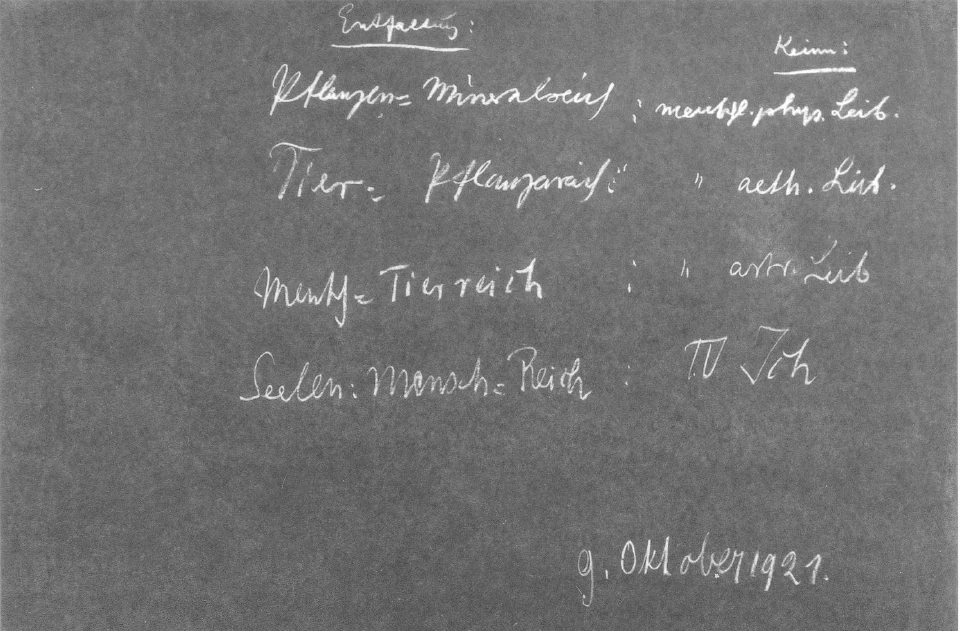
| Germ: | Unfolding: |
|---|---|
| human physical body | plant-mineral kingdom |
| human etheric body | animal-plant kingdom |
| human astral body | human-animal kingdom |
| human ego | soul-human kingdom |
[ 13 ] What we carry within us in our “I”: Nietzsche, a man who suffered tragically from the decaying civilization of the 19th century, felt that this “I” must actually break free—to save its future—from that which is already in a state of decay today. Because the entire idea remained abstract, he chose the abstract term “Übermensch.” But it is an indefinite, dark impulse to express not merely what is already complete within the “I,” but what lies dormant within it as a seed and, as such, must point toward future cosmic formations.
[ 14 ] Nietzsche expressed this beautifully on several occasions, saying: Man is, in essence, something that has emerged from the worm. But just as man emerged from the worm, so will the Übermensch emerge from man. — In doing so, he immerses himself with a sense of mystery into something that our era is actually tasked with bringing to light, if it does not wish to grope about in the darkness of a decaying culture and civilization.
[ 15 ] It is entirely understandable that Nietzsche, who suffered so tragically from our purely intellectualistic culture, distilled this intellectualistic concept of the Übermensch—which, when you get right down to it, has no real substance—from whatever was available within that intellectualistic culture. After all, Nietzsche never arrived at a true understanding of Christ. And the peculiar outcome for him was that, driven by this impulse of the “I-germ”—and, in turn, by the necessity of remaining within intellectualist culture—he became not a worshipper of Christ, but a worshipper of the Antichrist, indeed a veritable admirer and glorifier of the Antichrist. Antichristianity has come to light in a brilliant way in Nietzsche. But this anti-Christianity, if it were to remain what it is, would be capable of nothing more than inducing people to dream of an abstract Übermensch, while at the same time instilling in them the certainty that this abstract Übermensch dies with earthly existence. Nietzsche still wanted to cling desperately to the idea of evolution. But even this desperate clinging was of no help to him. From the abstractions of intellectualism, he arrived only at a “repetition of the same,” so that no higher stages would emerge later, but only the repetition of the same—which, however, as I said, exists desperately only to preserve the idea of development.
[ 16 ] So we have considered the spiritual, the soul, and the physical aspects of the human being. When we consider the spiritual aspect of the human being, it appears to us today precisely as the spirit that guides human beings. And insofar as we consider this spirit as the human spirit, it does not appear to us as being very differentiated. It bears within itself certain—I would say—hued aspects, but it appears to us as a unified whole. If we are to consider this human spirit within its cosmic context, we need spiritual science to do so. If we do not turn to spiritual science, we simply project this undifferentiated, unified, indeterminate human spirit out into the world, and a blurred form of pantheism arises. But if we wish to learn to recognize this human spirit through spiritual science, we penetrate into the world of the higher spiritual realms, which exist in mutual relationships with one another and in relation to humanity. What we have in our spirit is only concretely embedded in a world when we find it concretely embedded in the world of the higher hierarchies. What we experience as the fluctuating life of our soul—differentiated into thinking, feeling, and willing— we can only begin to recognize it when we seek it, as it were, in the intermediate stages between the human body’s constituent parts: just as thinking weaves between the physical body and the etheric body, mediating, as it were, the interaction of these two bodies; just as feeling weaves between the etheric and astral bodies, mediating the intermingling of the etheric and astral bodies. And if we wish to come to know the life of the will, then we must observe the interplay of the “I” and the astral body and, so to speak, study the life of the will in the interplay that develops between the two. Then we have the human being’s present moment, his soul life.
[ 17 ] And when we now descend to the physical nature of the human being, this physical aspect initially appears to us as if it were actually destined for nothingness. The physical body, which is of such great importance to human beings while they live on Earth, seems to be nothing in the face of the individual laws of nature, for it dissolves into them. They destroy it. The etheric body, I would say, is preserved for a short time after death, but it spreads out into the cosmos. It vanishes from the human being. It rises away. In turn, it seems to be nothing to the cosmos in the presence of the Earth. The astral body, at the end of the human being’s soul journey after death, is as if absorbed by the soul-spiritual existence, once again becoming as nothing. The “I” is given by the Earth; it seems to belong to the Earth. At first, we do not gain any insight from the “I” as to what it is meant to be for the future. But if we consider these human bodies in the light of spiritual research, we find that—just as in the physical body, the etheric body, the astral body, and the “I” body—the seeds for cosmic worlds actually lie within them. It is simply a matter of finding the ways to nurture what we carry within us—the seeds of future cosmic worlds—in the right way, so that these seeds can flourish. For seeds, as you know, can also decay, and like other seeds, these seeds, too, have the potential to decay.
[ 18 ] Our connection with the Mystery of Golgotha gives us the powers that make the Christ within us the gardener who does not allow the seeds to decay, but who carries them over into the world of the future. When the mineral kingdom of the Earth melts away, when the plant kingdom of the Earth decays, when the kingdom of the animal classes dies out, when even the present human form is no longer possible because it is an outgrowth of the Earth, and thus belongs to the Earth—when all of this disintegrates as if into nothingness—then the seeds will be there, which the gardener carries over into a future form of the earthly world, which I have called the Jupiter world in my *Secret Science*.
[ 19 ] Let us look to the spiritual realms above humankind: we perceive them in the past and understand their essence. But we know that in their present work they bring about what is weaving and living within our spirit. When we look at the soul world of human beings, we find the present; we find this soul world intimately connected with the present. But when we look at the physical world of human beings, we carry within us, in this physical world, the seeds for the future.
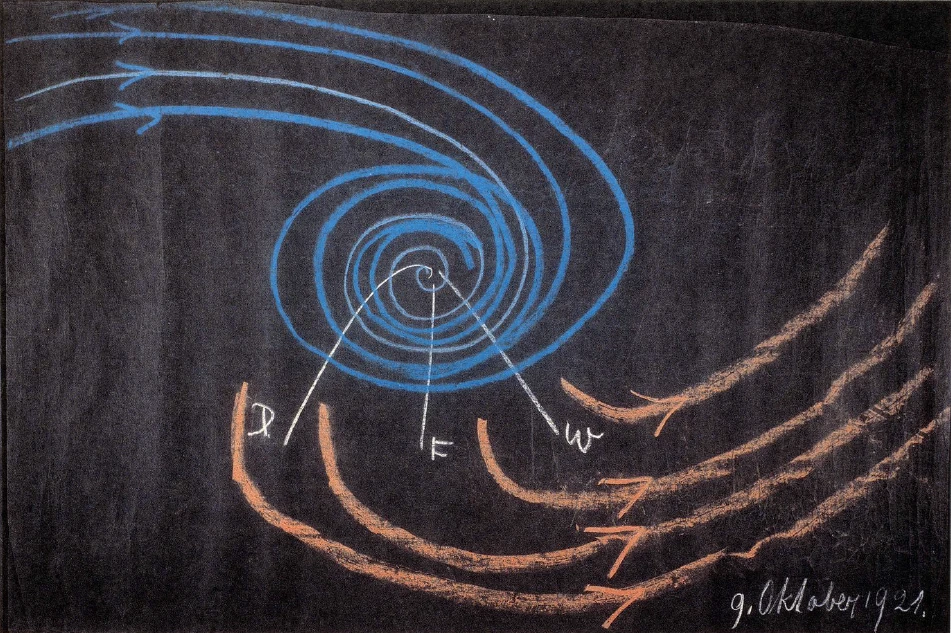
[ 20 ] Bodies reveal themselves to us according to their spiritual nature. When we look at them from the outside, they are bodies. When we delve into their inner essence, they are power and spirit—but power and spirit that grow into the future. In a symbol, one can bring together the past, present, and future in relation to the human being in roughly the following way: The past (see diagram, blue) flows in and circles within our present spirituality. From our spiritual nature, our soul life (light) radiates out into thinking, feeling, and willing. And thinking, in a sense, separates the physical body on one side and the etheric body on the other; feeling separates the etheric body on one side and the astral body on the other; willing separates the astral body on one side and the “I” on the other. And we can say: all of this develops germinally into the future to form new realms (red).
[ 21 ] In this way, we can also describe the various hierarchies that have a share in us as, in a sense, spiraling together here; and we have, schematically, the human vortex, which, where it converges at the center, forms a person’s present experiences in the soul.
[ 22 ] It is certainly true that knowledge of humanity is knowledge of the world. For even from this perspective, which we have once again adopted today, this is revealed to us. We have a world in the past. We have its effect today in the human spirit. Knowledge of the world must become knowledge of humanity if we are to understand the human spirit as it emerges from the world. Knowledge of humanity becomes knowledge of the world as we study human bodies, when we contemplate the nature of these bodies in their embryonic form and observe how what are the human’s outer shells already contain, in their very essence, two worlds within themselves. Past worlds are recognized in present-day human beings. Knowledge of the present-day human being, in terms of the spirit, means: knowledge of the world of the past. Knowledge of the present-day human being, in terms of the body, means: knowledge of the world of the future.
[ 23 ] Yes, indeed, from the most diverse perspectives, knowledge of the world is knowledge of humanity. If you wish to understand the world, look within yourself. If you wish to understand humanity, look at the world. If you wish to understand humanity as spirit, look at the glories of the past world. If you wish to understand the glories of future worlds, look into the embryonic nature of humanity’s present physical existence. Understanding humanity is understanding the world, and understanding the world is understanding humanity.
[ 24 ] More on that next time.