

Anthroposophy as Cosmosophy I
Human Traits in the Earthly and Cosmic Realms
GA 207
14 October 1921, Dornach
Translated by Steiner Online Library
Ninth Lecture
[ 1 ] In my recent reflections, I have shown how human beings can find a relationship to the world by seeking this relationship to the spiritual, the soul, and the physical. And I have shown you that if we seriously wish to bring the spiritual nature of the human being into our consciousness, we can do so only by turning our gaze upward toward the spiritual worlds. For in fact, the actions and mutual relationships of those hierarchies—which we have always summarized as the hierarchies of the Angeloi, Archangeloi, and Archai, and so on—are at work within our human spirit. And to bring the actions and relationships of these beings into consciousness means, at the same time, to bring humanity’s own spirituality into consciousness.
[ 2 ] Regarding the soul, I was able to explain to you how thinking takes place between the human etheric body and the physical body, how feeling takes place between the human etheric body and the astral body, and how willing takes place between the astral body and the human “I.” And then I showed you how what human beings today call their bodies must now be understood—if one wishes to bring them to consciousness in their true form—as seeds for future worlds. So that, in fact, what will take shape in the future existence of the world has its seeds in the human bodies we carry within us: in our physical body, which we shed here on Earth—but as it dissolves in the earthly realm, it becomes the seed for what the Earth will become after it has ceased to exist as the Earth. We come to know our etheric body—shortly after we have passed through the gate of death, it seemingly dissolves into the vast cosmos; but it becomes a seed for what the Earth is to become in the future. And so it is with our astral body and with what constitutes our “I-sheath.” This “I-sheath,” however, as we possess it here on Earth as human beings, has only been integrated into our being during this earthly existence.
[ 3 ] Today we live—that is to say, we have been living for a long time now—in the age of intellectualism. People understand what is in the world around them, just as we understand it today, through the intellect, through rational cognition. Everything that approaches human beings today in the form of education and civilization is geared toward this external knowledge. And even when we feel, our feelings remain dull and dreamlike. What becomes clear to human beings through feeling is precisely what the world currently provides as external knowledge based on its authoritative science. Thus, from the moment a person is sent to school, within our ordinary civilization, the only aspect of inner soul life they receive is the intellectual mastery of the environment. But to what extent does this intellectual mastery of the environment actually take effect? I could also put it this way: How deeply does this intellectual mastery of the environment penetrate our soul life?
[ 4 ] Let us consider a person who, at the age of six today, is sent to school—to those schools in which people are introduced to the external world solely through external methods. Let us assume that this person goes through our secondary schools. He may then even continue to learn something, may progress through the higher levels of education, and may absorb all that is required to become, in a spiritual sense, a leader of humanity in some field today. But what does such a person—whose inner life is shaped in accordance with the educational ideals of our time—actually take into his soul? He absorbs only what penetrates into his “I.” They absorb nothing more than what reaches into their “I.” It is then reflected back to them from those aspects of their human being into which the “I” is indeed embedded, but which are not called upon for actual self-conscious activity. From these, they receive—as reflections—their thoughts, their memories, their feelings, and what they know about their impulses of will. Everything else he experiences is weakened and dulled. His soul life takes place solely within the “I.” And everything that is conveyed to him is conveyed only to the extent that it enters his “I.”
[ 5 ] What happens, then, when what we call anthroposophical spiritual science approaches a person? When what we call anthroposophical spiritual science approaches a person, that person should actually learn to feel something that can be expressed as follows: “... to recognize the ‘I’ as a formation that, with a force against which the gravity of a snowflake’s breath was nothing, strove toward a state in which nothing of what modern culture designated as a spiritual gift played a role... .” For by approaching anthroposophical spiritual science, a person should truly come to say to themselves: This anthroposophical spiritual science places a very special demand on you. You can understand things that you take into your soul as ideas—things that others, who live solely within today’s educational system, would call fantastical or crazy—things that those living within today’s educational system, with their “I”-culture, cannot come to terms with. They cannot approach them with their “I”-culture. The earthly “I” cannot grasp what is presented in anthroposophy as a series of concepts, what is described there about the development of Saturn, the Sun, and the Moon, and about the spiritual, soul, and physical nature of the human being. Just consider this: if one were to ask a genuine philosopher of today—one who has not become so “crazy” or “clever” as to “regard Darwin as a midwife and the monkey as a work of art”—if one were to expect such a philosopher to understand that the human spirit, about which he speaks so much—though he speaks only words, this philosopher of today— can only be understood in connection with the higher hierarchies; that the human soul can only be understood in terms of thinking, feeling, and willing when one looks into the members of the physical body, the etheric body, the astral body, and the I! And now one is even expected to expect such a philosopher to see, within the human physical bodies—which he already regards as fanciful—the seeds of future worlds! Of course, one cannot arrive at this through what the modern “I” can perceive. If one is nevertheless able to connect or link anything from the soul life with these grotesque ideas—one need not be a clairvoyant oneself to do this, but need only accept the clairvoyant’s perceptions as ideas—then one does not do this in the “I,” but in the astral body. The shadows of thought that one receives today in the “I” as a reflection from the astral body do not tax the astral body. One can have these with “I-culture.” For if this is the astral body (see diagram, red) and here the “I” (green), then everything that modern human beings experience takes place here in the “I,” and their thoughts are nothing other than what the astral body casts into the “I” as shadows (yellow). One need not exert any effort in this process. One simply lets the “I”—which one has just acquired through the earthly organization—take the lead. One really does not need to exert any effort. One constructs a microscope, places a specimen under it, examines one specimen, then a second, looks at them, and pieces together the mental shadow images; one performs some mathematical operations, which, just as they are presented as “shadow operations,” take place internally. In doing so, one can remain entirely passive with regard to one’s inner experience of the world. One then further develops this passivity by shifting—though not in the Goethean sense—from inner work to observation. One no longer enjoys attending lectures that require active thinking, but prefers those in which many experiments are conducted; and between the experiments, amid the unpleasant noise used to explain them, one then falls asleep. Or one might even go to the movies. There, one certainly doesn’t need to be active in any way.
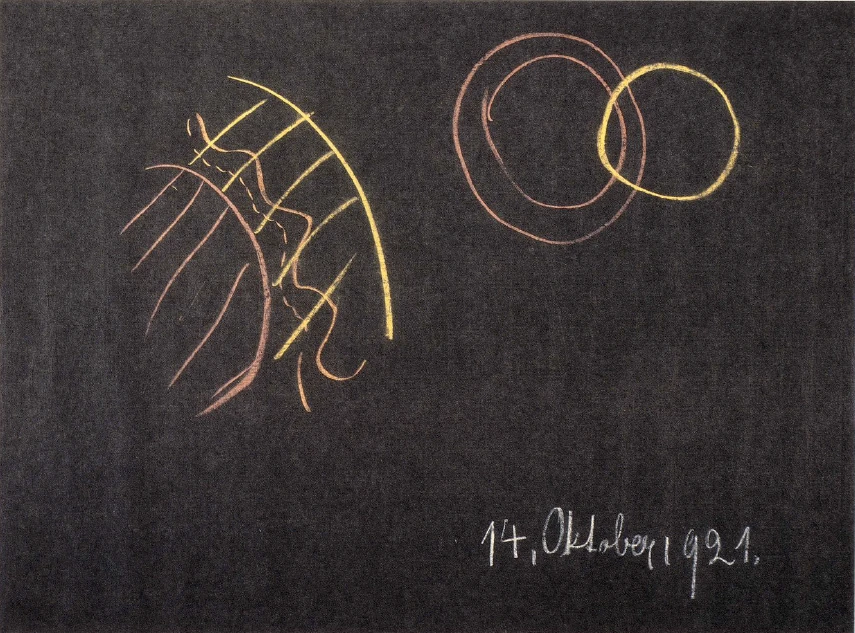
[ 6 ] That is precisely the culture of the ego. It will continue to spread further and further. But when it comes to anthroposophical spiritual science, one cannot proceed in that way. A contemporary theologian has said, mind you, that he wouldn’t read the *Akashic Records* even if I were to give him a lavishly illustrated copy as a gift. But he need not fear that he would be given a lavishly illustrated copy of the “Akashic Records,” for one must assimilate it in such a way that one actively participates in its formation from within. Even if one were to artistically and symbolically capture what one finds in the “Akashic Records,” this theologian would still not be able to make any use of such a “deluxe illustrated edition” of the “Akashic Records,” precisely because he placed the greatest value on the “illustrations.” — Well, yes.
[ 7 ] In anthroposophical spiritual science, one must actively participate inwardly; otherwise, of course, one hears only words that can easily be dismissed as mere fantasy. But one must learn to love this inward participation. One must resolve to do this. It is uncomfortable; but once you resolve to do it, you realize that it is refreshing, that it revitalizes a person both spiritually and physically.
[ 8 ] I know that some people have certain objections to this process of renewal. But they would like to acquire—through passive thinking alone—what they are supposed to gain through the active cooperation of the astral body in a process of arduous intellectual struggle, just as that theologian would probably prefer it if the entire *Outline of Esoteric Science* were shown to him in a movie theater. For that is roughly the nature of his concepts, which he also uses elsewhere in the essay where he speaks of the “illustrated deluxe edition” of the “Akashic Records.”
[ 9 ] In short, through anthroposophical spiritual science, something is set in motion that is not merely the “I,” but rather the astral body. There are, however, also people who sense this when they read an anthroposophical book. They feel something like that; something stirs within them. Now they are accustomed to moving inwardly only passively, as shadows of thought. Now something like an active intellect begins to stir within them. It feels to them as if they had lice inside, and then they become nervous about this inner stirring, and then they say: “This is unhealthy.” And then they complain about these difficult concepts presented to people in anthroposophical spiritual science. And especially those who observe such inwardly strangely affected people—their brothers, sisters, aunts, or uncles—take up this complaint as their own, claiming that anthroposophy is something that makes people nervous.
[ 10 ] But what is the situation here if we now ask: What is the relationship between the “I” culture that a person first absorbs during their earthly life and the culture that can be acquired through anthroposophical spiritual science? A simple schematic diagram can clarify this. Let us assume, then, that we have the Earth here (see diagram, red). It would have been preceded by the Moon, the Sun, and Saturn. The next planet, which emerges from the Earth after the Earth has met its demise, would be Jupiter (green). The parts of the human being—now in embryonic form—that are the physical body, the etheric body, and the astral body are now intensively involved in Jupiter; but the “I” is involved only under a certain condition. For if the “I” absorbs nothing other than what it can absorb through Earth culture, then this “I”-consciousness also ceases with the Earth; then the human being has become an Earth “I,” and ceases to be an Earth “I” along with the Earth. He must continue to develop into other forms.
[ 11 ] But when a person has developed to the point of having an astral body, when they have activated their astral body, this activity then radiates back to their “I.” The person then has an entity consisting of the “I” and the astral body, both of which are active within. He does not feel as if he—as I said earlier—had lice inside him, but rather he feels as if he were permeated from within by strong, healthy life forces—life forces that now connect him to what is already emerging as a seed from his physical sheaths into future earthly metamorphoses, in order to develop further in those future earthly metamorphoses.
[ 12 ] Anthroposophical spiritual science must certainly be regarded as something living. It does not merely provide people with a “theory” or a “theoretical worldview”; it gives them the life force that can lead them beyond mere earthly existence.
[ 13 ] Especially now, when we take such an insight—as we have allowed it to unfold before our souls in the last three lectures—very seriously; when we place the human being, in spirit, soul, and body, within the entire process of world-becoming and thereby sense something of inner human substance and are enriched by it—then we incorporate into this human being something that carries him or her beyond earthly existence. For it could very well be—although hopefully it will not be the case—that people, because they grow weary of it in the manner described earlier, will reject anthroposophical spiritual science. In that case, however, the human shell would continue to develop, but it would be appropriated by beings other than human beings, and human beings would sink into a lower existence than that for which they are destined.
[ 14 ] After all, this is what causes some people today to become anxious about humanity’s cosmic future—what leads some to suspect that humanity might be lost in the vastness of the universe through its own fault. And for this to happen, all it takes is for a few other things to come to pass—so that people do not merely come to realize: ‘Darwin was a midwife and the ape a work of art,’ that they do not merely realize that, after all, ‘under the guidance of conventional medicine,’ people speak of ‘nervous weakness, fatigue, psychasthenia,’ and so on, that they do not merely come to say to themselves: ‘I won’t write anything anymore; one would have to write with roundworms. I won’t read anything anymore. Who, then? The old, honest Titanides wrapped in sandwich paper?”
[ 15 ] Well, despite the hellish laughter coming from some quarters, one simply has to say: Those who no longer have any faith in the “Titanides with Icarian wings wrapped in bread wrappers,” those who realize that one should really only “write with roundworms” about everything that is in its embryonic stage in our culture in decline—they then ask: What is there left to read, what should one occupy oneself with? — who may then ask: Are we even still alive at all? — to them, as I said, despite the hellish laughter being raised from some quarters today, be given anthroposophical literature, and they should, in whatever way possible, be given a spiritual remedy so that they may rid themselves of the inhibitions caused by contemporary culture, which prevent them from absorbing what the soul absolutely needs today.
[ 16 ] There are many people in the world today who do not know what to do with themselves, for whom their bodies have become too heavy and their inner beings too crippled. It is precisely these people who should often be made to realize, in all seriousness, what invigorating and healing impulses lie in the genuine, active development of the thoughts and ideas of anthroposophical spiritual science.
[ 17 ] These matters must certainly—and I cannot stress this enough—be taken very seriously. Even today, we must be able to gain at least some insight into the actual state of affairs in our time regarding the consequences that may arise from the directions in which materialistic culture has headed.
[ 18 ] May we now also realize how essential it is that our culture be renewed today, drawing from its original sources!