

Anthroposophy as Cosmosophy I
Human Traits in the Earthly and Cosmic Realms
GA 207
15 October 1921, Dornach
Translated by Steiner Online Library
Tenth Lecture
[ 1 ] I would like to look back once more at our recent reflections. We have tried to form ideas about how to understand human spiritual life, human soul life, and human physical life. When we consider human soul life, that is, what a person feels taking place within as thinking, feeling, and willing, we find that the thinking aspect—that is, what is directly experienced as the content of thought—takes place between the physical body and the etheric body; that feeling takes place between the etheric body and the astral body; and that willing takes place between the astral body and the “I.” We can see from this that thoughts, insofar as we are fully conscious of them, merely represent what seems to rise up from the depths of our own being and can, in fact, only give form to the waves of soul life. Something like shadows rise up from the depths of the human being, fill our consciousness, and then become the content of thought.
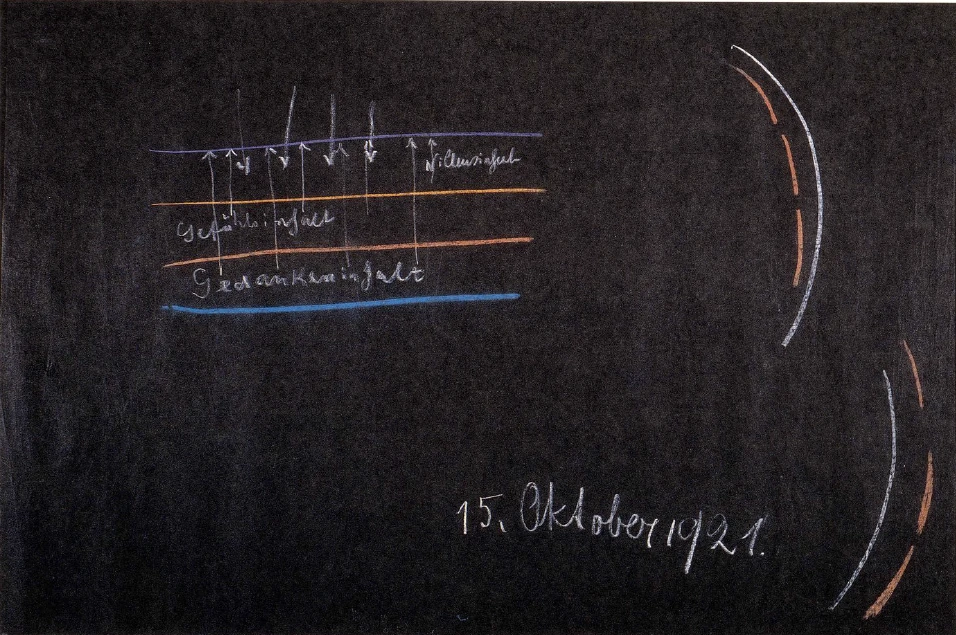
[ 2 ] If we wanted to represent this schematically, we could say: physical body (see diagram, blue), etheric body (orange), astral body (yellow), and the “I” (violet). Then, between the physical body and the etheric body, we would have the content of thought. — But you have seen from my descriptions in the last few lectures that, in truth, this content of thought is something far more real than what we experience in consciousness. What we experience in consciousness is, after all, only something that, as I said, rises in waves from the depths of our being up to the “I.” That is where it rises. The content of feeling lies between the etheric body and the astral body and, in turn, surges up to the “I,” and the content of will lies between the astral body and the “I.” It is thus closest to the “I.” We can say: It is in the will that the “I” is experienced in its most immediate form, while emotional and mental content rest in the depths of our being and merely send waves rising up into our “I.”
[ 3 ] But we also know that volition—that is, the content of the will as we experience it—is experienced in a dull manner. We know no more about the will as it is at work, say, in a movement of the arm or a movement of the leg, than we do about what takes place between falling asleep and waking up. The will lives dully within us. Yet it is what lives closest to our true self. Consciously—or, shall we say, in a waking state—we perceive the will only through the shadows of thought that rise up from the depths of our being. The ideas we consciously experience are shadows of a deep inner weaving; but they are, after all, only shadows, whereas we do experience the will directly, albeit dimly. Yet we can only have a waking awareness of the will through these shadowy thought-images.
[ 4 ] This is how the matter appears to us when we contemplate our human being and look into the depths of our inner self. We see how—I would say—little of ourselves is contained in our consciousness, how little of the innermost core of our being rises up into our consciousness. In a sense, we understand very little of what we are inwardly in terms of the “I,” and actually perceive only the tinge that the content of thought casts upon this dull, volitional “I.”
[ 5 ] With ordinary consciousness, one can hardly perceive anything more immediately real about this thought-filled, dull “I” than what we experience as our dull “I” just before waking up or just after falling asleep. But as soon as you wake up, the world of sensory perceptions bursts into this dull “I.” Just become aware for a moment of how dull your life is between falling asleep and waking up—so much so that you almost perceive this dullness as emptiness. And only upon waking, when you open your senses to the outside world and sensory impressions arrive, are you able—guided by these sensory impressions—to truly perceive yourself as a “self.” That is when the appearance of sensory perceptions bursts into the “self.” That is when the appearance of sensory perceptions fills that dull being of which I have just spoken. Thus, the “I,” as a fully conscious entity within the earthly human being, actually lives only in that state in which it has entered into contact with the external world through sensory images—through everything that enters its senses—and it is then the shadowed content of thought that emerges from within as the brightest, as that which illuminates the most.
[ 6 ] So one can say: Sensory perceptions come in from the outside. The content of the will is perceived only dimly. The content of emotion surges up and combines with the sensory impressions. We see red, and it fills us with a certain feeling; we see blue, we hear C-sharp or C, and we feel something as a result. But then we also form concepts about what these sensory impressions are. The content of thought, which comes from within, interweaves with the sensory impressions. The inner connects with the outer. But the fact that we live in a fully awake “I” is actually due to the sensory appearance, and our “I” contributes to this only as much as has just been described in terms of what strikes back against the external.
[ 7 ] Let us take note of this apparent meaning. Let us look at it and be clear about this: it is entirely dependent on our physical existence. It can only fulfill us by presenting our physical body to the external world while we are awake. This sensory appearance ceases at the moment when, passing through death, we shed our physical body in the sense we have discussed in the preceding reflections.
[ 8 ] Between birth and death, our “I” is, so to speak, awakened by the radiance of the senses. As awake earthly human beings, we can only experience our true nature to the extent that it comes to life through this radiance of the senses. Now vividly imagine how the human “I” captures the sensory appearance—which is, after all, only an illusion—and weaves it into its own human being. Now consider how the external becomes internal, how—as you can see in a dream— I would say, a very fine fabric is spun inwardly, into which the sensory impressions are woven. The “I” takes possession of what comes through the sensory impressions. The external becomes internal. But only that which becomes internal can a person carry through the gate of death.
[ 9 ] So it is, at first, a fine fabric that a person carries through the gate of death. He sheds his physical body, which conveyed sensory impressions to him. Therefore, sensory impressions are merely an illusion, for the physical body is cast off. Only to the extent that the “I” has absorbed this illusion into itself is it carried through the gateway of death. The etheric body is also cast off shortly after death. With this, however, that which lies between the physical body and the etheric body is cast off by the individual’s own being. As we have seen, this dissolves into the general cosmos at first, forming only the seed for further worlds; but it does not actually continue to live together with our human being after death. Rather, only that which has surged upward as waves and united with the sensory appearance lives on. When one considers this, one can gain a rough idea of what the human being carries through the gate of death.
[ 10 ] For this reason—because that is how it is—when asked, “How can someone build a bridge to a person who has passed away?”—one must say the following: This bridge cannot be built by sending abstract thoughts or vague ideas to the deceased. When one thinks of the deceased person with abstract ideas—what is it like there? Abstract ideas have almost nothing left of the radiance of the soul; they are faded, but there is also nothing inwardly real living within them—only that which wells up from the inwardly real. Only a faint trace of the human being lives on in abstract ideas. So what we grasp through our intellect is far less real than what fills our “I” in the light of the senses. What fills our “I” in the light of the senses awakens our “I.” But this awakened content is interwoven only with the waves that surge up from within us. So when we direct abstract, faded thoughts toward a deceased person, he cannot be in communion with us; but he can be when we vividly imagine, deep within ourselves, how we stood together with him here or there, how we spoke with him, and how he, through his own words, wanted this or that from us. The content of our thoughts—that pale, abstract content—will not bear much fruit; but it will if we develop a subtle sensitivity to the sound of his voice, to the particular kind of emotion or temperament with which he conversed with us, if we feel the warm, living togetherness with his wishes—in short, if we imagine these concrete details, but in such a way that our imaginings are images: when we see ourselves standing or sitting together with him, experiencing the world with him. One might easily believe that it is precisely these pale thoughts that linger beyond death. That is not the case. It is the vivid images that carry over into the afterlife. And within images of sensory perception—images we possess only because we have eyes and ears, a sense of touch, and so on—it is within such images that what the deceased can perceive takes shape. For with death, he has cast off everything that is merely abstract, pale, and intellectualistic thinking. Our pictorial conceptions—insofar as we have made them our own—we take with us through death. Our science, our intellectualistic thinking—we do not take any of that with us through death. A person may be a great mathematician, possess many geometric concepts—he sheds all of that just as he sheds his physical body. A person may know a great deal about the starry worlds and the Earth’s surface—but to the extent that this knowledge has been absorbed into pale thoughts, it is cast off at death. When a person, as a learned botanist, walks across a meadow and lets his theoretical thoughts about the meadow’s flowers run through his mind, this is a line of thought that fills him only here on Earth. But what strikes his eyes and is colored by his love for the flowers—that which is thus imbued with human warmth through the union of the pale thought with the experience of the “I”—that is carried through the gate of death.
[ 11 ] It is important to know what one actually acquires here on Earth as true human possessions—such that one can carry them through the gate of death. It is important to know that all the intellectualism that has constituted the mainstay of human civilization since the mid-15th century is something that has meaning only in earthly life—something that is not carried through the gate of death. So that one can say: The human race lived through the past eras we have discussed—beginning with the Atlantean catastrophe, through the long ages of ancient India, ancient Persia, the Egyptian-Chaldean period, and then through our own era up to the present—and throughout all this time, that is, up until the first third or the middle of the 15th century, they did not yet lead such a distinctly intellectual life as the one we so highly value today as the life of our civilization. — But of all that is carried away through the gate of death, people before the 15th century experienced far more. For precisely that which they have come to take pride in since the 15th century—that which actually constitutes the entire value of earthly life for today’s educated, so-called educated world—is something that has been extinguished by death. One could almost say: What is the defining characteristic of modern civilization? The defining characteristic of all that is so highly praised as having been brought about by Copernicanism and Galileanism is something that must be laid aside with death—something that a person can actually acquire only through earthly life, but which can also become for them nothing more than an earthly possession. And as human beings have evolved toward modern civilization, they have in fact achieved precisely this goal: to experience here, between birth and death, what has significance only for the earth. It is very important for modern human beings to know thoroughly that the content of what is regarded today—especially in the school system—as the highest has real significance only for earthly life. In our ordinary schools, we teach our children everything that constitutes modern civilization—not primarily for the sake of their immortal soul, but solely for the sake of their earthly existence.
[ 12 ] Intellectualism can also be correctly grasped by the soul in the following way. When a person wakes up in the morning, sensory images flood into their consciousness. They merely notice that thoughts weave through these sensory images like a fine net, and they actually live in images. These images disappear immediately when they fall asleep in the evening. Their life of thought also disappears then. But the appearance of these sensory images is nonetheless essential, for whatever the “I” appropriates from them passes through death with it. What comes from within—the content of thought—remains in the form of a brief memory, as you know, for a few days after death, as long as the person retains their etheric body. Then the etheric body dissolves into the vastness of the cosmos. This is a brief experience for the human being immediately after death: they feel that their images—which contain the sensory appearance—insofar as the “I” has appropriated them, are, I might say, interwoven with strong threads of what they have now appropriated through their knowledge. But they shed this along with their etheric body a few days after their death. Then the person lives into the cosmos with these images, and these images become interwoven into the cosmos just as they were interwoven into the person’s own being before death. Before death, the images took shape inwardly within the sensory perceptions. They are grasped by the human being—I might say—insofar as the person is bounded by their skin. After death, once the few days have passed during which the life of thought is still experienced—because one still has the etheric body before it dissolves—after these days, the images become, in a certain sense, larger. They expand in such a way that they are now, as it were, taken in outwardly, just as they were taken in inwardly during earthly life. One could schematically illustrate the entire process as follows: When this is the boundary of the human body (see drawing, light-colored) and the person has their impressions in the waking state, then their inner experiences are formed from the sensory impressions within their being. After death, the person experiences this boundary as an all-encompassing feeling; but the impressions, so to speak, flow out of them. They are perceived in the person’s surroundings (red). Thus, whereas during earthly life a person says, “My soul experiences are within me,” after death they say, “My soul experiences are before me, or rather, around me.” They merge with the environment. As a result, they also change internally. Let us say, for example, that a person, because he is a lover of flowers, has imprinted a rose—a red rose—particularly strongly upon himself through repeatedly experienced sensory impressions; then, when he experiences this “wandering out” after death, he will see the rose as larger—visually larger—but it will appear greenish to him. Thus the image also changes internally. Everything that a person has perceived in green nature—insofar as they have truly experienced this green nature with human feeling, not merely through abstract thoughts—now becomes, after death, a gentle, reddish environment surrounding their entire being. But the inner world migrates outward: after death, a person has, so to speak, what they call their “inner self” in their surroundings, on the outside.
[ 13 ] These insights, which thus belong to the human being insofar as the human being in turn belongs to the world itself—these insights—we can acquire through spiritual science. For it is only by acquiring these insights that we gain a conception of what we actually are ourselves. We cannot gain an understanding of what we actually are if we know ourselves only in the sense of what a human being is between birth and death and in the inner workings of their thoughts. For these are the things that, as such, fall away after death. Of the illusory appearance of the senses, only what I have just described to you remains, and it remains exactly as I have described it to you.
[ 14 ] It was in the mid-19th century that the materialistic mindset and worldview of civilized humanity, as I have often emphasized, had reached a culmination, a peak, there has been much talk of how, when a person establishes a religion for himself, or speaks of something divine or spiritual in the external world, he is actually only projecting his inner self outward. You need only read a thoroughly materialistic writer such as Feuerbach—who also had a great influence on Richard Wagner—to see how this materialistic way of thinking actually perceives only nature in the external world, that is, only the appearance of nature as it presents itself between birth and death, and how this materialistic mindset believes that all thinking about the divine-spiritual is merely the inner life of human beings, cast out and projected outward, so that human beings believe they may accept the divine-spiritual only because they project their own inner life outward. This apparent insight was called anthropomorphism. It was said: Human beings are anthropomorphic; they conceive of the world according to what lies within themselves. And indeed, around the middle of the 19th century, a phrase was coined among the truly characteristic materialists, intended to illustrate just how wonderfully far the human world had come, especially in recent times. It was said: “The ancients believed that God created the world; but we modern people know: Man has created God—that is, he radiates God outward from his own being.” —This was because people were aware only of the inner world that has significance between birth and death. And in reality, this was not merely a false view that people had formed, but rather they had developed a worldview that was, in fact, anthropomorphic: they had no other conceptions of the divine-spiritual than those that human beings had ultimately cast out of themselves and projected outward.
[ 15 ] But compare all of this with what I, for example, have described in my *Outline of Esoteric Science*; there you will see that the world is not depicted in the same way as human inner conceptions. What I describe there as the development of Saturn, the Sun, the Moon, and the Earth—human beings do not carry this within themselves. One must first assume what a person experiences after death—that is, what they can place before themselves. There is nothing anthropomorphic there. This “Esoteric Science” is presented in a cosmomorphic manner; that is to say, the impressions are such that they are actually experienced as existing outside the human being. That is why these things are not understood by those people who, in their imagination, can only experience what lies within the human being—as has indeed become the case, particularly in the intellectualistic age since the mid-15th century. This age perceives only what lives within the human being and projects it outward. One will never be able to describe an external world as I describe it in the chapter of my *Secret Science* that deals with the Saturn evolution—not even in its simplest, most elementary form—if one merely projects outward what lives within the human being.
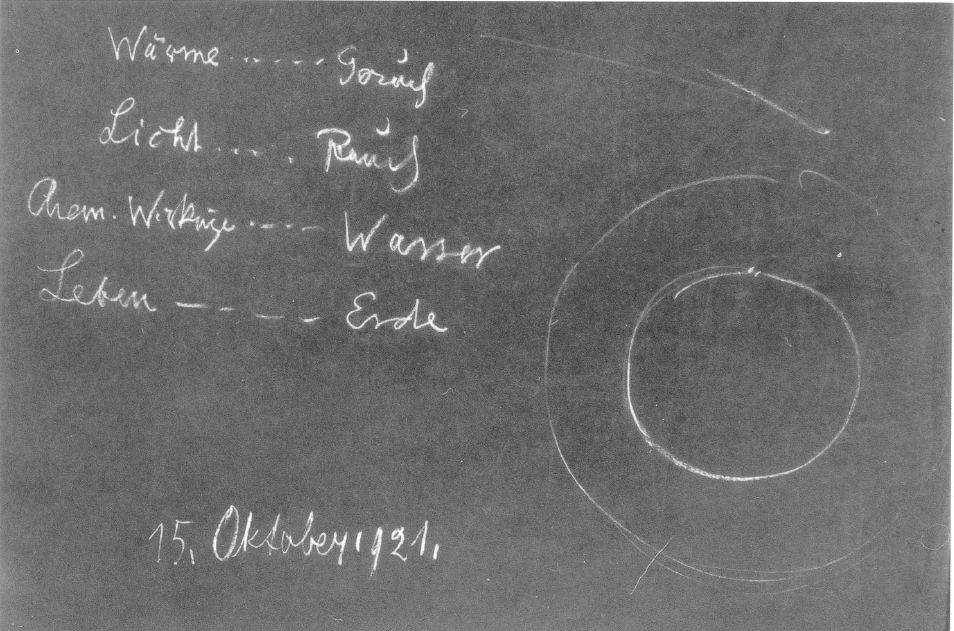
[ 16 ] You see, human beings live, for example, in warmth. Just as they perceive the world in colors through their sense of sight, so do they perceive the world in warmth through their sense of warmth. They experience warmth in their—I would say—inner being, insofar as it is bounded by the skin. But in doing so, they are already abstracting in their perception. Warmth perceived in the life of the world cannot really be described in any other way than by grasping it in its totality. Yet with warmth, there is always something present that, in human experience, can only be expressed by referring to the sense of smell. Warmth, objectively perceived from the outside, always has something of a smell to it.
[ 17 ] And now read the chapter in my *Secret Science* about that process on our Earth that exists primarily as warmth: how, in describing these things, the text also speaks of olfactory sensations. You will see from this that warmth is not described as humans experience it through intellectualism. It is separated from the human being. And what a person experiences here between birth and death as warmth is, immediately after death, present as a sense of smell.
[ 18 ] Here on Earth, human beings actually experience light in a very abstract way. They experience this light by succumbing to a constant illusion. I would like to point this out here as well: I wrote—it has now been, I think I can safely say, thirty-eight years—an essay, very naive and youthful, in which I tried to describe how people talk about light. But where, then, is the light? Human beings perceive colors; these are their sensory impressions. Wherever they look, they perceive colors—some sort of tinge—even when they know it is merely a tinge. But light—they live in light, yet they do not perceive the light itself; they perceive colors through the light, but they do not perceive the light itself. The extent to which people live under illusions in this regard in our intellectualistic age is evident from the fact that there is a “theory of light” in our physics; that people speak as if it were something that makes sense when viewed as a theory of light. It does not make sense. Only a theory of color makes sense, but not a theory of light.
[ 19 ] It took Goethe’s perfectly sound sense of nature to ensure that what emerged was not a theory of optics, but a theory of color. When we open our physics textbooks today, light is practically constructed: rays are drawn; they reflect off surfaces and do all sorts of things. But none of it is reality! You see colors. You can speak of a theory of color, but not of a theory of light. You live in the light. Through the light and by the light, you perceive colors, but nothing of the light itself. No one can see the light. Imagine you were in a room that was completely illuminated, but there wasn’t a single object inside. You might as well be in the dark. In a room that is completely dark, you would not perceive any more of it than you would in mere light; you could not even distinguish it from a completely dark room. You could only distinguish it through an inner experience. But as soon as a person has passed through the gate of death, just as one perceives the scent of warmth, one perceives something in the light for which we today, in our intellectualistic language, do not even have a suitable word—we would have to say: smoke. A surging in—that is what they truly perceive. The Hebrew language had a word for this: ruach. The surging in is perceived. That which we are actually the only ones justified in calling “air”—that is what is perceived there.
[ 20 ] And when we now look at what is at work everywhere in our earthly conditions as chemical effects: we perceive them in their manifestations—these chemical effects, these chemical etheric effects. From a spiritual perspective, without the physical body—and thus also after death—they provide what constitutes the substance of water.
[ 21 ] And life itself—that is the very substance of the earth, of the solid world. From the perspective of a dead person, our entire earth is perceived as a great living being. When we walk about here on earth, we also perceive its individual beings—insofar as they are earthly beings—as dead. But on what does this perception of the dead rest? The entire Earth is alive, and it reveals itself to us in its life immediately when we behold it from beyond death. If this is our Earth (it is drawn), then we always see only a very small part of it and are accustomed to seeing only that small part; but when we hover around it in spirit and also have a capacity for perception from the outside—so that the impressions are magnified—then we perceive it as a whole being. Then, however, it is a living being. — With this, I have pointed to something that is extraordinarily important to consider. (It is written on the board.)
Heat, Smell
Light, Smoke, Air
Chemical Effects, Water
Life, Earth
[ 22 ] You see, I once had a conversation with a gentleman who said that, thanks to the theory of relativity, we now finally know that we can imagine a person to be twice as tall as he actually is; that it’s all relative, that it all depends solely on the human perspective.
[ 23 ] That is a view that is completely out of touch with reality. For you see, if—it’s not even a strictly accurate image, but let’s say—a little sun beetle is crawling around on a human being, it is of a certain size in relation to the human being. It does not perceive the entire human being, but—in accordance with its own size—only a small part of the human being at any given time. And that is why, for the little sun beetle, the human being is not a living being; rather, the human being on whom it is crawling is just as dead to the little sun beetle as the Earth is dead to the human being. But you must also be able to think this idea in reverse. You must be able to say to yourselves: In order for a human being to experience the Earth as dead, they must have a certain size on the Earth. The size of a human being is not arbitrary in relation to the Earth, but is entirely commensurate with the entirety of human life on Earth. Therefore, one cannot conceive of a human being as large or small—for example, in the sense of the theory of relativity. Only when one thinks and imagines in a completely abstract, entirely intellectual way can one conceive of humans as large or small; only then can one say: If we were organized somewhat differently, humans might appear twice as large, and so on.
[ 24 ] This comes to an end when one embraces a concept that transcends the subjective and is capable of grasping the magnitude of humanity in relation to the Earth. It is also true that after death the entire human being expands out into the universe, that for a time after death the human being becomes much larger than the Earth itself. Then they perceive it as a living being. And then they perceive chemical processes in everything that is water. They perceive light in the airy realm—not air and light as separate entities, but light within the airy realm, and so on. Human beings experience images—images that are different from those of their waking life between birth and death.
[ 25 ] I said: We cannot take anything with us in death of what has been acquired by our soul through intellectual means—nothing at all. But before the 15th century, human beings still possessed a kind of inheritance from primeval times. As you know, this inheritance was so vast in primeval times that human beings possessed an atavistic clairvoyance, which then became dulled, faded, and paralysed, and which completely gave way to abstraction from the middle of the 15th century onward. But what human beings took with them through death from this divine inheritance was actually what gave them their very essence. Just as human beings take on physical matter here when they enter earthly existence through birth or, respectively, through conception, so it was the divine essence that they brought with them and carried through death that, if I may say so—the expression is grotesque, but it will make it understandable to you—a spiritual heaviness—which is, of course, polar opposites to physical heaviness—that gave him a spiritual heaviness.
[ 26 ] The way people are incarnating now, they no longer possess this heritage—if they are truly civilized human beings. At most, one can still notice it here and there: those who are not true members of civilization—who are becoming increasingly rare—still possess it within themselves. And it is indeed a serious matter for human development that, through what he receives from intellectualistic civilization, man essentially loses his true nature. And they face the danger that, after death, they will indeed grow to the point of having these impressions, but that they will lose their true essence—the “I”—as I already described yesterday from a different perspective. And there is only one salvation for this being, for the modern and future human being, and it can be recognized through the following: If we wish to grasp a reality here in the sensory world that makes thinking so powerful that it is not merely a pale image but possesses inner vitality—we can recognize such a reality, arising from within the human being, only in that pure thinking which I described in my *Philosophy of Freedom* as underlying action. Otherwise, all human consciousness consists only of sensory illusion. But when we act freely out of pure thinking—that is, as I have described it in my *Philosophy of Freedom*—when, in other words, we truly derive the impulses for our actions from pure thinking, we thereby endow this otherwise illusory thinking, this intellectualistic thinking, with reality by making it the foundation of our actions. And that is the only reality we can weave into the appearance of meaning purely from within and take with us through death.
[ 27 ] So what, then, do we actually take with us through death? That which we have experienced in true freedom here between birth and death. Those actions that correspond to the description of freedom in my *Philosophy of Freedom* constitute what a human being can carry through death, apart from the appearance of meaning, which transforms in the manner I have described. Through this, the human being regains a being. By freeing themselves from the determinism of the sensory world, the human being regains a being after death; through this, they become a real being. It is freedom that, when we attain this being, preserves us—precisely for the future as human souls—from spiritual and mental death.
[ 28 ] Those people who leave themselves entirely to the forces of nature—that is, to their instincts and drives—as I have described from a purely philosophical standpoint in my *Philosophy of Freedom*—live in something that decays with death. They then live their lives into the spiritual world. Of course, their images are there. But they would gradually have to be taken over by other spiritual beings if the human being did not develop in the full sense of freedom, so that he might once again become the being he was when he still possessed his divine-spiritual heritage.
[ 29 ] This is how deeply the age of intellectualism is connected to freedom. That is why I have always said: Human beings had to become intellectualists in order to become free. In intellectualism, human beings lose their spiritual essence, for they can carry nothing from intellectualism through the gate of death. But here they gain freedom through intellectualism, and what they thus gain in freedom, they can then carry through the gate of death.
[ 30 ] So a person may think as much as he wants in a purely intellectual way—none of it passes through the gate of death. But when a person uses thinking to live it out in free actions, then—in a sense—the spiritual-soul substance that makes him a being, rather than mere knowledge, passes with him through the gate of death from his experiences of freedom. In thinking, intellectualism robs us of our human being in order to allow us to attain freedom. What we experience in freedom is then given back to us as our human being. Intellectualism kills us, but it also gives us life. It allows us to rise again with a completely transformed being by making us free human beings.
[ 31 ] Today I began by describing this as it arises from the human being itself. Tomorrow I intend to relate what I have described today—based solely on human nature—to the Mystery of Golgotha, to the Christ experience, in order to show how, through death and resurrection, the Christ experience can now flow into human beings as an inner experience. More on that tomorrow.