

Anthroposophy as Cosmosophy I
Human Traits in the Earthly and Cosmic Realms
GA 207
16 October 1921, Dornach
Translated by Steiner Online Library
Eleventh Lecture
[ 1 ] In the course of our recent reflections, it became clear to us how fundamentally different a person’s entire worldview is, depending on whether they are living here between birth and death or in the spiritual world between death and a new birth. And we said yesterday that in our present age, since the middle of the 15th century, a human being can acquire the freedom here between birth and death, so that everything they accomplish out of the impulse of freedom then, in a sense, gives their being in the life between death and a new birth a certain weight, reality, and existence. Precisely when we break free here from the necessities of earthly existence, when we rise to motives for our will that are free—that is, when we draw nothing from the earthly realm for our will—we thereby build for ourselves the possibility of being an independent being between death and a new birth. However, in our age, this sort of self-preservation of being after death includes what might be called the relationship to the Mystery of Golgotha; and one can, of course, view this Mystery of Golgotha from a wide variety of perspectives. We have already considered a great many of these perspectives over the years; today let us examine it from the perspective that arises from contemplating the value of freedom for human beings.
[ 2 ] When a person lives here on Earth between birth and death, they actually have no self-perception in their ordinary consciousness. A person cannot look within themselves. It is, of course, merely an illusion when an external science, by observing what is dead in a human being—and indeed, at times, merely by observing the corpse—believes it can gain an inner understanding of the human organism. This is, after all, a delusion, an illusion. Here, between birth and death, a human being has only a perception of the external world. But what kind of perception of the external world does he have here? He has the perception that we have often called the perception of appearances, and I emphasized this strongly again yesterday.
[ 3 ] When we direct our senses outward toward our surroundings in the world between birth and death, the world presents itself to us as an appearance, as an illusion. We can take this illusion into our sense of self. We can, for example, retain it in our memory, thereby making it, in a certain sense, our own. But insofar as it stands before us when we look out into the world, it is precisely an illusion—an illusion that reveals itself as such particularly through the fact that, as I showed you yesterday, it disappears in death and reappears in another form, no longer experienced within us but rather experienced before us or around us.
[ 4 ] But if, in this day and age, human beings did not perceive the world as an illusion between birth and death—if they could not experience this illusion—then they could not be free. The development of freedom is possible only in the world of illusion. I hinted at this in my book *The Enigma of Man* by pointing out that, in fact, the world we experience can be compared to the images that look back at us from a mirror. These images, which look back at us from a mirror, cannot impose anything on us; they are merely images—they are illusion. And so what humans experience as the world of perception is also an illusion.
[ 5 ] Human beings are by no means entirely ensnared by the illusions of the world. They are ensnared in a world of illusions only through their perceptions, which fill their waking consciousness. But when a person looks at their drives, their instincts, their passions, their temperaments—at everything that wells up from the human being without their being able to form clear concepts of it, or at least waking concepts—then all of that is not illusion. It is indeed reality, but a reality that does not come to the forefront of a person’s present consciousness. Between birth and death, a person lives in a true world that they do not know, but which is never capable of truly granting them freedom. It can instill in them instincts that make them unfree; it can give rise to inner necessities; but never, ever can it allow a person to experience freedom. Freedom can only be experienced within a world of images, of illusion. And so, as we awaken, we must enter into a life of illusory perception so that freedom can develop there.
[ 6 ] This illusory life that we experience as our waking perceptual life—it was not always this way throughout the course of human history. If we go back to ancient times—times to which we have already cast our gaze on numerous occasions—when a certain instinctive perception existed, or what was a remnant of this instinctive perception, which, as a remnant, continued in a sense until the middle of the 15th century—if we look back to that time, we cannot say in the same sense that human beings, in their waking state, were surrounded only by an illusory world. For human beings, everything they perceived as the spiritual background of the world spoke to them through this illusion. They did, of course, perceive this illusion as well, but in a different way. For them, this illusion was an expression, a revelation of a spiritual world. This spiritual world has vanished behind the illusion. The illusion has remained. This is the essential point in the further development of humanity: that in earlier times, the illusion was perceived as the revelation of a divine-spiritual world, but that the divine -spiritual world has vanished, and the illusion now lies before human beings so that they may find their freedom within this illusory world—that is, human beings must find their freedom in an illusory world, for in the true world, which has receded entirely into the dull experiences of the inner life, they find no freedom, but only necessity. One can therefore say: If a person lives between birth and death—and everything I am saying applies only to our age—then their world of perception is a world of illusion. They perceive the world, but they perceive it as an illusion.
[ 7 ] What, then, happens between death and a new birth? In our recent reflections, we have pointed out that during this time, the human being does not perceive the external world that he or she experiences here between birth and death, but rather that in the period between death and a new birth, the human being essentially sees the human being itself—the inner being of the human being. For the human being, the human being is then the world. That which is hidden here on Earth is revealed in the spiritual world. The entire connection between the soul and the physical body of the human being, between the functioning of the individual organs—in short, everything that is, so to speak, symbolically speaking, within the human skin—the human being perceives this clearly between death and a new birth.
[ 8 ] But now, once again, it is the case in our age that human beings simply do not get the chance to live in the realm of the spirit. Life in the light is actually granted to them only between birth and death. Today, human beings do not have the opportunity to live in the light between death and a new birth. They are, so to speak, taken captive by necessity when they pass through death. As free as human beings feel in their perception here on Earth—where they can turn their eyes wherever they wish and can summarize what they perceive in concepts, in such a way that they experience their free action within these concepts—so unfree do they feel in relation to the world of perception between death and a new birth. They are, so to speak, swept away by that world. It is just as if, during this time, a person were to perceive as if they were here, as if they were, so to speak, hypnotized by every single sensory perception, as if they were carried away by every single sensory perception, so that they could not voluntarily break free from it.
[ 9 ] This is the phase of development that humanity entered in the mid-15th century. The divine-spiritual worlds have vanished from the earth’s appearance. In the time between death and a new birth, however, these divine-spiritual worlds take such a hold of him that he cannot maintain his independence from them. Only, I said, if human beings truly develop freedom here—that is, if they commit their whole being to the life of appearances—will they be able to carry their true self through the gate of death. But what else is necessary for this becomes clear when we consider another difference between our present-day view and older human views.
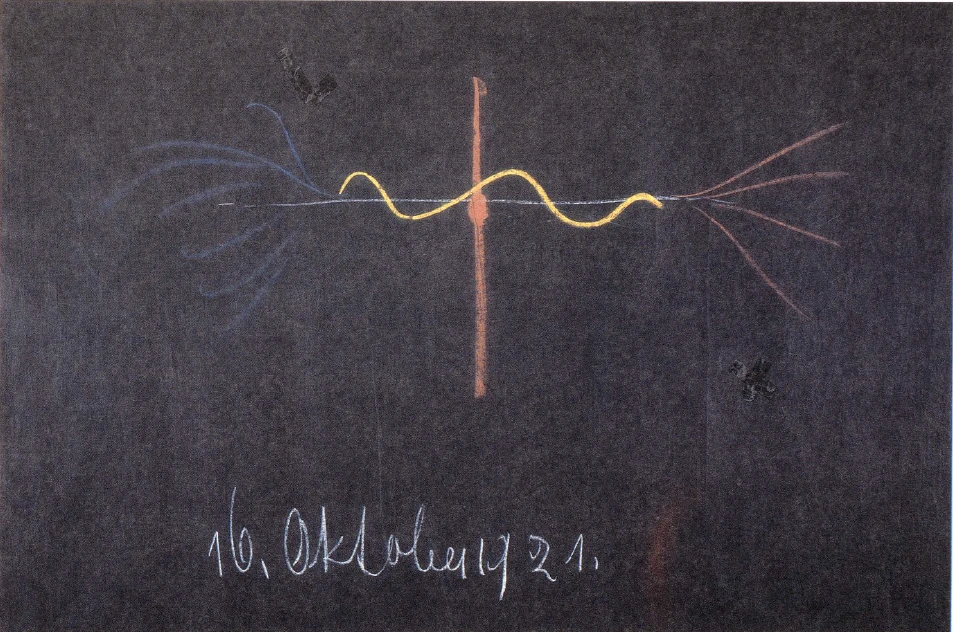
[ 10 ] Whether we consider humanity in general or the initiates and the mysteries of earlier times, the entire worldview was oriented differently than it is today. If one stops at what humanity has been able to recognize since the mid-15th century through the kind of knowledge that has emerged since then—if one points this out—one finds that humanity forms ideas about the Earth’s evolution and about the evolution of its own human species; but such conceptions—which could point in any satisfactory way to the beginning and end of the Earth—vanish from view. One might say that human beings can survey a certain line of development. They look back historically; they look back geologically. But when they go further back, they formulate hypotheses. They place the primordial nebula at the beginning (drawing $, p. 179, light horizontal line), which appears to be a physical entity. From this then develop—that is to say, it does not actually develop, but people imagine that it does—the higher beings of the natural kingdoms: plants, animals, and so on. Then, in turn, humans imagine the future based on current physical concepts: Ultimately, earthly existence will succumb to heat death (drawing with red lines on the right)—again, a hypothesis. Thus, humans perceive, so to speak, a segment between the beginning and the end. The beginning and the end blur into unsatisfactory constructs in the eyes of modern humanity.
[ 11 ] This was not the case in earlier times. In earlier times, people had very precise ideas about the beginning and end of the Earth, precisely because of that manifestation of the divine-spiritual in the light. We can look to the Old Testament; we can look to other religious teachings of the ancients: In the Old Testament, we find concepts developed specifically regarding the beginning of the world—in the manner in which such concepts could be conveyed at that time—so that human beings could understand their own existence on Earth through these concepts. No one can now comprehend human existence on Earth based on the Kant-Laplacean primordial nebula.
[ 12 ] If you consider the wonderful cosmogonies of the various pagan peoples, you have, once again, something from which human beings can understand their earthly existence. Humanity thus turned its gaze to the beginning of the Earth and was able to arrive at concepts that encompassed it. The ideas that then existed about the end of the Earth persisted even longer in people’s consciousness. We still see, for example, in Michelangelo’s “Last Judgment” and in other depictions of the “Last Judgment” right up to the present day, conceptions of the end of the world that thoroughly encompass human beings—conceptions that, no matter how difficult the ideas of guilt and atonement may be, do not destroy humanity.
[ 13 ] Let us consider today’s hypothetical conception of the end of the Earth: everything has been consumed by uniform heat. The entire human being has melted away. There is no place for humanity there. In addition to the fact that divine-spiritual being has vanished from the realm of perception, humanity has, over the course of time, lost those conceptions of the beginning and end of the Earth within which it can find its place, within which it can see itself in the cosmos in relation to the beginning and end of the Earth.
[ 14 ] What, then, was history for these people, in whatever form they may have conceived it? History was that which unfolded between the beginning and the end of the earth, and which acquired meaning through their conceptions of the beginning and the end of the earth. Take any pagan cosmology, and you can imagine the historical development of humanity. You go back to times when the earthly merges into a divine-spiritual weaving. History has meaning. Even looking forward, toward the end of the Earth, history has meaning. While the idea of the end of the Earth has remained more intact for vivid visualization and religious sentiment right up to modern times, the concept of the beginning of the Earth has, in a certain sense, persisted like a straggler in historical reflection right up to the present day. Even in such enlightened historical works as Rotteck’s World History, you can still find the lingering influence of this conception of the beginning of the Earth, which gives history a meaning. Even if it is now only a shadow of the beginning of the Earth in Rotteck’s World History—which, after all, was written at the beginning of the 19th century—it still lends meaning to historical development. This is what is significant and peculiar: that at the very same time when humanity enters a world of perception based on appearance—in which external nature thus appears to human perception as mere appearance—history loses its meaning for immediate human knowledge due to the absence of a beginning and an end to the Earth.
[ 15 ] Just take this matter completely seriously. Imagine, at the beginning of Earth’s evolution, a primordial nebula from which first indefinite forms emerge, then all beings, culminating in humankind; and imagine, at the end of Earth’s existence, the heat death, in which everything perishes, and in between, what we recount—for my sake—about Moses, the ancient Chinese sages, the ancient Indian, Persian, and Egyptian sages, extending beyond Greece and Rome, all the way to our own times, to which we add in our thoughts whatever might yet come—it all unfolds on Earth like an episode without a beginning or an end. History seems meaningless.
[ 16 ] One must simply bring this to mind. Nature can be grasped, even if not in its innermost essence. It appears to humans as an illusion as they experience it between birth and death. History becomes meaningless. And people today simply lack the courage to admit to themselves that history is meaningless—meaningless precisely because they have forgotten the beginning and the end of the earth. People today should actually perceive the greatest mystery in the historical development of humanity. They should say to themselves: This historical development is meaningless.
[ 17 ] Some individuals have sensed this. If you read what Schopenhauer wrote about the meaninglessness of history from the perspective of Western belief, you will see that Schopenhauer certainly felt this meaninglessness. The desire must arise to rediscover the meaning of history in a different way. From the world—which we can find sufficient for the understanding of nature—from the world of appearances, from it we can form a satisfying understanding of nature, precisely in the Goethean sense, if we refrain from hypotheses and remain within phenomenology, that is, the study of appearances. There can be satisfaction in the study of nature if we only refrain from disruptive hypotheses about the beginning and end of the Earth. But then we are, so to speak, locked inside our “cave”; we cannot see out. The Kant-Laplace theory and the heat death of the universe block our view into the vastness of the temporal universe.
[ 18 ] Essentially, this is the situation in which, according to common perception, humanity currently finds itself. Consequently, it faces a certain danger. It cannot quite settle into the mere world of phenomena, the world of appearances. Above all, it cannot integrate its inner life into this world of appearances. It wants to surrender to necessity—inner necessity—to instincts, drives, and passions. After all, we see little today of what arises from the free impulsiveness of pure thought. But just as much as human beings lack freedom here in life between birth and death, just as much does a lack of freedom—a compulsion of necessity in perception—come upon them through the hypnotic compulsion between death and new birth. Thus, human beings face the danger of passing through the gate of death, unable to take their own being with them, yet—as far as the world of perception is concerned—failing to settle into something free, but rather into something that submerges them in conditions of compulsion, something that causes them to become as if frozen in the external world.
[ 19 ] What must take hold in the life of humanity as we look toward the future is that the divine-spiritual will appear to human beings in a different way than it did in ancient times. In ancient times, human beings could conceive of a spiritual reality within the physical realm—at the beginning and end of the Earth—with which they could feel at one, a reality that did not exclude them. But more and more, however, human beings must take in from the center of this spiritualized existence, rather than from the beginning and the end (see drawing, vertical line in the center). And just as the Old Testament viewed the beginning of the Earth as a Genesis of humanity, within which human existence was secured, and just as pagan cosmogonies depicted humanity’s development out of a divine spiritual existence; just as one has a glimpse of the end of the Earth, which has been preserved, as mentioned, in the conceptions of the end of the world—which do not deprive humanity of its existence before itself—so must one find, in modern times, within a correct understanding of the Mystery of Golgotha as the midpoint of Earth’s development, that point where the divine and the earthly are once again seen as intertwined. Humanity must truly understand how God passed through humanity with the Mystery of Golgotha. Then what was lost to them regarding the beginning and end of the Earth will be restored to them. But there is a fundamental difference between this view of the Mystery of Golgotha and the earlier view of the beginning and end of the Earth.
[ 20 ] Just try to imagine how a pagan cosmogony came into being. Today, however, there is a widespread notion that these pagan cosmogonies are mere fabrications of the peoples. The idea is that just as people today freely link their thoughts together and then tear them apart again, so too did people in the past spin out their cosmogonies. But this is merely a misguided academic view and has nothing to do with reason. The point is that human beings were so deeply immersed in their worldview that they could not help but view the beginning of the world in the way it was presented to them in cosmogony and in myths. There was no freedom in this; it was quite simply something that arose for humanity out of necessity. Humanity had to look into the beginning of the Earth; it could not do otherwise, it could not refrain from doing so. Today, we can no longer truly imagine how humanity, through an instinctive capacity for knowledge, held the beginning of the Earth—and, in a certain sense, also its end—before its soul.
[ 21 ] Thus, people today cannot simply present the Mystery of Golgotha to their souls. This is the great difference between Christianity and the ancient religious teachings. If a person wants to find Christ, they must find him in freedom. They must freely profess their belief in the Mystery of Golgotha. The content of the cosmogonies was imposed upon people. The Mystery of Golgotha is not imposed upon people. They must approach the Mystery of Golgotha in freedom, through a certain resurrection of their being.
[ 22 ] Human beings are led to such freedom through what I have referred to in recent days as the “activity of cognition” in anthroposophical spiritual science. If a pastor believes he can receive the “Akashic Records” in a “deluxe illustrated edition,” that is, if he believes he can receive it in such a way that he need not exert himself in inner activity to transform what must first appear to his soul as concepts into images, then he shows that he, this pastor, is predisposed only toward a pagan understanding of the world, not a Christian one; for a person must come to Christ in inner freedom. Just as a person must confront the Mystery of Golgotha, so too does this belong to the most intimate means of his education toward freedom.
[ 23 ] In a sense, simply by experiencing the Mystery of Golgotha correctly, a person is torn away from the world. What happens then? First: A person can now live in a world of illusory perception, for within this world of illusory perception something stirs that leads them to a spiritual existence—the spiritual existence guaranteed by the Mystery of Golgotha. That is one thing. The other, however, is: History has ceased to have meaning because its beginning and end have been removed; it regains meaning because this meaning is imparted to it from the center. One learns to recognize how everything that lies before the Mystery of Golgotha tends toward and points to the Mystery of Golgotha, and how everything that lies after the Mystery of Golgotha emanates from this Mystery of Golgotha. History regains its meaning, whereas otherwise it is a mere illusion without beginning or end. Because the external world of perception appears to human beings as an illusory world due to their freedom, history—which is not permitted to do so—becomes an illusion; it stands there without a focal point. It dissolves into mist and fog, which, in essence, it had already done theoretically in Schopenhauer’s thought. Through a turning toward the Mystery of Golgotha, what is otherwise historical illusion gains inner life, a historical soul—one that is connected to everything human beings need in the modern age, things they need because they depend on their lives developing in freedom. When he passes through the gate of death, he will have developed here the great lesson of freedom and made the unfolding of freedom his own. The commitment to the Mystery of Golgotha casts into life the light that must pour forth over all that is free within the human being. And human beings have the opportunity to save themselves from the danger of appearing to possess the predisposition for freedom here on earth, yet failing to develop that freedom because they surrender to their instincts and drives, and thus fall prey to necessity after death. By now making his own a religious commitment that is of an entirely different nature than the older religious commitments—by allowing a religious commitment that lives solely in freedom to fill his entire soul—he transforms himself into one who experiences freedom.
[ 24 ] For this is what, in essence, only a few people in today’s civilization have come to realize: that only knowledge gained in freedom, knowledge gained through active engagement, can lead to Christ, to the Mystery of Golgotha. The historical message of the Bible was given to humanity so that, during a time when they were not yet open to spiritual science, they might receive an account of the Mystery of Golgotha.
[ 25 ] Certainly, the Gospel will never lose its value. It will take on ever greater significance, but the Gospel must be complemented by a direct understanding of the essence of the Mystery of Golgotha. Christ must also be able to be recognized, felt, and experienced through human power alone—not merely through the power emanating from the Gospels. This is precisely what spiritual science strives to achieve for Christianity. Spiritual science attempts to explain the Gospels. However, it is not based on the Gospels. Nor does it draw conclusions from the Gospels. It arrives at its high regard for the Gospels precisely because it discovers, as it were, in retrospect, all that is contained within them—and which, in essence, has already been lost to the external development of humanity.
[ 26 ] Thus, the entire recent development of humanity is linked, on the one hand, to freedom and the illusion of perception, and on the other hand, to the Mystery of Golgotha and the meaning of historical development. This sequence of various episodes, as we come to know it today in the conventional historical narrative, only gains true significance when the Mystery of Golgotha can be placed within the context of historical development.
[ 27 ] Many people did indeed perceive this in the right way, and they used the right image to describe it. They said to themselves: People once looked out into the vastness of the heavens; they saw the sun, but they did not see it as it is seen today, so that there are physicists who believe that a large ball of gas is floating out there in the universe. I have often said: Physicists would be very astonished if they could build a world balloon—and where they suspect a large ball of gas, they would find negative space that would carry them in an instant not merely into nothingness, but beyond nothingness, far beyond the sphere of nothingness. What is being developed today in materialistic cosmologies is pure fantasy. That is not how people imagined it in earlier times: the sun—a ball of gas floating out there—but rather, the sun was a spiritual being. That is what it still is for the true world-viewer today: a spiritual being that manifests itself outwardly only in the way the eye can perceive the sun. And ancient humanity perceived this central spiritual being as one with Christ. Ancient humanity pointed to the sun when speaking of Christ.
[ 28 ] Modern humanity must not now point away from the Earth, but toward the Earth; when it speaks of the Christ, it must seek the Sun within the human being, in Golgotha. The recognition of the sun as a spiritual being was precisely linked to a conception of the Earth’s beginning and end that was accessible to human understanding. With the conception of Jesus, in whom the Christ dwelt, a conception of the center of the Earth that is both accessible to human understanding and worthy of human dignity becomes possible; and from there, a radiance will extend toward the beginning and the end, which in turn causes the entire cosmos to appear in such a way that there is a place for the human being within it. We must therefore strive toward a time in which hypotheses about the beginning and end of the Earth are not constructed from materialistic, scientific conceptions, but rather a time in which we proceed from the knowledge of the Mystery of Golgotha, and from this foundation also survey the cosmic process of becoming. Through the outwardly shining sun, ancient humanity sensed the otherworldly Christ. Through the correct understanding of the Mystery of Golgotha, humanity beholds, within the historical unfolding of the Earth, the sun of this earthly unfolding through Christ. It shines so brightly out there in the world; it shines so brightly in history—physically out there, spiritually in history: the sun there, the sun here.
[ 29 ] From the perspective of freedom, this is the path to the mystery of Golgotha. Modern humanity must find this path if it wishes to move beyond the forces of decline and enter into the forces of ascent.
[ 30 ] This must be understood very deeply and thoroughly. And this understanding will not be merely abstract or theoretical; it will be one that fills the whole human being—an understanding to be felt and experienced through emotion. Christianity, as anthroposophy must speak of it, will be more than merely looking to Christ; it will be a state of being filled with Christ.
[ 31 ] People are always eager to know the difference between what was practiced as “older Theosophy” and Anthroposophy. Isn’t this difference obvious? Older Theosophy was simply a rehash of pagan cosmology. Throughout theosophical literature, you will find this rehashed pagan cosmology, which is unsuitable for modern people; it does speak to them of the beginning and end of the Earth, but that is no longer relevant to them. And what is missing from these writings? It is precisely these writings of older Theosophy that lack the center; the Mystery of Golgotha is missing from them entirely. And they lack it more fundamentally than even the external natural sciences do.
[ 32 ] Anthroposophy has a continuous cosmology that does not erase the Mystery of Golgotha, but rather incorporates it, so that it is contained within it. And all development—back to the Saturnic era and forward to the Vulcanic era—is viewed in such a way that the light for this vision radiates from the understanding of the Mystery of Golgotha. One need only have the good will to acknowledge such a fundamental contrast; then one will have no doubt whatsoever about the difference between older “theosophy” and anthroposophy.
[ 33 ] And if, in particular, so-called Christian theologians repeatedly lump anthroposophy and theosophy together, it is simply because these Christian theologians do not understand much about Christianity. It is, after all, deeply significant that Nietzsche’s friend, the truly eminent Basel theologian Overbeck, wrote his book on the Christian character of modern theology, seeking to demonstrate that modern theology—including Christian theology—is, in fact, no longer Christian. So one can say: Even external scholarship has already pointed out that modern Christian theology understands nothing of Christianity and knows nothing about it.
[ 34 ] One should just take a moment to thoroughly recognize everything that is unchristian. Modern theology, in any case, does not belong to the Christian tradition, but to the unchristian one. But out of convenience, people would like to wipe these things from their awareness. Yet they must not be wiped away, for the more that is wiped away, the more human beings lose the ability to truly experience Christianity from within. This must be experienced—it must be experienced—because it is the opposite pole to the experience of freedom that must emerge. Freedom alone, however—and it must be experienced—would lead a person into the abyss. The only guide across this abyss can be the Mystery of Golgotha.
[ 35 ] More on that next time.