Anthroposophy as Cosmosophy I
GA 208
13 November 1921, Dornach
Translate the original German text into any language:
Versions Available:
Anthroposophy as Cosmosophy II, tr. SOL
Zweiundzwanzigster Vortrag
Twenty-second Lecture
[ 1 ] Gestern haben wir das Hauptaugenmerk darauf gerichtet, wie der astralische Leib des Menschen und das Ich sich verhalten in dem Zustande zwischen dem Einschlafen und dem Aufwachen, und wir wollen noch einmal an dieses anknüpfen. Ich sagte, wenn wir dem Menschen, wie er im schlafenden Zustande als physischer Leib und Ätherleib ist, gegenüberstellen wollen sein Ich und seinen astralischen Leib, so müssen wir sagen: Das willensbegabte Ich, das willensmäßige Ich, das wird durch das Verhältnis, in das es kommt zu den Wesen der geistigen Welt während des Schlafes, gestaltet. - Also, wenn wir schematisch zeichnen: wir bekommen eine Gestaltung des Ich. Und ich sagte: Wenn man diese furchige Gestaltung des Ich (siehe Zeichnung Seite 197, hell) als eine Art Negativ betrachtet, wie man es in der Photographie hat - allerdings, auf die Größenverhältnisse darf man dabei nicht Rücksicht nehmen -, so würde die Gestaltung des menschlichen physischen Gehirns wie das Positiv sein. Den astralischen Leib, ihn müßten wir uns tingiert mit dem Seelischen der Umwelt denken, was ich schematisch dadurch ausdrücke, daß ich ihn in verschiedener Färbung zeichne (siehe, rosa, rötlich, gelb, lila).
[ 1 ] Yesterday we focused on how the human astral body and the “I” behave in the state between falling asleep and waking up, and we would like to pick up on this again. I said that if we wish to contrast the human being—as he exists in the sleeping state as a physical body and an etheric body—with his “I” and his astral body, we must say: The “I” endowed with will, the volitional “I,” is shaped by the relationship it enters into with the beings of the spiritual world during sleep. - So, if we draw a schematic diagram, we obtain a configuration of the “I.” And I said: If one regards this furrowed configuration of the “I” (see drawing on page 197, light-colored) as a kind of negative, as one has in photography—though, of course, one must not take the proportions into account here—then the configuration of the human physical brain would be like the positive. As for the astral body, we must conceive of it as imbued with the soul elements of the environment, which I express schematically by drawing it in various colors (see: pink, reddish, yellow, purple).
[ 2 ] Nun sagte ich gestern, daß damit ja noch nicht das Verhalten des physischen Leibes und des ätherischen Leibes im Schlafe besprochen ist, und wir haben das gestern weggelassen.Wir wollen das heute hinzufügen. Der physische Leib des Menschen, er ist ja scheinbar der äußeren Wissenschaft bekannt, aber eben wirklich nur scheinbar. Denn diese äußere Wissenschaft berücksichtigt wenig, wie gründlich verschieden der Gliedmaßen-Stoffwechselmensch und der Hauptesmensch sind. Der Hauptesmensch, der Kopfmensch, er ist nach seiner physischen Konstitution so, daß er eigentlich ein Nachbild ist dessen, was der Mensch während der Zeit zwischen dem Tod und einer neuen Geburt ist. Wiederum können dabei Größenverhältnisse nicht in Betracht kommen.
[ 2 ] Now, I said yesterday that this does not yet address the behavior of the physical body and the etheric body during sleep, and we left that out yesterday. Let us add that today. The human physical body is, after all, seemingly known to external science, but only seemingly so. For this external science pays little attention to how fundamentally different the “limb-metabolism human” and the “head human” are. The “head human,” the head-human, is, according to its physical constitution, actually a reflection of what the human being is during the time between death and a new birth. Again, proportions cannot be taken into account here.
[ 3 ] Das physische Gehirn, man betrachtet es ja heute in der Wissenschaft so, als ob es in seinem Bau nur ein Ergebnis der väterlichen und mütterlichen Organisation sei. Aber wir haben aus verschiedenen Betrachtungen, die wir angestellt haben, ja schon gesehen, daß das nicht den Tatsachen entspricht. Was beim Werden des Menschen hier in der physischen Welt vor sich geht, das besteht, wenn man es etwas grob und radikal ausspricht, darin, daß im mütterlichen Leibe eigentlich zunächst die Substanz ins Chaos geworfen wird und daß dieser chaotischen Substanz, die verlassen hat die Gesetzmäßigkeit sowohl des Chemischen wie des Physischen, eingepflanzt werden aus dem Universum heraus die Kräfte, welche den Embryo konstituieren. Und in diesen Kräften, die aus dem Universum heraus im mütterlichen Leibe gestaltend wirken, in denen befinden sich ja auch eingeimpft, möchte ich sagen, die Kräfte, die der Mensch selber mitbringt, nachdem er die Zeit durchlaufen hat zwischen dem Tod und einer neuen Geburt. Man möchte eigentlich sagen: Der Mensch wird selbst seiner Form nach dem mütterlichen Leib eingepflanzt. Im mütterlichen Leib wird nur das Bett für den Menschen geformt, und es ist eben im Universum so eingerichtet, daß da, wo eine Gelegenheit geschaffen wird, daß etwas Bestimmtes entstehen kann, dann dieses Bestimmte entsteht.
[ 3 ] The physical brain—as science views it today—is regarded as if its structure were merely the result of the paternal and maternal organizations. But we have already seen from various observations we have made that this does not correspond to the facts. What takes place during the development of the human being here in the physical world consists—to put it somewhat crudely and radically—in the fact that, within the mother’s body, the substance is initially thrown into chaos, and that into this chaotic substance—which has abandoned the laws of both chemistry and physics—forces from the universe are implanted, forces that constitute the embryo. And within these forces, which act formatively from the universe into the mother’s womb, there are also—I would say—implanted the forces that the human being brings with them after having passed through the time between death and a new birth. One might actually say: The human being is itself implanted into the mother’s womb in accordance with its own form. In the mother’s womb, only the bed for the human being is formed, and it is precisely arranged in the universe in such a way that where an opportunity is created for something specific to come into being, that specific thing does indeed come into being.
[ 4 ] Nun ist das menschliche Haupt innerlich so geformt, daß es erstens eine Nachbildung ist von dem, was sich hier gefurcht und tingiert hat im vorigen Erdenleben, daß aber in diesem Haupt auch ausgeprägt ist, man kann sagen, das ganze Universum. Den Erkenntnisvorgang begreift eigentlich die heutige Wissenschaft sehr schlecht, denn er ist so zu fassen, daß man sagt: In diesem menschlichen, kompliziert gebauten Gehirn, ist eigentlich durchaus eine Nachbildung des Universums vorhanden. Und was da drinnen an Formen auftritt, das ist so, daß es nicht durchdrungen werden kann von dem Ich und von dem astralischen Leibe. Die leben frei, wie ich in früheren Betrachtungen ausgeführt habe, in dem menschlichen Haupte. Darum weiß sich der Mensch gerade als Ich und astralischer Leib, weil diese frei leben. Nur mit dem Gliedmaßen-Stoffwechselmenschen können sich Ich und astralischer Leib wirklich verbinden, wie wir gesehen haben. Da wuchern sie drinnen und machen ihn vorzugsweise zu einem Willenswesen, wie wir ja auch wissen. Dadurch aber lebt in dem Gliedmaßen-Stoffwechselmenschen vorzugsweise das, was durch den Tod wiederum hinaustritt in die geistige Welt, die den Menschen seinem Ich und seinem astralischen Leib nach aufnimmt und zu weiteren Daseinsstufen trägt, während in dem Haupt des Menschen alles das vorhanden ist, was aus den früheren Leben und Leben zwischen Tod und neuer Geburt herkommt und sich gewissermaßen dieser Hauptesorganisation eingeformt und in sie eingelebt hat. Das Haupt des Menschen weist nach rückwärts, der Gliedmaßen-Stoffwechselmensch weist nach vorwärts und der rhythmische Mensch ist eben das Hinundherpendeln zwischen Vergangenheit und Zukunft.
[ 4 ] Now, the human head is internally structured in such a way that, first of all, it is a replica of what was imprinted and colored here in the previous earthly life; but the entire universe, so to speak, is also imprinted within this head. Modern science actually has a very poor understanding of the process of cognition, for it must be understood in this way: Within this human brain, with its complex structure, there is in fact a complete replica of the universe. And the forms that appear there cannot be penetrated by the “I” or by the astral body. As I have explained in earlier reflections, they live freely within the human head. This is why the human being is aware of itself specifically as the “I” and the astral body—because these live freely. Only with the metabolic human of the limbs can the “I” and the astral body truly unite, as we have seen. There they proliferate within and transform him primarily into a being of will, as we well know. Consequently, however, what lives primarily in the human being of limb metabolism is that which, upon death, steps out once more into the spiritual world—a world that receives the human being through his “I” and his astral body and carries him on to further stages of existence— while in the human head is present everything that comes from previous lives and from the lives between death and rebirth, and which has, so to speak, taken shape within this head organization and become part of it. The human head points backward, the limb-metabolic human points forward, and the rhythmic human is precisely this oscillation back and forth between the past and the future.
[ 5 ] Erst wenn man in dieser Weise auch den physischen Menschen versteht, wird man den Bau der Glieder, wird man das innere Leben der Glieder verstehen. Man wird verstehen, warum die Hauptesorganisation des Menschen eigentlich eine absteigende, eine sich fortwährend ablähmende ist, währenddem die Gliedmaßen-Stoffwechselorganisation eine sich fortwährend aufbauende ist. Man wird auch verstehen, warum die Gliedmaßen-Stoffwechselorganisation mit der chemisch-physikalischen Beschaffenheit der Erde zusammenhängen muß, welcher Zusammenhang sich ja durch die Ernährung ausdrückt.
[ 5 ] Only when one understands the physical human being in this way will one understand the structure of the limbs and the inner life of the limbs. One will understand why the human head’s metabolic organization is actually a descending one, one that is continually weakening, whereas the metabolic organization of the limbs is one that is continually building itself up. One will also understand why the metabolic organization of the limbs must be connected to the chemical and physical nature of the earth—a connection that is, after all, expressed through nutrition.
[ 6 ] Nun, dieser Gliedmaßen-Stoffwechselmensch, der nimmt eigentlich das auf, was darauf angewiesen ist, sich weiterzubilden. Während des wachen Lebens ist aber der Gliedmaßen-Stoffwechselmensch im Grunde genommen sehr darauf angewiesen, mit den Kräften, die von der Erde selbst ausgehen, zu rechnen. Der Gliedmaßen-Stoffwechselmensch ist der Schwere der Erde unterworfen; er ist den anderen Kräften der Erde unterworfen. Er ist denjenigen Kräften unterworfen, die ausgehen von seinen Nahrungsmitteln und ihn durchdringen. Er ist gewissermaßen durchaus ein Erdenwesen. Und weil der Gliedmaßen-Stoffwechselmensch seiner Formung nach nicht teilgenommen hat an dem, was der Mensch durchlebt hat zwischen dem Tod und einer neuen Geburt vor dem gegenwärtigen Erdendasein, dadurch ist dieser Gliedmaßen-Stoffwechselmensch auch während des wachen Lebens nicht fähig, sich dem äußeren geistigen Universum anzupassen. Er ist gewissermaßen der Physis der Erde hingegeben während des wachen Zustandes.
[ 6 ] Well, this “limb-metabolism human” actually absorbs what is necessary for its further development. During waking life, however, the “limb-metabolism human” is, in essence, very much dependent on the forces that emanate from the Earth itself. The limb-metabolism human is subject to the Earth’s gravity; he is subject to the Earth’s other forces. He is subject to the forces that emanate from his food and permeate him. In a sense, he is thoroughly an Earth being. And because the limb-metabolism human, by virtue of his formation, did not participate in what the human being experienced between death and a new birth prior to the present earthly existence, this limb-metabolism human is therefore unable to adapt to the outer spiritual universe even during waking life. He is, so to speak, devoted to the physical nature of the Earth during the waking state.
[ 7 ] Das ist aber im Schlafe nicht so. Denn im Haupte des Menschen ist ja alles das gebildet, was mit der Vergangenheit des Menschen, auch mit dem Leben zwischen dem Tod und der Geburt zusammenhängt. In diesem Haupte des Menschen sind, wie ich eben auseinandergesetzt habe, in den Formen der Organe auf eine leise, flüchtige Weise Bilder des ganzen Kosmos enthalten.
[ 7 ] But this is not the case during sleep. For everything connected to a person’s past—including life between death and birth—is formed within the human head. As I have just explained, this human head contains, in the forms of the organs, in a subtle, fleeting way, images of the entire cosmos.
[ 8 ] Das alles, was das Haupt des Menschen als ein Abbild des Universums ist, kann während des wachen Zustandes nicht auf den Gliedmaßen-Stoffwechselmenschen wirken. Das Haupt des Menschen ist ja als der Sitz der eminentesten Sinnesorgane in fortwährender Korrespondenz mit der äußeren irdischen Welt. Es wirkt durch das Haupt während des Wachens alles das ein, was gesehen, was gehört wird. Während des Schlafes ist es nicht etwa so, daß das menschliche Haupt nur auf eine physische Weise ernährt wird; das geschieht im Grunde genommen auch während des Wachens. Das ist gar nicht das Wesentliche für den physischen Leib während des Schlafes, sondern für den physischen Leib des Menschen während des Schlafes ist etwas ganz anderes die Hauptsache.
[ 8 ] Everything that the human head represents as a reflection of the universe cannot affect the metabolic being of the limbs during the waking state. For the human head, as the seat of the most eminent sense organs, is in constant correspondence with the external earthly world. Everything that is seen and heard is taken in through the head during wakefulness. During sleep, it is not merely the case that the human head is nourished in a physical sense; this, in fact, also occurs during wakefulness. That is not at all the essential aspect for the physical body during sleep; rather, something entirely different is of primary importance for the human physical body during sleep.
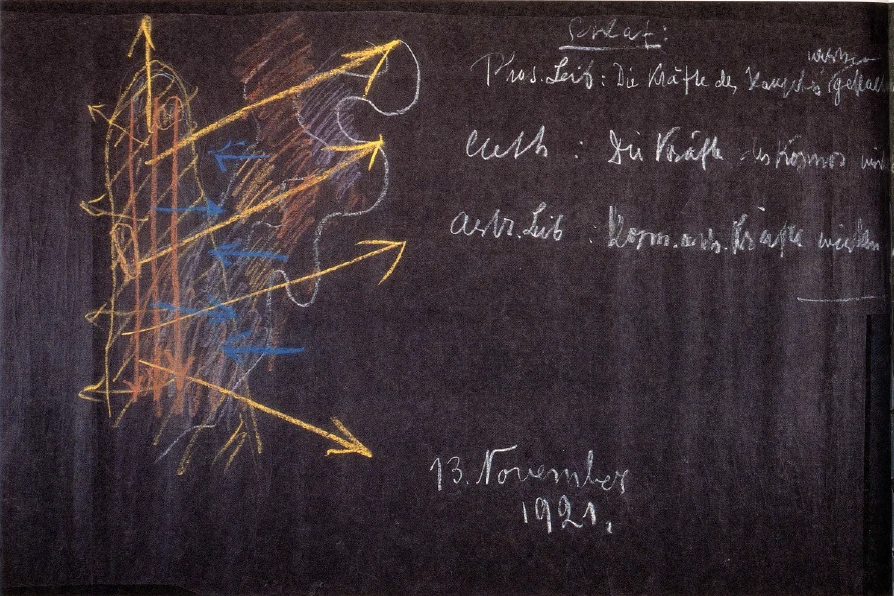
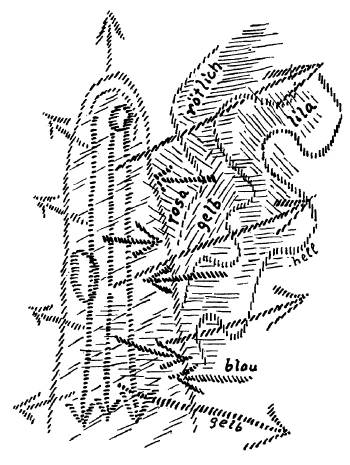
[ 9 ] Wir haben, sagen wir zum Beispiel in dem Auge nicht nur diejenige Organisation, welche das Sehen vermittelt, sondern wir haben im Auge zu gleicher Zeit ein Abbild des Kosmos, der geistigen Kräfte des Kosmos. Der Mensch hat in der Zeit vom Tode bis zu der Geburt gelebt im geistig-seelischen Kosmos. Die Organisation des Auges ist nachgebildet diesem Leben im geistig-seelischen Kosmos. Das Auge hat, so wie alle Organe des Hauptes, eine doppelte Aufgabe: erstens die Korrespondenz mit der Außenwelt durch das Sehen zu vermitteln. Das geschieht während des wachen Lebens. Während des Schlafeslebens wirkt das Auge mit seiner Umgebung, namentlich mit seiner Nerven- und Blutumgebung zurück auf den physischen Organismus, insofern dieser der Stoffwechsel-Gliedmaßenorganismus ist, und es wirken zum Beispiel während des Schlafes die Kräfte des geschlossenen Auges auf das Nierensystem des Menschen und prägen dem Nierensystem das kosmische Bild ein. Andere Organe des Hauptes prägen anderes aus dem Kosmos dem menschlichen Stoffwechsel-Gliedmaßensystem ein. Und so haben wir für den physischen Leib unsere Schlafenszeit vor allen Dingen dazu, daß die Kräfte des Hauptes gestaltend wirken auf den Stoffwechsel-Gliedmaßenmenschen (siehe Zeichnung, rötliche Pfeile, und Schema). Gerade während des Schlafes geschieht es, Tan daß, wenn ich schematisch zeichnen will, vom Haupte fortwährend gestaltende Kräfte nach dem unteren Menschen hin strahlen, so daß tatsächlich das Haupt sich während des Schlafes zum Stoffwechsel-Gliedmaßenmenschen als der geistig-seelische Gestalter verhält.
[ 9 ] In the eye, for example, we have not only the structure that enables vision, but at the same time we have a reflection of the cosmos—of the spiritual forces of the cosmos. Between death and birth, the human being lives in the spiritual-soul cosmos. The structure of the eye is modeled after this life in the spiritual-soul cosmos. The eye, like all the organs of the head, has a dual function: first, to mediate communication with the external world through sight. This occurs during waking life. During sleep, the eye, through its surroundings—namely its nervous and circulatory systems—exerts a reciprocal influence on the physical organism, insofar as this is the metabolic-limb system; for example, during sleep, the forces of the closed eye act upon the human renal system and imprint the cosmic image upon it. Other organs of the head imprint other aspects of the cosmos onto the human metabolic-limb system. And so, for the physical body, our sleep serves above all to allow the forces of the head to act formatively upon the metabolic-limb human (see drawing, reddish arrows, and diagram). It is precisely during sleep that—to put it schematically—formative forces continuously radiate from the head toward the lower human being, so that during sleep the head actually functions as the spiritual-soul formative force for the metabolic-limb human being.
[ 10 ] Der Schöpfungsbegriff wird ganz falsch gedacht, wenn man ihn auf irgendwelche Momente konzentriert. Wir werden eigentlich fortwährend geschaffen. Wir werden jede Nacht aus dem Geiste heraus geschaffen; es wird unser Stoffwechsel-Gliedmaßensystem geformt, belebt jede Nacht aus dem Geistigen heraus.
[ 10 ] The concept of creation is completely misunderstood if one focuses it on any particular moment. We are, in fact, continually being created. Every night we are created out of the spirit; our metabolic and limb systems are formed and enlivened every night from the spiritual realm.
[ 11 ] Sie wissen ja, daß die materialistische Wissenschaft der Gegenwart eigentlich nur das Gegenteil weiß, daß nämlich die Kräfte des Stoffwechsels auf das verbrauchte Gehirn wirken. Allein, dies ist nur die eine Seite. Während diese Wirkung von unten nach oben stattfindet, findet von oben nach unten die geistige und seelische Belebung des Menschen statt. Und es ist wichtig, sich klarzumachen, daß diese geistig-seelische Belebung einer hohen Bewußtseinsstufe untersteht. Wir Menschen werden diese Bewußtseinsstufe, die notwendig ist, um jene wunderbaren Vorgänge hervorzurufen, welche da für den physischen Leib des Menschen im Schlafe geschehen, erst während der Entwickelung des Vulkanplaneten haben; denn die Bewußtseinsstufe, die dem entspricht, das ist die des Geistesmenschen. Das Bewußtsein des Geistesmenschen ist wirklich im Menschen drinnen. Es macht sich geltend im Schlafe, und es macht sich geltend in den Vorgängen, die ich eben geschildert habe. Aber der Mensch ist auf seiner gegenwärtigen Entwickelungsstufe nicht in der Lage, sich gewissermaßen so weit selbst zu erkennen, daß er unter normalen Verhältnissen dieses Weben und Wesen eines viel höheren Bewußtseinsgrades, als er ihn für seine wachen Betätigungen hat, in sich verspüren würde.
[ 11 ] As you know, contemporary materialistic science actually holds the opposite view—namely, that the forces of metabolism act upon the exhausted brain. However, this is only one side of the story. While this effect takes place from the bottom up, the spiritual and psychological revitalization of the human being occurs from the top down. And it is important to realize that this spiritual and psychological revitalization is governed by a high level of consciousness. We humans will not attain this level of consciousness—which is necessary to bring about those wondrous processes that occur within the human physical body during sleep—until the development of the volcanic planet; for the level of consciousness corresponding to this is that of the spiritual human being. The consciousness of the spiritual human being is truly within the human being. It makes itself felt during sleep, and it makes itself felt in the processes I have just described. But at his present stage of development, man is not yet able, so to speak, to recognize himself to such an extent that, under normal circumstances, he would sense within himself this interplay and essence of a much higher level of consciousness than he possesses during his waking activities.
[ 12 ] Die rechte Würdigung solcher Dinge ist schon verknüpft damit, daß der Mensch durch die Geisteswissenschaft, wie wir sie hier kennenlernen, religiös vertieft wird. Wenn der Mensch das, was er ist, durch seine Lebensbetätigung vernachlässigt, verkümmern läßt, wenn er seinem physischen Leib nicht einzupflanzen versucht, was während des Erdenlebens eingepflanzt werden kann, dann greift er zerstörend ein in etwas, in dem, ihm unbewußt für sein normales Bewußtsein, ein viel höheres Bewußtsein herrscht, als er es selber haben kann.
[ 12 ] A proper appreciation of such things is inherently linked to the fact that, through spiritual science as we come to know it here, a person’s religious life is deepened. If a person neglects what he is through his life activities, allowing it to wither away, if he does not attempt to instill in his physical body what can be instilled during earthly life, then he intervenes destructively in something in which—unbeknownst to his normal consciousness—a much higher consciousness prevails than he himself can possess.
[ 13 ] Wenn wir hinausblicken in das Universum, blicken wir nicht nur in eine Welt, vor der wir, wenn wir sie richtig verstehen, bewundernd niedersinken im Geiste, sondern wir müssen uns ebenso verhalten, wenn wir mit richtigem Verständnis in das Walten des Übermenschlichen im eigenen menschlichen Inneren hineinschauen.
[ 13 ] When we look out into the universe, we are not only gazing upon a world before which—if we understand it correctly—we bow down in awe; we must do the same when, with true understanding, we look into the workings of the superhuman within our own human selves.
[ 14 ] Damit habe ich Ihnen ungefähr angedeutet, wie es sich für den Schlafzustand verhält mit dem physischen Leib des Menschen.
[ 14 ] With this, I have given you a rough idea of how the state of sleep relates to the human physical body.
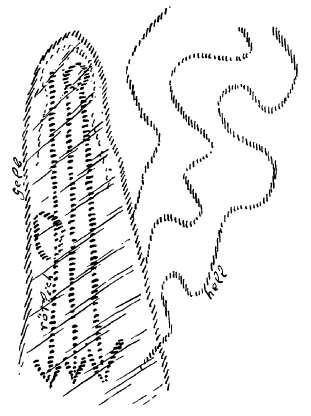
[ 15 ] Nun haben wir außer dem physischen Leib dann den Ätherleib (siehe Zeichnung Seite 197, schraffiert). Dieser Ätherleib des Menschen ist in wachem Zustande ja fortwährend den Wirkungen unterworfen, welche vom Ich, das sich in der Welt betätigt, und vom astralischen Leibe, der mit diesem Ich in Verbindung steht, ausgehen. Während des wachen Zustandes sehen wir stets die aufleuchtenden und sich abdämpfenden Farben und die anderen Tingierungen, die im astralischen Leibe stattfinden und in den Ätherleib hinüberschlagen, und wir sehen eigentlich während des Wachzustandes den Ätherleib sich anpassen an den astralischen Leib. Wir sehen aber auch das, was das Ich durch seine Gestaltung ist, hereinschlagen in den Ätherleib. Kurz, wir sehen während des wachen Zustandes ein Spielen des Ich und des astralischen Leibes im Ätherleib. Während des Schlafes, da ist der Mensch als Ich und als astralischer Leib außerhalb des Ätherleibes. Da spielt der astralische Leib mit seiner Tingierung, das Ich mit seiner Gestaltung nicht herein in den Ätherleib. Da ist der Ätherleib seiner eigenen Gestaltung überlassen. Und diese eigene Gestaltung, sie drückt sich dadurch aus, daß der Ätherleib in einer ganz großartigen Weise sich während des Schlafes gestaltet als ein Abbild des Universums.
[ 15 ] In addition to the physical body, we also have the etheric body (see illustration on page 197, hatched). This etheric body of the human being is, in the waking state, constantly subject to the influences emanating from the “I” that acts in the world and from the astral body, which is connected to this “I.” During the waking state, we constantly observe the colors brightening and fading, as well as the other colorations that take place in the astral body and spill over into the etheric body; and we actually see, during the waking state, the etheric body adapting to the astral body. But we also see what the “I” is, through its form, impacting the etheric body. In short, during the waking state we see the interplay of the “I” and the astral body within the etheric body. During sleep, the human being—as the “I” and as the astral body—is outside the etheric body. There, the astral body with its coloring and the “I” with its form do not play a role within the etheric body. There, the etheric body is left to its own form. And this form of its own is expressed in that, during sleep, the etheric body takes on a magnificent form as a reflection of the universe.
[ 16 ] Der ätherische Leib wird ja von dem Menschen seiner wesentlichen Substantialität nach aufgenommen, indem sich der Mensch aus dem vorgeburtlichen Leben hereinbegibt in das physische Erdenleben. Der ätherische Leib wird ja zusammengesetzt in dem Sinne, wie der Mensch gelebt hat zwischen dem 'Tod und einer neuen Geburt. Und alles, was da aus dem Universum heraus, wie symbolisch die Geisteswissenschaft sagt: was da der Mensch aus Nord, Süd, Ost, West in sich aufgenommen hat von den Himmeln, das trägt der ätherische Leib in sich. Er kann es nur aus dem angegebenen Grunde während des Wachzustandes nicht zeigen. Er zeigt es während des Schlafzustandes. Da ist der Mensch eigentlich ganz Erinnerung, Erinnerung zunächst an das Erdenleben.
[ 16 ] The etheric body is, in fact, taken up by the human being in its essential substance as the human being moves from prenatal life into physical life on Earth. The etheric body is, in fact, composed in accordance with the way the human being has lived between “death” and a new birth. And everything that comes from the universe—as spiritual science symbolically puts it: what the human being has taken in from the heavens—from the north, south, east, and west—is carried within the etheric body. For the reason stated, the human being cannot reveal this during the waking state. It is revealed during sleep. There, the human being is actually entirely memory—memory, first and foremost, of earthly life.
[ 17 ] Es kommt den Menschen ab und zu ins Bewußtsein, daß sie, indem sie in ihren ätherischen Leib untertauchen, in ein Bildermeer untertauchen, was sie dann zu den Träumen zählen. Wer aber in dieser Beziehung sich die Mühe gegeben hat, beim Aufwachen das Bildermeer zu beobachten, das der Mensch gleichsam durchmißt beim Aufwachen, wenn er beobachtet, was da erlebt wird, dann entdeckt er, wie eigentlich das ganze Erdenleben enthalten ist in diesem Ätherleib während des Schlafes. Der Mensch lebt und webt eigentlich in alledem, was er seit seiner Geburt durchgemacht hat im Ätherleib während des Schlafes. Aber alles das ist für den Ätherleib eben durchgestaltet vom Kosmos heraus, von kosmischen Kräften. Und weil jetzt nichts hereinspielt vom astralischen Leib und vom Ich, deshalb strahlt der ätherische Leib das aus, was er eingegliedert, eingeimpft erhalten hat bei seiner Geburt. Der Ätherleib des Menschen wird strahlend (siehe Zeichnung, gelbe Pfeile).
[ 17 ] From time to time, people become aware that when they sink into their etheric body, they are sinking into a sea of images, which they then classify as dreams. But anyone who has taken the trouble in this regard to observe, upon waking, the sea of images that a person traverses, as it were, upon waking—if they observe what is being experienced there—will discover how, in fact, the entire earthly life is contained within this etheric body during sleep. A person actually lives and weaves within all that they have experienced since birth in the etheric body during sleep. But all of this is shaped for the etheric body from outside by the cosmos, by cosmic forces. And because nothing now influences it from the astral body or the “I,” the etheric body radiates what it received—what was incorporated and instilled in it—at birth. The human etheric body becomes radiant (see drawing, yellow arrows).
[ 18 ] Das ist eine bedeutsame Tatsache, dieses Strahlendwerden des Menschen im Schlafzustande. Dieses Strahlendwerden des Menschen im Schlafzustande ist in der Tat etwas, was für die Erdenwelt, wenn diese in die Nacht getaucht ist nach der untergegangenen Sonne, im Gegensatz zu den physischen Strahlen der Sonne, ein seelisches Strahlen der Menschheit darstellt. Allerdings, in diesem seelischen Strahlen der Menschheit ist eingegliedert ruinierend, verkümmernd, zerstörend alles das, was die Menschen aus ihrer Schlechtigkeit heraus durch ihren astralischen Leib und durch ihr Ich dem ätherischen Leib während ihres Lebens einpflanzen. Aber die Erde würde mit ihrer Entwickelung nicht zurecht kommen, wenn dieses Erstrahlen der Menschheit nicht stattfände.
[ 18 ] This is a significant fact—the way a person begins to radiate while asleep. This radiance of the human being during sleep is, in fact, something that—for the earthly world, when it is plunged into night after the sun has set—represents a spiritual radiance of humanity, in contrast to the physical rays of the sun. However, incorporated into this spiritual radiance of humanity is everything ruinous, stunting, and destructive that human beings, out of their own wickedness, implant into the etheric body through their astral body and their “I” during their lifetime. But the Earth would not be able to cope with its evolution if this radiance of humanity did not take place.
[ 19 ] Hätte ein Beobachter dazu die nötigen Organe, und wäre er im Kosmos draußen und würde die Erde vom Kosmos aus beobachten, er würde sagen: Während des Tages sieht man auf der von der Sonne beschienenen Seite der Erde eben das zurückgestrahlte Sonnenlicht; aber wenn die Nacht sich über einen Teil der Erde lagert, dann phosphoresziert, dann leuchtet nach die Erde. — Und das, was da ein solcher Beobachter nachleuchtend finden würde, das sind die menschlichen Ätherleiber. Das alles braucht aber auch die Erde, um weiterzukommen in ihrer Entwickelung. Wenn auf der Erde keine Menschen schlafen würden, würde die vegetabile Kraft der Erde viel schneller ersterben müssen, als sie im Erdenleben eben erstirbt. Der Mensch ist durchaus nicht eingegliedert in das Erdendasein, um bloß für sich zu leben, er ist nicht bedeutungslos für die ganze Gestaltung der Erde. Was er in geistigen Welten aufnimmt zwischen dem Tod und einer neuen Geburt, das strahlt er wiederum schlafend aus seinem Ätherleibe in die Erdenentwickelung aus während seines irdischen Lebens.
[ 19 ] If an observer had the necessary senses, and if he were out in space observing the Earth from there, he would say: During the day, on the side of the Earth illuminated by the Sun, one sees precisely the sunlight reflected back; but when night falls over a part of the Earth, the Earth then phosphoresces—it glows. — And what such an observer would find glowing there are the human etheric bodies. But the Earth also needs all of this to continue its development. If no human beings were sleeping on Earth, the Earth’s vegetative power would have to die out much more quickly than it does in earthly life. Human beings are by no means integrated into earthly existence merely to live for themselves; they are not insignificant for the overall structure of the Earth. What they absorb in the spiritual worlds between death and a new birth, they in turn radiate from their etheric bodies into the Earth’s evolution while they sleep during their earthly lives.
[ 20 ] So daß wir sagen können: Für den physischen Leib ist es so, daß von oben nach unten gestrahlt wird; für den ätherischen Leib verhält es sich so, daß von innen nach außen gestrahlt wird. Das Schlafen des Menschen hat eben durchaus auch eine kosmische Bedeutung.
[ 20 ] So we can say: In the case of the physical body, the radiation flows from top to bottom; in the case of the etheric body, it flows from the inside out. Human sleep certainly has a cosmic significance as well.
[ 21 ] Deshalb mußte ich Ihnen gestern auch sagen: Wenn nun das Ich und der astralische Leib wiederum untertauchen in den Ätherleib, dann hat man die Empfindung des Herbstlichen, während man, wenn der Ätherleib frei liegt im Schlafe, die Empfindung des Frühlingshaften, Sommerlichen hat. Es ist in der Tat so, daß gewissermaßen mit dem Aus- und Eingehen des astralischen Leibes der Mensch sonnenhafter oder winterlicher wird in geistig-seelischer Beziehung.
[ 21 ] That is why I had to tell you yesterday: When the “I” and the astral body once again submerge into the etheric body, one has a sense of autumn; whereas when the etheric body lies exposed during sleep, one has a sense of spring and summer. It is indeed the case that, in a sense, as the astral body emerges and retreats, the human being becomes more sun-like or more winter-like in spiritual and soul terms.
[ 22 ] Wir können also sagen: Der ätherische Leib des Menschen ist im Schlafe so, daß die Kräfte des Kosmos, nämlich diejenigen, die der Mensch sammelt zwischen dem Tode und einer neuen Geburt, gestaltend wirken auf die Erde. Darinnen wirkt auch ein höheres Bewußtsein als das, was dem Menschen zunächst für seine wache Betätigung zur Verfügung steht. In dieser Tätigkeit, in dieser schlafenden Tätigkeit des Ätherleibes wirkt nämlich das Bewußtsein des Lebensgeistes. Es ist dasjenige Bewußtsein, zu dem der Mensch sich erst hinaufentwickeln wird, wenn unser Erdenplanet bei der Metamorphose des Venusdaseins angekommen sein wird.
[ 22 ] We can therefore say: During sleep, the human etheric body is in such a state that the forces of the cosmos—namely, those that the human being gathers between death and a new birth—have a formative effect on the Earth. Within this process, a higher consciousness is also at work than that which is initially available to the human being for their waking activities. For it is the consciousness of the life spirit that is at work in this activity—in this sleeping activity of the etheric body. It is the consciousness to which human beings will only evolve once our Earth has reached the stage of the Venusic phase in its metamorphosis.
[ 23 ] Wir sehen also: für das Ich und den astralischen Leib auf der einen Seite, für den physischen Leib und den Ätherleib auf der anderen Seite ist das Verhältnis so, daß sie im Schlafe nicht zusammenwirken, vom Aufwachen bis zum Einschlafen aber zusammenwirken. Ein Wechselverhältnis findet statt, eine Art Pendelschlag zwischen Zusammenwirken und Nichtzusammenwirken. Aber auch da ist es so, daß in dem Augenblicke, wo beim Aufwachen das Ich und der astralische Leib heranschlagen an den physischen Leib und den Ätherleib, und in dem Augenblick, wo sie beim Einschlafen wiederum sich herausziehen, daß da eine Wechselwirkung stattfindet, welche von einem Bewußtsein geregelt wird, zu dem der Mensch auch nicht mit seinem für die wache Betätigung geeigneten Bewußtsein herankommt. Der Mensch kann ja in einer gewissen indirekten Weise auf das Aufwachen und Einschlafen einen Einfluß haben. Aber jene feinen, intimen Vorgänge, die sich abspielen zwischen dem Ich und dem astralischen Leib einerseits und dem physischen und ätherischen Leib andererseits beim Einschlafen und beim Aufwachen, für diese intimeren Vorgänge hat das menschliche Bewußtsein keine Fähigkeit des Wahrnehmens.
[ 23 ] We see, then, that for the “I” and the astral body on the one hand, and for the physical body and the etheric body on the other, the relationship is such that they do not interact during sleep, but do interact from the moment of waking until falling asleep. An interplay takes place, a kind of pendulum swing between interaction and non-interaction. But here, too, it is the case that at the moment when, upon waking, the “I” and the astral body approach the physical body and the etheric body, and at the moment when they withdraw again upon falling asleep, an interaction takes place that is governed by a consciousness which the human being cannot access even with the consciousness suited to waking activity. Human beings can, of course, influence waking and falling asleep in a certain indirect way. But those subtle, intimate processes that take place between the “I” and the astral body on the one hand, and the physical and etheric bodies on the other, during falling asleep and waking—human consciousness has no capacity to perceive these more intimate processes.
[ 24 ] Ich möchte diese Wechselwirkung, die da stattfindet, durch diese gegeneinander sich bewegenden Pfeile (siehe Zeichnung Seite 200, blau) ausdrücken. In dieser Richtung, in diesem Ineinanderwirken, wie es sich namentlich ausspricht beim Aufwachen und Einschlafen, aber wie es in einer gewissen Weise doch fortdauert auch während des Wachens und sogar während des Schlafes, in diesem Durcheinanderweben astralischer und ätherischer Kräfte, da macht sich geltend, was wir nun für den astralischen Leib hauptsächlich konstatieren können. Wir können sagen: Für den Astralleib ist es ja so, daß er angeregt wird im kosmischen Sinne. Denken Sie, daß vom Einschlafen bis zum Aufwachen der astralische Leib ja durchaus seinen moralischen Empfindungen nach, wie ich gestern dargestellt habe, tingiert wird. Beim Aufwachen dringt er ein in den kosmisch gestalteten Ätherleib. Da muß er sich nach diesem richten, da muß er sich ihm anpassen. Und wir können sagen: Die kosmisch-astralischen Kräfte wirken auf die menschlich-astralischen Kräfte. Man kann das sehr gut verfolgen in einem besonderen Falle.
[ 24 ] I would like to express this interaction that takes place using these arrows moving toward and away from each other (see illustration on page 200, blue). In this direction, in this interplay—which is particularly evident when waking up and falling asleep, but which in a certain sense continues even while awake and even during sleep—in this interweaving of astral and etheric forces, what we can now primarily observe regarding the astral body comes to the fore. We can say: As for the astral body, it is stimulated in a cosmic sense. Consider that from the moment of falling asleep until waking up, the astral body is indeed colored by one’s moral feelings, as I described yesterday. Upon waking, it enters the cosmically structured etheric body. There it must align itself with it; there it must adapt to it. And we can say: The cosmic-astral forces act upon the human-astral forces. This can be traced very clearly in a particular case.
[ 25 ] Denken Sie sich, der Mensch hätte nicht durchgemacht dieses Leben zwischen dem Tod und einer neuen Geburt — wie ja das Tier es nicht durchgemacht hat —, sondern er käme so zur Welt, wie es die Aristotelische Weltanschauung fordert: Er würde ein neugeschaffenes Wesen bei seiner Geburt sein. Er brächte sich nicht die Wirkungen früherer Erdenleben und des Lebens zwischen dem Tod und einer neuen Geburt in das Leben herein. Dann würde der Mensch seinen Blick schweifen lassen, seine Sinne schweifen lassen über die äußeren Erfahrungen, aber er würde niemals diese äußeren Erfahrungen durch Begriffe, Vorstellungen der Geometrie und der Mathematik verbinden. Das ist nur ein Fall, aber es ist einer derjenigen Fälle, wo das, was für den Kosmos gilt, die Geometrie, in eine Wechselwirkung tritt mit dem, was nur für die irdische Umgebung gilt. Es wird das Irdische durchsetzt, die empirische Erfahrung wird durchsetzt von dem rationellen MathematischGeometrischen. Aber diese Wechselwirkung findet fortwährend statt, und sie findet so statt, daß darin das Geistselbst als Bewußtsein wirkt. Davon wissen natürlich die mathematischen Weltenbetrachter nichts, daß, während sie wirklich mathematisch betrachten, eigentlich immer das Geistselbst sie hinten beim Schüppel hat. Aber sie beachten das nicht, weil sie sich beschränken auf die Reflexion, die im gewöhnlichen menschlichen Bewußtsein davon vorhanden ist.
[ 25 ] Imagine that human beings had not gone through this life between death and a new birth—just as animals have not—but instead were born as the Aristotelian worldview dictates: they would be newly created beings at birth. They would not bring into their lives the effects of previous earthly lives and of the life between death and a new birth. Then human beings would let their gaze wander, let their senses wander over external experiences, but they would never connect these external experiences through concepts or ideas of geometry and mathematics. This is just one case, but it is one of those cases where what applies to the cosmos—geometry—interacts with what applies only to the earthly environment. The earthly realm is permeated; empirical experience is permeated by the rational, mathematical-geometric. But this interaction takes place continuously, and it takes place in such a way that the spiritual self acts within it as consciousness. Of course, those who view the world through mathematics know nothing of this—that while they are truly engaging in mathematical observation, the spiritual self is actually always pulling their strings behind the scenes. But they do not take this into account because they limit themselves to the reflection of it that exists in ordinary human consciousness.
[ 26 ] Dann erst, wenn der Mensch weder im Schlafe noch im Aufwachen oder Einschlafen ist, sondern wenn er voll untergetaucht ist mit seinem Ich und seinem astralischen Leib in den Ätherleib und in den physischen Leib, dann ist das gewöhnliche heutige Bewußtsein vorhanden, dann ist der Mensch nur hingegeben alldem, was heraus ist aus Geistesmenschen, Lebensgeist und Geistselbst. Wenn der Mensch angelangt sein wird auf jener Stufe des Daseins, die er haben wird, wenn die Erde die Metamorphose zum Jupiterdasein im Sinne meiner «Geheimwissenschaft im Umriß» wird durchgemacht haben, dann wird es so sein, daß der Mensch nicht mehr äußerlich durch Geometrie sich einen Würfel bilden wird und dann finden wird, daß diese ideelle Würfelform paßt auf das kristallisierte Salz, sondern er wird das als eine Einheit erblicken. Er wird so weit hingegeben sein an die äußere Welt, daß er gewissermaßen in dem Salz selber drinnen stecken wird. Es wird ein solches Salz zwar auf dem Jupiter nicht vorhanden sein, aber wir können uns durch solche Vorstellungen das Leben des Menschen in der Zukunft klarmachen.
[ 26 ] Only then—when a person is neither asleep nor awake nor falling asleep, but is fully immersed with their “I” and their astral body into the etheric body and the physical body—does the ordinary consciousness of today exist; only then is a person wholly devoted to all that emanates from the spiritual being, the life spirit, and the spiritual self. When a person has reached that stage of existence—which they will attain once the Earth has undergone its metamorphosis into a Jupiter existence, as described in my Outline of Esoteric Science, then it will be the case that human beings will no longer form a cube externally through geometry and then find that this ideal cube shape fits the crystallized salt; rather, they will perceive it as a single unity. They will be so absorbed in the external world that they will, so to speak, be immersed within the salt itself. Such salt will not, of course, exist on Jupiter, but through such conceptions we can gain a clear understanding of human life in the future.
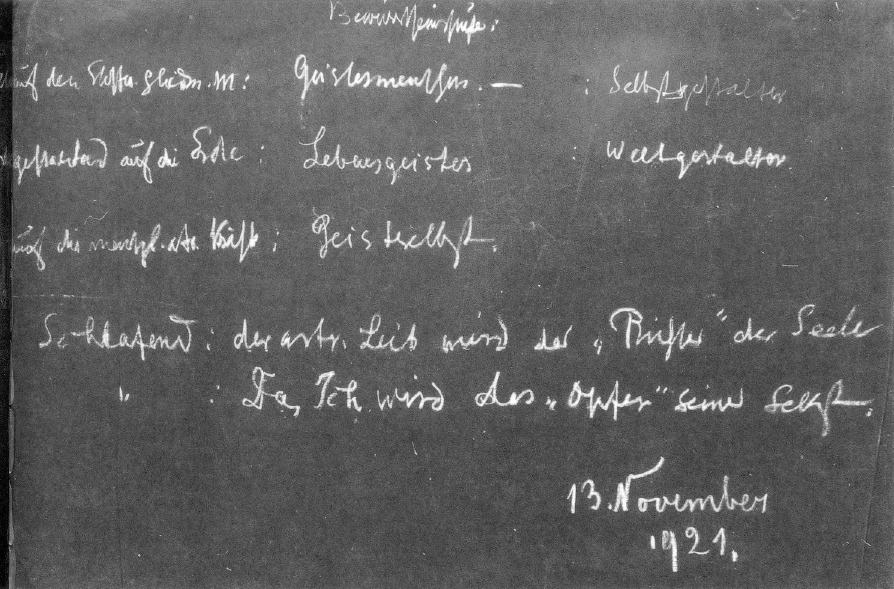
[ 27 ] So also können wir uns auch in derselben Weise, wie wir gestern den astralischen Leib und das Ich betrachtet haben, Vorstellungen darüber bilden, wie sich während des Schlafes der physische Leib und der ätherische Leib verhalten. Der physische Leib ist eigentlich während des Schlafes ein Selbstgestalter in bezug auf den Gliedmaßen-Stoffwechselmenschen, und der ätherische Leib des Menschen ist ein Weltgestalter.
[ 27 ] Thus, in the same way that we considered the astral body and the “I” yesterday, we can also form ideas about how the physical body and the etheric body behave during sleep. During sleep, the physical body actually acts as a self-shaper in relation to the human being’s limb metabolism, and the human being’s etheric body acts as a world-shaper.
[ 28 ] Wenn wir nun noch einmal zurückblicken auf das, was wir gestern betrachtet haben, so müssen wir sagen: Der astralische Leib des Menschen tritt aus dem physischen Leib und dem Ätherleib heraus während des Schlafes. In ihn strömen ein die seelischen Kräfte des Universums. Er wird von ihnen durchdrungen. Und je nachdem er seine Empfindung, seine Gemütsverfassung hat, können ihn diese Kräfte durchdringen. Wenn der Mensch sympathisiert mit dem Guten, dann werden ihn die schönsten Kräfte des Universums durchdringen können. Wenn der Mensch seine Neigungen entwickelt zum Bösen, dann wird sein astralischer Leib verkümmern. Für alle Stufen des Fühlens und Empfindens im Inneren gibt es gewisse Tingierungsnuancen, die der astralische Leib während des Schlafzustandes annimmt (siehe Zeichnung Seite 200, rötlich, gelb, rosa, lila). Man kann sagen, so wie der Mensch ist, so erfunkelt er in bezug auf seinen astralischen Leib während des Schlafzustandes. Der astralische Leib ist ja das, was während des Wachzustandes die Seelenverfassung ausmacht, die Gemütsverfassung. Diese Gemütsverfassung, die ergießt sich gewissermaßen während des Schlafzustandes in das seelische Universum, und in dieser Ergießung erlebt sich dann der Mensch, indem er seine Seelenverfassung verändert hat, aber indem er mit Bezug auf seine Seelenverfassung vor der seelisch-geistigen Welt steht.
[ 28 ] If we now look back once more at what we considered yesterday, we must say: The human astral body emerges from the physical body and the etheric body during sleep. The soul forces of the universe flow into it. It is permeated by them. And depending on a person’s feelings and state of mind, these forces can permeate the astral body. If a person sympathizes with goodness, then the most beautiful forces of the universe will be able to permeate them. If a person develops inclinations toward evil, then their astral body will wither away. For every level of inner feeling and sensation, there are certain shades of color that the astral body takes on during sleep (see illustration on page 200: reddish, yellow, pink, purple). One might say that just as a person is, so does their astral body shimmer during sleep. The astral body is, after all, what constitutes the state of the soul—the state of mind—during the waking state. This state of mind, so to speak, pours out into the spiritual universe during sleep, and in this outpouring the person experiences themselves—not by having changed their state of mind, but by standing before the spiritual-mental world in relation to their state of mind.
[ 29 ] Würde der Mensch, indem er mit seinem astralischen Leibe da hinauslebt, eindringen können in das Bewußtsein des Lebensgeistes, dann würde er sprechen können zu dem, was mit seinem astralischen Leib geschieht. Es geschieht das zunächst für den Menschen unbewußt, aber es geschieht. Wer würde denn sprechen, wenn der Mensch plötzlich schlafend das Bewußtsein des Lebensgeistes erlangte? Wer würde sprechen? Man kann da kein anderes Wort sagen als: Es würde sprechen der astralische Leib des Menschen als Richter über das Gute und Böse im Menschen. So daß man wirklich sagen muß: Schlafend wird der astralische Leib der Richter der Seele. — Es ist dieses, wenn man es richtig versteht, ein wichtiger Satz für das menschliche Leben. Es ist eine Wahrheit, die wie von jenseits der Schwelle zur geistigen Welt herüberleuchtet und die der Mensch sich möglichst oft vor seine Seele stellen sollte.
[ 29 ] If a person, by living out there with his astral body, were able to penetrate into the consciousness of the life spirit, then he would be able to speak to what is happening to his astral body. This happens, at first, unconsciously to the person, but it does happen. Who, then, would speak if a person suddenly attained the consciousness of the life spirit while asleep? Who would speak? One can say nothing else but this: The person’s astral body would speak as the judge of good and evil within the person. So that one must truly say: While asleep, the astral body becomes the judge of the soul. — If understood correctly, this is an important statement for human life. It is a truth that shines across as if from beyond the threshold to the spiritual world, and one that a person should hold before their soul as often as possible.
[ 30 ] Nehmen Sie das Entsprechende für das Ich. Das Ich tritt heraus aus dem physischen und dem Ätherleib, gestaltet sich in Gemäßheit der Kräfte der universellen Geistwesenheiten. Es wird so, wie es werden kann nach dem, wie es im physischen Leibe lebt. Würde es erwachen zum Bewußtsein des Geistesmenschen, dann würde es nicht bloß zu sich sprechen, wie der astralische Leib zu sich sprechen würde, wenn er plötzlich mit dem Bewußtsein des Lebensgeistes ausgestattet würde; sondern würde das Ich mit dem Bewußtsein ausgestattet, das in dem zurückgebliebenen physischen Leib wirkt, das die Kräfte von oben nach unten sendet in dem zurückgebliebenen physischen Leib, würde der Mensch also mit diesem Bewußtsein ausgestattet in seinem Ich, wenn es im schlafenden Zustand herausgetreten ist, dann würde der Mensch nicht nur eine Summe von Richtersprüchen über sich erleben, sondern dann schaut er, was er als Bild jetzt wird und was dann als Keim wirkt für seine folgenden Erdenleben.
[ 30 ] Take the corresponding concept for the “I.” The “I” emerges from the physical and etheric bodies and takes shape in accordance with the forces of the universal spiritual beings. It becomes what it can become, depending on how it lives within the physical body. If it were to awaken to the consciousness of the spiritual human being, it would not merely speak to itself, as the astral body would speak to itself if it were suddenly endowed with the consciousness of the life spirit; rather, the “I” would be endowed with the consciousness that is at work in the physical body left behind—the consciousness that sends the forces from above down into the physical body left behind— if the human being were thus endowed with this consciousness in his “I” when it has stepped out of the sleeping state, then the human being would not only experience a series of judgments concerning himself, but he would also see what he is now becoming as an image and what will then act as a seed for his subsequent earthly lives.
[ 31 ] Ich finde für diese Tatsache keinen anderen Ausdruck, wenn ich sie in einen Satz prägen will, als daß ich sage: Das Ich wird das Opfer seiner selbst, das Opfer des im Leibe wirkenden Geistes. — Ein Opfer kann so sein, daß es wohlgefällig aufgenommen wird; das kann auch bei dem Ich sein, indem es draußen gestaltet wird. Ein Opfer kann auch so sein, daß es verworfen wird. Das sind die äußersten, radikalsten Enden des Vorganges. Das, was der Mensch erlebt, liegt natürlich im wesentlichen in der Mitte. Aber ein Opfer kann auch verworfen werden, wenn es nicht würdig ist, geopfert zu werden. Wenn der Mensch also so erscheint vor den geistigen Wesen des Universums, daß er stark verkümmern muß durch das, was er durchlebt im physischen und im ätherischen Leibe während des Wachens, dann wird er ein verworfenes Wesen.
[ 31 ] I can find no other way to express this fact, if I am to encapsulate it in a single sentence, than to say: The “I” becomes a sacrifice of itself, a sacrifice to the Spirit at work within the body. — A sacrifice can be such that it is gratefully received; this can also be the case with the “I,” as it is shaped from the outside. A sacrifice can also be such that it is rejected. These are the most extreme, most radical outcomes of the process. What a person experiences, of course, lies essentially in the middle. But a sacrifice can also be rejected if it is not worthy of being sacrificed. Thus, if a human being appears before the spiritual beings of the universe in such a way that he must wither away severely due to what he experiences in the physical and etheric bodies during wakefulness, then he becomes a rejected being.
[ 32 ] Sie sehen also, daß der Opferbegriff durchaus angewendet werden kann für das, was da stattfindet. Und mir scheint, daß diese zwei Sätze: Schlafend wird der astralische Mensch der Richter seiner Seele —, und: Das Ich wird das Opfer seiner selbst —, daß diese zwei Sätze außerordentlich wichtig sind für das vollständige Verständnis der menschlichen Wesenheit.
[ 32 ] So you see that the concept of sacrifice can certainly be applied to what is taking place here. And it seems to me that these two statements—“While asleep, the astral human being becomes the judge of his own soul” and “The ‘I’ becomes the victim of itself”—are extraordinarily important for a complete understanding of the human being.
[ 33 ] Wenn man auf das sieht, was ältere instinktive Weistümer der Menschheit erlangt haben, nicht aus jener Klarheit des Bewußtseins heraus, aus der man heute nach anthroposophischer Geisteswissenschaft streben muß, sondern eben aus dem Instinkte heraus, dann wird man, wie ich Ihnen schon öfter angedeutet habe, Bilder bedeutsamer Urweisheit der Menschheit gewahr. Sie drücken sich aus in den Mythen, in den alten Weisheitssprüchen; sie drücken sich aber auch aus in den Kulthandlungen, die sich in den verschiedenen religiösen Systemen erhalten haben.
[ 33 ] If one looks at what humanity’s ancient instinctive wisdom has attained—not from that clarity of consciousness toward which we must strive today according to anthroposophical spiritual science, but precisely from instinct—then, as I have often hinted to you, one becomes aware of images of humanity’s significant primordial wisdom. They are expressed in myths and in ancient sayings of wisdom; but they are also expressed in the ritual practices that have been preserved in the various religious systems.
[ 34 ] Daher bekommen wir, wenn wir sie richtig verstehen, die tiefe Ehrfurcht vor den Überlieferungen von alten Religionsbildern, von alten Kultbildern. Und im Grunde genommen ist es so, daß ein lebendiges religiöses Empfinden des Menschen erst wieder kommen kann, wenn es aus der geisteswissenschaftlichen Erfassung der Welt, nicht bloß der Phrase, sondern dem tiefsten Gehalte nach, eben nicht bloß den Kopfmenschen, sondern den vollen Menschen erfaßt, indem sie ihm beibringt nicht nur Verständnis der Welt, sondern auch Ehrfurcht vor dem Walten des Geistigen in der Welt. Das haben wir ja besonders heute wieder gesehen. Diese Geisteswissenschaft wird wiederum religiöse Empfindungen des Menschen beleben können. Aber der Mensch ist auch durchgegangen — wir wissen, daß er das zum Behufe der ErJangung seiner Freiheit mußte — durch diejenige Zeit, in der er nur dem Intellektualismus, dem Rationalismus und dem damit verbundenen Materialismus gelebt hat, und der größte Teil der Menschheit lebt ja heute noch darin. Aber es muß wiederum zurückgekommen werden zum Erfassen dessen, was Geistiges in der Welt ist. Es muß wiederum gekommen werden zum Leben außerhalb des bloß intellektualistischen Erfassens der Welt, außerhalb des Erlebens des bloßen Kopfmenschen.
[ 34 ] Therefore, if we understand them correctly, we develop a deep reverence for the traditions of ancient religious images and cult images. And fundamentally, a living religious sensibility in human beings can only return when spiritual science’s understanding of the world—not merely in words, but in its deepest essence—reaches not just the intellectual mind, but the whole human being, by teaching them not only an understanding of the world, but also a sense of awe for the workings of the spiritual in the world. We have seen this once again, especially today. This spiritual science will once more be able to revive people’s religious sensibilities. But humanity has also gone through—and we know it had to do so in order to attain its freedom—a period in which it lived solely according to intellectualism, rationalism, and the materialism associated with them; and the majority of humanity still lives in that state today. But we must return once more to grasping what is spiritual in the world. We must once again come to a life beyond the merely intellectualistic understanding of the world, beyond the experience of the purely intellectual human being.
[ 35 ] Aber wenn wir, ich möchte sagen, überspringen diesen Zeitraum des Intellektualismus und zurückblicken in Zeiten, in denen noch lebendig waren die alten religiösen Bilder, die aber bis weit in das Mittelalter der modernen Menschheit herein zu gleicher Zeit Erkenntnisbilder waren, wenn wir auf die Kultbilder hinschauen, die in der religiösen Praxis geübt wurden, dann finden wir in alledem etwas, was ungeheuer ähnlich ist, nur eben aus dem Instinkt gewonnen, dem, was wir heute wiederum mit klarem Bewußtsein aus den geistigen Welten herausholen können. Denn ich muß schon sagen: Wenn der Gedanke aus der Inspiration hervorkommt, der sich ausdrückt in dem Satze: Der astralische Leib wird schlafend der Richter der Seele —, dann kann man finden, wie einem als adäquates Bild entgegentritt, was Michelangelo gemalt hat in der Sixtinischen Kapelle als «Weltgericht». Man hat in diesem Bilde des «Weltgerichtes» am Altar der Sixtinischen Kapelle etwa, was aus uralten Zeiten heraufragt. Es hat nur christliche Form angenommen. Und als es christliche Form angenommen hatte, war es schon mehr traditionell. Aus der Überlieferung heraus wurden diese Dinge hingemalt. Es hat Zeiten in der Menschheitsentwickelung gegeben, in denen diese Dinge lebendig angeschaut worden sind. Da hat der Instinkt eben hingeschaut auf die inspirierte Imagination der im Schlafe sich richtenden Menschenseelen.
[ 35 ] But if we, I would say, skip over this period of intellectualism and look back to times when the old religious images were still alive—images that, at the same time, served as images of knowledge well into the Middle Ages of modern humanity—if we look at the cult images that were used in religious practice, then we find in all of this something that is remarkably similar—only derived from instinct—to what we can now, in turn, draw from the spiritual worlds with clear consciousness. For I must say: When the thought arises from inspiration, expressed in the sentence: “The astral body, while asleep, becomes the judge of the soul”—then one can see how what Michelangelo painted in the Sistine Chapel as the “Last Judgment” presents itself as an adequate image. In this painting of the “Last Judgment” on the altar of the Sistine Chapel, for example, we have something that rises up from time immemorial. It has merely taken on a Christian form. And once it had taken on a Christian form, it had already become more traditional. These things were depicted based on tradition. There have been times in human development when these things were perceived vividly. At that time, instinct simply looked to the inspired imagination of human souls judging themselves in sleep.
[ 36 ] Und wiederum, wenn wir hinblicken auf das, was uns als ein so ungeheuer ergreifendes Bild entgegentritt als das Bild des Gotteslammes, des Christus, jenes Christus, der sich verbindet mit dem menschlichen Ich, der dieses menschliche Ich durchdringt, dann wird in unserer Seele rege der Gedanke — gerade wenn wir auf das sich opfernde Lamm hinschauen — des Opfers, das das Ich wird, indem es in den Schlafzustand übergeht, und wir finden, wie treffend durch das Bild des Lammes diese Opfernatur des Menschen während des Schlafes ausgedrückt wird. Wir kommen darauf, wie aus einem instinktiven Weisheitsbewußtsein heraus dieses Bild gefunden worden ist für jene Hilfe, welche das Ich in seinem Erdendasein braucht, weil es im Schlafe das Opfer wird seines eigenen Selbstes.
[ 36 ] And again, when we look upon what appears to us as such a profoundly moving image—the image of the Lamb of God, of Christ, that Christ who unites with the human “I,” who permeates this human “I”—then the thought stirs within our soul—precisely as we gaze upon the sacrificing Lamb — of the sacrifice that the “I” becomes as it passes into the state of sleep, and we find how aptly this sacrificial nature of the human being during sleep is expressed through the image of the Lamb. We come to realize how, out of an instinctive consciousness of wisdom, this image was found to provide the help that the “I” needs in its earthly existence, because in sleep it becomes the sacrifice of its own self.
[ 37 ] Man kann nicht anders, als immer wieder und wiederum darauf hinweisen, wie anthroposophische Geisteswissenschaft, indem man sie entwickelt, zwar strebt nach vollständig klaren Begriffen, aber nach solchen klaren Begriffen, wie sie sonst nur vorhanden sind im Aufbau der Mathematik oder der Geometrie; wie aber, weil diese Begriffe wurzeln in dem lebendigen Leben der Weltengeister, wie diese Begriffe, die da heraufkommen durch Geisteswissenschaft, überall so sind, daß sie uns nicht kalt lassen wie die mathematischen Begriffe, daß sie uns zu gleicher Zeit mit der Wärme der Empfindung, mit der Wärme anfeuernder Willensimpulse durchdringen. Wir erblicken hier den innigen Zusammenhang zwischen dem klaren Denken, dem warmen Fühlen und dem energischen Wollen im Menschen. Wir ermessen eigentlich erst von einem solchen Gesichtspunkte aus die ganze volle Menschennatur.
[ 37 ] One cannot help but point out again and again that anthroposophical spiritual science, in its development, does indeed strive for completely clear concepts—but for concepts of the kind that are otherwise found only in the structure of mathematics or geometry; yet, because these concepts are rooted in the living life of the world spirits, these concepts—which arise through spiritual science—are such that they do not leave us cold like mathematical concepts; rather, they permeate us at the same time with the warmth of feeling and with the warmth of inspiring impulses of will. Here we perceive the intimate connection between clear thinking, warm feeling, and energetic willing in the human being. It is only from such a perspective that we can truly grasp the full scope of human nature.
[ 38 ] Und auch mancher Blick in die Geschichte wird erst erhellt, wenn man von einem solchen Verständnisse des Menschen ausgehen kann. Bis tief ins Mittelalter herein, sagte ich, finden wir durchaus bei vielen Menschen noch ein Verständnis für den Wahrheitsgehalt der alten Bilder, für jenes Erleben der Welt sub specie aeternitatis, wie es vorhanden war im alten instinktiven Weisheitsleben, wie es wieder errungen werden muß durch klares Bewußtsein, zu dem man streben muß durch anthroposophische Geisteswissenschaft.
[ 38 ] And indeed, many aspects of history only become clear when one can proceed from such an understanding of human nature. Well into the Middle Ages, I said, we still find among many people an understanding of the truth contained in the ancient images, of that experience of the world sub specie aeternitatis, as it existed in the ancient, instinctive life of wisdom, and as it must be regained through clear consciousness—a state one must strive for through anthroposophical spiritual science.
[ 39 ] Manchmal sehen wir im Laufe der Geschichte merkwürdige Persönlichkeiten auftauchen, und in einer sonderbaren Weise leben sich solche merkwürdigen Persönlichkeiten gegenüber den Verhältnissen der Gegenwart, man möchte sagen, recht deplaciert in die Gegenwart herein. Ich sprach einmal während einer italienischen Reise mit einem Benediktiner-Ordenspriester in Monte Cassino. Er sprach davon, wie in seinem Brevier unter den Namen der Heiligen auch angeführt ist jener sächsische deutsche Kaiser, Heinrich II., der ja auch — ich weiß nicht, in wievielen Geschichtsbüchern es noch angeführt wird — der «Heilige» genannt wird. Wenn wir aber eingehen auf das, was dieser Heinrich II. gewollt hat — dessen Name also noch unter denjenigen ist, die in gewissen Breviergebeten katholischer Priester eine Rolle spielen —, der gewollt hat: Ecclesia catholica non Romana. — Das war das Losungswort Heinrich II., des Heiligen! Und in der Zeit, in der er lebte, also im 10., 11. Jahrhundert, da war es durchaus noch möglich, daß man aus einem richtigen Erleben alter überlieferter Weisheit davon sprechen konnte, daß das, was durch das Christentum in die Welt gekommen ist, werden soll eine Ecclesia catholica, das heißt eine Kirche für die ganze Menschheit, in der derjenige Geist herrscht, welcher eigentlich durch das Christentum hat in die Welt kommen sollen. Aber Heinrich II., der Heilige, wollte eine Ecclesia catholica non Romana, denn die Ecclesia catholica Romana ist geworden ein weltliches Reich. Und es ist so, daß überall da, wo die geistlichen Reiche weltliche Reiche werden, das Ahrimanische erfaßt das, was als ein Heiligtum lebt und auch schon lebte in den Urweistümern der Menschheit. Es war noch ein starkes Bewußtsein vorhanden in der Zeit Heinrichs II., daß die Ecclesia catholica getrennt werden kann von der Ecclesia catholica Romana, und daß man eigentlich streben müßte nach einer Ecclesia catholica non Romana.
[ 39 ] Sometimes, throughout history, we see remarkable figures emerge, and in a peculiar way, such remarkable figures seem—one might say—quite out of place in the present context. I once spoke with a Benedictine priest at Monte Cassino during a trip to Italy. He mentioned how, in his breviary, listed among the names of the saints is that Saxon German emperor, Henry II, who is also—I don’t know in how many history books this is still mentioned—called “the Saint.” But if we consider what this Henry II intended—whose name is thus still among those that play a role in certain breviary prayers of Catholic priests—he intended: Ecclesia catholica non Romana. —That was the motto of Henry II, the Saint! And in the time in which he lived, that is, in the 10th, 11th century—it was still entirely possible, based on a genuine experience of ancient, handed-down wisdom, to speak of how what had come into the world through Christianity was to become an Ecclesia catholica, that is, a church for all humanity, in which the very spirit that was actually meant to have come into the world through Christianity would reign. But Henry II, the Saint, wanted an Ecclesia catholica non Romana, for the Ecclesia catholica Romana had become a secular empire. And it is true that wherever spiritual realms become secular realms, the Ahrimanic seizes upon that which lives as a sanctuary and which already lived in the primordial wisdom traditions of humanity. There was still a strong awareness in the time of Henry II that the Ecclesia catholica could be separated from the Ecclesia catholica Romana, and that one should actually strive for an Ecclesia catholica non Romana.
[ 40 ] Ich sage, im Brevier steht dieser Heinrich II. als ein deplacierter Heiliger. Die Ecclesia catholica Romana hat nicht die geringste Veranlassung, ihn unter ihre Heiligen zu stellen, denn er war einer derjenigen, die aus heiligem katholischem Feuereifer heraus gerade die römisch-katholische Kirche überwinden wollten wegen der katholischen Kirche.
[ 40 ] I say that in the Breviary, this Henry II is listed as a misplaced saint. The Ecclesia catholica Romana has not the slightest reason to count him among its saints, for he was one of those who, out of holy Catholic zeal, sought to overthrow the Roman Catholic Church for the sake of the Catholic Church.
[ 41 ] Das sind historische Tatsachen, welche man gerade dann ins Gedächtnis der Menschen hereinrufen soll, wenn man auf die wichtigsten Wahrheiten hinweist, die wiederum durch anthroposophische Geisteswissenschaft an die Oberfläche des bewußten menschlichen Daseins gebracht werden können. Heute ist es sehr notwendig, auf diese Dinge hinzuweisen, denn in den einzelnen abstoßenden Erscheinungen, die Ihnen hier in unmittelbarer Nähe entgegentreten können aus der Ecclesia catholica Romana heraus, sehen Sie, wie ahrimanischer Geist eindringen konnte. Man darf sich auf der einen Seite durch diesen ahrimanischen Geist nicht täuschen lassen darüber, daß die Ecclesia catholica non Romana eben doch in sich birgt lichtvolle ewige Weisheit. Und in dem hiesigen Theologenkursus, den ich abhalten durfte, zeigte es sich, daß aus jener protestantischen Sehnsucht, die sich da geltend machte nach einer Vertiefung des Protestantismus nach der spirituellen Seite hin, aus dem Rationalismus, aus dem Intellektualismus heraus, es zeigte sich, daß einigen der Teilnehmer gegenüber das Wort: Ecclesia catholica non Romana geradezu wie eine Befreiung gewirkt hat. Denn wir sind heute durchaus auf dem Standpunkte, daß der Rationalismus ebenso überwunden werden muß wie das Welttum der römischen Kirche; daß die Menschheit wiederum sich zusammenfinden muß in einem allgemeinen geistigen Leben, das aber nicht in Anspruch genommen werden darf durch irgendein weltliches Herrschaftsgelüste.
[ 41 ] These are historical facts that should be brought to people’s attention precisely when pointing out the most important truths, which in turn can be brought to the surface of conscious human existence through anthroposophical spiritual science. Today it is very necessary to point these things out, for in the individual repulsive phenomena that you may encounter here in your immediate vicinity, emanating from the Ecclesia catholica Romana, you can see how the Ahrimanic spirit has been able to penetrate. On the one hand, one must not allow oneself to be deceived by this Ahrimanic spirit into forgetting that the non-Roman Catholic Church does indeed harbor within itself luminous, eternal wisdom. And in the theology course I was permitted to hold here, it became evident that, arising from that Protestant longing—which was making itself felt there—for a deepening of Protestantism toward the spiritual side, moving away from rationalism and intellectualism, it became evident that for some of the participants, the phrase: “Ecclesia catholica non Romana” had the effect of a true liberation. For we are today firmly of the view that rationalism must be overcome just as much as the worldliness of the Roman Church; that humanity must once again come together in a universal spiritual life, which, however, must not be co-opted by any worldly lust for power.
[ 42 ] Der ahrimanische Geist ist ein Lügengeist. Aus diesem ahrimanischen Geist heraus kann es selber vorkommen, daß sich Lügengeister dazu hergeben, das, was Fälschung ist, für Wahrheit zu erklären. Da ist es eben notwendig, daß man gerade aus der Tiefe des Weltgeschehens heraus den gründlichen Abscheu bekommt vor der Lüge. Diesen gründlichen Abscheu vor der Lüge, man bekommt ihn wahrhaftig, wenn man mit vollem Bewußtsein die Worte aussprechen kann: Der astralische Leib wird schlafend der Richter der Seele. Das Ich wird schlafend das Opfer seiner selbst.
[ 42 ] The Ahrimanic spirit is a spirit of lies. It can even happen, stemming from this Ahrimanic spirit, that spirits of lies lend themselves to declaring what is false to be the truth. That is precisely why it is necessary to develop a profound aversion to lies, arising from the very depths of world events. One truly acquires this profound aversion to lies when one can utter the following words with full consciousness: “The astral body, while asleep, becomes the judge of the soul. The ‘I,’ while asleep, becomes the victim of itself.”
[ 43 ] Verdunkelnd gegenüber diesen tiefen Wahrheiten wirkt der ahrimanische Geist, der auch in die Religionsbekenntnisse der neueren Zeit eingezogen ist. An denen, die sich ehrlich, aber auch mit einiger Energie zur anthroposophischen Anschauung bekennen, sollte es sein, in diesen Dingen nicht nur ein äußerliches, intellektualistisches Hinneigen zu den Weistümern zu empfinden, welche diese Anthroposophie bringen kann, sondern eine wirkliche innere Energie, eine Gefühls- und Willensenergie zu entwickeln, welche sich verbindet mit dem, was der Geist aus der geistigen Welt heraus durch anthroposophisch orientierte Geisteswissenschaft erfassen kann. Das, meine lieben Freunde, soll eben zu gleicher Zeit eine Anleitung dafür sein, wie unterschieden werden muß das, was auch in dem traditionellen Fortleben von religiösen Bildern und religiösen Kultbildern enthalten ist, von dem, wie heute manchmal diese religiösen Bilder und diese religiösen Kulte gehandhabt werden.
[ 43 ] The Ahrimanic spirit, which has also crept into the religious creeds of modern times, casts a shadow over these profound truths. Those who sincerely—but also with some vigor—profess the anthroposophical view should not merely feel an outward, intellectual inclination toward the wisdom that anthroposophy can offer, but should develop a genuine inner energy—an energy of feeling and will—that connects with what the spirit can grasp from the spiritual world through anthroposophically oriented spiritual science. This, my dear friends, is also meant to serve as a guide to how we must distinguish between what is contained in the traditional preservation of religious images and religious cult figures, and the way in which these religious images and religious cults are sometimes handled today.
[ 44 ] Wer würde nicht die tiefste Ehrfurcht haben auch vor dem, was wie aus geistesgrauem Altertum vom Oriente herüberleuchtend, in den Kulthandlungen der russischen orthodoxen Religion enthalten ist! Man kann überall zu diesen Kulthandlungen sich so verhalten, daß man gewissermaßen durch das, was da geschieht, durchdringt zu der ungeheuren Tiefe, die sich da enthüllt. Jahrtausende und Jahrtausende instinktiver Weisheitsentwickelung drückt sich in diesen Kulthandlungen aus.
[ 44 ] Who would not feel the deepest reverence for what, as if shining forth from the spiritual antiquity of the East, is contained in the ritual practices of the Russian Orthodox religion! One can approach these rituals anywhere in such a way that, through what is taking place there, one is, as it were, drawn into the immense depth that is revealed. Millennia upon millennia of instinctive development of wisdom find expression in these rituals.
[ 45 ] Nun, ich nahm einmal teil an einer solchen Kulthandlung in Helsingfors vor Jahren, wo zum ÖOsterfeste eine solche Kulthandlung zelebriert wurde, und ich darf sagen: Zu den traurigsten Erinnerungen meines Lebens gehört das, was da die Popenkomödianten, die furchtbaren innerlichen Lügner, mit der ewigen Wahrheit zusammenkomödiantisiert haben! Heute ist es eben in der Welt so, daß zusammenstoßen in der furchtbarsten Weise, unter dem Einflusse des ahrimanischen Materialismus, Lüge in der äußeren Darstellung und tiefe Wahrheit im Inneren. Ohne daß man dieses wirklich fühlen kann, kommt man heute nicht bis zu einer energischen Erfassung des Menschenwesens.
[ 45 ] Well, I once took part in such a ritual in Helsinki years ago, where it was celebrated on the occasion of the Easter festival, and I must say: Among the saddest memories of my life is what those priest-comedians—those terrible inner liars—did to the eternal truth by turning it into a farce! Today, the state of the world is such that, under the influence of Ahrimanic materialism, outward falsehood and inner truth clash in the most terrible way. Without truly feeling this, one cannot today arrive at a profound understanding of the human being.
[ 4 ] Aber wir haben es sehr nötig, bis zu dieser energischen Erfassung des Menschenwesens zu kommen, denn ich konnte es dazumal sehen, wie selbst begabten Leuten, die an jener Osterzeremonie teilgenommen haben, alles Bewußtsein von Menschenwesenheit ausgelöscht wurde, weil eine Zeremonie, die bei würdigem Zelebrieren im höchsten Maße geeignet gewesen wäre, eben von komödiantenhaften Popen mißbraucht worden ist.
[ 4 ] But we desperately need to arrive at this vigorous understanding of human nature, for I could see at the time how even gifted people who participated in that Easter ceremony had all awareness of their humanity wiped out, because a ceremony that, if celebrated with dignity, would have been supremely appropriate, was instead abused by clownish priests.
[ 47 ] Aber was hier in einer radikalen Weise geschehen konnte, das geschieht heute im Grunde genommen mehr oder weniger intensiv allüberall. Anthroposophisches Bewußtsein sollte dazu kommen, diese Dinge zu sehen, gründlich zu unterscheiden Wahrheit von Lüge auch da, wo sich diese Unterscheidung gar sehr unter dem Zwange der äußeren Verhältnisse verhüllt. Wir müssen überall für den ganzen Menschen und vor allen Dingen für das Zeitbewußtsein etwas gewinnen aus anthroposophischer Vertiefung. Das ist es, was ich in Anknüpfung an die letzten Betrachtungen heute noch vor Ihnen aussprechen wollte.
[ 47 ] But what could have happened here in a radical way is, in essence, happening today with varying degrees of intensity everywhere. Anthroposophical consciousness should be able to see these things and thoroughly distinguish truth from falsehood, even where this distinction is very much obscured by the pressures of external circumstances. We must gain something from anthroposophical deepening for the whole human being everywhere, and above all for our sense of the times. That is what I wanted to share with you today, following on from my previous reflections.