Anthroposophy as Cosmosophy I
GA 208
12 November 1921, Dornach
Translate the original German text into any language:
Versions Available:
Anthroposophy as Cosmosophy II, tr. SOL
Einundzwanzigster Vortrag
Twenty-first Lecture
[ 1 ] Wir haben in den letzten Betrachtungen den Menschen von den allerverschiedensten Seiten aus angesehen, und alle diese Auseinandersetzungen haben ja zuletzt das Ziel, die komplizierte menschliche Wesenheit immer besser kennenzulernen, vor allen Dingen die Weltstellung des Menschen. |
[ 1 ] In our recent reflections, we have examined human beings from a wide variety of perspectives, and all of these discussions ultimately aim to gain a deeper understanding of the complex human nature—above all, the human condition. |
[ 2 ] Nun wollen wir uns einmal zunächst an ein Einfachstes erinnern, das uns bekannt ist von den Elementen her: an die Tatsache, daß die menschliche Wesenheit, so wie sie vor uns im gegenwärtigen Weltenzyklus steht, wirksam an sich hat eben die vier Glieder des physischen Leibes, des ätherischen Leibes, des astralischen Leibes und des Ich. Und wir wollen uns einmal vor die Seele stellen, wodurch für den hauptsächlichsten Anblick, möchte ich sagen, diese vier Glieder der menschlichen Wesenheit sich offenbaren. Da müssen wir denn doch sagen, daß das Ich sich vorzugsweise offenbart durch alles das, was willensmäßig aus dem Menschen heraus kommt. Wenn der Mensch im Schlafe ist, so ruht ja, wie Sie wissen, vorzugsweise der Wille. Das heißt aber mit anderen Worten: das Willensmäßige drückt sich nicht aus durch die physische Organisation. Das Ich ist dann, wie wir wissen, außerhalb des physischen Leibes. Wir sehen gewissermaßen an dem Sichnicht-Ausdrücken des Willensmäßigen dieses Nichtvorhandensein des Ich im physischen Leibe des Menschen.
[ 2 ] Now let us first recall the simplest fact we know from the elements: the fact that the human being, as it stands before us in the present world cycle, effectively consists of the four members of the physical body, the etheric body, the astral body, and the I. And let us consider the soul, through which—I would say—these four aspects of the human being are revealed most clearly. We must then say that the “I” reveals itself primarily through everything that flows from the human being through the will. When a person is asleep, as you know, it is primarily the will that rests. But this means, in other words, that the volitional aspect does not express itself through the physical organization. The “I,” as we know, is then outside the physical body. We see, so to speak, in the fact that the volitional aspect does not express itself, this absence of the “I” in the human physical body.
[ 3 ] Das, was wir den astralischen Leib genannt haben, drückt sich für die unmittelbare Beobachtung des Menschen namentlich aus durch das Gefühlsmäßige, durch alles Gefühlsmäßige. Auch der astralische Leib des Menschen ist, wie wir wissen, im Schlafe außerhalb des physischen Menschen. Auch das Gefühlsmäßige ist ja während des Schlafes in das Dämmerdunkel des Bewußtseins hinübergerückt. Da das Bewußtsein im Schlafe überhaupt schweigt, kann man zunächst im Zweifel darüber sein, was sich nun eigentlich offenbart durch den physischen Leib und durch den ätherischen Leib. Wollen wir das auch zunächst unbesprochen lassen. Der physische Leib ist ja das, was am augenfälligsten an der Wesenheit des Menschen erscheint. Der ätherische Leib kann durch mancherlei, wie wir ja durch Jahre hindurch gesehen haben, erschlossen werden für den, der nicht durch Imagination eine Anschauung davon gewinnt. Aber zunächst wollen wir das Physische und das Ätherische unbesprochen lassen von dem Gesichtspunkte aus, von dem wir eben das Ich als das Willensmäßige, das Astralische als das Gefühlsmäßige in Betracht gezogen haben.
[ 3 ] What we have called the astral body manifests itself to the human being’s direct observation specifically through the emotional realm—through everything emotional. As we know, the human astral body, too, is outside the physical body during sleep. The emotional realm, too, has shifted into the twilight of consciousness during sleep. Since consciousness is entirely silent during sleep, one may initially be uncertain as to what is actually revealed through the physical body and the etheric body. Let us leave that aside for now. The physical body is, after all, what appears most strikingly in the human being’s nature. As we have seen over the years, the etheric body can be accessed in various ways by those who do not gain insight into it through imagination. But for now, let us leave the physical and the etheric aside from the perspective from which we have just considered the “I” as the volitional aspect and the astral as the emotional aspect.
[ 4 ] Nun, wenn wir das Menschenleben verfolgen vom Morgen bis zum Abend, also während seines wachen Zustandes, dann haben wir das Ich und den astralischen Leib arbeitend, willensmäßig, gefühlsmäßig arbeitend innerhalb des physischen und des ätherischen Leibes. Und wenn wir alles zusammenfassen, was als seelische Erlebnisse auftritt in diesem wachenden Zustande, so haben wir zunächst die Welt unserer Sinneswahrnehmungen, die an den physischen Leib gebunden sind. Wir haben dann dasjenige, was von uns als eine Folge unserer Sinneswahrnehmung erlebt wird; wir haben unsere Gedanken, unsere Vorstellungswelt. Und wir wissen ja ganz gut, daß diese Vorstellungswelt, so wie sie uns im wachenden Zustand entgegentritt, durchaus von dem Willensmäßigen und dem Gefühlsmäßigen durchzogen ist.
[ 4 ] Now, if we follow human life from morning to evening—that is, during the waking state—we see the “I” and the astral body functioning—through will and emotion—within the physical and etheric bodies. And if we summarize everything that occurs as soul experiences in this waking state, we first have the world of our sensory perceptions, which are bound to the physical body. Then we have what we experience as a consequence of our sensory perceptions; we have our thoughts, our world of imagination. And we know quite well that this world of imagination, as it presents itself to us in the waking state, is thoroughly permeated by the volitional and the emotional.
[ 5 ] Wir haben öfters betont, daß wir im Seelischen abstrakt gut unterscheiden können das Vorstellungsmäßige, das Gefühlsmäßige und das Willensmäßige. Aber in dem wirklichen Seelenleben, wie es sich abspielt, laufen diese drei Betätigungen des Seelenlebens durcheinander. Man kann verspüren das Willensmäßige, wenn man Vorstellungen miteinander verknüpft, oder wenn man Vorstellungen voneinander trennt. Man kann auch das Durchtränktsein der Vorstellung mit dem Gefühl durchaus in dem Bewußtsein verfolgen. Wenn die eine Vorstellung anwesend ist, haben wir ein Gefühl des Sympathisierens mit der Vorstellung, wenn eine andere Vorstellung vorhanden ist, vielleicht ein Gefühl der Antipathie für diese Vorstellung. Also die Vorstellungen sind gefühlsmäßig durchtränkt.
[ 5 ] We have often emphasized that, in the realm of the soul, we can clearly distinguish between the conceptual, the emotional, and the volitional. But in actual soul life, as it unfolds, these three aspects of soul life are intertwined. One can sense the volitional aspect when linking ideas together or when separating them from one another. One can also clearly observe in consciousness how a concept is imbued with emotion. When one concept is present, we feel a sense of sympathy toward it; when another concept is present, perhaps a feeling of antipathy toward that concept. Thus, concepts are imbued with emotion.
[ 6 ] Nun werfen wir einmal im Geiste den Blick darauf, wie im Einschlafen.das Ich und der astralische Leib den physischen Leib und den Ätherleib verlassen. Wir haben damit zurückgelassen in der physischen Welt etwas, was zwar dem äußeren Anblicke nach nicht gleich ist dem pflanzlichen Dasein, aber wesenhaft ihm doch gleichkommt, weil es auch physischen Leib und Ätherleib hat wie die Pflanze. Wir haben aber etwas, was uns zwar der äußeren Offenbarung nach im Tierischen entgegentritt, im Astralischen des Menschen, und wir haben in dem Ich des Menschen etwas, was uns in der besonderen Gestalt, also auch in der äußeren Offenbarung des Menschen entgegentritt. Aber da, wie wir wissen, das Ich und der astralische Leib vom Einschlafen bis zum Aufwachen außer dem physischen und Ätherleib vorhanden sind, können wir zum innerlich Wesenhaften vom Ich und astralischen Leib nicht diese Gestalt des Menschen oder diese tierische Wesenheit zählen, sondern wir müssen zunächst uns klarmachen, daß das Ich und der astralische Leib sich da nicht durch etwas offenbaren; daß, wenn Ich und astralischer Leib also für sich auftreten, wie es beim Menschen im Schlafe ist, sie sich für die physische Welt zunächst weder sinnlich noch verstandesgemäß offenbaren können.
[ 6 ] Now let us take a mental look at how, when we fall asleep, the “I” and the astral body leave the physical body and the etheric body. We have thus left behind in the physical world something that, although outwardly not identical to plant life, is nevertheless essentially the same as it, because it, too, has a physical body and an etheric body, just like a plant. However, we have something in the astral body of the human being that, outwardly speaking, appears to us as animal life, and we have in the human ego something that appears to us in the specific form—that is, also in the outward manifestation—of the human being. But since, as we know, the “I” and the astral body exist apart from the physical and etheric bodies from the moment of falling asleep until waking, we cannot count this human form or this animal nature among the inner, essential nature of the “I” and the astral body; rather, we must first realize that the “I” and the astral body do not reveal themselves through anything there; that when the “I” and the astral body appear on their own, as is the case with a sleeping human being, they cannot initially reveal themselves to the physical world either through the senses or through the intellect.
[ 7 ] Wir haben etwas durchaus Übersinnliches in dem Ich und dem astralischen Leib des Menschen gegeben. Wir wissen aber auch, daß, wenn wir ein Pflanzliches betrachten, wir gar nicht veranlaßt sein können, dieses Pflanzliche so anzusehen, wie wir einen Menschen ansehen. . Wenn wir einen Menschen ansehen, dann fragen wir zum Beispiel nach dem Moralischen, nach seinem Gut- und Bösesein. Das heißt aber, es hat auch keinen Sinn, gegenüber dem, was der Mensch in der physischen Welt nach dem Einschlafen zurückgelassen hat, also beim physischen Leib und Ätherleib des Menschen, zu fragen nach dem Gut- und Bösesein. Gegenüber dem Gut- und Bösesein verhalten sich der physische Leib und Ätherleib des Menschen neutral. Aber gerade das Ganze der moralischen Menschheitsverfassung wird ja in den Menschen, in die menschliche Wesenheit wiederum hineingebracht mit dem Aufwachen, mit dem Einzug des Ich und des astralischen Leibes in den physischen Leib und in den Ätherleib.
[ 7 ] We have identified something truly supernatural in the “I” and the astral body of the human being. But we also know that when we look at a plant, we cannot possibly be led to view it in the same way we view a human being. . When we look at a human being, we ask, for example, about morality—about whether they are good or evil. But this means it also makes no sense to ask about good and evil in relation to what the human being has left behind in the physical world after falling asleep—that is, in relation to the human being’s physical and etheric bodies. The human physical and etheric bodies are neutral with regard to good and evil. But it is precisely the entirety of humanity’s moral constitution that is brought back into the human being, into the human entity, upon waking—with the entry of the “I” and the astral body into the physical and etheric bodies.
[ 8 ] Damit aber kündigt sich auch für denjenigen Menschen, der nicht ein übersinnliches Schauen hat, schon an, daß Ich und astralischer Leib etwas zu tun haben mit dem, was wir die moralische Weltordnung nennen. Wir durchtränken gewissermaßen unseren physischen Leib und unseren Ätherleib mit der moralischen Weltordnung, wenn wir aufwachen. Und es ist ja für dasjenige Bewußtsein, das nicht zum übersinnlichen Schauen kommt, sondern sich nur an die gewöhnlichen Schlußfolgerungen des äußeren Lebens halten kann, auch nicht absurd, etwa zu sagen: Ich und astralischer Leib gehören im Grunde genommen einer ganz anderen Welt an als physischer Leib und Ätherleib. Denn der physische Leib und der ÄÄtherleib sind neutral gegenüber dem Gut- und Bösesein wie die Pflanzen; das Ich und der astralische Leib tragen die moralische Verantwortlichkeit in den physischen und in den Ätherleib hinein.
[ 8 ] This, however, already foreshadows—even for those who do not possess supersensible perception—that I and the astral body have something to do with what we call the moral world order. In a sense, we imbue our physical body and our etheric body with the moral world order when we wake up. And indeed, for a consciousness that does not attain supersensible perception but can only rely on the ordinary inferences of external life, it is not absurd to say, for example: The “I” and the astral body fundamentally belong to a completely different world than the physical body and the etheric body. For the physical body and the etheric body are neutral with regard to good and evil, just like plants; the “I” and the astral body carry moral responsibility into the physical and etheric bodies.
[ 9 ] Solche Erwägungen zeigen auch schon einem Menschen, der nicht zu der anschaulichen Erkenntnis anthroposophisch orientierter Geisteswissenschaft kommt, und legen schon dem mit seinen Erwägungen im gewöhnlichen Leben stehenden Menschen nahe, daß gewissermaßen polarische Gegensätze vorhanden sind einerseits im physischen und Ätherleib, die nach der Naturgestaltung hinneigen, und auf der anderen Seite im Ich und astralischen Leib, die nach der moralischen Gestaltung hinneigen.
[ 9 ] Such considerations reveal even to a person who has not attained the vivid insight of anthroposophically oriented spiritual science, and suggest even to the person whose reflections are grounded in ordinary life, that there are, so to speak, polar opposites: on the one hand, in the physical and etheric bodies, which tend toward the natural form, and, on the other hand, in the ego and the astral body, which tend toward moral formation.
[ 10 ] Nun müssen wir allerdings, wenn wir das, was da schon im gewöhnlichen Leben verfolgt werden kann, weiter verfolgen wollen, die Beobachtungen des schauenden Bewußtseins zu Hilfe nehmen. Wenn wir mit diesem schauenden Bewußtsein das Ich und den astralischen Leib verfolgen, wie sie sind in der Welt, der sie angehören zwischen dem Einschlafen und dem Aufwachen, dann finden wir, daß, ebenso wie die Umgebung des physischen Leibes hier die Natur ist, die geistige Welt die Umgebung von Ich und astralischem Leib ist in dem Zustande zwischen dem Einschlafen und dem Aufwachen. Ich und astralischer Leib befinden sich da durchaus in der geistigen Welt. Sie bringen für den Menschen aus dieser geistigen Welt die moralische Seelenverfassung mit. Sie können unmöglich, da physischer Leib und Ätherleib moralisch neutral sind, aus diesen die moralischen Impulse schöpfen, und es ist auch so: Sie schöpfen die moralischen Impulse aus der Welt, in der sie sich befinden zwischen dem Einschlafen und dem Aufwachen.
[ 10 ] However, if we wish to further explore what can already be observed in ordinary life, we must draw upon the observations of the watching consciousness. When we use this observing consciousness to follow the “I” and the astral body as they are in the world to which they belong—between falling asleep and waking up—we find that, just as nature is the environment of the physical body here, the spiritual world is the environment of the “I” and the astral body in the state between falling asleep and waking up. The “I” and the astral body are indeed situated in the spiritual world. They bring back to the human being from this spiritual world the moral state of the soul. Since the physical body and the etheric body are morally neutral, they cannot possibly draw moral impulses from them; and indeed, they draw their moral impulses from the world in which they find themselves between falling asleep and waking up.
[ 11 ] Die Geisteswissenschaft sagt uns für das hier in Betracht Kommende: Wenn der Mensch mit dem Einschlafen seinen physischen Leib und Ätherleib verläßt, so tritt er, allerdings unbewußt, vor die geistigen Wesenheiten der Welt hin, bringt vor diese Wesenheiten alles das, was er bewußt innerhalb des physischen und des Ätherleibes an moralischer Seelenverfassung ausgebildet hat, und ist genötigt, das, was er da hinausträgt aus seinem physischen und Ätherleib, gestalten zu lassen durch die geistig-seelische Welt. Und hier kommen wir zu einem anderen Aspekt derjenigen Betrachtungen, die wir immer angestellt haben, um die Brücke zu schlagen zwischen der ätherisch-physischen Welt und der moralisch-geistigen Welt.
[ 11 ] Spiritual science tells us the following regarding the matter at hand: When a person falls asleep and leaves his physical body and etheric body, he steps— albeit unconsciously, before the spiritual beings of the world, presenting to these beings everything he has consciously developed within his physical and etheric bodies in terms of his moral state of mind, and is compelled to have what he carries forth from his physical and etheric bodies shaped by the spiritual-soul world. And here we come to another aspect of the considerations we have always made in order to bridge the gap between the etheric-physical world and the moral-spiritual world.
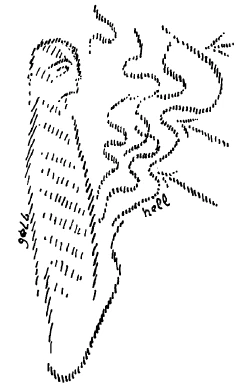
[ 12 ] Wenn wir zunächst auf das Ich sehen, es ist willensmäßig. Dieses willensmäßige Ich, das seine ganze Struktur, seine ganze Konstitution vom Aufwachen bis zum Einschlafen im physischen und Ätherleib ausgebildet hat, das tritt mit dem Einschlafen vor die Wesenheiten der geistigen Welt. Wenn wir hier als Menschen in der physischen Welt herumgehen, nehmen wir durch unsere Tastorgane die festen Körper wahr. Wir sehen die Farben, wir nehmen wahr. Wir treten mit den physischen Kräften der Welt in eine gewisse Beziehung. So tritt auch das willensmäßige Ich mit den Kräften der Welt, in der es zwischen dem Einschlafen und Aufwachen ist, in eine gewisse Beziehung. Stellen wir uns diese Beziehung, so wie sie sich der geistigen Beobachtung ergibt, einmal graphisch dar. Ich kann sie natürlich nur schematisch darstellen. Es sei dies der physische Mensch, wie er im Einschlafen ist, und es sei das, was ich nun hier zeichne, der ihn durchdringende Ätherleib (siehe Zeichnung, gelb). Ich müßte nun, wenn ich den Menschen im Wachen zeichne, den astralischen Leib hineinzeichnen und das Ich. Das tue ich nicht, denn ich will ja den Zustand charakterisieren, der eintritt, wenn der Mensch in den Schlaf fällt. Das Willensmäßige, also das Ich, tritt vor die Wesenheiten der geistigen Welt.
[ 12 ] If we first consider the “I,” it is a product of the will. This “I” of the will, which has formed its entire structure and constitution—from waking to falling asleep—within the physical and etheric bodies, appears before the beings of the spiritual world the moment we fall asleep. When we go about here as human beings in the physical world, we perceive solid bodies through our sense organs. We see colors; we perceive. We enter into a certain relationship with the physical forces of the world. In the same way, the volitional “I” enters into a certain relationship with the forces of the world in which it exists between falling asleep and waking up. Let us illustrate this relationship, as it appears to spiritual observation, in a diagram. Of course, I can only represent it schematically. Let this be the physical human being as he is when falling asleep, and let what I am now drawing here be the etheric body permeating him (see drawing, yellow). If I were to draw the human being in the waking state, I would now have to include the astral body and the “I.” I do not do this, however, because I wish to characterize the state that occurs when the human being falls asleep. The volitional aspect—that is, the “I”—steps forward before the beings of the spiritual world.
[ 13 ] Da tritt es so in Beziehung zu diesen Wesenheiten der geistigen Welt, wie wir durch unseren physischen Leib zu den Wesenheiten der physischen Welt während des Wachens in Beziehung treten. Nur ist diese Beziehung des willensmäßigen Ich zu den Wesen der geistigen Welt eine viel realere noch, möchte ich sagen, als die majaartige Beziehung, welche der physische Leib mit seiner Umgebung eingeht. Und vor allen Dingen drückt sich diese Beziehung dadurch aus, daß alles, was der Mensch als Böses in seiner Seelenverfassung hat vom Einschlafen bis zum Aufwachen, gewissermaßen — man kann diese Dinge nur bildhaft ausdrücken — das willensmäßige Ich bei dieser Berührung mit den Kräften der geistigen Wesenheiten verkümmern läßt, während das Gute, das in der Seelenverfassung liegt, dem willensmäßigen Ich gestattet, sich frei zu entfalten.
[ 13 ] It relates to these beings of the spiritual world in the same way that we relate to the beings of the physical world through our physical body while we are awake. Only this relationship of the volitional “I” to the beings of the spiritual world is, I would say, even more real than the maya-like relationship that the physical body enters into with its surroundings. And above all, this relationship is expressed in that everything a person has within their soul’s disposition that is evil—from the moment they fall asleep until they wake up—in a sense—one can only express these things figuratively — causes the volitional “I” to wither away during this contact with the forces of the spiritual beings, whereas the good that lies within the soul’s state allows the volitional “I” to unfold freely.
[ 14 ] Wenn man graphisch darstellen will, wie das geschieht, so kommt man — allerdings, Sie müssen das natürlich wiederum bildhaft ansehen — zu einer gewissen Gestaltung dessen, was da als geistige, willensmäßige Ich-Gestalt aus dem Menschen heraustritt. In bezug auf den Gliedmaßenmenschen ist ja das Ich auch während des Schlafes gerade ganz intensiv im Menschen darinnen. Ich möchte es nun graphisch so darstellen (die Zeichnung wird weitergeführt): Diese Furchungen, die ich zeichne (hell), die sind eigentlich entstanden durch die Gegenwirkungen der geistigen Wesenheiten, und ganz nach der moralischen Seelenverfassung gestalten sich diese Furchungen des Ich. Man kann schon sprechen von einer Geistgestalt, welche das Ich annimmt aus seiner moralischen Seelenverfassung heraus, indem es die geistige Welt betritt.
[ 14 ] If one wants to illustrate how this happens, one arrives—though, of course, you must again view this figuratively—at a certain form of what emerges from the human being as a spiritual, volitional “I.” With regard to the human being as a physical entity, the “I” is, of course, present within the person very intensely even during sleep. I would now like to illustrate this visually (the drawing continues): These grooves that I am drawing (in light color) have actually arisen through the counteractions of spiritual beings, and these grooves of the “I” take shape entirely according to the moral state of the soul. One can indeed speak of a spiritual form that the “I” assumes based on its moral state of mind as it enters the spiritual world.
[ 15 ] Nun tritt aber beim Einschlafen auch der astralische Leib in die äußere, mehr seelische Welt. Bei dem willensmäßigen Ich können wir sagen: Es tritt vor die Wesenheiten der geistigen Welt —, bei dem astralischen Leib können wir sagen: Er tritt mit dem Einschlafen in das Gebiet des äußeren Seelischen. — Also der gefühlsmäßige astralische Leib tritt in das Seelische ein.
[ 15 ] But when we fall asleep, the astral body also enters the outer, more soul-related world. Regarding the volitional “I,” we can say: It steps before the beings of the spiritual world—; regarding the astral body, we can say: It enters the realm of the outer soul-world as we fall asleep. — Thus, the emotional astral body enters the realm of the soul.
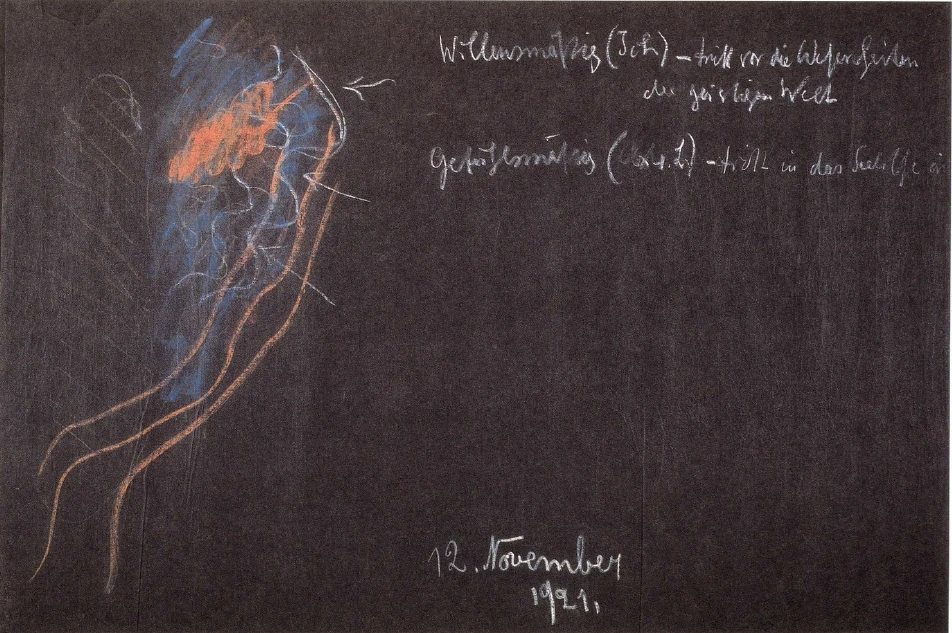
[ 16 ] Auch unsere Willensverfassung nach der Richtung des Guten und Bösen ist ja durchaus von Gefühlselementen, von Gefühlskräften durchzogen. Wir brauchen uns nur zu erinnern, wie wir, wenn wir eine gute Handlung begangen haben, gefühlsmäßig anders gestimmt sind, als wenn wir eine böse Handlung begangen haben. Man braucht nur auf das ganze Gebiet der Selbstvorwürfe und der inneren Befriedigung hinzudeuten, und man wird das gefühlsmäßige Durchtränktsein der moralischen Seelenverfassung ins Auge fassen können. Dieses Gefühlsmäßige tritt nun alles in die seelische Welt mit dem Einschlafen ein, und auch das tritt in Beziehung zur äußeren seelischen Welt. So wie wir durch unsere Vorstellungen während des Wachens zu der äußeren physischen Welt in Beziehung treten und dabei allerdings das Gefühlsleben innerlich ausbilden — aber es schließt sich eben bloß innerlich das Gefühlsleben an das Vorstellungsleben —, so tritt während des Schlafens direkt unser gefühlsmäßiges Astralisches an die seelische Welt heran. Da findet aber dann nicht eine Gestaltung statt. Für das Ich, für das willensmäßige Ich findet eine Gestaltung statt; ich habe diese Gestaltung schematisch durch eine Art Furchung ausgedrückt. Das, was durch die Wechselbeziehung des astralischen Leibes mit der seelischen Umgebung entsteht, kann ich nicht ausdrücken durch eine Furchung; ich muß es ausdrücken durch eine Tingierung, durch eine Durchtränkung. Und ich müßte das dann so zeichnen, daß, je nachdem unser Gemüt behaftet ist mit Selbstvorwürfen oder mit inneren Befriedigungen, mit Sympathie- und Antipathiegefühlen, es tingiert, durchsetzt wird von dem, was man schematisch durch eine gewisse Farbbezeichnung zum Ausdruck bringen kann (siehe Zeichnung, rötlich, blau). Es tritt also eine Gestaltung durch unser Ich für unseren, wie wir sagen, höheren Menschen ein, und eine Durchtingierung, eine Durchfärbung für unseren astralischen Menschen.
[ 16 ] Our disposition of the will toward good and evil is, after all, thoroughly permeated by emotional elements and emotional forces. We need only recall how, when we have performed a good deed, our emotional state is different from when we have committed an evil act. One need only point to the entire realm of self-reproach and inner satisfaction to grasp how deeply the moral state of mind is imbued with emotion. All of this emotional aspect enters the inner world when we fall asleep, and it, too, enters into a relationship with the outer world of the soul. Just as we relate to the outer physical world through our images while awake—and in doing so, of course, develop our emotional life internally—though the emotional life is merely attached to the life of the imagination on the inside—so, during sleep, our emotional astral body approaches the soul world directly. But no formation takes place there. For the “I,” for the volitional “I,” a formation takes place; I have expressed this formation schematically through a kind of furrowing. What arises through the interaction of the astral body with the soul environment, I cannot express through a furrowing; I must express it through a tinge, through an impregnation. And I would have to draw this in such a way that, depending on whether our mind is burdened with self-reproach or with inner satisfaction, with feelings of sympathy and antipathy, it is tinged, permeated by what can be schematically expressed through a certain color designation (see drawing: reddish, blue). Thus, a shaping takes place through our “I” for what we call our “higher self,” and a tingeing, a coloring, for our astral self.
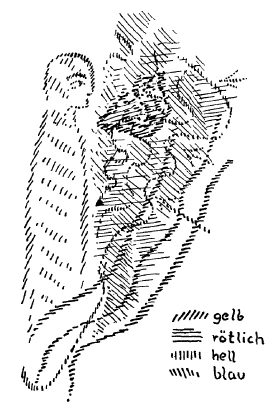
[ 17 ] Durchfärbung, Durchtingierung ist natürlich nur schematisch gesprochen. Denn obzwar man mit Recht das, was da geschieht, durch Farbbilder ausdrückt, muß man doch sagen, es ist eben nur ein Teil dessen, was geschieht, was man durch Farbbilder ausdrücken kann. Ich könnte ebensogut, statt daß ich hier Farben herzeichne, allerlei, sagen wir, musikalische Instrumente hier haben und verschiedene Töne anschlagen; dann würde ich das Schema eben durch andere Bilder, durch Tonbilder zum Ausdrucke bringen. Oder ich könnte selbst, sagen wir, Geschmacksempfindungen hineintingieren. Alles das, möchte man sagen, wirbelt durcheinander in dem astralischen Leib, der aus dem physischen Leib vom Einschlafen bis zum Aufwachen draußen ist. Die Sache ist so, daß man aber nun sieht: Die wirksamen Kräfte für alles das, was ich da gezeichnet habe, die haben eigentlich, schematisch gezeichnet, solch eine Richtung (rötliche Linien), daß von dem Gliedmaßen-Stoffwechselmenschen die bestimmenden Kräfte ausgehen. Man möchte sagen: Die geistigen Wesenheiten und die seelische Welt, die gestalten und tingieren, die wirken so, daß sie wie von unten herauf die Gestaltung, die Tingierung bewirken.
[ 17 ] “Permeation with color” and “permeation with tone” are, of course, only schematic terms. For although one is right to express what is happening there through images of color, one must still say that this is only a part of what is happening—what can be expressed through images of color. Instead of drawing colors here, I could just as well have all sorts of—let’s say—musical instruments here and strike different notes; then I would express the concept through other images, through sounds. Or I could even—let’s say—introduce sensations of taste into it. All of this, one might say, swirls about in the astral body, which is outside the physical body from the moment of falling asleep until waking up. The fact is, however, that one now sees: The active forces behind everything I have depicted here—schematically drawn—actually have such a direction (reddish lines) that the determining forces emanate from the human being’s limb metabolism. One might say: The spiritual beings and the soul world, which shape and color, act in such a way that they bring about the shaping and coloring as if from below.
[ 18 ] Wenn man nun versucht, darauf zu kommen, was man eigentlich in dem hat, was da vom Einschlafen bis zum Aufwachen als Ich und astralischer Leib gestaltet, tingiert außerhalb des Menschen ist, so kommt man zuletzt zu folgendem. Man lernt verstehen: Gegenüber jener vollkommenen Form des Menschen, die er vom Aufwachen bis zum Einschlafen ist, die er ist, wenn ineinandergefügt sind Ich, astralischer Leib, Ätherleib und physischer Leib — gegenüber dieser vollkommenen Wesenheit, die mit einer bestimmten Intensität des Bewußtseins auftritt, die mit unserem intellektualistischen, gefühlsmäßigen, willensmäßigen Bewußtsein auftritt, gegenüber dem hat das, was da außerhalb des Menschen im Schlafe ist, etwas Infantiles, etwas Kindhaftes. Wir gedenken des dumpfen Bewußtseins des Kindes und kommen höchstens diesem Zustande nahe, wenn er von Träumen durchsetzt ist. Wir müssen noch weiter ins Unvollkommene zurückgehend uns das dumpfe Bewußtsein des Kindes denken, wenn wir uns zur Ähnlichkeit dieses außerhalb des Menschen befindlichen Wesenhaften während des Schlafes wenden. Ich möchte sagen: Noch infantiler ist dasjenige, was da draußen im Menschen lebt, als das, was geistig-seelisch im Kinde ist.
[ 18 ] If one now tries to determine what actually constitutes that which, from falling asleep to waking up, takes shape as the “I” and the astral body—and which exists outside the human being—one ultimately arrives at the following. One comes to understand: In contrast to that perfect form of the human being that one is from waking until falling asleep—that one is when the “I,” the astral body, etheric body, and physical body—in contrast to this perfect being, which manifests with a certain intensity of consciousness, the consciousness of our intellect, feelings, and will—in contrast to this, what exists outside the human being during sleep has something infantile, something childlike about it. We recall the dull consciousness of a child and come closest to this state, at most, when it is interwoven with dreams. We must go even further back into imperfection to conceive of the child’s dull consciousness when we turn our attention to the similarity of this essential being that exists outside the human being during sleep. I would say: What lives out there in the human being is even more infantile than what exists in the child’s mind and soul.
[ 19 ] Was ist denn das eigentlich, was da seelisch und geistig vom Menschen im Schlafe außerhalb seiner lebt? Es ist sehr charakteristisch, daß für die geisteswissenschaftliche Beobachtung das Bestimmende von dem Gliedmaßen-Stoffwechselmenschen ausgeht. Und wenn man studiert, was man da durch übersinnliches Schauen beobachten kann, so hat man eigentlich das Gefühl — und dieses Gefühl steigert sich immer mehr zu einer ganz bestimmten Erkenntnis —, daß, wenn man dieses Ganze hier so betrachtet wie ein photographisches Negativ und sich das Positiv dazu denkt, richtig der Bau des menschlichen Gehirns herauskommt. Allerdings, die Größe stimmt nicht, aber das als Negativ vorgestellt und das Positiv dazu gedacht, gibt im Positiven das menschliche Gehirn.
[ 19 ] What, then, is this that exists outside the human being during sleep, in the realms of the soul and spirit? It is very characteristic that, from the perspective of spiritual science, the defining factor emanates from the human being as a metabolic entity of the limbs. And when one studies what can be observed there through supersensible perception, one actually has the feeling—and this feeling intensifies more and more into a very definite insight—that if one regards this whole as a photographic negative and imagines the positive image corresponding to it, the structure of the human brain truly emerges. Admittedly, the size is not correct, but when one imagines this as a negative and conceives the positive image to go with it, the positive image reveals the human brain.
[ 20 ] Und erinnern Sie sich an manches, was ich von anderen Gesichtspunkten her ausgeführt habe. Ich habe ausgeführt, wie der Bau des menschlichen Hauptes, so wie er in einem bestimmten Leben auftritt, innerlich, der Kräftestruktur nach, die Ausgestaltung des kopflosen Menschen, also des Menschen, den Kopf abgerechnet, vom vorigen Erdenleben ist, und daß dasjenige, was heute der Mensch ist, abgesehen von seinem Kopfe, die Kräfte enthält, die sein Haupt, sein Kopf im nächsten Erdenleben haben wird. Aber infantil, kindhaft ausgebildet und sogar ins Negativ verkehrt, sehen wir das schon in dem, was der Mensch vom Einschlafen bis zum Aufwachen aus sich herausserzt.
[ 20 ] And remember some of the things I have explained from other perspectives. I have explained how the structure of the human head, as it appears in a particular life, internally—in terms of its force structure—reflects the form of the headless human being—that is, the human being without a head—from the previous earthly life, and that what a human being is today, apart from his head, contains the forces that his head will possess in the next earthly life. But we can already see this—in an infantile, childlike form and even inverted into the negative—in what the human being expels from within themselves from the moment they fall asleep until they wake up.
[ 21 ] Tatsächlich haben wir in dem, was der Mensch vom Einschlafen bis zum Aufwachen aus sich heraussetzt, das Bildhafte von dem, was dann physisch verkörpert im menschlichen Haupte im nächsten Erdenleben zutage tritt. Das ist ein außerordentlich wichtiger Zusammenhang. Und wenn wir darauf zurückblicken, daß es eigentlich die moralische Seelenverfassung ist, welche das Bestimmende für diese Gestaltung, für diese Tingierung abgibt, so werden wir im nächsten Erdenleben die Einkörperung, die Verleiblichung der moralischen Seelenverfassung in den Kräften des menschlichen Hauptes zu suchen haben. Und indem sich dann diese Kräfte des menschlichen Hauptes als unser Denkvermögen, als unser Vorstellungsvermögen ausdrücken, haben wir dieses Denkvermögen, dieses Vorstellungsvermögen als die Wirkung unserer moralischen Seelenverfassung von diesem Leben. Das alles aber ist bildhaft vorhanden in dem, was der Mensch beim Einschlafen aus sich heraussetzt.
[ 21 ] In fact, what a person projects from within themselves from the moment they fall asleep until they wake up provides a pictorial representation of what will then physically manifest in the human head in the next earthly life. This is an extraordinarily important connection. And when we consider that it is actually the moral state of the soul that determines this form, this coloring, we must look for the embodiment, the materialization of the moral state of the soul in the powers of the human head in the next earthly life. And as these powers of the human head then express themselves as our power of thought and our power of imagination, we experience this power of thought and this power of imagination as the effect of our moral state of soul from this life. All of this, however, is present in a pictorial form in what the human being sends out from within themselves as they fall asleep.
[ 22 ] Und so könnte man eigentlich auf Grundlage der geisteswissenschaftlichen Beobachtung das Folgende sagen: Der Mensch stellt tatsächlich jede Nacht, indem er schläft, an eine andere Welt, an die geistig-seelische Welt, eine ganz bestimmte Anfrage. Er stellt sie natürlich nicht bewußt, aber er stellt sie mit dem Teil seines Wesens, der dann heraustritt aus seinem physischen und aus seinem Ätherleib. Er stellt die Anfrage an die geistige Welt: Wie nimmt sich vor den Wesen der geistigen Welt meine moralische Seelenverfassung aus? Und es wird ihm die Antwort gegeben. Sie wird ihm dadurch gegeben, daß er, je nachdem wie seine moralische Seelengestaltung ist, die Furchengestaltung und die Tingierung bekommt. Jeden Morgen, wenn der Mensch aufwacht, tritt er in die physische und ätherische Körperlichkeit hinein mit einer Antwort aus der geistig-seelischen Welt. Jedes Einschlafen ist eine Fragestellung, eine unbewußte Fragestellung an die geistige Welt, jedes Aufwachen ist ein unbewußtes Antwortgeben aus der geistigen Welt. Wir stehen fortwährend gewissermaßen mit unserem Unterbewußtsein mit der geistigen Welt in einer Korrespondenz, indem wir aus dieser geistigen Welt heraus uns die Antworten darüber holen, wie wir innerlich als Mensch eigentlich sind.
[ 22 ] And so, based on observations from the spiritual sciences, one could actually say the following: Every night, when a person sleeps, they are in fact making a very specific inquiry directed at another world—the spiritual-soul world. Of course, they do not pose it consciously, but they pose it with that part of their being which then emerges from their physical and etheric bodies. They pose the question to the spiritual world: How does my moral state of soul appear to the beings of the spiritual world? And an answer is given to him. It is given to him in such a way that, depending on the state of his moral soul, he receives a certain facial expression and complexion. Every morning, when a person wakes up, he enters his physical and etheric bodies with an answer from the spiritual-soul world. Every time we fall asleep, we pose a question—an unconscious question—to the spiritual world; every time we wake up, we receive an unconscious answer from the spiritual world. We are, so to speak, in constant correspondence with the spiritual world through our subconscious, drawing from this spiritual world the answers about what we are actually like inwardly as human beings.
[ 23 ] Und hier bekommen Sie eine Anschauung über etwas, was ja sonst immer außerordentlich abstrakt bleibt. Denken Sie doch, wenn der Mensch von seinem Gewissen spricht, dann spricht er von diesem Gewissen als etwas sehr Realem; wenn er aber irgendeine bestimmte Anschauung von seinem Gewissen geben soll, dann kommt er sogleich ins Unbestimmte. In bezug auf die moralische Impulsivität ist das Gewissen etwas sehr real Erlebtes in uns. Wenn man in Gemäßheit der äußeren Wissenschaft ebenso über das Gewissen nachdenkt, wie man etwa über Wärme oder Licht und dergleichen nachdenkt, dann fällt man ins Chaotische hinein. Man kommt zu keinen bestimmten Ansichten. Hier bekommen Sie eine bestimmte Ansicht. Hier bekommen Sie die Ansicht, daß Sie auf Ihre moralische Seelenverfassung fortwährend Antwort bekommen aus der geistigen Welt. Sie tragen das, was die geistige Welt an Ihnen gestaltet, herein in Ihr physisches und Ihr ätherisches Dasein. Damit tragen Sie die Stimme des Gewissens herein. Im wachen Leben verwandelt sich das, was man als Antwort bekommt in Gestaltung und Tingierung, in die Stimme des Gewissens. Überhaupt alles, was unsere innerliche moralische Stimmung ist, müssen wir aus solchen Erkenntnissen heraus auf den Schlafzustand beziehen.
[ 23 ] And here you get a sense of something that otherwise always remains extremely abstract. Just think: when a person speaks of his conscience, he speaks of it as something very real; but when he is asked to give a specific description of his conscience, he immediately becomes vague. With regard to moral impulsivity, the conscience is something we experience very concretely within ourselves. If one reflects on the conscience in accordance with external science in the same way one might reflect on heat or light and the like, one falls into chaos. One arrives at no definite views. Here, however, you gain a definite view. Here you gain the view that you continually receive a response to your moral state of mind from the spiritual world. You bring what the spiritual world shapes within you into your physical and etheric existence. In doing so, you bring in the voice of conscience. In waking life, what one receives as a response is transformed into form and nuance—into the voice of conscience. Indeed, everything that constitutes our inner moral disposition must be related to the state of sleep on the basis of such insights.
[ 24 ] Wir haben ja an vielen Beispielen gesehen, wie die instinktive Erkenntnis früherer Zeiten und auch jene instinktive Erkenntnis, die sich noch bei Menschen erhalten hat, die nicht von der Intellektualität durchaus durchzogen sind, wie diese instinktive Erkenntnis, wenn auch in bildhafter Form, weiser ist als die heutige Wissenschaft. Und so ist auch in den moralischen Maximen des instinktiven Erkennens vieles von dem enthalten, was uns, allerdings klarer, durchsichtiger, konturierter, durch eine wirkliche geisteswissenschaftliche Erkenntnis wieder wird. Man denke nur daran, wie eine Maxime des Volksbewußtseins die ist, daß, wenn man durch irgendeinen Menschen beleidigt ist, man die Empfindung, die man dadurch hat, nicht durch den Schlaf tragen soll, sondern sie womöglich vor dem Schlaf abmachen soll; daß man also den Zorn nicht durch den Schlaf tragen soll, sondern versuchen soll, ihn vor dem Schlafe zu beruhigen.
[ 24 ] We have seen from many examples how the instinctive insight of earlier times—and also that instinctive insight which has been preserved even among people who are not entirely permeated by intellectualism—how this instinctive insight, even if in pictorial form, is wiser than today’s science. And so the moral maxims of instinctive insight also contain much of what is revealed to us—albeit more clearly, more transparently, and with greater definition—through genuine spiritual scientific insight. One need only consider how a maxim of popular consciousness holds that, if one is offended by someone, one should not carry the feeling this causes into sleep, but should, if possible, resolve it before going to sleep; that is, one should not carry anger into sleep, but should try to calm it before sleeping.
[ 25 ] Wenn Sie wissen, daß das Einschlafen ein Fragestellen an die geistige Welt und das Aufwachen eine Antwort auf diese Frage ist, dann werden Sie sich sagen können: Sie bekommen eine andere Antwort und tragen eine andere Antwort des Morgens aus der geistigen Welt in Ihren physischen Leib herein, wenn Sie einen Zorn am Abend gemäßigt oder eine Beleidigung abgedämpft haben in Ihrem Empfinden, als wenn Sie diese Beleidigung in den Schlaf hineingetragen haben und in der Stimmung dieser Beleidigung die Frage an die geistige Welt stellen, oder wenn Sie zornig hineingehen in die geistige Welt und Ihre Frage durchglüht ist von Zorn. Wenn Sie etwas Zornmütiges in die geistige Welt hineintragen, so ist es, wie wenn ein vulkanischer Feuerstrom sich hineinergießen würde, und es muß dann von der äußeren seelischen Welt dieser vulkanische Feuerstrom tingiert werden (siehe Zeichnung Seite 183, rötlich). Das ist etwas anderes, als wenn man beim Einschlafen den Zorn abgedämpft hat.
[ 25 ] If you know that falling asleep is like asking a question of the spiritual world and waking up is the answer to that question, then you will be able to tell yourself: You will receive a different answer and bring a different answer from the spiritual world into your physical body in the morning if you have calmed your anger or softened the impact of an insult in your feelings by evening, than if you have carried that insult into your sleep and asked your question of the spiritual world while still in the mood of that insult, or if you enter the spiritual world in a state of anger and your question is inflamed with anger. If you carry something angry into the spiritual world, it is as if a volcanic stream of fire were pouring in, and the outer soul world must then be tinged by this volcanic stream of fire (see illustration on page 183, reddish). This is different from when you have subdued your anger before falling asleep.
[ 26 ] Es ist vieles von dem, was hier geschildert worden ist, in seinen Wirkungen nicht nur auf das menschliche Gemüt, sondern sogar auf die körperliche und innerliche organische Lebensstimmung zu erkennen, und viele innerliche Krankheitsursachen sind in dem zu suchen, was wir als Antwort bekommen auf die Fragen, die wir unbewußt an die geistige Welt im Einschlafen stellen. Denn unsere physischen und ätherischen Organe, sie müssen im Wachzustande durchaus fertig werden mit dem, was ihnen durch das willensmäßige Ich und durch den gefühlsmäßigen astralischen Leib mit dem Aufwachen aus der geistigen Welt hereingetragen wird.
[ 26 ] Much of what has been described here can be recognized in its effects not only on the human mind, but even on the physical and inner organic state of being, and many inner causes of illness are to be found in what we receive as answers to the questions we unconsciously pose to the spiritual world as we fall asleep. For our physical and etheric organs must, while we are awake, cope entirely on their own with what is brought to them from the spiritual world upon waking by the volitional “I” and the emotional astral body.
[ 27 ] Es ist eine durchaus irrtümliche Anschauung, wenn man glaubt: Nun ja, der Mensch erlebt während des Wachens vieles, aber während des Schlafens erlebt er nichts. — Was der Mensch während des Wachens erlebt, das sind Vorgänge, die sich zum großen Teil zwischen ihm und der Welt, der äußeren, der physischen Welt abspielen. Unsere Befriedigungen über das, was sich da abspielt, die begleiten wie innere Träume des Gemütes — wir wissen ja, daß das Gefühlsmäßige nur die Bewußstseinsintensität des Traumes hat —, wie traumhaft begleiten diese innerlichen Ereignisse das, was wir eigentlich deutlich an unserem Verhältnis zur äußeren physischen Welt haben. Aber wenn wir in dem Zustande sind zwischen dem Einschlafen und dem Aufwachen, dann geschieht durchaus in unserem Ich und in unserem astralischen Leibe viel Innerliches: Das willensmäßige Ich wird gestaltet, der gefühlsdurchtränkte astralische Leib wird tingiert mit den Kräften der äußeren geistigen und seelischen Welt. Und das alles sind nun auch Geschehnisse, sind Tatsächliches, das nun den physischen und den Ätherleib durchtränkt, durchdringt, durchzieht, durchströmt. Und je nachdem wir da durchtränkt und durchströmt werden, verhalten wir uns wiederum in der physischen Welt. Für das Innerliche tun wir mehr während des Schlafes als während des Wachens. Es hängt allerdings das, was wir während des Schlafes tun, von dem Wachen ab. Aber ich möchte sagen: Die ganze Tragweite des Schlafes, die hauptsächlichste Tragweite des Schlafes liegt im Grunde genommen nicht nur im physischen Erleben, sondern in der moralischen Struktur der menschlichen Wesenheit.
[ 27 ] It is a thoroughly mistaken view to believe: “Well, a person experiences many things while awake, but experiences nothing while asleep.” — What a person experiences while awake are processes that take place, for the most part, between the person and the world—the external, physical world. Our reactions to what is happening there accompany us like inner dreams of the mind—we know, after all, that the emotional realm has only the intensity of consciousness found in a dream—and just as in a dream, these inner events accompany what we actually experience clearly in our relationship to the external physical world. But when we are in that state between falling asleep and waking up, a great deal happens internally within our “I” and our astral body: the volitional “I” is shaped, and the emotion-imbued astral body is tinged with the forces of the outer spiritual and soul world. And all of this is also a series of events, is reality, which now permeates, penetrates, flows through, and courses through the physical and etheric bodies. And depending on how we are permeated and coursed through by these forces, we in turn behave in the physical world. We do more for our inner life during sleep than while awake. What we do during sleep, however, depends on our waking state. But I would like to say: The full significance of sleep—its most fundamental significance—lies not only in physical experience, but in the moral structure of the human being.
[ 28 ] Ich habe ja bei verschiedenen Anlässen darauf hingewiesen, wie ein äußerliches Denken gerade über die Beziehung des menschlichen physischen und ätherischen Organismus zum Einschlafen falsch denkt. Gewöhnlich wird ja die Sache — ich wiederhole nur, was ich öfter und ausführlich dargelegt hatte — so dargestellt, daß man sagt: Der Mensch ermüdet durch die Anstrengung seiner Glieder, durch die Arbeit, und er muß dann schlafen, weil dadurch die Ermüdung wieder ausgeglichen wird. Schon eine Besinnung darüber, daß man ja nicht immer durch die Ermüdung einschläft, könnte hier ein richtiges Denken zutage fördern. Man braucht sich nur daran zu erinnern, daß ein recht ausgeruhter Rentier zum Beispiel sich einen Vortrag anhört, zu dem er, weil sich das so gehört, vielleicht einmal geht, und nach den ersten fünf Minuten ist er gewöhnlich eingeschlafen — aus Ermüdung kaum!
[ 28 ] I have, in fact, pointed out on various occasions how external thinking is mistaken, particularly regarding the relationship between the human physical and etheric organisms and the process of falling asleep. Usually, the matter is presented—and I am merely repeating what I have explained often and at length—in such a way that people say: A person becomes tired through the exertion of their limbs, through work, and must then sleep because this restores the balance lost through fatigue. Simply reflecting on the fact that one does not always fall asleep because of fatigue could bring correct thinking to light here. One need only recall that a well-rested reindeer, for example, listens to a lecture—which it might attend once, simply because that is the custom—and after the first five minutes, it has usually fallen asleep—hardly out of fatigue!
[ 29 ] Wenn man alle diese Dinge verfolgt, die sich rein der äußeren Erfahrung auf diesem Gebiete ergeben, dann kommt man eigentlich darauf, daß das gewöhnliche Denken hier Ursache und Wirkung verwechselt. In Wahrheit sind wir ermüdet, weil wir einschlafen wollen. Die Impulse des Einschlafens treten viel innerlicher auf als in der Sphäre der Ermüdung, als in der Sphäre des körperlichen Gegenteils. Wenn wir keine Lust haben an der Außenwelt, dann tritt in uns die Sehnsucht auf, uns aus dieser Außenwelt zurückzuziehen. Dann verläßt das Seelisch-Geistige das Leiblich-Physische, und dann ermüdet das Leiblich-Physische. Wir ermüden, weil wir einschlafen wollen, nicht: Wir schlafen ein, weil wir ermüdet sind. Davon kann sich jeder überzeugen, wenn er nur will. Allerdings ist das Überzeugtwerden bei Dingen, die mit den selbstzufriedenen Interessen des Lebens so innig im Zusammenhang stehen, außerordentlich schwierig. Aber wir können uns schon überzeugen, wenn wir uns nur überzeugen wollen. Und wir werden dann schon dazu geführt, daß wir in dem Einschlafen nicht nur einen physisch-physiologischen Vorgang sehen, sondern daß wir das Einschlafen hineinstellen in den Gesamtkosmos, der, wie wir ja von den verschiedensten Seiten charakterisiert haben, auch die moralischen Impulse als reale Impulse, nicht als bloße Worte enthält. Und so zeigt uns gerade der Wechselzustand von Schlafen und Wachen, wie eine Brücke geschlagen werden kann zwischen dem Physischen und dem Moralischen in unserer Weltenordnung.
[ 29 ] If one examines all these phenomena that arise purely from external experience in this area, one actually comes to the conclusion that ordinary thinking confuses cause and effect here. In truth, we are tired because we want to fall asleep. The impulses to fall asleep arise much more inwardly than in the sphere of fatigue, than in the sphere of the physical opposite. When we have no interest in the external world, a longing arises within us to withdraw from it. Then the soul-spiritual leaves the physical-bodily, and the physical-bodily grows weary. We grow tired because we want to fall asleep, not: We fall asleep because we are tired. Anyone can convince themselves of this, if they are willing. However, becoming convinced of such things—which are so intimately connected with the self-satisfied interests of life—is extraordinarily difficult. But we can convince ourselves if we are only willing to do so. And we will then be led to see falling asleep not merely as a physical-physiological process, but to place it within the entire cosmos, which—as we have characterized from various perspectives—also contains moral impulses as real impulses, not merely as words. And so it is precisely the alternating states of sleep and wakefulness that show us how a bridge can be built between the physical and the moral in our world order.
[ 30 ] Du Bois-Reymond, derselbe Physiologe, der über die Grenzen des Naturerkennens — was ich öfter besprochen habe — seinen berühmten Vortrag gehalten hat, der sagte auch einmal: Den Menschen, wie er im wachen Leben vor uns steht, können wir überhaupt nicht begreifen. Nun, wir wissen ja, wie wir über einen solchen Ausspruch zu denken haben. Aber, meint Du Bois-Reymond, den schlafenden Menschen können wir begreifen. In dem schlafenden Menschen sind eben nur in einer komplizierteren Weise, meint er — wir wissen, daß das nicht richtig ist, aber wir wollen diesen Ausspruch betrachten —, die gesetzmäßigen Zusammenhänge der äußeren physischen Welt, die man begreift, vorhanden. So daß man also nur den schlafenden Menschen naturwissenschaftlich begreifen kann, nicht aber den wachen Menschen.
[ 30 ] Du Bois-Reymond, the same physiologist who gave his famous lecture on the limits of understanding nature—a topic I have discussed on several occasions—once said: “We cannot comprehend human beings at all as they stand before us in waking life.” Well, we know, of course, how we are to regard such a statement. But, Du Bois-Reymond argues, we can understand the sleeping human being. In the sleeping human being, he argues—though we know this is not correct, but let us consider this statement for the sake of argument—the lawful interrelationships of the external physical world, which we do understand, are present, albeit in a more complex form. Thus, one can only understand the sleeping human being scientifically, but not the waking human being.
[ 31 ] Es wird dadurch — wie gesagt, wir wollen uns heute nicht über die Richtigkeit oder Unrichtigkeit dieses Satzes unterhalten —, aber es wird damit von naturwissenschaftlicher Seite zugestanden, daß man mit naturwissenschaftlichen Mitteln nicht erfahren kann, was den Menschen durchdringt, durchzieht, wenn er wacht und daß sich der schlafende Mensch als physische Wesenheit ganz anders auch vor der naturwissenschaftlichen Denkweise ausnimmt als der wachende Mensch.
[ 31 ] This means—as I said, we do not wish to discuss the correctness or incorrectness of this statement today—but it is thereby acknowledged from a scientific standpoint that one cannot ascertain by scientific means what permeates and penetrates a person while awake, and that the sleeping person, as a physical entity, appears quite different—even to the scientific mindset—than the waking person.
[ 32 ] Die Naturwissenschaft weiß natürlich nichts von dem, was da heraustritt aus dem Menschen und vorhanden ist vom willensmäßigen Ich und gefühlsmäßigen Astralleib in der übersinnlichen Welt. Aber dieses Nichts, das die Naturwissenschaft ausdrückt, was ist es im Lichte unserer heutigen Betrachtungen? Das ist ja gerade etwas, was innerhalb der moralischen Weltordnung steht! Also gerade an dem Punkte, wo die naturwissenschaftliche Weltanschauung aufhört zu betrachten, da beginnt auch als reale Welt die eigentliche Wirksamkeit des Moralischen. Und nur in ihren Wirkungen zeigt sich dieses Moralische in der menschlichen Verfassung nach dem Aufwachen. Wir müßten also, wenn wir überhaupt das Terrain betreten wollen, wo das MoralischReale gefunden werden kann, die Welt betrachten, die der Mensch durchlebt zwischen dem Einschlafen und dem Aufwachen. Kein Wunder also, da ja die naturwissenschaftliche Weltanschauung dieses Terrain nicht betritt, daß sie nur das kennt als real, was die moralischen Impulse nicht enthält und die moralischen Impulse auf das Gebiet des bloßen Glaubens verweist.
[ 32 ] Natural science, of course, knows nothing of what emerges from the human being and exists in the supersensible world as the volitional “I” and the emotional astral body. But this “nothingness” that natural science describes—what is it in the light of our present considerations? It is, in fact, precisely something that belongs to the moral order of the world! Thus, precisely at the point where the natural-scientific worldview ceases to apply, the actual workings of the moral realm begin as a real world. And it is only through its effects that this moral realm manifests itself in the human condition after waking. So if we wish to enter the realm where the real moral can be found at all, we must observe the world that a person experiences between falling asleep and waking up. It is no wonder, then, since the scientific worldview does not enter this realm, that it recognizes as real only that which does not contain moral impulses and relegates moral impulses to the realm of mere belief.
[ 33 ] Dieser Glaube aber wird ebenso ein reales Erkennen wie das, was die naturwissenschaftliche Weltanschauung erreicht, wenn wir das andere Gebiet ins Auge fassen. Nur müssen wir in unserer Darstellung von ganz anderen Ausgangspunkten ausgehen, wenn wir überhaupt dieses geistig-seelische Gebiet, das vom Moralischen durchtränkt ist, ins Auge fassen wollen.
[ 33 ] This belief, however, becomes just as much a real form of knowledge as that achieved by the scientific worldview when we turn our attention to the other realm. We must, however, proceed from entirely different starting points in our exposition if we are to consider this spiritual-psychic realm, which is permeated by morality, at all.
[ 34 ] Hätte ich Ihnen hier irgend etwas hergemalt, was eine Nachbildung ist von einem Physischen, dann würde ich mich zu halten haben an das Physische, und das, was ich hierher gemalt hätte, wäre eben das Bild, und man würde von der äußeren Realität zu dem bloßen Bildhaften übergehen. Wenn man das Übersinnliche darstellt, muß man den umgekehrten Weg gehen. Es ist übersinnlich, man muß es innerlich erleben. Und dann geht man nach außen und stellt eben im Bilde das innerlich Erlebte dar. Dieses innerlich Erlebte ist auch ein durchaus in sich Bewegliches, und ich müßte eigentlich diese Tingierung glitzernd, glänzend, sich ineinanderschiebend, aufleuchtend, abdämmernd darstellen. Dieses Aufleuchten, Abdämmern, das ist aber durchaus zu beobachten, wenn man den ganzen Menschen durch geisteswissenschaftliche Forschung ins Auge faßt.
[ 34 ] If I had painted anything here that is a reproduction of a physical object, then I would have had to stick to the physical, and what I had painted here would simply be the image, and one would move from external reality to a mere image. When depicting the supersensible, one must take the opposite path. It is supersensible; one must experience it inwardly. And then one turns outward and depicts in the image what has been experienced inwardly. This inner experience is also something that is thoroughly dynamic in itself, and I would actually have to depict these hues as glittering, shining, intermingling, flaring up, and fading away. This flaring up and fading away, however, can certainly be observed when one looks at the whole human being through spiritual scientific research.
[ 35 ] Verschafft man sich eine Anschauung — ich versuche ganz genau zu reden — von astralischem Leib und Ich während des Schlafens, so ist die Gestaltung des Ich und die Tingierung des astralischen Leibes scharf und hell. Tritt jetzt das Ich und der astralische Leib in den physischen Leib und den Ätherleib zurück, so wird das, was hell, glitzernd, glänzend ist während des Schlafes, dunkel, dumpf; und das, was außerhalb des Leibes feste Konturen hat, das bekommt unbestimmte Konturen innerhalb des Leibes am Ich. Und man hat ein ganz bestimmtes Gefühl, wenn man dieses Untertauchen des Ich und astralischen Leibes beim Aufwachen in den physischen und in den Ätherleib verfolgt. Will man abstrakte Worte wählen, um dieses Gefühl auszudrücken, so wird man in der Regel ziemlich plump charakterisieren. Aber man kann es doch ziemlich scharf präzisieren, was da eigentlich ist. Beim Aufwachen des Menschen - man weiß aus dem übersinnlichen Anschauen vom Ich und astralischen Leibe, daß sie hell und scharf konturiert sind —; nachdem sie in den [physischen und Ätherleib] hineingegangen sind - ist der astralische Leib wie mit unscharfen Konturen, dumpf, dunkel, wenig glänzend. Da hat man dasselbe Gefühl, wie wenn man von Tag zu Tag das Herbst- und Winterwerden auf die Seele wirken läßt. Dem ganzen Menschen nach das Aufwachen betrachten, hieße sich in eine Stimmung versetzen, wie man sie im Winterwerden hat. Und beim Einschlafen, also bei dem Heraustreten des Geistig-Seelischen aus dem Menschen, hat man eine Seelenstimmung, wie man sie haben kann beim Frühling- und Sommerwerden. Man wird tatsächlich also in etwas ganz Besonderes geführt.
[ 35 ] If one forms a mental image—and I am trying to be very precise here—of the astral body and the “I” during sleep, the form of the “I” and the coloration of the astral body are sharp and bright. When the “I” and the astral body now return to the physical body and the etheric body, what is bright, glittering, and shining during sleep becomes dark and dull; and what has definite contours outside the body takes on indefinite contours within the body at the “I.” And one has a very definite sensation when one observes this immersion of the “I” and the astral body into the physical and etheric bodies upon waking. If one were to choose abstract terms to express this sensation, one would generally describe it rather clumsily. But one can nevertheless define quite precisely what is actually happening there. When a person awakens—we know from supersensible observation of the “I” and the astral body that they are bright and sharply defined—after they have entered the [physical and etheric bodies], the astral body appears as if with blurred contours, dull, dark, and lacking luster. One has the same feeling as when one allows the onset of autumn and winter to affect the soul day by day. To view the waking process in relation to the whole human being would mean putting oneself in a mood similar to that experienced as winter sets in. And upon falling asleep—that is, when the spiritual-soul aspect withdraws from the human being—one experiences a soul mood akin to that felt as spring and summer arrive. One is thus truly led into something quite special.
[ 36 ] Meine lieben Freunde, ich habe mich jetzt durch Wochen bemüht, Ihnen zu zeigen, wie die geisteswissenschaftliche Betrachtung uns dazu führt, den Menschen in den ganzen Zusammenhang zu bringen mit dem Kosmos. Ich habe Ihnen in Zusammenhang gebracht die menschliche Gestalt mit der Sternenwelt, mit der Fixsternwelt, die menschlichen Lebensstufen mit der planetarischen Welt. Wir werden überall herausgeführt aus dem Menschen, wenn wir den Menschen geisteswissenschaftlich betrachten. Heute betrachteten wir die Wechselzustände von Wachen und Schlafen, und wir werden, indem wir sie empfindend verstehen, wiederum aus dem Menschen herausgeführt, jetzt nicht in die Sternenwelt, sondern in die zeitliche Welt. Wir sagten uns: Wir verstehen das Aufwachen, wenn wir das Herbst-Winterwerden verstehen; wir verstehen das Einschlafen, wenn wir das Frühling-Sommerwerden verstehen. Wir werden vom menschlichen zeitlichen Verlaufe in den kosmischen zeitlichen Verlauf herausgeführt. Wir werden von den menschlichen Wechselzuständen zwischen Schlafen und Wachen in die Jahreszeitenwechselzustände Frühling, Sommer, Herbst und Winter geführt. Wir sehen im Menschen ein Abbild von dem, was auch in der Zeit geschieht, während wir uns ja nun seit Wochen bemüht haben, im Menschen ein Abbild des Makrokosmos zu sehen in bezug mehr auf das Räumliche.
[ 36 ] My dear friends, for weeks now I have been striving to show you how a spiritual-scientific perspective leads us to place the human being within the broader context of the cosmos. I have connected the human form with the world of the stars, with the world of the fixed stars, and the stages of human life with the planetary world. When we view the human being from a spiritual-scientific perspective, we are led out from the human being in every direction. Today we considered the alternating states of waking and sleeping, and by understanding them intuitively, we are once again led out from the human being—not into the world of the stars this time, but into the world of time. We said to ourselves: We understand waking up when we understand the transition from autumn to winter; we understand falling asleep when we understand the transition from spring to summer. We are led from the human course of time into the cosmic course of time. We are led from the human alternating states between sleep and wakefulness into the seasonal transitions of spring, summer, autumn, and winter. We see in human beings a reflection of what also happens in time, whereas for weeks now we have been striving to see in human beings a reflection of the macrocosm, focusing more on the spatial aspect.
[ 37 ] So stellt man den Menschen in die Welt hinein, und so begreift man den Menschen aus der Welt heraus. Dann allerdings stellt sich die moralische Weltordnung ebenso als eine Realität vor uns hin, nicht als eine Welt leerer Worte. Und dann, wenn der Mensch sich mit alldem durchdringt, was er fühlen kann aus diesem seinem Weltzusammenhang, dann durchdringt sich auch seine ethisch-moralische Welt mit den religiösen Impulsen, dann wird der ethische Wille im Menschen der Ausdruck des im Menschen waltenden göttlichen Willens, dann erhebt sich die Sphäre des Ethisch-Moralischen in die Sphäre des Ethisch-Religiösen. So sucht anthroposophische Geisteswissenschaft den Weg zum Ethischen und zum Religiösen. Davon wollen wir dann morgen weiter sprechen.
[ 37 ] This is how one places human beings within the world, and this is how one understands human beings from within the world. Then, however, the moral world order presents itself to us as a reality, not as a world of empty words. And then, when a person becomes imbued with all that he can feel from this context of his world, his ethical-moral world, too, becomes imbued with religious impulses, then the ethical will within the human being becomes the expression of the divine will at work within him, and then the sphere of the ethical-moral rises into the sphere of the ethical-religious. This is how anthroposophical spiritual science seeks the path to the ethical and the religious. We will speak further about this tomorrow.