Anthroposophy as Cosmosophy I
Human Traits in the Earthly and Cosmic Realms
GA 205
12 November 1921, Dornach
Translated by Steiner Online Library
Twenty-first Lecture
[ 1 ] In our recent reflections, we have examined human beings from a wide variety of perspectives, and all of these discussions ultimately aim to gain a deeper understanding of the complex human nature—above all, the human condition. |
[ 2 ] Now let us first recall the simplest fact we know from the elements: the fact that the human being, as it stands before us in the present world cycle, effectively consists of the four members of the physical body, the etheric body, the astral body, and the I. And let us consider the soul, through which—I would say—these four aspects of the human being are revealed most clearly. We must then say that the “I” reveals itself primarily through everything that flows from the human being through the will. When a person is asleep, as you know, it is primarily the will that rests. But this means, in other words, that the volitional aspect does not express itself through the physical organization. The “I,” as we know, is then outside the physical body. We see, so to speak, in the fact that the volitional aspect does not express itself, this absence of the “I” in the human physical body.
[ 3 ] What we have called the astral body manifests itself to the human being’s direct observation specifically through the emotional realm—through everything emotional. As we know, the human astral body, too, is outside the physical body during sleep. The emotional realm, too, has shifted into the twilight of consciousness during sleep. Since consciousness is entirely silent during sleep, one may initially be uncertain as to what is actually revealed through the physical body and the etheric body. Let us leave that aside for now. The physical body is, after all, what appears most strikingly in the human being’s nature. As we have seen over the years, the etheric body can be accessed in various ways by those who do not gain insight into it through imagination. But for now, let us leave the physical and the etheric aside from the perspective from which we have just considered the “I” as the volitional aspect and the astral as the emotional aspect.
[ 4 ] Now, if we follow human life from morning to evening—that is, during the waking state—we see the “I” and the astral body functioning—through will and emotion—within the physical and etheric bodies. And if we summarize everything that occurs as soul experiences in this waking state, we first have the world of our sensory perceptions, which are bound to the physical body. Then we have what we experience as a consequence of our sensory perceptions; we have our thoughts, our world of imagination. And we know quite well that this world of imagination, as it presents itself to us in the waking state, is thoroughly permeated by the volitional and the emotional.
[ 5 ] We have often emphasized that, in the realm of the soul, we can clearly distinguish between the conceptual, the emotional, and the volitional. But in actual soul life, as it unfolds, these three aspects of soul life are intertwined. One can sense the volitional aspect when linking ideas together or when separating them from one another. One can also clearly observe in consciousness how a concept is imbued with emotion. When one concept is present, we feel a sense of sympathy toward it; when another concept is present, perhaps a feeling of antipathy toward that concept. Thus, concepts are imbued with emotion.
[ 6 ] Now let us take a mental look at how, when we fall asleep, the “I” and the astral body leave the physical body and the etheric body. We have thus left behind in the physical world something that, although outwardly not identical to plant life, is nevertheless essentially the same as it, because it, too, has a physical body and an etheric body, just like a plant. However, we have something in the astral body of the human being that, outwardly speaking, appears to us as animal life, and we have in the human ego something that appears to us in the specific form—that is, also in the outward manifestation—of the human being. But since, as we know, the “I” and the astral body exist apart from the physical and etheric bodies from the moment of falling asleep until waking, we cannot count this human form or this animal nature among the inner, essential nature of the “I” and the astral body; rather, we must first realize that the “I” and the astral body do not reveal themselves through anything there; that when the “I” and the astral body appear on their own, as is the case with a sleeping human being, they cannot initially reveal themselves to the physical world either through the senses or through the intellect.
[ 7 ] We have identified something truly supernatural in the “I” and the astral body of the human being. But we also know that when we look at a plant, we cannot possibly be led to view it in the same way we view a human being. . When we look at a human being, we ask, for example, about morality—about whether they are good or evil. But this means it also makes no sense to ask about good and evil in relation to what the human being has left behind in the physical world after falling asleep—that is, in relation to the human being’s physical and etheric bodies. The human physical and etheric bodies are neutral with regard to good and evil. But it is precisely the entirety of humanity’s moral constitution that is brought back into the human being, into the human entity, upon waking—with the entry of the “I” and the astral body into the physical and etheric bodies.
[ 8 ] This, however, already foreshadows—even for those who do not possess supersensible perception—that I and the astral body have something to do with what we call the moral world order. In a sense, we imbue our physical body and our etheric body with the moral world order when we wake up. And indeed, for a consciousness that does not attain supersensible perception but can only rely on the ordinary inferences of external life, it is not absurd to say, for example: The “I” and the astral body fundamentally belong to a completely different world than the physical body and the etheric body. For the physical body and the etheric body are neutral with regard to good and evil, just like plants; the “I” and the astral body carry moral responsibility into the physical and etheric bodies.
[ 9 ] Such considerations reveal even to a person who has not attained the vivid insight of anthroposophically oriented spiritual science, and suggest even to the person whose reflections are grounded in ordinary life, that there are, so to speak, polar opposites: on the one hand, in the physical and etheric bodies, which tend toward the natural form, and, on the other hand, in the ego and the astral body, which tend toward moral formation.
[ 10 ] However, if we wish to further explore what can already be observed in ordinary life, we must draw upon the observations of the watching consciousness. When we use this observing consciousness to follow the “I” and the astral body as they are in the world to which they belong—between falling asleep and waking up—we find that, just as nature is the environment of the physical body here, the spiritual world is the environment of the “I” and the astral body in the state between falling asleep and waking up. The “I” and the astral body are indeed situated in the spiritual world. They bring back to the human being from this spiritual world the moral state of the soul. Since the physical body and the etheric body are morally neutral, they cannot possibly draw moral impulses from them; and indeed, they draw their moral impulses from the world in which they find themselves between falling asleep and waking up.
[ 11 ] Spiritual science tells us the following regarding the matter at hand: When a person falls asleep and leaves his physical body and etheric body, he steps— albeit unconsciously, before the spiritual beings of the world, presenting to these beings everything he has consciously developed within his physical and etheric bodies in terms of his moral state of mind, and is compelled to have what he carries forth from his physical and etheric bodies shaped by the spiritual-soul world. And here we come to another aspect of the considerations we have always made in order to bridge the gap between the etheric-physical world and the moral-spiritual world.
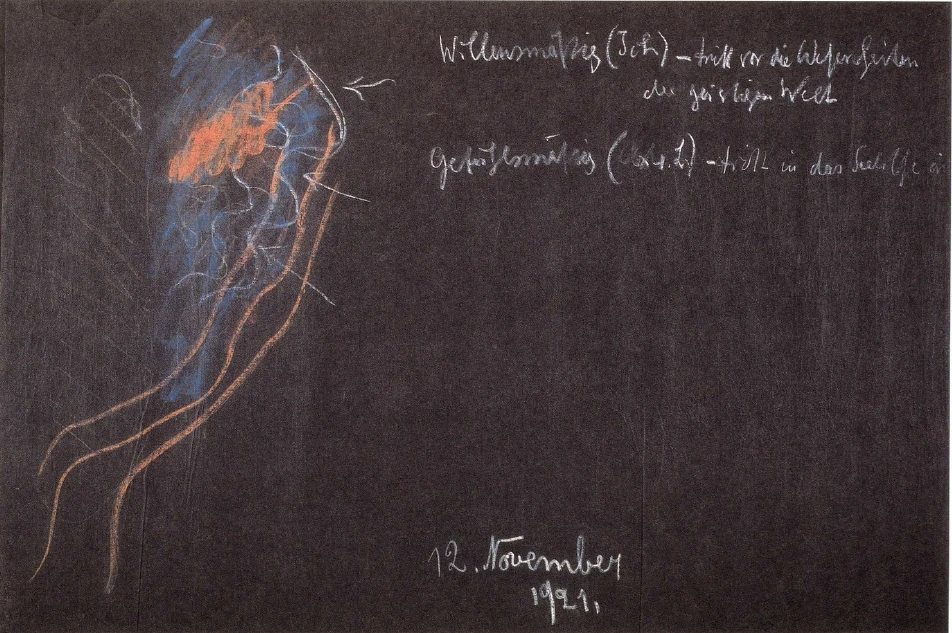
[ 12 ] If we first consider the “I,” it is a product of the will. This “I” of the will, which has formed its entire structure and constitution—from waking to falling asleep—within the physical and etheric bodies, appears before the beings of the spiritual world the moment we fall asleep. When we go about here as human beings in the physical world, we perceive solid bodies through our sense organs. We see colors; we perceive. We enter into a certain relationship with the physical forces of the world. In the same way, the volitional “I” enters into a certain relationship with the forces of the world in which it exists between falling asleep and waking up. Let us illustrate this relationship, as it appears to spiritual observation, in a diagram. Of course, I can only represent it schematically. Let this be the physical human being as he is when falling asleep, and let what I am now drawing here be the etheric body permeating him (see drawing, yellow). If I were to draw the human being in the waking state, I would now have to include the astral body and the “I.” I do not do this, however, because I wish to characterize the state that occurs when the human being falls asleep. The volitional aspect—that is, the “I”—steps forward before the beings of the spiritual world.
[ 13 ] It relates to these beings of the spiritual world in the same way that we relate to the beings of the physical world through our physical body while we are awake. Only this relationship of the volitional “I” to the beings of the spiritual world is, I would say, even more real than the maya-like relationship that the physical body enters into with its surroundings. And above all, this relationship is expressed in that everything a person has within their soul’s disposition that is evil—from the moment they fall asleep until they wake up—in a sense—one can only express these things figuratively — causes the volitional “I” to wither away during this contact with the forces of the spiritual beings, whereas the good that lies within the soul’s state allows the volitional “I” to unfold freely.
[ 14 ] If one wants to illustrate how this happens, one arrives—though, of course, you must again view this figuratively—at a certain form of what emerges from the human being as a spiritual, volitional “I.” With regard to the human being as a physical entity, the “I” is, of course, present within the person very intensely even during sleep. I would now like to illustrate this visually (the drawing continues): These grooves that I am drawing (in light color) have actually arisen through the counteractions of spiritual beings, and these grooves of the “I” take shape entirely according to the moral state of the soul. One can indeed speak of a spiritual form that the “I” assumes based on its moral state of mind as it enters the spiritual world.
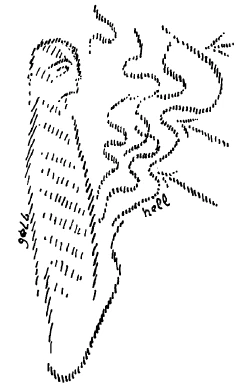
[ 15 ] But when we fall asleep, the astral body also enters the outer, more soul-related world. Regarding the volitional “I,” we can say: It steps before the beings of the spiritual world—; regarding the astral body, we can say: It enters the realm of the outer soul-world as we fall asleep. — Thus, the emotional astral body enters the realm of the soul.
[ 16 ] Our disposition of the will toward good and evil is, after all, thoroughly permeated by emotional elements and emotional forces. We need only recall how, when we have performed a good deed, our emotional state is different from when we have committed an evil act. One need only point to the entire realm of self-reproach and inner satisfaction to grasp how deeply the moral state of mind is imbued with emotion. All of this emotional aspect enters the inner world when we fall asleep, and it, too, enters into a relationship with the outer world of the soul. Just as we relate to the outer physical world through our images while awake—and in doing so, of course, develop our emotional life internally—though the emotional life is merely attached to the life of the imagination on the inside—so, during sleep, our emotional astral body approaches the soul world directly. But no formation takes place there. For the “I,” for the volitional “I,” a formation takes place; I have expressed this formation schematically through a kind of furrowing. What arises through the interaction of the astral body with the soul environment, I cannot express through a furrowing; I must express it through a tinge, through an impregnation. And I would have to draw this in such a way that, depending on whether our mind is burdened with self-reproach or with inner satisfaction, with feelings of sympathy and antipathy, it is tinged, permeated by what can be schematically expressed through a certain color designation (see drawing: reddish, blue). Thus, a shaping takes place through our “I” for what we call our “higher self,” and a tingeing, a coloring, for our astral self.
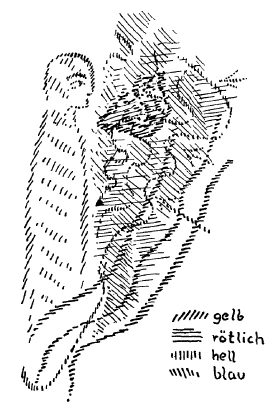
[ 17 ] “Permeation with color” and “permeation with tone” are, of course, only schematic terms. For although one is right to express what is happening there through images of color, one must still say that this is only a part of what is happening—what can be expressed through images of color. Instead of drawing colors here, I could just as well have all sorts of—let’s say—musical instruments here and strike different notes; then I would express the concept through other images, through sounds. Or I could even—let’s say—introduce sensations of taste into it. All of this, one might say, swirls about in the astral body, which is outside the physical body from the moment of falling asleep until waking up. The fact is, however, that one now sees: The active forces behind everything I have depicted here—schematically drawn—actually have such a direction (reddish lines) that the determining forces emanate from the human being’s limb metabolism. One might say: The spiritual beings and the soul world, which shape and color, act in such a way that they bring about the shaping and coloring as if from below.
[ 18 ] If one now tries to determine what actually constitutes that which, from falling asleep to waking up, takes shape as the “I” and the astral body—and which exists outside the human being—one ultimately arrives at the following. One comes to understand: In contrast to that perfect form of the human being that one is from waking until falling asleep—that one is when the “I,” the astral body, etheric body, and physical body—in contrast to this perfect being, which manifests with a certain intensity of consciousness, the consciousness of our intellect, feelings, and will—in contrast to this, what exists outside the human being during sleep has something infantile, something childlike about it. We recall the dull consciousness of a child and come closest to this state, at most, when it is interwoven with dreams. We must go even further back into imperfection to conceive of the child’s dull consciousness when we turn our attention to the similarity of this essential being that exists outside the human being during sleep. I would say: What lives out there in the human being is even more infantile than what exists in the child’s mind and soul.
[ 19 ] What, then, is this that exists outside the human being during sleep, in the realms of the soul and spirit? It is very characteristic that, from the perspective of spiritual science, the defining factor emanates from the human being as a metabolic entity of the limbs. And when one studies what can be observed there through supersensible perception, one actually has the feeling—and this feeling intensifies more and more into a very definite insight—that if one regards this whole as a photographic negative and imagines the positive image corresponding to it, the structure of the human brain truly emerges. Admittedly, the size is not correct, but when one imagines this as a negative and conceives the positive image to go with it, the positive image reveals the human brain.
[ 20 ] And remember some of the things I have explained from other perspectives. I have explained how the structure of the human head, as it appears in a particular life, internally—in terms of its force structure—reflects the form of the headless human being—that is, the human being without a head—from the previous earthly life, and that what a human being is today, apart from his head, contains the forces that his head will possess in the next earthly life. But we can already see this—in an infantile, childlike form and even inverted into the negative—in what the human being expels from within themselves from the moment they fall asleep until they wake up.
[ 21 ] In fact, what a person projects from within themselves from the moment they fall asleep until they wake up provides a pictorial representation of what will then physically manifest in the human head in the next earthly life. This is an extraordinarily important connection. And when we consider that it is actually the moral state of the soul that determines this form, this coloring, we must look for the embodiment, the materialization of the moral state of the soul in the powers of the human head in the next earthly life. And as these powers of the human head then express themselves as our power of thought and our power of imagination, we experience this power of thought and this power of imagination as the effect of our moral state of soul from this life. All of this, however, is present in a pictorial form in what the human being sends out from within themselves as they fall asleep.
[ 22 ] And so, based on observations from the spiritual sciences, one could actually say the following: Every night, when a person sleeps, they are in fact making a very specific inquiry directed at another world—the spiritual-soul world. Of course, they do not pose it consciously, but they pose it with that part of their being which then emerges from their physical and etheric bodies. They pose the question to the spiritual world: How does my moral state of soul appear to the beings of the spiritual world? And an answer is given to him. It is given to him in such a way that, depending on the state of his moral soul, he receives a certain facial expression and complexion. Every morning, when a person wakes up, he enters his physical and etheric bodies with an answer from the spiritual-soul world. Every time we fall asleep, we pose a question—an unconscious question—to the spiritual world; every time we wake up, we receive an unconscious answer from the spiritual world. We are, so to speak, in constant correspondence with the spiritual world through our subconscious, drawing from this spiritual world the answers about what we are actually like inwardly as human beings.
[ 23 ] And here you get a sense of something that otherwise always remains extremely abstract. Just think: when a person speaks of his conscience, he speaks of it as something very real; but when he is asked to give a specific description of his conscience, he immediately becomes vague. With regard to moral impulsivity, the conscience is something we experience very concretely within ourselves. If one reflects on the conscience in accordance with external science in the same way one might reflect on heat or light and the like, one falls into chaos. One arrives at no definite views. Here, however, you gain a definite view. Here you gain the view that you continually receive a response to your moral state of mind from the spiritual world. You bring what the spiritual world shapes within you into your physical and etheric existence. In doing so, you bring in the voice of conscience. In waking life, what one receives as a response is transformed into form and nuance—into the voice of conscience. Indeed, everything that constitutes our inner moral disposition must be related to the state of sleep on the basis of such insights.
[ 24 ] We have seen from many examples how the instinctive insight of earlier times—and also that instinctive insight which has been preserved even among people who are not entirely permeated by intellectualism—how this instinctive insight, even if in pictorial form, is wiser than today’s science. And so the moral maxims of instinctive insight also contain much of what is revealed to us—albeit more clearly, more transparently, and with greater definition—through genuine spiritual scientific insight. One need only consider how a maxim of popular consciousness holds that, if one is offended by someone, one should not carry the feeling this causes into sleep, but should, if possible, resolve it before going to sleep; that is, one should not carry anger into sleep, but should try to calm it before sleeping.
[ 25 ] If you know that falling asleep is like asking a question of the spiritual world and waking up is the answer to that question, then you will be able to tell yourself: You will receive a different answer and bring a different answer from the spiritual world into your physical body in the morning if you have calmed your anger or softened the impact of an insult in your feelings by evening, than if you have carried that insult into your sleep and asked your question of the spiritual world while still in the mood of that insult, or if you enter the spiritual world in a state of anger and your question is inflamed with anger. If you carry something angry into the spiritual world, it is as if a volcanic stream of fire were pouring in, and the outer soul world must then be tinged by this volcanic stream of fire (see illustration on page 183, reddish). This is different from when you have subdued your anger before falling asleep.
[ 26 ] Much of what has been described here can be recognized in its effects not only on the human mind, but even on the physical and inner organic state of being, and many inner causes of illness are to be found in what we receive as answers to the questions we unconsciously pose to the spiritual world as we fall asleep. For our physical and etheric organs must, while we are awake, cope entirely on their own with what is brought to them from the spiritual world upon waking by the volitional “I” and the emotional astral body.
[ 27 ] It is a thoroughly mistaken view to believe: “Well, a person experiences many things while awake, but experiences nothing while asleep.” — What a person experiences while awake are processes that take place, for the most part, between the person and the world—the external, physical world. Our reactions to what is happening there accompany us like inner dreams of the mind—we know, after all, that the emotional realm has only the intensity of consciousness found in a dream—and just as in a dream, these inner events accompany what we actually experience clearly in our relationship to the external physical world. But when we are in that state between falling asleep and waking up, a great deal happens internally within our “I” and our astral body: the volitional “I” is shaped, and the emotion-imbued astral body is tinged with the forces of the outer spiritual and soul world. And all of this is also a series of events, is reality, which now permeates, penetrates, flows through, and courses through the physical and etheric bodies. And depending on how we are permeated and coursed through by these forces, we in turn behave in the physical world. We do more for our inner life during sleep than while awake. What we do during sleep, however, depends on our waking state. But I would like to say: The full significance of sleep—its most fundamental significance—lies not only in physical experience, but in the moral structure of the human being.
[ 28 ] I have, in fact, pointed out on various occasions how external thinking is mistaken, particularly regarding the relationship between the human physical and etheric organisms and the process of falling asleep. Usually, the matter is presented—and I am merely repeating what I have explained often and at length—in such a way that people say: A person becomes tired through the exertion of their limbs, through work, and must then sleep because this restores the balance lost through fatigue. Simply reflecting on the fact that one does not always fall asleep because of fatigue could bring correct thinking to light here. One need only recall that a well-rested reindeer, for example, listens to a lecture—which it might attend once, simply because that is the custom—and after the first five minutes, it has usually fallen asleep—hardly out of fatigue!
[ 29 ] If one examines all these phenomena that arise purely from external experience in this area, one actually comes to the conclusion that ordinary thinking confuses cause and effect here. In truth, we are tired because we want to fall asleep. The impulses to fall asleep arise much more inwardly than in the sphere of fatigue, than in the sphere of the physical opposite. When we have no interest in the external world, a longing arises within us to withdraw from it. Then the soul-spiritual leaves the physical-bodily, and the physical-bodily grows weary. We grow tired because we want to fall asleep, not: We fall asleep because we are tired. Anyone can convince themselves of this, if they are willing. However, becoming convinced of such things—which are so intimately connected with the self-satisfied interests of life—is extraordinarily difficult. But we can convince ourselves if we are only willing to do so. And we will then be led to see falling asleep not merely as a physical-physiological process, but to place it within the entire cosmos, which—as we have characterized from various perspectives—also contains moral impulses as real impulses, not merely as words. And so it is precisely the alternating states of sleep and wakefulness that show us how a bridge can be built between the physical and the moral in our world order.
[ 30 ] Du Bois-Reymond, the same physiologist who gave his famous lecture on the limits of understanding nature—a topic I have discussed on several occasions—once said: “We cannot comprehend human beings at all as they stand before us in waking life.” Well, we know, of course, how we are to regard such a statement. But, Du Bois-Reymond argues, we can understand the sleeping human being. In the sleeping human being, he argues—though we know this is not correct, but let us consider this statement for the sake of argument—the lawful interrelationships of the external physical world, which we do understand, are present, albeit in a more complex form. Thus, one can only understand the sleeping human being scientifically, but not the waking human being.
[ 31 ] This means—as I said, we do not wish to discuss the correctness or incorrectness of this statement today—but it is thereby acknowledged from a scientific standpoint that one cannot ascertain by scientific means what permeates and penetrates a person while awake, and that the sleeping person, as a physical entity, appears quite different—even to the scientific mindset—than the waking person.
[ 32 ] Natural science, of course, knows nothing of what emerges from the human being and exists in the supersensible world as the volitional “I” and the emotional astral body. But this “nothingness” that natural science describes—what is it in the light of our present considerations? It is, in fact, precisely something that belongs to the moral order of the world! Thus, precisely at the point where the natural-scientific worldview ceases to apply, the actual workings of the moral realm begin as a real world. And it is only through its effects that this moral realm manifests itself in the human condition after waking. So if we wish to enter the realm where the real moral can be found at all, we must observe the world that a person experiences between falling asleep and waking up. It is no wonder, then, since the scientific worldview does not enter this realm, that it recognizes as real only that which does not contain moral impulses and relegates moral impulses to the realm of mere belief.
[ 33 ] This belief, however, becomes just as much a real form of knowledge as that achieved by the scientific worldview when we turn our attention to the other realm. We must, however, proceed from entirely different starting points in our exposition if we are to consider this spiritual-psychic realm, which is permeated by morality, at all.
[ 34 ] If I had painted anything here that is a reproduction of a physical object, then I would have had to stick to the physical, and what I had painted here would simply be the image, and one would move from external reality to a mere image. When depicting the supersensible, one must take the opposite path. It is supersensible; one must experience it inwardly. And then one turns outward and depicts in the image what has been experienced inwardly. This inner experience is also something that is thoroughly dynamic in itself, and I would actually have to depict these hues as glittering, shining, intermingling, flaring up, and fading away. This flaring up and fading away, however, can certainly be observed when one looks at the whole human being through spiritual scientific research.
[ 35 ] If one forms a mental image—and I am trying to be very precise here—of the astral body and the “I” during sleep, the form of the “I” and the coloration of the astral body are sharp and bright. When the “I” and the astral body now return to the physical body and the etheric body, what is bright, glittering, and shining during sleep becomes dark and dull; and what has definite contours outside the body takes on indefinite contours within the body at the “I.” And one has a very definite sensation when one observes this immersion of the “I” and the astral body into the physical and etheric bodies upon waking. If one were to choose abstract terms to express this sensation, one would generally describe it rather clumsily. But one can nevertheless define quite precisely what is actually happening there. When a person awakens—we know from supersensible observation of the “I” and the astral body that they are bright and sharply defined—after they have entered the [physical and etheric bodies], the astral body appears as if with blurred contours, dull, dark, and lacking luster. One has the same feeling as when one allows the onset of autumn and winter to affect the soul day by day. To view the waking process in relation to the whole human being would mean putting oneself in a mood similar to that experienced as winter sets in. And upon falling asleep—that is, when the spiritual-soul aspect withdraws from the human being—one experiences a soul mood akin to that felt as spring and summer arrive. One is thus truly led into something quite special.
[ 36 ] My dear friends, for weeks now I have been striving to show you how a spiritual-scientific perspective leads us to place the human being within the broader context of the cosmos. I have connected the human form with the world of the stars, with the world of the fixed stars, and the stages of human life with the planetary world. When we view the human being from a spiritual-scientific perspective, we are led out from the human being in every direction. Today we considered the alternating states of waking and sleeping, and by understanding them intuitively, we are once again led out from the human being—not into the world of the stars this time, but into the world of time. We said to ourselves: We understand waking up when we understand the transition from autumn to winter; we understand falling asleep when we understand the transition from spring to summer. We are led from the human course of time into the cosmic course of time. We are led from the human alternating states between sleep and wakefulness into the seasonal transitions of spring, summer, autumn, and winter. We see in human beings a reflection of what also happens in time, whereas for weeks now we have been striving to see in human beings a reflection of the macrocosm, focusing more on the spatial aspect.
[ 37 ] This is how one places human beings within the world, and this is how one understands human beings from within the world. Then, however, the moral world order presents itself to us as a reality, not as a world of empty words. And then, when a person becomes imbued with all that he can feel from this context of his world, his ethical-moral world, too, becomes imbued with religious impulses, then the ethical will within the human being becomes the expression of the divine will at work within him, and then the sphere of the ethical-moral rises into the sphere of the ethical-religious. This is how anthroposophical spiritual science seeks the path to the ethical and the religious. We will speak further about this tomorrow.