Anthroposophy as Cosmosophy I
Human Traits in the Earthly and Cosmic Realms
GA 205
13 November 1921, Dornach
Translated by Steiner Online Library
Twenty-second Lecture
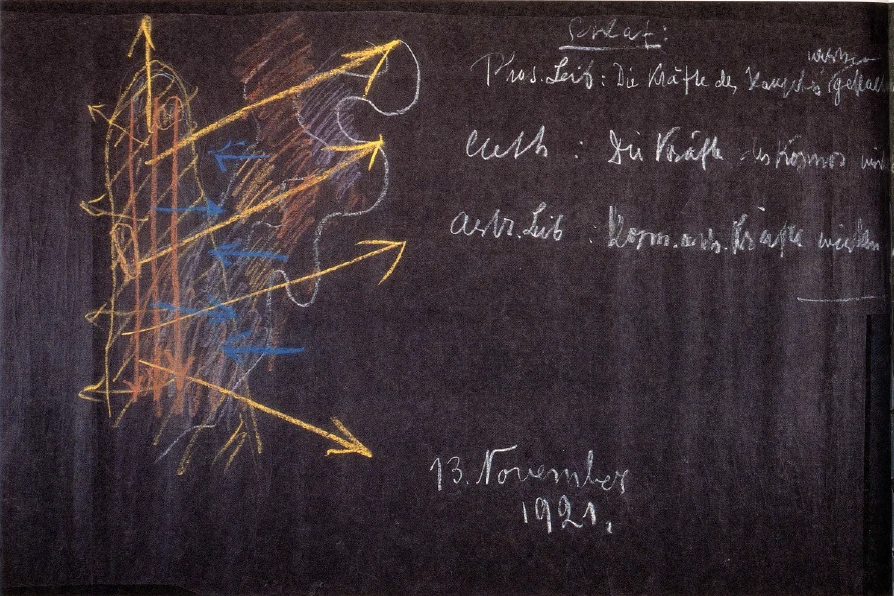
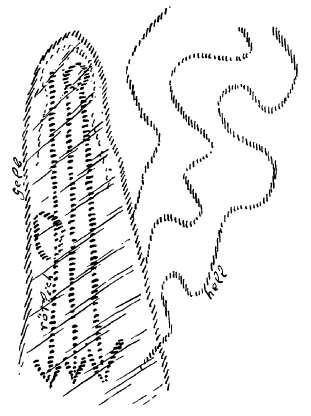
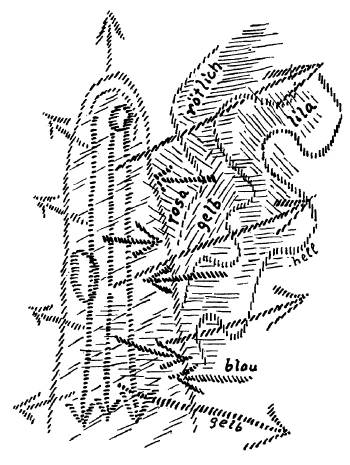
[ 1 ] Yesterday we focused on how the human astral body and the “I” behave in the state between falling asleep and waking up, and we would like to pick up on this again. I said that if we wish to contrast the human being—as he exists in the sleeping state as a physical body and an etheric body—with his “I” and his astral body, we must say: The “I” endowed with will, the volitional “I,” is shaped by the relationship it enters into with the beings of the spiritual world during sleep. - So, if we draw a schematic diagram, we obtain a configuration of the “I.” And I said: If one regards this furrowed configuration of the “I” (see drawing on page 197, light-colored) as a kind of negative, as one has in photography—though, of course, one must not take the proportions into account here—then the configuration of the human physical brain would be like the positive. As for the astral body, we must conceive of it as imbued with the soul elements of the environment, which I express schematically by drawing it in various colors (see: pink, reddish, yellow, purple).
[ 2 ] Now, I said yesterday that this does not yet address the behavior of the physical body and the etheric body during sleep, and we left that out yesterday. Let us add that today. The human physical body is, after all, seemingly known to external science, but only seemingly so. For this external science pays little attention to how fundamentally different the “limb-metabolism human” and the “head human” are. The “head human,” the head-human, is, according to its physical constitution, actually a reflection of what the human being is during the time between death and a new birth. Again, proportions cannot be taken into account here.
[ 3 ] The physical brain—as science views it today—is regarded as if its structure were merely the result of the paternal and maternal organizations. But we have already seen from various observations we have made that this does not correspond to the facts. What takes place during the development of the human being here in the physical world consists—to put it somewhat crudely and radically—in the fact that, within the mother’s body, the substance is initially thrown into chaos, and that into this chaotic substance—which has abandoned the laws of both chemistry and physics—forces from the universe are implanted, forces that constitute the embryo. And within these forces, which act formatively from the universe into the mother’s womb, there are also—I would say—implanted the forces that the human being brings with them after having passed through the time between death and a new birth. One might actually say: The human being is itself implanted into the mother’s womb in accordance with its own form. In the mother’s womb, only the bed for the human being is formed, and it is precisely arranged in the universe in such a way that where an opportunity is created for something specific to come into being, that specific thing does indeed come into being.
[ 4 ] Now, the human head is internally structured in such a way that, first of all, it is a replica of what was imprinted and colored here in the previous earthly life; but the entire universe, so to speak, is also imprinted within this head. Modern science actually has a very poor understanding of the process of cognition, for it must be understood in this way: Within this human brain, with its complex structure, there is in fact a complete replica of the universe. And the forms that appear there cannot be penetrated by the “I” or by the astral body. As I have explained in earlier reflections, they live freely within the human head. This is why the human being is aware of itself specifically as the “I” and the astral body—because these live freely. Only with the metabolic human of the limbs can the “I” and the astral body truly unite, as we have seen. There they proliferate within and transform him primarily into a being of will, as we well know. Consequently, however, what lives primarily in the human being of limb metabolism is that which, upon death, steps out once more into the spiritual world—a world that receives the human being through his “I” and his astral body and carries him on to further stages of existence— while in the human head is present everything that comes from previous lives and from the lives between death and rebirth, and which has, so to speak, taken shape within this head organization and become part of it. The human head points backward, the limb-metabolic human points forward, and the rhythmic human is precisely this oscillation back and forth between the past and the future.
[ 5 ] Only when one understands the physical human being in this way will one understand the structure of the limbs and the inner life of the limbs. One will understand why the human head’s metabolic organization is actually a descending one, one that is continually weakening, whereas the metabolic organization of the limbs is one that is continually building itself up. One will also understand why the metabolic organization of the limbs must be connected to the chemical and physical nature of the earth—a connection that is, after all, expressed through nutrition.
[ 6 ] Well, this “limb-metabolism human” actually absorbs what is necessary for its further development. During waking life, however, the “limb-metabolism human” is, in essence, very much dependent on the forces that emanate from the Earth itself. The limb-metabolism human is subject to the Earth’s gravity; he is subject to the Earth’s other forces. He is subject to the forces that emanate from his food and permeate him. In a sense, he is thoroughly an Earth being. And because the limb-metabolism human, by virtue of his formation, did not participate in what the human being experienced between death and a new birth prior to the present earthly existence, this limb-metabolism human is therefore unable to adapt to the outer spiritual universe even during waking life. He is, so to speak, devoted to the physical nature of the Earth during the waking state.
[ 7 ] But this is not the case during sleep. For everything connected to a person’s past—including life between death and birth—is formed within the human head. As I have just explained, this human head contains, in the forms of the organs, in a subtle, fleeting way, images of the entire cosmos.
[ 8 ] Everything that the human head represents as a reflection of the universe cannot affect the metabolic being of the limbs during the waking state. For the human head, as the seat of the most eminent sense organs, is in constant correspondence with the external earthly world. Everything that is seen and heard is taken in through the head during wakefulness. During sleep, it is not merely the case that the human head is nourished in a physical sense; this, in fact, also occurs during wakefulness. That is not at all the essential aspect for the physical body during sleep; rather, something entirely different is of primary importance for the human physical body during sleep.
[ 9 ] In the eye, for example, we have not only the structure that enables vision, but at the same time we have a reflection of the cosmos—of the spiritual forces of the cosmos. Between death and birth, the human being lives in the spiritual-soul cosmos. The structure of the eye is modeled after this life in the spiritual-soul cosmos. The eye, like all the organs of the head, has a dual function: first, to mediate communication with the external world through sight. This occurs during waking life. During sleep, the eye, through its surroundings—namely its nervous and circulatory systems—exerts a reciprocal influence on the physical organism, insofar as this is the metabolic-limb system; for example, during sleep, the forces of the closed eye act upon the human renal system and imprint the cosmic image upon it. Other organs of the head imprint other aspects of the cosmos onto the human metabolic-limb system. And so, for the physical body, our sleep serves above all to allow the forces of the head to act formatively upon the metabolic-limb human (see drawing, reddish arrows, and diagram). It is precisely during sleep that—to put it schematically—formative forces continuously radiate from the head toward the lower human being, so that during sleep the head actually functions as the spiritual-soul formative force for the metabolic-limb human being.
[ 10 ] The concept of creation is completely misunderstood if one focuses it on any particular moment. We are, in fact, continually being created. Every night we are created out of the spirit; our metabolic and limb systems are formed and enlivened every night from the spiritual realm.
[ 11 ] As you know, contemporary materialistic science actually holds the opposite view—namely, that the forces of metabolism act upon the exhausted brain. However, this is only one side of the story. While this effect takes place from the bottom up, the spiritual and psychological revitalization of the human being occurs from the top down. And it is important to realize that this spiritual and psychological revitalization is governed by a high level of consciousness. We humans will not attain this level of consciousness—which is necessary to bring about those wondrous processes that occur within the human physical body during sleep—until the development of the volcanic planet; for the level of consciousness corresponding to this is that of the spiritual human being. The consciousness of the spiritual human being is truly within the human being. It makes itself felt during sleep, and it makes itself felt in the processes I have just described. But at his present stage of development, man is not yet able, so to speak, to recognize himself to such an extent that, under normal circumstances, he would sense within himself this interplay and essence of a much higher level of consciousness than he possesses during his waking activities.
[ 12 ] A proper appreciation of such things is inherently linked to the fact that, through spiritual science as we come to know it here, a person’s religious life is deepened. If a person neglects what he is through his life activities, allowing it to wither away, if he does not attempt to instill in his physical body what can be instilled during earthly life, then he intervenes destructively in something in which—unbeknownst to his normal consciousness—a much higher consciousness prevails than he himself can possess.
[ 13 ] When we look out into the universe, we are not only gazing upon a world before which—if we understand it correctly—we bow down in awe; we must do the same when, with true understanding, we look into the workings of the superhuman within our own human selves.
[ 14 ] With this, I have given you a rough idea of how the state of sleep relates to the human physical body.
[ 15 ] In addition to the physical body, we also have the etheric body (see illustration on page 197, hatched). This etheric body of the human being is, in the waking state, constantly subject to the influences emanating from the “I” that acts in the world and from the astral body, which is connected to this “I.” During the waking state, we constantly observe the colors brightening and fading, as well as the other colorations that take place in the astral body and spill over into the etheric body; and we actually see, during the waking state, the etheric body adapting to the astral body. But we also see what the “I” is, through its form, impacting the etheric body. In short, during the waking state we see the interplay of the “I” and the astral body within the etheric body. During sleep, the human being—as the “I” and as the astral body—is outside the etheric body. There, the astral body with its coloring and the “I” with its form do not play a role within the etheric body. There, the etheric body is left to its own form. And this form of its own is expressed in that, during sleep, the etheric body takes on a magnificent form as a reflection of the universe.
[ 16 ] The etheric body is, in fact, taken up by the human being in its essential substance as the human being moves from prenatal life into physical life on Earth. The etheric body is, in fact, composed in accordance with the way the human being has lived between “death” and a new birth. And everything that comes from the universe—as spiritual science symbolically puts it: what the human being has taken in from the heavens—from the north, south, east, and west—is carried within the etheric body. For the reason stated, the human being cannot reveal this during the waking state. It is revealed during sleep. There, the human being is actually entirely memory—memory, first and foremost, of earthly life.
[ 17 ] From time to time, people become aware that when they sink into their etheric body, they are sinking into a sea of images, which they then classify as dreams. But anyone who has taken the trouble in this regard to observe, upon waking, the sea of images that a person traverses, as it were, upon waking—if they observe what is being experienced there—will discover how, in fact, the entire earthly life is contained within this etheric body during sleep. A person actually lives and weaves within all that they have experienced since birth in the etheric body during sleep. But all of this is shaped for the etheric body from outside by the cosmos, by cosmic forces. And because nothing now influences it from the astral body or the “I,” the etheric body radiates what it received—what was incorporated and instilled in it—at birth. The human etheric body becomes radiant (see drawing, yellow arrows).
[ 18 ] This is a significant fact—the way a person begins to radiate while asleep. This radiance of the human being during sleep is, in fact, something that—for the earthly world, when it is plunged into night after the sun has set—represents a spiritual radiance of humanity, in contrast to the physical rays of the sun. However, incorporated into this spiritual radiance of humanity is everything ruinous, stunting, and destructive that human beings, out of their own wickedness, implant into the etheric body through their astral body and their “I” during their lifetime. But the Earth would not be able to cope with its evolution if this radiance of humanity did not take place.
[ 19 ] If an observer had the necessary senses, and if he were out in space observing the Earth from there, he would say: During the day, on the side of the Earth illuminated by the Sun, one sees precisely the sunlight reflected back; but when night falls over a part of the Earth, the Earth then phosphoresces—it glows. — And what such an observer would find glowing there are the human etheric bodies. But the Earth also needs all of this to continue its development. If no human beings were sleeping on Earth, the Earth’s vegetative power would have to die out much more quickly than it does in earthly life. Human beings are by no means integrated into earthly existence merely to live for themselves; they are not insignificant for the overall structure of the Earth. What they absorb in the spiritual worlds between death and a new birth, they in turn radiate from their etheric bodies into the Earth’s evolution while they sleep during their earthly lives.
[ 20 ] So we can say: In the case of the physical body, the radiation flows from top to bottom; in the case of the etheric body, it flows from the inside out. Human sleep certainly has a cosmic significance as well.
[ 21 ] That is why I had to tell you yesterday: When the “I” and the astral body once again submerge into the etheric body, one has a sense of autumn; whereas when the etheric body lies exposed during sleep, one has a sense of spring and summer. It is indeed the case that, in a sense, as the astral body emerges and retreats, the human being becomes more sun-like or more winter-like in spiritual and soul terms.
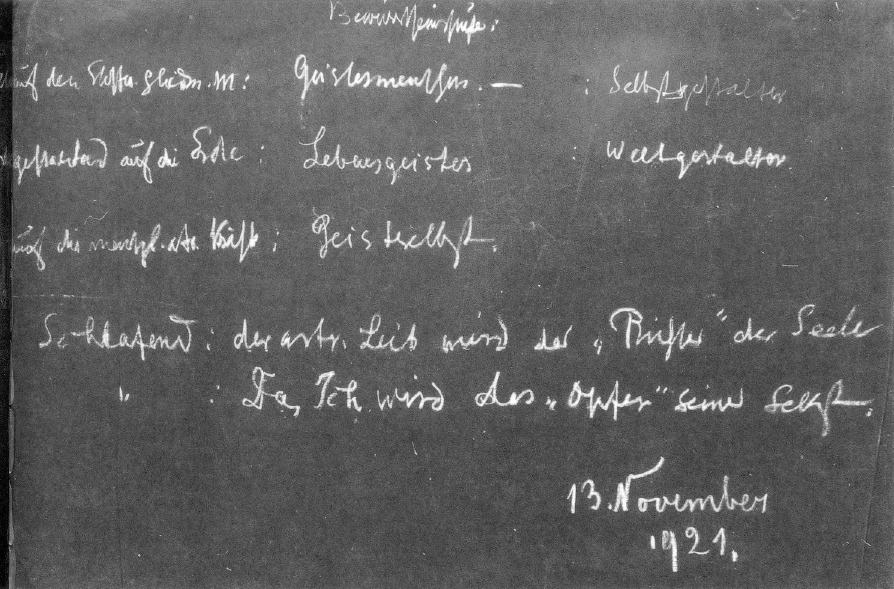
[ 22 ] We can therefore say: During sleep, the human etheric body is in such a state that the forces of the cosmos—namely, those that the human being gathers between death and a new birth—have a formative effect on the Earth. Within this process, a higher consciousness is also at work than that which is initially available to the human being for their waking activities. For it is the consciousness of the life spirit that is at work in this activity—in this sleeping activity of the etheric body. It is the consciousness to which human beings will only evolve once our Earth has reached the stage of the Venusic phase in its metamorphosis.
[ 23 ] We see, then, that for the “I” and the astral body on the one hand, and for the physical body and the etheric body on the other, the relationship is such that they do not interact during sleep, but do interact from the moment of waking until falling asleep. An interplay takes place, a kind of pendulum swing between interaction and non-interaction. But here, too, it is the case that at the moment when, upon waking, the “I” and the astral body approach the physical body and the etheric body, and at the moment when they withdraw again upon falling asleep, an interaction takes place that is governed by a consciousness which the human being cannot access even with the consciousness suited to waking activity. Human beings can, of course, influence waking and falling asleep in a certain indirect way. But those subtle, intimate processes that take place between the “I” and the astral body on the one hand, and the physical and etheric bodies on the other, during falling asleep and waking—human consciousness has no capacity to perceive these more intimate processes.
[ 24 ] I would like to express this interaction that takes place using these arrows moving toward and away from each other (see illustration on page 200, blue). In this direction, in this interplay—which is particularly evident when waking up and falling asleep, but which in a certain sense continues even while awake and even during sleep—in this interweaving of astral and etheric forces, what we can now primarily observe regarding the astral body comes to the fore. We can say: As for the astral body, it is stimulated in a cosmic sense. Consider that from the moment of falling asleep until waking up, the astral body is indeed colored by one’s moral feelings, as I described yesterday. Upon waking, it enters the cosmically structured etheric body. There it must align itself with it; there it must adapt to it. And we can say: The cosmic-astral forces act upon the human-astral forces. This can be traced very clearly in a particular case.
[ 25 ] Imagine that human beings had not gone through this life between death and a new birth—just as animals have not—but instead were born as the Aristotelian worldview dictates: they would be newly created beings at birth. They would not bring into their lives the effects of previous earthly lives and of the life between death and a new birth. Then human beings would let their gaze wander, let their senses wander over external experiences, but they would never connect these external experiences through concepts or ideas of geometry and mathematics. This is just one case, but it is one of those cases where what applies to the cosmos—geometry—interacts with what applies only to the earthly environment. The earthly realm is permeated; empirical experience is permeated by the rational, mathematical-geometric. But this interaction takes place continuously, and it takes place in such a way that the spiritual self acts within it as consciousness. Of course, those who view the world through mathematics know nothing of this—that while they are truly engaging in mathematical observation, the spiritual self is actually always pulling their strings behind the scenes. But they do not take this into account because they limit themselves to the reflection of it that exists in ordinary human consciousness.
[ 26 ] Only then—when a person is neither asleep nor awake nor falling asleep, but is fully immersed with their “I” and their astral body into the etheric body and the physical body—does the ordinary consciousness of today exist; only then is a person wholly devoted to all that emanates from the spiritual being, the life spirit, and the spiritual self. When a person has reached that stage of existence—which they will attain once the Earth has undergone its metamorphosis into a Jupiter existence, as described in my Outline of Esoteric Science, then it will be the case that human beings will no longer form a cube externally through geometry and then find that this ideal cube shape fits the crystallized salt; rather, they will perceive it as a single unity. They will be so absorbed in the external world that they will, so to speak, be immersed within the salt itself. Such salt will not, of course, exist on Jupiter, but through such conceptions we can gain a clear understanding of human life in the future.
[ 27 ] Thus, in the same way that we considered the astral body and the “I” yesterday, we can also form ideas about how the physical body and the etheric body behave during sleep. During sleep, the physical body actually acts as a self-shaper in relation to the human being’s limb metabolism, and the human being’s etheric body acts as a world-shaper.
[ 28 ] If we now look back once more at what we considered yesterday, we must say: The human astral body emerges from the physical body and the etheric body during sleep. The soul forces of the universe flow into it. It is permeated by them. And depending on a person’s feelings and state of mind, these forces can permeate the astral body. If a person sympathizes with goodness, then the most beautiful forces of the universe will be able to permeate them. If a person develops inclinations toward evil, then their astral body will wither away. For every level of inner feeling and sensation, there are certain shades of color that the astral body takes on during sleep (see illustration on page 200: reddish, yellow, pink, purple). One might say that just as a person is, so does their astral body shimmer during sleep. The astral body is, after all, what constitutes the state of the soul—the state of mind—during the waking state. This state of mind, so to speak, pours out into the spiritual universe during sleep, and in this outpouring the person experiences themselves—not by having changed their state of mind, but by standing before the spiritual-mental world in relation to their state of mind.
[ 29 ] If a person, by living out there with his astral body, were able to penetrate into the consciousness of the life spirit, then he would be able to speak to what is happening to his astral body. This happens, at first, unconsciously to the person, but it does happen. Who, then, would speak if a person suddenly attained the consciousness of the life spirit while asleep? Who would speak? One can say nothing else but this: The person’s astral body would speak as the judge of good and evil within the person. So that one must truly say: While asleep, the astral body becomes the judge of the soul. — If understood correctly, this is an important statement for human life. It is a truth that shines across as if from beyond the threshold to the spiritual world, and one that a person should hold before their soul as often as possible.
[ 30 ] Take the corresponding concept for the “I.” The “I” emerges from the physical and etheric bodies and takes shape in accordance with the forces of the universal spiritual beings. It becomes what it can become, depending on how it lives within the physical body. If it were to awaken to the consciousness of the spiritual human being, it would not merely speak to itself, as the astral body would speak to itself if it were suddenly endowed with the consciousness of the life spirit; rather, the “I” would be endowed with the consciousness that is at work in the physical body left behind—the consciousness that sends the forces from above down into the physical body left behind— if the human being were thus endowed with this consciousness in his “I” when it has stepped out of the sleeping state, then the human being would not only experience a series of judgments concerning himself, but he would also see what he is now becoming as an image and what will then act as a seed for his subsequent earthly lives.
[ 31 ] I can find no other way to express this fact, if I am to encapsulate it in a single sentence, than to say: The “I” becomes a sacrifice of itself, a sacrifice to the Spirit at work within the body. — A sacrifice can be such that it is gratefully received; this can also be the case with the “I,” as it is shaped from the outside. A sacrifice can also be such that it is rejected. These are the most extreme, most radical outcomes of the process. What a person experiences, of course, lies essentially in the middle. But a sacrifice can also be rejected if it is not worthy of being sacrificed. Thus, if a human being appears before the spiritual beings of the universe in such a way that he must wither away severely due to what he experiences in the physical and etheric bodies during wakefulness, then he becomes a rejected being.
[ 32 ] So you see that the concept of sacrifice can certainly be applied to what is taking place here. And it seems to me that these two statements—“While asleep, the astral human being becomes the judge of his own soul” and “The ‘I’ becomes the victim of itself”—are extraordinarily important for a complete understanding of the human being.
[ 33 ] If one looks at what humanity’s ancient instinctive wisdom has attained—not from that clarity of consciousness toward which we must strive today according to anthroposophical spiritual science, but precisely from instinct—then, as I have often hinted to you, one becomes aware of images of humanity’s significant primordial wisdom. They are expressed in myths and in ancient sayings of wisdom; but they are also expressed in the ritual practices that have been preserved in the various religious systems.
[ 34 ] Therefore, if we understand them correctly, we develop a deep reverence for the traditions of ancient religious images and cult images. And fundamentally, a living religious sensibility in human beings can only return when spiritual science’s understanding of the world—not merely in words, but in its deepest essence—reaches not just the intellectual mind, but the whole human being, by teaching them not only an understanding of the world, but also a sense of awe for the workings of the spiritual in the world. We have seen this once again, especially today. This spiritual science will once more be able to revive people’s religious sensibilities. But humanity has also gone through—and we know it had to do so in order to attain its freedom—a period in which it lived solely according to intellectualism, rationalism, and the materialism associated with them; and the majority of humanity still lives in that state today. But we must return once more to grasping what is spiritual in the world. We must once again come to a life beyond the merely intellectualistic understanding of the world, beyond the experience of the purely intellectual human being.
[ 35 ] But if we, I would say, skip over this period of intellectualism and look back to times when the old religious images were still alive—images that, at the same time, served as images of knowledge well into the Middle Ages of modern humanity—if we look at the cult images that were used in religious practice, then we find in all of this something that is remarkably similar—only derived from instinct—to what we can now, in turn, draw from the spiritual worlds with clear consciousness. For I must say: When the thought arises from inspiration, expressed in the sentence: “The astral body, while asleep, becomes the judge of the soul”—then one can see how what Michelangelo painted in the Sistine Chapel as the “Last Judgment” presents itself as an adequate image. In this painting of the “Last Judgment” on the altar of the Sistine Chapel, for example, we have something that rises up from time immemorial. It has merely taken on a Christian form. And once it had taken on a Christian form, it had already become more traditional. These things were depicted based on tradition. There have been times in human development when these things were perceived vividly. At that time, instinct simply looked to the inspired imagination of human souls judging themselves in sleep.
[ 36 ] And again, when we look upon what appears to us as such a profoundly moving image—the image of the Lamb of God, of Christ, that Christ who unites with the human “I,” who permeates this human “I”—then the thought stirs within our soul—precisely as we gaze upon the sacrificing Lamb — of the sacrifice that the “I” becomes as it passes into the state of sleep, and we find how aptly this sacrificial nature of the human being during sleep is expressed through the image of the Lamb. We come to realize how, out of an instinctive consciousness of wisdom, this image was found to provide the help that the “I” needs in its earthly existence, because in sleep it becomes the sacrifice of its own self.
[ 37 ] One cannot help but point out again and again that anthroposophical spiritual science, in its development, does indeed strive for completely clear concepts—but for concepts of the kind that are otherwise found only in the structure of mathematics or geometry; yet, because these concepts are rooted in the living life of the world spirits, these concepts—which arise through spiritual science—are such that they do not leave us cold like mathematical concepts; rather, they permeate us at the same time with the warmth of feeling and with the warmth of inspiring impulses of will. Here we perceive the intimate connection between clear thinking, warm feeling, and energetic willing in the human being. It is only from such a perspective that we can truly grasp the full scope of human nature.
[ 38 ] And indeed, many aspects of history only become clear when one can proceed from such an understanding of human nature. Well into the Middle Ages, I said, we still find among many people an understanding of the truth contained in the ancient images, of that experience of the world sub specie aeternitatis, as it existed in the ancient, instinctive life of wisdom, and as it must be regained through clear consciousness—a state one must strive for through anthroposophical spiritual science.
[ 39 ] Sometimes, throughout history, we see remarkable figures emerge, and in a peculiar way, such remarkable figures seem—one might say—quite out of place in the present context. I once spoke with a Benedictine priest at Monte Cassino during a trip to Italy. He mentioned how, in his breviary, listed among the names of the saints is that Saxon German emperor, Henry II, who is also—I don’t know in how many history books this is still mentioned—called “the Saint.” But if we consider what this Henry II intended—whose name is thus still among those that play a role in certain breviary prayers of Catholic priests—he intended: Ecclesia catholica non Romana. —That was the motto of Henry II, the Saint! And in the time in which he lived, that is, in the 10th, 11th century—it was still entirely possible, based on a genuine experience of ancient, handed-down wisdom, to speak of how what had come into the world through Christianity was to become an Ecclesia catholica, that is, a church for all humanity, in which the very spirit that was actually meant to have come into the world through Christianity would reign. But Henry II, the Saint, wanted an Ecclesia catholica non Romana, for the Ecclesia catholica Romana had become a secular empire. And it is true that wherever spiritual realms become secular realms, the Ahrimanic seizes upon that which lives as a sanctuary and which already lived in the primordial wisdom traditions of humanity. There was still a strong awareness in the time of Henry II that the Ecclesia catholica could be separated from the Ecclesia catholica Romana, and that one should actually strive for an Ecclesia catholica non Romana.
[ 40 ] I say that in the Breviary, this Henry II is listed as a misplaced saint. The Ecclesia catholica Romana has not the slightest reason to count him among its saints, for he was one of those who, out of holy Catholic zeal, sought to overthrow the Roman Catholic Church for the sake of the Catholic Church.
[ 41 ] These are historical facts that should be brought to people’s attention precisely when pointing out the most important truths, which in turn can be brought to the surface of conscious human existence through anthroposophical spiritual science. Today it is very necessary to point these things out, for in the individual repulsive phenomena that you may encounter here in your immediate vicinity, emanating from the Ecclesia catholica Romana, you can see how the Ahrimanic spirit has been able to penetrate. On the one hand, one must not allow oneself to be deceived by this Ahrimanic spirit into forgetting that the non-Roman Catholic Church does indeed harbor within itself luminous, eternal wisdom. And in the theology course I was permitted to hold here, it became evident that, arising from that Protestant longing—which was making itself felt there—for a deepening of Protestantism toward the spiritual side, moving away from rationalism and intellectualism, it became evident that for some of the participants, the phrase: “Ecclesia catholica non Romana” had the effect of a true liberation. For we are today firmly of the view that rationalism must be overcome just as much as the worldliness of the Roman Church; that humanity must once again come together in a universal spiritual life, which, however, must not be co-opted by any worldly lust for power.
[ 42 ] The Ahrimanic spirit is a spirit of lies. It can even happen, stemming from this Ahrimanic spirit, that spirits of lies lend themselves to declaring what is false to be the truth. That is precisely why it is necessary to develop a profound aversion to lies, arising from the very depths of world events. One truly acquires this profound aversion to lies when one can utter the following words with full consciousness: “The astral body, while asleep, becomes the judge of the soul. The ‘I,’ while asleep, becomes the victim of itself.”
[ 43 ] The Ahrimanic spirit, which has also crept into the religious creeds of modern times, casts a shadow over these profound truths. Those who sincerely—but also with some vigor—profess the anthroposophical view should not merely feel an outward, intellectual inclination toward the wisdom that anthroposophy can offer, but should develop a genuine inner energy—an energy of feeling and will—that connects with what the spirit can grasp from the spiritual world through anthroposophically oriented spiritual science. This, my dear friends, is also meant to serve as a guide to how we must distinguish between what is contained in the traditional preservation of religious images and religious cult figures, and the way in which these religious images and religious cults are sometimes handled today.
[ 44 ] Who would not feel the deepest reverence for what, as if shining forth from the spiritual antiquity of the East, is contained in the ritual practices of the Russian Orthodox religion! One can approach these rituals anywhere in such a way that, through what is taking place there, one is, as it were, drawn into the immense depth that is revealed. Millennia upon millennia of instinctive development of wisdom find expression in these rituals.
[ 45 ] Well, I once took part in such a ritual in Helsinki years ago, where it was celebrated on the occasion of the Easter festival, and I must say: Among the saddest memories of my life is what those priest-comedians—those terrible inner liars—did to the eternal truth by turning it into a farce! Today, the state of the world is such that, under the influence of Ahrimanic materialism, outward falsehood and inner truth clash in the most terrible way. Without truly feeling this, one cannot today arrive at a profound understanding of the human being.
[ 4 ] But we desperately need to arrive at this vigorous understanding of human nature, for I could see at the time how even gifted people who participated in that Easter ceremony had all awareness of their humanity wiped out, because a ceremony that, if celebrated with dignity, would have been supremely appropriate, was instead abused by clownish priests.
[ 47 ] But what could have happened here in a radical way is, in essence, happening today with varying degrees of intensity everywhere. Anthroposophical consciousness should be able to see these things and thoroughly distinguish truth from falsehood, even where this distinction is very much obscured by the pressures of external circumstances. We must gain something from anthroposophical deepening for the whole human being everywhere, and above all for our sense of the times. That is what I wanted to share with you today, following on from my previous reflections.