

Nordic and Central European Spiritual Influences
The Feast of the Epiphany
GA 209
23 December 1921, Berlin
Translated by Steiner Online Library
Man as an Earthly and Celestial Being III
[ 1 ] Throughout these lectures, I have often discussed how the human state of sleep is not limited to ordinary sleep, but how it plays a role in conscious everyday life, and specifically in such a way that even within our conscious daily life, we must distinguish between the fully awake state—which exists only in relation to our life of imagination—and what we carry within us as our emotional life. This is not integrated into our waking state in the same sense as the life of the imagination; rather, to the impartial observer, the life of feeling appears to be akin to the life of dreaming, except that the life of dreaming unfolds in images, whereas the life of feeling unfolds in the way we know it. Yet one will very easily realize that, on the one hand, the dream life—which, in the familiar way, conjures up images of unknown facts, facts unknown to ordinary consciousness, into everyday life—can only be assessed using our imaginative powers of discernment. Likewise, and in exactly the same way, we can assess the scope and significance of emotional life only through this discerning imaginative life. And what takes place during a volitional impulse—during its unfolding and its effect—is just as hidden from ordinary consciousness as what happens to a human being, as a soul-spiritual being, from the moment of falling asleep until waking up in a dreamless state of sleep. What actually takes place when we perform even the simplest act of will—say, when we raise our arms or legs through a single impulse of will—remains just as hidden as the processes of sleep. It is only because we see, as it were, the result of the act of will that the act of will enters our ordinary consciousness. We see—after we have formed the thought of raising our arm (though this is merely a thought)—and after the result has occurred, how the arm actually raises itself. And we come to know this result of the volitional act, in turn, through our imaginative life. But what actually takes place as a volitional act remains hidden from ordinary consciousness, so that we must describe everything that is a volitional impulse as a state of sleep, even in ordinary daily life. And everything that takes place as emotional life unfolds just like a dream.
[ 2 ] The point is that this set of facts, which I have just outlined as a prelude, can indeed make perfect sense to ordinary consciousness. If one suggests this in the abstract, it may not seem immediately understandable here and there. But upon examining the facts of consciousness, one will find that what has been said is entirely correct. Now, however, the developed consciousness can explore these facts further; in particular, it can examine how the life of imagination and the life of will take on a more precise form in the course of human life. We know, after all, that it is possible to ascend—through the exercises I have described in various writings—from ordinary, concrete cognition to imaginative cognition. It is only through this imaginative cognition, by means of its observation, that we can see how things actually stand in truth with regard to the human being as a totality. But it will still be useful to recall certain facts of ordinary consciousness before I present what imaginative cognition has to say, first of all, about the human being in relation to imagination and will.
[ 3 ] Let us consider our actual life of thought, the life of imagination. You will have to admit without hesitation: This life of imagination is not actually perceived as reality in an unbiased experience. Imaginations arise in our inner life, and there is no doubt that, with regard to the external course of an event, the inner process of imagination is something added to it. The external course of the event does not directly require that it be accompanied by the inner experience of imagination. The very same event that we imagine could also take place without us experiencing it through imagination. But immersing ourselves in these mental images also teaches us how, in the life of imagination, we initially live in something unreal in relation to the external world. In contrast, it is precisely in relation to the life of the will—which, to ordinary consciousness, appears as if experienced in sleep—that we become aware of our own reality and of the real relationships between ourselves and the world. As we simply imagine, we must increasingly come to realize: ideas exist within us just as images of objects exist in a mirror. And just as we do not perceive the images in the mirror as something real in relation to what we usually call the real world, so too, with sound reason, we cannot perceive ideas as such as something real.
[ 4 ] But there is still something that prevents us from regarding our ideas as something real. That is our sense of freedom. Just imagine: If we were to live out our ideas in such a way that these ideas unfolded within us like natural phenomena. Our life of imagination would be something like an external natural process unfolding as a necessity. We would be entangled in a chain of necessities. We would be able to think only what is contained within the chain of external natural necessities. We would never be able to have the feeling of freedom, which is, however, a fact in itself. We can perceive ourselves as free human beings only if what lives within us as free impulses springs from images that stand apart from the ordinary chain of necessary natural facts. It is only because we live in our imaginations through images that are not integrated into the series of necessary natural phenomena that we can experience free impulses of will arising from these imaginations.
[ 5 ] So when we consider the life of the imagination in this way, we perceive it everywhere as something unreal. In contrast, it is precisely the life of the will that assures us of our reality. That which manifests as an act of the will brings about changes in the external world that we must regard as realities. Through our will, we intervene in the external world in a real sense. That is why we can only have the feeling that, as beings of will, we are truly present in the external world. If we now proceed from these facts—which can be easily ascertained even through ordinary consciousness—to what the imagination can tell us, we arrive at the following: It is indeed the case that when we acquire imaginative knowledge and then, on this basis, attempt to arrive at a self-understanding of the human being, the human being initially appears, in the light of this imaginative knowledge, in two respects as a completely different being than he is to ordinary consciousness. To ordinary consciousness, our physical body appears as a self-contained, static entity, so to speak. We distinguish the individual organs of the physical body, and by observing these individual organs of the physical body in this way with ordinary consciousness, we gain the impression that we are dealing with distinct bodily parts that we can map out—that is, parts with clearly defined contours that are at rest within themselves.
[ 6 ] This ceases the moment we ascend to imaginative cognition and then view our physical life from the perspective of imaginative cognition. There is therefore nothing static that we—if we do not want to become schematic (though, of course, one can draw everything schematically)—can depict as self-contained figures. We cannot depict what imaginative cognition reveals to us about the lungs, heart, liver, and so on within closed contours; rather, what imaginative cognition reveals to us about the physical body is a continuous, self-moving process—it is a happening, not something static. It is a process, a becoming. It is a flow that we become aware of when we rise to imaginative insight. Everything is bubbling, I would say; everything is moving internally—not only spatially, but also in an intense sense; one thing flows into the other. We no longer have static organs, self-contained organs before us; we have a living process of becoming, a life and a weaving before us. We can no longer speak of the lungs, the heart, and the liver; rather, we must speak of the process of the lungs, the process of the heart, and the process of the liver. And in turn, these individual processes come together to form the overall process of the human being. This is the peculiarity: that the moment the human being is viewed from the perspective of imaginative insight, he appears as a being in motion within himself, as a being that is constantly becoming in every moment.
[ 7 ] But consider the significance of this changed perspective on the human being. When we look at the human body with its clearly defined features and then turn our soul’s gaze to our inner soul life, we never see anything in that soul life that we could depict with clear contours. In the life of the soul, we see something that unfolds over time, that is always becoming and never at rest. The life of the soul presents itself to us as a process that is visible only inwardly, in a spiritual-soul manner, yet is clearly present. This process of the soul life—which is already present to ordinary consciousness in an unbiased introspection of the human being—this becoming of the soul life bears very little resemblance to the bodily life, which rests within itself. Certainly, bodily life also reveals movement to us—the movement of breathing, the movement of circulation; yet I would say that here we have a transition to the dynamic, as the human being presents itself to us in imaginative perception. But compared to the fine, subtle movements that imaginative perception reveals in the human physical body, what appears to us as blood circulation, respiratory movement, and other movements within the body is, after all, relatively still. In short, what is perceived by ordinary consciousness in objective cognition as the human body is very different from what is perceived as the life of the soul, which is a ceaseless becoming, something in motion within itself, something that never rests. But when we regard the human body imaginatively, it becomes inwardly mobile; that is to say, in our perception of it, it becomes more like the life of the soul. Thus, imaginative perception provides us with the possibility—I would say—of elevating the vision of the physical body into the realm of the soul. Soul and body draw closer together. The body—the physical body—becomes more soul-like to imaginative perception.
[ 8 ] But I have actually shown you two things that lie in quite different fields. I have shown you the image that the physical body presents to imaginative cognition; I have shown you that it is something that moves within itself, something that is constantly becoming, and I have then shown you how, even for ordinary consciousness in introspection, ordinary soul life is such a process of becoming—never at rest, unfolding in time—a life that we simply cannot grasp within fixed contours or record within them.
[ 9 ] But when we ascend to imaginative cognition, this inner life of the soul also changes in our introspection, and it changes in the opposite direction from that of bodily life. That is indeed the remarkable thing: as we immerse ourselves in imaginative insights, we no longer feel that free fluidity in our thoughts, that free fluidity in the connection between one thought and another. We also feel that, as we ascend to imaginative cognition, our thoughts have something about them that subdues our inner life. In ordinary consciousness, we can add one thought to another. We can connect a subject with a predicate with complete inner freedom. We can also refrain from doing so, and we feel free in this connection of one idea with another.
[ 10 ] This is not the case when we rise to imaginative cognition. There, in the world of thought, we feel as though we are in something that unfolds through its own forces. There, we feel as though we are entangled in the web of thought, so that one thought connects with another not through us, but through its own forces. When we ascend to imaginative cognition, we can no longer say, “I think.” — We must then begin to say, “It thinks.” — And we are woven into this “It thinks.” We begin to perceive thinking as a real process. We feel it as a real process within us, just as we feel in ordinary everyday life that this pain seizes us and then leaves us, that this pleasure comes and goes. We feel reality in the world of thought as we rise to imaginative cognition. We feel something in our world of thought that becomes similar to the experience we otherwise have in relation to the physical body. From this you can see that, through imaginative insight, the imaginative life of the soul becomes even more like bodily life than the life of the soul is like this bodily life, which is grasped by ordinary consciousness in introspection. In short, for imaginative cognition, the body becomes very much like the soul. The soul, however, becomes like the body—though similar to bodily processes only insofar as they reveal themselves to imaginative consciousness as processes of becoming. Thus, for imaginative cognition, the soul approaches the body, and the body approaches the soul. We see, as it were, the soul-spiritual and the bodily-physical interpenetrating and becoming similar to one another as we ascend to imaginative cognition. In a sense, we are seized by a form of materialism in our experience of the soul, and our perception of bodily life—of physical life in general—is spiritualized. This is an important fact that emerges for imaginative cognition.
[ 11 ] And as we proceed further toward inspired insight, another mystery concerning the human being is revealed to us. Through inspired insight, we come to understand thinking and imagination—in terms of their material nature—even more deeply. We come to see what is actually taking place when we think. I said: We emerge from the freedom of the life of thought. It thinks, and we are entangled in this “It thinks.” Under certain circumstances, these are the very same thoughts that we freely connect and separate in ordinary consciousness, and which we experience in imaginative experience as unfolding out of an inner necessity. From this we see that freedom and necessity do not lie in the life of thought as such, but in our state, in our relationship to the life of thought within ordinary physical consciousness. But we learn to recognize the true nature of the experience of the unreality of thoughts present in ordinary consciousness. We learn to understand why we experience thoughts as unreal. For the following becomes clear: The organic process taking place within us proceeds in such a way that our organism absorbs substances and also excretes them. But it is not only those substances that are secreted from our body’s organic processes that are expelled outward through the excretory organs; such substances are also continually deposited within us. These substances, so to speak, remain along our nerve pathways and in other parts of our organism; they are expelled from the life process. We are constantly confronted in our life process with the fact that non-living matter is being excreted. Anyone who can closely observe the human life process will be able to perceive that inorganic substances are deposited throughout the organism. The coarse masses are excreted; but in a subtle way, substances are deposited everywhere. So we can say: The human organism lives in such a way that it first carries within itself the organic process, which I will now illustrate schematically for you here with white chalk. But within this organic process, we see inorganic, lifeless substances everywhere that are not excreted but instead accumulate throughout the body; I will sketch these schematically here with red chalk. I drew the red dots particularly densely at the top because it is mainly these non-excreted, lifeless substances that accumulate in the human head, where they remain. Now, the entire human organism is permeated by the “I.” I will draw this “I” into the schematic diagram with green chalk. Within our organism, the “I” comes into contact with the lifeless, excreted substances. It permeates them. There is, therefore, something in our organism that takes the form such that, on the one hand, the “I” permeates the organic process—the process within which these substances are contained as living substances—but on the other hand, the “I” also permeates that which is lifeless, or, I might say, mineralized, within our organism. When we think, what is constantly happening is that, stimulated by external sensory perceptions or by memories, the “I,” so to speak, takes possession of these lifeless substances and, in accordance with the external sensory stimuli or the stimulation from memories, balances them out—I might even say, draws with them—within us. For this is not a figurative notion, but corresponds entirely to reality: the “I” truly uses these inorganic substances just as if, for example, I were now—to use a comparison—to pulverize chalk here and then take the chalk powder with my finger and use that chalk-covered finger to draw all sorts of figures. The fact is that the “I” does indeed balance out these inanimate substances, takes possession of them, and draws figures within us—figures that, admittedly, do not look quite like the ones we usually draw externally. But within us, through the “I” and with the help of the lifeless substance, these figures are indeed drawn and crystallized, even if not in the crystalline forms we find in the mineral kingdom (see diagram, red). What takes place in this way between the “I” and that which has become mineral within us—and which separates itself as fine, solid, mineralized substances—is precisely what underlies our thinking as material substance. To the inspired insight, therefore, the thought process and the process of imagination actually appear as the “I” working upon the mineralized substance within the human organism. This is a more precise description of what I have often characterized in abstract terms when I said: “As we think, we are continually dying off.” That which first dies within us, that which rises out of life, that which becomes mineralized—this is what the “I” uses to draw within us, and with which the “I” actually draws the sum total of our thoughts. It is an activity and weaving of the “I” in the mineral realm—in that mineral realm which first comes into being within us, which we possess as our thinking.
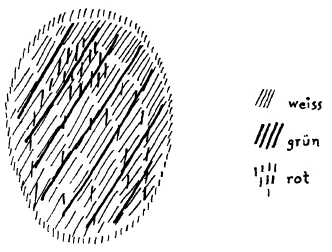
[ 12 ] You see, what I am describing here is what, I would say, emerged—in a mistaken intuition—from 19th-century materialism. This materialism, in its finest representatives—one of the finest representatives of this materialism was, after all, Czolbe—came to the intuition that, while thoughts flow through us, physical processes are taking place; but this materialism forgot—and that is why the intuition was erroneous—that it is the purely spiritual “I” that draws inwardly with the mineralized substances within us. It is precisely what we recognize as the actual awakening of ordinary consciousness that is based on this inner drawing with the mineralized substances within us.
[ 13 ] Let us now turn our attention to the other side of the human being—the side of the impulses of the will. If you look back once more at what I have just described, you may see in it a kind of captivity of the “I” by the mineralized element within us. Our “I” is precisely capable of working with this mineralized aspect, of drawing within it. The “I” can immerse itself in that which is mineralized within us.
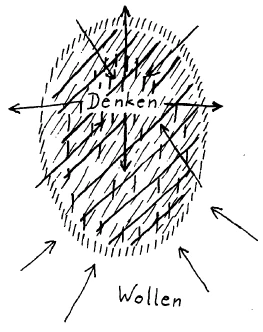
[ 14 ] If, on the other hand, we consider those life processes in which the substances are precisely those that are not mineralized—those that are in the midst of the living process—then we arrive, I would say, at the material aspect of the effects of the will. During sleep, after all, the “I” is outside the physical body. In the act of willing, the “I” is outside certain parts of our organism. This is because, at those locations, nothing is mineralizing at certain moments in time; rather, everything there is alive. From those parts of our organism where everything is alive—where, at the corresponding moment, nothing mineralized is being shed or separated—the impulses of the will unfold. But there, the “I” is expelled. The “I” is drawn into the mineral realm. It can interact with the mineral realm; it cannot interact with that which is alive. It is driven out of it, just as at night, when we sleep, this “I” is driven out of the entire physical body. But then the “I” is outside the body. Through mineralization, the “I” is driven back into the body. Through vitalization, the “I” is driven out of parts of the body. It is then just as much outside these parts as it is completely outside the physical body during sleep. And we can therefore say: whenever the will is active, parts of the “I” are always outside those parts of the physical body to which they are actually assigned. And where, then, are these parts of the “I” that are outside the corresponding parts of the physical body? Well, they are simply outside, in the surrounding space. They are integrated into the forces that permeate this space. When we exercise our will, we are, with a part of our “I,” outside ourselves. We incorporate forces that are spread throughout the world. When I move an arm, I do not move it through something that arises from within the organism, but through a force that is outside my arm, and into which the “I” enters by being driven out of certain parts of my arm. In willing, I go outside my body, and I move through forces that lie outside me. One does not lift a leg through forces that are within, but rather through forces that actually act from without; the same applies to the arm. Thus, while in thinking one is driven inward by the relationship of the “I” to the mineralized part of the human organism, in willing one is driven outward, just as in sleep. And no one understands volition who does not conceive of the human being as a cosmic being, who does not go beyond the boundaries of the human body, who does not know that in volition the human being incorporates forces lying outside the body. We immerse ourselves in the world; we give ourselves over to the world through volition. So that we can say: The material accompaniment of thinking is a mineral process within us, an imprinting of the “I” onto mineralized parts of the human organism. Willing within us represents a vitalizing, a spreading out of the “I,” an incorporation of the “I” into the spiritual outer world, and an influence on the body from the “I,” from the spiritual outer world inward.
[ 15 ] If we wish to schematically illustrate the relationship between thinking and willing, we must do so in the following manner. As you can see, it is entirely possible to trace the path from introspection into the life of the soul to the physical correlate of that life of the soul without thereby being tempted to fall into materialism in a one-sided way. One learns to recognize what takes place materially in thinking and willing. But one never loses the “I” by recognizing how the “I” becomes inwardly active with the inorganic in thinking, and, on the other hand, by recognizing how the “I” is driven into the spirit through the organic vitalizing force in the body. As the “I” is driven out of the body, it is brought into contact with the forces of the cosmos, and from the spiritual part of the cosmos—that is, from outside—the “I” unfolds the will.
[ 16 ] In this way, materialism is justified on the one hand, and at the same time overcome on the other. It is always amateurish to merely oppose materialism. For what it has to say in a positive sense is entirely valid. The only thing wrong with it is when it seeks to make itself the sole focus of a person’s worldview. In general, as one follows the world and its events with inner spiritual awareness, one comes to realize more and more that what individual human perspectives have to say in a positive sense is valid, and that they become invalid only when they seek to express something negative. And in this regard, spiritualism is often just as one-sided as materialism. Materialism is right in what it has to say that is positive; spiritualism is right in what it has to say that is positive. Only when both take a negative stance do they fall into error and fallacy. And it is no small error when people—in a layman’s, dilettantish manner—who imagine they have attained a spiritual worldview, yet understand nothing of material processes, look down on materialism. The material world is imbued with spirit; but one must also come to know it in its material particularities, avoid becoming one-sided, and recognize that one must view reality from its most diverse angles in order to grasp its full significance.
[ 17 ] This is what a worldview such as the one known as anthroposophy can best teach us.