Nordic and Central European Spiritual Influences
The Feast of the Epiphany
GA 209
18 December 1921, Berlin
Translated by Steiner Online Library
Man as an Earthly and Celestial Being II
[ 1 ] For some time now, we have been exploring the relationship between human beings and the universe in greater detail, and today we would like to add a few further thoughts to these reflections. When we consider human beings as they live in the present phase of human development—“present” here taken in the broadest sense, in relation to the great development of the world—which encompasses the history and, in part, even the prehistory of humanity, then we must say that, above all else, language stands out as a defining characteristic of this present phase of cosmic human development.
[ 2 ] Language elevates human beings above the other kingdoms of nature. Well, I already pointed out in last week’s lectures that, in the course of human evolution, language—speech in general—has changed. Humanity has also undergone a process of development in this area. I pointed out how, in very, very ancient times, language was something that human beings, so to speak, shaped from within themselves as their most primordial faculty, and how, with the help of their speech organs, they were thereby able to reveal the divine-spiritual forces living within them. I pointed out how, during the transition from Greek to Roman-Latin culture—that is, in the fourth post-Atlantean cultural epoch—it becomes clearly apparent that the individual sounds of language no longer have specific names but are simply designated as “sounds,” just as we are accustomed to today. In Greek, we still have a name for the first letter of the alphabet; in Latin, only “A.” In the transition from Greek to Latin, something that was alive in the language—concrete in the most eminent sense—is transformed into something abstract.
[ 3 ] One could also put it this way, in its true sense: As long as people have referred to the first letter of the alphabet as “Alpha,” they have found a source of inspiration in that name. The moment they began to call it simply “A,” inspiration—that inner experience—gave way to conformity to external convention, to the prose of life. This, after all, is the actual transition from the Greek to the Roman-Latin era: the evolution of civilized humanity from the poetic-spiritual world toward the prose of life. The Roman people, as I have often emphasized, are a sober, prosaic people; they are the people of jurisprudence, who carried prose and jurisprudence into later culture, whereas what lived on in Greek civilization continued to develop within human culture more or less as a kind of cultural dream—one to which one looks back and to which one then draws closer in one’s own revelations when one experiences inner life and seeks to express it. One might say: All poetry has something about it that makes it appear to European humanity as a daughter of Greece. All jurisprudence, all external structuring, all the prose of life has something about it that makes it appear as a daughter of the Roman-Latin people.
[ 4 ] I have also previously pointed out how a true understanding of Alpha—Aleph in Hebrew—leads to the realization that, by naming this letter as such, the intention was to express that it is the symbol of humanity. Alpha is actually—if one were to approximate it with a modern term—“the one who senses his own breath.” This designation directly alludes to the words of the Old Testament: the earthly human was created by having the living breath breathed into him. — Thus, what was done with breathing to make the human being an earthly human—the essence that was thereby imprinted upon the human being, namely, that he became the one who experiences and feels his own breathing, the one who takes breathing into his consciousness—this was to be expressed by the first letter of the alphabet.
[ 5 ] And the word “beta,” when viewed objectively—especially when one considers its counterpart in Hebrew—presents itself as something like an enclosure, an envelopment, a house. So that if one wanted to express in today’s language what was once felt when people first began to say “Alpha” and “Beta,” one might express it, for example, with the words: “Man in his house.” — And in this way, one could go through the entire alphabet and would articulate a concept, a meaning, a truth about the human being simply by saying the names of the alphabet one after another. In a sense, a comprehensive sentence would be uttered that gives expression to the mystery of the human being. This sentence thus begins by pointing out: the human being in his house, in his temple. The following parts of the sentence would then express how the human being behaves within it, what his relationship to the universe is. In short, what one would utter in succession as the names of the alphabet would not be something abstract—as when we say A, B, C today without really thinking of anything at all—but rather it would be an expression of the mystery of humanity, of humanity’s rootedness in the world. What people mean—or rather, no longer mean today, because they basically have no idea about these things anymore—when all sorts of societies speak of the lost primordial word, is precisely what lies in such a sentence, which encompasses the alphabet in its designations. So that we can look back on a time in human development when, in a sense, when a person turned to their alphabet, they did not breathe forth from within themselves that which is based on external events or external needs, but rather that which expressed their divine-spiritual mystery through their larynx and speech organs.
[ 6 ] One might say: Later on, what belongs to the alphabet was distributed among external objects, and people forgot what a human being can reveal about his or her spiritual and soul-related mysteries through language. The original human word of truth, the word of human wisdom, has been lost. Language has flowed into the sobriety of life. And when people speak today, they are no longer aware that the original primordial sentence, through which the Divine revealed their own being to them, has been forgotten, and that the fragments of this primordial sentence are present in the individual words and sentences of today.
[ 7 ] The poet, by not surrendering to the prosaic context of language but rather returning to inner experience, to inner feeling, to the inner shaping of language, attempts to return to the inspired primordial element of language. And one might say: every true work of poetry, from the smallest to the greatest, is such an attempt to return once more to the lost word, to take a step back from a life focused solely on utility, to those times when the essence of the world still revealed itself in the inner organism of speech.
[ 8 ] In language today, we distinguish between consonantal and vocalic elements. I have spoken at length about what one would find if one were to dive below the threshold of one’s consciousness. For ordinary consciousness, memories surface—that is, thoughts of experiences between birth and death. In ordinary consciousness, we do not descend any further into our own human being than to these thoughts left behind in memory. I have alluded, from a certain point of view, to what lies beneath this threshold of consciousness, forming something like a general human tragedy. But one can also point to it in the following way. One might say: When a person wakes up in the morning and their “I” and astral body merge into the etheric body and the physical body, the person does not perceive their etheric body and physical body from within. What the person perceives is something entirely different. Let us visualize this graphically.
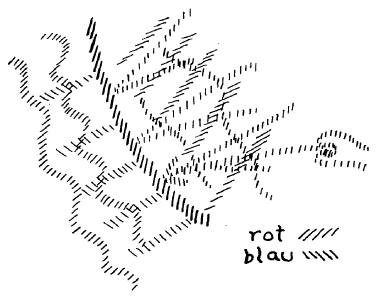
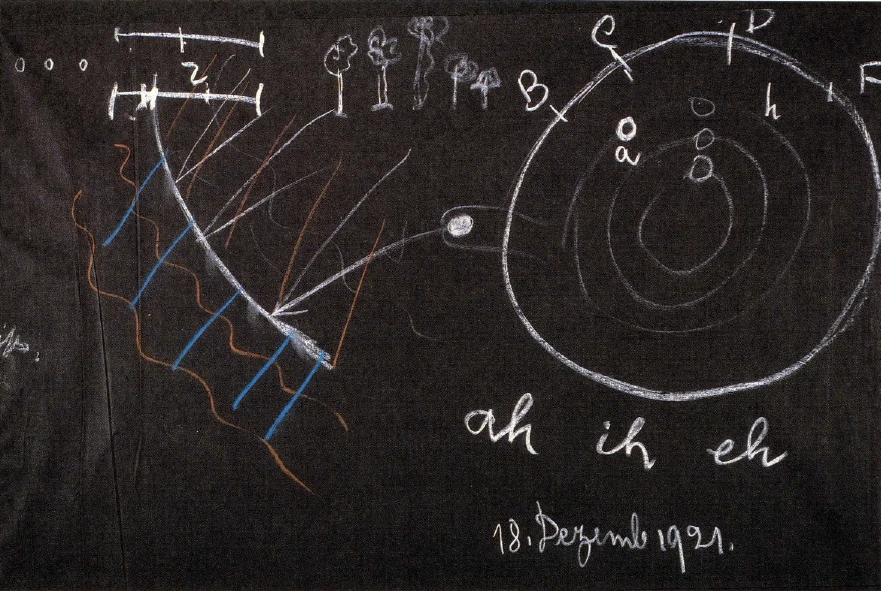
[ 9 ] Here, let’s say, we have the boundary between the conscious and the unconscious. The area shaded in red represents the conscious; the area shaded in blue represents the unconscious. Memories are reflected back from the conscious. After all, a person lives with their consciousness only within this realm; the rest remains unconscious. And what a person sees of the external world—or even of themselves—is nothing other than this. Let us say here: When a person’s eye is seen by their own eye, then what emanates as visible rays is reflected back into the person, and the person experiences it in their consciousness. Likewise, what a person carries within their own being below the threshold of consciousness is experienced in their astral body and in their “I,” but not in the waking state. This remains unconscious and essentially constitutes the actual content of the etheric body and the physical body. The etheric body is not recognized at all by ordinary consciousness, and the physical body is recognized only in terms of its outer appearance. One must first delve beneath the level of memory; only then does one perceive, as I have described, the primordial source of evil within the human being. But one also perceives something else: namely, a part of the human being’s connection to the cosmos.
[ 10 ] If, through appropriate meditation, one manages to pierce through the mental images, as it were, and remove what separates us inwardly from the etheric body and the physical body, and if one then looks down into the etheric body and the physical body, so that one perceives what lies beneath the threshold of consciousness, one hears a sound in the etheric body and likewise in the physical body. And this sound is the echo of the music of the spheres, which the human being has absorbed during the life between death and rebirth, during his descent from the divine-spiritual world into the physical world, for incarnation into what is given to him through the physical inheritance of his parents and ancestors. The sounds of the music of the spheres continue to resonate in the etheric body and in the physical body—in the etheric body insofar as they are vowel-like, and in the physical body insofar as they are consonant-like.
[ 11 ] As you will recall, as human beings pass through life between death and a new birth, they ascend into the world of the higher hierarchies. We have seen how human beings become attuned to the world of the Angeloi, the Archangeloi, and the Archai, and how they live within these hierarchical realms, just as they live here among the beings of the mineral, plant, and animal kingdoms. After this life between death and a new birth, they then descend once more into earthly life. And we have seen that on this path they first take with them the influences of the fixed-star sky—or rather, its representation, the zodiac—and then, as they descend further, the influences of the planetary sphere, the moving planets.
[ 12 ] Now, let’s consider the representative of the fixed-star sky: the zodiac. Human beings are exposed to these influences as they descend from the spiritual-soul life into earthly life. If one wishes to describe these influences according to their true nature, they are cosmic music—they are consonants—and the consonance within the physical body is the reverberation of the ringing of the individual constellations of the zodiac. The movements of the planets bring about what, within this cosmic music, is the vocalization. This imprints itself upon the etheric body. We thus unconsciously carry within our physical body a reflection of the cosmic consonance, and within our etheric body a reflection of the cosmic vocalism.
[ 13 ] This, I would say, remains initially silent in the subconscious. But as the child develops, those forces—which are the imitative forces of the cosmos—well up from the body into the speech organs and shape them. The speech organs located more internally are shaped from the human being’s essence in such a way that they can vocalize, and the organs located more toward the periphery—the palate, tongue, lips, and everything that constitutes the form of the physical body—are formed in such a way that they produce consonants. As the child learns to speak, a re-enactment of what has been absorbed—through the lower human being—into the physical body in terms of formative forces, as well as what has been absorbed into the etheric body, enters the child’s higher human being—not, of course, into the substances themselves, but into the forms. When we speak, therefore, we reveal—one might say—an echo of the experiences that the human being undergoes with the entire cosmos during the life between death and a new birth, while descending from the divine-spiritual world. Every detail of the alphabet is a precise reflection of what lives there in the cosmos.
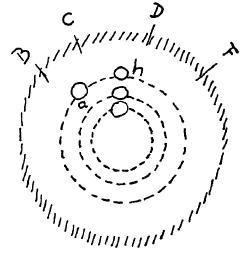
[ 14 ] You can roughly follow the zodiac images if we relate them to modern terminology by designating B, C, D, F, and so on as constellations of the zodiac. You can follow them by perceiving the planetary orbit as the letter “h.” “h” is not actually a letter like the others, but rather it represents the orbiting motion, the circling. And the individual planets in their orbits are always the individual vowels that, in some way, precede the consonants. So imagine that the vowel “a” appears here (see illustration on page 109); then you have “a” resonating together with B and C, but you have the “h” within every vowel. When you pronounce them, you’ll feel it: ah, ih, eh—the h is inside every vowel! What does it mean that the h is inside every vowel? It means: The vowel resonates in the cosmos. The vowel is not static; it resonates in the cosmos. And this circling, this resonating—that is expressed in the “h” that is mysteriously present within every vowel. So consider that somewhere in language, a vowel harmony was expressed: i, a, o, let’s say. What is expressed by this? It expresses something that is the cosmic influence of three planets. If you add a consonant to something like that, Joshua—that is, if you add an “s” in the middle—it means you are expressing not only the vocalization within the planetary sphere, but also the effect that the planets contained within “io a” experience in their movement as a result of a relationship with the constellation S. This means that in ancient human civilization, when a divine name was pronounced with vowels, a planetary mystery was thereby expressed. The deed of a divine being within the planetary world was expressed through the name. If a divine name was expressed by including a consonantal element within it, the deed of the divine being in question was conceived as extending upward to the representative of the fixed-star sky, to the zodiac.
[ 15 ] Back when people still had an instinctive understanding of these things—in the days of ancient, atavistic clairvoyance, clairaudience, and so on—they sensed a connection to the universe in human speech. They felt themselves speaking within this universe. As a child learned to speak, one sensed how what had been experienced in the divine-spiritual world before birth or before conception gradually unfolded from within the child’s being.
[ 16 ] One could say that if a person could see through to their inner self, they would have to admit: I am an etheric body; that is, I am the echo of the world’s vocalism. I am a physical body; that is to say, I am the echo of the world’s consonantism. And as I stand here on Earth, my being forms an echo of everything the zodiacal signs express. And the life of this echo is my physical body. And an echo is formed of everything the planetary sphere expresses in its revolutions, and this echo is my etheric body.
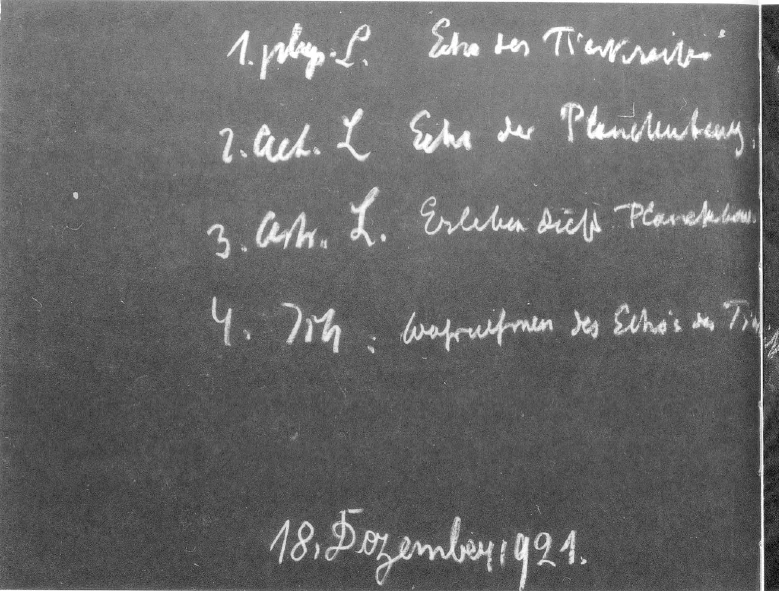
1. Physical body: Echo of the zodiac
2. Etheric body: Echo of planetary motion
3. Astral body: Experience of these planetary motions
4. Self: Perception of the echo of the zodiac.
[ 17 ] Saying that a human being consists of a physical body and an etheric body doesn’t really tell us anything. It’s nothing more than a very vague, indefinite term. If one were to speak in the real language—the one that can be learned from the mysteries of the cosmos—one would have to say: The human being consists of the echo of the fixed-star sky, of the echo of the planetary movements, of that which experiences the echo of the planetary movements, and of that which cognitively experiences the echo of the fixed-star sky. Then one would have expressed in the real language of the cosmos what is expressed abstractly with the words: “The human being consists of a physical body, an etheric body, an astral body, and the I.” One remains entirely in the abstract when one says: “The human being consists, first, of a physical body; second, of an etheric body; third, of an astral body; and fourth, of the I.” But one enters the concrete language of the universe when one says: The human being consists of the echo of the zodiac, the echo of the planetary movements, the experience of the imprint of these planetary movements as thinking, feeling, and willing, and in the perception of the echo of the zodiac. — The first is abstraction; the second is reality.
[ 18 ] When you say “I,” what is that, really? Now imagine that trees had been planted in a beautiful, aesthetic arrangement. You can see every single tree. Ultimately, all these trees become nothing more than a single point if you move far enough away. Take all the details—everything that resonates from the zodiac as world consonants—and step far enough away: everything that is internally shaped in the most manifold ways through sound converges for you into that single point called “I.” The fact is that what a person uses to name themselves is actually only the expression of what is perceived as if from an immeasurable distance from its true location in the universe. Everywhere, one must first trace things back to what appears here on Earth as their reflection, as their echo. Thus, when one sees the matter in its reality, everything from which a human being is constituted as a phenomenon—a mere appearance—dissolves before the higher and inner experience of the human being. When one looks at a human being and gradually comes to recognize them in their truth, the physical body actually ceases to stand before one in the way it otherwise does; then one’s gaze expands, and one reaches as far as the sky of fixed stars. And the etheric body, too, ceases to stand before one. One’s gaze expands, one’s experience expands, and one arrives at the perception of planetary life, for this human etheric body is, after all, merely a reflection of planetary life. And when a human being stands before you, nothing else actually stands before you but the phenomenon, the appearance, the image of what is taking place in planetary life. We think we have an individual human being before us; but this individual human being is an image of the entire world at a specific location. How, then, does a person from Asia fundamentally differ from a person from America? It is because the starry sky is reflected at two different points on Earth, just as one has different images of any external reality when viewed from different vantage points. It is indeed true that, as one observes a human being, the world opens up, and that through such observation one is confronted with the great mystery of how the human being is nothing other than a pictorial microcosm of the reality of the macrocosm.
[ 19 ] What, then, does this newer life actually consist of? When we look back from this newer life to the ancient life of humanity in primeval times, we find that the experience of humanity’s connection to the world was still present in the instinctive consciousness of those primeval times. One can experience this concretely through the alphabet. When a person wanted to express the full richness of the divine in a single primordial utterance, he spoke the alphabet. When he expressed his own mystery—as he had learned it in the mysteries—he described how he had descended through Saturn or Jupiter in their constellations of Leo or Virgo, that is, how they descended through the A or the I in their constellation to the M or the L. They expressed what they had experienced there of the music of the spheres, and that was their cosmic name. And in earlier times, people were quite instinctively aware that human beings brought a name with them through their descent from the cosmos to Earth.
[ 20 ] Christian consciousness later created a kind of abstract echo of this original consciousness by consecrating individual days through the commemoration of saints, who—when properly understood—are nothing other than the animators of the spiritual cosmos. And a person, if born on a certain day of the year, was to be given the name of the corresponding saint according to the calendar, because this was meant to express—now in a more abstract way—what had been expressed in more concrete terms in ancient times, namely, by deriving the human being’s cosmic name from the Mysteries based on what he experienced during the descent as his being was vocalized in conjunction with the consonantal sounds of the zodiac. And the entire human race together then had many names, but the harmony of these names was in turn conceived in such a way that it fitted into the general, all-encompassing name.
[ 21 ] So, viewed from this perspective, what was the alphabet? It was what the heavens revealed through their fixed stars and the planets moving across the sky above those fixed stars. When people spoke the alphabet in their original, instinctive wisdom, they were speaking of astronomy. In those ancient times, speaking the alphabet and the study of astronomy were one and the same. In those times, a field of knowledge such as astronomy was not conceived of in the same way that we today conceive of any field of scholarly knowledge—as something composed of individual perceptions and concepts. It was conceived of as a revelation that forced its way to the surface of human experience, either in the primordial principle itself or in parts of that principle. It was thus presented as a concrete experience of a part of primordial wisdom. And there is still a trace of a very dim awareness of this fact in the fact that, in the Middle Ages, those who were introduced to higher education still had to study grammar, rhetoric, dialectic, arithmetic, geometry, music, and astronomy. In this progression through the various fields of learning lies, in a still somewhat dim awareness, what was present in earlier times with instinctive clarity. Grammar has become something very abstract today. If one goes back to times that history does not, admittedly, record—but which are nonetheless still part of history—one finds that grammar was not as abstract as it is today, but rather that through grammar, people were introduced to the mysteries of the individual letters: they learned how the letters express something of the mysteries of the cosmos. Each vowel was associated with a specific planet, and each consonant with a specific sign of the zodiac; in this way, one came to know the stars through the letters. And as one progressed further from grammar to rhetoric, this involved working with that which lived within the human being as the activity of the astronomical. And as one ascended to dialectics, one engaged in the comprehension and processing in thought of that which lived within the human being as arising from the astronomical. And arithmetic was not taught as the abstraction it is taught as today, but as the essence that expresses itself in the mysteries of numbers. The number itself was viewed differently than it is today. I will point this out with just one small example.
[ 22 ] How do people imagine “one, two, three” today? Well, you picture a pea, then add another one—now there are two; then add another—now there are three. It’s a matter of adding one to the other, an accumulation. That’s not how people approached numbers in earlier times. Back then, the unit was the starting point. And by dividing the unit into two parts, you got the number two. So the number two wasn’t the result of adding one unit to another. It wasn’t a mere jumbling of units together; rather, the two was contained within the one. And the three was contained within the one in a different way, and the four in yet another way. The unit encompassed all numbers; the unit was the greatest. Today, the unit is the smallest. Today, everything is conceived in atomistic terms. There, the unity is the single element, and then the two is added, and everything is conceived atomistically. The original conception was the organic one. There, the unity is the greatest, and the subsequent numbers always appeared somewhat smaller and are all contained within the unity. This leads to entirely different mysteries of the world of numbers. These mysteries of the world of numbers give us a first glimpse of how we are not dealing here with something that lives merely inside the human hollow head—I say this because I have often pointed out that the human head is truly hollow, viewed from a spiritual perspective—but rather, we can come to perceive, in the numerical relationships, the relationships of the world’s objectivity. If one simply adds one to one, then of course that has nothing to do with things at all. I have a piece of chalk. If I add a second piece of chalk, it has nothing to do with the first. One has nothing to do with the other. But if I take unity as a given—every thing is a unity—and now turn to the numbers contained within that unity, then I do not arrive at the number two in an arbitrary way. I must break the piece apart. That is how I engage with reality.
[ 23 ] And so, after having risen in dialectics to grasp the idea of the astronomical, one then ventured further out into the universe through arithmetic, and in a similar way through geometry. From geometry, one gained a sense that the geometric, when conceived in a real sense, is the music of the spheres. This is the difference between what exists today and what was once present in instinctive primordial wisdom. Today we have music. The mathematical physicist calculates the pitches—for example, which pitches are at work in a melody. The musical person is actually forced to forget their musicality and slip entirely into the abstract—unless, as a truly enthusiastic musician, they run away from the mathematician beforehand. Thus, the person is led from immediate experience into the abstract, which, however, has very little to do with that experience. It is, of course, interesting in itself—especially if one has a mathematical aptitude—to trace the musical all the way down to the acoustic level; but it does not contribute much to the musical experience. The fact that someone today studies geometry and, as they continue, gradually begins to perceive the shapes as musical tones—that is, that one progresses, for example, from seventh grade to eighth grade by allowing geometry to fade into music—is, to my knowledge, not mentioned in the curricula. But that was the point of the former progression to the sixth part of what one had to learn: from geometry to music. And then the reality that originally lay at the foundation revealed itself. Astronomy in the unconscious was then what one consciously learned last—as astronomy, as the highest, as the seventh link in the trivium and quadrivium, as they say.
[ 24 ] One must view the history of humanity in terms of how consciousness has progressed, for this will give one a sense that consciousness must, in turn, return to these things. This is precisely what anthroposophical spiritual science seeks to do. It is therefore no surprise that those who are accustomed to accepting science as it is practiced today cannot find anything of value in Outline of Esoteric Science, for example, as I have written it. But it is necessary for humanity to return, in a fully conscious manner, to what is true reality—and which had to recede into the background for a time so that human beings could fully develop their freedom. Humanity could have developed an ever-stronger awareness of its necessary place within a divine cosmos had it not been cast out of this cosmos into the merely phenomenal, into mere appearance—and so forcefully that the entire manifold splendor and glory of the starry sky is compressed into the abstract “I.” This was necessary for the attainment of freedom. For it was only by compressing—in a completely indistinct manner—into the single point of the “I” that which fills all cosmic spaces and flows through all times that human beings could develop their freedom. But he would lose his very being; he would no longer know or possess anything of himself, and would no longer be able to act or function from within himself, unless he were to conquer the entire world once again from that single point of the “I,” unless he were to ascend once more from the abstract to the concrete. It is indeed important to recognize how, in the transition from the Greek to the Latin mode of being, abstraction took hold of European culture, and how the primordial word was lost precisely as a result. For a long time, Latin was the actual language of higher education. It was something like a convulsive clinging to what the Latin language had in fact already cast aside. Then what had been spoken in Latin linguistic contexts remained only as thought. Of the Logos, logic—the abstract thought—remained.
[ 25 ] There is something in the longing that a man like Goethe felt to understand the Greek spirit that could be expressed as follows: he wanted to break free from the abstraction of modern times, from the sober prose of Romanism, and wanted to advance toward the other daughter of primordial wisdom—toward what remains of Greek civilization. One must sense something like this if one is to understand Goethe’s intense longing for the South. Today’s standard school biographies, however, say nothing about these matters. But only when an awareness of how the human being is an expression of the entire cosmos resounds once more within every individual will the foundation be laid for the rising forces that humanity so desperately needs if civilization is not to descend into barbarism.