Old and New Initiation Methods
Drama and Poetry in the Shift
of Consciousness in the Modern Era
GA 210
7 January 1922, Dornach
Translated by Steiner Online Library
2. West, East, and Central
[ 1 ] Today, I would like to add a few more thoughts to the reflections on the Christ-Essence that have been made in recent days, both before and after Christmas. I would like to briefly outline that aspect of the Christ problem which is of particular significance for the problem of world society. It is precisely in the present age that people have the greatest need to reach an understanding across the globe. And no matter which aspects of life we look at today, there is hardly any sign of such an understanding. The need for understanding is there. What is lacking, however—one might say—is humanity’s ability to find a way to achieve such understanding. We see how attempts are being made today to discuss important matters of life. We see how conferences are taking place everywhere. In the depths of people’s souls, the reality regarding the matters intended for discussion at such conferences looks different from the words that are exchanged there. There is much pretense in the words exchanged there, and this pretense seeks to create the impression that everywhere, individual human beings are somehow seeking a balance or something similar with one another. But nowhere can such a balance be achieved, for, when it comes down to it, it is not human beings speaking to one another today, but rather members of different nations speaking to one another. Outwardly, it is people who are speaking. But what speaks through them is that which lives as the distinct essence of the individual nations. And since people in the present age are such that they look only at the literal content of words—not at what the words come from, where they are rooted—because they do not see the underlying conditions of life, it goes completely unnoticed how, in essence, the diversity of the individual national spirits speaks to one another, rather than one human being speaking to another.
[ 2 ] There could hardly be clearer proof—other than what has just been stated—that Christianity is not realized in the world today. Christianity is not realized, for to fully understand Christ means to find humanity within oneself. Christ is not a god of a people; Christ is not a god of a race; Christ is not at all the god of any group of people, but Christ is the God of the individual human being, insofar as this individual human being is merely a member of the whole of humanity. And only when one is able to understand the essence of Christ—free from all the preconceptions to which human beings are subject—in such a way that one comprehends it as the God of humanity, only then will Christ—and certainly then—have the greatest social significance throughout the entire world.
[ 3 ] One need only realize that, precisely in the “depths of the soul,” there are things at work today that cannot be expressed in words—words that are confined to their outward, phraseological content by the differentiation of the folk demons. One cannot bring about—through what humanity today wishes to remain comfortably stuck in—that which today can truly be brought about only from the depths of the human being. Today, depth is needed—a delving into the depths of the human being—if forces of ascent and fruitfulness are to enter into the development of the Earth once again. What is being said today across the various parts of the Earth does not even touch, in any significant way, the surface of what is rooted in the human being. And the search for that which is rooted in the deepest core of the human being must take hold within humanity.
[ 4 ] Let us take a moment today to outline, in a few broad strokes, how different people’s views are—at least in terms of the main points—regarding what might lead to an understanding and insight into the Christ problem. I have often mentioned to you the distinction between Western people, Eastern people, and those who fall somewhere between the West and the East. This distinction can be viewed from a wide variety of perspectives. One does it justice only by approaching it without any prejudice and with complete impartiality—that is, without harboring sympathy or antipathy toward one or the other group in this distinction from the outset, perhaps because one happens to belong to one group or the other oneself. Today, it is already necessary for all people on Earth to work together to bring about true Christ-unity. For it can be said that, across the most diverse parts of the Earth, the impulses to find unity are present precisely in the depths of humanity. But they must be sought in those depths.
[ 5 ] If we first turn our attention to what is particularly evident today in Western civilizations, we find that what is essential in Western civilizations can be expressed precisely through the unique spirituality of our time. This particular spirituality of our time has the characteristic of indulging in abstractions; it celebrates its greatest triumphs, so to speak, in the abstract-ideal realm. This ideal, this abstract realm, is best suited to understanding nature as it presents itself to the senses, and that aspect of social life which must unfold through the forces of this sensory world. With these forces—which I shall call the Western forces—one can certainly penetrate to the depths of the human being and the universe. Above all, these forces of the West have laid the foundation for scientific thinking and have sought, in accordance with this scientific thinking, those impulses in social life that humanity of the future will need in order to shape earthly life in a meaningful way. For one cannot shape earthly life in a meaningful way using the forces of the East. This will become clear from the following considerations. By no means has everything that lies in the treasures of Western spiritual life been brought to the surface.
[ 6 ] It is certainly true, first of all, that contemporary natural science could only have been founded on the fundamental forces of the human being, which can be expressed most adequately and most aptly precisely through today’s spirituality—through abstract-ideal spirituality. But it is also true that in all that has come to light, there is still something more essential present. What has come to light in the scientific and the associated social modes of thinking can be elevated to the spiritual level. One can progress from the laws of nature to the recognition of the essential in nature. This essential aspect of nature, however, is the divine-spiritual. And if one wishes to understand Christianity in a way appropriate to the latest needs of humanity, one will have to imbue it with the very spirit that, until now, has flowed forth through the forces of the West only via the natural sciences and their social implications. One is not satisfied merely to grasp something that fits one’s worldview from these forces of the West without having expressed it in clearly defined, sharply contoured ideal concepts. Humanity will need such clear, sharply defined concepts for the future of the Earth. It will have to come to present the highest spiritual reality to humanity in concepts just as clearly defined as those used to present the naturalistic and naturalistic-social aspects derived from the forces of the West.
[ 7 ] And when we look at the forces of the East, what becomes most clearly apparent is that if we were to attempt to characterize Christianity—or the divine-spiritual in general—using such clear, precise concepts derived from the forces of the East, this would be a futile endeavor. Starting with Russia and continuing throughout Asia, the entire East gives rise to such folk forces that are not capable of rising to the divine-spiritual in sharply defined terms, but which are predisposed to accomplish this ascent to the spiritual forces from the depths of their feelings.
[ 8 ] If one wishes to characterize Christianity in the Western sense, one needs philosophy; one needs a worldview clothed in modern forms of thought. If one wishes to characterize Christianity through the forces of the East, one will not find such forms of thought if one remains confined to the folk tradition. If one remains within the realm of external, sensory life, one must turn to something else. One must, for example, characterize the feelings that one immediately encounters as one travels farther and farther from the West toward the East—and which can already be found in the regions of Central Europe bordering the East. One must look at the living rooms of ordinary people, who have an altar with an image of the Mother of God in one corner; one must observe how this image of the Mother of God is treated by the visitors who arrive there. The first greeting offered everywhere is to the image of the Virgin Mary; only then are the people who happen to be in the room greeted. It is something that springs from all the other forces of the human being, rather than, for example, from abstract, ideal forces. There is a radical contrast between the innermost feeling toward the divine-spiritual as it exists in the West on the one hand and in the East on the other. But all these forces are root forces that can develop further, that can produce leaves and shoots and ultimately bear fruit, if only they thoroughly understand themselves.
[ 9 ] The West is capable of regaining, in a form appropriate to the modern human spirit, such a conception, such a sense of God the Father, alongside which the other divine-spiritual essences of the Son and the Holy Spirit can stand. But above all, it is the West’s task to make that contribution which leads to conceptions and feelings about God the Father in a different way than earlier times were able to do—times that merely awakened intuitions in this regard. And when those forces develop that are primarily present in the East—and which one might characterize as being of a nature that defies reason, one might call a non-intellectual manner—such that one must resort to an outward gesture to grasp them—these sensations, these feelings, and the impulses of will that accompany them will, as they continue to develop and absorb the forces radiating toward them from the West, be able to develop an appropriate concept and an appropriate sense of the God the Son. Thus, one can only correctly understand the development into the future by viewing what can be accomplished in individual regions of the Earth as contributions to an overall result.
[ 10 ] When we look today at the most outstanding Western minds, we see them—even though they are often, or even mostly, unaware of it themselves—struggling to grasp the concept of God the Father, a concept that emerges from the foundations of the natural sciences. When we look toward the East, we see—one might say from people’s outward gestures, from what springs from their heart and will—a struggle to grasp the concept of God the Son, the Christ. The middle ground is situated between these two extremes. And it is precisely what has developed in the culture of the middle ground over the course of modern times that reveals this positioning to us. The defining characteristic of the most modern theology of the European center is precisely this: that it vacillates everywhere, both with regard to a conception of the Father and with regard to a conception of the Son or Christ. The striving for such a conception is taken incredibly seriously. But it is precisely the seriousness of this striving that has driven the striving itself apart into two distinct branches. On the one hand, we see knowledge developing, and on the other, we see faith. We see how knowledge is to be assigned only that which extends to the sensory world and everything that belongs to it, and we see how faith—which is not meant to become knowledge—is assigned everything that constitutes humanity’s relationship to the divine-spiritual. This ambivalent striving expresses that which is searching, but which, without unification with the other regions of the earth—with the East and the West—can obtain neither an adequate conception nor a feeling of the Father God nor of the Son God.
[ 11 ] How such cooperation on a spiritual level is to take place across the globe is particularly evident in the early steps taken in this direction by the Russian philosopher Vladimir Soloviev. This Russian philosopher incorporated Western thought forms into his own thinking. Anyone familiar with Western thought patterns will find this form everywhere in Soloviev, but will also find it handled differently than it is in the West. When approaching Soloviev with a Western mindset, one must first reorient oneself—not in terms of the content of the thought, but rather in terms of the human attitude toward that content. They must undergo a complete inner metamorphosis.
[ 12 ] Let us take, for example, what I would call one of Soloviev’s cardinal propositions, into which he has poured much of the human striving for an understanding of human nature itself and its relationship to the world. He says: Man must strive for perfection. And this striving is expressed in his quest for truth. As man unites truth more and more with his soul, he will become ever more perfect. And without this becoming more perfect, human life would be worthless. Human beings must have the prospect of being able to reach the highest peaks of perfection through truth; otherwise, life would be nothingness, worthlessness. But at the same time, human beings must become partakers of immortality, for a process of self-perfection that would succumb to death would be a great deception of the world. [See note for citation.]
[ 13 ] Such a thing is certainly expressed in forms of language and thought modeled on the West—the form of thought is borrowed, the form of language is modeled. But the way it is expressed, and the way the impulse to express it arises, is impossible in the West. You cannot find this expressed in the same way by any Western philosopher. Just imagine if Mill or Bergson were to say something like that! It is unimaginable. And today, one must have a sense for such things. One must have a sense of the sources of life from which certain words spring. The content of words becomes increasingly meaningless in comparison to a worldview. The sense of the sources of life from which things emerge—that is what has meaning.
[ 14 ] Today, one can only imagine speaking about human beings in the way Soloviev does if one is a person who has personally experienced what, in essence, each of his compatriots does when facing the icon—the image of the Mother of God—which is at the very heart of this folk tradition, from which one may prove, without abstract-logical reasons; in that folk tradition, where proofs derived from mere abstract logic are considered less significant than those arising from the whole person.
[ 15 ] Even in these lines by Soloviev, one senses that they resonate from the East, emanating from the whole person, not merely from the human intellect. Because Soloviev speaks, thinks, and feels from within his cultural heritage, his entire worldview bears a tendency toward Christ. Because he—I would say—has adopted the thought forms of the West as something external, his worldview bears, alongside the Christ-oriented tendency, a tendency toward God the Father. That is why we find in him what we otherwise hardly find anywhere in the present day: an original, clear distinction in human feeling between the path to God the Father and the path to Christ, to God the Son. One can already find in a mind such as Vladimir Soloviev a hint of what must come in the future. For there must be a collaboration among the most diverse spheres of life across the earth. But this cannot come about if any one sphere of life believes it possesses the whole.
[ 16 ] My dear friends, humanity originated from a state of unity. And if we go back to the dark, gray primeval times of human development, we find a primordial wisdom that was, admittedly, still instinctive, but which, precisely as such instinctive wisdom, filled the whole human being. Across the entire earth, people did not yet communicate through the logical content of language, but rather communicated externally through this primordial wisdom, because they still possessed the inner ability to understand one another—I would say—through gestures of which modern humans have no idea. People communicated through something that today has survived, at most, in those remnants of our linguistic heritage that we call interjections or words of emotion. Of course, when a person sighs, “Ah!” or exclaims, “Oh!”, they are understood everywhere! Understanding at the time of this instinctive primordial wisdom was similar to such understanding. Today we have forgotten how to feel in our entire language the way that primordial wisdom felt, and such feeling has survived only in relation to interjections—the words of emotion—which we, after all, use only exceptionally.
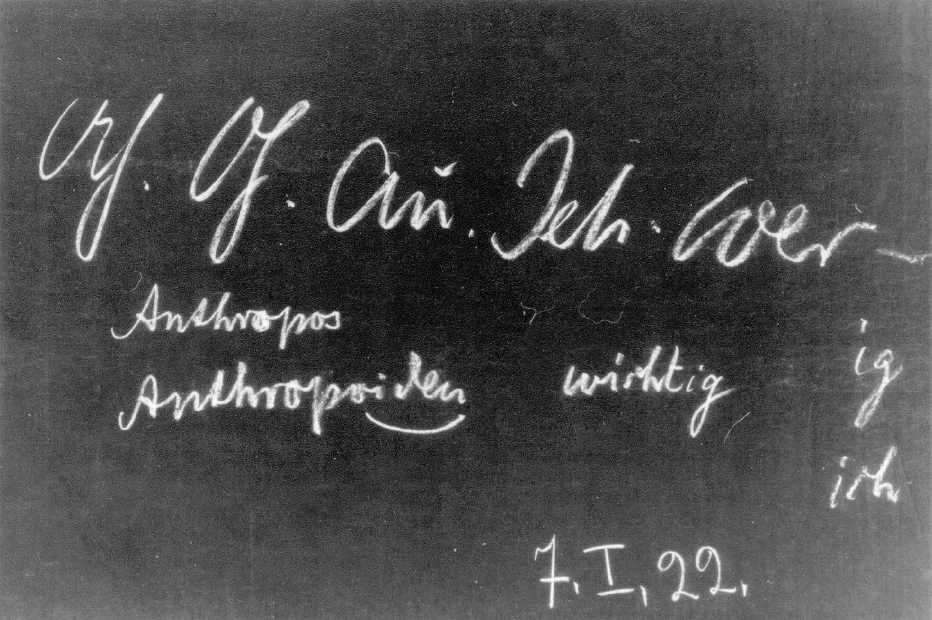
[ 17 ] Just as an aside, it is particularly telling that, as a result of people’s dissatisfaction—which stems from the sheer chaos of our intellectual life—novelists are beginning to write in interjections. You can already come across this today; I’m not quoting anything here, but merely describing how it might be. [It is written on the board.] One can already find in some prose works today, for example: “Ah! Oh! Ouch! Yikes!”, and then it begins: “Who”—followed by a few more interjections. At least some recent novels show that we are heading in this direction. They are symptomatic and not without significance. Let that just be said in parentheses.
[ 18 ] But we have forgotten how to express in language what we today express only through words of feeling. Just think about it: when we say “Anthropos”—it means “human being.” I don’t want to go into the underlying reasons why it means “human” right now. When we say “anthropoids,” we mean the higher, human-like animals. This is connected to the word that means “to be similar”—a state of being similar to humans. The similarity is expressed in the suffix “oids.” Now there is a curious connection between Greek and, for example, German. However, in German, what is expressed here as “likeness” is contained in the suffix “ig” or “ich.” So when we have, for example, “Wicht,” which is related to “Gewicht” (weight), to that which is heavy: When we say it mockingly, we also use it to contrast it with what is particularly “light”; but when we want to use it as an adjective, so that the quality is similar to what is implied by “Gewicht,” then we say “wichtig.” We thus express in this “wichtig” something like: similar to weight.
[ 19 ] But consider this: when we pronounce the “ig”—which we pronounce just like “ich”—when we pronounce this “ich” on its own, we have the German term for the ego, for one’s own being, if we wish to designate it. And that is certainly an etymological truth as well. In the “Ich” lies the striving toward that essence within the human being which, through its totality, can become world-like. “Ich”—all-like, [a] microcosm in relation to the macrocosm. However, if one wishes to understand such things, one must not merely dwell on the superficial considerations currently pursued by etymology or linguistics; rather, one must go a layer, a level deeper and be able to grasp a certain meaning in the relationships between sounds.
[ 20 ] I mentioned this only to characterize one of the traits that must lead us to immerse ourselves once again in language in search of a much more vibrant content than we find today in the languages of the world. We must simply reach the point where we do not take words merely as words, but seek them out at their roots in life. We must learn to understand that two people can say exactly the same thing, and yet it is different depending on whether it stems from one way of life or another. But we will need such a deepening of our sensibilities if we are to enter into that collaboration among humanity across the globe that will be necessary if humanity is to experience another ascent.
[ 21 ] It is not enough simply to address Christ as “Lord, Lord!” — Christ must become something that fills the whole human being. This can only happen if we use our intellect to draw upon something that confronts us, for example, when we look to the primordial wisdom of the world and say to ourselves: It made humanity a unity. — But that was a unity within which the individuality of each person was lost. Then evolution continued. The individualization of humanity set in more and more. More and more, people felt themselves moving toward that point where each had to feel like an individual, for that alone is the guarantee of experiencing freedom. Something had to pour into human development that could now, in turn, bring unity across the entire Earth, and what poured in there is the Christ-essence. And only then will the Christ-Essence be truly understood—when, in light of it, one feels the impulse toward a social unification of humanity across the entire Earth. And conversely, one can also say: Only a correctly understood Christ-Essence leads to a true social impulse across the entire Earth.
[ 22 ] We turn our gaze to the primordial wisdom that has developed from certain instinctive depths to certain heights of perception—not our present-day perception, but that of the ancient past. We find this way of seeing, in its final stage of development, expressed as it were through a world symbol in what the three wise men from the East—the Magi from the East—brought to Christ Jesus. What led them to Christ Jesus is the most ancient and, at that time, the highest human wisdom. And at the same time, as expressed by another evangelist, we find the way in which the individual human being, simply from the innermost powers of his soul—as in a “dream,” where the individual is alone with himself—even when he is in company, he is alone— we find how, dreaming from the solitude of their souls, the shepherds in the fields are now also led to Christ Jesus: the first dawn of a new age. As early as the 4th century A.D., humanity no longer possessed the wisdom of the Magi from the East. And at the moment of the Mystery of Golgotha, we find primordial wisdom in its highest form, which then fades away, merging and becoming intertwined with that which initially appears in the utmost poverty of wisdom, but which must undergo ever further development so that it may ultimately take root in every single human being, while also uniting all human beings with one another. That very wisdom which had led the Magi from the East to Christ Jesus—Augustine, in his youth, still sought to preserve what remained of it. But Augustine had already received it in a form to which he could not, in the long run, remain faithful. It had, in fact, fallen into complete decline. And Augustine had to turn to what was there at the beginning of development—that which must go on and on, that which must be sought, so that humanity may once again achieve unity across the entire globe.
[ 23 ] If we follow these hints—for they are meant to be nothing more than hints at first—in the right way, they will unleash forces that lead us deeper and ever deeper into an understanding of the Christ-Essence, into an understanding of the Mystery of Golgotha. That is what I wanted to add today to last week’s reflections.
[ 24 ] I will give the next lecture here tomorrow at 8 a.m.