Old and New Initiation Methods
Drama and Poetry in the Shift
of Consciousness in the Modern Era
GA 210
1 January 1922, Dornach
Translated by Steiner Online Library
1. New Year's Reflection
[ 1 ] Ladies and gentlemen, my dear friends! Yesterday I spoke about the science of initiation from various perspectives. Today I would like to characterize certain aspects that, in a certain sense, belong to the current forms of expression of the science of initiation. If we must perceive a deep rift in all aspects of civilized life today, and if, as people of the present, we must—as we develop full consciousness—feel this deep rift with its chaotic effects in the world with a certain sense of tragedy, then, in a certain respect, this rift is expressed most particularly in the fact that modern human beings cannot perceive any connection to the world toward which they must look if they are to grasp their true human worth and their true human dignity: to the moral world, and also to the world that brings about the religious feelings, contemplations, and exaltations of the human soul.
[ 2 ] On the other hand, human beings look to that which constitutes natural existence—to which they, after all, also belong. Over the course of the last few centuries, natural existence has presented itself to the human soul in such a way that it has, so to speak, swallowed up all reality, all true being. Natural existence, with its laws indifferent to the moral, boils down to external necessity, and human beings are bound up in this necessity in their everyday lives. No matter how one defines the beginning and end of this necessity, it is impossible for a person, when they perceive themselves as existing within this necessity, to attain their true humanity. He must look up from natural existence to the moral content of the world. He must grasp the moral content of the world as that which ought to be, that which he should regard as an ideal. But no knowledge of the kind prevalent today shows him how moral ideals might, for example, be integrated into the laws of nature, or how necessity might be placed in the service of morality.
[ 3 ] For people today, the world breaks down into these two elements, which are incompatible with contemporary consciousness: the moral world and the material world. People look at birth and death and find, framed by them, the existence of which the knowledge recognized today seeks to speak to them. On the other hand, human beings must look up to a world that rises above birth and death, a world that, in contrast to the ever-changing, actual material world, possesses eternal significance; and they must conceive of their spiritual being as connected to this eternal significance of the moral world. But the Platonic worldview—which still contained the last remnants of Orientalism in the sense that the external sensory world is an appearance, an illusion, and the world of ideas is the true, real world—this Platonic worldview offers no answer for modern man if he remains confined to his present-day consciousness.
[ 4 ] The science of initiation, in turn, seeks to reestablish itself within human civilization; it seeks to remind people once again that behind the world perceived by the senses lies a spiritual world, and that within this spiritual world—which humanity looks up to as the moral realm—there exists a powerful, dynamic, and real world. The science of initiation must, so to speak, strip natural existence of the absolute reality it has usurped and restore reality to the moral world. It can do this only by resorting to means of expression other than those provided by the scope of today’s languages and the scope of today’s world of ideas and concepts.
[ 5 ] To people today, the language of initiatory science still seems like something foreign, something illusory, because they have no inkling that real forces lie behind these forms of expression and that human beings—whether they use spoken language or a structured language—are always compelled to recognize that language cannot provide a fully adequate expression of what they see and perceive. After all, what is the word “human being,” if we consider its sound alone, compared to the rich content that presents itself to us in terms of the spiritual, the soul, and the physical, when we stand before a real human being! In the same way, a supersensible world—living beyond the sensory world and within the moral world—rages, surges, and works in manifold ways within the science of initiation. And this science of initiation must choose diverse forms of expression to convey that which, admittedly, appears far richer than any means of expression can convey.
[ 6 ] Today I would like to speak about some of these means of expression as they relate to human beings in their immediate existence—means of expression that have already been mentioned here in recent days by one side or the other, and which are well known to those of you who have been engaged in anthroposophical spiritual science for some time.
[ 7 ] It is said—both rightly and wrongly—that the true essence of the human being eludes knowledge. One can say this in a certain sense, but not in the sense in which it is very often said today. For the science of initiation, however, the true nature of the human being reveals itself in such a way that it cannot be grasped directly through definitions, descriptions, or explanations. If I may use a comparison, grasping the human nature is like trying to draw the point around which a balance beam pivots. You cannot draw it. I can draw the left and right sections of the balance beam, but I cannot draw the point around which the balance beam pivots. That point is determined by the fact that the left section of the balance beam extends from left to right up to that point, and at that point the right section begins and continues from there.
[ 8 ] In a similar way, the deepest essence of the human being cannot be grasped in adequate terms and ideas. But it can be grasped if one tries to observe the deviations from this nature. Human nature represents, so to speak, a state of equilibrium between a deviation that constantly seeks to move in one direction and one that constantly seeks to move in the other. Human beings, as they stand in life, are constantly exposed to two dangers in their earthly existence: straying toward one side or the other—as we might call it in technical terms—toward the Luciferic and the Ahrimanic sides.
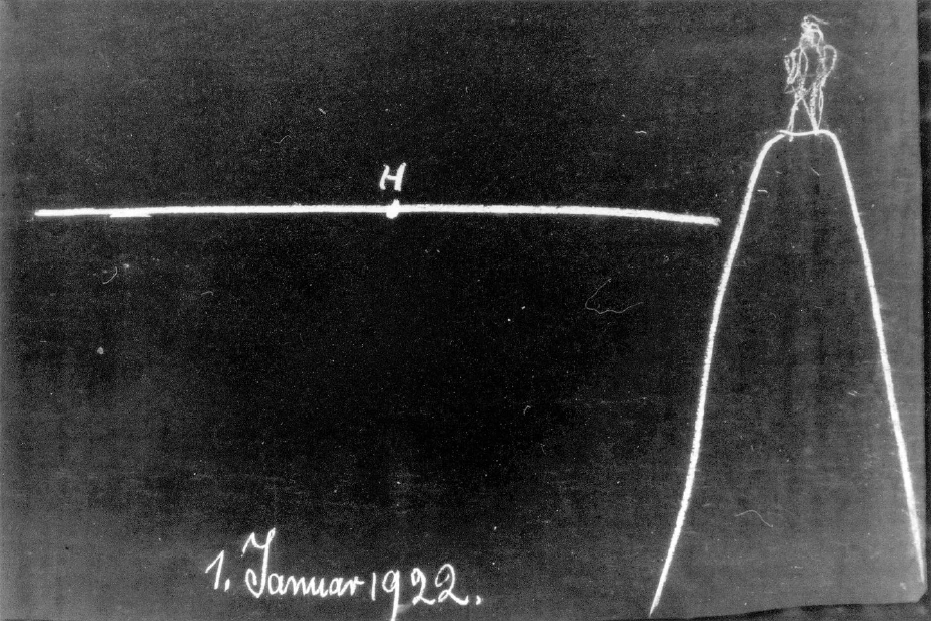
[ 9 ] In ordinary life, a person’s state of equilibrium is initially brought about by the fact that only a part of their entire, full being is engaged in the physical form, and that within the overall context of the world, they do not need to maintain this state of equilibrium themselves, but rather that spiritual beings standing behind them bring about this state of equilibrium. Thus, in ordinary earthly life today, from the perspective of ordinary consciousness, human beings do not perceive the two dangers through which they can deviate from their state of balance—either toward the Luciferic side or toward the Ahrimanic side. This is precisely what is distinctive about the science of initiation: that as a human being, one feels as if standing on a high cliff when one begins to see through to the essence of the world—on a high cliff, with an abyss to the left and right. The abyss is always there, but in ordinary life, human beings do not see the abyss—or rather, the two abysses. If one wishes to come to know oneself fully, one must perceive the abysses; one must at least learn to recognize them. On the one hand, the human being is drawn toward the Luciferic; on the other, toward the Ahrimanic. And one can characterize the Ahrimanic and the Luciferic by considering the human being in terms of body, soul, and spirit.
[ 10 ] Let us first consider a perspective that takes as its starting point the physical nature of the human being. This physical nature of the human being is only outwardly and seemingly a unified whole to the senses. In truth, human beings are constantly caught between the forces that rejuvenate them and the forces that cause them to age, between the forces of birth and the forces of “death.” Not a single moment of life passes in which only one kind of force is present in our bodies; both are always there.
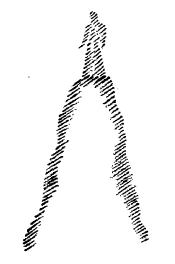
[ 11 ] When we are children—very young children, for my part—the rejuvenating, Luciferic forces predominate within us; but deeply hidden within human nature are also the senile forces, those forces that ultimately cause the calcification and sclerosis of the body, those forces that then lead us to death. And both kinds of forces must be present in the human body. Through the Luciferic forces within it, the body has a constant potential—I might say—to develop toward the phosphoric, toward warmth. In extreme cases, such as illness, these forces act in such a way that the person develops a fever, pleurisy, or inflammatory conditions. But this tendency toward fever and inflammatory conditions is always present within him. It is merely kept in check, held in balance by the other forces that seek to solidify him, to calcify him, to mineralize him. And therein lies the essence of the human being: that there is a state of equilibrium between these two polar, oppositely directed types of forces.
[ 12 ] We will only have a valid physiology and a valid biology when we view every single organ of the human being and the human being as a whole in such a way that the heart, lungs, liver, and so on contain polar opposites within themselves—tending, on the one hand, toward dissolution into heat and, on the other hand, toward solidification into the mineral realm. Nor will we truly understand the functioning of the organs until we are able to view the whole human being—and, in turn, each individual organ—from this perspective. The study of human health and disease can only be placed on a sound foundation when these polarities can be recognized everywhere within the physical human being. One will then know, for example, that in human beings, when they undergo the change of teeth around the age of seven, the Ahrimanic forces become active toward the head; that when a person reaches sexual maturity and their physical nature develops toward the warm side, the Luciferic forces are at work; and that the human being, in their rhythmic nature, is actually constantly swinging back and forth—even in a physical sense—between the Luciferic and the Ahrimanic principles. Only when we learn to speak of the Luciferic and Ahrimanic aspects of human nature without superstition, with scientific precision—just as we speak today, without superstition or mysticism, of positive and negative magnetism, of positive and negative electricity, of light and darkness— only then will we be able to gain an understanding of the human being that is on a par with the abstract understanding of inorganic nature that we have attained over the course of the last few centuries.
[ 13 ] Even today, many people speak in abstract terms about all kinds of polarities within human beings. There are mystical, nebulous writings—publications that attribute all manner of positive and negative qualities to human beings. They shy away from making the ascent to something much more concrete, more spiritual, yet spiritually concrete in the truest sense, and therefore speak just as abstractly about the human being in its polarity—about the positive and the negative—as they speak of polarity in inorganic nature. Only this can be the science of the human being: the ascent from the meager concepts of positive and negative, from the meager concepts of polarity as we find them in inorganic nature, to the fulfilled concepts of the Luciferic and Ahrimanic in the human being.
[ 14 ] When we turn to the soul, which unfolds as the second member of the human being in the higher sense, we see the Ahrimanic at work in everything that drives the human soul toward what is purely rational and intellectual. Our natural science today is almost entirely Ahrimanic. As a person develops toward the Ahrimanic aspect of the soul, they cast aside everything that infuses concepts and ideas with warmth; he devotes himself only to what renders concepts and ideas ice-cold and dry, and he feels particularly satisfied in today’s scientific thinking when he is thus Ahrimanic—when he moves within dry and cold concepts, when he can shape every explanation of the world in such a way that it follows the pattern by which we perceive inorganic, lifeless nature. And as the soul becomes imbued with the moral, the Ahrimanic appears within it in everything that tends toward the pedantic, the rigid, and the philistine on the one hand; but also, on the other hand, toward the free, the independent, and that which seeks to draw the full fruits of material existence from this very material existence—that which seeks to perfect itself entirely by permeating material existence.
[ 15 ] In fact, both the Ahrimanic and the Luciferic always appear from two sides. On the one hand, they represent something that is a deviation. As a deviation, the Ahrimanic represents pedantry, philistinism, and one-sided intellectualism. On the other hand, it represents precisely that which lies entirely within a necessary line of human development moving forward—that which develops the will to liberation, the will to make use of material existence, the will to liberate humanity, and so on.
[ 16 ] The Luciferic element in the human soul represents everything through which a person seeks, as it were, to rise above themselves. This can lead them into the nebulous realm of the mystical. It can lead them into realms where all thinking about the material world seems vulgar and base, so that they are led astray and tempted to utterly despise this material existence and to lose themselves entirely in what lies beyond the material—in everything that tempts human beings to wish they had wings, so they might at least escape their earthly existence with their soul. This represents the Luciferic aspect to him in a spiritual sense. Alongside the Ahrimanic—sober, dry, cold science—there arises sultry mysticism, that which manifests in religious creeds as ascetic contempt for the earth and so on.
[ 17 ] By characterizing the Ahrimanic and Luciferic aspects of the soul, one sees how the human soul, too, must exist in a state of balance between two polar opposites. One can say that the Luciferic aspect, too, points to the possibility of a wrong path, but also to the possibility of a necessary further development of the true human being. The aberration is the vague, hazy, nebulous mysticism that dissolves all clear concepts into an indeterminate, misty twilight and thereby seeks to lead the human being beyond themselves. But that which is not merely a legitimate Luciferic influence, but one that lies at the very heart of humanity’s necessary progress, reveals itself when a person creates in such a way that they do not permeate material existence with the life principles that are real today in order to fully exploit the impulses of this material existence, as is the case with the Ahrimanic, but rather when he dulls material existence to the point of illusory appearance and uses it in this illusory state to represent something supersensory—to represent something that is spiritually real but, within this spiritual reality, cannot also be sensually real through mere natural existence.
[ 18 ] The Luciferic forces thus give human beings the ability to express the spiritual within the illusory realm of the senses. And this is the aspiration of all art, of all beauty. Lucifer thereby also becomes the protector of beauty and of the artistic. And when human beings seek the right balance between the Luciferic and the Ahrimanic, they may allow the artistic—the Luciferic—to work into this balance in the form of beauty. It is not a matter of saying, in a one-sided way, that human beings must guard against the Ahrimanic or the Luciferic. The point is that human beings find the right relationship to the Ahrimanic and the Luciferic, that they always maintain a state of balance between the two. If they maintain this state of balance, then the Luciferic may shine into life in the form of beauty, in the form of the artistic, by conjuring into life something unreal, which is then transformed by the human being’s own power into a semblance of reality.
[ 19 ] The Luciferic forces strive to bring into present-day existence that which has long since passed in the world of the past—and which, therefore, according to the laws of existence, cannot truly be part of present-day existence. When a person pursues the cosmically conservative, when they seek to bring into the present what were once appropriate forms of existence, they fall into the influence of the Luciferic in a false way. So, for example, if they adopt a worldview that lives in vague images—images that were fully justified only in ancient cosmic ages—and if they allow everything that lives in their soul to blur into one another, then they surrender themselves in a false way to the Luciferic realm. When a person gives external, material existence a form such that it expresses something it cannot express through its own natural laws—marble can express only the laws of mineralogy—when a person imposes upon marble that which it can never express through its own natural power, then plastic art arises. Then what cannot be reality in such a sensory context—then unreality is conjured into existence. And this is precisely Lucifer’s aim: he wants to lead human beings away from the reality in which they find themselves—between birth and death—toward a reality that was, admittedly, direct reality for other ages, but which cannot be the true reality for this age.
[ 20 ] If we now consider human beings from a spiritual perspective, then the Luciferic and the Ahrimanic can also be applied to the spiritual realm. In earthly existence, the human being initially expresses itself spiritually through the alternating states of waking and sleeping. In the waking state, our spiritual part is entirely devoted to the material world. In this regard, the following must be said: When a person falls asleep, from the moment of falling asleep until waking up, they are in a state that can be described as a spiritual-soul existence. When falling asleep, a person steps out of the physical and etheric body with their spiritual-soul existence, and upon waking, they re-enter the physical and etheric body with their spiritual-soul existence. Thus, in a sense, a person carries their spiritual-soul state within themselves during sleep; but the soul state—that is retained almost entirely as soul life upon waking. Only with the spirit does the human being fully re-enter the body. Thus, in the waking state, with our spirit, we become entirely physical—we immerse ourselves in the physical—at least to a high degree, during the current period of human development. We then pass from a state of existence such as we have in sleep into the state of wakefulness. We are carried over from one state into the other. And this transition is brought about by forces that we must count among the Ahrimanic forces.
[ 21 ] When we consider human beings in terms of their spiritual nature—that is, in terms of that state of transition between waking and sleeping, which indeed reveals the human spirit in relation to physical life on Earth—we must say that upon waking, the Ahrimanic force is most active; conversely, when falling asleep, the Luciferic force is most active. Human beings are carried from their immersion in the physical-bodily realm into the free spiritual-soul state. They are carried into a state in which they no longer think in Ahrimanic concepts, but only in images that dissolve the sharp, Ahrimanic contours of concepts, causing everything to interweave and blur. They are brought into a state where this blurring of images is the norm. In short, we can say: It is the Ahrimanic that rightly carries us from the state of sleep into the waking state, and it is the Luciferic that rightly carries us from the waking state into the state of sleep.
[ 22 ] Deviations arise only when too little of the Luciferic impulse is carried into the waking state, so that the Ahrimanic impulse exerts too strong an influence during the waking state. Then the Ahrimanic impulse will push the human being too strongly down into the physical realm, will not allow him to remain at the level of the soul’s feelings of good and evil, at the level of moral impulses. It will plunge them into the emotional and the passionate. It will plunge them into the instinctual life, into the animalistic. It will unite the human being, in terms of their “I,” too thoroughly with the physical body.
[ 23 ] And again: When the Luciferic principle acts inhumanly within a person, that person will carry too much of their waking life into their sleep life. Dreams will appear in the sleep life that are too reminiscent of daily life. These, in turn, will have a retroactive effect on the waking life and drive it into an unhealthy mysticism. One sees that everywhere in life, the human being’s state of balance must be brought about by the two polarities—the Luciferic and the Ahrimanic—but that deviations can occur. As I have already indicated, we will only have a proper science of the human body—including a correct understanding of health and disease—when we can identify this polarity throughout bodily life. We will only have a true psychology when we are able to perceive this polarity in the soul.
[ 24 ] Today, in those sciences that are regarded as psychology—the study of the soul—people talk haphazardly about thinking, feeling, and willing. In the life of the soul, thinking, feeling, and willing also flow into one another. No matter how pure our thoughts may be—by connecting and separating them, the will is at work within them. And even when we perform only instinctive movements, our thought impulses still influence the exercise of the will. Nowhere in the life of the soul are thinking, feeling, and willing separate; everywhere they interact with one another. And if one separates them in the way that is customary today, the separation is an abstract one; thus, speaking of thinking, feeling, and willing consists only of three abstractions. What we call thinking, feeling, and willing—we can distinguish them; we can present them as abstract concepts—but as such abstract concepts, they may serve us for our discriminating cognition; they do not give us a true picture of reality.
[ 25 ] We can only gain a true picture of reality if we look into feeling and willing within every thought, into thinking and willing within every feeling, and into thinking and feeling within every willing. But in order to see through this abstract thinking, feeling, and willing to the concrete life and surging of the soul, we must bring to mind how the life of the soul swings toward one polarity and then toward the other—how it swings toward the Ahrimanic polarity and expresses itself there in thought. In these thoughts, impulses of will should be present as much as possible. If we learn to recognize, on a higher level of understanding, the distinctive nature of the Ahrimanic, then we feel the polarity of thinking in the soul; and when we see the soul swinging in the other direction, toward willing, then no matter how many thought-contents may be present in the acts of willing—if we grasp the Luciferic character of willing, then we have grasped the living nature of willing in the soul. What are abstractions, concepts, and ideas must be transformed within us into living intuition. But we do not gain this unless we resolve to ascend to something like the intuitions of the Luciferic and the Ahrimanic.
[ 26 ] Even when it comes to the historical life of humanity, we can only bring reality into our imagination if we are able to perceive the influence and ebb and flow of the Luciferic and Ahrimanic forces in the individual historical periods. If we consider the historical period, say, from Augustine to the end of the Middle Ages and the dawn of the modern era, up to the 15th century—if we observe how people, especially in their outer lives, allow those impulses to take effect that arise from their deepest inner selves, from their emotional lives; if we observe how people in this era sought to shape even their outer political and social lives in accordance with what they believed they could perceive as the divine impulse recognized within themselves: We clearly sense the Luciferic influence at work in this period of history.
[ 27 ] And when we move on to more recent times, when we see how human beings turn their gaze outward toward the mechanical and physical aspects of the world—which can be adequately grasped only in the right way through thinking, through engagement with the external world—we clearly see the Ahrimanic force at work in this period. However, this must not lead us merely to the conclusion that the period from Augustine to Galileo was Luciferic, and the period from Galileo to the present day was Ahrimanic. That, in turn, would itself be an Ahrimanic judgment; it would be an intellectualistic interpretation. If one wishes to move from such an intellectualistic interpretation toward something living—toward a participatory understanding of existence in which the human being is situated—then one must use different means of expression. Then one must say: In the period from Augustine to Galileo, in order to strive for a state of equilibrium, the human being had to defend himself against the Luciferic. In more recent times, in order to strive for a state of equilibrium, human beings have had to defend themselves against the Ahrimanic.
[ 28 ] It is not merely a matter—and this must be recognized more and more clearly—of saying this or that in our advancing civilization, but rather of being able to decide whether this or that can be said in response to a given situation. It may be true in an abstract sense that the Middle Ages were Luciferic and modern times are Ahrimanic; but this abstract truth lacks real impetus. Real impetus arises when we say: Human beings were able to sustain themselves in the Middle Ages through the struggle against the Luciferic, and human beings can sustain themselves in modern times through the struggle against the Ahrimanic. What is merely a cliché in relation to reality can also be true in an external, abstract sense: what is truly valid in the life of the imagination is only that which is genuinely present within us in relation to the situation of human existence that really matters. What modern human beings must guard against most of all is falling into clichés. Time and again, we see that people who already believe themselves to be part of the anthroposophical movement say that this or that person has said something that is entirely in accord with anthroposophy. — What matters is not outward agreement in words, but the spirit—the living spirit—and the living, real context in which something is embedded. If we look today merely at the outwardly logical content of human statements, we do not escape the danger of empty phrases.
[ 29 ] I have recently cited a striking example a few times to various groups of my listeners, showing how statements that are, in and of themselves, entirely correct can seem strange when viewed through the lens of a sense of reality. I cited the example of how, in 1884, Prince Bismarck made a remarkable statement in the German Reichstag when he sensed the social democratic threat approaching. He wanted to dissuade the majority of the working population from following the radical social democratic leaders, and, acting on this impulse, Bismarck said that every person has the right to work. “Grant every person the right to work; provide them with work through the state as long as they are able to work; provide for them”— —so spoke he, the German Chancellor—“provide for them when they grow old and can no longer work, and in times of illness, with what they need to live, and you will see that the broad masses of workers will turn away from the promises of the labor leaders.”—In 1884, Prince Bismarck uttered these words in the German Reichstag.
[ 30 ] Curiously, if you go back a bit—almost a century—you’ll find that someone else said, almost word for word, the exact same sentence: “It is the duty of humanity to grant everyone the right to work, to provide them with work through the state as long as they are able to work, and to provide for them through the state if they are sick or disabled and can no longer work.” — And this other person was Robespierre. In 1792, he incorporated this sentence into his “Declaration of the Rights of Man.” It is curious that the radical Robespierre said exactly the same thing in 1792 as Prince Bismarck—who certainly did not want to be a Robespierre—did in 1884 in the German Reichstag. You see, two people can say exactly the same thing, and yet it is not the same. And curiously enough, back in 1884, Prince Bismarck invoked the fact that the right to work was guaranteed to every worker in Prussia, since this had been enshrined in the Prussian Landrecht in 1794. Curiously, then, Prince Bismarck not only says the same thing, but he also claims that what Robespierre demanded was already contained in the Prussian Landrecht. But the reality is that, back then, Bismarck uttered these words only because he sensed an impending danger arising precisely from the fact that what is literally written in the Prussian Landrecht is not actually there.
[ 31 ] I cite this example not because it is a political one, but because it so strikingly illustrates that two people can say exactly the same thing word for word, and yet it corresponds to opposite realities. I wish to draw attention to the fact that we must enter an era in which we focus less on the wording and more on the experience of reality. Otherwise, we will fall into the trap of empty phrases—precisely in the realm of spiritual life—which play such a major role in our current spiritual existence. It is precisely this transition from what is merely correct in content to what is vividly experienced as true—this transition—that is to be brought about by the introduction of initiatory science into human civilization, a science that moves from mere logical content to the experience of the spiritual world. And whoever correctly observes the outward symptoms of historical development in the present, looking ahead to the near future, will be able to gain from these symptoms a feeling and a sense of the justified, indeed necessary, entry of the science of initiation into world civilization. That, my esteemed audience, my dear friends, is what I wanted to present to your souls today as a kind of New Year’s reflection.
[ 32 ] The next evening lecture will take place on Saturday at 8:00 p.m.