

Old and New Initiation Methods
Drama and Poetry in the Shift
of Consciousness in the Modern Era
GA 210
19 March 1922, Dornach
Translated by Steiner Online Library
12. The Ideal of Freedom in Schiller and Goethe
[ 1 ] Various circumstances have led us to consider how, during the transition from the 13th to the 14th and 15th centuries, the age of intellectualism began—the age we have often referred to as that of the fifth post-Atlantean culture. It is characterized precisely by the fact that in this era, human beings come to regard the intellectual as the guiding force in all their endeavors. We have often spoken of how this intellectualism has taken shape in the various spheres of inner life. Everything that is characteristic of human development has an inner aspect through which it manifests itself more fully in people’s feelings, in their views, in the prevailing impulses of the will, and so on. At the same time, however, it also has an outer aspect through which it manifests itself in the conditions that arise historically in the course of human development; and here it must be said that, for the time being, the most significant historical expression of the intellectualist age is the French Revolution—that great world movement of the late 18th century.
[ 2 ] However, throughout human history, many things have pointed to the need to strive for this kind of social coexistence, which then found tumultuous expression in the French Revolution. And much has remained from the French Revolution that revives in one form or another here and there—namely, in the external social conditions of humanity. One need only consider how the French Revolution represents something that, in the way it manifested itself at the end of the 18th century, would not have been possible before—precisely because, in everything humanity strove for here on Earth, it did not actually seek full satisfaction on this Earth itself.
[ 3 ] Let us be clear about this: in the historical development of humanity, prior to the era of the French Revolution, there was never a period in which people would have said: Everything that a human being can strive for through their thinking, feeling, and willing must also find a corresponding external expression in earthly existence itself. — In the era preceding the French Revolution, people were well aware that the earth cannot provide everything a human being might need for their mind, soul, and body. Human beings have always felt connected to a supersensible world and have attributed to this supersensible world the task of satisfying what cannot be satisfied on Earth.
[ 4 ] However, long before the French Revolution found its tumultuous expression, people in various parts of the civilized world were striving to establish a social order through which as many human needs as possible could be met on earth. The fundamental character of the French Revolution, however, lies in the fact that it sought simply to bring about a social condition that is a fitting expression of human thought, feeling, and will right here on earth. This is, in essence, the aspiration of intellectualism.
[ 5 ] Intellectualism has earthly existence as its domain. Intellectualism seeks to satisfy everything that exists in the sensory-physical world. It therefore also seeks to bring about, within the physical order of the earth, social conditions that are an expression of the intellectual. This striving to bring about in social conditions whatever human beings can aspire to extends all the way to the worship of the goddess of reason—which actually referred to the goddess of the intellect. One can therefore say: From very ancient conditions, in which people guided themselves by the impulses that came to them from the initiates and students of the mysteries, through which they incorporated the divine-spiritual itself into their social order—from those ancient conditions, humanity’s social striving moved, so to speak, toward the Egyptian conditions, where what the kings learned from the priests about the will of human development—as expressed, for example, in the stars—was incorporated into the social order. Later, in ancient Rome—still in the era of the kings—attempts were made—as suggested by the conversation between Numa Pompilius and the nymph Egeria—to bring about the desired social conditions through the exploration of the spiritual world. From this interweaving of the spiritual with the sensory-social, the demand then developed more and more: Everything on earth should be shaped in such a way that it is a direct expression of the intellect.
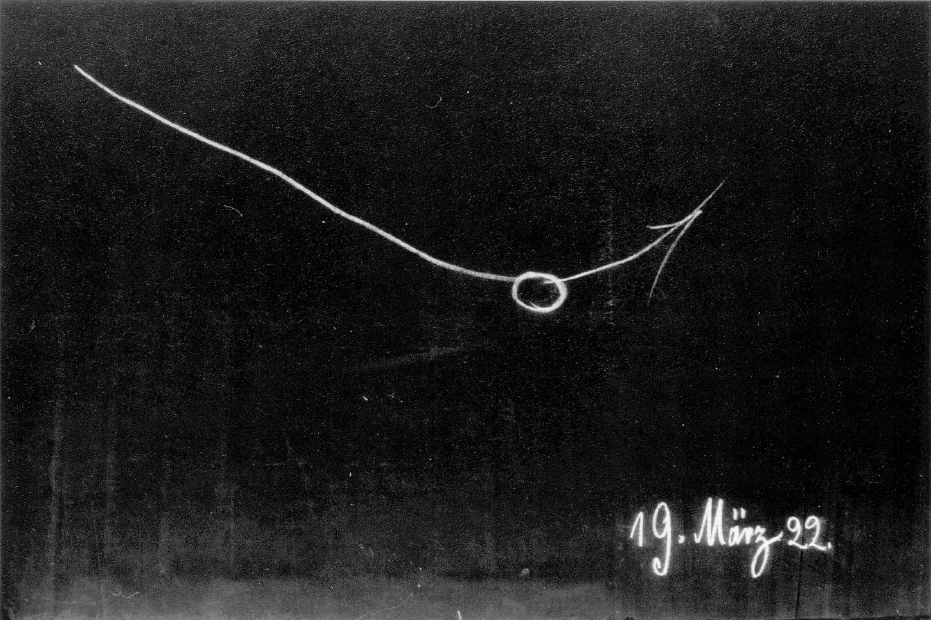
[ 6 ] If one wishes to represent such a trajectory schematically, one must depict it as a downward curve. The French Revolution marks the low point (see diagram); from there, the trajectory had to rise again. This upward movement was also immediately attempted as a reaction to the French Revolution, and we can see precisely—as, for example, in Schiller’s letters “On Aesthetic Education,” where we can read it ourselves—how he was inspired by what was outwardly expressed in the French Revolution to seek, within the human being, a reconnection with the spiritual world. For Schiller, the question arose: If it is impossible to bring about a perfect social order here on earth, how can human beings attain what can satisfy them in terms of their thinking, feeling, and willing; how can human beings attain freedom on this earth?
[ 7 ] And Schiller answered this question by saying: If a person lives logically, in accordance with the necessities of reason, then he is simply a servant of those necessities; he is not a free being. If a person follows his sensual drives, his mere instincts, then he, in turn, obeys the necessity of nature; he is not a free being. — And Schiller came to conclude: In fact, a person is a free being only when he is either creating art or enjoying it. Freedom can be realized in the world solely and exclusively through a person’s artistic creation or artistic enjoyment. In artistic contemplation, what is otherwise the compulsion of rational necessity or the compulsion of natural necessity—as Schiller puts it—is balanced out. When a person lives within the artistic realm, it is indeed the case that they do not perceive in artistic objects the same compulsion of thought as they do in logical inquiry. Even in what meets them through the senses, they do not perceive the sensual stimulus; rather, the sensual stimulus is ennobled through spiritual contemplation in the realm of art. Human beings are thus, insofar as they are beings capable of art, also capable of unfolding freedom within earthly existence.
[ 8 ] Schiller thus seeks to answer the question: How can human beings, as social beings, attain freedom? — And he arrives at the answer that human beings can attain freedom only as beings receptive to art; that they cannot be free in submission to the necessities of reason, nor, for that matter, in submission to the necessities of nature.
[ 9 ] This was particularly evident in the magnificent way it found expression in the exchange between Goethe and Schiller during the period when Schiller was writing his letters “On the Aesthetic Education of Man.” This is evident in how Schiller received what Goethe was revising at the time in his Wilhelm Meister, and how he was enthralled by this style of presentation—this portrayal of inner freedom—because Goethe, as an artist, was by no means an intellectualist, but rather a spirit who created through free thought, while at the same time remaining firmly grounded in sensory experience within art. Schiller sensed this. He perceived Goethe’s artistic activity as free as a child’s play. And we see how Schiller is enthusiastic about this free artistic activity of human beings, which is reminiscent of a child’s play. This inspired him to say: “The artist is the only true human being, and even the best philosopher is merely a caricature in comparison”—as he wrote in a letter to Goethe. But it also inspired him to say: “Man is only fully human when he plays, and he actually plays only when he is fully human.” — This does not refer to frivolous or merely entertaining play, but rather to artistic activity and artistic enjoyment. It refers to a person’s immersion in artistic experience, and it refers to a person’s true liberation.
[ 10 ] Now, at what price would one—in a situation where one was moving away from what had been sought as a social order during the French Revolution and striving once more toward something that a person must achieve from within, something that cannot be granted by external state institutions—at what price, then, would a person seek to purchase this social freedom? They were willing to pay the price that it could not be given to them through logical reasoning, could not be given to them externally in ordinary physical life, but only through exclusive engagement in artistic experience.
[ 11 ] One might say that one finds an expression of these feelings precisely in the greatest minds of this age—in Schiller in theoretical form, and in Goethe, who, after all, lived this life of freedom in practice. Let’s take a look at the characters Goethe created from real life, through whom he sought to portray what is genuinely human, what is truly human. Let’s look at Wilhelm Meister. Wilhelm Meister is a character through whom Goethe sought to portray genuine, true humanity. But from the perspective of a holistic view of life, Wilhelm Meister is, at heart, a loafer. He is not a person who, in the highest sense of the word, seeks a worldview that sustains the soul. Nor is he a person who can take up a profession or a job in his external life. He just wanders through life. Underlying this is the fact that the very ideal of freedom to which Goethe and Schiller aspired could only be attained by people who tear themselves away from a life of thought and hard work. One might say that Schiller and Goethe wanted to point out the illusion of the French Revolution—the illusory belief that something external, such as a state, could grant people freedom. They wanted to emphasize that human beings can only attain this freedom from within.
[ 12 ] This, however, highlights the great contrast between Central Europe and Romance-speaking Western Europe. Romance-speaking Western Europe believed in the power of the state in an absolute sense—and indeed still believes in it today. In Central Europe, by contrast, the reaction arose that the ideal of humanity could actually only be found within oneself. But this came at the expense of fully immersing oneself in life. A person like Wilhelm Meister had to strive to step outside of life.
[ 13 ] As we can see, in the initial attempt, full humanity could not be found in real human beings. Of course, if all people were to become artists in order to establish, as Schiller said, the “aesthetic society,” then we might have an aesthetic society, but this aesthetic society would not be very viable. For example—to say something radical right off the bat—I cannot quite imagine how the sewers would be cleared in such an aesthetic society. Nor can I imagine how, in such an aesthetic society, many of the tasks that must be accomplished according to strict logical principles would be carried out. The ideal of freedom shone brightly before humanity, but human beings could not strive to realize this ideal of freedom while fully immersed in life. That upward surge toward the supersensible had to be sought once again—and now in a conscious form, just as a downward surge had previously taken place atavistically; a renewed upward surge into the spiritual world had to be sought. The ideal of freedom had to be upheld, but the upward surge had to be sought. One had to first gain the ability to secure freedom for human action, for being fully immersed in active life. This, it seemed to me, could only be achieved by following the path outlined in my Philosophy of Freedom.
[ 14 ] When a person rises to that inner state of mind through which he becomes capable, as I have just described, of finding moral impulses in pure thought, then he becomes a free person despite his most complete immersion in life. That is why, in my Philosophy of Freedom, I had to introduce a concept not otherwise found in moral treatises or sermons: the concept of moral tact, of acting naturally out of moral tact, and of the transformation of moral impulses into habitual action.
[ 15 ] Consider the role that moral sensibility plays in my Philosophy of Freedom, and you will see how true human freedom—that is, the entirety of humanity—is to be introduced not merely into feeling, as in aesthetic society, but also into volition. The person who has thus attained a state of mind in which pure thoughts can live as moral impulses within their will may then step into life—no matter how burdensome it may otherwise be—and will have the possibility of standing within this life as a free person, insofar as life demands action and deed from us.
[ 16 ] And to this end, it was necessary to seek a way—even for what is a necessity of reason, for what is the intellectual grasp of the world—to find that which ensures human freedom and independence from external compulsion. This, in turn, could only be achieved through anthroposophical spiritual science. By learning to understand the possibility of entering into what is experienced in the spirit through the world’s mysteries and enigmas, human beings unite their own humanity in thought with the inner spirit of the world. And through freedom, they enter into the science of the spirit.
[ 17 ] The best way to see what is at stake here is to observe how people in this field still resist becoming free so terribly even today. This, in turn, is a perspective from which one can understand the opposition to anthroposophy. People do not want to be free in the spiritual realm. They want to be compelled, guided, and directed by something. And because everyone is free to accept or reject the spiritual, people simply reject it and choose that which they are not free to accept or reject.
[ 18 ] Whether there is lightning and thunder, or whether oxygen and hydrogen combine in a laboratory through a certain process—there is no definitive decision as to whether to acknowledge this or not. As for whether there are angels and archangels, it is up to each person to acknowledge this. They may also deny it. But the person who now possesses a genuine impulse toward freedom comes, through this very impulse, to recognize the spiritual in thought. What was contained as an initial impulse in Schiller’s letters “On the Aesthetic Education of Man” and in Goethe’s entire artistic work—the realization of human freedom through inner struggle, through inner striving— it can only be achieved when one recognizes that human beings can add to what they experience as free beings in the artistic realm a free experience in the realm of thought, a free experience in the realm of will, which merely needs to be developed in the right way.
[ 19 ] Schiller simply took what the Age of Reason had to offer. In Schiller’s era, art still drew its inspiration from this intellectualism. In it, Schiller still found human freedom. But what intellectualism offers to thought is unfree; it is subject to logical compulsion. Schiller did not recognize the possibility that freedom could prevail, neither in action nor in ordinary, hard life. We first had to achieve this through the introduction of anthroposophical spiritual science, so that freedom could also be recognized in the realms of thought and will. For Schiller and Goethe recognized it only in the realm of feeling.
[ 20 ] But such a path to the full recognition of human freedom is, of course, only possible if human beings also arrive at an inner insight into the connection between what they can experience in their souls as spiritual and the natural world. As long as the two abstract concepts of nature and spirit stand side by side in human perception, human beings cannot progress toward a true understanding of freedom in the sense I have described. The person who, without immersing themselves in the spiritual world through meditation, concentration, and so on, acknowledges—solely through their common sense—what has been discovered through imagination, inspiration, and intuition, does indeed experience something in this act of acknowledgment. For example, someone who simply reads books or listens to lectures—without falling asleep in the process — what is brought forth from the world through imagination, will certainly need to approach these revelations of the spiritual world differently than what is written in a modern physics or chemistry textbook, or in a book on botany or zoology, even though everything can be understood through common sense.
[ 21 ] One can take in everything that is written in modern botany or zoology without really engaging in any inner activity. However, one cannot—without engaging in inner activity, as is entirely possible through common sense—assimilate what is presented, for example, in my Outline of Esoteric Science. Everything can be understood, and anyone who says it is incomprehensible simply does not want to engage their thinking actively; rather, they want to accept it as passively as one passively accepts the images in a movie theater. There, of course, one does not need to engage one’s thinking very much, and that is how people today would like to accept everything. They can also accept what is presented in the laboratory in this way. But what is said in my Occult Science cannot be accepted in this way. At most, it sometimes turns out that certain professors would like to accept it that way. Then they probably suggest that those who observe such things should have themselves examined in psychological laboratories, as they are called today. That is just as sensible as if someone were to demand that a person who solves mathematical problems undergo an examination to determine whether he is capable of solving mathematical problems. To that person one would say: If you want to see whether the mathematical problems have been solved correctly, then you simply have to learn how to solve them; then you can verify it. — And it would be foolish to reply: “No, I don’t want to do that; I don’t want to learn how to verify them, but instead I’ll have them examined in a psychological laboratory to see if they’re solved correctly!” — Yes, that’s roughly the kind of demands sometimes made today by professors, whose views are then parroted by all sorts of “generals” with malicious intent. These demands are foolish; they are stupid—but that is no obstacle to their being asserted today with great aplomb.
[ 22 ] Anyone who, through inner activity, immerses themselves in what arises from the imagination will, however, derive a certain benefit for their soul. After all, it is not insignificant for the soul when someone strives to understand what has been recognized through the imagination. There are certain remedies that act on this or that condition of human illness. Today, it is already extraordinarily difficult to make remedies effective in people at all. But whoever has made an effort to understand the imaginative realm through common sense activates so much of their life force that remedies—if they are the right ones—become more effective in them, so that the organism does not reject them.
[ 23 ] Today, foolish people claim that anthroposophical medicine seeks to heal people through hypnosis, suggestion, and so on—as they call it—by spiritual means. You can read about this in all sorts of publications in connection with the remarks I have just made about medicine during my lecture tours in recent months. But that is not the point at first. The point is to truly advance modern medicine through spiritual insights. Of course, one cannot heal by simply instilling a thought; yet, to put it in very concrete terms, spiritual life is significant for the effectiveness of remedies insofar as the person who strives to understand imaginative imagery thereby makes his physical organism more receptive to the right remedies when he needs them due to his state of illness than someone who remains stuck in mere external intellectualism—that is, in today’s materialism with its system of thought. |
[ 24 ] Humanity will need to take in what can be grasped imaginatively, if only because otherwise the physical body of human beings would increasingly fall into such a state that it could no longer be healed once it became ill. For the spiritual-soul aspect must always lend a helping hand in this regard. All the processes that exist in nature do not merely manifest themselves in what is visibly taking place, but rather in such a way that this visible unfolding is permeated everywhere by the spiritual-soul aspect. Therefore, if one wishes to activate a physical substance in the human organism, one must, in a certain sense, have the spiritual-psychic element that brings this physical substance into action. The entire process of humanity demands that the human soul’s constitution, in turn, be permeated by what can be grasped in a spiritual-psychic sense.
[ 25 ] One might say, however, that there is a great deal of longing among humanity today for this soul-spiritual realm. But this longing often remains stuck in the unconscious and subconscious. And what people have in their consciousness—which is, after all, nothing more than a mere remnant of intellectualism—rebels against the spiritual, resists it, and it is sometimes grotesque to see how people resist this spiritual aspect. Before my eurythmy performances, I usually explain how eurythmy is based on a genuine visible language; just as spoken language develops from the structures of the organism, so too does the visible language of eurythmy. Just as sound by sound—vowels, consonants, all vowels and consonants—are brought forth based on human experience arising from the human organism, so too in eurythmy, sound by sound is visibly brought forth, and there is truly speech taking place. One would think that people to whom such eurythmy is presented would try, above all, to grasp the fundamental impulse that eurythmy is, in fact, a language.
[ 26 ] Of course, you might not immediately understand what this means. But it’s not hard to get a feel for what’s meant if one is truly willing to do so. But recently—in Berlin they call it “Ulkiges”—I read something incredibly “Ulkiges” as a review of a eurythmy performance. Someone said: Yes, the absurdity of these eurythmy performances was evident in the fact that the performers first portrayed serious, solemn themes and then humorous ones, and strangely enough—as the witty critic discovered—the humorous elements were portrayed with the same movements as the serious, solemn ones. You see, he understood so much about the matter that he believes the humorous elements must be portrayed with different sound symbols than the serious ones! If one can truly grasp that eurythmy is a truly visible language, this would mean that every language needs its own sounds for the serious and different sounds for the comic! So if someone were to begin reciting in German or French, they might use the “I,” the “U,” and so on, but if they were then to recite something humorous, they would have to use different sounds. I don’t know how many people have come to this conclusion, as this critic from one of the leading German newspapers has brought to light something utterly foolish; but that is how it appears when you look at it in reality. It is, therefore, something that signifies that in these minds every capacity for thought has already ceased; they can no longer think at all. For this is the result, the conclusion of intellectualism as it spreads today across all areas of life: that people first allow their thoughts to become dead, inner contents of the soul. How rigid, how dead are most of the thoughts produced today; how little inner flexibility they possess; how much they merely mimic what has been produced here or there! In our age, we have, in essence, extraordinarily few original thoughts. But what has died—and the thoughts of our age are, after all, mostly dead—does not remain in that same state. Look at a corpse after three days; look at it after five years, or even after forty years: it continues to die, it continues to decay. And the fact that this goes unnoticed—that the thoughts have already entered a state of decay—is evident when someone says: “The impossibility of eurythmy lies in the fact that the same movements are used for humorous scenes as for serious ones”—this is due solely to the fact that people are unable to train their common sense, for example, on inspired truths such as those found in anthroposophy. If one trains one’s common sense—without undergoing occult development oneself—on inspired truths, then one develops a subtle sense for living truth, for what is healthy and unhealthy in human thinking and in human inquiry. And then—forgive the expression—such assertions as the ones I have just mentioned begin to “stink.” Then one acquires the ability to smell the stench of decay emanating from these thoughts. This ability to smell is precisely what our contemporaries lack to a great degree. But a large portion of our contemporaries do not notice this; instead, they skim over these things.
[ 27 ] It is indeed necessary to look very deeply into what humanity needs. Humanity truly needs that freedom of the soul’s disposition toward thought, which is possible only when a person rises to the level of absorbing spiritual truths within themselves. Otherwise, we will naturally face the decline of culture that is so clearly evident today in all areas. Sound judgment and the immediacy of impression are qualities that humanity has already largely lost—qualities that must not be lost, but which will only be preserved if human beings find their way to an understanding of the spiritual.
[ 28 ] It is indeed entirely conceivable that a person can find a purpose in life through anthroposophy if they approach, with their common sense, what can be gained through imagination, inspiration, and intuition. In devoting themselves to what has been explored through imagination, people find, for example, that inner vitality which makes them receptive to remedies—among other things—and which, for instance, enables them to become free individuals who are not susceptible to all manner of public influences.
[ 29 ] By immersing oneself in inspired truths, a person comes to have a sure sense of what is true and what is false. They also come to put this sure sense into practice in social life. How few people, for example, are still able to listen today! They simply cannot listen; they always react immediately with their own opinion. It is precisely this ability to listen to others that is developed in a beautiful way when a person immerses themselves in inspired truths using their common sense. And what a person needs for life—a certain detachment from one’s own self, a certain selflessness—is developed to a high degree through immersing oneself in intuitive truths. And this immersion in imaginative, inspired, intuitive truths is the meaning of life.
[ 30 ] It is, of course, more convenient to say that people can derive such a purpose in life from what Waldo Trine promises: that one need only read things for their content and thereby gain a purpose in life—whereas it is more difficult to attain a purpose in life through anthroposophical means. It can only be acquired through work—by immersing oneself in the imaginative realm or in what has been explored imaginatively, through inspiration, and through intuition. But then this is also a purpose in life that is deeply connected to the human personality, to the whole being of the human person. And it is precisely that which seeks to enter the world as anthroposophy that provides such a secure purpose in life.
[ 31 ] We will continue this discussion next Friday, my dear friends. I would like to announce that a public eurythmy performance will take place next Sunday at 5 o'clock.