

Old and New Initiation Methods
Drama and Poetry in the Shift
of Consciousness in the Modern Era
GA 210
26 February 1922, Dornach
Translated by Steiner Online Library
11. Seeking Access to the Spiritual World from the Perspective of the Modern State of Mind
[ 1 ] The two preceding lectures were devoted to reflections intended to highlight how that momentous upheaval—which occurred in the entire spiritual constitution of civilized humanity in the 15th century, that is, with the transition from the fourth to the fifth post-Atlantean epoch—continued to exert its influence on significant figures. And perhaps I may briefly outline once more today, by way of introduction, what I have set forth in these two reflections. I have pointed out how intensely a figure like Goethe felt the lingering effects of that upheaval, how he sensed that the rational, the intellectual, was now taking root in the human soul as a definite experience; how he felt that one must come to terms with this intellectualism within the soul, and how he still had certain intuitions that this intellectualism had been preceded by a direct communion of human beings with the spiritual world. Even if it was not quite as it had been in the days of ancient, atavistic clairvoyance, there was nonetheless a kind of retrospective view of the time when people, when they spoke of knowledge, were still aware that such knowledge is possible only if one, so to speak, steps away from the world of the senses in order to somehow perceive the spiritual beings that lie beyond the sensory world.
[ 2 ] Goethe imbued the character of Faust with the entire emotional world of his own soul. We see how Faust is dissatisfied with the mere intellectualism he has encountered in the four faculties:
Alas, I have now studied philosophy,
law, and medicine,
and, unfortunately, theology as well!
I have studied them all thoroughly...
[ 3 ] In other words: I have burdened my soul with the entire complex of intellectual knowledge and now find myself in a state of utter doubt; that is why I have surrendered to magic.
[ 4 ] Goethe thus imbues the character of Faust with a return to communion with the spiritual world, stemming from his dissatisfaction with the intellectual sciences. This was very clear to the young Goethe; it was what he wanted to express through his Faust character. And in seeking to portray this—his own inner struggle—he chose the figure of Faust as its representative. And I said that even if this is not the case with the historical, mythological Faust, in light of what Goethe has described, we can imagine Faust as a professor who might have taught in Wittenberg in the 16th or even the 17th century, and who, after all, “for ten years” led his students by the nose in every possible way—straight, crooked, and all in between. And once we put forward this hypothesis, we can certainly examine what that educational process looked like—how the new intellectualism was intertwined with what still pointed back to the old times, when communication with the spiritual world and with the spiritual creative forces was still possible for human beings.
[ 5 ] I then asked whether, beyond what is presented to us in the Faust cycle, we might find traces—even in a broader context—of the influence that someone like Faust might have had in the 15th, 16th, and 17th centuries. And that is when we came upon Hamlet and were able to say: The character that Shakespeare created in Hamlet—whom he, in turn, took from the Danish legends but reshaped—this character of Hamlet appears to us as a disciple of Faust, as one of those who had just been led by the nose for ten years by personalities such as Faust. We then see this Hamlet as he himself is placed in contact with the spiritual world, how his mission is given to him from the spiritual world, and how he is continually disrupted by what he has acquired through his intellectual education. In short, we see, in a sense, the entire transition from the fourth to the fifth post-Atlantean epoch in this figure of Hamlet as well.
[ 6 ] And I went on to say: If one now considers the overall atmosphere and the artistic composition of Shakespeare’s plays—particularly his historical plays—one finds that this twilight atmosphere of transition is present in the artistic work of the playwright himself. I then pointed out how, in a certain sense, especially in Central Europe, Goethe and Schiller, with their entire inner lives, were caught up in the aftershocks of this transition, yet how, in a certain sense, they were unwilling to accept what the intellectualist worldview had since brought about in people’s lives. This led them back to Shakespeare, because in Shakespeare—in Hamlet, Macbeth, and so on—they found the art of approaching the spiritual world; because, starting from there, they were able to cast their gaze upon the spiritual powers that were now already hidden from the intellectualist worldview.
[ 7 ] Goethe did this in his Götz von Berlichingen by, in a sense, taking sides with the old era of the fourth post-Atlantic period as it was drawing to a close, rejecting what had arisen through intellectualism. And Schiller, in his early plays—particularly the Robber drama— to such an extent that, although he does not point to the supernatural there—he wants to be entirely realistic—we nevertheless find, almost down to the very words, the Ahrimanic in the characterization of Karl Moor, while in the characterization of Franz Moor we have a lingering echo of the Luciferic element as it reigns in Milton’s Paradise Lost. In short, we see—despite the realism—a kind of yearning for a conception of reality in which the spiritual powers and forces can be glimpsed shining through.
[ 8 ] I went on to suggest how, in the West, Shakespeare was able—if I may put it that way—to create art in complete harmony with his social environment. First of all, if we take Hamlet—Shakespeare’s most characteristic play—we see how he brings the action very close to the supernatural world throughout; and the same is true of Macbeth. We see, for example, how in King Lear he draws this supernatural world more deeply into the human personality—but into the abnormal human personality, into the realm of madness. We see how, in his royal dramas, he does indeed shift toward realism, yet how a unique, long-term dramatic portrayal of development actually prevails within them; how he incorporates the workings of the forces of fate throughout, but in such a way that it all ultimately culminates in the age of Queen Elizabeth.
[ 9 ] One might say: What prevails in Shakespeare’s plays is a look back at the old times that gave rise to his present, but in such a way that this present is accepted; that everything depicted artistically from the old times serves to make the present more understandable. One could say that Shakespeare depicts the past, but he depicts it in such a way that he places himself within his social present in the West, so that a certain period of time has now been reached in which things can unfold as they do. We see that a certain satisfaction sets in regarding what has now come to pass in relation to the external world. Intellectualism in the social order is accepted by the human being of the external, physical, earthly world—by the social human being—while the artistic human being in Shakespeare looks back and actually depicts what, from the supersensible realm, has created mere intellectualism.
[ 10 ] We see how this then becomes impossible in Central Europe. There, Goethe and Schiller—and Lessing before them—cannot position themselves within the social order in such a way as to accept it. They all trace their roots back to Shakespeare, but to the Shakespeare who himself had turned back to the past. They want the past to find a different continuation than that of their surroundings. Shakespeare is, in a sense, content with his surroundings; they are dissatisfied with theirs.
[ 11 ] Goethe created the Götz drama out of this spirit of intellectual revolution, while Schiller created his early dramas. We see how external earthly reality is criticized here, and how, in the realm of art, there is a back-and-forth weighing of that which can only be attained in the idea, that which can only be attained in the spirit. So one can say: In Goethe and Schiller there is no acceptance of the present; rather, one must console oneself for what exists in external, sensory reality with what works down from the spiritual world. Shakespeare, in a sense, brings the supersensible into the sensible. Goethe and Schiller can only accept the sensible by always keeping the spiritual in view. Thus, in Goethe’s and Schiller’s dramas, there is an interplay between the spiritual and the physical—essentially, an unresolved disharmony. And I then said: If one were to travel further east, one would find that what is spiritual is no longer present on earth at all. Eastern Europe has not created anything into which the spiritual plays a part; rather, the East looks up to the spiritual; it flees from external influences and looks up to the spiritual as the redeeming force.
[ 12 ] So I was able to explain it to you by framing the whole thing as an image, as a mental picture: If we imagine Faust in Wittenberg as Hamlet’s teacher, then we see Hamlet sitting at the back of the classroom, listening, then returning to the West and readjusting to Western civilization. But if we were to seek out the being who could have gone east after listening to Faust in the auditorium, we would have to look for an angel who had listened to Faust from the spiritual world and then gone east. So that everything he would have conveyed would not have unfolded in the same way that Hamlet’s deeds and actions unfold on the physical plane, but rather it would have unfolded through the human being, in the spiritual world.
[ 13 ] And I explained yesterday how, out of this mood—precisely during the time he was getting to know Schiller—Goethe was compelled to bring the essence of humanity back into contact with the spiritual world; how he—since he could not articulate it as theoretically as Schiller, the philosopher, did in his Aesthetic Letters—was compelled to drive it into the realm of the imaginative in the “Fairy Tale of the Green Snake and the Beautiful Lily.” How Schiller was then further compelled to bring the external reality of human life back into contact with the spiritual as well, and indeed, I would say experimentally, by allowing Wallenstein’s belief in the stars to prevail in Wallenstein, which acts like a fate upon Wallenstein’s personality, and by having fate itself, in close interweaving with this belief in the stars, take effect in The Bride of Messina. Thus these characters were compelled, time and again, to turn back to that era when people still had direct contact with the spiritual world.
[ 14 ] I then said that Goethe and Schiller lived at a time when it was not yet possible to regain access to the spiritual world from the perspective of the modern state of mind. That is why Goethe felt compelled to do so, whereas Schiller—had he lived longer—would likely have, in his philosophical pursuits—as can be seen from the “Maltese Fragment” —, would undoubtedly, had he completed this drama, have gained insight into the way in which, particularly within an order such as the Order of St. John, the Order of Malta, or the Knights Templar, the spiritual worlds were at work in human deeds. But Schiller was simply not granted the opportunity to present his “Maltese” to the world as a finished drama; he died too soon. Goethe, on the other hand, was unable to advance to a true grasp of the spiritual world, and so he turned away. And we can say: albeit in a substantially transformed form, Goethe did indeed return to Catholic symbolism, to Catholic worship, to the cult of images. So that we are formally reminded of the Theophilus legend of the good nun Hrosvitha from the 9th century, even if Goethe ultimately has Faust redeemed in a Christianizing tableau. One might say that one can still sense—albeit rendered with Goethe’s grandiose artistic sensibility—in the line, “The eternal feminine draws us upward!” the ascent of the 9th-century Theophilus through the Virgin Mary.
[ 15 ] When one surveys these things, one gains a deep insight into the inner struggle against intellectualism—that intellectualism which causes a person to experience, inwardly, the “corpse of thought” of what a human being is before descending, through birth or conception, into their physical earthly life. What lives within us as thought—if we do not nourish it with the insights of spiritual science—is, after all, merely a spiritual corpse. What we actually are spiritually up until our earthly life dies as it enters the body, and we carry the corpse of that within us. It is our earthly power of thought, the power of thought of our ordinary consciousness.
[ 16 ] How does that which is actually dead in a spiritual sense come back to life? That is the great question of the soul that lives on in Goethe and Schiller. They do not express this philosophically, but they feel it intuitively. They structure their poetry around it. But they have this feeling: there is something dead if we remain solely within the realm of the intellectual. We must bring it to life. Out of this feeling, they reach back toward a belief in the stars, toward all manner of possibilities, in order to bring the spirit into what they wish to portray. It is indeed necessary to observe how, in such outstanding personalities, the course of the world manifests itself—flowing into their souls and becoming their own struggle. One cannot understand the present unless one sees how what must be striven for in the present—a renewed attainment of the spiritual world—was precisely the great problem for Goethe and Schiller.
[ 17 ] It is indeed true that with this great upheaval in the 15th century—which is simply ignored entirely in conventional historical accounts—human beings came to view themselves in an entirely different light. And one need not attempt to capture this with theoretical concepts. One must try to trace it in people’s feelings—how it was in the making and how it later played out, after the upheaval had already taken place in terms of its essential spiritual force.
[ 18 ] At the crucial junctures of spiritual development, these matters are also highlighted in a decisive way. Just consider how this is presented to us in Wolfram von Eschenbach’s Parzival. You are all familiar with the events of Parzival. You know that the crucial point in Parzival’s entire development lies in the fact that he first receives instructions from a kind of mentor to go out into the world without asking too many questions. In Gurnemanz, we see a representative of that ancient worldview which still sees human beings as being in communion with the spiritual world, as he tells Parzival: “Do not ask; for questions, after all, arise from the intellect, and the spirits flee from the intellect. If you wish to draw near to the spiritual world, therefore, you must not ask.”
[ 19 ] But times have changed; the turning point is upon us. It has been foretold: Even if Parzival must be transported back many centuries—say, to the 7th or 8th century—the fact remains that everything has already been lived out in the Temple of the Grail. In a sense, the institutions of the future are already there; that is where one must look. For this is the essential point: that humanity’s position is now changing with this transition from the fourth to the fifth post-Atlantean epoch, and that previously there was no need to ask—previously, in a sense, what Goethe says in paradoxical terms held true:
The great power
Of science
Hidden from the whole world!
And to those who do not think,
It is given as a gift,
They have it without a care.
[ 20 ] Do not ask, for thinking drives away the spirits! That was the proper order before, but in the age of intellectualism, one must rediscover the spiritual world through the intellect, not by suppressing thought. So the exact opposite must happen—one must ask! This entire shift—that in the fifth post-Atlantean epoch, the longing for the spirit must be born out of the human being in the form of questioning—this entire shift is already evident to us in Parzival. But there is something else, something very remarkable, that we encounter in Parzival. I would like to characterize it as follows:
[ 21 ] Languages, as we know them today, are, after all, far removed from their origins. They have simply evolved. When we speak today—as I have often pointed out—the individual sound combinations no longer evoke what those sound combinations originally denoted. One must first acquire a more refined sense of language in order to experience, within the language itself, what the language signifies. This was not the case in humanity’s original languages. Back then, when one encountered any combination of sounds, one knew that within that combination lay precisely what one experienced in its meaning. Today, the poet tries to imitate this, for example: “And it surges and boils and roars and hisses.” Here, in the language of poetry, we have imitated something of what is to be seen out there. But all of this is already derived; in every single sound, people once felt the most intimate connection with what was taking place outside. Today, at most, only dialects can still lay claim to the fact that one feels this connection to external reality in the words of the dialects. But language is still close to our soul. In our soul, language forms a special element.
[ 22 ] The fact that this has taken root as a deep feeling in the human soul is yet another consequence of the transition from the fourth to the fifth post-Atlantean epoch—again, something that neither philology nor history takes into account. The fact that people lived even more deeply within their language during the fourth post-Atlantean epoch—and no longer at all during the fifth—is due to a different relationship between human beings and the world. Just imagine: when a person, through speech, goes along with the sound of the waves, with the thunder and the lightning, and with everything that is out there—when a person, by setting their own vocal organs in motion, felt how what is happening outside reverberates within those vocal organs—how differently the human being, with their “I,” is connected to what is taking place out there in the world! And this is precisely what is becoming increasingly detached with the transition from the fourth to the fifth post-Atlantean epoch. The “I” becomes inner, and language, through the “I,” becomes inner as well; consequently, however, it also becomes less significant, less descriptive of the external world. Such things are certainly not perceived by a mode of cognition that has become intellectualistic. One hardly thinks to characterize these things; but in order to understand correctly what is taking place within humanity, one will have to characterize them.
[ 23 ] Now just imagine what might emerge there. Picture it very vividly: the fourth post-Atlantean epoch, the fifth post-Atlantean epoch—of course, I’ll have to describe everything in extremes now—the transition isn’t abrupt, but to illustrate it, one must be somewhat abrupt, so to speak. Let’s assume this is the human being in the fourth post-Atlantean epoch, and this in the fifth post-Atlantean epoch (see diagram). In the fourth post-Atlantean epoch, when the things of the world (green) are present, the human being—with his words, which I will now designate as red to indicate that they are part of him—is still connected to those things through his words. In a sense, he lives his way into the thing through his words. In the fifth post-Atlantean epoch, it happens more and more that human beings experience words as something soulful, in a sense, something inwardly separate.
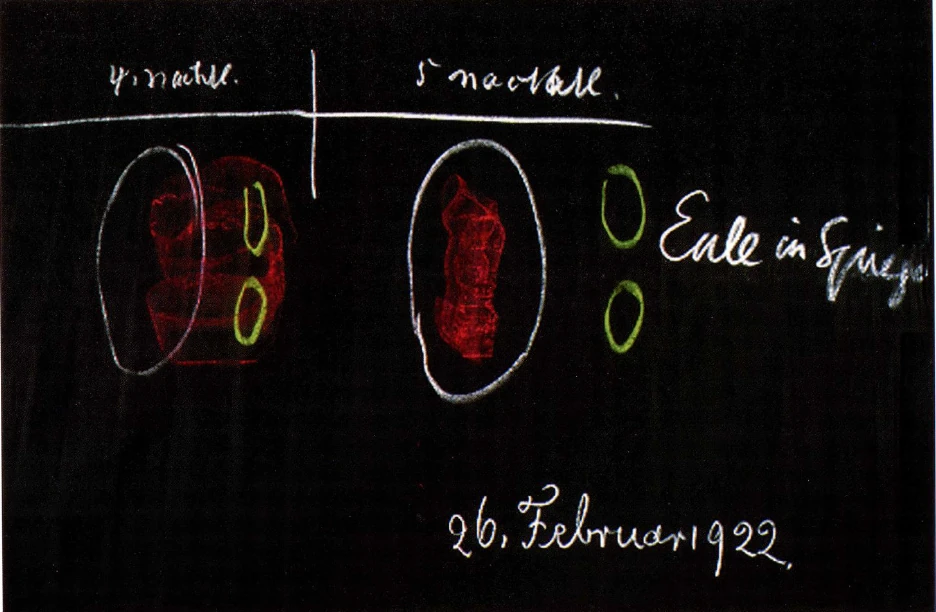
[ 24 ] Let’s bring what is before us into sharp focus—I would even say grotesquely sharp focus—in our minds. When we look at the person there—in the fourth post-Atlantean epoch—we can say: He still lives with things; the things out there in the world, the things he does himself, will therefore unfold according to his own words. When you see such a person acting and at the same time hear how he describes his actions, the two correspond. Just as his words correspond to external things, so too do his actions correspond to his words. When the person there—in the fifth post-Atlantean epoch—speaks, you no longer notice that his words resonate in what he does. What kind of connection to the activity do you perceive when you say today, “I’ve been chopping wood”? — With what’s happening out there—the chopping—one no longer perceives the movement of the axe at all. As a result, however, the connections between sounds gradually fade; they then truly no longer correspond to the external action. You can no longer find a connection. And when someone listens pedantically to the words yet still does what the words imply, it becomes something entirely different. Someone says, “I’m baking mice.” — If someone were actually to bake mice, it would look grotesque; no one would understand it.
[ 25 ] People sensed this and said: A person should consider what is actually inside their soul in relation to what they do on the outside; it is just like when an owl looks into a mirror! Just as when you hold a mirror up to an owl, so too would the actions of someone who follows words to the letter appear. And from this feeling, Till Eulenspiegel emerged in the second half of the 14th century. Eulenspiegel is what is held up to humanity. Not that this should be taken to refer to Till Eulenspiegel himself; rather, because Till Eulenspiegel takes literally what people express in dry, abstract words, people see themselves in a way they otherwise would not. He is the owl-mirror in which the owls can truly see themselves. [The following is written on the blackboard: “Owl in Mirror.”]
[ 26 ] Night has fallen. In the past, people looked into the spiritual world. They also chose their words so that they were in harmony with the world. Back then, people were eagles. Now they have become owls. The world of the soul has become a night bird. And in the adventurous world depicted by Till Eulenspiegel, it is precisely the owl that is held up to a mirror.
[ 27 ] This is how one can view what occurs in the spiritual world. Things already have their underlying causes. One simply cannot understand history—and thus the essence of present-day humanity—unless one can look at the spiritual processes at work. In particular, it is important to move beyond all external characterizations. I urge you to look up in any dictionary the various explanations given for “Eulenspiegel”! One cannot understand this unless one looks into the entire process of spiritual life. In spiritual science, what really matters is that one truly discovers the spirit within things; it is not a matter of whether or not one knows, in a conceptual sense, about certain spiritual beings existing outside the sensory world, but rather that one finds one’s way into the spiritual contemplation of reality.
[ 28 ] The shift that has taken place—where people used to feel close to the spiritual world and later felt as if they had been cast out—is something that can certainly be seen in other contexts as well. I ask you to try to feel the full depth of the impulse that runs through something like the Parzival epic. Consider Parzival, as his mother Herzeleide dresses him in a jester’s costume so that he will not grow into the world that represents the new age. He is meant to remain in the old world. But he grows into it nonetheless. He grows into the world of the Grail. He thus grows out of sensory reality and into the spiritual world. The 17th century also has a kind of Parzival, but a comical one: there, everything is steeped in the comic. In the intellectualist age, if one is honest, one cannot at first muster the spiritual disposition that prevails in Parzival. But a person like that—who must set out, must lose himself in the world, and who ultimately ends up in solitude, finding his spiritual salvation—is also portrayed in the 17th century, after the turning point: this is Christoffel von Grimmelshausen’s Simplicissimus. Just consider the entire narrative of Simplicissimus. Of course, you must pay attention to the mood—there, the pure, I would say sacred, Parzival mood; here, the humorous, comic mood. But take Simplicissimus: the son of a farmer from the Spessart. During the Thirty Years’ War, his family’s house is burned down. The son must flee and comes upon a hermit in the forest who teaches him all sorts of things. But the hermit dies. Now he is cast out into the world; he must wander. He grows into all the events and strokes of fate that the Thirty Years’ War brings. He arrives at the court of the governor of Hanau. Outwardly, he has learned nothing; outwardly, he is a complete fool, but he is, despite all this, a man of inner depth. And because he appears to be such a complete fool on the outside, the governor of Hanau says to himself: “This is a fool who knows nothing; this is Simplicissimus; this is the simplest of men. Why should I educate him? To be a court jester.” So he trains him to be a court jester.
[ 29 ] But now the outer self and the inner self have become separated. The “I” has become independent of the outer man. And this is precisely what is shown in Simplicissimus. Now the outer man in the outer world is the fool who has been trained as a court jester, whom everyone takes for a fool; and the inner man in Simplicissimus—he, in turn, takes all those who make a fool of him for fools himself, for, even though he has learned nothing at all, he is far wiser than the others who have made a fool of him; for he brings forth from within himself the other kind of intellectuality—that which comes from the spiritual—while the intellectuality that comes merely from the intellect confronts him in the external world. And now the intellectualists take him for a fool, and he, the fool, brings intellectualism from the spiritual world and now makes fools of the others who want to make fools of him. Then he is captured by Croats, wanders about the world on adventures, and finally returns to the hermitage to live for the salvation of his soul.
[ 30 ] Yes, Wilhelm Scherer had already recognized the similarity between Simplicissimus and Parzival, but what matters is the difference in mood. What matters is that what was still entirely immersed in the emotional soul in Parzival has risen into the conscious soul, that the caustic intellect is at work, and that the comic—which can, after all, only have its origin in the caustic intellect—is at work there. But if one has a sense of this shift in mood, then one will see, precisely in such works—which truly do not arise merely from individuals—what has actually taken place in the development of humanity. And Christoffel von Grimmelshausen has simply imbued the entire mood and way of thinking of his time into this Simplicissimus, just as—one might say—one finds the entire people at work in poetry, gathering together everything that the soul can see as an owl in a mirror, and through this, all manner of stories are brought together in Till Eulenspiegel.
[ 31 ] It would certainly be necessary to examine all these connections in greater detail, not merely to characterize them in specific terms. I can, of course, only give you a few examples myself. If one were to say everything that could actually be said, one would have to talk about these things for years. But that is not the only point; rather, the point is that one truly comes closer to a spiritual understanding of things when one learns about such matters—which are usually presented in a purely external way—within their spiritual contexts as well. And so one may say: Everywhere one sees how the spiritual development of humanity is permeated by that tremendous upheaval that took place as we moved from the fourth into the fifth post-Atlantean epoch. The fact is that if one goes back just a little from the turn of the epoch, one immediately encounters what points out to us in all phenomena just how profound this upheaval was.
[ 32 ] It is really only in such a context that one can fully understand the significance of the characters that spiritual life has carried forward from the past into the present. Take Lohengrin, the son of Parzival. Ask yourself honestly: Is it really so obvious that Elsa is not allowed to ask Lohengrin his name and lineage? People accept this as a given; but why she actually shouldn’t ask is something that isn’t given enough thought, because things usually have two sides to them. Certainly, one can present the matter differently, but an important point is contained in the following:
[ 33 ] Lohengrin is the emissary of the Grail, the son of Parzival. What, then, are we dealing with within the Grail community? Those who knew the secret of the Grail believed that the Grail Temple was not merely home to the chosen Grail Knights, but that anyone who was pure of heart and a Christian in the true sense of the word was drawn—so it was said—toward the Grail during sleep, from the moment they fell asleep until they awoke. The Grail was conceived as the very gathering place of truly Christian souls during the night’s sleep. One sought to be transported away from earthly life. Therefore, those who led the Grail Kingdom also had to be transported away from earthly life. Among them was Lohengrin, the son of Parzival. Therefore, anyone who wished to work in accordance with the impulses of the Grail had to feel completely at home in the spiritual world; they had to feel entirely as a member of the spiritual world; above all, they were not allowed to feel themselves a member of the outer earthly world. In a certain sense, they had to have, so to speak, the potion of forgetfulness.
[ 34 ] Lohengrin is sent forth from the Grail Castle. He unites with Elsa of Brabant—and thus with the entire people of Brabant. He marches against the Hungarians in the retinue of Henry I. In this way, he carries out important impulses in world history on behalf of the Grail. His ability to do this stems from the power he draws from the Grail Temple. Indeed, if we go back to the fourth post-Atlantean epoch, these things take on a different character; there, it was not merely the external impulses—those graspable by the intellect—that were at work, but spiritual impulses were also at work everywhere. The historical account is such that one hardly notices this.
[ 35 ] Today, quite rightly, we are once again speaking of meditation formulas—simple phrases that, through their simplicity, have an effect on consciousness. I don’t know how many people today look at this with the right understanding when history tells them that those who were called upon to join the Crusaders—and this was during the fourth post-Atlantean epoch—were given the meditation formula “God wills it,” and that this formula indeed worked with spiritual power. This was, in a sense, a form of social meditation conveyed through the phrase “God wills it.” Pay attention to such things in history, and you will find many more examples like this! You will discover the origins of the ancient mottos. You will see how certain noble families set out on their conquests under such mottos, and how they acted through spiritual means, with spiritual weapons. The Knights of the Grail, and figures such as Lohengrin, acted with the most powerful spiritual weapons. He could do so only if the memories of his outward lineage, his outward name, and his outward family did not stand in his way. He had to transport himself, as it were, into a sphere where he could devote himself to the spiritual, and where his interaction with the outside world was limited solely to sensory perception, not to any memories. He had to carry out his deeds under the influence of the potion of forgetfulness. He must not be reminded; the thought must not arise in his soul: “My name is such-and-such; I am of this lineage.” — That is why Elsa of Brabant must not ask him. This is necessary for him. The moment he is asked, he will remember. It would have exactly the same effect on his actions as if his sword were broken.
[ 36 ] If we go back beyond the period when everything became intellectualistic—and when people began to frame what had come before in intellectualistic terms and to imagine everything as if it had been just as it was later on—if we go back beyond what belongs to that intellectualistic period, we find the spiritual present everywhere in social activity. And people relied on the spiritual; they therefore relied, for example, on moral principles just as they did on medicines.
[ 37 ] I would like to see how, in this age of intellectualism—when people adhere solely to intellectualism—they would react if one were to stock morality as a medicine in one’s pharmacy! But then again, one need only go back a few centuries to the time before this shift. Read “Poor Henry” by Hartmann von Aue, who belongs to the same era as Wolfram von Eschenbach. There before you stands the knight—the wealthy knight—who has, however, fallen away from God, who has lost the connection with the spiritual world in his soul, and who therefore experiences this atheistic state that has come over him as a physical illness as well: “Miselsucht,” a kind of leprosy. People shun him. No doctor can cure him. He goes to a wise doctor in Salerno. The doctor tells him there is no physical cure for him; the only cure is for a pure virgin to let herself be killed for him. The blood of a pure virgin can free him from this affliction. He sells all his possessions, lives in solitude on his farmstead, and is cared for by a steward. This steward has a daughter. She falls in love with the leprous knight, the knight with leprosy. She hears about the only thing that could be his cure. She decides to die for him. He goes with her to the doctor in Salerno; but there he changes his mind. He would rather continue to have leprosy than accept this sacrifice. But the very fact that her willingness to sacrifice herself existed has an effect. He is gradually healed. — We see the influence of the spiritual in spiritual life; we see how moral impulses were understood as healing forces. Today people say: Well, either it was a coincidence, or it didn’t happen at all—people just make up stories like that. — Whatever one may think of this individual case—it must nevertheless be pointed out that in the age preceding the fifteenth century, the influence of soul to soul was, in essence, much stronger than it was later, including the influence of what souls thought, felt, and willed. For that social separation between people that arose later is, in fact, a direct consequence of intellectualism. And the more intellectualism flourishes, the less people seek what must counteract it—the spiritual—the more intellectualism will drive individual personalities apart.
[ 38 ] This was bound to happen; individualism is a necessity. But it is from individualism that the social must be discovered. Otherwise, the “social age” consists of people being antisocial and therefore clamoring for socialism. Indeed, they clamor most for socialism precisely because, deep down in their souls, they are antisocial. But we must take note of this social element that confronts us in a work of poetry such as Hartmann von Aue’s “Poor Henry.” This also comes to light in works of the spirit, and in such works it is very clearly evident in the mood. There is, in fact, a completely different mood present in this “Poor Henry.” Of course, we cannot call it sentimental; for sentimentality only emerged later, as an unnatural departure from intellectualism. But there is a kind of pious mood, indeed a kind of spiritual mood, within it. If one wants to be honest about these same matters later on, then one must turn to comedy; one must portray them as Christoffel von Grimmelshausen did in Simplicissimus, or as the people themselves are portrayed in Till Eulenspiegel.
[ 39 ] This feeling of being cast out of the world is not something we encounter only in the literature of a particular people; in fact, we encounter it everywhere. And now you can see how, in all of this, there lies a different relationship between human beings and themselves. Human beings must once again raise the question from an entirely new standpoint: Yes, what am I, actually, as a human being? — This question continues to resonate. That is why, from this new intellectualist standpoint, the question is posed anew time and again: What, actually, is a human being? — In the past, people turned to the spiritual world. There, people truly sought what Faust, in turn, seeks in vain. People turned to the spiritual world when they wanted to know: What is a human being, really? Because they knew: Outside of this physical earthly life, a human being is, after all, a spirit. So if a person wants to come to know their true nature—which they also live out in their physical earthly life—then they must turn to the spiritual world. But they are increasingly turning away from turning to the spiritual world.
[ 40 ] In Faust, Goethe hints at this: I must turn to the spiritual world if I am to recognize him—the Spirit. — But it is not possible. The Earth Spirit does appear, but Faust cannot perceive this Earth Spirit through ordinary cognition. The Earth Spirit says to him: “You resemble the spirit you comprehend, not me!” Faust must turn away, toward Wagner; in Wagner he then sees the spirit he comprehends. He does not comprehend the Earth Spirit—he, the “image of the deity.” Goethe thus lived in an age when people strove to discover the essence of the human being from within the spiritual world. See what happened after Goethe died. Then people wanted to know again—this time from a position of intellectualism—what a human being actually is. Now follow this further: People cannot turn to the spiritual world to learn what a human being is. Nor can they find it within themselves, for language has already become a “soul owl.” So they turn to the people who still embody the old times, at least outwardly. In the 19th century—what emerges? 1836 Jeremias Gorthelf: Bauernspiegel; 1839 Immermann: Oberhof, Drei Mühlen, Schwarzwälder Bauerngeschichten; 1849 George Sand: La petite Fadette; 1847 Grigorovich: Anton the Unfortunate; 1847–1851 Turgenev: A Hunter’s Sketches.
[ 41 ] It is the longing to find, in the simple person, the answer to the question: What, after all, is a human being? — In the past, people turned to the spiritual world; now they turned to the farmers. Over the course of two decades, a longing to write village stories has spread throughout the world, because people want to study human nature. One cannot study them, since people simply cannot recognize themselves—at most, they gaze into the mirror like owls—which is why they turned to ordinary people. But you can, in turn, demonstrate in every single instance—from Jeremias Gotthelf to Turgenev—how everything ultimately boils down to getting to know human beings. Out of these unconscious village stories, in all these simple tales—including those by George Sand and so on—there is a striving for an understanding of human nature. Intellectual life only becomes transparent when one perceives it from such a perspective.
[ 42 ] This is what I have sought to present to you in these three lectures, in a sense to illustrate the transition from the fourth to the fifth post-Atlantic epoch. For it is not enough to characterize this transition with a few arbitrary, abstract concepts—as was naturally done at first—but rather, the point is to be able to perceive the whole of reality in a spiritual way, precisely through anthroposophy. I wanted to give you an example of this in these lectures.
[ 43 ] I will take the liberty of announcing the next lectures after my return. The course in Berlin is about to begin, and I must travel there. So, after my return, I will continue these reflections here.