Human Questions and Cosmic Answers
GA 205
22 July 1922, Dornach
Translated by Steiner Online Library
Thirteenth Lecture
[ 1 ] Today I would like to include in our reflections a somewhat more in-depth consideration of cosmic contemplation. As human beings, we must be fully aware that during the time that elapses between birth and death, we are here on Earth, and that everything that makes an impression on us—in both the narrower and broader senses—we perceive with our senses and also with our intellect solely from the perspective of our earthly sojourn. We often become aware of how deeply we are bound to this earthly existence through our outer physical body. We learn as early as elementary school that human beings can only live by breathing in the air that surrounds them, which consists of a specific mixture of oxygen and nitrogen. Human beings are entirely dependent on this air for their vital functions. We need only consider how different our physical life would be if, for example, the air surrounding us contained more oxygen than is actually the case. Let us suppose, for a moment, that more oxygen were mixed into the air; then we would live at a faster rate—that is, we would have a much shorter lifespan on Earth, calculated in terms of years. Time would, so to speak, be condensed, and our lifespan would have to be shorter. This is, of course, only a very rough illustration. We can imagine that, with regard to every factor in our environment that influences us—if it were altered even slightly—our entire human organism would be different. Such considerations are, in fact, made more frequently today. People are becoming aware of humanity’s physical dependence on its environment. Yet today, at most, people are only vaguely aware—in a purely abstract sense—that human beings also possess a soul-spiritual nature; and, fundamentally speaking, we never have as precise a conception of this soul-spiritual nature as we do of the physical body. We know the physical-bodily aspect of our constitution so well that we can say how differently an abundance of oxygen in the air would affect a person. As for the spiritual-soul aspect, we do not give it much thought—thoughts that might go something like this: If this spiritual-soul aspect were somewhat different from what it is, could it then exist on Earth specifically between birth and death?
[ 2 ] Just as our physical body is adapted to the amount of oxygen in the air, and just as many other aspects of our body are adapted to the conditions that prevail immediately near the Earth’s surface, so too is our spiritual-psychic nature, between birth and death, thoroughly adapted to what exists immediately at the Earth’s surface. And when one becomes fully aware of this, one will also be able to say to oneself: Just as a human being, physically as an earthly human, could not live out there, just a few miles away from the Earth’s surface, so too, under conditions other than those on Earth, the human soul—with its thinking, feeling, and willing—as it lives in the Earth’s environment, simply could not live. Elsewhere, in a different relationship to the Earth, it would likewise have to be organized differently as a soul-spiritual being. Just as the human body would have no use for its lungs—as they are currently organized—if it were miles away from the Earth’s surface, so too would the human soul, with its thinking, feeling, and willing—as they develop in earthly life—be unable to function under conditions other than those on Earth.
[ 3 ] It would be impossible to form any clear ideas about these things at all if it were not possible for those who seek inner spiritual development to experience spiritual states different from those found in ordinary thinking, feeling, and willing. You all know from the descriptions in my book *How Does One Attain Knowledge of the Higher Worlds?* that one can attain such different soul moods and states of mind—that one can arrive at an entirely different inner life. One can attain an inner life that involves not only ordinary thinking but also imagination—that is, one that lives in images rather than in thoughts. One can go further and attain inspiration. Just as our lungs inhale air—drawing in the physical substance of the air—so too can we, in a sense, inhale the spiritual-soul substance, the substance of the spiritual-soul realm that pervades the world. And just as the lungs, when they inhale oxygen, derive their life from this oxygen—just as the entire human body derives its life from this oxygen—so, too, does the human soul derive its life from the inspirations that take place when such higher knowledge is attained. And the same is true of the next stage of knowledge, intuition.
[ 4 ] There, then, the soul rises to an entirely different inner content. There, it experiences something fundamentally different. But this different experience is connected, as you know, to what might be called a soul-level departure from the body. When we ascend to imagination, inspiration, and intuition, we no longer feel as though we are within our body as we do when we are in ordinary earthly life. It is then with the spiritual-soul being just as if, for example, the lung were transformed into an organ that breathes in light instead of air. Then it could indeed live several miles outside the earthly realm with the organism to which the lung belongs. Now, this is not possible in the physical realm at first—at least not for human beings—but it is possible for the spiritual-soul aspect within us when we step out of our body and then experience imagination, inspiration, and intuition in our soul, so that we actually leave the earthly perspective behind and arrive at the very perspective we had before we descended into a physical body. By ascending to imagination, inspiration, and intuition, we actually move from an earthly view of the world to a cosmic view of the world. We are simply no longer on Earth, but rather we view the earthly realm from a different perspective.
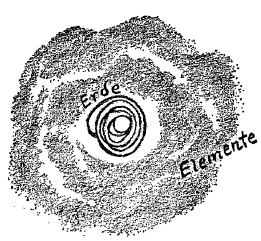
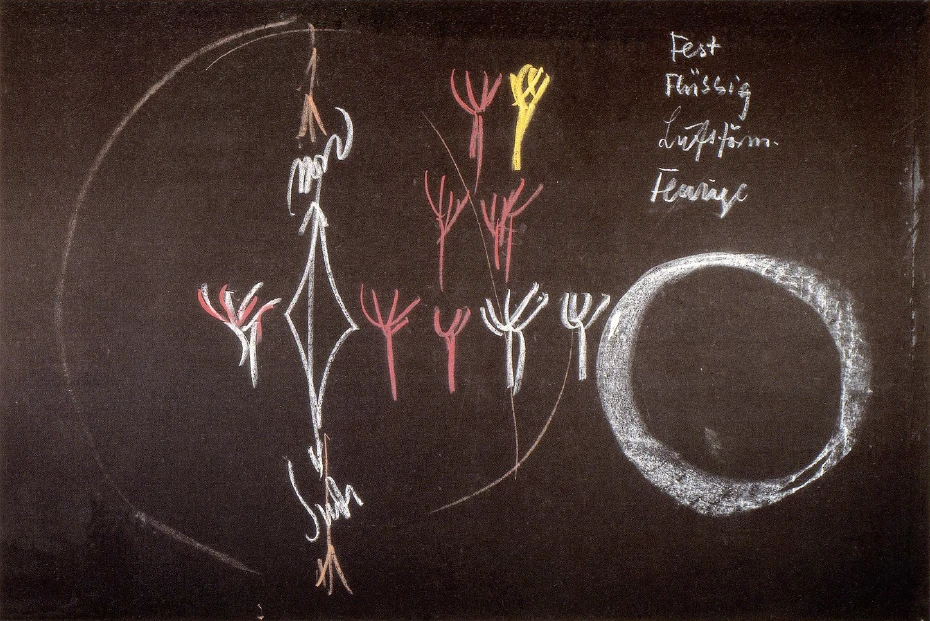
[ 5 ] This is not particularly significant when it comes to observing human souls. However, it is of great significance when it comes to understanding the spiritual realm within the cosmos itself. I would like to illustrate this for you with a schematic drawing. Imagine for a moment that here is the Earth, and the human being on Earth. The human being perceives the elements in his earthly surroundings. We can call them the solid, the liquid, and the gaseous. He perceives the fiery and the warm. But then what belongs directly to the Earth’s surface comes to an end. With the perception of the fiery and the warm, the human being already rises to the perception of the Earth’s surroundings. They enter into the realm of light, into what we call the light ether. It is, after all, our special characteristic that we can perceive the light ether through our gazing, our seeing. But when imaginative perception arises in a person, they do not feel as though they are standing here on Earth, letting their gaze wander out into the light ether; rather, they actually feel as if they were perceiving and viewing the whole from the outside (drawing, red).
[ 6 ] Especially with regard to what I am discussing here, one can speak with considerable certainty about how this happens. When you stand anywhere on Earth and let your gaze wander freely out into the cosmos, you are, after all, looking into the light everywhere during the day. At night, you look up at the starry sky. There, if I may put it that way, you make use of the perceptive power of your eye. But this perceptive power of your eye is also constantly supported by the power of the will. In earthly vision, you actually use this power of the will only to focus your eye. But when you ascend to imaginative cognition, this willpower develops more and more, especially for the individual senses. You feel, as it were, as though you are rising out into space through your eyes and are increasingly able to view the cosmos from the outside.
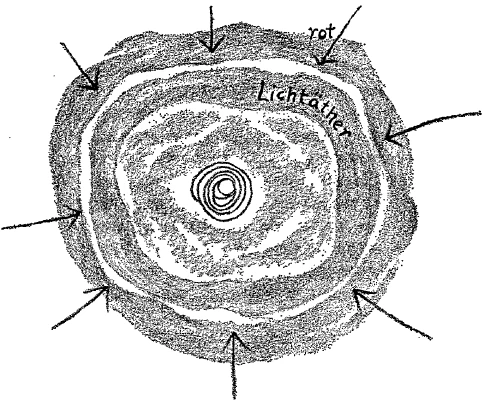
[ 7 ] You need not believe that what I am describing here involves your eye becoming enormous, growing all the way out, and then allowing you to view the cosmos from the outside just as you now view it from the inside. You do not attain this through the power of perception, but precisely through the will becoming clairvoyant. It is an experience within the expanding will, in which you yourself are present. In this case, you also look at the stars from the outside, just as a human being, when as a soul in the spiritual world, likewise looks at the stars from the outside—from a place where there are certainly no stars anymore, not from the etheric realm, but from the astral realm, of which one can say that there is still space there, and of which one can also say that there is no longer any space there. It no longer makes much sense to speak of what I have just described as if it were still space. But one feels as if one had space itself within oneself. Yet then you do not see any stars. You know you are looking toward the stars, but you do not see stars; instead, you see images. In fact, you see images everywhere within the starry space. It suddenly becomes clear to you why, in ancient times, when people depicted the spheres, they did not merely paint stars but rather painted images.
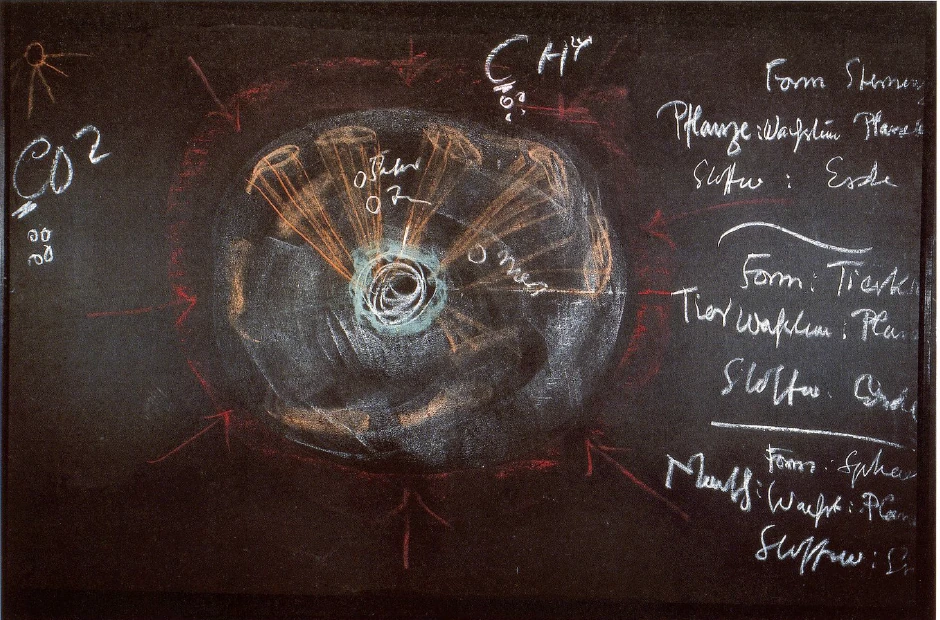
[ 8 ] But now imagine looking through these images. Then you will realize: Forces are radiating down to Earth from all these images; only these forces converge. When you look from here, from Earth, at a shining star, you have the feeling that the rays are diverging. If you look at this from the outside, you have the feeling that the rays—the light effects emanating from the images—are not merely light effects but also force effects—and that they converge. These force effects extend all the way down to the Earth. And what do they do there? Well, you see, they shape the forms of plants, for example. And those who look with imagination say: The lily is a plant form found on Earth that was created in this form, in this shape, by this group of stars. Another form—the tulip—was created by a different group of stars.
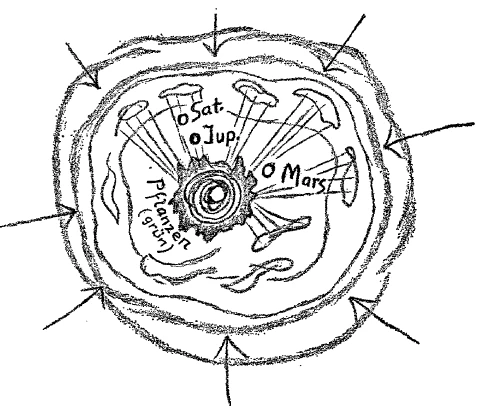
[ 9 ] And so you see what on Earth is the vegetation cover (green), as it were, realistically depicted from the starry sky. The fact is that the form of the plant is actually determined and created by the cosmos. And you will now easily understand: If you look further into it, if you see the fixed stars out there, then closer to Earth you see the planets Saturn, Jupiter, Mars, and so on. They are moving. The fixed stars show you stationary constellations that give the plants their form. But the moving planets send down forces of motion. It is these forces that first draw the plants up from the root, then cause them to grow higher and higher, and so on. Just as the form of the plants is shaped by the fixed starry sky, so is their movement shaped by the motion of the celestial bodies closer to Earth. Only what takes place within the plant itself—this metabolism, such as when the plant absorbs carbon dioxide, assimilates it, as they say, and secretes carbon, thereby forming its carbon body—that comes from the forces of the Earth itself. We can therefore say: When we consider the plant in its entirety, its form comes from the starry sky, its growth comes from the movement of the planets, and its metabolism comes from the Earth.
[ 10 ] These are things that are regarded today by those who call themselves true scientific minds as sheer folly, yet they are, in fact, the true reality. For anyone who observes a plant in its growth and form the way we do today is like someone—I must use a simile here that I have employed many times before—who looks at a magnetic needle pointing north with one end and south with the other, and who then says: “It is inherent in the magnetic needle that one end points north and the other south.” — It is not inherent in the magnetic needle at all; rather, natural science naturally assumes that the entire Earth is a great magnet, attracting one end toward the north and the other toward the south. In natural science, one already calls upon the entire Earth to explain the direction of the magnetic needle. In exactly the same way, however, if one wants to explain the entire form of the plant, one must take the entire universe into account. The plant is formed out of the entire universe. It is simply a tremendous absurdity that the very same people who, for example, invoke the entire Earth to explain the direction of the magnetic needle, want to explain the plant solely in terms of its cells and their forces. Just as the magnetic needle can only be understood when placed within the context of the Earth’s entire magnetic system, so too can plants only be comprehended when placed within the context of the entire cosmos—when one comes to say to oneself: Here I am walking through a region, let’s say, of Central Europe; for this Central Europe, during the flowering season, these particular constellations are especially significant; that is why the plants of this region grow here, for the heavens cause certain plants to grow in a particular area on Earth.
[ 11 ] If one wishes to view plants from this perspective—that is, if one goes all the way down to their form—then one must actually draw upon the entire cosmos. With animals, one need only go as far as the constellations of the zodiac. I have already spoken about this. The stars outside the zodiac have no influence on animals. The animal has thus become more independent; its organic development no longer depends on the entire cosmos, but only on what is within and beneath the zodiac.
[ 12 ] Human beings have become even more independent, for it is only the planets that influence them—not insofar as they are souls, but insofar as they are physical organisms. Only where this transitions into the moral and the spiritual must we then go beyond planetary influence, as was done in the older, truly sound views on astrology—not in today’s amateurish and dilettantish ones, which are still backward. But from all this you can see that one must already say, in a certain sense—though always only insofar as one considers the external aspects—that this applies to the plant. As for the animal, its form is related to the zodiac, its growth to the motion of the planets, and its metabolism to the Earth.
[ 13 ] When we turn our attention to human beings, we can no longer attribute their form to any particular constellations, but only to the entire universe as such; we can only say: the sphere—not the individual constellations, but the entire sphere. That is why I once said—and I have already had it published—that the human brain is, in a certain sense, a reflection of the entire starry sky, not of a single group of stars. So there is the sphere for the form. As for growth, however, planetary motion also plays a role in a certain sense—but now the entire planetary motion, not individual planets, as is the case for plants and animals; and for metabolism, in turn, the Earth.
Plant:
Form, Starry Sky
Growth, Planets
Metabolism, EarthAnimal:
Form, Zodiac
Growth, Planets
Metabolism, EarthHuman:
Form, Sphere
Growth, Planets
Metabolism, Earth
[ 14 ] What, then, was the nature of the progress in the development of knowledge? Essentially, right up until the time of the Mystery of Golgotha, no one of any significance in the realm of knowledge had ever doubted the things I have just explained. Even if this ancient knowledge was not the fully conscious knowledge we strive for today through anthroposophy, for example, a kind of dreamlike yet clairvoyant knowledge did exist in those ancient times, particularly up until the Mystery of Golgotha. And those people who were recognized as having some understanding of the world did not doubt at all that, when they looked at a flower, they had to relate it to certain constellations in the starry sky. And the same was true of other things as well.
[ 15 ] Then this knowledge gradually faded away during the first four centuries following the Mystery of Golgotha, and after the great eradication of the ancient knowledge — a process I have described on several occasions — only those insights remained that were then carried over into the Middle Ages, which have been distorted in many ways, which are now recorded in old tomes, and which still delight some people who do not wish to take refuge in the new insight, but who always want to look back to the old ways.
[ 16 ] The insight to which we are once again striving in full consciousness today—the cosmic insight into even that which appears here on our Earth as a form—this cosmic insight we are striving for today was, admittedly, not present in the form of conscious clairvoyance, but it did exist in a certain way. It gradually faded more and more. And then, after humanity had devoted itself for some time to what arose from within—the artistic shaping of the word in drama, of thought in dialectics, of sound and the interplay of words in rhetoric, the perception of number in arithmetic, and the perception of form in geometry— after humanity had devoted itself for several centuries to this artistic cultivation of the soul’s powers, a worldview emerged that no longer seeks out there in the cosmos, that no longer asks: What is out there that allows a lily or a tulip to bloom on Earth? Instead, a worldview emerged that calculates only the current positions of the stars and their sizes, that accepts only mathematics, and that, at most, accepts mechanics and physics as astrophysics when the world of the stars—when the extraterrestrial realm—is taken into consideration.
[ 17 ] If this is the earth and there is a mole living in it, then the mole has a certain worldview. But there is not much that is sun-like in this worldview. In more recent times, people have lost the ability to look out from the blooming lily or the blooming tulip toward the starry sky, just as the mole has no way of looking out beyond the darkness of the earth. And so people are simply trapped within the earth, water, air, and fire. At most, they gaze out into the light like the earthworm does when it emerges during a rain shower and perhaps perceives a faint glimmer of the light out there. In relation to the spiritual world, it has indeed become a mole-like existence into which humanity has gradually entangled itself. For whatever a person can find within themselves, like a mole—the mathematical relationships—that is what they seek out there in the cosmos; but they do not seek the concrete and the spiritually real out there in the cosmos. One could indeed say: The experience of freedom could only come to human beings because they once led this “mole-like” existence for a while—because they looked at the lily and no longer knew that an image of heaven is reflected in the lily; because they looked at the tulip and no longer knew that an image of heaven is reflected in the tulip. Through this, they have turned their energies more toward their inner world, and they have come to the experience of freedom. But today we have reached the point where we must necessarily take in the spiritual universe once again with the eye of the soul. That which for centuries appeared only as a mathematical, mechanical structure of space must once again appear before the soul’s eye as a spiritualized cosmos. One might even say: For centuries, humanity in the civilized world has led a spiritual existence akin to that of a mole—albeit for the sake of cultivating human freedom; for everything experienced in the progress of humanity has a purpose. But one must see through to this meaning; one must not remain stuck at a single stage of development, but must move forward with that development and must be clear today: Now that humanity has developed the experience of freedom within its earthly, mole-like existence, it must once again emerge to behold the spiritual, the spiritual world—not merely the mathematical world.
[ 18 ] But try to vividly imagine what I have just explained. It is truly as if, in a spiritual sense, darkness had fallen over the first four centuries after Christ, as if people had once looked out into the cosmos and—figuratively speaking—beheld the light of the Spirit. There was just enough time—because this spiritual vision persisted for four centuries after the Mystery of Golgotha, even though it grew increasingly dim—for the event of Golgotha, the Christ event, to still be spiritually perceived in the early centuries. But even the literature referring to this spiritual contemplation of the Christ event has been eradicated. Indeed, nothing remains of this literature except what the opponents have written. Humanity now faces the Mystery of Golgotha in such a way that, apart from the simple—or seemingly simple—accounts in the Gospels, it lacks the great descriptions that the spiritualists of the first four centuries still provided. We have only the accounts of the opponents. Of the greatest accounts of the Mystery of Golgotha, we have about as much as posterity would have of anthroposophy if it were to read only the writings of Ka/ly. I think one would not exactly get an adequate picture from that. One must always bear in mind how those first four centuries worked to eradicate precisely the most profound insights that still existed when people looked out into the cosmos and knew that Christ had come to Earth from a spiritual cosmos. One had to understand the spiritual cosmos in order to comprehend how Christ had come to Earth from the spiritual world and incarnated in a human being. Then, because humanity immersed itself solely in the earthly realm, nothing remained but the memories of the Mystery of Golgotha. These memories were passed down from generation to generation. And what was passed down as memory came to be called “revelation”; people sought to comprehend it through the intellectualism that was increasingly on the rise.
[ 19 ] What, then, is the task that falls to us today in the face of these things? Our task is to learn once again to look out into the universe and to be able to see Spirit everywhere—not merely by immersing ourselves within ourselves and seeking to experience the spiritual there, but by being able to experience Spirit in all the forms of the cosmos outside. This is our task; it must happen again. We must once again penetrate the luminous Spirit of the entire cosmos; then we will also see the Mystery of Golgotha in a new light.
[ 20 ] I have explained to you how, in the last third of the 19th century, this purely denominational clinging to the mystery of Golgotha had, in fact, already ceased to exist. I have told you that a thinker like Karl Julius Schröer said as early as the beginning of the 1870s: Religious disputes are, in fact, an anachronism. People, he believed, were already striving for something entirely different—a different kind of piety, a different kind of connection to the spiritual world. — But it has essentially taken these last fifty years for even such feeble attempts to be made as the one I cited for you in Werfel’s *The Mirror Man*. But now we see that individual people are being driven to rediscover their connection with the spiritual world. Just don’t think that this connection with the spiritual world can be found easily. It cannot be found easily for the simple reason that what is called “science”—what is practiced everywhere as official science—has such tremendous authority today. But that, in fact, has emerged from this “mole-like existence.” I don’t mean that in a derogatory sense at all. I only ask you not to think that I am trying to criticize the present age by using the term “mole-like existence.” I merely wish to characterize it; I truly do not intend to say anything derogatory, for, when all is said and done, quite great achievements have been made since the 15th century by these cosmic moles we call human beings.
[ 21 ] If you don’t believe this, try studying the geography of moles or earthworms from a humanities perspective. It is, admittedly, an imagined geography, but it is a magnificent one; it is simply not suited to human beings. And if you were to study the geography of plants! A plant doesn’t even dream in its etheric body, but what can be discovered in the etheric body is truly more magnificent than anything that can be learned in a university department today. So, I certainly don’t mean this in a derogatory way when I say “a mole’s existence,” because I hold it in the highest regard.
[ 22 ] But the world is, after all, in a state of development, and the time has now come when we must once again turn to spiritual perception, to the contemplation of the spiritual realm. Human beings cannot continue to live without immersing themselves in this spiritual contemplation of the spiritual realm. And now we must become fully clear on how these things have actually taken effect over the past fifty years. And here I would like to present another characteristic personality. Sometimes one can study much more precisely through individual personalities how things develop in relation to human cultures and their progress than by describing them in a more impersonal and abstract way.
[ 23 ] In my previous reflections, I have referred you here to Brentano and Nietzsche in order to show you, through what human souls have gone through, what this development was actually like. Today I would like to show you more from the other side—how a person has been perceived by his fellow human beings.
[ 24 ] In the 1820s—on July 22, 1822, to be exact—a certain Gregor Mendel was born; today we are celebrating his 100th birthday. I mentioned him recently when I said that, while we were in Vienna, articles about Gregor Mendel were appearing everywhere because his 100th birthday is now approaching. This Gregor Mendel was born the son of a farmer in a Silesian village; he studied with great diligence and made excellent progress, and was then ordained a priest in Moravia at the age of twenty-four. He thus became a Catholic priest. As a high school student and later at the seminary, Gregor Mendel was an exceptionally—as they say—model student. It was customary in Austria at that time—in the 1840s or 1850s—for particularly well-behaved, diligent students to receive scholarships from their monasteries. They were then sent to the university to be trained as secondary school teachers—for high schools and secondary schools—because almost all positions in high schools and secondary schools—as I also mentioned recently when I described our trip to Vienna to you—were held by monks or priests. In Austria, priests served as teachers at schools—which are called “higher schools” here—all the way up to the universities.
[ 25 ] He was sent to Vienna to study mathematics and the exact sciences. Back then, after three years of study, one had to take the teacher certification exam. Mendel sat for the exam, apparently thinking—since he had always received such excellent grades in the past—that it would be just as easy this time. In the end, he failed the teaching certification exam, had to retake it, failed again, and was unable to retake it a third time; for if one has failed such an important exam twice, there is no way to proceed further.
[ 26 ] Due to all sorts of circumstances—as was once the case in old Austria—a school principal somewhere in Moravia once said: “Well, we don’t have anyone else who made it through and got good grades; but we need a teacher, so we’ll just hire Gregor Mendel.” And so he became a secondary school teacher for fifteen years. There’s no denying it—he did become one of those secondary school teachers who had been sent there as priests to teach in these higher schools.
[ 27 ] But then he really indulged his love of natural science, conducting a large number of experiments on the mechanisms of heredity, particularly in plants. He collected and planted plants—some, let’s say, with reddish flowers, and others with whitish flowers. He then had the ones with reddish flowers pollinated by those with whitish flowers, and as a result obtained plants with only reddish flowers—these were the daughter plants. But in the second generation, the pattern changed. There was a certain number of reddish flowers, whitish flowers, mottled flowers, and so on. In short, Gregor Mendel said to himself: I must seek out the atoms—the truly atomistic—in the plant world, in the organic world in general. — Anyone familiar with the development of intellectual thought knows how much thought was given to heredity back then. There are an immense number of theories of heredity. But Gregor Mendel did not concern himself much with these theories of heredity; instead, he planted his pea plants and observed how heredity occurred when he had a white pea fertilized by a reddish one, he observed whether he would get a red, white, or mottled pea, and in this way, over generations, he determined, for example, how color develops and how inheritance in general takes shape under various conditions, proportions, and the like in peas.
[ 28 ] Yesterday I described to you the period—it was in the 1860s—when everything I have described began to emerge, as reflected in Herman Grimm’s *Unüberwindliche Mächte*, Paul Heyse’s *Kinder der Welt*, Du Bois-Reymond’s *Grenzen des Naturerkennens*, and so on, from a wide variety of perspectives. In Mendel’s case, this led him to establish the laws of inheritance.
[ 29 ] The examiners for the two teacher certification exams—they at least paid enough attention to Gregor Mendel to fail him twice, meaning they issued him a certificate twice: Completely unfit to teach any science to high school or middle school students! — As for the others who came later, they didn’t concern themselves with Gregor Mendel at all. The books he wrote on the laws of inheritance have been gathering dust in the libraries. No one has paid any attention to them anymore.
[ 30 ] But for about twenty or twenty-five years now, you’ll find that people have been taking an increasing interest in Gregor Mendel. They’ve been rediscovering his laws of inheritance. For we are now facing a very special phase in science. In that era, when Herman Grimm sought to show how the human intellect cannot overcome class prejudices because it lacks strength, in the era when Du Bois-Reymond uttered his “Ignorabimus,” when Paul Heyse wrote his *Children of the World*—in short, in the era when the intellect, the intellect had become increasingly lifeless and enfeebled, yet among non-denominational people everywhere there was a tendency toward a new piety—one that has now been at work for fifty years—at the very same time when efforts were being made everywhere to develop atomism into a dehumanizing force in science, Gregor Mendel, too, strove to discover botanical and zoological atomism. He sought to analyze the heredity of every plant by breaking it down into red and white flowers, large and small, thick and thin flowers, to observe how thick and thin, red and white flowers, once they exist, remain as unchanging as atoms remain unchanging. Back then, people used to say, for example: “We have carbon in carbonic acid, and we have carbon in hydrocarbons.” Hydrocarbons are something entirely different from carbonic acid, but both contain carbon. The atoms present as carbon—whether in carbonic acid or in hydrocarbons—are the same.
[ 31 ] Mendel said: Here I have a red pea flower, and here I have a white pea flower. Now they produce offspring—some of which may be red. But then those offspring produce more offspring, and among them some are red, some are white, and some are mottled, speckled with red and white. And now it continues: They have more offspring, and among them there are again red, white, and mottled ones, and so on. — Now we have the atomistic perspective with regard to plants. If we consider only the color—red and white—then where the peas are red, the white is merely hidden; it is also there inside, just hidden. But in the subsequent generations, it emerges again, just as carbon is present in carbonic acid and in hydrocarbons—substances that are entirely different from one another. That is, after all, the essence of atoms: carbon is here and there; it is the same everywhere—the fixed, eternal atoms. The eternal atoms in the plant, which are passed down through heredity, are the colors, but also, for example, whether the plant is thick or thin, large or small; yet the white remains—it is simply hidden at times. Just as oxygen is hidden in water, so here the white is hidden in the red children and reappears when the opportunity arises.
[ 32 ] Gregor Mendel was truly a great man, for—in keeping with the spirit of his time and what was then considered appropriate—he pursued atomism as it applied to the inanimate world, and he did so in the right context: the plant kingdom. Building on that foundation, he also made very interesting observations regarding the animal kingdom, even though he failed his teacher certification exam twice. He did all of this, but people at the time paid no attention to it.
[ 33 ] Then came the time when, with the discovery of radium and so on, atomism in the inanimate world was shattered. Recently, a speech was given by the university president in Berlin that seems to have explained this very well: we can no longer cling to the old concept of atomism today. But people don’t catch their breath so quickly. Now they’re in a sort of state of disorientation, having lost their atomism. It no longer works in physics, nor does it quite work in chemistry either. So, after Gregor Mendel had been gathering dust for a long time, his laws of inheritance have been unearthed, and today you can find everywhere that people speak of “Mendelism,” that Mendelism is regarded as something of the very highest order in the field of genetics, a hundred years after his birth. Centennial celebrations for Gregor Mendel are now being held throughout the scholarly academies.
[ 34 ] It is an interesting life: The priest, who remained completely unnoticed during his lifetime and who failed the teaching certification exam twice, nevertheless accomplished something that a great number of academies across the globe today celebrate as a truly groundbreaking intellectual achievement. With Brentano, I showed you the man from the inside—how he viewed the world, how he thought about the Vatican Council and the dogma of infallibility. With Nietzsche, I tried to show you something similar. With Gregor Mendel, I wanted to show you more of how others viewed him. For it is, after all, interesting that the academic body failed him twice on his teaching certification exam, that he then remained completely overlooked, and yet now dominates the world with regard to the so-called laws of inheritance. What is this? It is, in essence, nothing other than the emergence of the final phase of intellectualism—and indeed something else as well, which I would like to discuss tomorrow. But the emergence of intellectualism—the final gasps of intellectualism, which is, after all, so closely linked to atomism—we can perceive this in the relationship the world has had with Gregor Mendel and continues to have today.
[ 35 ] Truly, I have absolutely no desire whatsoever to detract in the slightest from Gregor Mendel’s fame. On the contrary, I have taken this opportunity today to introduce you to a truly great man, so that you, too, may reflect on this great man here. He is a great man. But it is precisely through great men and their inner and outer destinies that one can study the further development of humanity. It is not through the small, but through the great, that one must study this, and Gregor Mendel is a great man; and you can rest assured that I am happier about the fact that he is celebrated today in all manner of scientific academies than I would have been had he failed his exams twice. You can certainly believe that. But the fate of Gregor Mendel is indeed extraordinarily interesting. And I would like to say: This current clinging to atomism in the organic world is tremendously characteristic of our time and actually belongs to all the phenomena I wanted to describe to you these past few days—phenomena I illuminated yesterday from a different perspective and which I presented to you today from the perspective of Mendelism, on the occasion of the centennial celebration of Johann Gregor Mendel.