Human Questions and Cosmic Answers
GA 205
21 July 1922, Dornach
Translated by Steiner Online Library
Twelfth Lecture
[ 1 ] The most recent lectures here were largely devoted to an examination of how one should conceive of the current sense of time. Last time, I attempted to look back to earlier periods and draw attention to how what now lives in people’s souls has, in fact, been developing within Western civilization for a very long time. Today I would like to highlight, in a series of anecdotes drawn from the immediate present, some aspects that might draw your attention to how a spiritual life must necessarily take shape out of the general sense of time—simply out of the necessity inherent in human development. We can indeed say: No matter where we ultimately observe human beings—whether in the West of our present civilization, in the Middle, or in the East—everywhere, upon a more intimate contemplation of time, it can become clear to us that without the introduction of a spiritual impulse, progress is simply no longer possible.
[ 2 ] Today, by characterizing the beginning and the end—in a sense, to prepare the ground for tomorrow and the day after—we want to take stock of the last fifty years of Central European intellectual development. I intend to do this in a symptomatic way. I intend to do so by highlighting certain characteristics of the beginning and the end of these last fifty years.
[ 3 ] If we go back to the early 1970s, for example, we find a wide variety of spiritual phenomena that shed light on the state of the human soul at that time. I would like to highlight a few of these spiritual phenomena. There, let’s say in 1872 or 1873, we have a sensational novel that is intimately connected with the trends of that time. For younger people today, these things have actually been forgotten, but the novel I am referring to is indeed one that, some fifty years ago, captured the imagination in an extraordinarily profound way. I am referring to Paul Heyse’s *Children of the World*. Paul Heyse, a renowned short-story writer of his time, sought with this novel to portray a number of characters in their lives—all of whom were already imbued with a certain vague religiosity, yet who had at the same time fallen away from any religious creed. Thus, he wanted to contrast the “children of God”—whom, I might say, Paul Heyse viewed, using traditional terminology, as belonging to some denomination—with the “children of the world,” who belonged to no denomination, who, as one said at the time, were non-denominational, but who nevertheless possessed a certain inclination toward the religious. Now, I do not wish to speak too much about this novel itself, but rather I would like to draw attention to how such a work—which thus portrays people who are non-denominational—made an impression at that time.
[ 4 ] I have often mentioned my old friend and teacher Karl Julius Schröer to you. He had a peculiar way of examining intellectual phenomena as they manifested their effects in broader social life. And so Karl Julius Schröer characterized the impact of Paul Heyse’s *Children of the World* by saying that it was extraordinarily remarkable how this novel, back then—that is, fifty years ago—passed from hand to hand, arousing interest everywhere, and how it was actually through this novel that people first came to realize things they had never thought about before: that they were distant from any positive religious creed, and that even in their religious searching they did not remain confined within any particular religious creed. And Schröer made the extraordinarily interesting observation at the time that people who, up until then, had fully participated in their church’s liturgical practices—that is, who had gone through the motions of their church’s old rituals and customs out of habit—that such people said this work actually expressed their innermost convictions. Schröer then concludes with a statement that is particularly interesting: that in the face of such a phenomenon, religious disputes appear as an anachronism, as something that no longer fits into the present—he is referring to the present at the beginning of the 1870s—because people’s thinking had already moved beyond that. But as I said, even though all of this is true, we must still say: The people described here have lost all connection to any of the existing denominations, yet there is a certain trait within them that drives them to seek some kind of religiosity. They simply cannot find it. They go through life without a denomination, unable to find a connection to a spiritual world through religious feeling.
[ 5 ] If we now turn our attention from such a phenomenon—which took place more within the realm of fiction and literature—to the lecture halls, we find that it was around the same time that Du Bois-Reymond articulated the conviction held by an extraordinary number of people within the scientific community regarding the “Limits of Knowledge of Nature,” a work I have already mentioned frequently. In this famous lecture, which Du Bois-Reymond delivered in 1872, he states that certain knowledge is possible only if one traces external natural phenomena through experimentation and observation and advances to a kind of mathematical-mechanical thinking about the structure of the world—to a kind of mechanism, an atomistic mechanism of the world’s structure. Science cannot go beyond such a conception of the world; everything else must be left to faith. But if one had asked the people who spoke this way in the early 1870s—such as Du Bois-Reymond in his “Limits of Natural Knowledge”—“How, then, should people seek their way into spiritual worlds, even in a religious sense?” — no answer would have been given. There would have been only a statement, very similar to the one made by all those people described in Paul Heyse’s *Children of the World* as non-denominational.
[ 6 ] Now it must be said that all those people who participated in what is called “cultured” life—those who had absorbed some scientific outlook, who had adopted certain other views prevalent at the time—were, in fact, all more or less in a certain frame of mind. For whether or not they continued to practice their old religious beliefs depended essentially on old habits of life, on all sorts of prejudices and the like; it did not depend on a strict, rigorous assertion of what the consciousness of the times would actually have imparted to their souls. In fact, over the past fifty years, people have lived with an indefinite, wavering attitude toward the spiritual world. But we can find such indefiniteness in other areas as well. A few years before the publication of Heyse’s *Children of the World*, Du Bois-Reymond’s *The Limits of Natural Knowledge* were published, the famous art critic Herman Grimm published *The Insurmountable Powers*, also a novel. The class prejudices and class distinctions that dominate people in Western civilization were portrayed there as insurmountable powers. And in this novel, the class distinctions within Western civilization are contrasted in an interesting way with what developed—out of certain, I might say, “historyless” unfamiliarities in America—as a new way of life, a life that did not have to contend with class distinctions and class prejudices in the same way. And it is interesting how Herman Grimm, in the late 1860s—that is, about half a century ago—describes how the European, despite all his liberalism and humanism, lacks the strength to truly transcend class differences. For him, these are insurmountable forces.
[ 7 ] If one wants to delve deeper and ask: Why are such things insurmountable forces for Europeans? — one can arrive at no other answer than this: Because the kind of thinking that has taken on a certain passive character in them—the kind of thinking I described to you, for example, when I spoke about Richard Wahle—which extends only to “events” and refuses to delve into the root causes, which thus seeks not to grasp forces but only phenomena—because this very kind of thinking has dominated the leading figures of the past fifty years. With such a way of thinking—which has no forces of its own, which is, one might say, merely a way of thinking consisting of powerless mental images—with such a way of thinking, one simply cannot overcome what has arisen in reality as class distinctions and class prejudices. This required a way of thinking steeped in reality, a way of thinking permeated by reality. And this way of thinking, permeated by reality—which once created class distinctions, which once created everything socially real in the first place—this dynamic way of thinking, in contrast to merely descriptive thinking, has actually been entirely lost to people within European civilization over the past fifty years. It was lacking in their science, which is why they relied everywhere solely on observation and experiment; but it was also lacking in their daily lives, which is why they continued to perpetuate what had arisen from old habits rooted in the old class prejudices. They did not bother to think about it any further. For if one had wanted to think about it, one would have needed active thinking. And when the proletarian class began to take class distinctions and social distinctions into account, this feeble thinking, which contains no dynamism, was completely set aside. Then it was said: These social distinctions do not stem at all from forces inherent in human thought, but solely from economic and physical forces. A simple conclusion was drawn.
[ 8 ] There you have what stood at the starting point of our modern intellectual life fifty years ago. And now I would like to present to you a work that was published recently and that is, in turn, characteristic of our time: namely, Werfel’s *The Mirror Man*. Here you have something that has emerged just as directly from certain forces of our time as *Children of the World* or *The Invincible Powers* emerged from the era of fifty years ago.
[ 9 ] So, what situation do people like Werfel face today? In recent decades, this lifeless and insipid way of thinking has taken hold. People have somehow sought a religious connection, a connection to a spiritual world, but nothing came of it. Human nature, however, cannot actually remain one-sided in the long run. It can do so for about fifty years in the course of world history, but then a reaction within human nature begins again. In a certain sense, it strives for something more powerful—if we stick to the last fifty years—than that lifeless and enless way of thinking actually was. Well, quite a few contemporary works already bear witness to this striving toward a more powerful grasp of reality, but Werfel’s *Spiegelmensch* illustrates this particularly vividly.
[ 10 ] This “mirror man” of Werfel compels one to speak of the present in roughly these terms: For long enough, people have been searching—in an indefinite, lifeless, and enervated way—for that which makes a person truly human. Now, a vague inner feeling is asserting itself regarding the paths that have been taken over the last fifty years—paths that are not really paths at all, but rather slippery walkways on which one constantly slipped and slid. Nothing can truly be achieved on these slippery walkways; we must get some steel back into our blood. Out of such a striving of our times, something like this “Mirror Man” has emerged. Let us sketch, with just a few strokes, what is depicted in this “Mirror Man.” It is not my intention to sin against artistry by characterizing for you what this Mirror Man is. But that is not the point at all; rather, we will see shortly that what I am about to say also strikes at the very heart of artistry.
[ 11 ] We see here a person who is only halfway mature, one who has grown weary of the external life as it is lived today. He bids farewell to this external life and now, in fact, wants to truly become human. For he admits to himself that within ordinary life, as we lead it today—in Asian, European, and American civilizations alike—one cannot truly become a human being. You get up in the morning, have breakfast, and do whatever is necessary to maintain your place within the social order; you have lunch or entertain guests and talk about things that perhaps need not be said at all—things that ultimately serve no other purpose than to move your lips, to keep them from being idle; you go for a walk with your guests or do whatever else people do these days. In such a community, one cannot truly become human—I am not recounting this verbatim, I am merely characterizing it. It is therefore necessary to try a different path if one wishes to become human. And so this “hero”—to use the old aestheticist style—attempts to become human by seeking admission to a monastery. But he is told that this is an extraordinarily difficult undertaking. I do not wish to describe the details, but only to point out what is important to me today. He is thus told that this is an extraordinarily difficult undertaking, and that, above all, he must be clear that he has to pass through three stages of insight. In the first stage of insight, he would have to gain clarity about humanity’s relationship to the world, insofar as this relationship is determined within the human “I” itself. Thus, this life within the “I” and this striving to transcend the “I” constitute the first stage of insight. The second worldview would consist in the fact that, after one begins in a certain sense to shed the “I,” one no longer views the world from one’s prejudiced standpoint as before, when one had not even begun to shed the “I.” And the third perspective would be one in which a person truly penetrates the world and its reality, not as it is seen by the person living within their “I.” This is explained to them. And they are cautioned accordingly not to seek such an incarnation too impetuously. They are simply made aware of the difficulties. Yet they do not turn away from it.
[ 12 ] This is how he is initiated. The introduction takes place—I’ll just mention the essentials—by his being led into solitude for the night, into a room where only one monk watches over him. And there, after initially giving himself over to his thoughts, he falls into a brief sleep from which he believes he will wake up very soon. And now he finds himself in the room, one wall of which bears a mirror. In this mirror he sees himself, and he is astonished at what this signifies. What is meant is that when, after a period of mental concentration and after a resolution as strong as the one this man has made, one stands before one’s own reflection, one sees oneself in a different way. The point being made, then, is that it is only now that the person begins to see himself. The reflection looks similar to him, yet at the same time somewhat different. And as he does what must follow from such a surprising experience—striking the mirror, believing he has wounded himself—the “mirror man” steps out of the mirror to meet him: that part of him which, in a certain sense, is himself and yet, at the same time, is not himself.
[ 13 ] Now the human being has reached the first stage of knowledge. He must get used to moving through the world not merely as an “I”-being—yet without “I”-consciousness—but rather by moving through the world accompanied by that which is himself and yet not quite himself: his mirror self. In the company of this mirror self, which now tempts him into all manner of actions in the outer world, lies an encounter with worldly phenomena and with his own deeds in a new way, precisely because he finds himself face to face with his own “I.”
[ 14 ] Well, I don’t want to go into the details. The person in question is actually lying in bed, but he passes through whatever he is able to pass through based on his previous experiences of the external world and his external actions. These aren’t always very pleasant. But how someone describes such things depends, of course, on his own taste. You can tell from the way the author describes things what his disposition is in such a case. After all, people also experience the world according to their own tastes. We are thus guided through our experiences of the world. Just as Mephisto in *Faust* has something of a driving force about him, this “mirror man” is now always the driving force, and he is led from one event to the next, being led to commit many wrongs. Everything appears to him in a new light, for he has, after all, looked into the mirror and seen himself. He now perceives one thing after another in the world. At times he sees things as they appear to him as an “I-human”; at other times, as they appear to him now that he is able to take his own reflection into account. He continues to immerse himself in the phenomena of the world. In doing so, he steps further and further out of his “I.” The “mirror man,” who is rather frail at first, grows fatter and fatter. This is a polar-parallel phenomenon that is depicted in a rather intriguing way. And so this human being now lives his way through the world, experiencing in a different way what he could have experienced earlier, now that he has beheld his own “I.” And in the end, he has become so entangled in worldly experiences that he must become his own judge, condemning himself to death—which, in turn, is very characteristic. He finds that he cannot actually live within the world.
[ 15 ] When he entered the monastery, he was already aware that it is impossible to live within today’s society if one wishes to become human. This realization has intensified to such an extent that now, having become his own judge, he sentences himself to death. And now he awakens. In a sense, he awakens out of this execution of his own death sentence. He is, after all, back in the same room where he was before. Now he looks at the mirror again. But as he looks at it now, he notices, for example, that the mirror does not reflect a procession of monks passing by. Earlier, when he had looked into the mirror, it reflected himself and everything that was in front of the mirror. But now a procession of monks is passing by and is not reflected. From this he realizes that he is no longer standing in front of a mirror, but that the mirror has become a window. He looks through it and out into the wide world; he sees the landscape there. He has attained the third vision. For now he sees the world, whereas at first he had seen only what the mirror reflected. By having the “mirror man” at his side, he saw what he had seen before in a different way. But now he sees, as it were, through the surface of things—as it is depicted—out into the free reality. It is, of course, implied that he now also looks out into the spiritual reality.
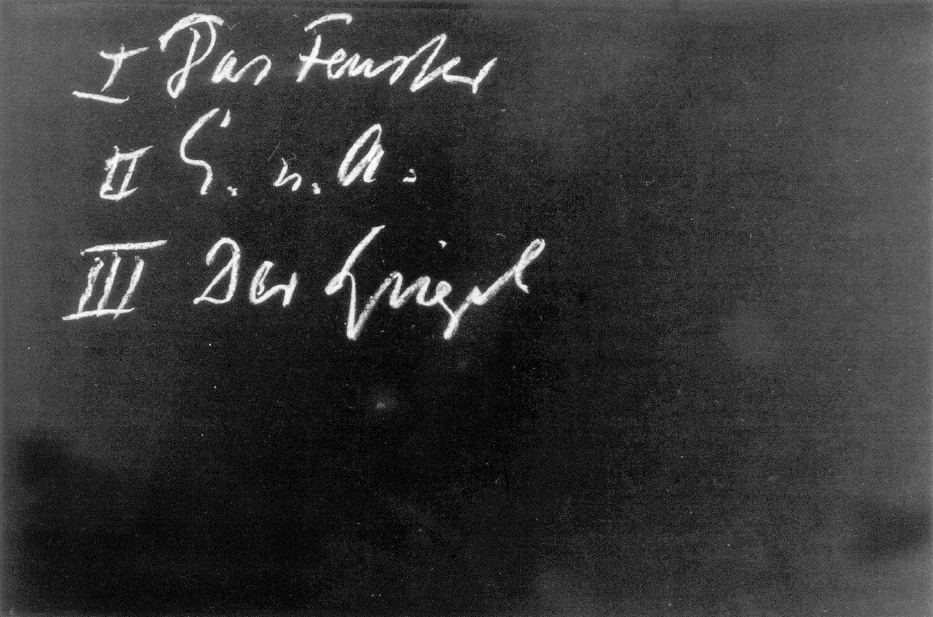
[ 16 ] So we have a trilogy before us: the first is the mirror, the third is, let’s say, the window. The mirror has become a window. So here we have the two polar, mutually opposed views of the world. At first, everyone sees in the other “their own reflection”—sees in the other only what they already carry within themselves, where they are caught up in their own ego—and thus sees everywhere in their neighbor or in anything observed in nature only their own reflection. Finally, after piercing through the mirror, they no longer see the mirror, but look through the surface of things into the spiritual realm. And in between
[ 17 ] That's where the two merge into one another: one into the other.
1. Der Spiegel
2. One into the Other
3. The Window
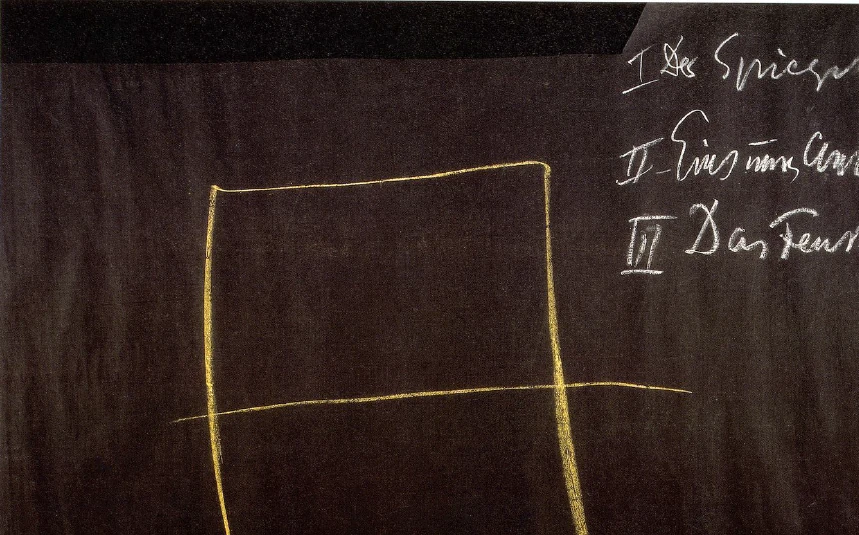
[ 18 ] Well, I’d like to begin by pointing out two distinctive aspects of this drama. The first is this: We see that there is a desire to portray a person ascending toward a certain religious union with another world. The fact that the first part, “The Mirror,” is short can at least be forgiven, because it is very interesting to see how the person immerses themselves in a contemplation of their own “I,” so that this “I” becomes so concrete to them that it now accompanies them through their experiences of the world. The middle section is quite detailed, and a great many experiences are described there. To find these at all appealing, one must have a certain taste—or, one might even say at times, a lack of taste—for them. But as I said, everyone must simply approach it according to their own taste. In any case, this section, where one looks into the experiences of the world, is very long. The third part, however, is quite short, and what is seen out there is actually only—I would say—symbolically hinted at, as if looking through a window; nothing concrete really comes into view. This third part is quite short. That is the one peculiarity I would like to highlight. The other peculiarity, however, is this: One must acknowledge that here, in the most beautiful way, there is an aspiration to infuse thought with vitality and vigor. But one also sees that modern people—of the sort that Werfel represents—are initially quite incapable of this. Why? Well, it is very peculiar. When I had finished reading this drama—and I read it with the greatest interest, I must say, because I find it extraordinarily significant as a symptom of our present spiritual life as represented by individual personalities—I had to say the following to myself: The sequence is as follows: 1. The Mirror; 2. One into the Other; 3. The Window. But one could also read the whole thing from back to front. Of course, one would have to rephrase it, but one could also read the whole thing from back to front. Why? Because it is entirely possible to interpret the matter in such a way that one says to oneself: The way a person initially relates to the world is how things appear to him. He is not at all distinct from the things themselves. He has not yet awakened to his sense of self. He stands before the window, looking out into the world. Now we could say that the old monk, to whom he has now come and to whom he says that he can no longer bear it, since everything he sees through the window is always inside him, and that he wants to find himself—that the old man now says to him: Yes, there are three stages of perception to go through. The first perception is provided by the world, without our finding our “I” within it. We lose ourselves in the world. The second perception allows us to gain something of the “I,” and there, gradually, a multitude of beings comes toward us from the world. The world becomes animated, imbued with spirit. We used to see it as spiritless; now the world is imbued with spirit. Everywhere, from every being—from plants, animals, clouds, and so on—something spiritual comes toward us. Many spiritual beings come toward us in this second stage. In the third stage, we awaken. We step up to the window and look out. But we see everything anew, for only now do we see the real world. The window has transformed into a mirror; the human being has come to himself. He unites all these mirror-like beings—the plants, animals, and clouds that met him out there in the world—within his single “I,” which has now become cosmic. And now, by recognizing himself, he truly sees the cosmos for the first time.
[ 19 ] One could quite easily rewrite the whole thing from back to front—the last part of the trilogy first, then the middle part, and finally the part with which it began. This is extraordinarily interesting, because it is precisely this that makes this drama particularly characteristic of the present day. What, then, is the distinctive feature of intellectualism?
[ 20 ] Yes, the peculiarity of intellectualism is that one can begin a line of thought anywhere and stop anywhere, and one can assert one thing or another—I have often emphasized this. In theory, one can prove anything; in theory, one can disprove anything. Intellectualism—which is nothing more than a system of lifeless and powerless thoughts—allows one to start anywhere, proceed to a certain point, and then stop. But one can also start at that same point and proceed in the opposite direction.
[ 21 ] It is possible today to be a very intelligent person and a staunch materialist, for materialism can be quite well proven intellectually, and if one is purely intellectual—as happened after a meeting following our anthroposophical congress in Vienna—one can, from the standpoint of contemporary monism, wage a purely intellectual battle against the spirit. One can quite easily prove that materialism is correct. But one can also choose to be a spiritualist and prove that just as well. All these things—as long as one lives solely in the intellectual realm—can certainly be proven, and these intellectual discussions have the appearance of immense persuasive power.
[ 22 ] And that is indeed how it is in our time. By becoming entangled in spiritualism, materialism, realism, and idealism, people do not realize that they are becoming entangled in the spirit of intellectualism. They rightly feel: This can be rigorously proven. They are the creatures of intellectualism. Precisely because it is true that things can be proven, that is why it is so disheartening when one is compelled today to seriously analyze something from reality, and then “free discussion” is called for. One person says this, another says that, and a third says something else. Basically, if you’re even a little bit of a sharp thinker, you can say: They’re all right. Of course, they might just as well all be wrong. — All this talk, after all, serves at most one purpose: that one or the other might finally see what an immense deception of the self it is to live in intellectualism, for with intellectualism, simply everything can be proven. It just comes down to having immersed yourself long enough in some direction or movement, in some sect or party or something else—then you can quite rightly say: Yes, it’s all clear; the other person, who claims the opposite, is just a fool. — Certainly, but the other person can just as easily prove that the first person, in turn, is a fool and that his own assertion is correct. This is entirely possible today given the state that intellectual life has reached; it goes without saying. And so it goes without saying that one can write such a play today without coming anywhere near a true spiritual insight. For the fact that Werfel does not come near it proves that nothing significant is seen through the window; spiritual insight would, after all, only begin if one were to see something significant through the window. But if one merely describes three steps, and then—after describing how he woke up and looks out—fails to describe what he sees; if one makes so many concessions to general consciousness that one can write about such a “mirror man” and yet, when faced with something reasonable like *Outline of Esoteric Science* or *How Does One Gain Knowledge of the Higher Worlds?* or the like—if one were to say: “If you accept that, you’re out of your mind”—if, in other words, one can always just say: “Yes, the person in question has reached the window, but I am wary of seeing what one sees when looking out the window”—then one is simply not yet ready to immerse oneself in true spiritual life; one is simply completely stuck in intellectualism.
[ 23 ] That is why I was allowed to speak that way. Of course, one would not have the right to offer a philosophical critique of a work of art. But I did not offer a philosophical critique at all; what I said is just as much an artistic interpretation. Because this is what happens to you: you read a trilogy, reading it with the utmost interest. Afterward, when you’re finished, you suddenly find yourself standing on your head! — That’s an uncomfortable feeling, and, to get back on your feet again, you’d have to rewrite the whole story from back to front. It would take a very long time to finally work your way back to your feet, to your proper footing. Yes, it is certainly true that one is also artistically deceived when one realizes: Inside is the spinning wheel of intellectualism, whereas the work of art must, in fact, make a beautiful impression. You cannot reverse that. Try, for example, to turn Goethe’s *Faust* upside down, to write it from the end to the beginning. You cannot do that! A work of art cannot be turned inside out. Here, with this particular work, you can do so because the intellectual aspect predominates—because it has not penetrated all the way to true contemplation. Intellectualism has, admittedly, grasped the vague, unconscious feeling that vitality and power must flow into the thoughts; but in reality, neither vitality nor power has entered it—there is nothing inside. Once again, it is merely a schematic representation of a more real inner experience. And so it is precisely in something like this—which is truly full of spirit, which is extraordinarily significant in relation to what our time is capable of producing—that we see where the path must lead.
[ 24 ] For fifty years now, people have had the feeling that they must be moving toward something spiritual, yet they wish to avoid the true path. So they draw from all sorts of old traditions concepts such as the threefold path and the like. But what is characteristic here is that people today embrace this threefold path; it can be found in all sorts of books that describe various ancient, atavistic, clairvoyant paths.
[ 25 ] As long as one refrains from accepting what one sees when looking through the window, this story of the “mirror,” “one into the other,” and “through the window” can very easily remain part of one’s spiritual life. It is easy to describe if one has only such general notions of it. But as long as one stops there, one still cannot escape the intellectualism that holds the people of the present captive with its immense spell.
[ 26 ] I have, after all, pointed out this intellectualistic element in our time in the most varied ways. I have, after all, pointed out how, within the Theosophical Society, one could venture into all manner of branches, where grand schemes were laid out—races and rounds, entire world systems, and all manner of things—all constructed in wonderfully intellectualistic forms—all intellectualistic! Again, when it came to characterizing the structure of the human being, a schema: Physical body: dense physical matter; etheric body: finer matter; astral body: even finer; Kama-Manas: even finer; Manas: even finer, ever finer and finer. Yes, but understood precisely from the perspective of intellectualism! This process of becoming thinner never stopped! But it is simply intellectualistic. Just as one can keep turning a wheel, so too, if one sticks solely to the intellectualistic, one can make matter become thinner and thinner. And so we have had an intellectualistic theosophy, and so we have here an intellectualistic work of poetry that even ventures into the mystical and is certainly admired by a large number of our contemporaries—and quite rightly so—because it is precisely in such poetry that one sees how, after all, the striving of our time is once again directed toward something spiritual.
[ 27 ] But my judgment is by no means unartistic. As I observe this “mirror man,” who accompanies the hero throughout his entire evolutionary life, I see that this “mirror man” is something entirely different from Mephisto in relation to Faust. There is life in Faust. You know, I once explained how, in the end, Mephisto is simply the other side of Faust—just as Wagner is. “You resemble the spirit you comprehend, not me.” You resemble Wagner, you resemble Mephisto, and so on. But there is life within it. Yet it is not yet life when the self leaps out of the mirror, at first frail and then growing fatter and fatter as the human being himself grows further and further out of life.
[ 28 ] In short, the inanimate, the abstract—in other words, that is what prevails here from beginning to end. The abstract can always be turned on its head. And since, artistically speaking, one senses no rich, intense vision anywhere—but rather, everywhere, merely thought templates inflated into images—one senses something inartistic. And it is strange that, in the present day, precisely this kind of thing is often defended by saying: “Anthroposophy—yes, there one strives only for ideas, and that is something unartistic.”—But in anthroposophy, one strives for insight; one simply must be truly prepared for this insight. One must look through a window and see something. But here, what is actually called “artistic” is something that hasn’t quite hatched from the egg, something that is just beginning to hatch but is content to remain inside the egg. You know what I mean, that the chick doesn’t really hatch from the egg to live its life in the world. It’s as if a person were trying to embark on a path of knowledge, yet were still shying away from the spiritual world in all its concreteness and definiteness. I won’t speculate on what happens to the egg when the chick just can’t quite manage to hatch! But isn’t that exactly how it is with such products of the spirit that never quite manage to hatch?
[ 29 ] I do not mean to say anything against the value of such things. In fact, from the perspective of the present, I see something of the very highest order in this “mirror man.” But from a higher vantage point, it must certainly be characterized and situated in the spiritual life—and in the entire cultural life of the present—as I have attempted to sketch out.