

The Secret of the Trinity
GA 214
24 July 1922, Dornach
Translated by Steiner Online Library
Second Lecture
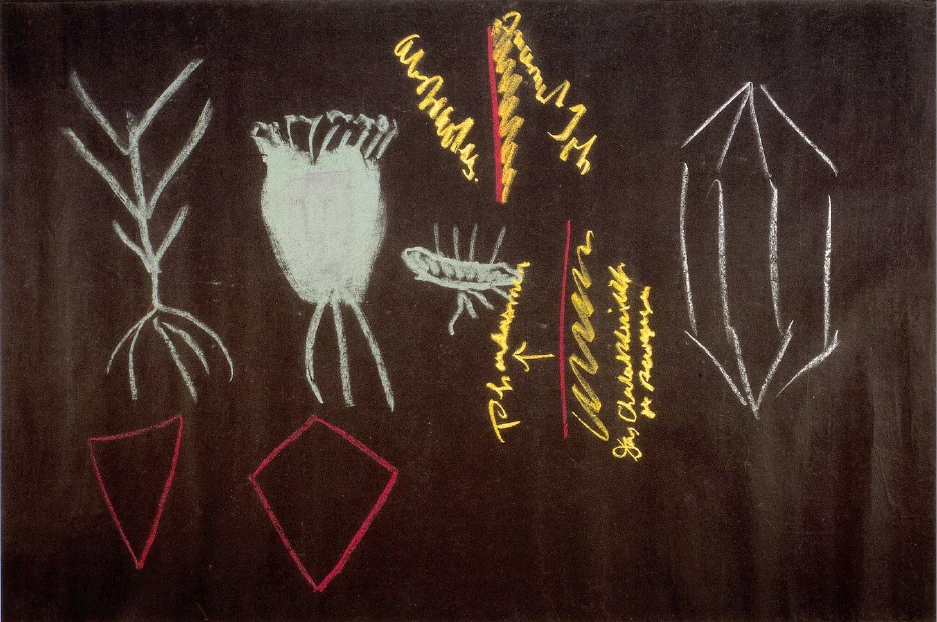
[ 1 ] In various complex ways, we have already seen how human beings can truly be understood only in the context of the entire universe, in the context of the cosmos as a whole. Today, in order to bring this topic to a culmination in a specific direction over the next few days, let us consider this relationship between the human being and the cosmos in a simpler way. We must note that what appears to us as the physical world constitutes the immediate surroundings of the cosmos. But this physical world actually presents itself to us only where it is the mineral kingdom; at least, it presents itself to us in its most essential form only there. Within the mineral kingdom—in the broader sense, which naturally includes water and air, thermal phenomena, and the phenomena of the heat ether—we can study the forces and the essential nature of the physical world. This physical world manifests its effects, for example, in gravity, in phenomena such as chemical and magnetic behavior, and so on. But in reality, we can only study the physical world within the mineral realm; as soon as we move up into the plant kingdom, the ideas and concepts we have formed about the physical world no longer suffice. No one in recent times has actually felt this as intensely as Goethe. Goethe, who as a relatively young man became acquainted with the plant world from a scientific perspective, immediately sensed that the plant world must be understood through a different kind of perspective than the physical world. He took issue with the science of plants as Linnaeus had developed it. This great Swedish naturalist had, after all, developed botany in such a way that he focused above all on the external forms—and also on the finer details—of the individual plant species and genera. Based on these forms, he established a system of classification in which similar plants are grouped into genera, so that plant genera and species stand, as it were, side by side, just as we otherwise arrange objects of the mineral kingdom side by side. This is precisely why Goethe was repelled by Linnaeus’s approach to classifying plants—because the individual plant forms were placed side by side. “That,” Goethe told himself, “is how one views minerals—that which exists in the mineral kingdom; with plants, one must adopt a different approach.” With plants, Goethe said, one should proceed as follows, for example: Let us say there is a plant that develops roots, then a stem (see drawing), and on that stem, leaves, and so on. But it doesn’t have to be exactly like that with a plant (Drawing 1), Goethe thought to himself; rather, it could also be like this, for example (Drawing 2). Here is the root; but the life force, which in this plant form (drawing 1) begins to develop directly at the root, remains here (drawing 2) still contained within itself and “does not develop a thin stem that immediately branches into leaves, but forms a thick stem.” As a result, the force of the leaves is absorbed into this thick stem, and only a little force remains to then develop leaf buds and, perhaps, the flower. It may also be the case, however, that the plant develops its root only very sparsely. Some of the root’s force remains. This develops as shown (Drawing 3), and then sparse leaf and stem buds develop from it. But internally, all of this is the same. Here, the stem is slender and the leaves are robust (Drawing 1). Here (Drawing 2), the stem is bulbous and the leaves are sparse. The idea is the same in all three plants, but one must keep the idea internally flexible in order to transition from one form to another. Here (Drawing 1), I must develop this form: slender stems, individual leaves; “gather the power of the leaves”: within this idea (Drawing 2), I arrive at the other form; “gather the power of the roots”: within this idea, I arrive at yet another form, the third. And so I must form a flexible concept, and from this flexible concept, the entire plant system becomes a unity for me.
[ 2 ] While Linn arranged the various forms side by side and observed them as mineral forms, Goethe sought to grasp the entire plant system as a unity of fluid ideas, so that, in a sense, he slips out of one plant form with this idea and, by transforming this idea himself, slips into another plant form, and so on.
[ 3 ] This kind of contemplation, this way of viewing things through fluid ideas, was for Goethe the very foundation of an imaginative approach. So one can say: When Goethe approached Linnaeus’s system of plant classification, he sensed that ordinary, concrete knowledge—which is well suited to the physical world of the mineral kingdom—is insufficient when it comes to plant life. He felt that, in contrast to Linnaeus’s system, an imaginative approach was necessary.
[ 4 ] In other words, Goethe said to himself: When I look at a plant, it is not at all the physical aspect that I see—or at least that I am supposed to see—but rather this physical aspect has become invisible, and what I see I must grasp through ideas other than those of the mineral kingdom. — It is extremely important that we take this to heart. For we can say to ourselves, if we hold this before our soul in the right way: In the mineral kingdom, physical nature is outwardly visible all around us. In the plant kingdom, physical nature has become invisible. Of course, gravity—everything that belongs to physical nature—still acts upon the plant kingdom; but it has become invisible, and what has become visible is a higher nature—that which is constantly in motion within, that which is alive within. — It is the etheric nature within the plant that is actually visible. And we are mistaken when we say: The physical body of the plant is visible. — The physical body of the plant has actually become invisible; and what we see is the etheric form.
[ 5 ] How, then, does the visible aspect of a plant actually come about? Well, if you have a physical body—for example, a rock crystal—you immediately see the physical aspect (Figure 4). When you have a plant, you do not see the physical aspect; instead, you see the etheric form in the plant (Figure 5). But this etheric form is filled with the physical; physical substances live within it. When the plant loses its life and turns into coal in the earth, you can see how the physical carbon remains: it is inside the plant. So we can say: The plant is filled with the physical, but it dissolves the physical through the ethereal. The ethereal is what is actually visible in the plant’s form. The physical is invisible.
[ 6 ] So the physical becomes visible to us in the mineral kingdom. In the plant kingdom, the physical already becomes invisible to us, for everything we see is simply the ethereal made visible through the physical. Of course, we would not be able to see plants with our ordinary eyes if the invisible etheric body did not carry physical—let’s say, grains, to put it roughly. The physical makes the etheric form visible to us; but this etheric form is what we actually see—the physical is, so to speak, merely the means by which we see the etheric. Thus, the etheric form of the plant is actually an example of an imagination—but only of the kind that does not become immediately visible in the spiritual world, but rather becomes visible through physical inclusions.
[ 7 ] So ask, my dear friends: What are imaginations? — One can answer you as follows: All plants are imaginations. However, as imaginations, they are visible only to the imaginative consciousness; the fact that they are also visible to the physical eye stems from the fact that plants are filled with physical particles, and through this, the ethereal becomes visible to the physical eye in a physical way. But if we want to speak correctly, we must not even say: We see something physical in the plant. — We see a true imagination in the plant. So you have imaginations all around you in the forms of the plant world.
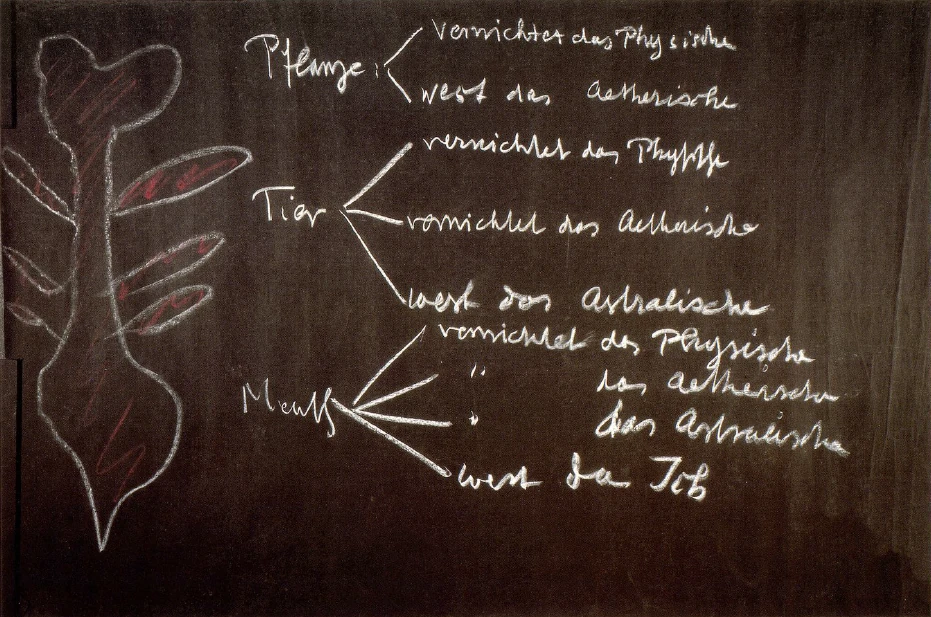
[ 8 ] Let us now ascend from the plant kingdom to the animal kingdom; here, it is no longer enough to turn to the ethereal. We must go one step further. You see, in the case of the plant, we can say: It, in a sense, destroys the physical and “weaves” the ethereal—using “wesen” as a verb.
The plant:
destroys the physical
and the ethereal
[ 9 ] As we ascend to the animal realm, we can no longer cling merely to the etheric; rather, we must conceive of animal formation in such a way that the etheric is now also destroyed. So that we can say: The animal destroys the physical—as the plant already does—but it also destroys the ethereal, and it resides in that which can then assert itself once the ethereal has been destroyed. When the physical is destroyed by the plant, the ethereal can assert itself. Now, if the etheric is, so to speak—roughly speaking—merely a filling, granular substance, then that which is no longer in ordinary space but acts within ordinary space—that is, the astral—can exist. We must therefore say: The astral exists in the animal. — When we look at the animal, the astral exists within it.
The Animal:
destroys the Physical
destroys the Etheric
destroys the Astral
[ 10 ] Well, Goethe strove with all his might to grasp dynamic ideas and concepts in order to understand this fluctuating life in the plant world. In the plant world, we still encounter the ethereal, because the plant, in a certain sense, pushes its way up to the surface of this ethereal realm. It lives within the form of the plant. With animals, we must recognize that there is something within them that does not push its way to the surface. The very fact that a plant must remain where it has taken root shows that there is nothing inside the plant that does not also emerge to the surface and become visible. — The animal moves freely. There is something within it that does not emerge to the surface and become visible. This is the astral aspect of the animal. It is something that cannot be grasped merely by making our ideas more flexible, as I have illustrated here, where we move from form to form within the idea itself (see the first three plant drawings). That is not sufficient for the astral aspect. If we want to grasp the astral aspect, then we must go further; we must say: Something else enters into the etheric, and what is inside there could, for example, make the form tuberous and enlarge it from within (Drawing 2). — With plants, you must always look to the exterior for the reason why the form changes. You must be flexible with your idea. But this mere flexibility is not enough to grasp the animal. There, you must incorporate something else into your concepts.
[ 11 ] If you want to understand how different conceptual activity must be in animals compared to plants, you must not only have a flexible concept that can take on various forms, but the concept must also internally incorporate something that it does not possess within itself. This is what one might call “inspiration” in the formation of concepts. Just as we take in air from the outside when we breathe in—while in our other organic activities, which lie below the level of breathing, we remain within ourselves—so, if we want to understand animals, we must not only have flexible concepts, but also incorporate something from the outside into these flexible concepts.
[ 12 ] We can—to put it another way—if we want to truly understand the plant, come to a standstill; we can also, in our minds, regard ourselves as beings that remain stationary. And if we were to stand still our entire lives, we could still make our concepts flexible enough to encompass the most diverse plant forms; but we could never form the idea, the concept of an animal, if we ourselves could not run around. We must be able to run around ourselves if we want to form the concept of an animal. Why?
[ 13 ] Yes, if you have, say, this concept of a plant (see Figure 1) and transform it into this second one, then you yourself have transformed that concept. But when you walk, your concept changes as a result of walking. You yourself must breathe life into the concept. That is what transforms a mere imagined concept into an inspired one. With the plant, you can imagine that you yourself are completely calm inside and are merely altering the concepts. If you want to imagine a concept of an animal—most people certainly don’t like to do this, because the concept must come alive within you; it stirs inside you—then you take in the inspiration, the inner vitality, not just the external sensory weaving from form to form, but the inner vitality. You cannot fully imagine an animal without incorporating this inner vitality into the concept.
[ 14 ] That was something Goethe simply could not achieve. He did manage to say to himself: The plant world is a sum of concepts, of imaginations. But with animals, one must incorporate something into the concept; one must bring the concept itself to life internally. — You can see that imagination does not live in the individual plant from the fact that, when the plant stands and grows in its soil, it changes its form in response to external stimuli, but it does not change its form internally. The animal is the moving concept, the living concept, and there one must take in inspiration; and it is only through inspiration that one penetrates to the astral realm.
[ 15 ] And when we turn our attention to the human being, we must say: He destroys the physical, he destroys the etheric, he destroys the astral, and he destroys the ego.
Human beings:
destroy the physical
destroy the etheric
destroy the astral
destroy the “I”
[ 16 ] When it comes to animals, we must tell ourselves: We are not actually seeing the physical, but rather an inspiration that appears to be physical. That is why human inspiration—breathing—can very easily take on an animal form when it is subject to some kind of disturbance. Just try to recall some of the figures from your nightmares: what animal forms appear to you there! These animal forms are indeed inspired forms.
[ 17 ] We can only grasp the human “I” through intuition. In reality, the human “I” can only be grasped through intuition. In animals, then, we see inspiration; in human beings, we actually see the “I,” the intuition. We are mistaken when we say of animals: “We see the physical body.” — We do not see the physical body at all. It is dissolved, it is annihilated; it merely illustrates inspiration to us, just as the etheric body does. In animals, we actually see the astral body externally through the physical and etheric bodies. And in human beings, we already see the “I.” What we see there is not the physical body—it is, in fact, invisible—nor the etheric body, nor the astral body. What we see in a human being is—externally formed, physically formed—the “I.” This is why, for example, in terms of visual perception—in terms of visibility—the human being appears outwardly in his or her incarnate form in a color that does not otherwise exist, just as the “I” does not otherwise exist in other beings. So, if we want to express ourselves correctly, we must say: We can only fully comprehend a human being if we conceive of them as consisting of a physical body, an etheric body, an astral body, and an “I.” What we see before us is the “I,” and invisible within it are the astral body, the etheric body, and the physical body.
[ 18 ] But we can only truly understand human beings if we take a closer look at the matter. After all, at first we see only the outer aspect of the “I.” But inwardly, the “I” in its true form could only be perceived through intuition. Yet human beings do perceive something of this “I” even in ordinary life, in ordinary consciousness: these are their abstract thoughts; animals do not have these, because they do not yet have an “I.” Animals lack the capacity for abstraction because they do not yet have an “I.” So we can say: Outwardly, in the human form, we see the earthly embodiment of the “I.” And when we experience ourselves from within through our abstract thoughts, there we have the “I”; but these are merely thoughts, not realities; they are images.
[ 19 ] If we now descend within the human being to the astral body that is located within him but has been destroyed within him, we arrive at that which can no longer be seen from the outside, but which we do see when we observe the human being in motion and when we perceive his form through that motion. The following visualization is necessary for this. Imagine a small, dwarfish person—a rather plump one who walks along on short legs. Observe his movement: you will grasp his movement from his short legs, which he pushes forward almost like little pillars. A tall, lanky person with long legs will move differently. In your observation, you will see a unity between movement and form. You will also find this unity if you train yourself in such matters. When you see that someone has a receding forehead or a protruding chin, their head movements will differ from those of someone with a receding chin and a forehead that juts far forward. You will see a connection everywhere in human beings between their form and their movement if you simply look at them as they stand before you and gain an impression of their incarnation—of how they maintain their composure. You are looking at their “I” when you pay attention to what passes from their form into movement, and what, as it were, flows back from movement.
[ 20 ] Try studying the human hand to see how someone with long fingers moves their fingers differently than someone with short fingers. Movement merges into form, and form into movement: There you can still make out, I would say, a shadow of his astral body—albeit expressed through external physical means. But you see, as I describe it to you, it is a primitive inspiration. Most people, for example, do not perceive this in people who walk the way Fichte walked through the streets of Jena; they do not see what lies within them. Anyone who saw Fichte walking through the streets of Jena also sensed that movement and shaping that was present in his speech organs—and which, especially when he wanted to be persuasive, was expressed in the shaping of his speech organs and was already inherent in that shaping. It takes a primitive inspiration to see this.
[ 21 ] But if we now look from within at what is seen from the outside—and what I have just described to you as perceptible through this primitive inspiration—it is essentially the human life of imagination, permeated by feeling, the one in which abstract thoughts are already experienced internally. Memories that arise as images also exist within this element. We can say: Viewed from the outside, the “I” expresses itself, for example, in the incarnate form, but also in the other forms that appear there. Otherwise, we could not speak of physiognomy at all. If, for example, we see someone whose mouth corners are turned down when he keeps his face calm, this is entirely karmically rooted in the formation of his “I” in this incarnation. Viewed from within, however, these are abstract thoughts.
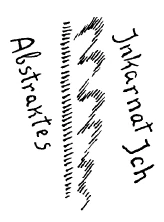
[ 22 ] If we consider the astral body, it is outwardly characterized by its movements and inwardly by phantasms or images of the imagination; the actual astral body itself eludes observation to a greater or lesser extent. In human beings, the etheric body eludes observation even more. The etheric body is, so to speak, no longer truly visible from the outside, or at most visible in physical manifestations in exceptional cases. It can also become visible, for example, when someone—with all due respect—sweats; this is a manifestation of the etheric body outwardly. But you see, this requires imagination to connect the sweating to the whole human being. Paracelsus certainly did this. For him, not only the manner but also the very essence of sweating differed from one person to another. For him, the whole human being was expressed in this—the etheric aspect of the whole human being. So here, the external aspect recedes very strongly; but internally, it stands out all the more in experience, namely in feeling. The feeling experienced inwardly—the entire emotional life—is actually what lives in the etheric body when it acts from within, so that one experiences it from within. After all, the emotional life is always accompanied by inward secretion. And essentially, the perception of the etheric body in human beings presents itself in this way—forgive me for stating this again with all due respect—that, for example, the liver sweats, the stomach sweats, that everything sweats, that everything secretes. It is precisely in this inner secretion that the etheric life of the human being lives. The liver is surrounded by a constant mist of perspiration, just as the heart is surrounded by a constant mist of perspiration: all of this is mist, shrouded in clouds. This must be grasped through imagination.
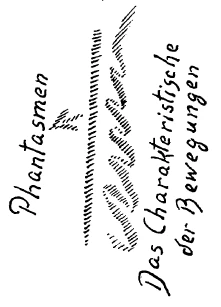
[ 23 ] When Paracelsus spoke of human perspiration, he did not say, “This is only on the surface”—but rather, he said, “No, this permeates the whole human being”—that is his etheric body, which one sees when one looks beyond the physical. This inner experience of the etheric body, then, is the emotional life.
[ 24 ] And the external experience of the physical body—that is, in fact, not readily perceptible. We do, however, perceive the physical aspect of corporeality when, for example, we pick up a child: It is heavy, just as a stone is heavy. That is a physical experience; it is what belongs to the physical world, what we perceive there. If someone slaps us, in addition to the moral experience there is also a physical one—an impact; but as a physical phenomenon, it is actually just an elastic impact, like when one billiard ball strikes another. We must definitely distinguish the physical aspect from the rest. But when we perceive this physical aspect inwardly in the same way that I mentioned earlier—that we perceive the outer aspects of emotional life inwardly—then within the physical processes, within the mere physical processes, the human will is experienced inwardly. The human will is what, in a simpler way, unites human beings with the cosmos.
[ 25 ] Well, you see, when we look for inspiration all around us, we find it in the forms of animals. The diversity of animal forms acts upon our perceptions as inspiration. From this you can see that when we perceive inspirations in their pure form, without them being filled with physical corporeality, these inspirations can represent something essentially higher than animals. They certainly can. But inspirations that exist purely in the spiritual world may also appear to us in animal-like forms.
[ 26 ] In the days of the older, atavistic form of clairvoyance, people tried to represent the inspirations they had in a spiritual way through animal forms; for example, the sphinx owes its form to the fact that it is actually meant to depict something that was seen through inspiration. We are therefore already dealing with superhuman beings when we speak of animal forms in the purely spiritual world. During the era of atavistic clairvoyance, as it still existed in the first four Christian centuries—that is, certainly still at the time of the Mystery of Golgotha—it was not merely an outward, superficial symbolism, but a truly inner knowledge that expressed higher spiritual beings, accessible to inspiration, in animal forms.
[ 27 ] And it is entirely consistent with this that the Holy Spirit was depicted in the form of a dove by those who drew attention to inspiration. How should we understand it today when we are told that the Holy Spirit appears in the form of a dove? We must understand it in such a way that we say: Those who spoke in this way were people inspired in the old, atavistic sense. In the realm where the Holy Spirit revealed Himself to them purely spiritually, they perceived Him in this form as inspiration. And how would these contemporaries of the Mystery of Golgotha, endowed with atavistic inspiration, have characterized the Christ?
[ 28 ] . They may have seen him outwardly; in that sense, they saw him as a human being. To see him as a human being in the spiritual world, they would have had to possess intuition. But even at the time of the Mystery of Golgotha, there were no such people who could see him as the “I” in the intuitive world; they were unable to do so. But they could still see him through atavistic inspiration. Then they would also have needed animal forms to express Christ themselves. “Behold, this is the Lamb of God”—that is the right language for that time, a language we must familiarize ourselves with if we are to return to an understanding of what inspiration is, or rather, how one sees through inspiration what can appear in the spiritual world: “Behold, the Lamb of God!” It is important that we learn once again to recognize what is imaginative, what is inspired, what is intuitive, and that through this we learn to put ourselves in the mindset of the language that echoes down to us from earlier times.
[ 29 ] This way of speaking represents realities in relation to the older views; but we must first learn to express these realities in the way they were expressed, for example, at the time of the Mystery of Golgotha, and come to regard them as self-evident. Only in this way will we enter into the meaning of what, for example, was depicted over in Asia as the winged cherubim, what was depicted in Egypt as the Sphinx, what is depicted to us in the Holy Spirit as a dove, what is depicted to us even in Christ as the Lamb—which was, after all, inspiration, or rather, inspired imagination, in which Christ was repeatedly depicted in the most ancient times.