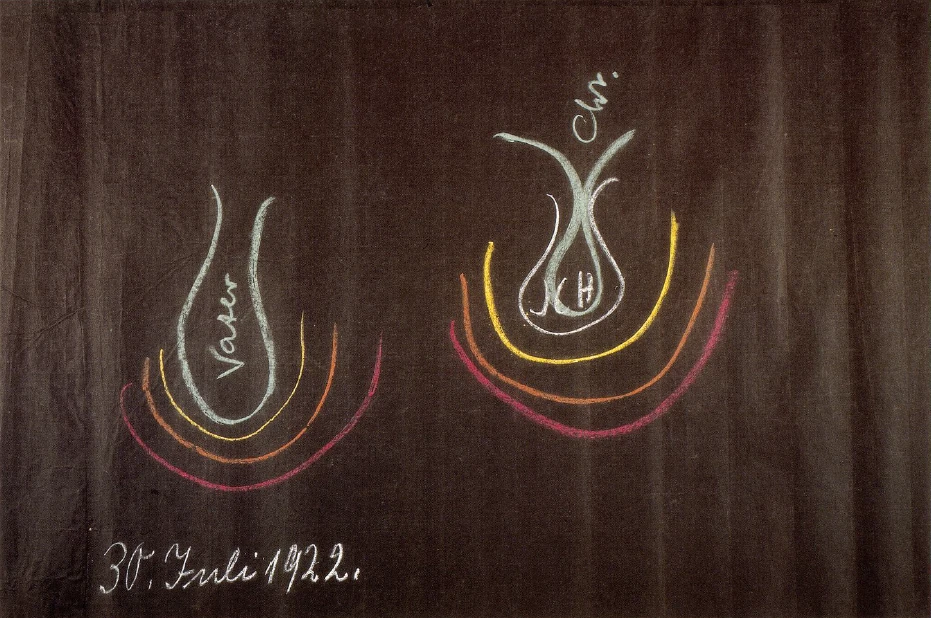
The Secret of the Trinity
GA 214
30 July 1922, Dornach
Translated by Steiner Online Library
Fourth Lecture
[ 1 ] Let us once again look back at what I alluded to yesterday—how it has been stifled by the progressive intellectualization of human culture. Let us look back at the older, atavistic principles of initiation, and then see how those people who still lived by these principles, as initiates, confronted Christianity and, based on their views, formed what later became dogmatic content—content that, as such, particularly after the 8th, 9th centuries, could no longer be understood.
[ 2 ] We need only recall that, prior to the Mystery of Golgotha, the impact of the true human “I” principle was essentially absent from human civilization. Human beings were, of course, always predisposed to possess this “I” principle within themselves. They were also created to shape their outer and inner being out of this “I” principle. But only slowly and gradually did human beings come to sense—and, above all, to become conscious of—what constitutes the “I” essence and the “I” power within them. So one can say: Although, of course, even in the times before the Mystery of Golgotha, the human being consisted of a physical body, an etheric body, an astral body, and an “I,” human consciousness did not contain this “I”-essence within itself. The “I”-essence was more or less unconscious. Essentially, in those earlier times, people walked the earth who did not live in full consciousness of their “I.” But in reality, it is only possible for the “I” to exert its influence within the human being when the person is no longer developing their physical body to its fullest—I would say, no longer with full vitality. Those people who were still unaware of their “I” developed their physical bodies with greater vitality than those who subsequently entered into full consciousness of the “I.” And this entry into full consciousness of the “I”—though it did not take place suddenly, but rather unfolded over the centuries before and after the Mystery of Golgotha—is clearly discernible to the spiritual-scientific view of history. And we must say: What a human being can actually sustain with full vitality—in their physical body as well as in their etheric and astral bodies—can only be sustained when something of the divine-spiritual nature flows into the human being. As long as human beings possessed atavistic clairvoyance in the absence of ego-consciousness, this divine-spiritual essence did indeed flow from the cosmos into them. Human beings could never have become free beings had the ego not emerged as a result of the divine-spiritual no longer flowing into them in the old sense. Human beings became free beings only by gaining power in their awareness of the “I.” But this was possible only when human beings gradually developed themselves into what abstract thoughts are. Abstract thoughts, however, are actually the corpses of the spiritual world. I have already drawn attention to this in these lectures: Just as the corpse remains of our physical body when we pass through earthly death, so too does a corpse remain of that spiritual-soul being that we are in the spiritual world before we descend into the physical world. But this has only been the case since the time when human beings were endowed with the consciousness of their “I.” And these thoughts—the abstract thoughts—represent this corpse. By becoming capable of grasping abstract thoughts within ourselves, we grasp the corpse of our spiritual-soul being as it was before descending into the earthly world. But the fact that we grasp the corpse of our spiritual-soul being presupposes that something of the dying, paralyzing principle also enters our physical body.
[ 3 ] Yes, human evolution is such that human nature has changed over the course of human development on Earth. The old bodies were different from the new ones. The old bodies were such that, although human beings were not free within them, they moved within their bodies in a fresh, inherent nature that was brought about by their own physical, etheric, and astral activity. Thus, one can say: We in the civilized world are already living in a period of human development in which the body is beginning to decay. And it is precisely through this decaying body—which is the foundation for intellectualistic, that is, abstract thoughts—that we gain our freedom. Through this decaying body, human beings have achieved everything of which they are so proud today as intellectualistic scientists.
[ 4 ] When we consider this, we must realize: Before the Mystery of Golgotha, full “I”-consciousness did not yet exist within human beings on Earth. But there were indeed people who, even back then, developed this full “I”-consciousness—who developed it through the mystery rites. These were precisely the initiates. We have already discussed a wide variety of topics regarding what took place within the ancient mystery temples with those who underwent initiation and ascended to this fully conscious “I,” while it was a general characteristic of human nature not yet to possess a fully conscious “I.” However, the ancient initiate could ascend to this fully conscious “I” only because, through the sacred rite of the mysteries, something entered into him that had been perceived within all ancient cultures and civilizations as the eternal Father of the cosmos. And the initiate of the ancient mysteries, upon reaching a certain point in his initiation, had this experience, saying to himself: “The Father lives within me.”
[ 5 ] If we were to imagine, for example, such an initiate within ancient Hebrew culture, we would have to say: This initiate described what had happened to him through the initiation in the following way. He said: It is characteristic of humanity in general that, although the Father sustains and supports them, the Father does not enter into their consciousness nor kindle consciousness into the “I.” The Father gives the ordinary human being merely the spirit of the breath; He breathes life into him, and that is the living soul. But the initiate sensed that, in addition to what was breathed into him as the living soul, a special spiritual essence—the living Father-principle of the cosmos—entered into the human being. And then, when this divine Father Principle had entered into this ancient initiate of the Hebrew world and the human being had become conscious of it, that person rightly expressed what “I” meant to him: “I am who I am.” — And so such a person, who walked among the ancient peoples and who, through the indwelling of the divine Father-principle, could rightly utter the “I”—which throughout antiquity was actually the unpronounceable name of the deity, the Father-deity—was himself regarded as the Father’s representative on earth. And these initiates were called the Fathers who walked among the peoples. They were called Fathers because they represented the divine Father principle among other human beings. And it was said of them that the divine Father entered into them during the Mysteries. Therefore, the Mysteries were regarded as something in which, within the earthly realm, that which otherwise surges and weaves its way through the entire cosmos took shape. Within the place of the Mysteries—and then, in turn, through that place within the human being—a dwelling was built for the divine Father principle. The human being himself became this dwelling of the divine Father principle.
[ 6 ] Through the Mysteries, people sensed the surging and pilgrimage of God the Father within the earthly world, and they looked out into the cosmos, into the great world; and since they perceived it as permeated and interwoven by the divine Father principle, they called it the macrocosm, the great world. And people then looked toward the site of the Mysteries, where a hut had been built for this Father God, in which those who had themselves become the hut of this Father God as human beings were initiated; and they called what the Mysteries were—they called what the human being himself was through the Mysteries—the small world, the microcosm. This is something that persisted all the way up to Goethe; for when Goethe became a member of lodges, he adopted the usage of “the Great and the Small World,” and by the Great World he meant precisely the macrocosm, while by the Small World he meant the lodge, which was to be for him a reflection of the Great World.
[ 7 ] All of this entered a different phase as the Mystery of Golgotha drew near in the course of human evolution. This was something fundamentally different. During this Mystery of Golgotha, the first people walking the Earth were those who felt within themselves something of the independent “I.” “I”-consciousness had, so to speak, begun to take root in human beings. But at the same time, something else had come to pass: the human physical body began to become internally fragile, to disintegrate. And so, at this time—in the middle of Earth’s evolution—human development faced a great danger: the danger of losing connection with the spiritual world more and more, but also the danger that the physical body might disintegrate more and more.
[ 8 ] To remedy this, the very Being we know as the Christ decided to pour Himself into Jesus of Nazareth in the same way that the divine Father principle had previously poured itself into the initiates. This divine Father principle had poured itself into the initiates. Through this, the “I” had been kindled within the initiates, in addition to the physical body, the etheric body, and the astral body. Only those, as I have already said, were permitted to utter the “I”—which was in fact the unpronounceable name of God Himself—into whom the divine Father had entered.
[ 9 ] But now, in the middle of Earth’s evolutionary period, there were people who began to call themselves “I,” who raised the “I” into consciousness. Into such a person—who was Jesus of Nazareth—the principle known as the Son principle, the Christ principle, now entered. This Christ principle thus entered the “I.” Whereas we previously witnessed the entry of the Father principle into the physical body, the etheric body, and the astral body, we now witness the entry of the Christ principle into the human being who had developed further.
[ 10 ] Now, recall how I have described human beings in recent days. I told you: Plants destroy their physical nature from within—one might say they corrupt it; animals corrupt both the physical and the etheric nature; and human beings corrupt the physical, the etheric, and the astral nature. He did not corrupt them completely during the period of human evolution prior to the Mystery of Golgotha; now he has corrupted them completely, as his “I” has truly taken up residence within his being. The initiate of the ancient mysteries, however, freed himself completely from the physical body, the etheric body, and the astral body by allowing the divine Father-principle to flow into him and by becoming an “I” even in that era.
[ 11 ] When Christ entered into Jesus of Nazareth, however, He did not merely destroy the physical body, the etheric body, and the astral body, but also the “I,” to the extent that it had developed in Jesus of Nazareth at that time. Thus, the higher Christ principle dwelt within Jesus Christ, a principle that relates to the “I” in the same way that the human “I” otherwise relates to the astral body.
[ 12 ] This is something that only the ancient initiates—who had developed higher powers of perception—were able to perceive. When these ancient initiates looked at human beings as they were in their time, they saw how each human being united within themselves all the forces of the other beings of nature, towered above them, and, in a sense, encompassed them. They saw how one can find within the human physical body the mineral kingdom, within the human etheric body the plant kingdom, within the human astral body the animal kingdom, and then the human being proper. When these initiates of earlier times—these fathers of the peoples, insofar as some of them were still present— now received news of this Christ event, of the approaching event at Golgotha, they were able to see a being in Christ in whom more was now contained—in whom not only did the earthly beings reach up to the human being, but in whom the human being, in turn, reached up to the divine-spiritual being.
[ 13 ] If there is something within human beings—as a human expression—that we know to be living within the outer physical body of a human being, then we will understand how these initiates saw in Christ Jesus more than just a human being, how they saw something walking upon the earth that transcended humanity and human nature. These initiates saw Christ Jesus in a special radiance—not merely in his human incarnation, but with a special, radiant splendor.
[ 14 ] The ancient initiates could, however, also perceive this special, radiant splendor in their fellow initiates: it was the power of the Father Principle that dwelt within them. But now they perceived not only what dwelt in the ancient initiates as the divine Father Principle; now they perceived something that radiated from Christ Jesus in a special way, because in him not only had the physical body, the etheric body, and the astral body been destroyed, but also the “I,” insofar as it could exist in a human being at that time.
[ 15 ] This is why Christ Jesus, as a particularly radiant being, could be seen not only by the initiates but also by other people who were especially gifted in this regard. And this was the immensely new development even for the initiates at the time of the Mystery of Golgotha: that other people, endowed only with natural gifts and not with mystical gifts—even if they were only a few individuals—recognized the higher nature in Christ Jesus.
[ 16 ] This led to the realization that, with the Mystery of Golgotha, something was now to take place that had previously, in essence, occurred only within the mysteries themselves. Something had been brought out into the great world, into the macrocosm, that had previously taken place only within the microcosm, within the small world. And it is indeed the case that the mystery of Christ was first proclaimed in its purest and clearest form within the last mystery schools of antiquity, and that it was precisely this proclamation of the mystery of Christ that was lost to modern civilization in the course of the first four centuries of European development. These ancient initiates knew—because in Christ Jesus lived not merely the Father principle but also the Son principle—that Christ Jesus represented something that is unique within earthly evolution, unique insofar as, in the course of further development, no such Mystery of Golgotha could ever occur again, nor could such an indwelling of the Son-principle in a human being take place again as it did in Jesus of Nazareth.
[ 17 ] And these Initiates knew that the Christ had entered humanity as the Healer, as the great Healer, as the One who prevents the human body from suffering harm by becoming frail due to the entry of the “I.” For what would have happened if the Christ had not appeared as the Healer? Had the Christ not appeared as the Healer, then when people die—when they shed their decaying body—the signs of decay would, through the shedding of the decaying body, radiate back into their soul life, which they unfold after death. The dead would be troubled and tormented by what the decaying physical body represented during earthly life. These souls who have passed through death would have to witness how the earth itself suffers harm by having to receive a decaying body. And the ancient initiates knew—as do those who call themselves Christians in the true sense of the word, those who have penetrated to the inner fulfillment with the Christ principle—how these souls could now look down upon their bodies, which had been taken from them in death, so that they could say: Through Christ’s indwelling within us while we were children of the Earth, we have healed this physical body to such an extent that it can be returned to the Earth without becoming a source of decay for the Earth itself. What the human being needed in order to become an “I” had to be healed within the Earth. For in order to become an “I,” human beings had to have a decaying body; but if this decaying body had remained, the Earth would have suffered harm. And the souls, if they had looked down upon their physical bodies—which had been taken up by the Earth—would have been tormented after death by the feeling that the Earth itself was suffering harm from this decaying physical body.
[ 18 ] This is what came about through the Mystery of Golgotha: that human souls could now say to themselves, after passing through the gate of death, “Yes, we bore him on Earth, this decaying physical body; it is thanks to him that we have the opportunity to develop a freer ‘I’ within our human being.” But Christ, through his indwelling in Jesus of Nazareth, has healed this physical body so that it is not harmful to earthly existence, so that we can look down upon earthly existence with peace of mind, knowing that, after the Mystery of Golgotha, not a single unrighteous seed falls into this earthly existence through the body that the human being needs for the use of his “I.” And so Christ passed through the Mystery of Golgotha in order to sanctify the human physical body for earthly life.
[ 19 ] Well, if things had remained that way, what would have happened in the course of Earth’s evolution? If it had remained that way, one could have said: In ancient times, the Father God entered into human beings so that they, as souls, could ascend to the “I” and, as initiates, proclaim to other human beings the true nature of the human being—the “I”-nature. Then the Son, the Christ, entered into human existence. Those who rise to the task of bringing about the indwelling of Christ within themselves are thereby saving their physical bodies for the sake of Earth’s evolution. Just as the soul of humanity was saved through the ancient Father principle and its indwelling in human evolution via the mysteries, so too is the physical body of humanity saved through the Healer, through the Savior, through Christ, who passed through the Mystery of Golgotha.
[ 20 ] But if it were to stop there, those who know their bodies are saved would now have to carry Christ within themselves as the being active within them—the being that is also active in them physically. And thus human beings could once again become unfree beings. If things had remained that way—back when freedom began to dawn in the 14th century A.D.—human beings would have developed to the point where they could have received Christ within themselves to bring peace to their souls after death, so that these souls could have looked down upon the earth as I have just described to you; but human beings would not have been able to become free. If they had wanted to become good, they would have had to allow Christ to work within them in the same way that the Father had worked in people who were not initiates in ancient times. Back then, as the “I” was developed within them, people became free. The initiates became free people in ancient times; the others were unfree because the Father lived within them unconsciously. If the Christians had been beings conscious of Christ within themselves, then whenever they had wanted to become good, they would have had to extinguish their ego-consciousness in order to awaken Christ within themselves through the extinction of that ego-consciousness. They themselves could not have been good; only Christ within them could have been good. People would have had to walk the earth with Christ dwelling within them, and as Christ made use of their human bodies, the healing of those bodies would have taken place. But the good deeds that people would have performed would have been the deeds of Christ, not the deeds of human beings.
[ 21 ] That was not the task, the mission, of the Divine Son, who had bound himself to Earth’s evolution through the Mystery of Golgotha. He wished to dwell within humanity, but he did not wish to cloud the emerging sense of self in human beings. He had done this once before in the person of Jesus, who, from the time of his baptism onward, lived in the consciousness of the Son rather than in ego-consciousness. But this was not to be the case for the people of future times. For the people of future times, the ego was to be able to rise to full consciousness, and yet Christ was to be able to dwell within these people.
[ 22 ] For this to happen, it was necessary for the Christ, as such, to disappear from the immediate sight of human beings—to remain united with earthly existence, yet vanish from their direct view. The expression that was customary in the ancient places of initiation for such an event became applicable to him: When a being that is physically visible—one whose existence can be observed by people who perceive the physical world—ceases to be visible, it is said that he has ascended. It has simply entered those regions where physical visibility no longer exists. Thus Christ ascended; thus he became invisible. For he would, in a certain sense, have retained his full visibility had he dwelt within human beings and extinguished the “I,” so that they could have become good only through Christ actually acting within them.
[ 23 ] The way in which Christ was still visible to the apostles and disciples even after his Resurrection—that way disappeared: Christ ascended into heaven. But He sent to humanity that divine essence which does not extinguish the sense of self—an essence to which one ascends not through visual perception, but precisely through the invisible Spirit. He sent the Holy Spirit to humanity.
[ 24 ] Thus, the Holy Spirit is actually that which was to be sent by Christ so that human beings might retain their sense of self and so that Christ might dwell within them unconsciously. So that when a person brings before their soul—in the fullest sense of the word—what kind of being they truly are, they must say: When I look back at what the ancient initiates knew, I see that the Father Principle lives within me—the principle that fills the cosmos, that manifested in those ancient initiates and unfolded the “I” within them. This is the very principle that lived with us before we descended into the physical world. — Through the indwelling of this Father Principle, the ancient initiates remembered with complete clarity the way they lived before they had descended into the physical world. There they sought the divine in the pre-birth, in the pre-existent: Ex deo nascimur.
[ 25 ] After the Mystery of Golgotha, it could no longer be true for human beings that “I see the Christ,” for then they could not have become good through themselves; then only the Christ within them could have been good. This could only come about through the human being: *In Christo morimur*. He could die into Christ; he could unite the Christ with that which is the principle of death within him.
[ 26 ] But his new consciousness could be awakened by the essence that Christ sent him, by the essence of the Holy Spirit: Per spiritum sanctum reviviscimus.
[ 27 ] You see, this shows you the connection within the Trinity. But at the same time, it demonstrates that it is entirely within Christianity to attain the awakening of the Spirit even without a direct vision of Christ Himself. By sending the Holy Spirit to humanity, Christ has enabled people to rise from the intellectual realm on their own to comprehend the spiritual. It must therefore not be said that human beings cannot comprehend the spiritual and supernatural through their own spirit; the only way a person could justify this failure to comprehend the supernatural would be by ignoring the Holy Spirit, by speaking only of God the Father and God the Christ. The Gospel, too, clearly indicates—for those who are willing to see, who are willing to read—that it is itself a revelation: that human beings, through the Spirit dwelling within them, can comprehend the supernatural if they but turn toward Christ. That is why we are told that the Holy Spirit appeared at Christ’s baptism. And with the appearance of the Holy Spirit, the words resound throughout the cosmos: “This is my beloved Son; today I have begotten him.”
[ 28 ] The Father is the unbegotten Begetter who brings the Son into the physical world. But at the same time, the Father makes use of the Holy Spirit to reveal to humanity that the supersensible can be grasped in the spirit, even if this spirit is not seen, but rather when this spirit works its abstract spiritual nature upward toward the living from within, when, through the Christ dwelling within it, it brings to life the thought-body that we possess from our pre-birth existence, brings to life.
[ 29 ] At that time, the bestowal of the Holy Spirit and the manifestation of the Holy Spirit Himself at baptism had been accomplished by the Father. And when Christ sent this Holy Spirit to His own, this bestowal took place through Christ, through the Son. Therefore, it was an ancient dogma that the Father is the begetting, unbegotten One; that the Son is the One begotten by the Father; and that the Holy Spirit is the One bestowed upon humanity by the Father and the Son. This is not merely an arbitrarily established dogma, but rather the initiatory wisdom of the first Christian centuries, and it was only later that it was obscured, just as the trichotomy and the Trinity were obscured.
[ 30 ] Within evolving humanity, the divine principle at work in the Christian sense cannot be understood apart from the Trinity, and if another revelation of God takes the place of the Trinity, then this is, in essence, not a fully Christian revelation. One must understand the Father, the Son, and the Holy Spirit if one wishes to understand, in concrete terms, the revelation of God in its true sense.
[ 31 ] And so the Gospel itself was no longer understood when Scholasticism decreed that human beings have only one revelation—that of faith—and that they cannot, through their own knowledge, ascend to the supernatural. This decree concerning human cognition, which was separated from faith, was itself a sin against Christianity; it was a sin against the proclamation of the Holy Spirit by the Father at the baptism of Jesus, and by Jesus Himself at the outpouring of the Holy Spirit on the Day of Pentecost.
[ 32 ] Thus, within the course of European development, in what has consistently called itself Christianity, there have been many transgressions against the original Christian impulses, and today humanity truly needs to return once again to these original Christian impulses.
[ 33 ] These original Christian impulses have in many cases become set in stone within the dogmas. But when one penetrates to the living spirit, one will once again kindle a fire from what is true within the dogmas. Then the dogmas will cease to be dogmas. What is wrong with the Church is not that it has perpetuated the dogmas, but that it has frozen them, crystallized them, and removed them from human understanding. By limiting human understanding to the sensory world alone, the dogmas had to crystallize, had to harden, and had to become incomprehensible. For it is impossible that faith could ever truly bring about understanding. What must be redeemed within humanity is knowledge itself; it is the restoration of knowledge to the supersensible.
[ 34 ] And this call—it essentially comes to us from Golgotha, if we understand it correctly, if we know how Christ—after passing through the Mystery of Golgotha—sent the Spirit into humanity in addition to his divine Father-principle. Whoever looks upon the cross at Golgotha must at the same time behold the Trinity, for Christ, in all His interwoven connection with the earthly development of humanity, truly reveals the Trinity.
[ 35 ] That, my dear friends, is what I wanted to impress upon your hearts today, and what should serve as the foundation for our further reflections in the coming days.