The Secret of the Trinity
GA 214
5 August 1922, Dornach
Translated by Steiner Online Library
Fifth Lecture
[ 1 ] When a person makes use of their ordinary consciousness, they are aware of only a part of what is connected with their existence. When we look around the world, our ordinary consciousness provides us with the images of the external world that we can evoke within ourselves through our senses. And as we then reflect on what our senses provide us—as we form thoughts—memory images of these thoughts remain with us. Thus, life in the soul unfolds in such a way that a person observes the external world and lives with it; but in living with the external world, they also carry within themselves the memory images of the past that they have experienced.
[ 2 ] However, ordinary consciousness does not correctly recognize what lives in memory. People imagine it goes something like this: They have received insights and perceptions from the external world, which have produced images within them; these images remain somewhere, and they can recall them in their inner life as images of memory. But that is not how it works. Consider step by step what actually takes place within a person. You will have already noticed how things that one does not particularly dwell on in thought—but merely observes with the senses, for example with the eyes—produce afterimages. Goethe describes such afterimages, as formed by the eyes, very well in his *Theory of Colors*: as fading images. You look at something, close your eyes: altered images fade away. In everyday life, you pay little attention to these fading images, because you employ a more vigorous activity for perception: you think. When a person engages in weak mental activity, and the external world presents an image to the eye, an afterimage lingers. But when a person now reflects, they, so to speak, draw the activity coming from the outside further inward, and their mental image then lingers. This, too, is a lingering effect.
[ 3 ] These mental images are stronger, and their aftereffects are also more intense than those of mere sensory afterimages; but, when it comes down to it, they are really just a higher level. These mental afterimages would nevertheless fade away, just as sensory afterimages fade away, if they were evoked solely as mental images. But that is not the case at all. For human beings do not consist solely of their head, but also of the rest of their organism, which is, after all, something quite different from the head. The head is, in fact, primarily an afterimage of what happens to a human being before they descend from the spiritual world into the physical world through birth or conception. It is far more physical than the rest of the organism. The rest of the organism is less physically developed than the head, and one could say: The spiritual is actually present in the head only as an image, whereas it is spiritually strong in the rest of the organism. You have a strongly physical head, sculpted; there is little spirit within it in the spiritual sense. And you have a body that is not, physically speaking, a strong reflection of what the human being was before birth, before descending, but the spiritual aspect is stronger in the rest of the body. In the head, the physical aspect is more developed; in the rest of the body, the spiritual aspect is more developed.
[ 4 ] The thoughts we have would fade away just as quickly as the afterimages in our eyes if they were not taken up and processed by our mental organism. But the spiritual organism could not do much with these images if something else did not take place. For while we perceive these images—which we then turn into fleeting thoughts that actually exist only in our minds—we receive, just as we receive images through the eye that we then process into thoughts, in addition to the image—for we do, after all, receive the images from the physical-etheric world—we also receive the spiritual from the rest of the world into ourselves, so that we not only carry the spirit within us, but the rest of the world’s spirit also continually enters into us. So you can say: With your eyes, you perceive something from the physical-etheric world that exists within you as a visual impression; but behind this lies a very real spiritual process that remains solely in the unconscious. Human beings cannot perceive it with ordinary consciousness. This is a spiritual process that runs entirely parallel to physical perception. And while you perceive the image—which lingers briefly in your eye—while you have the thought that you might hold onto for a moment, but which would also fade away, something spiritual is taking place within you; and when you recall it later, you simply turn your gaze inward and observe what has taken place spiritually within you while you were perceiving.
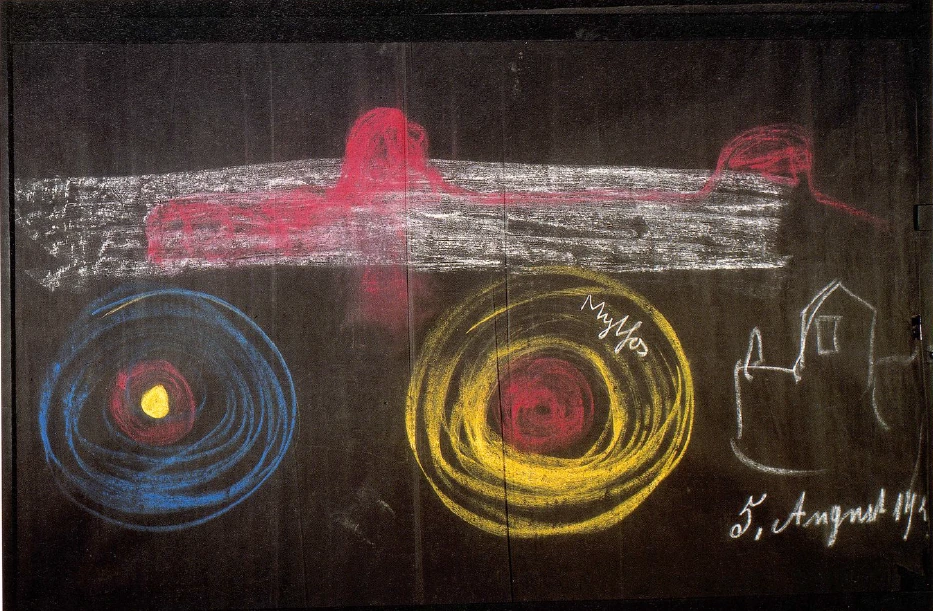
[ 5 ] I’d like to illustrate this further with a concrete example. Let’s assume you see something in the outside world—say, a machine. You have the image of the machine. In the sense that Goethe described it, this produces an afterimage that flashes briefly and then fades. You form the idea of the machine, which lasts longer but would also eventually fade. But the machine also sends something else into your mental organism. In the case of the machine, however, this is something not very beautiful; in the case of a plant, for example, it is much more beautiful. The plant sends something into you. And now, let’s say after a month, you look within yourself. The memory arises in you through what also entered you at that time—without your knowing it—simultaneously with what aroused the thought. It is not the thought that has been transformed down there, but rather an unconscious mental process has taken place. This is observed later. Memory is observation—the later observation of a spiritual process that ran parallel to physical perception. —You see, this is actually how we humans live in the world: there is our continuous stream of existence; we are immersed in the ocean of the spiritual world. And now, between death and a new birth, we continue our existence within this spiritual world. But there are times when we emerge from the spiritual world with our heads. So we move away, and at certain times, like a fish leaping out of the water, we emerge. That is earthly life. Then we dive back down. Then another earthly life follows. For we do not emerge from this ocean of spiritual existence with our entire spiritual being, but only with our heads. Down there, we always remain within the spiritual world. It’s just that with our ordinary consciousness, we don’t know what’s going on. So, from the perspective of spiritual perception, we can actually say: Between death and a new birth, a person lives in the spiritual world. Then they look up with their head into their physical life, but the main part of them remains in the spiritual world, even between birth and death. And it is good for us that we remain immersed in it, for otherwise we would have no memories. What the spiritual world gives us makes this possible. Remembering is indeed a spiritual process that belongs entirely to an objective world, not merely to a subjective one. Ordinary consciousness succumbs to an error in this regard. It does not believe that a real process is linked to memory. But ordinary consciousness is mistaken, just like someone who has a mountain with a castle in front of them. Now they see it very clearly; now they believe in its reality. Now they move away. The object becomes increasingly distorted by perspective, and they would say, because it becomes increasingly distorted: “Now I have only an image, no longer reality.” This is how we distance ourselves from reality over time. The castle does not change in terms of its reality in space when our image of it changes. Nor does that to which our memory image corresponds change in terms of its reality. It remains, just as our castle remains. We are mistaken only because we cannot correctly assess our temporal perspective. Thus, many things relating to human beings can simply be set straight. What we have as a consciousness unfolding in time is, in fact, nothing other than a perspectival view of the past. The past does not pass away; it remains. Our images merely shift into a temporal perspective.
[ 6 ] Well, but it is precisely this relationship to that which lies within us—which, between birth and death, consists of spiritual processes—that has changed quite significantly for human beings in the course of their earthly lives. When we consider the human being, we see that he consists of the physical and the etheric bodies. But that would be only the part of the human being that lies in bed at night while he sleeps. During the day, the astral body and the “I” are also immersed within this physical and etheric body. The “I” of those people who lived before the Mystery of Golgotha—and we ourselves were such people in earlier incarnations—began to fade as the Mystery of Golgotha approached. At that time, people awoke in a different way than those who came after the Mystery of Golgotha. The astral body always penetrates completely into the etheric body. But in the past, the I also penetrated very deeply into the etheric body. Today, that is no longer the case. Today, the I enters only the head region of the etheric body. Thus, in the ancient human being, the I was completely submerged and therefore also reached the lower regions of the etheric body. Today, it does not descend that far, but only into the head. This enables us to think in an intellectualistic way. The moment we were to submerge more deeply, we would receive instinctive images within ourselves. And the “I” is actually still very much outside the physical body in the modern human being. Thus, his intellectual nature is based precisely on the fact that he no longer submerges his “I” into his entire etheric body. If that were to happen, they would possess instinctive clairvoyance. But since they no longer immerse themselves in their entire etheric body—but only in that of the head—they do not acquire this instinctive clairvoyance, but rather a clearly conscious vision, a clearly conscious perception of the external world—though only a perception of the external world through the head, just as our own perception is. The ancient human being saw with his entire being. The modern human being sees only with the head. And the head is, in fact, the most physical aspect of the human being between birth and death. Therefore, the human being of the intellectualistic age is given only what he perceives through his physical head and what he perceives through the etheric body of the head: the thoughts he is able to form. Even the process of remembering—which, admittedly, takes place down below—eludes consciousness. Modern man interprets this entirely incorrectly, as I have explained. As a result, the ancient human being saw not only the physical external world around him, but also the spiritual being behind it. The physical external world was not particularly clear to him; for him, it was far more vague than it is for the modern human being. But in return, they saw everywhere behind the things that spread out in the physical world divine-spiritual beings of a lower kind, but also those of a higher kind. It is a childishly naive notion to believe that when ancient people described their gods in nature, they were simply making things up. They did not make anything up. It would be just as naive as if we heard from someone that they had seen this or that while awake, and we were to say: “They just made that up.” — The ancients did not merely invent these things; rather, they saw them, interwoven with their sensory perceptions, which were consequently much less distinct precisely because they were, so to speak, viewed against the backdrop of the divine-spiritual events unfolding. The ancient person, then, had a completely different worldview. Upon waking, they simply plunged deeper into their etheric body and thereby had a different worldview. They were within themselves, and through this, the divine-spiritual beings revealed themselves to them in their destinies.
[ 7 ] Human beings looked into the worlds of the gods that had preceded their own world. The gods revealed their destinies to human beings, and by looking into the worlds of the gods, human beings were able to perceive the destinies of the gods. He could say: I know where I come from; I know to which world I am connected. This was because human beings could find the starting point of their perspective within themselves. They transformed their etheric body into an organ capable of perceiving this divine world. Modern human beings cannot do this. They can only take their perspective from the head, which lies outside the most spiritual part of the etheric body. The etheric body of the head is chaotic; it is not as thoroughly organized as the etheric body of the rest of the organism. That is why human beings now see the physical world more clearly than before, but they no longer see the gods behind it. However, in the present age, they are undergoing a certain preparation for this. They are on the path to stepping completely outside of themselves and taking their perspective from the outside. This is something that will be granted to human beings in the future. They are already on their way toward this, for if one is immersed in nothing but one’s own head, one is actually engaged with the world only through the most abstract thoughts. One is no longer truly immersed in anything, one might say; it is somewhat of an exaggeration to say: “One is immersed in nothing but one’s own head.” — For a human mind gives one only an awareness of physical, earthly existence. But to the same extent that a person grows out of their mind, they will in turn gain knowledge—this time of the human being itself. When a person was still within themselves, they had gained knowledge of the fate of the gods. By stepping outside of themselves, human beings can gain knowledge of their own cosmic destiny. They can look within themselves. And if people would only make a real effort right now, the mind would not hinder them nearly as much as is commonly believed from looking into their own human destiny, into the cosmic destiny of humanity. The only obstacle is that people are so set on wanting to live in nothing but their minds; and just as one speaks of “parochial politics,” one could also speak of “mind-centered knowledge.” It is a refusal to look beyond what the mind produces when people are currently still unwilling to allow themselves to understand, through their own sound common sense, what anthroposophy now offers as human wisdom—as something that can be known about human beings.
[ 8 ] Thus, human beings are on the path to getting to know themselves, because they are gradually shifting their point of departure from outside the human being. So the general destiny of humanity is to emerge more and more from the etheric body and to get to know the human being. But this is, of course, something that involves a certain danger. One gradually loses—or at least there is the possibility of losing—the connection with one’s etheric body. It is precisely this that has been remedied in the world destiny of humanity through the Mystery of Golgotha. Whereas human beings previously viewed the destinies of the gods from the outside, they have since been enabled to see their own world destiny as human beings. But as they step further and further out of themselves and the Mystery of Golgotha is understood as Paul intended—“Not I, but Christ in me”—human beings return to the human realm through their connection with Christ. Thus, it is precisely through the experience of Christ that they can endure this gradual stepping out. But this experience of Christ must indeed become ever more intense. Therefore, as the outer world of the gods faded more and more in the course of world destiny, the possibility dawned within the human being to now have a divine destiny that has unfolded on Earth itself—one that is thus completely connected with humanity.
[ 9 ] The fact is that when we imagine ancient people, they were surrounded by their perceptions of the gods. They formed these perceptions from images. That was his mythology, the myth. These perceptions of the gods have faded. In a sense, there is only the physical world around human beings. But in return, he now has the opportunity to connect within himself to the destiny of the gods, to the god’s passage through death, to the god’s resurrection. In ancient times, human beings directed their spiritual eye outward, saw the destinies of the gods, and formed from them the myth—experienced in images, in flickering images—a myth that can take many forms because, fundamentally, it lives in the spiritual world in the most diverse ways. One might say that this world of the gods was something that was already perceptible to earthly human beings—albeit with a certain degree of obscurity—as they perceived it through their instinctive clairvoyance. Therefore, people shaped the images of this world of the gods differently according to their various characters. This is why the myths of different peoples have come to differ. Human beings perceived a real world, but they perceived this real world more in dreams—dreams that, however, originated from the external world. These were images of greater or lesser clarity, but the clarity was not great enough to be unambiguous for all people.
[ 10 ] Now came a divine destiny that unfolded right here on Earth. The other divine destinies were more distant from humankind. Humankind viewed them from a distance. Therefore, they were not clearly visible to humankind. They were more distant from humankind in its earthly life. The Christ event, however, is very close to humankind in its earthly life. He saw the gods indistinctly because, in a sense, he viewed them from a distance. He does not yet fully grasp the Mystery of Golgotha because it is too close to him. He perceived the gods from a distance, with some blurring due to that distance, because they were far from him—too far to see them clearly; otherwise, all peoples would have formed the same myth. The Mystery of Golgotha is too close to human beings. They are too strongly connected to it. They must first gain perspective; by stepping further and further outside of themselves, they must gain perspective on the destiny of the gods on Earth, on the Mystery of Golgotha.
[ 11 ] That is why those who lived at the time the Mystery of Golgotha took place and were still able to see—why they find it easy to understand Christ. They could understand him easily because they had, after all, seen the world of the gods and now knew: Christ had come down from this world of the gods to this earth for his further destiny, which begins with the Mystery of Golgotha. They had, however, already caught a faint glimpse of the Mystery of Golgotha; but they could see Christ clearly right up to the Mystery of Golgotha. They therefore had much to say about Christ as God. They only began to discuss what had become of this God when he was immersed as a human being through John’s baptism in the Jordan. That is why, in the early days of Christianity, we find a very pronounced Christology and no Jesusology. And because the world of the gods in general ceased to be something familiar, Christology initially transformed into mere Jesulogy. And Jesulogy grew ever stronger up through the 19th century, when Christ was no longer even grasped by the intellect, but when modern theology took great pride in understanding Jesus as humanly as possible and letting Christ go.
[ 12 ] But it is precisely through spiritual insight that we must find the perspective needed to recognize what is essential—Christ in Jesus. For only in this way does it become possible—instead of losing all connection with the human being and merely observing him from the outside—to once again see the human being and humanity itself with a sense of participation, indirectly through the connection with Christ, by way of an understanding of the Mystery of Golgotha.
[ 13 ] So that we can say: Humanity is on the path, by stepping outside of itself, to gradually transform spiritual reality entirely into abstract concepts and ideas. In this regard, humanity has indeed already come a very long way, and the following could actually lie ahead for it: People could advance further and further in their abstract, intellectual capacities and develop a kind of conviction within themselves through which they would say to themselves: Yes, we do experience the spiritual, but this spiritual realm is merely a mirage; it has no substance—it consists of mere ideas. — Humanity must once again find the means to imbue these ideas with spiritual substance. This will happen as they experience Christ alongside their transition into intellectual life. Thus, modern intellectualism must grow together with Christ-consciousness. As human beings, we must simply refuse to acknowledge certain things if we cannot find this Christ-consciousness precisely through the path of intellectualism.
[ 14 ] You see, in ancient times, people spoke of the Fall. They spoke of this image of the Fall in the sense that, as if by its very nature, humanity had belonged to a higher world and had fallen into a lower one—which, when taken figuratively, certainly corresponds to reality. One can certainly speak of a Fall in a real sense. Just as the ancient person felt correctly when he said to himself: “I have fallen from a spiritual height and united myself with what lies lower”— so too should the modern human being recognize how thoughts that are becoming ever more abstract also lead him into a kind of fall—but a fall in which one ascends, where the human being, so to speak, falls upward, that is, rises, yet rises toward his own ruin in the same sense that the ancient human being felt himself falling toward his ruin. Just as the old human being, who still understood the Fall in the sense of the Old Testament, in which Christ saw the One who brought humanity into the right relationship to this sin—namely, to the possibility of redemption—, just as the old human being, having developed consciousness, was seen by Christ as the one who lifted him up out of the Fall—so too should the newer human being, who is entering into intellectualism, be seen by Christ as the one who gives him the weight necessary so that he does not fly away spiritually from the earth or from the world in which he is meant to dwell.
[ 15 ] While people of the past tended to view the Christ event primarily in terms of the development of the will—which is, of course, connected to the Fall—people today should learn to view Christ in connection with thought; yet this thought must lose its reality if people are unable to give it weight, so that reality may once again be found within the life of thought itself.
[ 16 ] One really must admit: Humanity is undergoing a process of development. And just as Paul was able to speak of the old Adam and the new Adam—Christ—so, in a certain sense, modern man may do the same; but he must be clear that the person who still carried the old consciousness within himself felt transcended by Christ, and that the newer person should know himself protected by Christ from hurtling off into the nothingness of mere abstraction, of mere intellectualism. Modern man needs Christ to transform his sin, which extends into the vastness of the universe, into something within himself that can once again become good. And the thought becomes good through its ability to reconnect with true reality, with spiritual reality. Thus, especially for those who penetrate the mysteries of the universe, there is certainly the possibility of placing Christ even within the most modern development of consciousness.
[ 17 ] And now let’s return to our earlier image, which I based on the human capacity for memory. There we can say: Yes, we continue to live as human beings in the spiritual world, rising above the spiritual world by peering out into the physical world with our heads. But we do not emerge completely; we emerge only with our heads. We remain in the spiritual world in such a way that even our memories are always active within it. Our world of memories remains down below in the ocean of the spiritual world. — You see, as long as we stand between birth and death and are not strong enough in our sense of self to see everything that is happening down there—even with our own memories—we remain unaware of what is actually happening to us as humanity in the modern age. But when we die, matters become very serious with regard to this spiritual world, from which we rise in physical existence like a fish gasping for air. And there we do not look back in such a way that we believe we are seeing insubstantial images of memory, succumbing to the error that the perspective of time also kills reality. A person surrenders to memory for the time being just as one who, because of spatial perspective, does not consider what he sees in the distance to be reality, but merely images; who would therefore say: “Yes, when I walk far away, that castle over there is so small—so terribly small—that it cannot possibly be real, for people cannot possibly live inside such a small castle, so it cannot be real either.”—That is roughly the conclusion here as well. When a person looks back in time, they do not regard the images of memory as realities, because they do not take temporal perspective into account. But that ceases when all perspective ceases, when we are outside of space and time. When we have died, then that ceases. There, what lives within the temporal perspective appears very strongly as reality.
[ 18 ] It is now possible that we have brought into our experience what I call Christ-consciousness. Then, after death, we look back and see that we have connected with reality in life, that we have not merely lived abstractly. The perspective ceases; reality stands there. But if we have remained at the level of mere abstract experience, then reality certainly stands there as well, but we have built castles in the air during our earthly life. We have built something that has no solidity of its own. One can certainly build with intellectual understanding and knowledge, but the result has no solidity; it is fragile.
[ 19 ] Thus, modern man needs to be imbued with Christ-consciousness so that he may connect with realities, so that he builds not castles in the air, but castles of the spirit. For the earthly realm, castles in the air are something where what lies beneath them is not dense enough. For spiritual life, castles in the air are something that lies beneath the spirit. Castles in the air always remain in their place. They are simply too insubstantial for earthly existence, yet too physically dense for spiritual existence. People are then unable to detach themselves from the dense physical realm, which, however, actually has a lesser reality compared to the spiritual; they remain earthbound and fail to develop a free relationship with earthly existence when they have built castles in the air through intellectualism.
[ 20 ] So you see, Christ-consciousness has a very real significance precisely for intellectualism—a significance in the sense of a genuine doctrine of salvation—salvation from building castles in the air—for our existence after we have passed through the gate of death.
[ 21 ] For anthroposophy, these things are not articles of faith; they are insights that can be gained in the same way as mathematical insights are gained by those who know how to apply mathematical methods.