The Secret of the Trinity
GA 214
6 August 1922, Dornach
Translated by Steiner Online Library
Sixth Lecture
[ 1 ] When the first volume of Spengler’s *The Decline of the West* was published some time ago, one could see in this literary work something that embodied a determination to engage more deeply with the fundamental signs of decay and decline in our time. One could see how, in many of the forces at work throughout the Western world today, someone had developed a sense that these impulses must, in fact, gradually lead to the complete collapse of Western civilization, along with its American offshoot; and that someone who had developed this sense was also striving, with great knowledge and a command of many scientific ideas, to offer a kind of assessment of these phenomena.
[ 2 ] It was clear, however, that Oswald Spengler perceived the decline. One could also see even back then that, precisely because he was himself immersed in this decline throughout his entire way of thinking, he had a keen sense of everything that was in decline; and that, because he—I would say—felt decadence in his own state of mind, he no longer held out any hope—and this was understandable—for anything that might still emerge from mass civilization. He believed that the West would simply succumb to a certain kind of Caesarism, a certain kind of assertion of power by individuals who would replace the differentiated, multifaceted cultures and civilizations with something simple and brutal.
[ 3 ] It was clear that a man like Spengler had not the slightest inkling that salvation for this Western culture and civilization could come from the will of humanity—if that will were directed toward asserting, in the face of everything that is hurtling headlong into decline, what, after all, if people today so desire, can be drawn forth from within the human being as a new force. Oswald Spengler had not the slightest inkling of such a new force, which must, of course, be a spiritual force, one that must be derived from the spiritual realm.
[ 4 ] Thus one could see how a very knowledgeable, witty person—capable of formulating such insightful observations based on a certain penetrating vision—could actually arrive at nothing other than a certain hope for a brutal display of power, one that lies apart from all that is spiritual, apart from all inner human striving, and is based solely on the unfolding of precisely that external, brutal force.
[ 5 ] Nevertheless, when the first volume was published, one could at least have a certain respect for the—I must use the word once more—vivid spirituality, an abstract, intellectual spirituality, as opposed to the dullness that is so utterly ill-equipped to cope with the driving forces of history and that today so often sets the tone, particularly in literature.
[ 6 ] Oswald Spengler’s second volume was published recently, and it indeed illustrates, in a much more powerful way, everything that is alive in a person of the present day—a person who, with a certain brutality, rejects everything truly spiritual that might emerge as a worldview or outlook on life.
[ 7 ] This second volume is certainly witty as well. But despite the witty insights it contains, it actually reveals nothing other than the appalling sterility of a way of thinking that is abstract and intellectualistic to the extreme. This is so extraordinarily remarkable because it reveals the unique intellectual formation of a figure who is, after all, a significant contemporary personality.
[ 8 ] In this book—the second volume of Spengler’s *The Decline of the West*—the beginning and the end, above all, are extraordinarily interesting. But this beginning and this end are interesting in a sad way; they actually characterize the entire state of mind of this man. One need only read a few sentences from the beginning to immediately grasp the state of mind of Oswald Spengler, as well as that of many people today.
[ 9 ] What can be said about this has not merely a significance within German literature, but a thoroughly international significance. Spengler begins with the following sentence: “Observe the flowers in the evening, when, in the setting sun, one after another they close: something eerie then comes over you, a feeling of mysterious dread toward this blind, dreamlike existence bound to the earth. The silent forest, the silent meadows, that bush and this vine do not stir. It is the wind that plays with them. Only the little mosquito is free. It still dances in the evening light; it moves wherever it pleases,” and so on.
[ 10 ] Starting with flowers and plants—well, time and again, whenever I wanted to point out what specifically characterizes contemporary thought, I found myself compelled to begin with the kind of understanding that people today apply to inanimate, mineral, and inorganic nature. Perhaps some of you will recall how, time and again, I have used the example of the collision of two elastic spheres—in which the state of one sphere can be mathematically deduced from the given state of the other—to characterize contemporary thought’s quest for transparency in perception.
[ 11 ] Of course, someone of Oswald Spengler’s intellectual caliber might say: “After all, ordinary thinking doesn’t allow us to see how the force of elasticity works in there, or what the deeper connections are.” Yes, anyone who thinks that way simply does not know what is essential to the clarity of thought in the present moment. For such an objection would be worth no more—and no less—than the one someone might raise if I were to say, “I understand a sentence written down on paper,” and they were to reply, “You don’t really understand it, because you haven’t examined the nature of the ink with which the sentence was written!” — It always comes down to finding out what the matter actually is. When surveying inorganic nature, the point is not whatever force impulses one might still find behind it—just as, behind what is written down, the point cannot be the ink itself—but rather what one has clearly present within one’s thought processes.
[ 12 ] This is what humanity has achieved since the time of Galileo and Copernicus as a specific mode of thought, which, on the one hand, demonstrates that it can be used only to comprehend lifeless, inorganic nature; yet, on the other hand, by first devoting oneself to this mode of thought as the simplest and most primitive form of pure thought, one can thereby first unfold within it the freedom of the human soul, the freedom of the human being in general. Only those who see through the nature of concrete thinking—with its transparency, as it prevails in inanimate nature—can then ascend to the other processes of thinking and perception, to that which permeates thinking with perception: imagination, inspiration, and intuition.
[ 13 ] It is therefore the primary task of anyone who today wishes to have a say—in the most intimate sense—regarding the external structure of our cultural life to recognize what actually constitutes the source of strength of contemporary thought.
[ 14 ] And anyone who has thus sensed the power of contemporary thought knows how this way of thinking operates within the machine, how this way of thinking has brought us modern technology, in which—based on this way of thinking—we construct external, inorganic, lifeless systems that possess precisely the degree of transparency required for human activity.
[ 15 ] Only when one understands this does one proceed to the realization that, the moment we survey the plants, we enter into pure confusion with this thinking, which is initially grasped in its abstraction. Anyone who wishes to apply this crystal-clear thinking to the mineral world alone in its abstract form—not merely as a stepping stone for the development of human freedom—but who now directs his gaze toward the plant world solely through this mode of thinking, will find before him in the plant world something nebulous, dark, and mystical that he cannot penetrate. For the moment we look up toward the plant world, we must be clear that here—at least to the extent that Goethe intended with his “primordial plant” and with the principle through which he metamorphoses the primordial plant through all plant forms — at least in this Goethean sense, anyone who has advanced from an understanding of the real forces of the thinking that reigns in the inorganic must sense, in the plant world, that it remains dark and mystical in the worst sense of our time, unless one advances to an imaginative contemplation—at least precisely in the sense in which Goethe founded his botanical views.
[ 16 ] When someone like Oswald Spengler rejects imaginative insight and yet begins to describe the plant world, he does not arrive at anything that provides clarity and strength; instead, he arrives at a jumble of thoughts, at mysticism in the very worst sense of the word—namely, materialistic mysticism. And if one must say this from the very beginning, it is precisely this beginning that, in turn, characterizes the end of this book.
[ 17 ] The conclusion of this book deals with the machine—the very thing that has left its mark on modern civilization—the machine that stands opposite humanity as an object that, while initially alien to human nature, has nevertheless served as the very basis for the development of transparent thinking.
[ 18 ] Some time ago—immediately after the publication of Oswald Spengler’s book—and under the impression of the impact Spengler’s book had made, I gave a lecture at the Technical University in Stuttgart on anthroposophy and the technical sciences, in order to show how, precisely by immersing themselves in technology, human beings develop the very configuration of their inner life that then sets them free. So that, by experiencing all spirituality as having been extinguished in the machine-driven world, human beings gain the impetus—precisely within that machine-driven world—to draw spirituality from within themselves through an inner effort; so that anyone who today understands the pervasive presence of the machine in our entire civilization must say to themselves: This machine, with its impertinent transparency, with its brutal, horrifying, demonic spiritlessness, compels human beings—if they only understand themselves—to draw from within themselves those seeds of spirituality that lie within them. Through this contrast, the machine compels human beings to develop a spiritual life.
[ 19 ] What I had intended to say at the time, however, was—as I could see from the aftermath—not understood by anyone.
[ 20 ] At the end of his work, Spengler offers a reflection on the machine. Well, what you read there about the machine ultimately comes across as a kind of glorification of the fear of the machine. What is said about the machine is, in fact, something that can be perceived as the pinnacle of modern man’s superstition toward the machine, which he perceives as demonic, just as certain superstitious people perceive demons. He describes the inventors of the machine; he describes how, little by little, the machine has emerged, how, little by little, the machine has taken hold of civilization. He describes the people in whose era the machine made its entrance: “But for all of them, there was also the truly Faustian danger that the devil had a hand in the matter, leading them in spirit up that mountain where he promised them all the power on earth. This is the meaning of the dream of those strange Dominicans, such as Petrus Peregrinus, of the perpetual motion machine, through which God’s omnipotence would have been wrested from him. They succumbed to this ambition time and again; they wrested the secret from the deity in order to be God themselves.”
[ 21 ] Oswald Spengler interprets the matter as follows: because humans have come to control machines, it is precisely through this control that they can learn to imagine themselves as gods, since, in his view, the god of the universe controls the machine. How could humans not feel elevated to the status of gods when they now control a microcosm!
[ 22 ] “They eavesdropped on the laws of the cosmic rhythm in order to violate them, and thus created the /dee of the machine as a small cosmos that obeys only the will of man. But in doing so, they crossed that fine line where, for the devout piety of others, sin began—and that is what led to their downfall, from Bacon to Giordano Bruno. The machine is the devil’s: this is what true faith has always felt.”
[ 23 ] Well, of course he’s just being ironic here. But you can see that he doesn’t mean it merely ironically when, in his witty way, he uses words that sound somewhat archaic. The following passage illustrates this: “But then, along with rationalism, comes the invention of the steam engine, which turns everything upside down and transforms the economic landscape from the ground up. Until then, nature had rendered services; now it is yoked as a slave, and its work is measured—as if in mockery—in horsepower. We moved from the muscular power of Black people, which was harnessed in organized enterprises, to the organic reserves of the Earth’s crust, where the life force of millennia lies stored as coal, and today we turn our gaze to inorganic nature, whose hydropower is already being harnessed to support coal. With millions and billions of horsepower, the population is growing at a rate no other culture would ever have deemed possible. This growth is a product of the machine, which demands to be operated and controlled and, in return, multiplies the strength of each individual a hundredfold. For the sake of the machine, human life becomes precious. Work becomes the central concept of ethical reflection. In the 18th century, it loses its derogatory connotation in all languages. The machine works and compels humans to cooperate. The entire civilization has reached a level of activity that makes the earth tremble.”
[ 24 ] “What has now unfolded over the course of a century is a spectacle of such magnitude that people of a future culture, with a different spirit and different passions, must be overcome by the feeling that nature itself was thrown into turmoil at that time. In other respects, too, politics has swept across cities and peoples; human economic activity has deeply intervened in the destinies of the animal and plant worlds, but that merely touches upon life and then fades away again. This technology, however, will leave behind the mark of its days when everything else has vanished and sunk into oblivion. This Faustian passion has altered the face of the Earth’s surface.”
[ 25 ] “And these machines are becoming increasingly dehumanized in their form—ever more ascetic, mystical, and esoteric. They envelop the earth in an infinite web of subtle forces, currents, and tensions. Their body is becoming ever more spiritual, ever more secretive. These wheels, rollers, and levers no longer speak. Everything that is crucial retreats into the interior. The machine has been perceived as diabolical, and rightly so. In the eyes of a believer, it signifies the dethronement of God. It delivers sacred causality into the hands of man, and it is set in motion by him silently, irresistibly, with a kind of prescient omniscience.”
[ 26 ] “Never has the microcosm felt superior to the macrocosm. Here there are small living beings who, through their spiritual power, have made the inanimate dependent on themselves. Nothing seems to match this triumph, which only one culture has achieved—and perhaps only for a few centuries.”
[ 27 ] “But it is precisely through this that the Faustian man has become a slave to his own creation.”
[ 28 ] We see here the thinker’s utter bewilderment in the face of the machine. This thinker has no inkling of how the machine is not at all that which might in any way be mystical to the one who grasps the inanimate in its non-mystical way.
[ 29 ] And so we see that Oswald Spengler begins with a muddled description of the plant world because he actually has no concept whatsoever of the nature and character of contemporary knowledge—which is intimately connected with the development of machine-based life—since thinking remains for him merely an abstraction, and he is therefore unable to perceive the function of thinking within the machine-based realm. Thinking becomes there an entirely insubstantial image, so that in the machine age, human beings may all the more become essential beings, able to bring forth their soul and spirit from within themselves through resistance to the machine. That is the human significance, that is the significance of machine life for the development of the world!
[ 30 ] Anyone who, in an attempt to begin with metaphysical clarity, starts with a muddled description of the plant world does so because, in that frame of mind, he is opposed to the machine.
[ 31 ] Thus, Oswald Spengler understood the function of modern thought only in its abstract nature, and he turns to that which remains obscure to him—the vegetative.
[ 32 ] Now, if we consider the mineral, the plant, the animal, and the human realms, the human realm is characterized in the present by the fact that, since the middle of the 15th century, we have progressed entirely toward mineral-transparent thinking. So that when we look at the people of today—at what they are like inwardly as observers of the external world—we must say: As human beings, they have developed, precisely today, a perception of the mineral realm. But then one must characterize the significance of this mineral thinking in the way I have just done.
[ 33 ] But if someone knows nothing about the nature of the mineral realm, then, when he begins with the plant realm, he will only reach as far as the animal realm. For the animal realm contains the plant realm within itself in the same form as we today contain the mineral realm. This is what is characteristic of Oswald Spengler: that he begins with the plant realm and, in his concepts, does not go beyond the animal realm at all, conceiving of human beings only insofar as human beings are animals, and that thinking—which, in reality, can only be understood in its true meaning since the 14th century—that is, understood as I have just described it—appears to him as something extraordinarily incomprehensible. Therefore, he reduces it, as far as he possibly can, to the animal realm. So that, for example, we see him examining how, just like an animal, humans also have sensory perception, and how this sensory perception in animals already becomes a kind of judgment. And so he attempts to present thinking merely as something like an intensification of the animal life of perception.
[ 34 ] Essentially, no one has demonstrated as radically as Oswald Spengler that, through abstract thought, humans today can only reach as far as the non-human world—and can no longer comprehend the human world! And what is actually characteristic of human beings—that humans can think—Oswald Spengler regards as nothing more than a sort of afterthought, one that is inexplicable and, fundamentally, superfluous to human beings. For, according to Spengler, this thinking is, at its core, something highly superfluous in human beings: “Understanding abstracted from feeling is called thinking.” Thinking has forever introduced a dichotomy into human consciousness. From the very beginning, it has regarded reason and sensuality as higher and lower powers of the soul. It has created the fateful opposition between the world of light perceived by the eye—which is described as an illusory world and a deception of the senses—and a world that is, in the literal sense, “pre-presented,” in which concepts, with their ever-present, subtle emphasis on light, carry out their essence.”
[ 35 ] Now, in examining these matters, Spengler develops an extraordinarily curious idea: namely, that, fundamentally, the entire intellectual civilization of humankind depends on the eye—in fact, it is derived solely from the world of light—and that concepts are, in essence, merely somewhat refined, somewhat distilled perceptions in the light, mediated through the eye. Oswald Spengler simply has no idea that thinking, when it operates purely, does not merely take in the world of light perceived by the eye, but rather that thinking brings this world of light together with the whole human being. It is an entirely different matter whether we are thinking of an entity connected to the eye’s perception or whether we are speaking of concepts. Spengler also speaks of “imagining,” but it is precisely through this that he seeks to prove that thinking is actually nothing more than a kind of mental dream and a refined world of light within the human being.
[ 36 ] Now I would like to know whether, using not abstract thinking but common sense, one can ever associate the word “stand”—when it is truly experienced—with anything that belongs to the world of light! — One “stands” on one’s legs; one uses one’s whole being to do so. When someone says “imagine,” they dynamically connect the concept of light with what they experience within themselves as dynamic, as a force at work, as something that plunges into reality. Through realistic thinking, we do indeed plunge into reality. Consider the most important thoughts—apart from mathematical ones—everywhere these thoughts lead to something from which you can see that in our thoughts we have not merely a light- and air-based organism, but also that which a human being experiences as a soul experience, by allowing it to be illuminated by the light while at the same time standing with both feet firmly on the earth.
[ 37 ] Therefore, everything Oswald Spengler develops here about this world of light transformed into thought is, at the end of the day, nothing but extraordinarily witty drivel! This is precisely what must be stated once and for all: the introduction to this second volume is witty drivel. This witty drivel then rises to assertions such as: “This impoverishment of the sensory realm simultaneously signifies an immeasurable deepening. Human wakefulness is no longer merely the tension between the body and the environment. It now means: life in a world of light that is closed in on itself. The body moves within visible space. The experience of depth is a powerful penetration into visible distances from a center of light: it is that point we call the “I.” “I” is a concept of light.”
[ 38 ] Anyone who claims that the “I” is a concept of light has no idea how intimately the experience of the “I” is linked, for example, to the experience of heaviness in the human organism; such a person has absolutely no understanding of the mechanics of experience that can already occur within the human organism! But when it does occur—consciously—then the leap is made from abstract thinking to concrete, real thinking that leads into reality.
[ 39 ] One might say: Oswald Spengler is a prime example of how abstract thought has become “airy,” even “light,” and carries the whole person away from reality, so that he stumbles around out there somewhere in the light and now has no idea that there is also, for example, a heaviness, that there is also something that can be experienced, not merely observed. The observational standpoint of John Stuart Mill, for example, is taken to its extreme here. That is why the book is extraordinarily characteristic of our time.
[ 40 ] A sentence on page 13 seems incredibly witty, but when you get right down to it, it’s “flimsy and insubstantial”: “One forms ideas about ideas and finally arrives at a grand architectural structure of thought, whose buildings lie in full clarity, as it were, in an inner light.”
[ 41 ] Oswald Spengler thus begins with the clichéd. He finds the plant realm to be “asleep”; this initially represents the world that is truly asleep all around us. He finds that the world “awakens” in the animal kingdom, that the animal develops a kind of microcosm within itself. He does not go beyond the animal realm; he merely explores the relationship between the plant and animal realms, finding the plant realm in sleep and the animal realm in wakefulness.
| Sleep: | Mineral Plant-based |
| Wakefulness: | Animal-based Human-based |
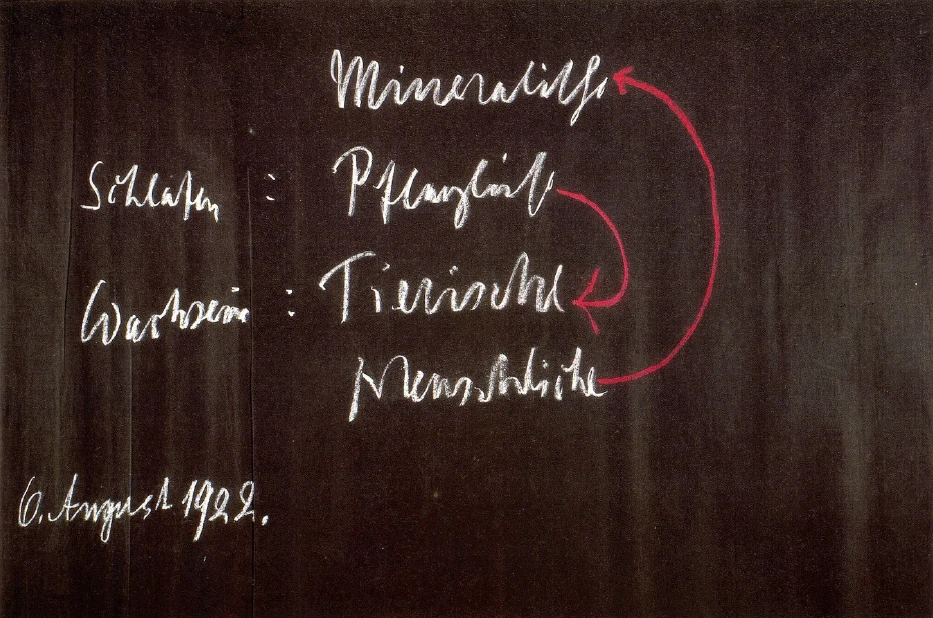
[ 42 ] But everything that happens in the world actually happens under the influence of that which sleeps. The animal—and, for Oswald Spengler, this includes humans as well—has sleep within it. It does indeed. But everything that has significance for the world arises from sleep, for sleep contains movement within itself. Waking contains only tensions—tensions that generate all manner of internal discrepancies—but they are merely tensions that, in a sense, are added to the universe as something external. Fundamentally, an independent reality is that which arises from sleep.
[ 43 ] And floating in this soup are all sorts of such fat globules—more or less superfluous, or tasty and unpalatable—that is, the animal aspect. But the soup could also exist without these fat globules. It’s just that these fat globules bring something into reality. In sleep, one does not find the “where” and “how” within it; one finds only the “when” and “why.” So that even in the case of human beings—who, as animals, still contain the plant element within themselves (Oswald Spengler has no idea what role the mineral element plays in the human)—we find the following: Insofar as they are plant-like, they live in time; he places himself within the “when” and the “why,” in that what came before is the “why” of what comes later. That is the causal aspect. And as human beings continue to live in this way within history, they are actually living out the plant-like aspect within history. The animal aspect—and with it the human aspect—which asks about the “where” and the “how”: these are simply the fat globules; they are added on. This is, of course, quite interesting in terms of inner tensions; but they do not actually have anything to do with what really happens in the world. So one can say: through the interconnections of the world, the “when” and the “why” of the sequence of times are implanted in the world.
[ 44 ] And in this flowing soup, the fat globules float, each with its own where and how. And when a human being—such a fat globule—floats there, the where and how actually concern only him and his inner tensions, his wakefulness. What he does as a historical being comes from sleep.
[ 45 ] In the past, people used to say—as a kind of religious fantasy—that the Lord gives one what is theirs in their sleep. — For Spengler’s conception of man, nature is bestowed in sleep! Such is the thinking of one of the most significant figures of our time, who—in order to avoid gaining clarity about himself—first gets swept into the plant realm, only to find that this whirlpool carries him no further than the animal realm, into which the human realm, too, is swept.
[ 46 ] Now, one might believe that this whirlwind of thought, in its ingenuity, avoids the worst mistakes that thinking has made in the past; that it is, in a sense, true to itself in this regard. If plant-like existence is to be applied to the history of humanity as well, then let it remain plant-like. But it would not be appropriate to conduct a historical analysis based on the human being of the plant kingdom. Now, Oswald Spengler—indeed, quite ingeniously—conducts historical analyses of what, in its development, renders humanity plant-like in its slumber. But in order to have something to say about this “sleep” of humanity, he resorts to the worst kind of thinking one could possibly employ: namely, anthropomorphism—artificially distorting everything and projecting human traits onto everything. Thus, as early as page 9, he speaks of the plant, which has no wakefulness, because he wants to use it to learn how he should now write history and also provide a description of what people do while in a state of sleep.
[ 47 ] But now read the first few sentences on page 9:
[ 48 ] “A plant exists without being awake.” Good.
[ 49 ] “In sleep, all beings become plants,” he says. So humans as well as animals! Nice. —
[ 50 ] “The tension with the environment has subsided; the rhythm of life goes on.”
[ 51 ] And now here's a great sentence:
[ 52 ] “A plant knows only its relationship to when and why.”
[ 53 ] Now the plant begins not only to dream, but also to “know” in its blissful sleep. One is thus faced with the following conjecture: This sleep, which is supposed to spread as a narrative throughout human development, could in fact begin to awaken. For by the same token, Oswald Spengler could then write a history in which he attributes to the plant an awareness of when and why. Indeed, this sleeping nature of the plant even possesses highly interesting characteristics:
[ 54 ] “The pushing of the first green shoots through the winter soil, the swelling of the buds, the full force of blooming, fragrance, radiance, and ripening: all of this is a longing for the fulfillment of a destiny and a constant, yearning question of ‘when.’”
[ 55 ] Yes, it’s very easy to describe history as the life of a plant once you’ve prepared yourself for it through anthropomorphism!
[ 56 ] And because all this is so, Oswald Spengler goes on to say: “The ‘where’ can have no meaning for a plant-like existence. It is the question with which the awakening human being reflects daily on his world. For only the pulse of existence endures through all generations. Waking begins anew for every microcosm: that is the difference between conception and birth. The one is a guarantee of permanence; the other is a beginning. And that is why a plant is conceived but not born. It is there, but there is no awakening; no first day unfolds a world of the senses around it.”
[ 57 ] If one wants to reflect on Spengler’s ideas, one really must, like a roly-poly toy, first stand on one’s head and then flip over in order to rethink what is currently being thought in the human sense! But you see, by devising such a metaphysics, such a philosophy for himself, Oswald Spengler now comes to say: This dormant force within man—that which is like a plant within him—is what makes history. What is this within man? The blood, the blood that flows through the generations.
[ 58 ] Well, this is how Oswald Spengler develops a method that allows him to say: The most important events that unfold in human history are brought about by blood. To do so, however, he must still make a few intellectual leaps: “In this respect, wakefulness is synonymous with ‘determining,’ whether it involves the tactile sensations of an infusor or human thought of the highest order.”
[ 59 ] Yes, if one thinks in such abstract terms, then one simply cannot discern the difference between the tactile sensations of an infusor and the thinking of a human being of the very highest order! And then one arrives at all sorts of extraordinarily strange assertions—namely, that this thinking is actually an adjunct to human life as a whole: deeds arise from the blood, and history is made from the blood. And even if there are some who reflect on this, it is merely abstract reflection and has not the slightest connection to what is actually happening: “That we not only live but are aware of ‘life’ is the result of that contemplation of our corporeal being in the light. But the animal knows only life, not death.”
[ 60 ] And so he explains that what really matters must emerge from the darkness, from the plant-like, from the blood, and that all those people who have accomplished something in history have not, well, created anything out of an idea or out of thought, but rather that thoughts—even the thoughts of thinkers—merely accompany the process. Oswald Spengler cannot find enough disparaging words to describe what thinking accomplishes.
[ 61 ] And then he contrasts them with all those who truly act because they let thinking be thinking, and let thinking be the business of others: “There are those born to be people of fate and those born to be people of causality.” The truly living person—the farmer and warrior, the statesman, military leader, man of the world, merchant, anyone who wants to become rich, command, rule, fight, or take risks—the organizer and entrepreneur, the adventurer, fencer, and gambler—is separated by a whole world from the ‘intellectual’ person” — Spengler puts “intellectual” in quotation marks — “separated by a whole world from the holy, the priest, the scholar, the idealist, and the ideologue, whether the latter is destined for this by the power of his thought or by a lack of blood. Existence and wakefulness, rhythm and tension, instincts and concepts, the organs of circulation and those of touch—there will rarely be a person of standing in whom one side does not necessarily outweigh the other in importance.”
[ 62 ] “...the active person is a whole human being: in the contemplative person, a single organ seeks to act independently of and in opposition to the body.”
[ 63 ] “For only the man of action, the man of destiny”—that is, the one unconcerned with abstract ideas—“ultimately lives in the real world, the world of political, military, and economic decisions, where concepts and systems count for nothing. Here, a good blow is worth more than a good conclusion, and there is wisdom in the contempt with which the soldier and statesman have, throughout the ages, looked down upon the ink-stainers and bookworms who believed that world history existed for the sake of the intellect, science, or even art.”
[ 64 ] That’s clearly stated! But so clear, in fact, that one can tell who said it: that it was, after all, written by a “pen-pusher and bookworm” who is merely putting on airs for the sake of others. And it must indeed be a “pen-pusher and bookworm” who writes: “There are people born of fate and people born of causality.” The truly living person—the farmer and warrior, the statesman, military leader, man of the world, merchant, anyone who wants to become rich, command, rule, fight, or take risks—the organizer and entrepreneur, the adventurer, fencer, and gambler—is separated by an entire world from the ‘intellectual’ person: the saint, priest, scholar, idealist, and ideologue.” As if confessionals had never existed and confessors had never existed! Yes, there are even other beings from whom all these kinds of people draw their ideas. In the company of all such people mentioned there—statesmen, military leaders, men of the world, merchants, fencers, gamblers, and so on—one has even found fortune-tellers and card readers! So the world through which the statesman, the politician, and so on are supposed to be separated from the “spiritual” person is, in reality, not nearly as vast as that. Anyone who can observe life will find that such things are written without any consideration of life itself. And Oswald Spengler, who is a witty man and a significant figure, takes this to the extreme. After stating that in the realm of real events, a blow is worth more than a logical conclusion, he continues as follows: “Here, a good blow is worth more than a good conclusion, and there is wisdom in the contempt with which the soldier and statesman have, in all ages, looked down upon the ink-stain writers and bookworms who believed that world history existed for the sake of the mind, science, or even art. Let us state it unequivocally: understanding freed from feeling is only one aspect of life, and not the decisive one. In a history of Western thought, the name Napoleon may be omitted; but in real history, Archimedes, with all his scientific discoveries, was perhaps less influential than that soldier who killed him during the storming of Syracuse.”
[ 65 ] Well, if a brick had fallen on Archimedes’ head, then according to this theory, that brick would be worth more than everything that came from Archimedes—in the sense of real, logical history! But this isn’t something written by just any run-of-the-mill journalist today—it’s written by one of the most intelligent people of our time. That is precisely what is so significant: that something like this is written by one of the most intelligent people of our time.
[ 66 ] And now, what, then, is actually the active force? Thought, which floats on the surface. What is the active force? The blur.
[ 67 ] Someone who speaks about blood from a spiritual perspective—that is, scientifically—will first ask how blood is formed and how it relates to the food a person consumes. Blood is not yet present in the intestines; it is created only within the human being. The idea of blood flowing down through the sexes—well, if any false mystical notion can be conceived, this is it. Everything that nebulous mystics have ever said—at least to some extent, even if vaguely—about the inner life of the soul has not been as bad a form of mysticism as this Spenglerian mysticism of blood. It points to something where all possibility ceases altogether—not merely in the sense that one cannot think about it—which wouldn’t matter in Oswald Spengler’s case, since one doesn’t actually need to think; it’s really just a luxury of life—so that wouldn’t matter; but if one wishes to remain a rational human being—or even just a rational higher animal—one should stop talking about something one can approach as little as one can approach a blur.
[ 68 ] From this perspective, however, it is indeed possible to begin a historical analysis with the following sentence: “All great events in history are driven by such cosmic entities—by peoples, parties, armies, and classes—while the history of the spirit unfolds in loose communities and circles, schools, educational strata, movements, and ‘-isms.’ And here again it is a matter of fate whether such masses, at the decisive moment of their greatest potency, find a leader or are driven blindly forward; whether the leaders of chance are men of high rank or entirely insignificant figures who are swept to the forefront by the tide of events, like Pompey or Robespierre. It is the hallmark of a statesman that he perceives with complete certainty the strength, duration, direction, and intent of all these mass psychologies—which form and dissolve in the flow of time—yet even here it is a matter of chance whether he can master them or is swept away by them.”
[ 69 ] This then inaugurates a view of history in which blood triumphs over everything that enters the historical process through the spirit!
[ 70 ] Now: “A power can only be overthrown by another power, not by a principle, and there is no other power to stand against money”—except blood, he means—“Money is overcome and abolished only by blood. Life is the first and last, the cosmic flow in microcosmic form. It is the fact within the world as history. In the face of the irresistible rhythm of the succession of generations, everything that wakefulness has built up in its spiritual worlds ultimately fades away. History is about life and always only about life, the race, the triumph of the will to power, and not about the victory of truths, inventions, or money. World history is the Last Judgment: it has always vindicated the stronger, fuller, more self-assured life—namely, its right to existence, regardless of whether it was right in the eyes of waking consciousness—and it has always sacrificed truth and justice to power and race, condemning to death those people and nations for whom truth was more important than deeds, and justice more essential than power. Thus the spectacle of a high culture—this entire marvelous world of deities, arts, thoughts, battles, and cities—closes once more with the primordial facts of eternal blood, which is one and the same as the eternally circulating cosmic tides. The bright, image-rich waking life plunges back into the silent service of existence, as the Chinese and Roman imperial eras teach; time triumphs over space, and it is time whose inexorable course embeds the fleeting chance of culture on this planet into the chance of humanity—a form in which the chance of life flows for a time, while behind it, in the world of light perceived by our eyes, the flowing horizons of Earth’s history and the history of the stars open up.”
[ 71 ] “But for us, whom fate has placed within this culture and at this moment in its development—in which money is celebrating its final victories and its legacy, Caesarism, is approaching quietly and inexorably—the direction of our will and our duty is thus defined within a narrowly delineated circle, without which life is not worth living.”
[ 72 ] Oswald Spengler thus points to the coming Caesarism—that which will emerge just before the complete downfall of Western civilizations, and into which today’s culture will transform.
[ 73 ] I have presented this to you today for the reason that the alert person—though, of course, Oswald Spengler doesn’t care about the alert person!—but because the alert person, even if he or she is an anthroposophist, should still take a closer look at what is actually happening. And so, from this perspective, I wanted to draw your attention specifically to a problem of our time. But it would be a poor conclusion if I were to say only this much about this problem of our time. Therefore, before we have to take a longer break, I will give another lecture next Wednesday before my trip to Oxford.