

Fundamental Impulses of Humanity's Development Throughout World History
GA 216
22 September 1922, Dornach
Translated by Steiner Online Library
Third Lecture
[ 1 ] In the past few hours, I have endeavored to describe in detail the connection between the physical and psychological aspects of human existence and the spiritual forces of the world. Today I would like to supplement the picture that has thus been sketched by describing, in a manner similar to that used for the physical and psychological existence of the human being, details from historical life and the connections between historical life and the spiritual worlds.
[ 2 ] In our materialistic age, our view of human history is limited to the external aspects. People simply seek to record what takes place within the physical, sensory world, while paying no attention to the interplay of the spiritual world with humanity’s historical actions. Our age is, in fact, completely lacking the ability to view what people do in the course of history in connection with the beings and forces that underlie human existence.
[ 3 ] Let us now look back to earlier periods of human development, beginning with the eras that I have described in my book An Outline of Esoteric Science as the Proto-Indian and Proto-Persian ages of humanity. Of course, during this era, people accomplished many things that we refer to as the substance of history. But we must be clear that it was precisely in that era that the events which later appeared as outward historical facts arose least of all from human consciousness; for we know, after all, that in the very earliest times human consciousness was permeated and interwoven with a kind of dreamlike clairvoyance. Images appeared in people’s consciousness, the content of which was influenced by spiritual beings who then inspired people to do this or that.
[ 4 ] Now, during the period I am referring to, the act of inhalation played an extraordinarily important role in human life. The very fact that, in those ancient times, the entire breathing process had become a conscious process—a process of perception—through yoga exercises should make it clear to you that breathing played a major role in those earliest times, especially the act of inhalation, more so than the act of exhalation. In our present age, we are not at all aware that, in addition to the coarse material substances we seek in the air when we inhale, all manner of other substances are also present—albeit in an extraordinarily fine dispersion. Even the substances that we otherwise encounter in a solid, mineral state on Earth during our present earthly existence are distributed in a very fine manner throughout the atmosphere, and human beings breathe them in. However, in their very fine dispersion within the atmosphere, these substances have a peculiar tendency to form shapes. Certainly, substances also form shapes within the Earth’s substance. We know these forms as the crystals of minerals. But I am not referring to these crystals now. I am referring to those substances that are finely distributed in the air sphere—we might also say in the air-ether, insofar as it permeates the air sphere. These substances also form shapes, but these shapes are not like mineral forms; rather, they resemble the forms of human organs. This is a peculiarity of the ether that permeates the air. If we can observe how it permeates the air and how it can appear to us in our imaginative life of knowledge, we perceive that in this ether, so to speak, fine, ethereal formations flit about, which take the form of lungs, liver, or stomach—in any case, the forms of internal human organs. If we are trained in etheric observation, we can observe all human forms out there in the world ether. However, these organ forms are generally enormous in comparison to the physical organs we carry within us. We see mighty etheric forms of the liver and lungs permeating the space that surrounds us in the cosmos.
[ 5 ] What is, so to speak, floating around in the air outside as forms—that is what a person breathes in. And it is good that they can breathe it in, because as they do so, these forms—which, so to speak, enter us along with the air—always have a restorative, healing effect on our organs. Our organs deteriorate more and more as we go through life. And, if I may put it somewhat crudely, they are, in a sense, patched up again by what we breathe in. We know how difficult it is for “therapy” to patch up human organs. But the therapy referred to here must actually have a continuous effect on the human being—and it does.
[ 6 ] In those earliest times of humanity’s historical development, people were able—without any special training—to perceive these etheric forms, and especially their significance for human beings, through their original, dreamlike clairvoyance; to perceive what it means, for example, when the human stomach form is inhaled along with the pepsin-like substance finely dissolved in the etheric realm and is then received by the human stomach organ. In ancient times, people were exceptionally well-informed about such matters, and the further back we go in time, the more they understood the relationship between human beings and the subtle organization of the environment.
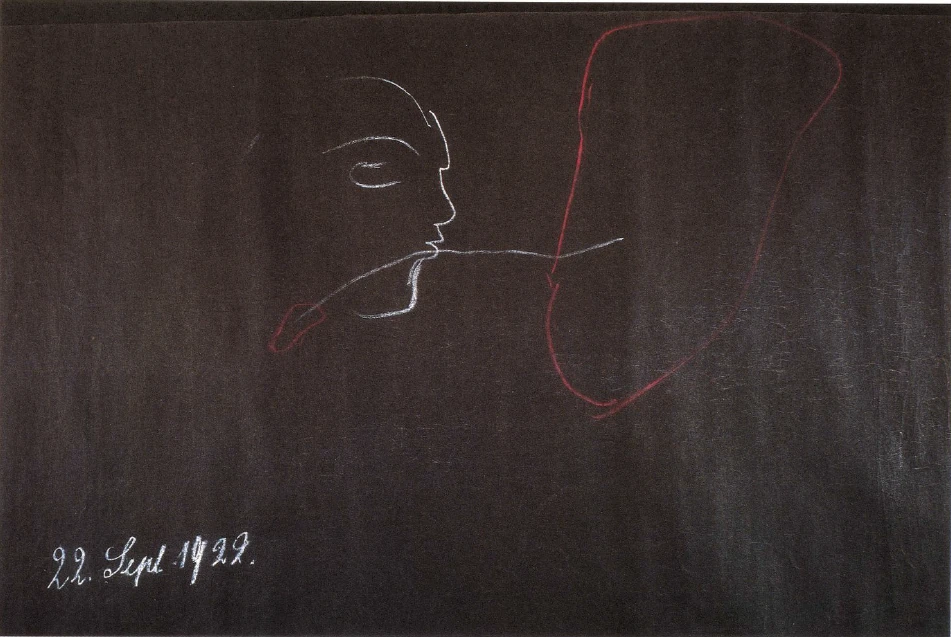
[ 7 ] But this entire process—the entry of the etheric form into human beings through inhalation—was not merely automatic; it was not merely a matter of the human being, so to speak, allowing air to be blown into them as into an evacuated space, as when we make a hole in the receptacle of an air pump. It was not merely a matter of the human being inhaling it; rather, this process—this sort of immersion of the world forms into the human being—was accompanied by the activity of spiritual beings. Let us suppose there is such a form here (see drawing on page 43); the human being inhales it, and it immerses itself into the human being (red); but at the same time, this is accompanied by the activity of spiritual beings.
[ 8 ] Now, in the lectures I have given—some of them publicly, some here very recently—we have come to know a particular kind of spiritual being and its significance for human beings. I am referring here to those spiritual beings whose physical image is found in the Moon and its radiance. They are the spiritual beings of the Moon. It was these spiritual lunar beings, particularly during the times I am now speaking of, who were able to form their paths from the outer cosmic circle into human beings through these forms. Thus, in those ancient times of humanity’s historical development on Earth, human beings absorbed the spiritual lunar cosmos into themselves through the process of inhalation and thereby stimulated the spiritual lunar beings to become active within them. What I am telling you here was the substance of a science and wisdom that was extensively studied in the most ancient mysteries of humanity. For the initiates of these mysteries knew that human beings are subject to this process, that they draw the spiritual lunar cosmos into themselves. But they also knew that this drawing in takes place primarily at night, when people are asleep. But because all human beings in primeval times possessed a dreamlike clairvoyance—an intermediate state between waking and sleeping—one could also expect these spiritual lunar beings to enter into human beings during certain times of the day. And the entire guidance that the initiates of the ancient mysteries provided for humanity was designed to master what these lunar beings carried into human beings through the process of inhalation, so that human beings would be enabled to utilize the forces of these lunar beings—which, after all, were thereby actually making their way into the inner being of the human being—in their own actions.
[ 9 ] You must be aware that teaching in such an intellectual manner as we see today did not exist in those earlier times. Nevertheless, the initiates of the Mysteries had ways and means of guiding and directing the peoples in a much more intense manner than was later the case and than is particularly the case now. For example, in the very earliest times of human development, the art had been fully developed within the Mysteries of communicating with these lunar beings—whom human beings inhaled at night and during the clairvoyant intervals of their waking hours—and of inspiring them to bring something very specific into humanity. This was the path through which the ancient mystery initiates were able to guide people in a magnificent way, with the lunar beings serving as their helpers through the process of inhalation. Humanity today has only a very inadequate understanding of the special, extraordinarily mysterious processes that found their outward reflection in all manner of ceremonial rites—processes that were used in earlier times to guide humanity from the mystery sites.
[ 10 ] But now, as humanity continued to evolve, a new era dawned. The ancient clairvoyance grew increasingly dim, so that those special processes—which the ancient initiates had been able to bring about in the manner just described during the primordial Indian and Persian periods—became ever more difficult. Certainly, up until the Mystery of Golgotha and for a few centuries thereafter, remnants of the ancient clairvoyance still existed, particularly in certain regions. But it had become very subdued, and in particular, the procedures I have just described were no longer carried out in the 3rd and 2nd millennia before the Mystery of Golgotha with the same intensity as had been the case in the most ancient times of human earthly evolution, immediately following the Atlantean era. I would say that the initiates of the mysteries found themselves increasingly at a loss whenever they sought to use the power of the lunar beings to guide humanity. And if I am to make clear to you what transpired between the initiates of the mysteries and the lunar beings—who in earlier times were employed in the processes I have described—I would like to express it this way: For example, when an initiate of the Egyptian-Chaldean era approached a lunar being and sought to give it a task—namely, to imprint this or that upon the human soul after the lunar being had entered it through inhalation—such a lunar being would often say, as it were, to the initiate: “We no longer have a refuge on Earth during the waking hours; we find refuge only during the night.” — But during the night, it would have seemed extremely questionable to the initiates to influence the people of Earth indirectly through the lunar beings, for then the people would have been treated, as it were, automatically. This would have resulted in something that, in certain terminology, is certainly described as the art of black magic. The good initiates, of course, rejected this outright; so it was of immense significance to them when the lunar beings—who were to be their helpers in guiding humanity—gave them the reply: “We have no refuge on Earth during the daytime.” — And so the initiates of these mysteries faced the danger of having no helpers on the paths they had embarked upon to guide humanity.
[ 11 ] But on the other hand, what later came into the world through the Mystery of Christ was not yet present; so there was an interim period between the ancient age of clairvoyance—in which everything I have described could take place—and the time that then transformed everything in the spiritual working on Earth, the time inaugurated by the Mystery of Golgotha. We can study this interim period particularly closely through the development of Egypt. For the Egyptian-Chaldean development follows the primordial Persian era. The initiates of the Chaldean people were of very little help to themselves with regard to the questions I am now addressing. In a certain sense, they were utterly at a loss and consequently sought what they needed to guide humanity through a rather external means: through their knowledge of the stars, through their art of astrology. For what the Chaldean initiates learned through their astrology could, precisely in those earlier times, be learned in a completely different way through those lunar beings who entered human bodies with the inhalation of breath. But now these very beings said that they could find no refuge on Earth. And so what they had previously provided, in a sense, as inner strength was replaced by the power of external observation.
[ 12 ] The initiates of the Egyptian world helped one another in a completely different way. The initiates of the Egyptian world sought ways and means to provide shelter on Earth for the lunar beings. Thus, for those beings who, according to the primeval laws of world evolution, were no longer destined to find a home on Earth, the initiates of the Egyptian mysteries sought to provide such a home. And it was precisely the Egyptian mystery priests, the Egyptian initiates, who found a way to provide a home on Earth for the Luciferic lunar spirits.
[ 13 ] The Egyptian priests succeeded in solving this mystery—in persuading the moon spirits to descend once more to Earth, even though, according to the eternal course of cosmic evolution, this was no longer their destiny—by populating the tombs with mummies. I have discussed this in earlier lectures from other perspectives. Today I would like to discuss it from this cosmic-historical perspective. The mummified corpse of the human being became the dwelling place of the Luciferic moon gods. What in ancient times could be observed naturally simply by coming together with people and clairvoyantly observing their breathing—something that no longer takes place at all in these natural processes, but which, through the ancient breathing of human beings, so to speak, permeated all of social life and played a role in humanity— found a substitute in those places where the spirits—who had no refuge in humanity during the daytime, who would otherwise have had to wander homelessly upon the earth and could not have been utilized for historical earthly events—were, so to speak, housed within the mummified human beings, within the mummies. For the mummies were the dwellings of the lunar beings. And when the Egyptian initiate stood before the mummy with full understanding, he studied in the mummy what had formerly been studied out in the living world. He looked, as it were, at what the lunar gods were doing in the dwellings that had been granted to them. And in this way, the initiates became aware of what they could then, through these lunar deities, instill into the historical development of humanity in the most diverse ways.
[ 14 ] As paradoxical as it may seem to a modern, materialistically minded person, it is nonetheless true: If one wishes to understand what unfolded as a historical process within the Egyptian cultural epoch, one can do so only by not merely studying the external historical monuments, but by studying—from that eternal chronicle of the worlds, which can be read through imaginative and inspired vision—what those spiritual lunar beings did, for whom no external monuments were erected and who left behind no written historical documents. But what those people accomplished for whom the external monuments were erected was inspired by the spiritual lunar beings in a roundabout way, through the work of the initiates with the lunar beings, to whom shelter had been granted in the mummies during the day on Earth. And one can only truly recognize the origin of what is written in the historical records if one can seek out, in the world chronicle, the beings who tell us: “During the 3rd, 2nd, and 1st millennia B.C., we were able to inhabit the Earth only because the Egyptian initiated priests provided us with earthly dwellings within the mummies.” — From these lunar beings, we can learn the origins of the intentions behind the historical events of that time.
[ 15 ] If, then, one wishes to understand human beings according to their true nature, one must turn to the stars and the hierarchies, as I have explained in my last two lectures here. But if one wishes to understand the historical development of humanity correctly, one must be able to study the spiritual forces that play a role in this historical development. Then one must be willing to study the meaning of such a striking phenomenon as the mummification of human beings by the ancient Egyptians. Things that, before today’s materialistic perspective, often appear to humanity merely as curiosities or customs can be understood in their inner meaning when one is able to investigate them through true spiritual science. The mummies were once temples of the gods. Even the moon gods, who had already become Luciferic, had their dwellings within the mummies.
[ 16 ] In the Greco-Roman era—that is, in the fourth post-Atlantean epoch—things changed somewhat. That was when the transcendent nature of inhalation came to an end. Inhalation retained its significance, but that preeminence of inhalation ceased. And, in a sense, inhalation and exhalation became processes of equal significance for human beings, events of equal importance. This is something to which the Greek initiates, in turn, paid very special attention in their work. And that wonderful state of balance between inhalation and exhalation, which distinguished the Greek people in particular, led to Greek art emerging as exemplary in the form in which we find it recorded in history.
[ 17 ] The Greeks were not predisposed to particularly attract the lunar beings through inhalation. However, it was characteristic of them, through their initiates, to make particularly effective those beings who, in a sense, developed a state of being half-flying, half-floating in the air, and who preferred to sway in the state of equilibrium between inhalation and exhalation. And if one goes back to those ancient times of Greek development—when what later emerged in a more external form was actually first inspired—if one goes back to the times that, emerging from magnificently primitive forms, gave rise to Greek visual art, Greek tragic art, and also Greek philosophy, one finds that it was precisely the initiates of the Greek Mysteries who possessed the gift of making special use, in their guidance of humanity, of those beings that swayed lightly within the balance established between human inhalation and exhalation. And, fundamentally speaking, one cannot truly understand the art of Apollo and Orphic wisdom unless one knows that both derived their special animating force from the fact that their helpers were elemental-demonic beings who moved within this balance of inhalation and exhalation. The strings of Apollo’s lyre were tuned according to what could be observed when these beings danced on the balance between human inhalation and exhalation—between the lunar and terrestrial spheres—there, I might say, on the strings of the cosmos, which were woven in rhythm by inhalation and exhalation. It was the dances of the air demons that were imitated in the tuning given to the strings of Apollo’s lyre and other similar instruments. We must look into the spiritual world if we wish to explore what has taken place in the outer historical world.
[ 18 ] Let’s imagine for a moment what I was able to say here some time ago: that recitation, the training in the ancient recitative, and the training in hexameter are based on the relationship between the rhythm of breathing and the rhythm of blood circulation in a person with a sense of rhythm. Remember what I discussed in a course over at the Bau in this regard, specifically with reference to the formation of the hexameter. For the Greek initiates, the study required to arrive at this hexameter was once a thoroughly concrete endeavor. As we inhale, we take in the vibrations of the cosmos and adapt them to our inner being.
[ 19 ] As we exhale again, we impart to the breathing rhythm some of the vibration of our pulse in the blood circulation; so that we can say: in our inhalation, the outer world pulses into us; in our exhalation, the pulsation of our own blood radiates outward. Thus, in the human etheric body—especially for the Greek initiate, who was trained to perceive these things—it was possible to observe how, around the human being in the etheric and astral bodies, cosmic rhythms and pulsating rhythms met, intertwined, and upon which the air spirits swayed and performed their dances. This was the study to which Homer was devoted when he brought the hexameter, in particular, to its highest flowering, for it was born out of the human being’s connection with the world.
[ 20 ] Some things only become clear when one looks at the things preserved in history with the discerning eye of an artist and the artist’s discerning gaze. I don’t even want to mention that, ultimately, the materialist worldview—instead of actually reflecting on the specific way in which something like the Homeric epics came into being—resorts to saying: There was no Homer at all. — It is, after all, the simplest thing one can do from the standpoint of the materialistic mindset of our time. To comprehend Homer is impossible for this materialistic science; and what one cannot comprehend is, according to the mindset that has become so terribly vain and arrogant in our time, not allowed to exist at all. Whatever one cannot grasp with one’s scholarly intellect is not allowed to exist—and therefore does not exist. Since one cannot understand Homer, he simply does not exist. But perhaps something else would be better! You can still find portraits of Homer everywhere in museums. Now, I’m not saying that this bust of Homer is particularly good, but it is good enough that when you look at this Homer—depicted as blind—who, despite his blindness, has a very distinctive look in his eyes and, in particular, reveals a peculiar posture of the head in a certain way—when you put yourself in the mindset of this bust of Homer, you get the feeling: perhaps he went blind of his own free will—I am, of course, speaking in figurative terms here—so as not to be disturbed by sight while listening intently. He is listening to what he perceives in the pulsation that resonates from the pulse of the cosmos and from the pulse of human blood, of the human etheric body, and upon which the air beings perform their harmonious, melodic dances. What he hears there—where something is buzzing, as when we listen to a swarm of mosquitoes buzzing, where, for example, the hexameter is being buzzed—what he hears in this buzzing, now that he is not disturbed by sight or by ordinary bright daylight, condenses for him in such a way that he, so to speak, feels his way with his ears at the same time.
[ 21 ] Take a look at the Homer head! This is a groping act of hearing, a hearing act of groping—a very special kind of life that flows through this plaster or marble form. In it, the blind eye is still somewhat stretched out from within the head’s being, which, as it were, flashes through it, which not only hears, but also feels the sounds and holds back the felt sound in order to transmit to the chanting vocal organ that which has been taken in from the cosmos into the human being at a time when it was not inhalation on the one hand and exhalation on the other that played a prominent role, but rather when the interplay of the two—inhalation and exhalation—was present.
[ 22 ] The most intriguing question that should arise in a person’s mind when looking at this head of Homer must surely be: How did he breathe? — This head is completely undisturbed by external light. This head is entirely devoted to the mysteries of the breath: This perception of the Homer head, which can be seen everywhere, would be wiser than trying to dismiss the old Homer through argument. The reasons for disproving Homer’s existence through scholarly argument were so alluring and tempting that even Goethe could not quite come to terms with them. The first person in Goethe’s time to dismiss Homer—who claimed that there had never been a Homer at all—was the German philologist Wolf. But even Goethe could not escape the alluring, seductive arguments of this philologist. And although he was actually always horrified by the idea that Homer might have been devoured by a wolf, on the other hand he was nevertheless partly dismayed by the incredibly clever points that had been raised. What can’t modern cleverness accomplish! People have truly become extraordinarily clever. But being clever does not mean knowing anything about the world.
[ 23 ] Later, Herman Grimm attempted—not, however, to bring Homer back to life, since Homer had not actually been eaten by the wolf at all, but rather only an image of Homer had been devoured, an image that had gradually taken shape—later, Herman Grimm attempted the following. He said: Let’s not concern ourselves with Homer at all for now, nor with the wolf that devoured him, but let’s look at the Iliad, Homer’s epic. Let’s try reading this epic of Homer’s, but not the way a philologist reads it, rather the way an ordinary person reads it. Let’s try reading the first canto and see what artistic technique was used in its opening. Let’s then observe the progression, the further development. Let’s move on to the second and subsequent cantos: it’s remarkable how, time and again, there is an inner composition within them, how each canto is structured, with a wonderful inner sense of artistry, in a manner similar to the one before it.
[ 24 ] Herman Grimm applied this line of reasoning throughout the entire Iliad. He went on to say: It would indeed be most peculiar if there had never been a Homer at all, but rather if, over the course of time, first one person, then a second, then a third had each composed a small section of the Iliad, which were later compiled. Perhaps, according to philologists, Faust will one day be viewed in the same way, because contradictions will be found in it. In any case, it turned out that it would be a very strange story indeed if a work as uniformly composed as the Iliad had been pieced together from all sorts of fragments that originated here and there.
[ 25 ] It is indeed necessary to delve so deeply into history that one can truly bring to mind the way in which spiritual beings are woven into and influence the immediate historical events. This is also what anthroposophical spiritual science must strive to do, and today I have attempted to bring this to life for you, beginning with the earlier period up to the time of the Greeks. Tomorrow we will then see how, since the Mystery of Golgotha, these spiritual beings have also proven to be active in human actions—which are becoming ever freer—within our own historical present, and how we can come to understand what we ourselves must do if it becomes necessary, for example, to help ourselves in a manner similar to that of the Egyptian initiates, who sought to provide shelter for certain lunar beings. Perhaps it is necessary that, in our time, something similar must take hold, arising from a true understanding of the spirit.