

Fundamental Impulses of Humanity's Development Throughout World History
GA 216
30 September 1922, Dornach
Translated by Steiner Online Library
Seventh Lecture
[ 1 ] We have seen how the fundamental impulses of humanity’s historical development are expressed in phenomena such as the remarkable tendency of Egyptian culture toward the mummification of the human form and, in more recent times, toward the preservation of ancient forms of worship—which, in a certain sense, also constitutes a kind of mummification, but one of cultural events. If we return once more to some reflections on Egyptian culture, as it is outwardly revealed in the mummy, we must connect what we have gained there as an insight with a presentation I gave during the course recently held over at the Goetheanum, but which I have also given here on several occasions. I am referring to the description of ordinary human thought activity, as it is exercised by human beings in such a way that they gradually develop it within themselves during childhood, acquire a certain capacity for it, and then carry it out between adolescence and death. We have come to know this thinking activity—this, as I have often called it, “intellectualistic self-activity”—as a kind of inner soul-corpse.
[ 2 ] We have repeatedly brought to mind that thinking, as it is carried out by human beings in earthly life, is only properly understood when one is able to relate it to its true nature in the same way that the physical body left behind by a person who has passed through the gate of death relates to the living human being on earth. That which makes a human being a human being actually departs from the person, and what remains in the physical body is something that can only have this form—the form that appears to us precisely because it has been left behind by a living human being. No one could be so naive as to believe that the human corpse could come into being in its present form through some mere convergence of forces. It must be a remnant; something must have preceded it; the living human being must have preceded it. The external nature we study does indeed have the power to destroy the form of the human corpse, but it does not have the power to create it. This human form is created by what is inherent in the human being as higher constituents of its being. But these are gone with death. Just as we can tell by looking at a corpse that it originated from a living human being, so too, when we view thought in the right way, we see that it cannot, by itself, be as it appears to us in earthly life, but that it is a kind of corpse in the soul—namely, the corpse of what it was before the human being descended from the spiritual-soul worlds into physical earthly existence. In its pre-earthly existence, the soul was something that, in a sense, died at birth; and the corpse of this soul that has died is thought.
[ 3 ] How could it be otherwise, since it was precisely those people who knew best how to live through thought who sensed this folly, this death of abstract thought! I need only refer you to that moving passage with which Nietzsche begins his description of philosophy in the tragic age of the Greeks—the passage where he describes how the Greek world of thought, in the presocratic philosophers such as Parmenides or Heraclitus, rises to the abstract concepts of being and becoming. There, says Nietzsche, one feels an icy chill coming over oneself. And so it is. Just compare this with how the people of the ancient Orient sought to comprehend this external nature through vivid, inwardly active—albeit more dreamlike—soul-formations. Compared to this thinking that is alive within itself—whose flowering we encounter in Vedanta philosophy and in the Vedas—compared to this stirring thinking, to this thinking that sprouts and flourishes everywhere, weaving its way through the whole human being with inner life, what later appears as abstract thought is, in fact, a dead corpse. Nietzsche sensed this when he felt compelled to describe the pre-Socratic philosophers, who were actually the first in human development to ascend to such abstract thoughts.
[ 4 ] But look at these Eastern sages who preceded the Greek philosophers. You will find no doubt there that human beings first had a spiritual existence before they descended to Earth. One cannot experience thinking as a living reality and at the same time not believe in the pre-earthly existence of human beings. Anyone who experiences thinking as a living reality is just like someone on Earth who recognizes a living human being. Anyone who no longer experiences thinking as a living force—as the Greek philosophers did even before Socrates—may believe that human beings are beings who are born only at the moment of birth, as Aristotle did. So we must distinguish between the once-Oriental, inwardly active, and living thinking—through which one knew that one had just entered earthly existence from spiritual worlds—and that thinking which then emerged as dead thinking, or “corpse thinking,” through which one comes to know nothing other than what is accessible to one between birth and death.
[ 5 ] Now put yourself in the shoes of such a person in Egypt, let’s say in the 2nd millennium before the Mystery of Golgotha. He must have said to himself: Over there in the Orient, there were once people who experienced thinking as a living reality. — But this Egyptian sage was still in a unique situation. He did not yet possess the soul life that we have today. Just imagine very vividly what the soul life of such an Egyptian sage was like. To feel living thought—which had already slipped away from the soul—was no longer possible, and abstract thought had not yet emerged. A substitute was created through the embalming of mummies, through which—as I have described—one arrived at the concept of form, at human ideas of form. One trained oneself to comprehend this dead human form in the mummy, and through this one first learned abstract thinking, dead thinking.
[ 6 ] In contrast, in more recent times, certain occult communities have preserved rituals, forms of worship, and ceremonial acts that were once very much alive among humanity—in the manner I described yesterday—but which are now preserved as dead traditions. You need only recall what you may have read about the rituals of, say, the Masonic Order. There you will find that ceremonies of the first degree, the second degree, and the third degree are performed. These ceremonies are learned, described, or performed in an external manner. They were once full of life; people once lived within them just as a plant lives through its life principle. Today they have become lifeless. Even the Mystery of Golgotha has been able to evoke inner vitality only in a few priestly souls, a vitality that is, so to speak, linked to the worship practices of the churches that arose after the Mystery of Golgotha. But humanity has not yet attained the ability to infuse worship with full vitality. For that, something else is necessary.
[ 7 ] The way of thinking that humanity currently possesses is, in fact, oriented toward the dead. For the living thinking that once existed, there is, for the time being, no understanding at all. The intellectualistic thinking that humanity has been pursuing, particularly since the mid-14th century, is a corpse. That is why this way of thinking is so eager to limit itself solely to dead nature, to the study of the mineral kingdom. And people also want to study plants, animals, and even human beings themselves solely in terms of their mineral, physical, and chemical forces, because they want to deal only with this dead thinking, this corpse of thought, which the purely intellectualist person carries around with them.
[ 8 ] In these lectures that I am now delivering to you as part of this series, I simply had to mention Goethe. As you know, Goethe was a member of the Masonic Order. He experienced the rituals of the Masonic Order, but he experienced them in a way that only Goethe could. From the forms of worship that are otherwise preserved only through tradition, a direct, living experience emerged for him. For him, it was truly the case that he could connect with that spiritual entity which, as I have described, flows into this earthly existence from pre-earthly existence; which, as I said, was always a kind of rejuvenating force for Goethe, for Goethe truly rejuvenated himself many times in his life. And out of this inner life emerged from Goethe what is, in essence, one of the greatest and most significant phenomena in modern spiritual life—yet one that has not been properly appreciated to this day: the idea of metamorphosis.
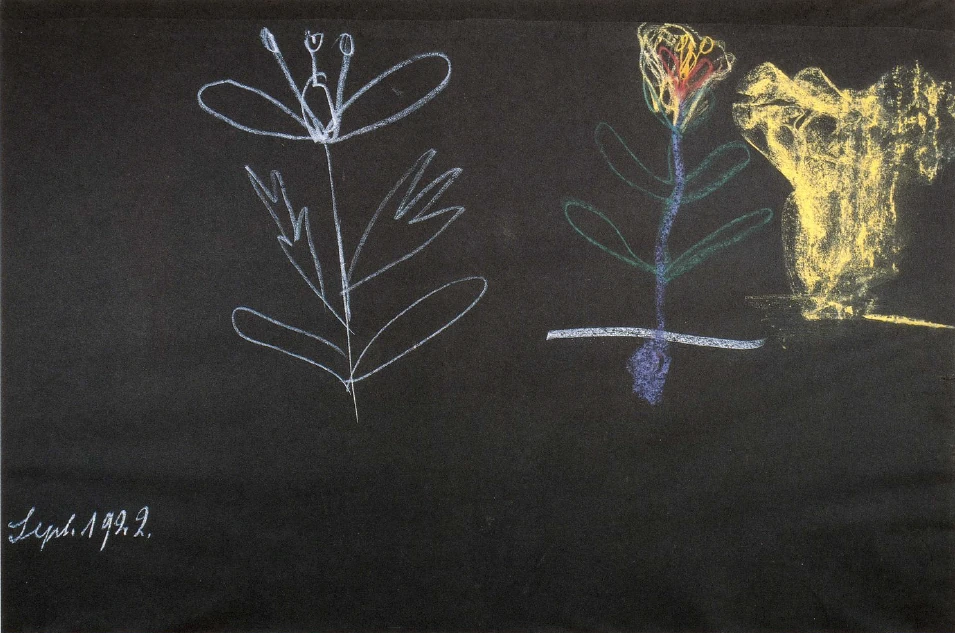
[ 9 ] What, then, did Goethe actually accomplish by formulating the idea of metamorphosis? It was precisely the rekindling of an inwardly living way of thinking—a way of thinking capable of entering into the cosmos. Goethe rebelled against Linnaean botany, where one places one plant next to another, forms a concept of each individual plant, and believes that one must neatly organize it all into a system. Goethe could not go along with that. Goethe did not want merely these dead concepts; he wanted a living way of thinking. He achieved this by first looking into the plant itself. And for him, the plant now became something that developed coarse, unformed leaves at the bottom, followed by more formed leaves—which are, however, transformations, metamorphoses of the former—then the petals with a different color, then the stamens, and in the center the pistil—all transformations of the one basic form of the leaf itself. Goethe did not view the plant leaf in such a way that he would say, for example: “This is one plant leaf, and that is another plant leaf.”—Goethe did not view the parts growing on the plant in this way; rather, he said: “The fact that this leaf looks like this and that leaf looks like that is merely an outward appearance.” Viewed from within, the leaf itself possesses an inner power of transformation, so that externally it can just as easily look like this (right) as it can like that (left). There are not two leaves at all; it is actually one leaf, presented in two different ways.
[ 10 ] “And when I have a plant (see drawing),” Goethe said to himself, “the green leaf down below, the petal (red) up above”—; the intellectual philistine says: “Those are two; they’re simply two leaves.” — What could be more self-evident to the intellectualistic philistine than that these are two leaves, since one is red and the other green? But if a person has a green coat and a red jacket, those are indeed two, for when it comes to clothing—at least in modern times—philistine thinking prevails; there, such philistine thinking is indeed appropriate. But the plant does not go along with this philistinism, Goethe told himself; the red leaf is the same as the green leaf. There are not two leaves at all; it is actually just one leaf in different forms; at one point, the same force is at work down there at point A. There it acts in such a way that the forces are drawn mainly from the earth. The plant draws the forces out of the earth, sucks them upward, and the leaf must grow under the influence of the earth’s forces and turns green. And as the plant continues to grow (violet), the sun comes and shines on it more and more intensely than down below. The sun prevails; the same impulse grows toward the sun and turns red.
[ 11 ] Goethe might have said something like this: When we see a person who watches another person eating an awful lot while he himself has nothing, well, then he turns pale with envy. Another time, someone gives him a slap, and then he turns red. Yes, according to the same principle by which one calls these two leaves, one could also say: These are two people; one time he is pale, the other time he is red, so there are two people. — Just as these are not two people, neither are these two leaves. It is one leaf; one time it is this one, in another place it is that one. This isn’t particularly remarkable to Goethe, after all, because a person can also walk from one place to another, and yet the people you see in different places aren’t two different people! In short, Goethe concluded that this side-by-side observation of things is not truth but an illusion—that this is one leaf, the green one here and the red one there.
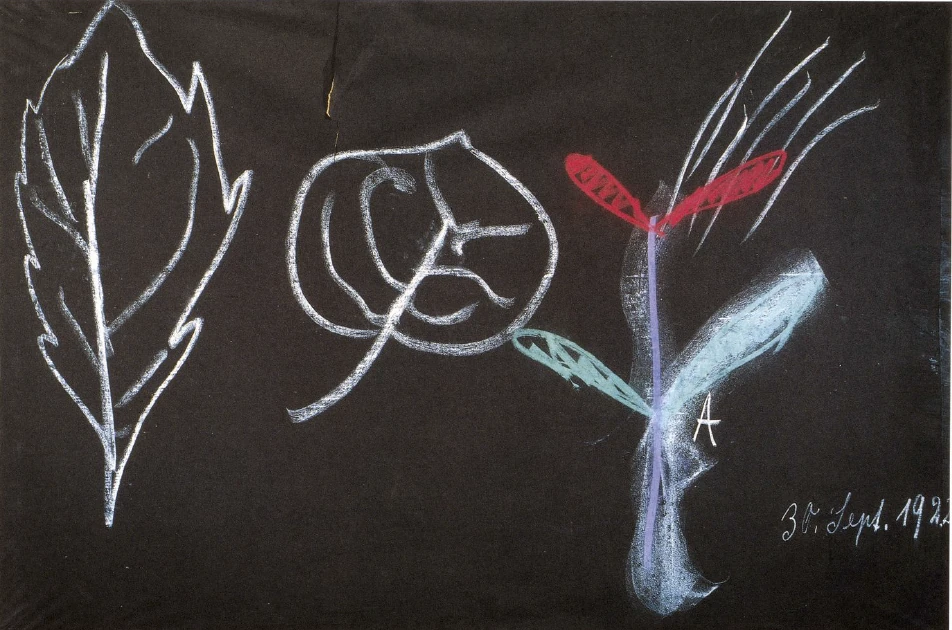
[ 12 ] But just as he observed the various parts of the plant, he also observed the various plants themselves. Let’s look at it this way: We have a plant of some kind. It’s doing well; it can form a proper root from the seed, a stem, proper leaves on the stem, a proper flower, even stamens and the pistil inside the stamens (see drawing). Goethe Do said: “The stamens are also just the same leaf.” — He could have said: “Yes, the intellectualist claims that the red petals are so wide, the stamens are as thin as a thread, only they have a stigma at the top.” — And yet Goethe saw in the broad petal and the very narrow stamen merely different forms of the same leaf. He could also have said figuratively: “Haven’t you ever seen that a person was once in their life as slender as a switch, only to later spread out and become quite fat? These aren’t two different people, after all.” — So petals and stamens are one and the same, and as I said, the fact that they’re in different places doesn’t matter—and that wasn’t essential to Goethe either. A person who can’t run very fast can’t be in two places at once. An educated banker in Berlin once said, when he was being terribly harangued from all sides: “Do you think I’m a little bird that can be in two places at once?” — Yes, humans simply can’t do that, but the point here is that Goethe sought the principle of metamorphosis—the revelation of unity in multiplicity, of unity in diversity—everywhere. Through this, Goethe brought the concept of metamorphosis to life.
[ 13 ] If you grasp what I have just said, you will get an idea of the spirit. For consider everything I have just told you: the fact that, in essence, the entire plant is a leaf, shaped in various ways—this certainly cannot be grasped in a physical sense. Here you must grasp something spiritually that changes in the most diverse ways. It is spirit that lives in the plant kingdom. And we can go further; as I said, we can take a plant that is well cared for—one whose seed is sown in the soil in the proper way, which then receives the gentle spring sun at the right time, followed by the sun of midsummer, and can then develop its seed as the sun’s rays grow weaker. But let’s suppose the plant is placed in such natural conditions that it has no time at all to develop a root, nor a proper stem, nor proper leaves, but instead must develop everything that would otherwise develop in the petals—all of it—terribly quickly and indistinctly, because it simply has no time to form all of that so rapidly. Then it becomes a sponge, a fungus.
[ 14 ] Here you have two extreme cases: a plant that has time to differentiate itself in every detail—developing roots, stems, leaves, flowers, fruits, and everything else. But a plant that is placed in such natural conditions that it has no time at all to form a root—in that case, everything remains only hinted at; it cannot develop stems and leaves either, and what is contained in the flowering principle and the formation of fruit, it must produce quickly and indistinctly. It barely takes root in the earth before it develops with tremendous speed what other plants develop slowly. Think of the poppy, which, after allowing its green leaves to emerge so slowly, can carefully and gradually form its red petals, then the stamens, and finally the coquettish pistil nestled in the center of the poppy. In the case of the mushroom, this must be done quickly and hastily; there’s no time to differentiate, no time to bask in the sun—because the sun isn’t even there to allow for such pretty coloring—in short, it becomes a mushroom. In the mushroom, we have a very indistinct, hastily thrown-together flower. Once again, we have one; two completely different plants are actually one and the same.
[ 15 ] But one must change a little on the inside if one really wants to think all this through. For the intellectual—Goethe might have said: the stiff philistine—looks at the lush red poppy, with its bulbous, well-formed pistil in the center, and now he is supposed to look at a mushroom. At the same time, he is supposed to keep the concept he has formed of this poppy so flexible that it can become indistinct, and that in the poppy itself he already sees, in its very structure, the chanterelle or the imperial mushroom or something like that; that’s not possible, is it? So that his intellect doesn’t have to engage—so that he doesn’t actually need to activate his mind, but at most just has to turn his head a little—one must specifically show him the chanterelle or the imperial mushroom. Then he can picture them side by side—you see, then he succeeds!
[ 16 ] That is precisely the difference between dead thinking and the inwardly animated, living thinking that Goethe shaped for the metamorphosis. It was indeed an inner discovery of the most magnificent kind that came into the world through Goethe. That is why, in the very first volume of Goethe’s Scientific Writings, which I published in the early 1880s, I wrote the following sentence in the introduction: Goethe is at once the Copernicus and Kepler of organic natural science, and just as Copernicus and Kepler purified the concept of external, lifeless nature in order to encompass the astronomical and the physical within that purified concept, so Goethe accomplished the same for organic natural science through the living concept—the concept of metamorphosis. And that is his central discovery.
[ 17 ] And if one wishes, this very concept of metamorphosis can then be extended to encompass all of nature. Goethe, of course, immediately thought—once he was able to derive plant forms from this idea of metamorphosis—that this must also apply to animals. — But that is more difficult. Goethe managed quite well to conceive of one leaf emerging from another in his mind. But how one is supposed to imagine, say, a vertebra in the spine undergoing a metamorphosis in form to become a skull bone—so that metamorphosis can also be applied to animals and humans—that was simply more difficult. And yet, as I have told you many times before, Goethe succeeded when, in 1790 on the Lido near Venice, he was fortunate enough to come across a sheep skull that had fallen apart in a particularly revealing way. It was a sheep’s skull that had fallen apart into its individual bones. Then it dawned on him: Even though they are greatly transformed, they do look like the vertebrae of the spine. — And so he formed the idea that, at the very least, the bones can also be conceived of as representing a single “bone impulse” that merely manifests itself in various forms.
[ 18 ] But when it comes to the whole human being, Goethe did not get very far with this, because he did not succeed in moving from his idea of metamorphosis to true imagination. However, if one arrives at true imagination and, from there, at inspiration and intuition, then this unity becomes even more significant. And I have already been able to point out how this unity manifests itself in the human being when one grasps the idea of metamorphosis correctly. From the same perspective—the one from which Goethe, in the blossoms of dicotyledonous plants, saw the mushroom as he conceived them as increasingly simpler and simpler, more and more entangled—one must study the human head as it appears to us today; then one can conceive of it as a metamorphosis of the rest of the skeleton.
[ 19 ] Try looking at half a lower jaw on a human skeleton with an artist’s eye. If you look at it with an artist’s eye, you’ll find it hard not to compare what you see down there—what’s attached here and then extends downward—with the arm and leg bones. If you imagine the leg bones and arm bones transformed, then you also have two legs here—the lower jaw—only these are atrophied. The head is a lazy fellow who doesn’t walk, who always sits. That’s why it sits on its two legs, which are in a state of decay, which are atrophied. But if you imagine, for example, that a person’s legs were tied together with a string, you could almost mimic what is shown here. And if you look at this with an artistic eye, you could already imagine how to position the legs so that they, too, would be immobile, just like the lower jaw.
[ 20 ] But one can only truly understand how things stand when one regards the human head as a transformed human body. I have explained to you: this human head that we bear in our present earthly life is the transformed, headless body that we carried within us in our previous earthly life. The head from that time has been lost to us—for some people, presumably even during their earthly life—but in any case, after the earthly life, the powers of the head have also been lost. The head does not endure. I am referring now to the powers—not the matter, of course, but the powers—and these powers that you now carry in your head, you previously carried on the rest of your body, if you imagine yourself decapitated. In a previous earthly life, you in turn carried the head from the earthly life before that. And what you now have as your body is truly being metamorphosed, transformed, and you will carry it as your head in your next earthly life. That is why it is there first. Look at the human embryo in the mother’s womb: the head comes first; the rest of the body develops later because it is a new formation; but the head originates from the previous earthly life—it is the transformed body, it is form, it has been carried over through the entire life between death and a new birth, takes shape as the head, and the other limbs develop around it. And so we can say: By taking into account the repeated earthly lives, we now see in the human being the ultimately developed metamorphosis. In what Goethe arrived at in the early 1280s—the idea of plant metamorphosis—lies the foundation that now leads us to a living conception of becoming, ascending through the entire animal kingdom up to the human being, and in such a way that it also yields the idea through which we comprehend the repeated earthly lives in their form. Goethe’s thinking was inwardly enlivened by his participation in the rituals of his cult. There, even if it did not come clearly into his consciousness, he nevertheless gained an inkling of how the human being—still entirely spiritual in pre-earthly existence—carries over the forces remaining from the previous earthly life, beginning with the skeletal structure; how these were brought by the human being into this earthly life and shaped into the form of the head under the protective covering of the mother’s womb.
[ 21 ] Goethe did not know this, but he had a hunch and initially applied it to the simplest form of life: plant life. Since his time was not yet ripe for it, he was unable to extend this concept as far as it can be extended today—namely, to the understanding of the human transformation from one earthly life to the next. It is usually said with a sense of pity that Goethe developed this metamorphosis because his artistic nature got in the way. That is what the pedants and philistines say, out of pity. Anyone who is not a pedant or a philistine must say with enthusiasm: Goethe was simply able to add the artistic to science and, precisely through this, arrive at flexible concepts. — But one cannot understand nature that way, says the philistine dialectician. One must have rigidly logical, strictly logical concepts, as he puts it. — But if nature were an artist, then the whole of natural science—which excludes art and relies solely on external concepts—might suffer the same fate that a Munich artist, who was a contemporary of the great aesthetician Carrière and with whom we once struck up a conversation about Carrière, once told me about. He said: “We artists back then, in our youth, didn’t attend Carrière’s lectures.” If we ever did go in, we’d walk right back out and say, ‘That’s the aesthetic grunter!’ — Just as it happened to the aesthetician that the artist called him a “grumbler of delight,” so too might nature, were she herself to speak of her secrets, perhaps not even call the purely logical naturalist a “grumbler of delight,” but rather a “grumbler of woe”—for nature, after all, creates artistically. And one cannot command Nature to allow itself to be understood merely logically; rather, one must understand Nature as it is.
[ 22 ] Such, then, is the course of historical development. Once upon a time, in the ancient Orient, there were living concepts. I have described to you how, initially through the transformation—the metamorphosis—of the respiratory process, these living concepts had become a process of perception. Human beings had to work their way toward the dead concepts. The Egyptians were not yet able to do so. They gradually approached the dead concepts by first developing the human being himself—in all his folly—within the mummy. But now we are in a position where we must reawaken the concept. And this cannot happen simply by traditionally preserving old occult forms, but by truly immersing ourselves in it—not only finding our way into it further and further, but also developing what Goethe was the first to grasp as the idea of metamorphosis: the living concept. Whoever masters the living concept—that is, the soul’s grasp of the spiritual—is also capable of, from within the spirit, once again enlivening human outer action. Then we will reach the point where what I have often spoken of to our anthroposophical friends can truly be achieved: that one does not stand at the laboratory table or the dissection table in such an indifferent, materialistic manner and tinker around there, but rather that one perceives what one discerns from nature as its secrets to be the deeds of the spirit, which is active as it flows through nature: that the laboratory table becomes an altar. Until reverence and religious feeling find their way into our science—as long as a separate religion stands apart from science and serves merely human egoism—and until science itself learns to revere what it investigates—just as the ancient mystery school students learned to revere, as I have demonstrated in my book Christianity as a Mystical Fact— we will not return to ascending forces within humanity. We must once again learn to understand all research as a communion with the spiritual world. Then we will discern from nature what truly advances humanity in its development. And then we will undergo, in reverse, the process of mummification that humanity once had to undergo. Just as the Egyptians took the human corpse to embalm it—so that even now, in a way I might call almost spine-chilling, entire colonies of mummies can be seen in the museums to which the Europeans have carried them off—just as human thought once solidified within the mummy, so must it be reawakened in the future. The ancient Egyptians took the human corpse, embalmed it, and preserved death. We must feel that we carry the death of the soul within us when we have merely abstract, intellectualistic thoughts. We must feel: This is the mummy of the soul. We must learn to understand what still lived as an intuition in Paracelsus when, upon extracting a certain substance from the human organism, he called it the “mummy.” He saw the mummy in a small, substantial remnant of the human being. He did not need an embalmed corpse to see the mummy, for to him the mummy was the sum of the forces that could bring a person to death at any moment, unless they were revived again during the night.
[ 23 ] Dead thinking reigns within us. Thinking represents the death of the soul. In our thinking, we carry the mummy of the soul within us. It constitutes precisely what is most highly valued in contemporary culture. If one wishes, one can see metamorphoses in museums where one mummy after another is on display—provided one is endowed with a somewhat more universal perspective, such as Goethe’s, for example. One can walk through the halls there and then step out onto the street with the feeling: In today’s age of intellectualism, there is no difference at all, for the fact that the mummies do not walk and that people walk out there on the street is merely a coincidence, merely an external detail. The people walking outside on the street today, in this intellectual age, are mummies of the soul—soul mummies—because they are entirely filled with dead, intellectualistic thoughts, with thoughts that cannot live. Just as original life has become frozen in the Egyptian mummies, so too has the life of the soul become frozen, and it must be brought back to life for the future of humanity. We must not carry this on as far as we have with anatomy and physiology. The Egyptians were permitted to do this with physical human corpses. But we must not continue to mummify the abstract corpse of the soul that we carry within us in our intellectualistic thinking. Today there is a general tendency to embalm thought, so that it becomes merely pedantically logical and no spark of enthusiastic life can enter into it.
[ 24 ] When mummies are photographed, the resulting images are, of course, equally rigid. It is difficult to distinguish such a photograph of a mummy from the mummy itself in terms of rigidity. But when one picks up a literary work today—whether in this or that field—it is a photograph of the mummified soul. There you have an image of the mummified soul; the soul has been embalmed. Perhaps one might still harbor a little doubt, because people possess something else besides their intellect, which is, after all, mummified. That is precisely why they walk around: they have all sorts of carnal and other impulses. This image of the mummy doesn’t come across very clearly, but in books today it’s already very evident; we can already sense the embalming very strongly. But we must move away from this embalming; instead of the embalming agents the Egyptians used for their mummies, we need a different ingredient—we need an elixir of life. Not in the way some might imagine today—to perfect the physical body—but something that brings thoughts to life, that “demumifies” them. And when we understand this, we have placed a profound, significant historical impulse before the soul. Just as humanity allowed its spiritual culture to become frozen in the process of mummification when it embalmed the mummies, so too must we, in turn, imbue that which is born mummified within the spiritual human being—in the course of their education and development—with a spiritual-soul elixir of life, so that it may continue to penetrate into the future. There are two forces: the embalming of the Egyptians and the de-embalming that modern humanity must learn.
[ 25 ] Modern humanity urgently needs to learn how to “unembalm” its rigid, dead spiritual powers. This is actually a particularly important task. For otherwise, phenomena such as those I spoke to you about here some time ago will arise. Then someone like Spengler realizes that these embalmed concepts are no good, that embalmed concepts lead to the death of culture. In an article in Goetheanum, I showed what happens with Spengler. He did indeed realize that all these concepts are dead, but his own concepts are not alive either. He fared like that woman from the Old Testament who looked back. Spengler looked back at all the dead, mummified concepts that exist, and thus he turned into a pillar of salt. It is just as lifeless. It happened to Spengler just as it did to Lot’s wife. He froze into a pillar of salt, for his concepts are just as lifeless as those of others.
[ 26 ] It is an ancient occult saying that wisdom dwells in salt, but only when it is dissolved in human Mercury and human Phosphorus. Spengler possesses the wisdom that has solidified within the salt, but what is missing is both the Mercury that sets this salt in motion and thereby makes it universal and cosmic, and—even more so—the Phosphorus. For to ignite—I mean to ignite spiritually through enthusiasm—is something that cannot be done with Spengler’s concepts if one reads him with feeling, particularly with artistic feeling. They all remain salty and stiff and taste sour, and one must first thoroughly imbue oneself with Mercury and Phosphorus afterward if one wishes to digest this block of salt called The Decline of the West. We must break free from the salt, from the rigidity. We must apply the elixir of life precisely to the mummified soul, to the abstract systems of concepts. That is what we need.