

Spiritual Connections
in the Makeup of the Human Organism
GA 218
20 October 1922, Dornach
Translated by Steiner Online Library
3. Spiritual Connections in the Structure of the Human Organism I
[ 1 ] The point of the reflections we have recently undertaken here is that, on the one hand, there are the great events of history—and indeed of human development as a whole—in the course of earthly existence, and on the other hand, there is the individual human being standing before us. And fundamentally, the situation is such that one can truly understand one aspect only when one is also able to relate it to the other. And so today, I would like to add a reflection on the human being himself to what was intended some time ago to provide us with broad historical perspectives, so that these two lines of inquiry may, in a sense, come together again in the coming days. When we describe the human being—as we have often done from the perspective of the anthroposophical worldview—we must first distinguish the physical human organism, then we find this physical human organism permeated by the etheric organism, and integrated into this system—formed by the physical and etheric organisms—are the astral organism and the “I.” We can infer from the way in which a person transitions into the state of sleep and back again into the waking state that, on the one hand, the physical organism and the etheric organism are more closely bound together, and on the other hand, the “I” and the astral organism are more closely bound together. For even though these four aspects of human nature are interwoven in the waking state, they separate in the sleeping state in such a way that, on the one hand, the “I” and the astral body remain more closely united, and on the other hand, the physical and etheric bodies do so. Thus, the astral body and the etheric body do not hold together as tightly, I might say, as, for example, the “I” and the astral body, or the physical body and the etheric body do.
[ 2 ] If we wish to examine these things in detail, we must first consider how they take effect. And here I would like to start with the concrete. A person perceives the environment. What does that actually mean: that a person perceives the environment? — Let us first consider this purely in terms of the facts. A person perceives the environment—which means that something is acting upon them. But we must ask ourselves, when it comes to the whole person, what is it that the environment acts upon first?
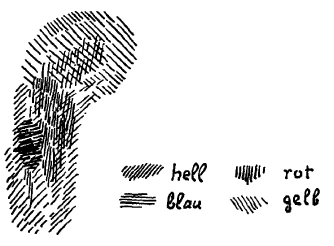
[ 3 ] Now, even though at first glance it might seem as if what comes from the environment when we see affects the human physical organism, this is not the case. It is true that when we face the external world with our eyes, we have the physical eye (see illustration, light-colored). Certainly, we have the physical eye, but everything that takes place within the physical eye is only something mediated. What happens initially is actually a play of processes within the “I” and within the astral organism. I want to illustrate this by interweaving the eye with this (yellow) as the “I”—it naturally extends further into the organism—and with this (red) as the astral organism. We must be very clear that what comes into play first when we see are processes within the “I” and the astral organism. You can actually recognize this immediately if you look at your vision not superficially, but with a bit more depth. You need only reflect on this when, for example, you see the color red somewhere: can you, at the very moment you see the red, distinguish yourself—in terms of your “I”—from that red? You cannot; you cannot distinguish yourself from that red—you are that red. This red is something that completely fills your consciousness. You are nothing other than this red. You can see this particularly clearly by, let’s say, imagining that this red is the only thing you can see. You see a large red surface. When you look at this large red surface, you must first reflect on the fact that you are an “I.” You must first separate the “I.” But while you are looking at the large red expanse, during that time, the red and the “I” have merged. And it is the same with the human astral organism.
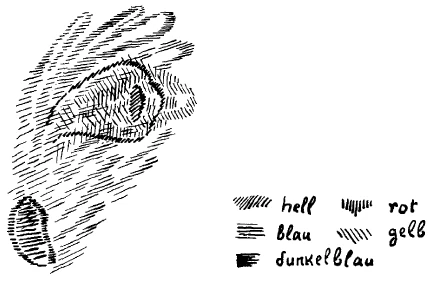
[ 4 ] So the first thing we must consider when we look is the processes taking place in the “I” and in the astral organism. With regard to the eye—just consider for a moment how complex the role of the eye is—it is important to note that human beings have a kidney system; I’ll sketch it here schematically (dark blue). This renal system belongs, first and foremost, to the human physical organism and contains solid components. As you know, I’ve often told you: the human being does not contain an extraordinary amount of solid, mineral matter. Ninety percent of the human body is actually a column of water. But he does, after all, have solid components within him. These solid components are, in fact, constantly suspended in the liquid, in the aqueous medium. Thus, we must regard this renal system as the point of origin of the aqueous substance, which is not only present in the secretions of the renal system but also flows through the entire organism, ascending, among other places, into the eye.
[ 5 ] But this watery substance, which, so to speak, radiates from the renal system into the entire organism and even into the eye, is by no means a lifeless watery substance; rather, it is a living watery substance. You would get a completely wrong idea of what the fluid, the watery substance, is in the human being if you were to imagine, within the living human organism (see drawing, blue), that you are dealing with water there, just as it flows in a stream. That is not the case. In a stream we have dead water; in the human organism we have living fluid. It is not only the plasma fluid that is alive; all fluids in the human organism are alive. And finely dissolved throughout this fluid are the solid components I mentioned earlier, which are, so to speak, carried along on the waves of the fluid, even into the eyes. Again, riding the waves of the inner fluid, the human etheric organism radiates into the eyes. Two elements now meet within the eye. The human etheric organism (blue) fills the eye and, from there, the optic nerve; and what now flows into this fluid filled by the etheric organism is the astral image that arises in the human astral body (red). And this here (yellow) is what arises through the “I.” It flows in there; it also flows onward from there.
[ 6 ] As a result, however, the human eye and the human optic nerve simultaneously receive, on the one hand, the external impression—which was originally present in the “I” and the astral body—and, on the other hand, from within, the physical body and the etheric body; the physical body is supported by the mineral components of human nature, and the etheric body is supported by the liquid components of human nature.
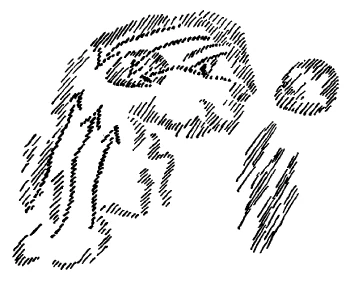
[ 7 ] The fact is that this does not stop at the eye; rather, what the eye conveys radiates into the rest of the organism. In seeing, we are essentially dealing with an encounter between what takes place in an extraordinarily complex way within the “I” and the astral body, and what, so to speak, strikes back from within the organism as the physical and etheric bodies—the physical body in its mineral constituents, and the etheric body on the waves of the living fluid. Now, what I have shown you here regarding vision actually takes place continuously within the human organism. Continuously, within the human organism, the etheric body—I would say, driven by the physical body upon the waves of the living fluid—encounters the astral body with all that constitutes external impressions, driven by the “I.” And our entire human constitution, our entire inner state, actually depends on the way these two currents meet within us, for they must meet in the right way. What does that mean: to meet in the right way? Well, here again we are dealing with something extraordinarily complicated. In the organization of the human head, the situation is initially as follows (see drawing on p. 56): the head is actually a plastic image of the forces that the human being possessed in pre-earthly existence as a soul-spiritual being. The head is plastically formed; it develops very early in embryonic life and essentially retains only the power to shape. If the human head did not possess this power to shape, it would essentially be a lifeless body. This human head is a marvelous structure. It is a faithful imprint of the physical, the etheric, and even the astral body—and even of the “I”—depicting how these enter earthly existence from the super-earthly worlds. The head truly takes shape as a reflection of those cosmic experiences that the human being has undergone in pre-earthly existence, and it retains only the plastic-forming forces. When we observe a child, all plastic-forming power actually emanates from its head. From the head, a force radiates into the rest of the organism, through which the human being, during his or her growth, maintains the plastic shaping of his or her organs in the appropriate manner.
[ 8 ] So, what emanates from the head is, in essence, purely a formative, plastic force. And when something like that enters the head—such as what enters during the act of seeing—it is actually received in such a way that a force is formed which seeks to shape. What enters through the eyes seeks to take shape within the human being. Above all, it seeks to shape the nerves—the nervous system—in such a way that, so to speak, there is a kind of image within the human being of what was there as an external impression. One can therefore say: in this direction (see drawing, arrows from top to bottom), from the senses inward, a formative force flows. This force seeks, in a sense, to transform the human being into a statue in a subtle way. It is truly the case that everything we see actually seeks to transform us into a statue in a certain subtle way. However, this force is counteracted—for example, here from the renal system in all that I have described—by another force (arrows from bottom to top). This force continually dissolves what is seeking to take shape. Imagine what this is like. If I were to illustrate this for you, I would have to say: Starting from the eye, a very subtle image, a form, seeks to take shape here. This process aims to extend all the way to the formation of a physical shape. There is always a kind of influence at work whereby salt substances—which are otherwise dissolved—clump together, as it were, seeking to become solid salt. So there is a constant tendency toward formation. Now, from down below there is always a tendency to dissolve it again. So that in the human organism we constantly have a tendency from the outside toward the inside to form what is to become a statue; and from the inside, it is constantly being dissolved again.
[ 9 ] This process, which takes place through the encounter of the astral with the etheric—which flows toward the astral on the waves of the liquid—is of immense importance for human life; in fact, it essentially constitutes the whole of human life. For suppose, for example, that someone tells you something this evening. That, too, is an impression. It arises in a different way than when you see a red surface, but it is still an impression. What is communicated to you in this way, in turn, seeks to take shape within you. If it can take shape, it remains in your memory. And if you happen to have a mind that is very keen on immediately committing every impression to memory, then you have a wonderful memory. You can, like a machine, always rattle off everything that anyone tells you. But that’s not the case for most people, because most people have a very strong tendency to dissolve things again; whatever comes toward the plastic formative forces as a fluid radiation through the etheric body is constantly being dissolved. It’s actually a warm current that is constantly dissolving. When you consider this, something extraordinarily interesting emerges.
[ 10 ] For example, if one truly wants—as a human being, not as a human automaton—to retain the things one remembers, it should not be the case that when someone tells you something, you immediately form such a solid inner structure of memory that you can constantly rattle off the information. There are people like that, but then you become dependent; it is no longer you yourself who remembers things, but rather the things take hold of you—you become an automaton. If you want to be an independent person, then the following process must take place.
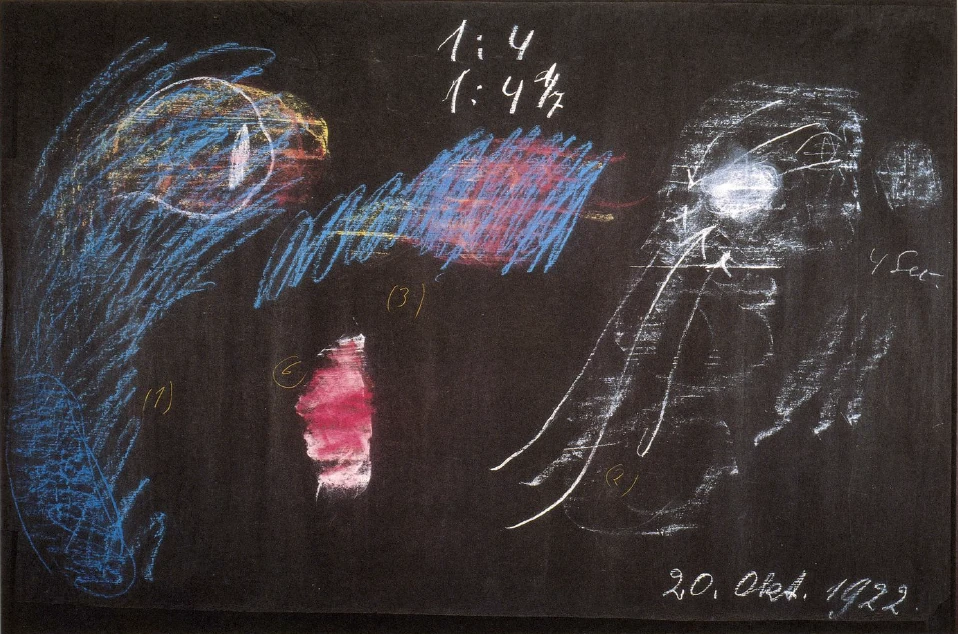
[ 11 ] To begin with, what someone tells you and what you read exists in the “I” and in the astral body, and now seeks to penetrate, first through the brain and then through the head, into the fluid, and then to consolidate itself, giving rise to a kind of mineral formation, a salt-like formation. But it is good if the inner current comes and initially wipes this out, so that at most the impression penetrates into the fluid—where it blurs, however—and no solid formation arises at first. Because no solid formation arises at first, the matter remains solely in the astral body. Now one sleeps the following night. Then one goes out with the astral body and the “I.” There it strengthens somewhat during the state of sleep (see drawing, right). Then it returns upon waking (left), and may be erased again; and this usually happens three to four times. Only after the fourth sleep is the erasing force no longer strong enough, and then it becomes so firmly established that this three-dimensional form, which is no longer dissolved within, becomes the foundation for mental images and memories.
[ 12 ] You will say: But I also remember the things I heard yesterday—even though I haven’t slept on them a few times. — Quite right; but that is not what matters at first. The fact that you remember the things you heard yesterday stems from the fact that the matter is still in the astral body, and may still be making an impression on the etheric body. But one does not forget immediately after one day, nor after the second, nor after the third day. If the matter is truly forgotten, then even after the fourth day the inner dissolving force is still so strong that the whole matter is dissolved; then it is dissolved. For if, given the strength that is present due to its coming in a fourth time, it can still be dissolved there, then we inevitably forget the matter.
[ 13 ] That is a very interesting fact. And this fact—which can be observed through the power of imagination, simply by looking at how things are retained—leads us to something else; it leads us to recognize that the head, the human head, is in general a much slower entity than the rest of the human being. When we have spoken of a threefold division of the human being and have placed the rhythmic organism in the center—with the nervous-sensory organism, that is, the head organism, on one side, and the limb-metabolic organism on the other—we can say: the head organism, in its entire development, in its entire being and becoming, actually sets a much slower “pace” than the metabolic-limb organism. And it is the case that while this inner gathering (on the left), this shaping—it is not actually like that, but I will say it by way of example—took, say, one second for some impression, there had already been four waves of extinction emanating from the kidney system. So there had already been four waves of extinction. (See drawing on page 56.)
[ 14 ] This is evident from the fact that our pulse beats four times for every single breath we take. The respiratory system is the one that acts from the rhythmic system upward toward the head and imparts to it a tempo four times slower. The pulse—that is, blood circulation—is what acts from the rhythmic system down toward the metabolic-limb system, imparting to it a pace four times faster. And in what is expressed there by the four times faster pace of blood circulation lies everything that dissolves. In the way it is expressed through the four times slower pace of the head lies everything that solidifies—everything that actually seeks to turn the human being into a statue.
[ 15 ] It is quite interesting that this interaction I have described to you—that is, let’s say, the upward surges of the kidney system and the downward surges caused by external influences—is actually in sync with the rhythm of breathing and blood circulation; in fact, as the impact occurs, a dissolution attack is launched four times for every one. And this is also why we need to sleep on it four times, so that the external impact can become sufficiently established.
[ 16 ] Things come together in a wonderful way when one can truly understand the inner structure of the human organism. But this is also connected to something else.
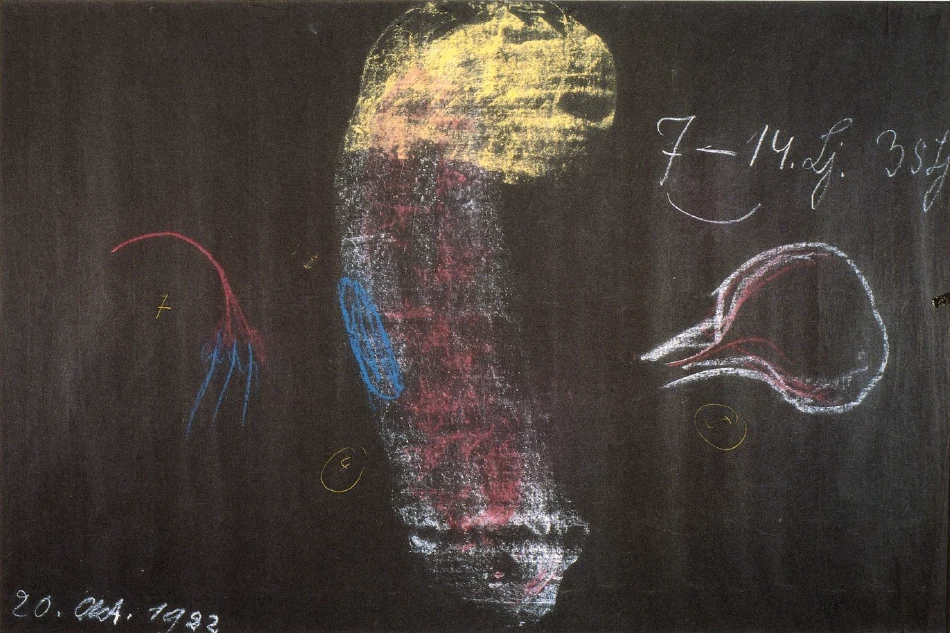
[ 17 ] So you see, as we move upward in the human body, toward the head, we encounter a pace of life that is four times slower than the one we find when we move toward the digestive organs, for example, or, let’s say, the renal system. The renal system works very rapidly and carries what it processes internally all the way up to the etheric, which floats on the waves of the living water. When a person closes their eyes and consciously quiets their brain, and then perceives what flows out from the kidneys, it is the imaginations that float on the living water; thus their own inner being is revealed to them in the form of imaginations. It is an extraordinarily interesting structure. When the renal system is here (see drawing), the so-called living water flows out from the renal system into the entire organism. What is secreted there is, after all, merely the excess that is expelled outward through the relatively firm action of the kidneys; but at the same time, this “living water”—interwoven with the etheric organism—also flows throughout the entire organism. Yet this etheric organism is filled entirely with imaginations (red); it is completely permeated by imaginations. These imaginations can be perceived as the image of one’s own organism when one quiets the brain consciousness and all sensory perceptions. In that state, the system is healthy. But when the kidney is diseased and, precisely because of the diseased kidney, there is an excessive outflow into the water of life, all sorts of formations arise within, and then the familiar subjective symptoms characteristic of kidney disease manifest. So what is at work there—which is essentially a continuous pulsation driven by internal body heat, but a pulsation in inner images—encounters what comes from the outside, which seeks to take on a three-dimensional form; this inner process works four times faster than what works from the outside inward. And this is evident once again in the fact that we have certain periods in the course of our lives, insofar as these periods are viewed as originating from the etheric organism—that is, precisely from what I have just sketched here. We must, of course, speak of seven-year cycles, which we do: the change of teeth, sexual maturity, and so on. We can say, for example: The physical organism reaches the end of its period at the end of the seventh year, just as it is in the process of getting its second set of teeth. From that point on, the etheric organism begins to be particularly active in its own right, right up to sexual maturity. But what takes place in these periodic, rhythmic processes every seven years is counteracted by the head, which continually seeks to slow down these processes, for the head proceeds at a much slower pace. At the end of the twenty-eighth year, the head is only where the “main” part of the human being is at the end of the seventh year. This is a very important secret of human individual development.
[ 18 ] Outwardly, this is expressed only in the fact that it is not until we are well into our late twenties that we can truly say we have fully matured, both internally and externally, in every respect. Everything that originates from the head is only truly completed during this period. The head is, in fact, only seven years old at the age of twenty-eight. This is therefore something present in the whole human being. Just as we have breathing and blood circulation, and just as breathing relates to blood circulation, so too do the processes of the head relate, in life and in the entire process of becoming, to the processes that originate in the digestive system—and indeed in the human metabolic-limb system as a whole. This relationship is roughly one to four. This has great significance for life. It means, for example, that everything we teach a child through upbringing or education between the ages of seven and fourteen actually plays out slowly within the head, and has only fully played out within the head—so that it has been fully realized there—by the age of thirty-five; it is not until the age of thirty-five that it has fully vibrated out in the head. There are four periods of seven years to consider. The first seven years are from the seventh to the fourteenth year of life, the second seven years from the fourteenth to the twenty-first, the third from the twenty-first to the twenty-eighth, and the fourth from the twenty-eighth to the thirty-fifth. It is only then that the mind has truly caught up.
[ 19 ] This sheds an extraordinarily significant light on proper methods of education and instruction, for it shows you that instruction and education must be structured in such a way that they are sufficient. If you simply observe what interests the child from the ages of seven to fourteen—what occupies the child’s attention and what is appropriate to the child’s capacity for understanding—you can teach the child exactly what the child is ready to grasp at that very moment. But the processes of the human being’s limb-metabolic body—which are, after all, the physical vehicle for what is being absorbed—cease after seven years. Now something must remain; even if the material has departed, it must be able to be assimilated by the head and must also last until the age of twenty-one; then the material is gone again; it must last until the age of twenty-eight, at which point the substance is gone again; and it must now last until the age of thirty-five. By then, it is finally entirely within the etheric body, and it is not so easy to extract from there, because it is not always excreted in the same way.
[ 20 ] But you see how things interact in human life; how we must in fact realize that if we were merely a head at the age of twenty-eight, we would actually be only seven years old. If we were merely a head at the age of thirty-five, we would actually be only fourteen years old. Our peaceful development is constantly challenged by the metabolic-limb system in relation to what the head—what the human head actually wants. Therefore, if one wishes to understand the human being, one must not regard the substance of the head as equivalent to the substance of the rest of the organism; rather, one must see the interplay between the metabolic-limb organism and the head organism as a rhythm—and this extends down to the individual organ.
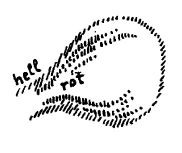
[ 21 ] Consider the eye. In the eye, the optic nerve extends on one side, while blood vessels extend on the other (see diagram, red). Because the blood vessels extend, you have the metabolic system within the eye. Because the optic nerve extends, you have the sensory-nervous system within the eye. Now look into the eye. There is, in fact, a one-to-four ratio within the eye between the processes in the optic nerve and the retina, and the pulse rate. Within the eye, two rhythms are constantly vibrating in unison, their ratios behaving as one to four. And the internal processes of the eye are based on this interplay of two different rhythms. What takes place in the choroid of the eye seeks to dissolve, right within the eye, that which seeks to consolidate itself in the optic nerve. The optic nerve constantly seeks to create contoured structures within the eye. The choroid, with the blood flowing through it, constantly seeks to dissolve these structures.
[ 22 ] It’s not as crude as one might usually imagine; rather, the arteries of the eye actually follow their own course, and the veins then branch off from them (see diagram, red), so that one does not simply connect to the other. In the eye in particular, the artery actually flows in such a way that the blood, so to speak, flows out and is only then reabsorbed by the vein; thus a gentle flow and reabsorption takes place within the eye. It is a completely false and crude view to believe that arterial blood immediately passes into venous blood there. That is not the case. What occurs there is a subtle outflow followed by reabsorption. And within this outflow, the rhythm of circulation vibrates, and in the nerve adjacent to it, the rhythm of respiration vibrates—and these two rhythms intertwine within the eye. Thus, seeing actually consists of these two rhythms colliding within the eye. Imagine if these two rhythms were the same: then we would not see.
[ 23 ] Suppose you’re walking alongside a car. If you’re walking just as fast as the car, you won’t feel anything from it. But if you walk four times slower and still keep up with the car, you’ll feel a pulling sensation. The car will keep moving forward, and you’ll have to hold back if you want to slow it down. And that’s how it is inside the eye: the function of the optic nerve is to hold back this rhythm, which is four times faster. And in this holding back, what then becomes perception—which manifests as visual perception—is formed, just as you feel the car when you walk four times slower; when you walk at the same speed as it, you don’t feel it.
[ 24 ] And yourself—how do you experience yourself as “I”? You experience yourself through the fact that your head functions four times slower than the rest of your body. This is the inner sense of self, the inner perception of self—this lagging behind the pace of the metabolic activity in your limbs, as carried out by the functions of the head.
[ 25 ] And countless human symptoms are based precisely on the following: For every organism, there is a certain degree of balance between these four and one. One can always say that, depending on how a person is constituted, a certain degree of balance exists. After all, it is never exactly one to four, but rather all sorts of ratios; this is what makes people unique. But for every human individual, a specific ratio exists. If this is disrupted—for example, if a person’s normal ratio for a certain age is one to four, and circumstances arise that cause the ratio to shift from one to four to one to four and seven-eighths—then the dissolving force is working too strongly, and the person cannot become a sufficient “statue.” And you need only recall certain forms of illness in which a person dissolves too strongly within themselves; there you have the archetype of such illnesses.
[ 26 ] But the opposite can just as easily happen too quickly. This gives rise to phenomena that manifest as convulsions. When the astral body vibrates through the etheric and physical organisms too quickly—when the astral body flashes through them too rapidly and does not grasp them slowly enough—convulsive phenomena arise.
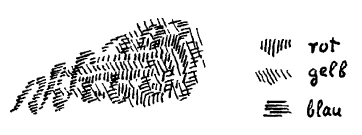
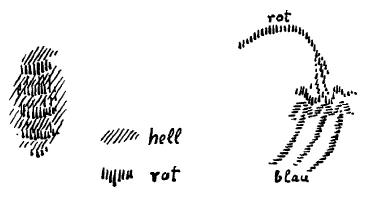
[ 27 ] Take, for example, the common childhood convulsions. These common childhood convulsions are due to nothing other than the fact that, in the child, the astral organism and the “I” must first properly integrate into the physical organism and the etheric organism. The proper relationship must first be established. Now imagine that the astral organism and the “I”—which initially vibrate into the human being’s limb metabolism—are vibrating too quickly. The other human being cannot grasp this immediately. When the vibration is correct, it is such that if, for example, you have here a portion of the physical and etheric human being that is to be permeated by the astral human being and the “I,” this permeation occurs slowly. I would like to say: Every current of the astral always properly seizes a tiny drop of the water of life that is permeated by the etheric. They adapt to one another when the right tempo is present. But if it vibrates in too quickly (see diagram, red, light), then the astral penetrates the etheric and thus also the water of life, and convulsive states arise, which can occur particularly as childhood convulsions, because the correct rhythm in this inflow must first establish itself (see diagram, red, blue).
[ 28 ] This has very far-reaching implications; for example, it means that a very serious form of illness, which is causing a great deal of concern today, will at least find its explanation in this: namely, that the proper interplay is disrupted in a particular way; one such disease is, for example, the extremely vicious polio, which can be explained in this way, though this does not immediately provide a cure, because the lack of coordination is caused by conditions that lie further back in time.
[ 29 ] In general, it is only possible to gain insight into the human organism if one can truly take such circumstances into account—if one knows that it is not merely in an abstract sense that a person sleeps with their ego and astral body separate from the physical and etheric bodies, but also when one knows that what exists at night apart from the physical and etheric bodies contains the impulses for a much slower life activity than what remains behind during the night. While asleep, the human being is almost entirely a “limb-metabolic being,” right up to the brain, for everything there takes place under the influence of the limb-metabolic being.
[ 30 ] Now, inwardly, the human being is very strongly exposed to the Ahrimanic forces in relation to everything that is subject to the slow rhythm, and very strongly to the Luciferic forces in relation to everything that corresponds to the fast rhythm. And so you could also say, if you were to look at the Wood Group: In it, everything Ahrimanic is set to the slow rhythm, which consequently hardens the forms and makes them pointed and stiff. In everything Luciferic, the focus is on the fast rhythm, which rounds everything out because it proceeds more rapidly; it therefore rounds everything out, does not stiffen it, but makes it undulating. You can see from the sculptural forms that we are dealing with a ratio of three or four to one.
[ 31 ] These things are just as important for understanding the healthy human organism as they are for understanding the diseased human organism. And we shall see how science will need this complement, which can come only from what is here called anthroposophical spiritual science. I will continue these reflections so that I may then bring them together in such a way that, on the one hand, history emerges from the human being, and on the other hand, the human being emerges from history.