

Spiritual Connections
in the Makeup of the Human Organism
GA 218
22 October 1922, Dornach
Translated by Steiner Online Library
4. Spiritual Connections in the Structure of the Human Organism II
[ 1 ] Today I would like to show how our understanding of the human being can serve as a foundation for grasping broader historical contexts, so that perhaps tomorrow we can move on to understanding something along these lines, drawing specifically from the present. I already spoke the day before yesterday about the human being himself in his constitution. Today I would like to approach this from a different perspective.
[ 2 ] Let us simply consider human beings as they are in their day-to-day lives, starting today with their most ordinary aspects. In order to sustain themselves, human beings must nourish themselves. They must take into their own organism what we usually call natural substances—from the animal, plant, and, to some extent, mineral kingdoms. But what human beings take in from their external environment undergoes a tremendous transformation within the human organism. First of all, when we consume food in the usual way, we take it into our organism—at most prepared through cooking—in the same state as it initially exists in the surrounding natural world, perhaps just slightly processed. Furthermore, through our breathing, we take in air in the same state as it exists in our environment. Let us now set aside for the moment other factors that are, in fact, even more important—such as light, which we also take in from our surroundings just as it is in its original form as light; but even food and air must undergo a tremendous transformation within our organism so that they can fill it, so that they can, so to speak, become human within our organism.
[ 3 ] Described in general terms, the process is quite well known today. We ingest food—which, as mentioned, may already be somewhat prepared—when we first come into contact with it. We first process it—namely through secretions from the glands and the rest of the digestive system—we take it in, wash it over, and saturate it with a substance called ptyalin, which is secreted by the salivary glands. We then move the food further into our digestive system. I do not need to describe the path it takes here. But I must describe the entire process to you. By taking food into our bodies and processing it there, it is already somewhat altered compared to what it is out in the environment. What the food becomes inside us could never be achieved through external processes. In a chemistry laboratory, we can process the substances that make up our food in a wide variety of ways. However, what happens to the food when we bring it into our stomach and from there into our digestive system cannot be replicated there. There, the food actually becomes something entirely different from what it initially appears to be on the outside.
[ 4 ] First, what happens to them is that, so to speak, every trace of external life is eradicated from them. People eat meat. This is taken from the external environment, the animal kingdom. But as people consume it, they first expel—through predigestion, so to speak—and then through further digestion, everything that these foods represent in the “animal bodies.” Furthermore, all the life that plant-based foods contain—by virtue of having belonged to a living being within the plant—must first be expelled. We absorb only the truly mineral components as external material substances. When we add salt to our food—which is already of a mineral nature externally—or when we add sugar, which, even though it may originate from the organic kingdom, has nevertheless been processed to such an extent through external preparation that it has already been rendered dead, we have ingested something that is already dead. This undergoes the very least transformation within us; it really undergoes only a transformation that could just as well be carried out externally in a laboratory setting. But everything that enters our organism from the animal and plant kingdoms must first be thoroughly—if I may put it that way—killed.
[ 5 ] In our cooking, too, we engage in a kind of “pre-killing,” so to speak, by subjecting the food to heat and so on. This is thoroughly carried out by our digestive system, so that when our food has undergone a certain internal transformation on its way to the intestines—when it has reached these lower digestive organs— essentially everything that constitutes their external nature has been expelled from them—for example, animal foods are subjected to the astral body and the etheric body of the animal, while plant foods are subjected to the etheric body of the plant, and so on. So, on the journey from the mouth to the intestines, it must first be ensured that all food is dead.
[ 6 ] For when the food reaches those glandular organs—which then transport the food from the intestines into the lymphatic vessels and blood vessels—the food must be revitalized along this path. The food must first become “dead” within us and then be revitalized again. We could not tolerate within our human organism a continuation of the life that exists in the animal from which we derive our food, or that exists in the plant. At most, we can absorb inorganic matter in such a way that it presents us with our own laws. We could not, for example, eat cabbage; we could not allow it to reach our intestinal villi during digestion in such a way that the same ethereal forces would still be present there that the cabbage possesses by virtue of belonging to a plant. The etheric and astral aspects of the food must first be removed. And then what we take in must be able to be absorbed and revitalized by our own etheric body. The life of the food within us must come from us. And this occurs as it travels from the intestinal system through the vessels toward the heart. So we can say: as the food enters the blood and the blood flows through the heart, our etheric body absorbs what has been transferred into us from the food that was initially killed. So you can imagine: When the food passes from the mouth into the intestines, the last traces of the external world are gradually lost, but here (see drawing, red) they are revitalized all the way to the heart. This revitalization means precisely that they are absorbed by our own etheric body. However, we would possess too little of the character of the earthly realm if only what I have described to you so far were to happen. For we would then have to be beings who, all the way up to the heart, have nothing but a mouth and digestive system—and then we would have to begin to be angels, because our etheric body would absorb the food and completely dissolve it. We could not be earthly beings. We would then have to be nothing more than flying mouths with attached throats, and still possess a stomach, intestines, and heart—and then, wouldn’t you agree, all of that would be absorbed by our etheric body. But otherwise, we would have to be nothing but an etheric body, and within that etheric body the food would simply evaporate. We could not be earthly human beings. The fact that we can be so is made possible by the absorption of oxygen from the air. Thus, the oxygen from the air is taken into that part of the etheric body which is permeated by foodstuffs, and through this we retain the possibility of being earthly, physical human beings here on Earth between birth and death (see illustration, light-colored). Thus, oxygen transforms that which would otherwise evaporate from our etheric body into something earthly and living. Oxygen is the substance that brings something—which would otherwise form only as an etheric entity—into the earthly realm. We have now reached the connection between the heart and the lungs. The heart alone would not yet make us earthly human beings; rather, it would only bring us to the point where we would connect our etheric body to the heart and, as such, fly about the earth as angels—who might therefore possess certain features that some might find unattractive, such as a mouth, throat, intestines, and vessels leading up to the heart. But because the heart is connected to the lungs and absorbs oxygen, the intake of food is not only etherized but also earthified.
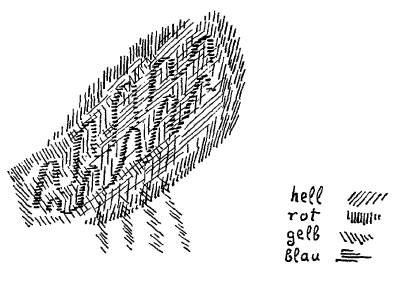
[ 7 ] Now comes the necessity that what has been taken up by our etheric body—which must be saturated with oxygen so that we can be earthly human beings—must be incorporated into the astral body. This has not yet been taken up by the astral body; it has only been taken up by the etheric body. The activity must now be developed whereby everything that has developed up to the level of heart and lung function is absorbed by the entire organism—but in such a way that the astral organism also plays a role in this process. This activity is mediated by the human renal system, which now secretes what is unusable from the substances that are absorbed, but channels the remainder throughout the entire organism via pathways that modern physiology does not actually describe, but which do exist.
[ 8 ] And there, if I may put it this way, the entire mass—which, however, remains alive even now—it has merely been completely killed off in the intestinal tract, only to be revived and saturated with oxygen— is transported into the astral body through the activity of the renal system, which extends throughout the entire organism and radiates everywhere, so that the astral body can now participate in the further shaping of what is brought about within us by the food we eat (see illustration, yellow).
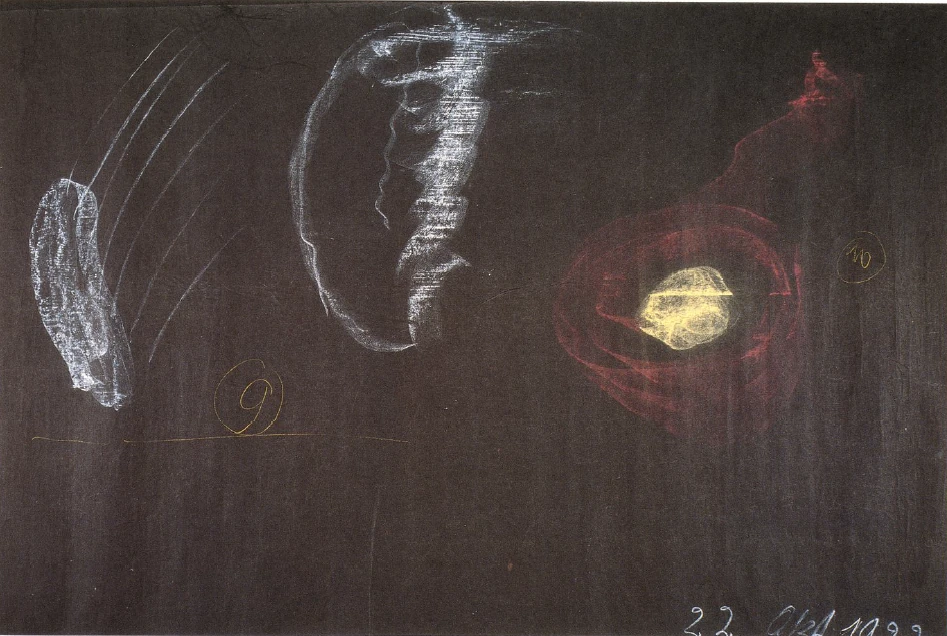
[ 9 ] This astral organism, insofar as it receives its impulses from the kidney system, is now in turn connected to the head-sense system, which, in a sense, lies over it like a blanket. And the kidney and head systems together now act continuously in such a way that what is actually fluid and diffuse due to the activity of the heart is now shaped into specific organs. If only the mouth, stomach, intestines, heart, and lungs were present, we would not have any solid organs at all; rather, the stomach itself would have to be a fluid, internally moving organ, as would the lungs and the heart. None of this could be solid. These organs are shaped by the kidneys, and the kidneys are aided by that which emanates from the head.
[ 10 ] In fact, the organs must be formed not only during childhood, but continuously; for our organs are constantly being destroyed. Over the course of seven to eight years, an organ such as the stomach, for example, is completely destroyed. Its substance is entirely depleted and is constantly renewed. Formative forces must therefore always be present to renew these organs. Much more work must be done on this during childhood. Later in life, however, these formative forces are still present.
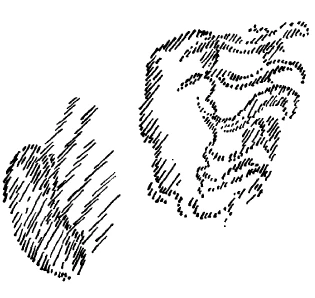
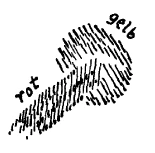
[ 11 ] This is how it works (see illustration on page 74): The kidney system, which radiates these forces on one side, would only form the organs on that one side. For example, it would shape a lung—viewed from the side—so that it would be neatly defined toward the back, but toward the front it would become blurred; it would seem to float out of place. Now the force from the head must meet it, so that the front surface is formed from the head, ensuring that the individual forms of the human being are always shaped in such a way that, so to speak, the kidney radiates the forces, and forces then come from the head that contain them, so that the organs acquire contours and are rounded. The surfaces are formed externally from the head. The kidneys, however, provide a kind of radiation into the organism. It is roughly like, let’s say, when I want to sculpt something. I take mortar or some other soft substance in one hand, and then I teach myself to throw the mortar upward with one hand (see drawing, yellow, red) and smooth it out with the other hand. Let the act of throwing upward represent the kidneys; I could do this by using a tub of some kind from which I take the substance (see drawing); I fling it upward, smooth it out at the top, and in this way obtain these organs, which are actually radiating and shaped. This is how the organs are formed in connection with the kidney system and the head system, and within them the forces of the astral body are at work. This is therefore a process that takes place amid an extraordinarily intense transformation of nitrogen. The nitrogen there is no longer what it is externally, for the nitrogen—which still retains a resemblance to external nitrogen—is then excreted via uric acid and urea. But what radiates from the kidney and is processed there is actually nitrogen that has been internally transformed to the point of becoming part of the active forces of the astral body. This is something entirely different from external nitrogen.
[ 12 ] There you have what the human being receives as food, processed to the point where it is absorbed into the astral realm, into the astral body of the human organism. These processes, as I have just described them to you—albeit in a somewhat modified form—also take place in animals. Animals also undergo these processes, which go even further in the case of higher animals. In lower animals, however, there are at most only hints of what is about to be described. Higher animals possess these processes because they branched off from the human race; they still possess them, but in their case they are deformed and degenerated.
[ 13 ] Well, something else now shines into all that is being formed there. So, first we have this process of the food moving along until it is broken down. We reach a point where the pancreas is one of the final glands to bring the process to the stage where, as these substances flow toward the lymph, they are vitalized and can be absorbed into the etheric body; then, through the connection from the heart to the kidneys, the whole process is propelled into the astral body. But now the ego must also become involved. Everything that is in our organism must be taken up by the ego.
[ 14 ] Now I have shown you how that which unites with us is utilized by the etheric and astral organisms, how it is absorbed by the renal system and radiated into the astral realm, and how it is transformed there into the earthly realm with the help of nitrogen. Otherwise, we would have to become angels again if nitrogen were not at work within us, which, through the kidney system, maintains our astral body within the physical realm. But the whole process would not shape us in such a way that the “I” also participates in the whole if the liver system were not there (see diagram on page 71, blue). The liver system drives the whole process into the “I.” You see, it is the continuation of the heart’s action, for the heart’s action extends even into the intestines.
[ 15 ] Absorption through the lymphatic vessels is another process associated with the heart. The heart is generally the organ that, together with the lungs, drives external substances into our own etheric body. From there, it is the renal system that drives it into our astral body. And the hepatic system, with its secretion of bile, drives the whole process into our actual “I.” The biliary and hepatic systems are found only in the higher animal kingdom; in lower animals, not even bile acid is found in the bodily substances. The liver system, then, with its unique structure of the portal vein and so on—which can be demonstrated anatomically in every specimen—now directs the whole process in such a way that it is taken up by the “I.” If all that is radiated through the kidneys into the body were the only substance present, it would be absorbed solely by the astral body. Because the liver is present, because bile is secreted by the liver and is already mixed with the chyme in the intestine, and because the whole process is thus already permeated by liver products (see diagram on page 71, blue), it is then driven into the ego-organism. Thus, through the liver—which essentially has hydrogen as its physical representative—our ego-organism also participates in the entire structure of the human organism. Human beings actually have nothing living, nothing astral, to take in from the outside; whatever they take in from the outside must first be transformed within their own organ system so that it can be absorbed into their own astral, etheric, and ego systems.
[ 16 ] There we have the entire—I would say—normal organization of the human being. Think about how all of this must work in harmony. For example, kidney function must not be disrupted; if kidney function is disrupted by a congested or atrophic kidney, then the astral body is not being utilized. In reality, it is actually the other way around: if the astral body is not in order, then a congested or atrophic kidney develops. Thus, in the condition of the kidney—that is, when there is a congested or atrophic kidney—we have a clear reflection of what is actually taking place in the human astral body, just as we have a precise reflection of what is taking place in the human etheric body when the heart is degenerate. I told you last time that there is even a correspondence in the rhythm. In what radiates upward from the kidney (see drawing on page 71, yellow), there are always four pulses, whereas in what flows downward from above, from the head, there is only one pulse. The same ratio applies here as is expressed in the relationship between the breath and the pulse. So, if I may use this comparison once more, I would have to make a circular motion with my hand four times more slowly here. That is precisely how the organism functions (see illustration on page 74, bottom).
[ 17 ] Everything must be in perfect harmony; otherwise, it won’t work. Being sick means that this harmony is simply not there. So let’s take an example: the etheric body is perfectly fine; but the astral body isn’t powerful enough to absorb everything that flows from the heart to the kidneys and process it properly. This can happen when the etheric body is working too hard. I said it was in order, but let’s now assume it is working too hard. If the etheric body is working too hard and the astral body is normal, then kidney stagnation can arise with its characteristic consequences. If the etheric body is functioning correctly and the astral body is working too hard, the kidneys are not being utilized sufficiently. Because the astral body is working too hard, whatever radiates over is absorbed by it without the kidney cooperating properly in the correct regulatory process. As a result, the kidney is bypassed, and a shrunken kidney develops, which, at the same time—because it has a retroactive effect—leads to a degeneration of heart function and of the heart itself.
[ 18 ] You can see that in this way it is possible to gain an overall view of what is taking place within the human organism, and that the degeneration of the organs reveals how the members of the human being—the physical body, the etheric body, the astral body, and the I—are not interacting in the proper way.
[ 19 ] One must simply be aware that all these things must be coordinated and must interact in the proper way. Take, for example, the case where a particular organ system is not properly permeated by some part of the human organism—the astral body, for instance—in the wrong way; this can happen in two ways. Either what emanates from the renal system—that is, the head provides the rounding-off, while the renal system provides the outflow—is stimulated too strongly, so that everything working from the heart toward the renal system actually constitutes excessive stimulation for the renal system. It is in this excessive stimulation that you must actually seek the ultimate root causes of all inflammations—of everything that constitutes inflammation and ulceration in the human organism. One need only then seek to understand how such an inflammation arises somewhere in the organism, and one must then attempt, through the remedy, to balance the situation in such a way as to limit this excessive effect on kidney function.
[ 20 ] The simplest way to achieve this is to try to curb the excessive development of radiant internal body heat—which always accompanies such conditions—by inducing internal cooling, for example, through the intake of precisely those substances that develop in the floral organs of plants. This is the distinctive feature of the substances that develop specifically in the floral organs of plants: they can be used to counteract inflammation by inducing internal cooling. Or it may also be the case that the plastic mental activity, which counteracts kidney activity, is too strong. This leads to the formation of swellings. In these cases, the plastic, the rounding-off activity—I would say, the crystallizing activity—is simply too great. In such cases, one must—by applying heat from the outside (though it must be applied in the correct manner)—in a sense envelop the tumor externally with heat, so that it is gradually healed from the outside (see diagram, yellow, red). All tumors are actually healed from the outside; one simply has to create the possibility within the organism—let’s say, through the injection of substances that spread in a certain way—to use a specific substance to, in some way, cause the tumor to be enveloped by a radiating force (red). So that gradually, once you’ve managed to have the tumor irradiated from the outside and surrounded by radiation, it is brought to dissolution; then it crumbles and ceases to exist. If you have an inflammation, on the other hand, you must introduce the remedy into the organ where the inflammation is located via the digestive system, delivering a cooling agent from the digestive system. Inflammation must be treated from the inside (see illustration on the right).
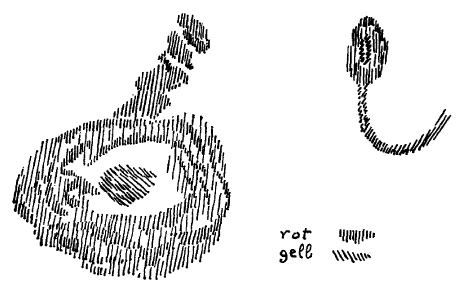
[ 21 ] One just has to find the right pathways. Every substance has a specific distribution within the human organism. For example, there are substances that, when administered orally, do not affect the esophagus; they are completely indifferent to it—all the pepsin, ptyalin, and so on—and are concerned, for example, only with the heart. For others, the heart is also irrelevant; they are first carried through the stomach and heart to the kidneys, where they become active. Thus, every substance has its own intrinsic affinity. One simply has to use the right substances. However, there are also substances that, if you administer them, would not affect gastric cancer at all. They have no affinity for it whatsoever, but they do, let’s say, affect breast cancer.
[ 22 ] One must therefore find a way to attack an ulcer or inflammation from within, or to approach it from the outside, so to speak, and lay siege to it. Tumors must be besieged from the outside. This is how the processes within the organism must be studied, and they must be in perfect harmony. To do this, of course, one must understand these higher aspects of human nature. It is impossible to speak of the kidney at all if one simply places a person on the dissection table and cuts them open after they have died. Then the kidney lies next to the liver, for all I care; but what do we know about the kidney and the liver other than that both consist of cells and are structured from cells in different ways? For the kidney has an intimate relationship with the astral body, and the liver with the “I.” That is what gives them their character. Without that, the whole thing is completely meaningless to define or consider.
[ 23 ] If you take an organ such as the spleen, for example, conventional physiology and medicine don’t have much to say about it. In all the relevant textbooks, you’ll find the same note everywhere: “We still know nothing about the spleen today.” — You’ll find this everywhere; just look it up. That’s not at all surprising. You see, the genius of language is actually wiser in this regard than what science has to offer in this field. In this case—and in others—it is precisely the genius of the German language that is extraordinarily wise—and indeed, it is the genius of the English language that refers to the spleen as “spleen.” And that is an exceptionally apt term, for the spleen is connected to all those human activities that go beyond the ego, that already approach the spiritual self, and the spleen is, in fact, the very organ of the spiritual self. This already delves quite deeply into the spiritual realm. The thing is, one has to be able to handle it. Most people cannot handle what is truly spiritual, and so the activity of the spleen does not stimulate them to engage in the spiritual realm; rather, they become “spleenish.” They are actually brought down. “Spleen” is, after all, nothing other than a spirit that, instead of going to the head, burrows into the intestines. “Spleen” is therefore an exceptionally apt term that points directly to the spiritual realm, for which the spleen is the corresponding organ.
[ 24 ] Therefore, the spleen also exerts a balancing effect, as described in the brochure prepared by our Physiological Institute in Stuttgart—specifically by Dr. Kolisko—which details the spleen’s activity in relation to platelet formation and the entire digestive process. This is truly the first time a scientific and systematic description of spleen function has been undertaken. If such work were carried out at any other research institute, it would very quickly be regarded as an extraordinarily groundbreaking achievement. But the fact is that when something emerges within our circle, within the bosom of our society, it does not make its way out into the world. We do not speak of it. It is not necessary to speak of it merely to boast, but because it could have a beneficial effect in the context of the overall course of events. But the first step toward not speaking of the matter is already being taken within our Anthroposophical Society. I would like to gauge how many of our members have had the opportunity for the full significance of the matter to truly sink in! It is therefore not surprising that, when the Anthroposophical Society begins to neglect what is happening among us, this naturally has an effect on the outside world as well. In fact, we do not merely work behind closed doors, but in the most important matters we also exclude the interest of the Anthroposophical Society! But that is something I—at least today—wish to mention only in passing. What is important, however, is that we can truly understand the human organism only if we understand its higher structure.
[ 25 ] You can see how precisely these things must be in harmony. Something in the organism immediately goes wrong if even the slightest irregularity affects the astral organism, because at that very moment the kidneys cease to function properly, and then all the consequences of impaired kidney function set in.
[ 26 ] But this is not true of human beings in general; rather, it changes from age to age. Human beings are an extraordinarily delicate organism, but this is not always the same. If we go back just a few centuries—after all, a few centuries are not much in the grand scheme of development—we arrive, for example, at the time when the present age, the actual epoch of the development of consciousness, began. We go back beyond the 15th, 14th, and 13th centuries in the Christian era. It was indeed the case that, particularly in the civilized world—as grotesque as this may seem to people today—from roughly the 4th century through the 14th century, kidney function was the most important; and since then, liver function has become the most important for human nature as a whole.
[ 27 ] I would like to say: human anatomy and physiology do indeed change over the course of centuries—and especially millennia—and one cannot study history without delving into the subtle structure of the human being and understanding how such transformations in the external manifestations of civilization, such as those from the Middle Ages to the modern era, are also linked to a transformation of the entire organization of humanity.
[ 28 ] One must return to such matters; otherwise, on the one hand, science will continue to stand still, becoming ever more irreligious and anti-religious because, in the end, it is merely groping around with its scalpel and probe and so on; and on the other hand, religious life, which no longer has anything to say about the world but is directed solely toward people’s selfish instincts regarding life after death. The two stand side by side. Our religiosity today has completely forgotten that God created the world. It still speaks of the divine, but it has forgotten that God created the world, and that one can find traces of divine creation everywhere in the things of the world. One must not merely speak of abstract, pie-in-the-sky-like transformations of civilization throughout history; rather, one must understand how, precisely through the delicate human organism—through this fine-tuning of the infinitely delicate clockwork of human organization—the divine creative forces transform human beings; how, for instance, by I might say, tightening the string of kidney activity a little more, then loosening it, and then tightening the string of liver activity—a completely different music of civilization emerges.
[ 29 ] Only if we do not limit ourselves to contemplating a God who is separate from the world, but instead trace God down into his specific actions, will we have what the humanity of the future needs; otherwise, it will ultimately embrace the abstract entirely and arrive at purely materialistic science. Only if we can penetrate to the concrete details of the material effects in divine creation will we be able to infuse religion with science and, in turn, lead science back to religion.
[ 30 ] And you see, around the turn of the 12th, 13th, 14th centuries in Europe, a worldview emerges that I have already characterized from various angles, and which finds expression in the Grail legend, in the Parzival legend, and in everything composed by poets such as Wolfram von Eschenbach, Hartmann von Aue, Gottfried von Straßburg, and so on. That is where these motifs emerge. In the Parzival epic—the authentic Parzival epic—one motif in particular emerges: the sudden desire to depict how human beings are to develop into what was called “saelde” at that time. This is the feeling of a certain inner sense of happiness, *saelde*, related to our concept of “bliss,” but not the same thing; *saelde* is being permeated by a certain inner sense of happiness. This emerges and actually dominates the entire civilization of the 13th and 14th centuries. All poetic motifs, as well as all prose motifs—but especially the Parzival motif—are permeated by this, and everything strives toward it. People strive for this “saelde,” for this inner sense of happiness, which, however, is not meant to be irreligious or merely a sense of inner contentment, but rather a state of being imbued with the divine creative forces.
[ 31 ] Why does this come up? It comes up because this transition is taking place from kidney activity to liver activity. You can understand this if you turn to physiology. The earlier physiologists were, in a certain sense, of course, better physiologists than the materialistic physiologists of today; for they were, in fact, the writers of the Old Testament, where it was said, for example—as I have already pointed out—that if one had bad dreams: “The Lord has punished me through my kidneys this night.” This knowledge of certain connections between abnormal kidney function and bad dreams persisted, and people in the 8th, 9th, 10th centuries, that one becomes heavy as a result of kidney activity. Kidney activity had gradually become a burden to people. Of course, outwardly one speaks only of something that had become a burden. One could not quite escape it. People clung to the earthly. And so they experienced this permeation with bile from the physical side—which was, however, connected to a permeation with salt—as a redemption, an inner redemption—an inner yet God-filled sense of bliss, a striving away from the dullness of the kidney. The kidney, after all, also develops a thinking activity; the kidney develops the dull thinking activity in human beings indirectly through the ganglionic system, which is then connected by induction to the spinal cord system and the brain system; it develops, in particular, the very kind of thinking that played a major role in the Middle Ages. At that time, it was called “dullness.” And this development from dullness to enlightenment—salvation—was, after all, something that became the Parzival motif. Parzival develops from dullness to salvation.
[ 32 ] One must not merely view this in an abstract way, but must also look at it with some feeling and sensitivity. At first, Parzival is just as he emerges from his culture, which has become burdensome. It’s hard to get him moving. Only later does the saelde enter him, after he has passed through doubt. Doubt is within him—the shaking of his heart and lungs. After he has passed through this, he finds his way into the saelde.
[ 33 ] And there is such a possibility: to trace, right down into the very fibers of the human organism, the moods that are at work in the grand history of the world. One could say: Among the influential figures—those who developed such a “Parzival” motif—it is the case that they were the pioneers, the first forerunners of this modern organization of humanity, which has transitioned from the old “kidney activity” to the newer “liver activity.”
[ 34 ] One must not look down on such things. One must not say: “This is base sensuality.” — God, too, did not look down on creating base matter; rather, He simply created it. Likewise, it is the task of knowledge to trace the divine creative activity all the way to the outermost reaches of the material world, and not merely to be a distinguished historian who describes Parzival and says: “When describing Parzival, one must not at the same time consider something as base as human physiological activity.”
[ 35 ] The world is one, and in order to understand the great historical contexts, one must at the same time be able to truly shed light from that vantage point onto the individual human contexts. Earlier times, including the Middle Ages, still possessed traces of such insights. You can trace this in descriptions, such as those in *Poor Henry*, where we see how moral healing still takes place, and so on.
[ 36 ] These points—which I would like to briefly mention today—serve to highlight that all human knowledge constitutes a great unity; that one can descend from what must be grasped through the highest religious ideas down to what people often consider so base that they refuse to consider it. The fault lies precisely in the form that contemporary science has taken, which is completely unaware that one must trace the spirit all the way into the outermost ramifications of matter; but only then does one gradually learn to understand the world. Only then does one also learn to rise to a truly religious conception of the world; whereas otherwise it is often merely a selfish one—a conception that speculates on human selfish motives but does not delve into the knowledge that would lead us not to a decline but to an upsurge in civilization.
[ 37 ] The rise of civilization is, after all, linked to people letting the light into themselves and viewing the world in the light rather than in darkness. Today’s physiology and anatomy, which merely lay people on the dissection table and merely observe the symptoms that can be observed in sick people—even through materialistic science—simply do not manage to truly understand the human being from within.
[ 38 ] One might say: once the nutrients have been absorbed, killed, enlivened, astralized, and transformed into the “I”—only then can one understand ptyalin and pepsin in the absorbed, killed food. Transferred to the lymph glands, carried to the heart, ignited by the heart, permeated by the kidneys, made astral, absorbed by the liver, and transformed into the “I.” Then the whole process can be taken up by the activity of the spleen, and then, under certain circumstances, the spleen’s activity may transform a person into an enthusiast—one who receives strength from the spiritual world—or, conversely, the spleen’s activity may turn them into a moody, listless person who just wants to sit in their chair, who would prefer not to let the spirit penetrate them, who does not want to think. There are many such people today. They drive one to despair because they sit in their chairs—really just a heavy mass, as if they had no head at all. The activity of the spleen, which could be something lofty in a human being, actually has a stifling effect on these people. Instead of enthusiasm, they have spleen, and this manifests itself in a wide variety of forms today.
[ 39 ] But what we need today is work that transforms as much whimsy as possible into enthusiasm, into passion, so that people may have not just a sleepy civilization, but an alert one. That is precisely what should emanate from anthroposophy: being awake, having enthusiasm, transforming knowledge into real activity, into action, so that through anthroposophy, a person does not merely know something but becomes something. Only then does anthroposophy have a goal and can it truly achieve such a goal. But to become drowsy through anthroposophy means, in fact, to accord far too much respect to the physical qualities of the spleen and to fail to bring the spleen’s higher spiritual qualities to fruition. This, however, points to something that present-day humanity needs very much indeed. It needs fire; it needs enthusiasm; it needs to be able to be inspired by something. As long as we are unable to do this, we will always think only of ourselves, and that means placing too much value on what is excreted from us as uric acid and urea—substances that are actually intended not to be incorporated into a closed system—cell, protein—but rather to be transformed into that fluctuating protein that constitutes our very being. We are, in essence, a living, yet vast, cellular entity in constant, lively motion; for we have carbon within us, we obtain oxygen as food is etherized, we obtain nitrogen when food is processed by kidney activity, we obtain hydrogen through liver function in conjunction with sensory activity, and in this way we also obtain sulfur—either the “inappropriate” kind, which is mostly discussed today, or the “proper” sulfur. But we do obtain what is necessary for us to be living beings consisting of protein, carbon, oxygen, nitrogen, and also sulfur—but as I said, it must be proper sulfur. Today there is still too much of the other kind, the kind the students were referring to when they spoke of that philosophy professor in Würzburg. He had become so boring that in the end he had only two students left; he could only hold his lectures to a group of three, but then you yourself become the third one. And finally, no one was left. And then he found the words “Sulfur Shack” written on his door. I don’t mean that kind; that’s far too widespread today. But what a human being must be is a being that is thoroughly alive, thoroughly imbued with soul, and thoroughly imbued with spirit. And that is something one can indeed learn, especially when one considers it down to the outermost ramifications of the material world. Only then will we have a true physiology; only then will we have something that can truly address human nature in a therapeutic way.