Spiritual Connections
in the Makeup of the Human Organism
GA 218
23 October 1922, Dornach
Translated by Steiner Online Library
5. Spiritual Connections in the Structure of the Human Organism III
[ 1 ] You will have already gathered from various earlier reflections that I do not like to use the phrase: “We are living in a transitional period”—for every period is a transitional period, namely from what came before to what comes after, and the question is always simply this: to what extent is any given period a transitional period, and what is changing?
[ 2 ] Well, in our time there is indeed a very important transition for those who can look into the spiritual world, and the wisdom of ancient times has always pointed to this important transition. In the epochs when people truly still spoke of a spiritual world—even if only based on ancient, dreamlike insights—it was always said that, after a certain period of time, the so-called “dark age” would come to an end and an “age of light” would begin. Now, if one examines the words of the ancient sages and takes them seriously, one does indeed come to the conclusion that they meant this transition from the dark age to the age of light would occur at the turn of the 19th to the 20th century—the very era in which we are now living. However, we need not go so far as to use anthroposophy to revive that ancient, dreamlike wisdom. I have often said that this is by no means the case, but rather that anthroposophy is what can currently be recognized through spiritual research. Anthroposophy is therefore not meant to be a revival of some ancient wisdom, but rather a contemporary insight. But on this matter—regarding the transition from the dark age to the age of light—contemporary insight must certainly agree with the ancient wisdom.
[ 3 ] As little as one can say—when considering current events from an external perspective—that we as humanity, specifically as the civilized people of Europe, are moving from worse to better conditions, so true is it, on the other hand, what ancient wisdom already meant by the transition into the age of light, and what we must mean again today. We simply need to understand things in the right way. I would first like to use an example to clarify the difference between an “age of light” understood in this sense and a “dark age.”
[ 4 ] The people who once, around the 5th millennium B.C., spoke of such a dark and a light age regarded this dark age as the consequence of an earlier light age and expressed the opinion that, after the dark age had lasted for a while, a light age would come again. It will therefore be instructive to look back and see how, in essential human matters, the age of light that once existed—which was present around the 7th or 8th millennium B.C.—differed from the later dark age from which we humans are now to emerge.
[ 5 ] As I said, I would like to illustrate this with an example—the example of healing. The example of healing is very applicable here, because it reveals so much. In that ancient, luminous age, healing was not achieved by focusing on the physical human body. People did not even think of it that way. In fact, in that ancient, luminous age, people did not speak of “illness” in the sense that we still speak of it today—though we will cease to do so in the future. Of course, in those ancient times people also observed that a person might experience a deterioration of their organs in one way or another—that they were, in one way or another, simply not healthy—but they did not speak of “illness”; rather, they said quite plainly: “There is a death, and it is taking hold of the person.” —And they saw a kind of struggle between life and death in the situation where we today say that a person is ill. So in those earlier times, people did not speak of illness and health, but rather, when a person had become ill in our sense, they said: “Death is fighting within them.” And restoring health was seen as a battle against death, as driving death out. So people actually spoke of life and death. And illness was merely a special case of death, I would say—a small dying; health was life.
[ 6 ] Why did people speak that way? They spoke that way because, back then, healing was done entirely through the human etheric body. Back then, so to speak, people did not concern themselves with the human physical body; rather, they healed entirely through the human etheric body.
[ 7 ] How was that done? Well, let’s say a person back then had been afflicted by something we today call pneumonia. The form of pneumonia was somewhat different back then, but we can still speak of this disease. People used to say back then: This person has become too dependent on the region of the earth where they live. — After all, this was in an era when population migrations and people leaving their homes were less common than they are today. People—at least the majority of them—usually stayed their entire lives in the place where they were. Nevertheless, in such a case people would say: “This person has become too dependent on the spot on Earth where they were born.” — In those earlier times, people knew quite clearly that a person had already had a pre-earthly existence; through their insight, so to speak, and through their destiny, they had themselves determined their earthly location during that pre-earthly existence. Thus, people used to say: If a person is struck by pneumonia before the age of forty, or even earlier, then he has not chosen his earthly location quite correctly. He does not quite fit in with his earthly abode. — In short, the illness was attributed to the relationship between his human constitution and the patch of earth on which he lived.
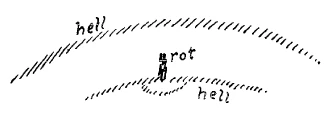
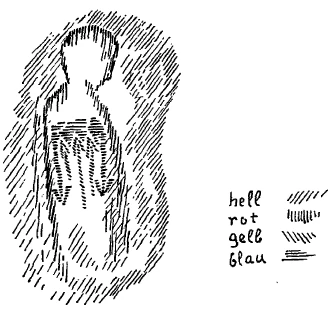
[ 8 ] If I were to illustrate this, it would look like this (see drawing on page 91): if one were to imagine the Earth in this way, one would say to oneself that when a human being lives there, he is too heavily dependent on this spot on Earth, and one must heal the human being by liberating him inwardly from his external dependence on this spot on Earth. This can be achieved by bringing them into relationship with the surrounding cosmos, with the outer heavenly world. It was said: Heaven is what was humanity’s home before they were here on Earth. They do not quite fit in on Earth. One must heal them by bringing them into the proper relationship with the cosmos. — And this was done, for example, by saying: Since there are too many earthly influences within human beings—since, so to speak, there is too much gravity and everything connected with gravity within them—one must lighten them; one must bring the superterrestrial forces into them. — People reasoned: Supernatural forces are at work in these or those plant blossoms. So they processed these or those plant blossoms by extracting their sap. They reasoned: This plant, which blooms at a certain time of year, blooms due to the influences of the cosmos at that time of year. — People then investigated the extent to which human beings are influenced specifically by this season. To this end, in earlier times, the connections between human beings and celestial phenomena were explored in a horoscope-like manner. And people were then given as remedies whatever brought their etheric body into a general vibration. People reasoned as follows: If this is the human being (see drawing $93, red), then this is his etheric body (light), and he has contracted pneumonia because his etheric body in the region of the lungs is too strongly inclined toward the Earth (blue), and because the Earth forces exert too great an influence on him. Now, they administer to him extracts from plant blossoms, which act within him and overcome these forces (yellow). Thus, forces were introduced to him that connected him to the cosmos. The aim was to bring the entire etheric body into the correct vibrations so that the incorrect individual vibrations could be balanced out. So the question was always asked: What must be done with the etheric body?
[ 9 ] Well, why was it possible to proceed in this way at all? It was possible because people had a clear conception of the human etheric body. In those earlier times, people did not merely see the physical human body; rather, they saw the physical human body glowing—they saw the etheric body. Human beings were beings of light, and just as we judge an incarnate person today—for example, if someone is pale, we conclude they are ill—so too did people in those days assess a person’s state of health by observing the etheric body, by its coloration, for example, if it turned red, blue, or green. On what, then, was their understanding of human nature based in those days? On light—on that which was light within the human being. This is to be taken quite literally: it was the Age of Light; it was the age in which people truly saw what lived within the human being as light.
[ 10 ] If you consider human health and illness from today’s perspective, you will find that even today it must be said: light has an immensely strong influence on human health. People must strive to ensure that their bodies receive the proper amounts of light. We know, of course, how children who suffer from a lack of light at a tender age develop rickets or other diseases that are definitely related to a lack of light—though naturally other factors are involved as well; a disease can never be attributed to a single cause—but conditions such as rickets, for example, are definitely linked to a lack of light. One can certainly observe how much, let’s say, children living in city apartments where little light enters are susceptible to rickets, and how little children—on average, of course—are prone to rickets when they can be adequately exposed to light. So even today, we can certainly say that human beings absorb light into themselves.
[ 11 ] But the light that human beings absorb today is, if I may put it that way, mineral light. Human beings absorb the light that is radiated onto the Earth and onto the minerals and then reflected back to them, or the light they receive directly from the sun. It is mineral light. Even the light that falls on the meadows and on the trees is channeled to us in a mineralic way. It is dead light that we absorb today through our skin, through our entire being. In that ancient age of light, which preceded the dark age, people were aware that this dead light actually had no significance for them.
[ 12 ] Today’s historians—including cultural historians—are completely unaware of such things. The light that we value so highly today was not something those ancient people considered particularly valuable at all. They distinguished between the light they valued and the light we value today in much the same way as, say, when we sit down to eat and have a plate, a spoon, and a fork, with some kind of cake or something else edible on the plate. We eat the cake; of course, we also value the knife and fork, but we don’t eat them—they’re just there. So for the ancients, what they valued as “light” was simply an accompaniment to what we today primarily value as “light.” But what they valued as “light” came from the plant kingdom. We no longer take that in today in the same way it was taken in during those ancient, luminous times. Today we take pleasure in being able to go out into the sun. People of old took pleasure in walking across a meadow or through a forest because they absorbed into themselves—through their skin—the light that the forest had first absorbed, the light that was alive in the forest and alive in the meadow. And the other kind—the dead light—was merely an ingredient. For us, the “addition” has become the main thing. People of old lived in the light that the flowers and the trees of the forest gave them. For them, this was a source of being inwardly permeated by light—by inner, living light—and not by dead light. We have absolutely no conception of this with our abstract joy in the forest, with our abstract joy in the flowers, with all that which, fundamentally speaking—I would say—is philistine in a cosmic sense. It may still be very beautiful, but it is philistine in contrast to the inner, soulful exultation that the ancient people felt in the presence of the forest, the meadow, and indeed in the presence of everything that lived out there. The ancient person felt connected to his trees, to the plant that was just right for him. Ancient people felt sympathy and antipathy in the most vivid way toward this or that plant. For example, we walk through meadows like those around the Goetheanum in the fall. We make a philistine judgment, thinking that the autumn crocus, *Colchicum autumnale*, might be beautiful. Ancient people would walk past these plants in such a way that they became sad, that their skin would even dry out slightly as they passed the Colchicum autumnale. They even felt their hair become somewhat limp. Whereas, when they passed, say, red-flowering plants—for my sake, plants such as today’s poppy—their hair would become fluffy and soft. So he experienced the light of the plant world in its fullest. It was the Age of Light, and his entire cultural life was shaped by it; it was also shaped by his ability to heal—that is, to combat death through the observation and treatment of the etheric body.
[ 13 ] This had a lasting effect, and we can still see, for example, when we look back at ancient Greek medicine—at Hippocrates—how they speak of the humors of the human body: black and yellow bile, blood, and phlegm. These terms actually still evoked memories of the ancient Age of Light. Phlegm essentially referred to the etheric body, and blood, for example, to the vibrations that the astral body causes within the etheric body, and so on. So these aftereffects were still present, and essentially it was not until the time of Galen—when, in other areas of human cultural life as well, the focus on the purely physical world began to emerge—that the view of the human being, insofar as it was to form the basis of healing processes, also took on a physical character. Attention turned to the human physical body.
[ 14 ] But it was not until the great turning point in the 15th century—specifically, the first half of the 15th century—that people truly knew nothing more about the human etheric body, not even how it expressed itself in the temperaments, and that they began to focus more and more solely on the human physical body. Even the older physical medicine was still somewhat different from what it later became, particularly in the 18th and 19th centuries. The old physical medicine still retained traditions, at least from the earlier healing through the etheric body, and one actually gets the impression of that older, European medicine as well, that the old principles had been retained and merely applied to the physical realm. In a sense, the human physical organism was still continually viewed as being under the influence of the etheric organism. It was only in more recent times—the Copernican era, the Galilean era—that people began to focus increasingly on the physical human body alone, and they ceased to know something that earlier times had known quite precisely. People today tend to think: If a person eats this or that substance found out there in nature, it essentially remains the same within the human organism. But that is not true. Only salts, for example, remain roughly the same; but everything else—as I said yesterday—that exists in the animal and plant kingdoms becomes something entirely different within the human organism. The human organism transforms it completely. It was known that the physical human organism, in its inner composition, is “not of this world,” and it was known that, fundamentally speaking, falling ill is nothing other than a continuation of what happens through human eating. And there was indeed a time, particularly among Arab physicians, when every act of digestion was viewed as a partial disease process, when the view held regarding digestion—which is by no means incorrect—was that once a person has eaten, they have introduced something foreign into themselves and are, in fact, ill. They must first overcome the illness through their internal organism, through their internal organic functions. So that one actually lives continuously in a state of “being a little sick,” “overcoming the illness a little,” and “healing a little.” We eat ourselves sick and digest ourselves healthy. For a time, particularly among Arab physicians, this was indeed a view that—if I may put it this way—has something very sound about it, for there is actually no clear boundary between what we today call “eating oneself healthy” and “eating oneself sick.” Just imagine for a moment how easy it is to harm oneself through eating. What one can still, as they say, normally overcome quickly turns into something one can no longer overcome. Then one is simply sick. But the line really cannot be drawn at all.
[ 15 ] Nor is it generally easy—even in the case of bruises, for example—to draw a clear line between what can still be balanced in a completely natural way and what requires intervention through a healing process. Thus, one once rightly viewed the onset of internal illness as a continuation of eating—specifically, eating that was not entirely proper. And so one studied the daily digestive process—that is, healthy digestion; that is what was studied.
[ 16 ] So it’s also quite a common practice that some people, who can’t quite stomach this or that without a little salt, add more salt to it; some even have to add pepper, others paprika, don’t they? Because they can’t tolerate these things as they are, they adjust them to their liking. Again, there is no limit when someone needs pepper or paprika as a remedy; again, there is no limit whether one gives pepper or paprika to aid digestion, or whether, if the situation worsens, one turns to something from the mineral kingdom. Whether one gives it as a food additive or as medicine is irrelevant. Here, too, there is an overlap; here, too, there is no limit.
[ 17 ] So what we knew for certain was this: whenever a person takes in anything at all from the external world, it affects their internal organism, and they must absolutely overcome it. Whether I end up getting a rusty nail stuck in me and my organism has to expel it, or whether I put something into my stomach that cannot remain there as is, and my organism has to go through all these processes in order to assimilate it—these are merely differences of degree. But this insight—that the human organism is not of this earth, that it can sustain itself on this earth only if it is continually stimulated to overcome the forces of this earth—was already present. For we do not eat in order to take in this or that food, but we eat so that we may develop within ourselves the forces that overcome that food. We eat to resist the forces of this Earth, and we live on this Earth by offering this resistance.
[ 18 ] But this was gradually forgotten. People simply took the whole matter in a materialistic way, and in the end they were only testing whether this or that substantial element in this or that plant offered any benefit. Yes, you see, that is what was once meant—and what we must mean again today—by the “dark age.” Everything has indeed become dark. People used to look up to the luminous etheric body; that was what a human being was to them. Now one sees nothing more of this light. One perceives only where substances are, and one clings to the dead light. But this dead light has, for the human being, initially only abstract concepts; it has yielded only intellectualism. Today, however, we are in a transitional phase toward the necessity of recognizing the light anew in a fresh way. In the past, human beings knew within themselves that they possessed this luminous etheric body. Now we must increasingly develop this perception—etheric perception—in the external world, particularly in the plant kingdom.
[ 19 ] Goethe laid the groundwork for this in his theory of metamorphosis. However, he also expressed the whole concept in an intellectualistic, abstract manner. This must increasingly take the form of images. And we must be clear that we must arrive at the point of seeing the plant world in luminous images. Just as human beings shone in the earlier age of light, in the future the nature around us—insofar as it is the plant world—must shine forth in the most manifold imaginings of plant forms. Then, precisely through this radiance of plant forms within the plants themselves, we will once again find the remedies. This necessity lies before us. While the people of the earlier age of light beheld an inner light, it is incumbent upon the people of the present to look into the outer world and behold a light there—this light in the outer world.
[ 20 ] And this light can be kindled as one delves deeper and deeper into spiritual science. You might say: Spiritual science, anthroposophy—I’m just reading terms there, and after all, when I read *Outlines of Esoteric Science*, there are terms in there too; so I don’t really have a reason to actually look. — But, my dear friends! This *“Esoteric Science”* has a twofold purpose: First, to become acquainted with what is written within; but that is not the whole story. If you have read my *“Esoteric Science”* just as you would any other book, then you are familiar only with the match. But if you want fire, you must not say: “This match is not fire after all!” It’s nonsense to say, when someone gives you a match, that they’re giving you fire—it doesn’t look like fire, after all. Esoteric Science doesn’t look like clairvoyance! That would be just like saying: “The match doesn’t look like fire.” — It will look like fire once you strike the match. And if it doesn’t work the first time, strike it a second time, and so on. That’s how it is with “esoteric science.” If you’ve read it just like any other book, then it’s still just the match; but if you’ve properly rubbed it into your entire human being, then you’ll see—it will ignite. It has only just begun to catch fire! But it is catching fire, my dear friends. And anyone who says, “This is far removed from what one is actually striving for—clairvoyance”—well, that person just wants to look at the match, not light it. But it will never become a fire if you merely look at the match. So it is indeed true: you must first know the match; otherwise, you might succumb to the delusion that you could light a fire with a pin. Of course, you cannot light a fire with a pin—that is, with modern science; you can only light it with the match, with the real match; but the fact is, you can light it!
[ 21 ] This is precisely the challenge facing humanity today, and perhaps it is in a field such as medical knowledge and skill that it will become most evident whether we can make the transition from merely observing the darkness within the material world—that is, looking at a plant flower in the same way just as we do today—to imaginative, pictorial observation by lighting a match, and from there to recognize how this or that affects the human being. And anyone who reflects on this matter even a little will have to admit: This is what lies before humanity today; it must step out of the darkness and back into the light; it must learn to judge with clarity.
[ 22 ] I’d like to clarify this once more with an example. Let’s assume, for the sake of argument, that a doctor today diagnoses me with an enlarged heart. He does so using the methods common today, and he finds that my heart is enlarged. There isn’t much one can do with such a diagnosis. One might have tried to see if this or that could help, but one doesn’t know the connection. One doesn’t know the connection because one doesn’t fully understand the whole picture. A true understanding, however, will reveal the following. Suppose, as I have often explained to you, that the human being actually renews his organism every seven years. But I also told you last time how this renewal takes place. Unprocessed substances are constantly sent out from the kidney system, so to speak, upward, forward, or downward. The head system carries out the rounding off (see diagram), so that waves (blue) continuously emanate from the head system, which bring about the form, and effects (red) take place from the kidney system, which are interrupted and shaped by the waves—four times faster, as I have said.
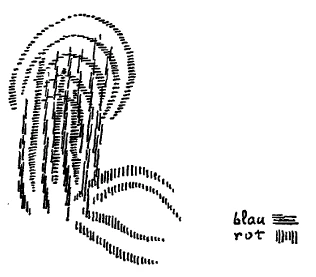
[ 23 ] Take an organ such as the heart (see illustration on page 102, light-colored). There, too, this kind of renewal takes place in every person after about seven or eight years. The heart is renewed. It is remade. Just as you see with your fingernails—that they grow outward and always regrow when you cut them—so it is with the whole human being: the body constantly renews its matter from the center out. Now, however, imagine that the rhythmic human being is not functioning properly—that the rays from the renal system are shooting out far too quickly for his organism, so that the correct ratio of four to one is not maintained. This varies from person to person; every human being is an individual in this regard, but it is true in relation to the structure of the human being as a whole. So suppose this is not in balance—suppose the rays from the renal system are emanating too rapidly. What will happen as a result?
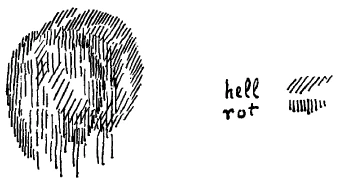
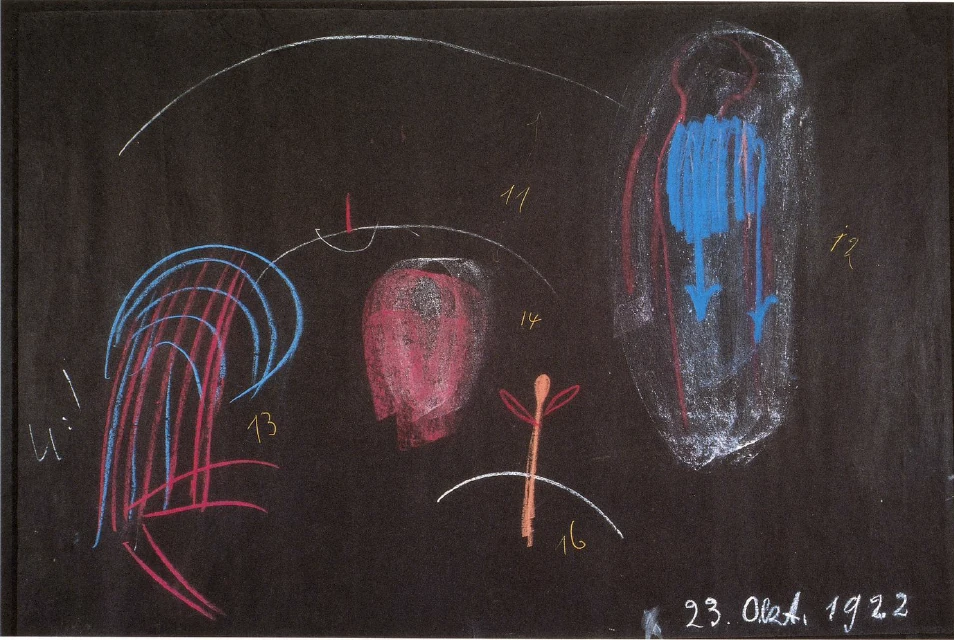
[ 24 ] This is because the following can happen. The renewal process is, after all, ongoing—so let’s assume that before the old heart is completely out, completely cast aside (see diagram, light-colored), the new one has already been pushed in (red). That’s too fast. If the renewal proceeds too quickly, phenomena such as heart enlargement occur. First and foremost, you will be able to tell from the onset of heart enlargement that something is not right with kidney function. Precisely when you take these matters seriously—the renewal of the human being over seven or eight years—you will see: if what is supposed to be renewed is already complete after six years, then the old has not yet been sufficiently pushed aside, and the organ expands, or at least strives to expand. So one must learn to look at things, to observe them in living motion. This is what lies ahead of us. Above all, we must see what has always been merely compartmentalized. How does a doctor diagnose today?
[ 25 ] Today’s physician makes a diagnosis by tracing the contours of the heart from the outside—precisely that which constitutes the finished organ. It doesn’t really matter that much to look at what the finished organ is like, because it is, after all, an organ that is constantly receding and then advancing again. And in this receding and advancing there is something more internally dynamic, and when I depict it, it is essentially like depicting a flash of lightning; it is in a state of constant motion. So if I want to grasp a person, I must grasp them in their aliveness. And this aliveness—I can find it today only if I understand the whole world and view the person from within that world.
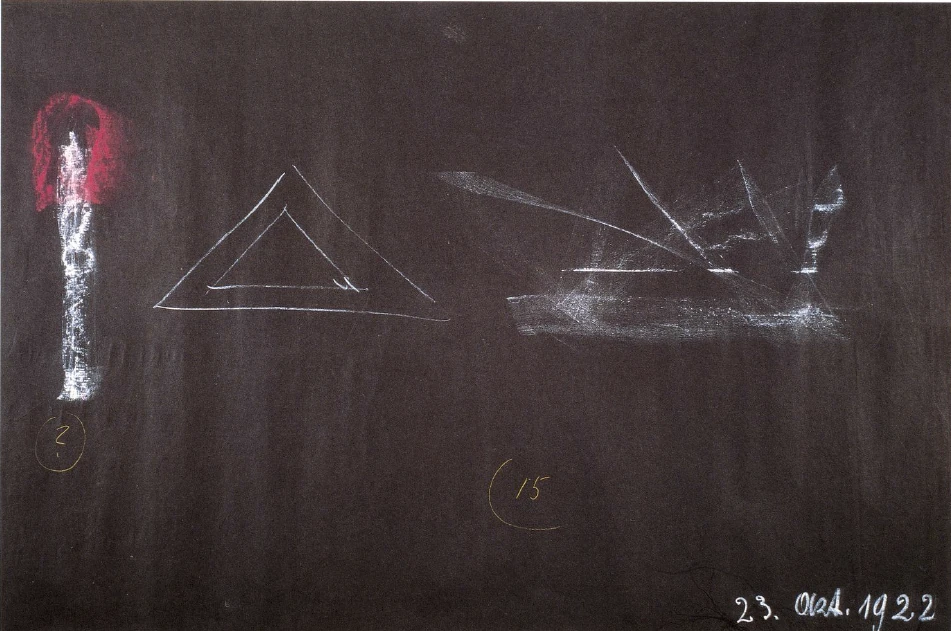
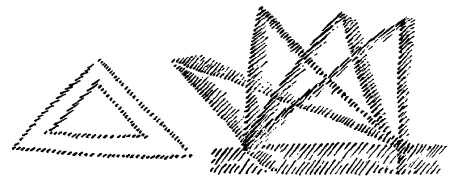
[ 26 ] This is what lies ahead of us: everything must transition into flexible cognition. Above all, we really need to start fostering this flexibility as early as elementary school. It is a terrible thing when we keep children stuck in rigidity at school. For example, it has always been a bit of a struggle for me that children are given, say, a ready-made triangle with which they do all sorts of things. This static state is actually meaningless. Basically, we should have something where the triangle can be moved. What matters is that the child truly grasps the idea that all of this is to be understood only in motion (see drawing).
[ 27 ] Of course, it is terribly difficult to discuss these matters with those who want nothing more than their peace and quiet and certainly do not want anything that requires them to be active as human beings; it is difficult to communicate with such people, who want their peace and quiet and who are already annoyed when the children make a fuss, and now the teaching materials are supposed to make a fuss as well. It is, of course, a terrible thing—but that is how it is; we must move on to what is alive. And all of this, taken together, amounts to the call to ascend into the bright, luminous age. We must step out of the dark age and into the bright, luminous age.
[ 28 ] And because people are unable to do so—that is, they convince themselves that they cannot—because people are unwilling, because people cling to the old and do not want to embrace the new, and because the old no longer fits, that is why we are experiencing these terrible catastrophes in the present. And we will experience even more of them if people do not bring themselves to step into the new.
[ 29 ] What appears as a catastrophe is, after all, the reaction of the dark age, which no longer belongs in the present. But of course it is terribly difficult to find understanding there, because it is only in the contrast between old age and youth today that something like a glimpse of the new, luminous age emerges. Young people usually say: “Oh, the old folks are philistines.” — This, too, has its precedents. The great German philosopher Johann Gottlieb Fichte had already foreseen this when he made the classic remark that one should actually kill all thirty-year-olds, because human beings are, in fact, decent only until they reach the age of thirty. That is, of course, a famous saying of Fichte’s, and since Goethe was already considerably older when Fichte made it, he was terribly annoyed and then mocked this entire doctrine in the second part of his *Faust*. It was indeed annoying, wasn’t it, for Goethe. So one finds that young people already agree that the older generation are philistines, but so far such matters haven’t been taken all that seriously, because young people act that way up to a certain age, and then, as a rule, become even greater philistines than the older generation ever were. It transitions quite smoothly into philistinism. These things must also be understood from this perspective.
[ 30 ] So I believe that the issue at hand is this: we now know that the choice is between Spenglerism—that is, the Decline of the West—and adapting to the newly emerging Age of Enlightenment, as opposed to the darkness in which humans were mere earthworms in relation to the cosmos. It is no different than that. But for a time in history, man had to be an earthworm, because otherwise he would have been completely swallowed up by the light. He could only win his freedom in the dark age—and indeed, only truly at the end of the dark age, in modern times. He could only win his freedom because the light left him unharmed, allowing him to lead the life of an earthworm.
[ 31 ] But as I told you, the people of the earlier Age of Light received the light primarily through the plant world. The plants, so to speak, drank in the cosmic light, and humans, in turn, drank from the cup the light that the plants offered them.
[ 32 ] Today we have only the dead light. But upon the rays of this dead light, Christ once descended and accomplished the Mystery of Golgotha. This is the great cosmic mystery of the new age. True, we have the dead light. The dead light cannot bring us salvation. But it was upon the rays of this dead light that Christ entered the earth and accomplished the Mystery of Golgotha. And even if we have only this dead light outside of us today, we can still enliven Christ within ourselves. And with Christ truly present within us, we enliven all the light on earth around us, bring life into the dead light, and ourselves have a life-giving effect on the light. This means that we must enter the new age of light with the right Christ impulse. And it is, in essence, the denial of the Christ impulse that prevents people from seeing clearly how a dark age gives way to the age of light.
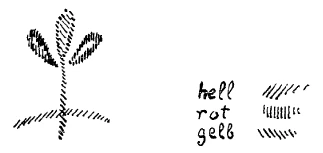
[ 33 ] It is indeed true. When the plant grows out of the ground (see illustration on p. 105), it develops the ovary at the top using the forces from the previous year, as I have already shown you; only the petals grow from the light of this year. What the plant draws out of the earth actually comes from the previous year. Thus, it was a well-preserved light that the plants once gave to humankind in the ancient age of light. We must simply find a way to perceive this dead light in the world with the spirit that is generated within us as we take in the power of Christ through the living contemplation of the Mystery of Golgotha. Then, as I have described, we will enliven the light. But we can only do this if we learn to view all things in the way I have just attempted to explain to you in these lectures.