Spiritual Connections
in the Structure of the Human Organism
GA 218
23 October 1922, Dornach
Translate the original German text into any language:
Versions Available:
Spiritual Connections in the Makeup of the Human Organism, tr. SOL
5. Geistige Zusammenhänge in der Gestaltung des menschlichen Organismus III
5. Spiritual Connections in the Structure of the Human Organism III
[ 1 ] Sie werden schon aus allerlei früheren Betrachtungen ersehen haben, daß ich nicht die Phrase gerne gebrauche: Wir leben in einer Übergangszeit —, denn jede Zeit ist eine Übergangszeit, nämlich vom Früheren zum Späteren, und es handelt sich immer nur darum: inwiefern ist irgendeine Zeit eine Übergangszeit, was geht über?
[ 1 ] You will have already gathered from various earlier reflections that I do not like to use the phrase: “We are living in a transitional period”—for every period is a transitional period, namely from what came before to what comes after, and the question is always simply this: to what extent is any given period a transitional period, and what is changing?
[ 2 ] Nun, in unserer Zeit ist tatsächlich für denjenigen, der hineinschauen kann in die geistige Welt, ein sehr wichtiger Übergang vorhanden, und auf diesen wichtigen Übergang hat ja die Weisheit ältester Zeiten immer hingewiesen. In den Epochen, in denen von einer geistigen Welt in Wahrheit noch die Rede war, wenn auch nur aus alten traumhaften Erkenntnissen heraus, ist immer gesagt worden, nach Ablauf einer gewissen Zeit werde das sogenannte finstere Zeitalter zu Ende gehen und ein lichtes Zeitalter beginnen. Nun, wenn man die Worte der alten Weisen prüft und ernst nimmt, so kommt man ja wirklich darauf, daß sie gemeint haben, um die Wende des 19. zum 20. Jahrhundert, in der wir eben jetzt leben, sei dieser Übergang von dem finsteren in das lichte Zeitalter. Wir brauchen uns aber nicht etwa darauf einzulassen, durch Anthroposophie die alte traumhafte Weisheit zu erneuern. Ich habe oftmals gesagt, daß das durchaus nicht der Fall ist, sondern daß es sich bei Anthroposophie um dasjenige handelt, was man gegenwärtig durch geistige Forschung erkennen kann. Anthroposophie soll also nicht die Erneuerung irgendwelcher alter Weisheit sein, sondern eine gegenwärtige Erkenntnis. Aber in dieser Sache, bezüglich des Obergange: aus dem finsteren Zeitalter in das lichte Zeitalter, muß die gegenwärtige Erkenntnis eben der alten Weisheit durchaus zustimmen.
[ 2 ] Well, in our time there is indeed a very important transition for those who can look into the spiritual world, and the wisdom of ancient times has always pointed to this important transition. In the epochs when people truly still spoke of a spiritual world—even if only based on ancient, dreamlike insights—it was always said that, after a certain period of time, the so-called “dark age” would come to an end and an “age of light” would begin. Now, if one examines the words of the ancient sages and takes them seriously, one does indeed come to the conclusion that they meant this transition from the dark age to the age of light would occur at the turn of the 19th to the 20th century—the very era in which we are now living. However, we need not go so far as to use anthroposophy to revive that ancient, dreamlike wisdom. I have often said that this is by no means the case, but rather that anthroposophy is what can currently be recognized through spiritual research. Anthroposophy is therefore not meant to be a revival of some ancient wisdom, but rather a contemporary insight. But on this matter—regarding the transition from the dark age to the age of light—contemporary insight must certainly agree with the ancient wisdom.
[ 3 ] So wenig man auch, wenn man gerade die Ereignisse der Gegenwart ins Auge faßt, vom Äußerlichen her sagen kann, wir treten als Menschheit, namentlich als zivilisierte Menschheit Europas etwa aus schlimmeren in bessere Zustände ein, so wahr ist auf der anderen Seite aber dennoch dasjenige, was schon die alte Weisheit gemeint hat mit dem Übertritt in das lichte Zeitalter, und was wir heute wieder meinen müssen. Wir müssen die Dinge nur in der richtigen Weise verstehen. Ich möchte zunächst an einem Beispiele klarmachen, wie der Unterschied eines in diesem Sinne gemeinten lichten Zeitalters und eines finsteren Zeitalters ist.
[ 3 ] As little as one can say—when considering current events from an external perspective—that we as humanity, specifically as the civilized people of Europe, are moving from worse to better conditions, so true is it, on the other hand, what ancient wisdom already meant by the transition into the age of light, and what we must mean again today. We simply need to understand things in the right way. I would first like to use an example to clarify the difference between an “age of light” understood in this sense and a “dark age.”
[ 4 ] Die Menschen, die einstmals, etwa im 5. vorchristlichen Jahrtausend, von einem solchen finsteren und lichten Zeitalter gesprochen haben, die haben dieses finstere Zeitalter als die Folge von einem früheren lichten Zeitalter angesehen und haben die Meinung ausgesprochen, daß, nachdem das finstere Zeitalter eine Weile gedauert haben werde, wiederum ein lichtes Zeitalter kommen werde. Es wird also lehrreich sein, zurückzublicken, wodurch sich in wesentlichen menschlichen Angelegenheiten das lichte Zeitalter, das einmal vorhanden war, das etwa da war im 7. oder 8. vorchristlichen Jahrtausend, wodurch sich dieses lichte Zeitalter von dem späteren finsteren Zeitalter, aus dem wir Menschen nun heraustreten sollen, unterschieden hat.
[ 4 ] The people who once, around the 5th millennium B.C., spoke of such a dark and a light age regarded this dark age as the consequence of an earlier light age and expressed the opinion that, after the dark age had lasted for a while, a light age would come again. It will therefore be instructive to look back and see how, in essential human matters, the age of light that once existed—which was present around the 7th or 8th millennium B.C.—differed from the later dark age from which we humans are now to emerge.
[ 5 ] Ich möchte das, wie gesagt, an einem Beispiel klarmachen, an dem Beispiel des Heilens. Das Beispiel des Heilens ist sehr gut anwendbar dabei, denn man kann daran sehr vieles sehen. In jenem alten hellen oder lichten Zeitalter heilte man nämlich nicht dadurch, daß man hinblickte auf den physischen Menschenleib. Daran hat man gar nicht gedacht. Man hat überhaupt in jenem alten lichten Zeitalter nicht in dem Sinne von Krankheit gesprochen, wie man heute noch von Krankheit spricht, wie man aber aufhören wird in der Zukunft zu sprechen. Man hat in jenen alten Zeiten natürlich auch die Erscheinung gehabt, daß ein Mensch nach dieser oder jener Richtung einen Verfall seiner Organe erlebte, daß er nach dieser oder jener Richtung eben nicht gesund war, aber man hat nicht von Krankheit gesprochen, sondern man hat geradezu gesagt: Es gibt einen Tod, und der bemächtigt sich des Menschen. — Und man sah eine Art von Kampf zwischen Leben und Tod in dem Falle, wo wir heute sagen, der Mensch ist krank. Also in jenen älteren Zeiten sprach man nicht von Krankheit und Gesundheit, sondern man sprach davon, wenn ein Mensch in unserem Sinn krank geworden war: in dem kämpft der Tod. Und das Gesundmachen sah man als ein Bekämpfen, ein Austreiben des Todes an. Man sprach also eigentlich von Leben und Tod. Und Krankheit war nur ein spezieller Fall des Todes, möchte ich sagen, ein kleines Sterben; Gesundheit war das Leben.
[ 5 ] As I said, I would like to illustrate this with an example—the example of healing. The example of healing is very applicable here, because it reveals so much. In that ancient, luminous age, healing was not achieved by focusing on the physical human body. People did not even think of it that way. In fact, in that ancient, luminous age, people did not speak of “illness” in the sense that we still speak of it today—though we will cease to do so in the future. Of course, in those ancient times people also observed that a person might experience a deterioration of their organs in one way or another—that they were, in one way or another, simply not healthy—but they did not speak of “illness”; rather, they said quite plainly: “There is a death, and it is taking hold of the person.” —And they saw a kind of struggle between life and death in the situation where we today say that a person is ill. So in those earlier times, people did not speak of illness and health, but rather, when a person had become ill in our sense, they said: “Death is fighting within them.” And restoring health was seen as a battle against death, as driving death out. So people actually spoke of life and death. And illness was merely a special case of death, I would say—a small dying; health was life.
[ 6 ] Warum sprach man so? Man sprach aus dem Grunde so, weil man dazumal ganz vom ätherischen Leib des Menschen aus heilte. Man kümmerte sich sozusagen damals nicht um den physischen Leib des Menschen, sondern man heilte ganz und gar vom ätherischen Leib des Menschen aus.
[ 6 ] Why did people speak that way? They spoke that way because, back then, healing was done entirely through the human etheric body. Back then, so to speak, people did not concern themselves with the human physical body; rather, they healed entirely through the human etheric body.
[ 7 ] Wie machte man das? Nun, sagen wir, der Mensch wäre dazumal von so etwas befallen worden, was wir heute eine Lungenentzündung, Pneumonie nennen. Die Krankheitsform der Lungenentzündung hatte einen etwas anderen Typus dazumal, aber man kann immerhin von dieser Krankheitsform sprechen. Da sagte man sich dazumal: Dieser Mensch ist zu stark abhängig geworden von der Erdengegend, in der er lebt. — Es war ja das in den Zeiten, wo Menschenwanderungen, wo das Verlassen der Orte seltener waren als heute. Die Menschen blieben zumeist, wenigstens die Mehrzahl der Menschen, ihr ganzes Leben an dem Orte, wo sie waren. Dennoch, man sagte in einem solchen Falle: Der Mensch ist zu stark abhängig geworden von dem Erdenflecke, auf dem er geboren ist. — Man wußte in jenen älteren Zeiten ganz genau: der Mensch hatte schon ein vorirdisches Dasein, er hat sozusagen durch die Überschau, durch sein Schicksal sich im vorirdischen Dasein seinen Erdenort selber bestimmt. So also sagte man sich: Wenn ein Mensch etwa vor dem vierzigsten Jahre oder noch früher von einer Lungenentzündung, von Pneumonie befallen wird, dann hat er sich seinen Erdenort eben nicht ganz richtig gewählt. Er paßt nicht recht zu seinem irdischen Aufenthalte. — Kurz, man leitete die Krankheit ab von dem Verhältnis seiner menschlichen Organisation zum Erdenflecke, auf dem der Mensch war.
[ 7 ] How was that done? Well, let’s say a person back then had been afflicted by something we today call pneumonia. The form of pneumonia was somewhat different back then, but we can still speak of this disease. People used to say back then: This person has become too dependent on the region of the earth where they live. — After all, this was in an era when population migrations and people leaving their homes were less common than they are today. People—at least the majority of them—usually stayed their entire lives in the place where they were. Nevertheless, in such a case people would say: “This person has become too dependent on the spot on Earth where they were born.” — In those earlier times, people knew quite clearly that a person had already had a pre-earthly existence; through their insight, so to speak, and through their destiny, they had themselves determined their earthly location during that pre-earthly existence. Thus, people used to say: If a person is struck by pneumonia before the age of forty, or even earlier, then he has not chosen his earthly location quite correctly. He does not quite fit in with his earthly abode. — In short, the illness was attributed to the relationship between his human constitution and the patch of earth on which he lived.
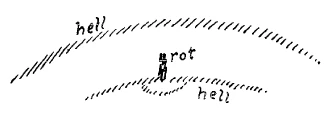
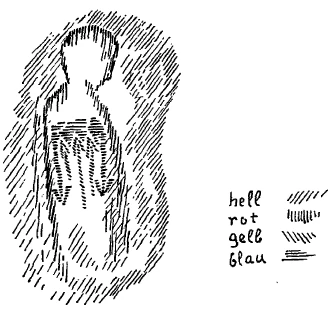
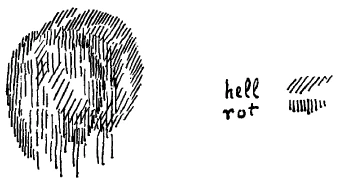
[ 8 ] Wenn ich das aufzeichnen will, so wäre also das so (siehe Zeichnung Seite 91), wenn man sich so die Erde vorstellte, so sagte man sich, wenn da der Mensch lebt, so ist er zu stark abhängig von diesem Erdenfleck, und man muß den Menschen dadurch heilen, daß man ihn innerlich befreit von der äußerlichen Abhängigkeit von diesem Erdenfleck. Das kann man dadurch, daß man ihn in Beziehung bringt zu dem umliegenden Kosmos, zu der äußeren Himmelswelt. Man sagte: Der Himmel ist dasjenige, was des Menschen Heimat war, bevor er hier auf der Erde war. Er paßt nicht recht auf die Erde herein. Man muß ihn heißen dadurch, daß man ihn in die richtige Beziehung zum Kosmos bringt. — Und das tat man dann etwa in der Weise, daß man sagte: Man muß also den Menschen, weil zuviel Erdenwirkungen in ihm sind, weil gewissermaßen zuviel Schwerkraft und das, was mit der Schwerkraft zusammenhängt, in ihm ist, man muß ihn erleichtern; man muß die überirdischen Kräfte in ihn hineinbringen. — Man sagte sich: Überirdische Kräfte wirken in diesen oder jenen Pflanzenblüten. Also man bearbeitete diese oder jene Pflanzenblüten, indem man ihren Saft gewann. Man sagte sich; Diese Pflanze, die blüht zu einer gewissen Jahreszeit; sie blüht durch die Einflüsse des Kosmos zu dieser Jahreszeit. — Man erforschte nun, inwiefern der Mensch gerade durch diese Jahreszeit beeinflußt wird. Zu diesem Zwecke wurden ja in älteren Zeiten die Abhängigkeiten des Menschen von den Himmelserscheinungen in einer horoskopartigen Weise gesucht. Und man gab dann als Arzneien dem Menschen dasjenige, was seinen Ätherleib in eine allgemeine Schwingung brachte. Man sagte sich so: Wenn das der Mensch ist (siehe Zeichnung $. 93, rot), dann ist das sein Ätherleib (hell), und er ist an Pneumonie erkrankt aus dem Grunde, weil sein Ätherleib in der Gegend der Lunge zu stark der Erde zuneigt (blau), und weil die Erdenkräfte auf ihn zu großen Einfluß haben. Jetzt bringt man ihm eben Säfte von Pflanzenblüten bei, welche in ihn hineinwirken und welche diese Kräfte überwinden (gelb). Man führte ihm also Kräfte zu, die ihn in Zusammenhang brachten mit dem Kosmos. Dadurch strebte man an, den ganzen Ätherleib in richtige Schwingungen zu versetzen, damit die unrichtigen einzelnen Schwingungen ausgeglichen werden. Also man fragte sich immer: Was muß man mit dem Ätherleib tun?
[ 8 ] If I were to illustrate this, it would look like this (see drawing on page 91): if one were to imagine the Earth in this way, one would say to oneself that when a human being lives there, he is too heavily dependent on this spot on Earth, and one must heal the human being by liberating him inwardly from his external dependence on this spot on Earth. This can be achieved by bringing them into relationship with the surrounding cosmos, with the outer heavenly world. It was said: Heaven is what was humanity’s home before they were here on Earth. They do not quite fit in on Earth. One must heal them by bringing them into the proper relationship with the cosmos. — And this was done, for example, by saying: Since there are too many earthly influences within human beings—since, so to speak, there is too much gravity and everything connected with gravity within them—one must lighten them; one must bring the superterrestrial forces into them. — People reasoned: Supernatural forces are at work in these or those plant blossoms. So they processed these or those plant blossoms by extracting their sap. They reasoned: This plant, which blooms at a certain time of year, blooms due to the influences of the cosmos at that time of year. — People then investigated the extent to which human beings are influenced specifically by this season. To this end, in earlier times, the connections between human beings and celestial phenomena were explored in a horoscope-like manner. And people were then given as remedies whatever brought their etheric body into a general vibration. People reasoned as follows: If this is the human being (see drawing $93, red), then this is his etheric body (light), and he has contracted pneumonia because his etheric body in the region of the lungs is too strongly inclined toward the Earth (blue), and because the Earth forces exert too great an influence on him. Now, they administer to him extracts from plant blossoms, which act within him and overcome these forces (yellow). Thus, forces were introduced to him that connected him to the cosmos. The aim was to bring the entire etheric body into the correct vibrations so that the incorrect individual vibrations could be balanced out. So the question was always asked: What must be done with the etheric body?
[ 9 ] Nun, warum konnte man denn überhaupt in dieser Weise vorgehen? Man konnte das aus dem Grunde, weil man eine deutliche Vorstellung vom menschlichen Ätherleib hatte. In jenen älteren Zeiten sah man nicht bloß den physischen Menschenleib, sondern man sah den physischen Menschenleib leuchten, man sah den Ätherleib. Der Mensch war ein Lichtwesen, und wie man heute am Inkarnat beurteilt, wenn zum Beispiel einer blaß ist, daß er krank ist, so beurteilte man seinen Gesundheitszustand an dem Ätherleib, an der Färbung, wenn er zum Beispiel rot oder blau oder grün wurde. Worauf gründete man also seine Menschenkenntnis in der damaligen Zeit? Auf das Licht, auf dasjenige, was im Menschen Licht war. Es ist ganz wörtlich zu nehmen: es war das lichte Zeitalter, es war das Zeitalter, in dem man das, was im Menschen als Licht lebte, wirklich sah.
[ 9 ] Well, why was it possible to proceed in this way at all? It was possible because people had a clear conception of the human etheric body. In those earlier times, people did not merely see the physical human body; rather, they saw the physical human body glowing—they saw the etheric body. Human beings were beings of light, and just as we judge an incarnate person today—for example, if someone is pale, we conclude they are ill—so too did people in those days assess a person’s state of health by observing the etheric body, by its coloration, for example, if it turned red, blue, or green. On what, then, was their understanding of human nature based in those days? On light—on that which was light within the human being. This is to be taken quite literally: it was the Age of Light; it was the age in which people truly saw what lived within the human being as light.
[ 10 ] Wenn Sie vom heutigen Gesichtspunkte aus den Menschen nach Gesundheit und Krankheit betrachten, so werden Sie ja finden, daß auch heute gesagt werden muß: das Licht hat einen ungeheuer starken Einfluß auf die menschliche Gesundheit. Der Mensch muß darnach trachten, daß er die richtigen Quantitäten von Licht in seinen Organismus hereinbekommt. Wir wissen ja, wie Kinder, die im zarten Alter an Lichtmangel leiden, der Rachitis verfallen oder anderen Krankheiten, die eben durchaus mit dem Lichtmangel zusammenhängen — natürlich auch mit anderen Dingen, niemals ist eine Krankheit nur aus einer Ursache abzuleiten —, aber solche Dinge, wie Rachitis zum Beispiel, hängen durchaus mit Lichtmangel zusammen. Man kann durchaus konstatieren, wie sehr, sagen wir, die Kinder der Rachitis ausgesetzt sind, die in der Stadt in Wohnungen sind, wo wenig Licht hineinkommt, und wie wenig Kinder zu Rachitis neigen — im Durchschnitt natürlich —, die in gehöriger Weise dem Licht exponiert werden können. Also auch heute können wir durchaus sagen, daß der Mensch Licht in sich aufnimmt.
[ 10 ] If you consider human health and illness from today’s perspective, you will find that even today it must be said: light has an immensely strong influence on human health. People must strive to ensure that their bodies receive the proper amounts of light. We know, of course, how children who suffer from a lack of light at a tender age develop rickets or other diseases that are definitely related to a lack of light—though naturally other factors are involved as well; a disease can never be attributed to a single cause—but conditions such as rickets, for example, are definitely linked to a lack of light. One can certainly observe how much, let’s say, children living in city apartments where little light enters are susceptible to rickets, and how little children—on average, of course—are prone to rickets when they can be adequately exposed to light. So even today, we can certainly say that human beings absorb light into themselves.
[ 11 ] Aber das Licht, das heute der Mensch in sich aufnimmt, das ist, wenn ich mich so ausdrücken darf, mineralisches Licht. Der Mensch nimmt dasjenige Licht auf, was auf die Erde, auf die Mineralien gestrahlt und zu ihm zurückgestrahlt wird, oder was er direkt von der Sonne bekommt. Es ist mineralisches Licht. Auch das Licht, das auf die Wiesen, das auf den Baum fällt, wird in mineralischer Weise zu uns geleitet. Es ist totes Licht, das wir heute einsaugen durch unsere Haut, durch unseren ganzen Menschen. In jenem alten lichten Zeitalter, das dem finsteren Zeitalter vorangegangen ist, da waren sich die Menschen bewußt, daß dieses tote Licht eigentlich für sie keine Bedeutung hatte.
[ 11 ] But the light that human beings absorb today is, if I may put it that way, mineral light. Human beings absorb the light that is radiated onto the Earth and onto the minerals and then reflected back to them, or the light they receive directly from the sun. It is mineral light. Even the light that falls on the meadows and on the trees is channeled to us in a mineralic way. It is dead light that we absorb today through our skin, through our entire being. In that ancient age of light, which preceded the dark age, people were aware that this dead light actually had no significance for them.
[ 12 ] Solche Dinge weiß der heutige Geschichtsforscher, auch der Kulturhistoriker, gar nicht. Das Licht, das wir heute so sehr schätzen, das war für jene alten Menschen gar nicht etwas so Schätzenswertes. Ungefähr so unterschieden sie zwischen dem Lichte, das sie schätzten, und diesem heute von uns geschätzten Lichte, wie, sagen wir, wenn wir uns zu Tisch setzen und Teller und Löffel und Gabel haben, auf dem Teller irgendeinen Kuchen oder irgend etwas anderes Eßbares. Da essen wir den Kuchen; wir schätzen auch natürlich Messer und Gabel, aber wir essen sie nicht, sie sind dabei. So war für die Alten bei dem, was sie als Licht schätzten, das dabei, was wir heute vorzugsweise als Licht schätzen. Aber das, was sie als Licht schätzten, das kommt vom Pflanzenreich. Das nehmen wir heute gar nicht mehr in der Weise auf, wie es in alten lichten Zeiten aufgenommen worden ist. Wir erfreuen uns heute, wenn wir in die Sonne gehen können. Der alte Mensch erfreute sich, wenn er über eine Wiese, durch einen Wald ging, weil er in sich, durch seine Haut hereinsaugte das Licht, das zunächst der Wald aufgesogen hatte, das belebt war im Walde, belebt war auf der Wiese. Und das andere, das tote Licht, das war die Zutat. Für uns ist die Zutat die Hauptsache geworden. Der alte Mensch lebte in dem Lichte, das ihm die Blumen, das ihm die Bäume des Waldes gaben. Für ihn war das ein Quell innerlichen Durchlebtwerdens mit Licht, mit innerlichem lebendigem Licht, und nicht mit totem Licht. Wir haben gar keine Vorstellung davon mit unserer abstrakten Freude am Walde, mit unserer abstrakten Freude an den Blumen, mit alldem, was im Grunde genommen, ich möchte sagen, im kosmischen Sinne philiströs ist. Es mag noch immer sehr schön sein, aber es ist philiströs im Gegensatz zu dem, was an innerlichem seelischem Jauchzen vorhanden war bei den alten Menschen im Angesichte des Waldes, der Wiese, im Angesichte überhaupt dessen, was da draußen lebte. Der alte Mensch fühlte sich verbunden mit seinen Bäumen, mit dem, was gerade die für ihn geeignete Pflanze war. Der alte Mensch fühlte Sympathie und Antipathie in der lebendigsten Weise mit dieser oder jener Pflanze. Wir gehen zum Beispiel über solche Wiesen, wie sie um das Goetheanum herum im Herbste sind. Wir urteilen philiströs, die Herbstzeitlose, das Colchicum autumnale sei vielleicht schön. Der alte Mensch ging an diesen Pflanzen so vorbei, daß er traurig wurde, daß seine Haut sogar sich etwas trocknete, während er an dem Colchicum autumnale vorbeiging. Er empfand sogar etwas von Schlaffwerden der Haare. Während, wenn er vorbeiging, sagen wir, an rot blühenden Pflanzen, meinetwillen an solchen Pflanzen, wie der heutige Mohn es ist, seine Haare flaumig, weich wurden. Also er erlebte das Licht der Pflanzenwelt absolut mit. Es war das lichte Zeitalter und darnach richtete sich sein ganzes Kulturleben, darnach richtete sich auch, daß er heilen konnte, das heißt, daß er den Tod bekämpfen konnte durch die Beobachtung und durch die Behandlung des Ätherleibes.
[ 12 ] Today’s historians—including cultural historians—are completely unaware of such things. The light that we value so highly today was not something those ancient people considered particularly valuable at all. They distinguished between the light they valued and the light we value today in much the same way as, say, when we sit down to eat and have a plate, a spoon, and a fork, with some kind of cake or something else edible on the plate. We eat the cake; of course, we also value the knife and fork, but we don’t eat them—they’re just there. So for the ancients, what they valued as “light” was simply an accompaniment to what we today primarily value as “light.” But what they valued as “light” came from the plant kingdom. We no longer take that in today in the same way it was taken in during those ancient, luminous times. Today we take pleasure in being able to go out into the sun. People of old took pleasure in walking across a meadow or through a forest because they absorbed into themselves—through their skin—the light that the forest had first absorbed, the light that was alive in the forest and alive in the meadow. And the other kind—the dead light—was merely an ingredient. For us, the “addition” has become the main thing. People of old lived in the light that the flowers and the trees of the forest gave them. For them, this was a source of being inwardly permeated by light—by inner, living light—and not by dead light. We have absolutely no conception of this with our abstract joy in the forest, with our abstract joy in the flowers, with all that which, fundamentally speaking—I would say—is philistine in a cosmic sense. It may still be very beautiful, but it is philistine in contrast to the inner, soulful exultation that the ancient people felt in the presence of the forest, the meadow, and indeed in the presence of everything that lived out there. The ancient person felt connected to his trees, to the plant that was just right for him. Ancient people felt sympathy and antipathy in the most vivid way toward this or that plant. For example, we walk through meadows like those around the Goetheanum in the fall. We make a philistine judgment, thinking that the autumn crocus, *Colchicum autumnale*, might be beautiful. Ancient people would walk past these plants in such a way that they became sad, that their skin would even dry out slightly as they passed the Colchicum autumnale. They even felt their hair become somewhat limp. Whereas, when they passed, say, red-flowering plants—for my sake, plants such as today’s poppy—their hair would become fluffy and soft. So he experienced the light of the plant world in its fullest. It was the Age of Light, and his entire cultural life was shaped by it; it was also shaped by his ability to heal—that is, to combat death through the observation and treatment of the etheric body.
[ 13 ] Das wirkte lange nach, und wir sehen zum Beispiel noch, wenn wir zu der älteren griechischen Medizin zurückgehen, zu Hippokrates, wie gesprochen wird von den Säften des Menschen, von schwarzer und heller Galle, von Blut und von Schleim. Damit waren eigentlich noch immer Erinnerungen an das alte lichte Zeitalter gemeint. Der Schleim war im Grunde genommen für den Ätherleib gemeint und zum Beispiel das Blut für jene Schwingungen, die der astralische Leib im Ätherleib bewirkt und so weiter. Also diese Nachwirkungen waren noch da, und im Grunde genommen bekam erst in der Zeit des Galen, als auch schon für das andere menschliche Kulturleben das Rechnen mit der bloßen physischen Welt heraufkam, auch die Anschauung des Menschen, insofern sie die Grundlage von Heilprozessen sein sollte, einen physischen Charakter. Man sah auf den menschlichen physischen Leib hin.
[ 13 ] This had a lasting effect, and we can still see, for example, when we look back at ancient Greek medicine—at Hippocrates—how they speak of the humors of the human body: black and yellow bile, blood, and phlegm. These terms actually still evoked memories of the ancient Age of Light. Phlegm essentially referred to the etheric body, and blood, for example, to the vibrations that the astral body causes within the etheric body, and so on. So these aftereffects were still present, and essentially it was not until the time of Galen—when, in other areas of human cultural life as well, the focus on the purely physical world began to emerge—that the view of the human being, insofar as it was to form the basis of healing processes, also took on a physical character. Attention turned to the human physical body.
[ 14 ] Aber so richtig war das doch erst an der großen Wende im 15. Jahrhundert, in der ersten Hälfte des 15. Jahrhunderts, daß man gar nichts mehr wußte vom menschlichen Ätherleib, nicht einmal, wie er sich in den Temperamenten ausdrückt, daß man anfing, immer mehr und mehr bloß auf den physischen Leib des Menschen hinzuschauen. Es war auch die ältere physische Medizin noch etwas anderes, als sie später, namentlich im 18. und 19. Jahrhundert geworden ist. Die alte physische Medizin hatte noch immer Traditionen, wenigstens von dem früheren Heilen durch den Ätherleib, und man hat eigentlich den Eindruck von jener älteren, auch europäischen Medizin, daß man alte Grundsätze behalten hatte und sie nur auf das Physische übertragen hatte. Es wurde gewissermaßen der physische Menschenorganismus doch fortwährend unter dem Einfluß des ätherischen Organismus gesehen. Erst in der neueren Zeit, in der kopernikanischen Zeit, in der Galilei-Zeit, fing man an, immer mehr bloß den physischen Menschenleib zu betrachten, und man hörte auf, etwas zu wissen, was die früheren Zeiten ganz genau gewußt haben. Man denkt ja heute: Wenn der Mensch diesen oder jenen Stoff, den man da draußen in der Natur findet, ißt, so bleibt er im menschlichen Organismus im Grunde genommen dasselbe. Das ist aber nicht wahr. Annähernd dasselbe bleiben nur etwa die Salze; aber alles das — ich habe es ja gestern gesagt —, was im Tier- und Pflanzenreich ist, wird im menschlichen Organismus etwas ganz anderes. Der menschliche Organismus ändert es völlig. Man wußte, daß der physische Menschenorganismus in seiner inneren Zusammensetzung «nicht von dieser Welt ist», und man wußte, daß im Grunde genommen Krankwerden nichts anderes ist als eine Fortsetzung dessen, was durch das menschliche Essen geschieht. Und es gab tatsächlich eine Zeit, insbesondere unter den arabischen Ärzten, wo man jede Verdauung als einen partiellen Krankheitsprozeß ansah, wo man über die Verdauung die Ansicht hatte, die durchaus nicht etwa unrichug ist: hat der Mensch gegessen, so hat er etwas Fremdes in sich hinein gebracht und er ist eigentlich krank. Er muß erst durch seinen inneren Organismus, durch die innere organische Funktion die Krankheit überwinden. So daß man eigentlich fortwährend in einem «Ein-bißchenKranksein», «Ein-bißchen-die-Krankheit-Überwinden», «Ein-bißchen-Heilen» lebt. Man ißt sich krank und verdaut sich gesund. Das war tatsächlich eine Zeitlang, namentlich unter arabischen Ärzten, eine Anschauung, die durchaus — wenn ich mich so ausdrücken darf — etwas sehr Gesundes hat, denn es gibt eigentlich keine Grenze zwischen dem, was man heute Sich-gesund-Essen nennt und dem Sich-krank-Essen. Denken Sie sich doch nur einmal, wie leicht es möglich ist, daß man sich beim Essen verdirbt. Da geht gleich dasjenige, was man gerade noch, wie man sagt, normal überwinden kann, über in das, was man nicht mehr überwinden kann. Dann ist man eben krank. Aber die Grenze ist wirklich gar nicht zu ziehen.
[ 14 ] But it was not until the great turning point in the 15th century—specifically, the first half of the 15th century—that people truly knew nothing more about the human etheric body, not even how it expressed itself in the temperaments, and that they began to focus more and more solely on the human physical body. Even the older physical medicine was still somewhat different from what it later became, particularly in the 18th and 19th centuries. The old physical medicine still retained traditions, at least from the earlier healing through the etheric body, and one actually gets the impression of that older, European medicine as well, that the old principles had been retained and merely applied to the physical realm. In a sense, the human physical organism was still continually viewed as being under the influence of the etheric organism. It was only in more recent times—the Copernican era, the Galilean era—that people began to focus increasingly on the physical human body alone, and they ceased to know something that earlier times had known quite precisely. People today tend to think: If a person eats this or that substance found out there in nature, it essentially remains the same within the human organism. But that is not true. Only salts, for example, remain roughly the same; but everything else—as I said yesterday—that exists in the animal and plant kingdoms becomes something entirely different within the human organism. The human organism transforms it completely. It was known that the physical human organism, in its inner composition, is “not of this world,” and it was known that, fundamentally speaking, falling ill is nothing other than a continuation of what happens through human eating. And there was indeed a time, particularly among Arab physicians, when every act of digestion was viewed as a partial disease process, when the view held regarding digestion—which is by no means incorrect—was that once a person has eaten, they have introduced something foreign into themselves and are, in fact, ill. They must first overcome the illness through their internal organism, through their internal organic functions. So that one actually lives continuously in a state of “being a little sick,” “overcoming the illness a little,” and “healing a little.” We eat ourselves sick and digest ourselves healthy. For a time, particularly among Arab physicians, this was indeed a view that—if I may put it this way—has something very sound about it, for there is actually no clear boundary between what we today call “eating oneself healthy” and “eating oneself sick.” Just imagine for a moment how easy it is to harm oneself through eating. What one can still, as they say, normally overcome quickly turns into something one can no longer overcome. Then one is simply sick. But the line really cannot be drawn at all.
[ 15 ] Ebensowenig ist sonst selbst bei Quetschungen zum Beispiel auch die Grenze zwischen dem, was noch auf eine ganz naturgemäße Weise ausgeglichen wird, und dem, wo man zu Hilfe kommen muß durch einen Heilprozeß, gar nicht so ohne weiteres zu ziehen. So daß man also einmal in dem innerlich Krankwerden mit Recht eine Fortsetzung des Essens sah, ein nicht ganz richtiges Essen. Und so studierte man den täglichen Verdauungsprozeß, also das Sich-gesund-Verdauen; das studierte man.
[ 15 ] Nor is it generally easy—even in the case of bruises, for example—to draw a clear line between what can still be balanced in a completely natural way and what requires intervention through a healing process. Thus, one once rightly viewed the onset of internal illness as a continuation of eating—specifically, eating that was not entirely proper. And so one studied the daily digestive process—that is, healthy digestion; that is what was studied.
[ 16 ] So ist es auch eine ganz gute Sitte, daß der eine oder andere, der dies oder jenes nicht so ungesalzen vertragen kann, es sich weiter salzt; mancher muß es sich sogar pfeffern, mancher paprizieren, nicht wahr. Weil er die Dinge nicht so ohne weiteres vertragen kann, richtet er es sich zu. Da ist wiederum keine Grenze, wenn einer Pfeffer oder Paprika braucht als Heilmittel; da ist wieder keine Grenze, ob man nun Pfeffer oder Paprika gibt, damit man sich gesund verdauen kann, oder ob, wenn die Sache ärger wird, man etwas aus dem Mineralreich nimmt. Ob man das nun als Speisezusatz oder als Medizin gibt, darauf kommt es nicht an. Da ist wiederum ein Ineinanderlaufen, da ist wiederum keine Grenze.
[ 16 ] So it’s also quite a common practice that some people, who can’t quite stomach this or that without a little salt, add more salt to it; some even have to add pepper, others paprika, don’t they? Because they can’t tolerate these things as they are, they adjust them to their liking. Again, there is no limit when someone needs pepper or paprika as a remedy; again, there is no limit whether one gives pepper or paprika to aid digestion, or whether, if the situation worsens, one turns to something from the mineral kingdom. Whether one gives it as a food additive or as medicine is irrelevant. Here, too, there is an overlap; here, too, there is no limit.
[ 17 ] Also das, was man genau wußte, das ist: wenn der Mensch überhaupt irgend etwas aus der äußeren Welt zu sich nimmt, so beeinträchtigt das seinen inneren Organismus, und er muß es unbedingt überwinden. Ob ich mir schließlich einen rostigen Nagel einstoße und mein Organismus ihn herausschwären muß, oder ob ich in meinen Magen etwas hineinbringe, was so nicht bleiben darf, und mein Organismus alle diese Prozesse durchmachen muß, damit er es assimiliert, das hat nur Gradunterschiede. Aber diese Erkenntnis, daß der menschliche Organismus nicht von dieser Erde ist, daß er auf dieser Erde sich nur erhalten kann, wenn er fortwährend angeregt wird, die Kräfte dieser Erde zu überwinden, die war vorhanden. Wir essen nämlich nicht, damit wir diese oder jene Speise in uns bekommen, sondern wir essen aus dem Grunde, damit wir die Kräfte innerlich entwickeln, die diese Speise überwinden. Wir essen, um Widerstand zu leisten gegen die Kräfte dieser Erde, und wir leben auf dieser Erde dadurch, daß wir Widerstand leisten.
[ 17 ] So what we knew for certain was this: whenever a person takes in anything at all from the external world, it affects their internal organism, and they must absolutely overcome it. Whether I end up getting a rusty nail stuck in me and my organism has to expel it, or whether I put something into my stomach that cannot remain there as is, and my organism has to go through all these processes in order to assimilate it—these are merely differences of degree. But this insight—that the human organism is not of this earth, that it can sustain itself on this earth only if it is continually stimulated to overcome the forces of this earth—was already present. For we do not eat in order to take in this or that food, but we eat so that we may develop within ourselves the forces that overcome that food. We eat to resist the forces of this Earth, and we live on this Earth by offering this resistance.
[ 18 ] Aber es wurde das allmählich vergessen. Man nahm die ganze Sache eben materialistisch, und man probierte schließlich nur noch, ob dieses oder jenes Substantielle in diesen oder jenen Pflanzen eine Hilfe gewährt. Ja, sehen Sie, das ist dasjenige, was man einmal gemeint hat und was wir heute wieder meinen müssen mit dem finsteren Zeitalter. Es ist ja alles finster geworden. Man hat früher auf den hellen Ätherleib hingeschaut; der war einem der Mensch. Jetzt sieht man nichts mehr von diesem Licht. Man nimmt nur wahr, wo Stoffe sind, und man hält sich an das tote Licht. Aber dieses tote Licht hat für den Menschen zunächst nur abstrakte Begriffe, hat nur den Intellektualismus hergegeben. Heute stehen wir aber im Übergange zu der Notwendigkeit, in neuer Weise das Licht wiederum zu erkennen. Früher hat der Mensch in sich gewußt: er hat diesen lichten Ätherleib. Jetzt müssen wir immer mehr ausbilden das Erkennen, das ätherische Erkennen in der äußeren Welt, namentlich in der Pflanzenwelt.
[ 18 ] But this was gradually forgotten. People simply took the whole matter in a materialistic way, and in the end they were only testing whether this or that substantial element in this or that plant offered any benefit. Yes, you see, that is what was once meant—and what we must mean again today—by the “dark age.” Everything has indeed become dark. People used to look up to the luminous etheric body; that was what a human being was to them. Now one sees nothing more of this light. One perceives only where substances are, and one clings to the dead light. But this dead light has, for the human being, initially only abstract concepts; it has yielded only intellectualism. Today, however, we are in a transitional phase toward the necessity of recognizing the light anew in a fresh way. In the past, human beings knew within themselves that they possessed this luminous etheric body. Now we must increasingly develop this perception—etheric perception—in the external world, particularly in the plant kingdom.
[ 19 ] Goethe hat damit den Anfang gemacht in seiner Metamorphosenlehre. Er hat allerdings das Ganze auch noch intellektualistisch abstrakt in Begriffe gefaßt. Das muß immer mehr und mehr zu Bildern werden. Und wir müssen uns klar sein darüber, daß wir eben dahin kommen müssen, das Pflanzliche in leuchtenden Bildern zu sehen. Während der Mensch geglänzt hat im früheren lichten Zeitalter, muß in Zukunft die Natur um uns herum, insofern sie Pflanzenwelt ist, in den mannigfaltigsten Imaginationen der Pflanzenformen erglänzen. Dann werden wir auch gerade durch dieses Erglänzen der Pflanzenformen in den Pflanzen wiederum die Heilmittel finden. Diese Notwendigkeit steht vor uns. Während ein inneres Licht geschaut haben die Menschen des früheren lichten Zeitalters, obliegt den Menschen der Gegenwart das Schauen in der äußeren Welt, wiederum ein Licht zu schauen, dieses Licht in der äußeren Welt.
[ 19 ] Goethe laid the groundwork for this in his theory of metamorphosis. However, he also expressed the whole concept in an intellectualistic, abstract manner. This must increasingly take the form of images. And we must be clear that we must arrive at the point of seeing the plant world in luminous images. Just as human beings shone in the earlier age of light, in the future the nature around us—insofar as it is the plant world—must shine forth in the most manifold imaginings of plant forms. Then, precisely through this radiance of plant forms within the plants themselves, we will once again find the remedies. This necessity lies before us. While the people of the earlier age of light beheld an inner light, it is incumbent upon the people of the present to look into the outer world and behold a light there—this light in the outer world.
[ 20 ] Und dieses Licht kann angefacht werden, wenn man sich mehr und mehr in die Geisteswissenschaft vertieft. Sie können sagen: Geisteswissenschaft, Anthroposophie — da lese ich doch auch nur Begriffe, und schließlich, wenn ich die «Geheimwissenschaft im Umriß» lese, dann sind da auch Begriffe drinnen; da habe ich doch nicht den Anlaß, nun auch wirklich zu schauen. — Doch, meine lieben Freunde! Diese «Geheimwissenschaft» hat ja ein doppeltes Ziel: Zunächst, daß man das kennenlernt, was drinnen steht; aber das ist noch nicht das Ganze. Wenn Sie meine «Geheimwissenschaft» so gelesen haben wie ein anderes Buch, dann kennen Sie nämlich erst das Zündhölzchen. Wenn Sie aber Feuer haben wollen, so dürfen Sie nicht sagen: Dieses Zündhölzel ist doch kein Feuer! Es ist doch Unsinn, zu sagen, wenn der mir ein Zündhölzel gibt, daß er mir Feuer gibt, es sieht doch nicht aus wie Feuer. Geheimwissenschaft schaut doch nicht aus wie Heilsehen! Das wäre gerade so, wie wenn Sie sagen würden: Das Zündhölzel schaut doch nicht aus wie Feuer. — Es wird schon aussehen wie Feuer, wenn Sie das Zündhölzel erst anreiben. Und wenn es das erste Mal nicht geht, reiben Sie ein zweites Mal und so weiter. So ist es mit der «Geheimwissenschaft», Wenn Sie es so gelesen haben wie ein anderes Buch, dann ist es eben erst das Zündhölzel; aber wenn Sie es richtig verrieben haben in Ihrem ganzen menschlichen Wesen, da werden Sie schon sehen, da zündet es. Es hat nur noch wenig gezündet! Aber es zündet, meine lieben Freunde. Und derjenige, der sagt: Das steht dem, was man eigentlich anstrebt, dem Hellsehen, ganz fern —, der will eben das Zündholz bloß angucken, nicht anzünden. Aber es wird nie ein Feuer, wenn Sie das Zündhölzel bloß angucken. Also es ist tatsächlich so: man muß schon erst das Zündholz kennen, sonst wird man sich dem Wahn hingeben können, daß man mit der Stecknadel anzünden könnte. Sie können natürlich mit der Stecknadel — das heißt mit der modernen Wissenschaft — nicht anzünden; Sie können es nur mit dem Zündhölzel, mit dem wirklichen Zündhölzel anzünden; aber es ist so, man kann es anzünden!
[ 20 ] And this light can be kindled as one delves deeper and deeper into spiritual science. You might say: Spiritual science, anthroposophy—I’m just reading terms there, and after all, when I read *Outlines of Esoteric Science*, there are terms in there too; so I don’t really have a reason to actually look. — But, my dear friends! This *“Esoteric Science”* has a twofold purpose: First, to become acquainted with what is written within; but that is not the whole story. If you have read my *“Esoteric Science”* just as you would any other book, then you are familiar only with the match. But if you want fire, you must not say: “This match is not fire after all!” It’s nonsense to say, when someone gives you a match, that they’re giving you fire—it doesn’t look like fire, after all. Esoteric Science doesn’t look like clairvoyance! That would be just like saying: “The match doesn’t look like fire.” — It will look like fire once you strike the match. And if it doesn’t work the first time, strike it a second time, and so on. That’s how it is with “esoteric science.” If you’ve read it just like any other book, then it’s still just the match; but if you’ve properly rubbed it into your entire human being, then you’ll see—it will ignite. It has only just begun to catch fire! But it is catching fire, my dear friends. And anyone who says, “This is far removed from what one is actually striving for—clairvoyance”—well, that person just wants to look at the match, not light it. But it will never become a fire if you merely look at the match. So it is indeed true: you must first know the match; otherwise, you might succumb to the delusion that you could light a fire with a pin. Of course, you cannot light a fire with a pin—that is, with modern science; you can only light it with the match, with the real match; but the fact is, you can light it!
[ 21 ] Vor dieser Notwendigkeit steht eben das Menschengeschlecht heute, und vielleicht wird sich am meisten gerade an so etwas, wie es das medizinische Wissen und Können ist, zeigen, ob man den Übergang finden wird von dem bloßen Anschauen des Finsteren im Stofflichen — so daß man irgendwie anschaut eine Pflanzenblüte, so wie man es heute tut —, zu dem imaginativ bildhaften Anschauen durch Anzünden des Zündhölzels, um von da aus dann zu erkennen, wie dies oder jenes auf den Menschen wirkt. Und derjenige, welcher sich die Sache jetzt ein wenig überlegt, der wird sich sagen müssen: Das steht vor der heutigen Menschheit, sie soll aus der Finsternis wiederum ins Licht eintreten, sie soll lichtvoll urteilen lernen.
[ 21 ] This is precisely the challenge facing humanity today, and perhaps it is in a field such as medical knowledge and skill that it will become most evident whether we can make the transition from merely observing the darkness within the material world—that is, looking at a plant flower in the same way just as we do today—to imaginative, pictorial observation by lighting a match, and from there to recognize how this or that affects the human being. And anyone who reflects on this matter even a little will have to admit: This is what lies before humanity today; it must step out of the darkness and back into the light; it must learn to judge with clarity.
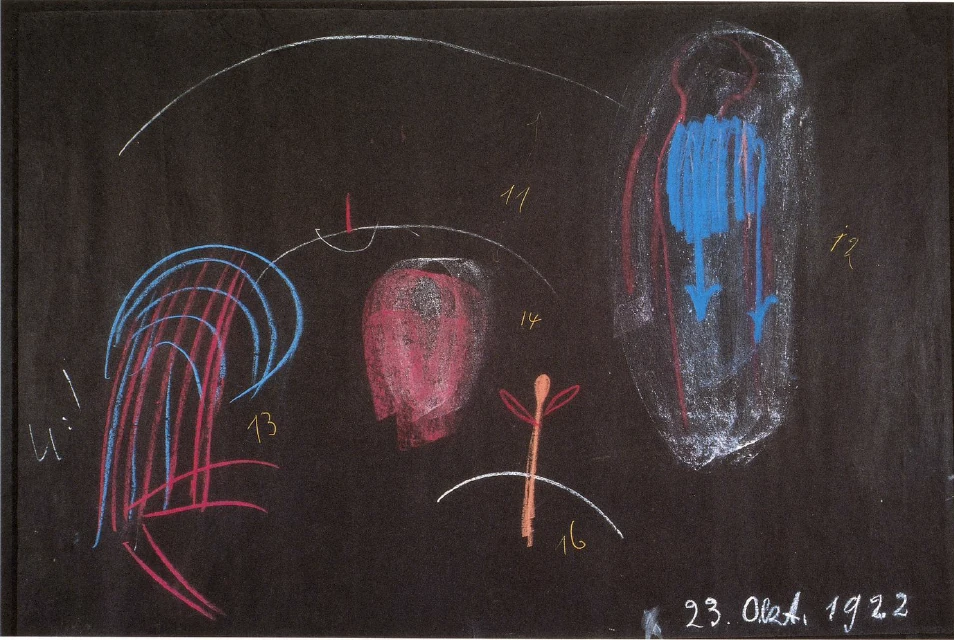
[ 22 ] Ich will das noch einmal an einem Beispiel klarlegen. Nehmen wir einmal an, der heutige Arzt diagnostiziert meinetwillen Herzerweiterung. Er macht das in der Weise, wie man das heute macht, und er findet die Herzerweiterung. Man kann nicht viel anfangen mit einer solchen Diagnose. Man hat vielleicht probiert, ob dieses oder jenes da helfend wirken kann, aber man weiß ja keinen Zusammenhang. Man weiß keinen Zusammenhang, weil man die ganze Sache nicht durchschaut. Ein richtiges Durchschauen aber wird folgendes ergeben. Nehmen Sie einmal an, daß, wie ich Ihnen öfter auseinandergesetzt habe, der Mensch doch eigentlich seinen Organismus immer nach sieben Jahren erneuert. Ich habe Ihnen aber auch das letzte Mal gesagt, wie diese Erneuerung geschieht. Da werden immerfort vom Nierensystem aus die unverarbeiteten Stoffe gewissermaßen nach aufwärts oder auch nach vorne oder nach unten geschickt. Vom Kopfsystem aus wird die Abrundung vollzogen (siehe Zeichnung), so daß fortwährend vom Kopfsystem aus solche Wellen gehen (blau), welche die Form bewirken, und vom Nierensystem aus solche Wirkungen stattfinden, die durch die Wellen abgebrochen und geformt werden (rot), viermal schneller, habe ich gesagt.
[ 22 ] I’d like to clarify this once more with an example. Let’s assume, for the sake of argument, that a doctor today diagnoses me with an enlarged heart. He does so using the methods common today, and he finds that my heart is enlarged. There isn’t much one can do with such a diagnosis. One might have tried to see if this or that could help, but one doesn’t know the connection. One doesn’t know the connection because one doesn’t fully understand the whole picture. A true understanding, however, will reveal the following. Suppose, as I have often explained to you, that the human being actually renews his organism every seven years. But I also told you last time how this renewal takes place. Unprocessed substances are constantly sent out from the kidney system, so to speak, upward, forward, or downward. The head system carries out the rounding off (see diagram), so that waves (blue) continuously emanate from the head system, which bring about the form, and effects (red) take place from the kidney system, which are interrupted and shaped by the waves—four times faster, as I have said.
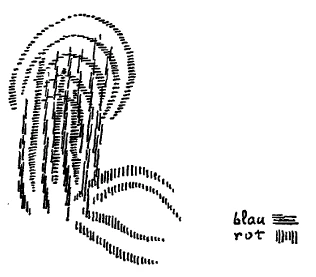
[ 23 ] Nehmen Sie ein solches Organ wie das Herz (siehe Zeichnung Seite 102, hell}. Auch da findet ungefähr nach sieben, acht Jahren bei jedem Menschen ein solcher Austausch statt. Das Herz wird erneuert. Es wird neu gemacht. Dasjenige, was Sie an den Fingernägeln sehen, daß sie nach außen hin wachsen, immer nachwachsen, wenn man sie abschneidet, das ist auch beim ganzen Menschen so: daß er vom Mittelpunkte her die Materie immer erneuert. Nun denken Sie aber einmal, es sei der rhythmische Mensch nicht in Ordnung, es sei so, daß für seine Organisation viel zu schnell diese Strahlen vom Nierensystem herschießen, daß also nicht das richtige Verhältnis von vier zu eins besteht. Das variiert für jeden Menschen, jeder Mensch ist in dieser Beziehung eine Individualität, aber es ist das mit Bezug auf seine ganze Menschheitskonstruktion der Fall. Nehmen Sie also an, es sei das nicht in Ordnung, es schlage ein zu schnelles Strahlen vom Nierensystem her. Was wird dadurch geschehen?
[ 23 ] Take an organ such as the heart (see illustration on page 102, light-colored). There, too, this kind of renewal takes place in every person after about seven or eight years. The heart is renewed. It is remade. Just as you see with your fingernails—that they grow outward and always regrow when you cut them—so it is with the whole human being: the body constantly renews its matter from the center out. Now, however, imagine that the rhythmic human being is not functioning properly—that the rays from the renal system are shooting out far too quickly for his organism, so that the correct ratio of four to one is not maintained. This varies from person to person; every human being is an individual in this regard, but it is true in relation to the structure of the human being as a whole. So suppose this is not in balance—suppose the rays from the renal system are emanating too rapidly. What will happen as a result?
[ 24 ] Dadurch kann nämlich das Folgende geschehen. Der Erneuerungsprozeß geschieht ja fortwährend — nehmen wir also an, bevor das alte Herz ganz heraußen ist, ganz weggeworfen ist (siehe Zeichnung, hell), ist das neue schon hineingeschoben (rot). Da geht es zu schnell. Wenn die Erneuerung zu schnell geht, so kommen solche Erscheinungen wie die Herzerweiterung. Am allerersten werden Sie an der beginnenden Herzerweiterung nachweisen können, daß an der Nierentätigkeit etwas nicht in Ordnung ist. Gerade wenn Sie diese Dinge ernst nehmen von der Erneuerung des Menschen in sieben, acht Jahren, da werden Sie sehen: wenn das schon nach sechs Jahren fertig ist, was erneuert werden soll, so ist das Alte noch nicht genügend fortgeschoben, und das Organ dehnt sich, oder strebt wenigstens darnach, sich zu dehnen. So muß man die Dinge anschauen lernen, in lebendiger Bewegung anschauen lernen. Das steht vor uns. Wir müssen vor allen Dingen dasjenige sehen, was man immer nur abgegrenzt hat. Wie diagnostiziert denn heute der Arzt?
[ 24 ] This is because the following can happen. The renewal process is, after all, ongoing—so let’s assume that before the old heart is completely out, completely cast aside (see diagram, light-colored), the new one has already been pushed in (red). That’s too fast. If the renewal proceeds too quickly, phenomena such as heart enlargement occur. First and foremost, you will be able to tell from the onset of heart enlargement that something is not right with kidney function. Precisely when you take these matters seriously—the renewal of the human being over seven or eight years—you will see: if what is supposed to be renewed is already complete after six years, then the old has not yet been sufficiently pushed aside, and the organ expands, or at least strives to expand. So one must learn to look at things, to observe them in living motion. This is what lies ahead of us. Above all, we must see what has always been merely compartmentalized. How does a doctor diagnose today?
[ 25 ] Der heutige Arzt diagnostiziert so, daß er am liebsten außen aufzeichnet die Konturen des Herzens, so recht eben dasjenige, was fertiges Organ ist. Es kommt gar nicht so sehr darauf an, hinzuschauen, wie das fertige Organ ist, denn es ist eben ein Organ, das immer wegflutet und wieder nachgeschoben wird. Und in diesem Weggehen und Nachschieben ist ein innerlich Beweglicheres, und wenn ich es aufzeichne, so ist es im Grunde genommen so, wie wenn ich den Blitz aufzeichne; es ist in einer fortwährenden Beweglichkeit. Ich muß also, wenn ich den Menschen erfassen will, ihn in seiner Lebendigkeit erfassen. Und diese Lebendigkeit, die finde ich heute nur, wenn ich die ganze Welt verstehe und den Menschen aus der Welt heraus.
[ 25 ] Today’s physician makes a diagnosis by tracing the contours of the heart from the outside—precisely that which constitutes the finished organ. It doesn’t really matter that much to look at what the finished organ is like, because it is, after all, an organ that is constantly receding and then advancing again. And in this receding and advancing there is something more internally dynamic, and when I depict it, it is essentially like depicting a flash of lightning; it is in a state of constant motion. So if I want to grasp a person, I must grasp them in their aliveness. And this aliveness—I can find it today only if I understand the whole world and view the person from within that world.
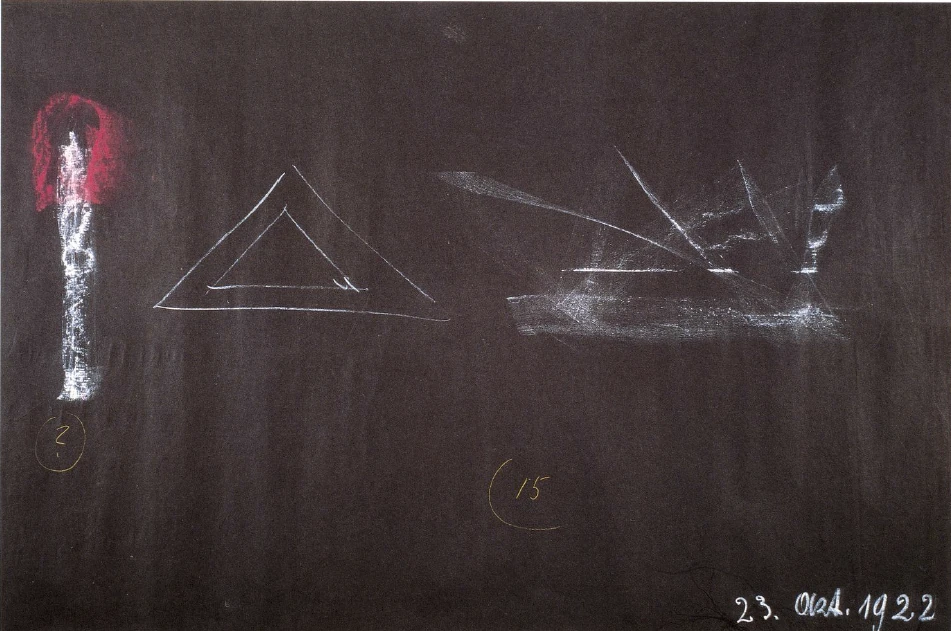
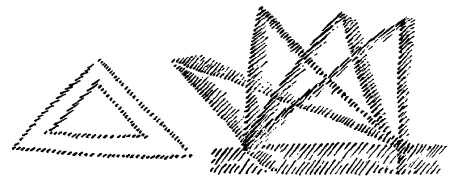
[ 26 ] Das steht vor uns: es muß alles in bewegliches Erkennen übergehen. Vor allen Dingen müssen wir eigentlich schon in der Schule anfangen mit der Beweglichkeit. Es ist etwas Fürchterliches, wenn wir die Kinder im Unbeweglichen halten in der Schule. Es ist zum Beispiel mir immer schon etwas Schweres, daß die Kinder, sagen wir, irgendein fertiges Dreieck haben, mit dem sie alle möglichen Sachen machen. Dieses Stillstehende ist eigentlich nichts. Man müßte im Grunde genommen so etwas haben, wo das Dreieck verschiebbar ist. Darauf kommt es an, daß das Kind richtig die Vorstellung bekommt, daß das alles nur in Bewegung erfaßt werden soll (siehe Zeichnung).
[ 26 ] This is what lies ahead of us: everything must transition into flexible cognition. Above all, we really need to start fostering this flexibility as early as elementary school. It is a terrible thing when we keep children stuck in rigidity at school. For example, it has always been a bit of a struggle for me that children are given, say, a ready-made triangle with which they do all sorts of things. This static state is actually meaningless. Basically, we should have something where the triangle can be moved. What matters is that the child truly grasps the idea that all of this is to be understood only in motion (see drawing).
[ 27 ] Es ist natürlich furchtbar schwer, sich über diese Dinge mit denjenigen, die am liebsten ihren Frieden haben wollen und nur ja nicht so irgend etwas haben möchten, wo man als Mensch tätig sein muß, es ist schwer, sich mit solchen Menschen zu verständigen, die ihre Ruhe und ihren Frieden haben möchten, und die auch schon bös sind, wenn die Kinder spektakulieren, und nun auch noch die Unterrichtswerkzeuge spektakulieren sollen. Es ist etwas Furchtbares natürlich: aber es ist so, wir müssen zum Lebendigen übergehen. Und das alles zusammengefaßt, ergibt eben die Forderung, ins helle, lichte Zeitalter hinaufzukommen. Wir müssen eintreten aus dem finsteren ins helle lichte Zeitalter.
[ 27 ] Of course, it is terribly difficult to discuss these matters with those who want nothing more than their peace and quiet and certainly do not want anything that requires them to be active as human beings; it is difficult to communicate with such people, who want their peace and quiet and who are already annoyed when the children make a fuss, and now the teaching materials are supposed to make a fuss as well. It is, of course, a terrible thing—but that is how it is; we must move on to what is alive. And all of this, taken together, amounts to the call to ascend into the bright, luminous age. We must step out of the dark age and into the bright, luminous age.
[ 28 ] Und weil die Menschen es nicht können — das heißt, sie reden sich ein, daß sie es nicht können —, weil die Menschen nicht wollen, weil die Menschen an dem Alten hängen und nicht eintreten wollen ins Neue, und weil das Alte nicht mehr hereinpaßt, deshalb ist es, daß wir die schrecklichen Katastrophen in der Gegenwart erleben. Und wir werden sie noch mehr erleben, wenn die Menschen sich nicht bequemen, ins Neue einzutreten.
[ 28 ] And because people are unable to do so—that is, they convince themselves that they cannot—because people are unwilling, because people cling to the old and do not want to embrace the new, and because the old no longer fits, that is why we are experiencing these terrible catastrophes in the present. And we will experience even more of them if people do not bring themselves to step into the new.
[ 29 ] Das, was als Katastrophe auftritt, das ist ja die Reaktion des finsteren Zeitalters, das nicht mehr in die Gegenwart hereingehört. Aber da ist es natürlich furchtbar schwer, Verständnis zu finden, weil höchstens in dem Gegensatz zwischen dem Alter und der Jugend heute so etwas auftritt wie eine Ahnung von dem neuen lichten Zeitalter. Die Jugend sagt in der Regel: Ach, die Alten sind Philister. — Auch das hat ja seine Vorgänger. Der große deutsche Philosoph Johann Gottlieb Fichte hat ja das schon vorgeahnt, indem er den klassischen Ausspruch tat, daß man eigentlich alle Dreißigjährigen totschlagen sollte, weil der Mensch eigentlich nur bis zu seinem dreißigsten Jahre anständig ist. Das ist ja ein berühmter Fichtescher Ausspruch, und da Goethe, als Fichte ihn getan hat, schon wesentlich älter war, so hat er sich furchtbar geärgert und hat dann diese ganze Lehre in seinem «Faust» im zweiten Teile verspottet. Es war ja auch ärgerlich, nicht wahr, für Goethe. So findet man, daß die Jugend ja schon damit einverstanden ist, daß die Alten Philister sind, aber bis jetzt ist es eben noch nicht zu großem Ernst gekommen mit solchen Dingen, weil die Jugend das bis zu einem gewissen Lebensalter macht, und dann in der Regel sogar ein noch größerer Philister wird, als die Alten es gewesen sind. Es geht ganz hübsch in das Philisterium über. Die Dinge müssen eben auch von dieser Seite aus innerlich genommen werden.
[ 29 ] What appears as a catastrophe is, after all, the reaction of the dark age, which no longer belongs in the present. But of course it is terribly difficult to find understanding there, because it is only in the contrast between old age and youth today that something like a glimpse of the new, luminous age emerges. Young people usually say: “Oh, the old folks are philistines.” — This, too, has its precedents. The great German philosopher Johann Gottlieb Fichte had already foreseen this when he made the classic remark that one should actually kill all thirty-year-olds, because human beings are, in fact, decent only until they reach the age of thirty. That is, of course, a famous saying of Fichte’s, and since Goethe was already considerably older when Fichte made it, he was terribly annoyed and then mocked this entire doctrine in the second part of his *Faust*. It was indeed annoying, wasn’t it, for Goethe. So one finds that young people already agree that the older generation are philistines, but so far such matters haven’t been taken all that seriously, because young people act that way up to a certain age, and then, as a rule, become even greater philistines than the older generation ever were. It transitions quite smoothly into philistinism. These things must also be understood from this perspective.
[ 30 ] Ich meine also, daß es sich schon darum handelt, daß wir nun wissen: entweder Spenglerismus, das heißt Niedergang des Abendlandes, oder Sich-Anbequemen dem neu auftretenden Zeitalter des Lichtes gegenüber der Finsternis, in welcher die Menschen dem Kosmos gegenüber Regenwürmer waren. Das ist nicht anders. Aber es mußte in der Geschichte eine Zeitlang der Mensch Regenwurm sein, weil er sonst von dem Lichte ganz hingenommen wäre. Er konnte seine Freiheit nur erringen im finsteren Zeitalter, und zwar erst eigentlich am Ausgange des finsteren Zeitalters, in der neueren Zeit. Er konnte seine Freiheit nur dadurch erringen, daß das Licht ihn ungeschoren ließ, daß er ein Regenwurmdasein führen konnte.
[ 30 ] So I believe that the issue at hand is this: we now know that the choice is between Spenglerism—that is, the Decline of the West—and adapting to the newly emerging Age of Enlightenment, as opposed to the darkness in which humans were mere earthworms in relation to the cosmos. It is no different than that. But for a time in history, man had to be an earthworm, because otherwise he would have been completely swallowed up by the light. He could only win his freedom in the dark age—and indeed, only truly at the end of the dark age, in modern times. He could only win his freedom because the light left him unharmed, allowing him to lead the life of an earthworm.
[ 31 ] Nun aber sagte ich Ihnen, die Menschen des älteren lichten Zeitalters haben vorzugsweise das Licht der Pflanzenwelt empfangen. Die Pflanzen tranken gewissermaßen das kosmische Licht, und der Mensch trank wiederum aus dem Becher das Licht, das ihm die Pflanzen darreichten.
[ 31 ] But as I told you, the people of the earlier Age of Light received the light primarily through the plant world. The plants, so to speak, drank in the cosmic light, and humans, in turn, drank from the cup the light that the plants offered them.
[ 32 ] Wir haben heute nur das tote Licht. Aber auf den Strahlen dieses toten Lichtes ist einstmals der Christus hereingezogen und hat das Mysterium von Golgatha vollbracht. Das ist das große Weltengeheimnis der neuen Zeit. Zwar haben wir das tote Licht. Das tote Licht kann uns nicht selig machen. Aber auf den Strahlen des toten Lichtes ist der Christus auf die Erde hereingezogen, hat das Mysterium von Golgatha vollbracht. Und wenn wir außer uns auch heute das tote Licht haben, dann können wir in uns den Christus beleben. Und mit dem Christus in richtiger Weise in uns, beleben wir alles Licht auf Erden um uns herum, tragen Leben in das tote Licht hinein, wirken selber belebend auf das Licht. Das heißt, wir müssen mit dem richtigen Christus-Impuls in das neue Zeitalter des Lichtes eintreten. Und die Verleugnung des Christus-Impulses ist es im Grunde genommen, welche die Menschen davon abhält, richtig zu sehen, wie ein finsteres Zeitalter in das lichte Zeitalter hinübergeht.
[ 32 ] Today we have only the dead light. But upon the rays of this dead light, Christ once descended and accomplished the Mystery of Golgotha. This is the great cosmic mystery of the new age. True, we have the dead light. The dead light cannot bring us salvation. But it was upon the rays of this dead light that Christ entered the earth and accomplished the Mystery of Golgotha. And even if we have only this dead light outside of us today, we can still enliven Christ within ourselves. And with Christ truly present within us, we enliven all the light on earth around us, bring life into the dead light, and ourselves have a life-giving effect on the light. This means that we must enter the new age of light with the right Christ impulse. And it is, in essence, the denial of the Christ impulse that prevents people from seeing clearly how a dark age gives way to the age of light.
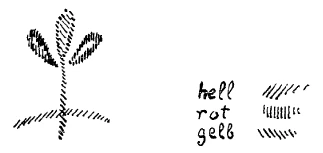
[ 33 ] Es ist schon so. Wenn die Pflanze herauswächst aus der Erde (siehe Zeichnung S. 105), so entwickelt sie, wie ich Ihnen schon gezeigt habe, den Fruchtknoten oben noch mit den Kräften aus dem vorigen Jahre; nur die Blütenblätter wachsen aus dem Lichte dieses Jahres heraus. Dasjenige, was die Pflanze aus der Erde herauszieht, ist eigentlich vom vorigen Jahre. So daß es ein recht konserviertes Licht war, was die Pflanzen den Menschen einstmals im alten lichten Zeitalter gegeben haben. Wir müssen eben die Möglichkeit finden, das tote Licht mit demjenigen Gemüte in der Welt aufzufassen, das in uns erzeugt wird, indem wir die Kraft des Christus in der lebendigen Anschauung des Mysteriums von Golgatha aufnehmen. Dann beleben wir, wie ich es dargestellt habe, das Licht. Das können wir aber nur, wenn wir alle Dinge versuchen lernen so anzuschauen, wie ich das eben gerade in diesen Vorträgen versuchte, vor Ihnen auseinanderzusetzen.
[ 33 ] It is indeed true. When the plant grows out of the ground (see illustration on p. 105), it develops the ovary at the top using the forces from the previous year, as I have already shown you; only the petals grow from the light of this year. What the plant draws out of the earth actually comes from the previous year. Thus, it was a well-preserved light that the plants once gave to humankind in the ancient age of light. We must simply find a way to perceive this dead light in the world with the spirit that is generated within us as we take in the power of Christ through the living contemplation of the Mystery of Golgotha. Then, as I have described, we will enliven the light. But we can only do this if we learn to view all things in the way I have just attempted to explain to you in these lectures.