

Spiritual Connections
in the Structure of the Human Organism
GA 218
20 October 1922, Dornach
Translate the original German text into any language:
Versions Available:
Spiritual Connections in the Makeup of the Human Organism, tr. SOL
3. Geistige Zusammenhänge in der Gestaltung des menschlichen Organismus I
3. Spiritual Connections in the Structure of the Human Organism I
[ 1 ] Es handelt sich bei Betrachtungen, wie wir sie vor kurzer Zeit hier angestellt haben, darum, daß auf der einen Seite die großen Ereignisse der Geschichte, überhaupt der menschlichen Entwickelung, im Laufe des Erdendaseins stehen, und auf der anderen Seite der einzelne Mensch vor uns steht. Und im Grunde genommen sind doch die Sachen so, daß man wahrhaft verständnisvoll das eine nur dann durchschauen kann, wenn man es auch gegenüber dem anderen zustande bringt. Und so möchte ich denn heute zu dem, was uns vor einiger Zeit große geschichtliche Ausblicke geben sollte, eine Betrachtung über den Menschen selber hinzufügen, damit diese beiden Auseinandersetzungen sich dann in den nächsten Tagen gewissermaßen wiederum zusammenfinden können. Wenn wir den Menschen beschreiben, so wie wir ihn ja öfter vom Gesichtspunkte anthroposophischer Weltanschauung aus uns vor die Seele gestellt haben, so haben wir an ihm zu unterscheiden zunächst den physischen menschlichen Organismus, wir haben dann diesen physischen menschlichen Organismus vom ätherischen Organismus durchdrungen, und in dieses System, das sich aus physischem und ätherischem Organismus bildet, eingegliedert den astralischen Organismus und das Ich. Wir können entnehmen aus der Art und Weise, wie der Mensch in den Schlafzustand und von diesem wieder zurück in den Wachzustand übergeht, daß stärker gebunden sind auf der einen Seite physischer Organismus und ätherischer Organismus, und auf der anderen Seite wiederum Ich und astralischer Organismus. Denn wenn auch im Wachzustande des Menschen diese vier Glieder der menschlichen Natur ineinandergefügt sind, so trennen sie sich doch im Schlafzustande so, daß einerseits Ich und astralischer Organismus gewissermaßen mehr zusammenhalten und auf der anderen Seite physischer und ätherischer Organismus. So daß also der astralische Organismus und der ätherische Organismus nicht so straff, möchte ich sagen, zusammenhalten, wie zum Beispiel das Ich und der astralische Organismus oder der physische und der ätherische Organismus.
[ 1 ] The point of the reflections we have recently undertaken here is that, on the one hand, there are the great events of history—and indeed of human development as a whole—in the course of earthly existence, and on the other hand, there is the individual human being standing before us. And fundamentally, the situation is such that one can truly understand one aspect only when one is also able to relate it to the other. And so today, I would like to add a reflection on the human being himself to what was intended some time ago to provide us with broad historical perspectives, so that these two lines of inquiry may, in a sense, come together again in the coming days. When we describe the human being—as we have often done from the perspective of the anthroposophical worldview—we must first distinguish the physical human organism, then we find this physical human organism permeated by the etheric organism, and integrated into this system—formed by the physical and etheric organisms—are the astral organism and the “I.” We can infer from the way in which a person transitions into the state of sleep and back again into the waking state that, on the one hand, the physical organism and the etheric organism are more closely bound together, and on the other hand, the “I” and the astral organism are more closely bound together. For even though these four aspects of human nature are interwoven in the waking state, they separate in the sleeping state in such a way that, on the one hand, the “I” and the astral body remain more closely united, and on the other hand, the physical and etheric bodies do so. Thus, the astral body and the etheric body do not hold together as tightly, I might say, as, for example, the “I” and the astral body, or the physical body and the etheric body do.
[ 2 ] Wenn wir diese Dinge im einzelnen dann betrachten wollen, so müssen wir sie einmal in ihrer Wirkungsart uns vor die Seele stellen. Und da möchte ich zunächst vom Konkreten ausgehen. Der Mensch sieht die Umwelt. Was heißt das eigentlich: Der Mensch sieht die Umwelt? — Wollen wir zunächst das einmal ganz rein auf das Tatsächliche hin ins Auge fassen. Der Mensch sieht die Umwelt — heißt, irgend etwas wirkt auf ihn. Aber wir müssen uns fragen, wenn es sich um den vollständigen Menschen handelt, auf was wirkt da zunächst die Umwelt?
[ 2 ] If we wish to examine these things in detail, we must first consider how they take effect. And here I would like to start with the concrete. A person perceives the environment. What does that actually mean: that a person perceives the environment? — Let us first consider this purely in terms of the facts. A person perceives the environment—which means that something is acting upon them. But we must ask ourselves, when it comes to the whole person, what is it that the environment acts upon first?
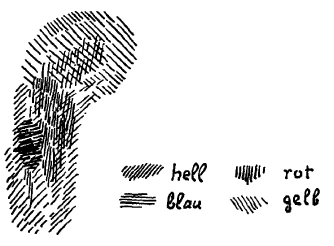
[ 3 ] Nun, wenn es auch für eine oberflächliche Betrachtung so aussehen könnte, als ob auf den physischen Organismus des Menschen dasjenige wirkt, was da beim Sehen aus der Umwelt herauskommt, so ist es doch nicht so. Wir haben zwar, wenn wir der Außenwelt sehend gegenüberstehen, das physische Auge (siehe Zeichnung, hell). Gewiß, wir haben das physische Auge, aber alles, was im physischen Auge vor sich geht, das ist erst etwas Mittelbares. Was zunächst geschieht, das ist eigentlich ein Spiel von Vorgängen im Ich und im astralischen Organismus. Ich will das dadurch andeuten, daß ich das Auge mit diesem (gelb) als dem Ich durchsetze — es geht natürlich dann weiter in den Organismus hinein — und mit diesem (rot) als dem astralischen Organismus. Wir müssen uns ganz klar sein, dasjenige, was zuerst in Betracht kommt, wenn wir sehen, das sind Vorgänge im Ich und im astralischen Organismus. Sie können das eigentlich unmittelbar erkennen, wenn Sie nicht oberflächlich, sondern etwas intimer Ihr Sehen ins Auge fassen. Sie brauchen sich nur darauf zu besinnen, wenn Sie zum Beispiel irgendwo eine rote Farbe sehen, ob Sie sich selber in dem Augenblicke, wo Sie das Rot sehen, unterscheiden können in bezug auf Ihr Ich von diesem Rot. Sie können das nicht, Sie können sich nicht unterscheiden von diesem Rot, Sie sind dieses Rot. Dieses Rot ist etwas, was Ihr Bewußtsein ganz erfüllt. Sie sind nichts anderes als dieses Rot. Sie können ja das ganz besonders gut dadurch sehen, daß Sie, sagen wir, sich vorstellen, dieses Rote wäre das einzige, was Sie sehen können. Sie sehen eine große rote Fläche. Sie müssen sich erst besinnen, wenn Sie diese große rote Fläche anschauen, daß Sie ein Ich sind. Sie müssen erst das Ich abtrennen. Aber während Sie die große rote Fläche anschauen, während dieser Zeit ist das Rot und das Ich zusammengeflossen. Und ebenso ist es mit dem astralischen Organismus des Menschen.
[ 3 ] Now, even though at first glance it might seem as if what comes from the environment when we see affects the human physical organism, this is not the case. It is true that when we face the external world with our eyes, we have the physical eye (see illustration, light-colored). Certainly, we have the physical eye, but everything that takes place within the physical eye is only something mediated. What happens initially is actually a play of processes within the “I” and within the astral organism. I want to illustrate this by interweaving the eye with this (yellow) as the “I”—it naturally extends further into the organism—and with this (red) as the astral organism. We must be very clear that what comes into play first when we see are processes within the “I” and the astral organism. You can actually recognize this immediately if you look at your vision not superficially, but with a bit more depth. You need only reflect on this when, for example, you see the color red somewhere: can you, at the very moment you see the red, distinguish yourself—in terms of your “I”—from that red? You cannot; you cannot distinguish yourself from that red—you are that red. This red is something that completely fills your consciousness. You are nothing other than this red. You can see this particularly clearly by, let’s say, imagining that this red is the only thing you can see. You see a large red surface. When you look at this large red surface, you must first reflect on the fact that you are an “I.” You must first separate the “I.” But while you are looking at the large red expanse, during that time, the red and the “I” have merged. And it is the same with the human astral organism.
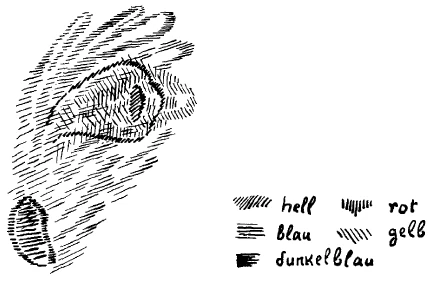
[ 4 ] Also das erste, was wir ins Auge zu fassen haben, wenn wir sehen, sind Vorgänge im Ich und im astralischen Organismus. Beim Auge kommt in Betracht — sehen Sie sich nur einmal an, in welch komplizierter Weise das Auge in Betracht kommt —, daß der Mensch ein Nierensystem hat; ich zeichne es hier schematisch (dunkelblau). Dieses Nierensystem gehört zunächst dem physischen Organismus des Menschen an und hat in sich feste Bestandteile. Sie wissen, ich habe Ihnen öfter gesagt: der Mensch hat nicht so außerordentlich viel Festes, Mineralisches in sich. Er ist zu neunzig Prozent eigentlich eine Wassersäule. Aber er hat immerhin feste Bestandteile in sich. Diese festen Bestandteile schwimmen eigentlich fortwährend im Flüssigen, im Wäßrigen. So daß wir zu gleicher Zeit dieses Nierensystem als den Ausgangspunkt anzusehen haben von Wäßrigem, das nicht nur in der Absonderung vom Nierensystem vorhanden ist, sondern das durch den ganzen Organismus geht, unter anderem auch ins Auge heraufgeht.
[ 4 ] So the first thing we must consider when we look is the processes taking place in the “I” and in the astral organism. With regard to the eye—just consider for a moment how complex the role of the eye is—it is important to note that human beings have a kidney system; I’ll sketch it here schematically (dark blue). This renal system belongs, first and foremost, to the human physical organism and contains solid components. As you know, I’ve often told you: the human being does not contain an extraordinary amount of solid, mineral matter. Ninety percent of the human body is actually a column of water. But he does, after all, have solid components within him. These solid components are, in fact, constantly suspended in the liquid, in the aqueous medium. Thus, we must regard this renal system as the point of origin of the aqueous substance, which is not only present in the secretions of the renal system but also flows through the entire organism, ascending, among other places, into the eye.
[ 5 ] Aber dieses Wäßrige, das da vom Nierensystem gewissermaßen ausstrahlt in den ganzen Organismus und auch bis ins Auge hineinstrahlt, das ist durchaus nicht ein totes Wäßriges, sondern das ist ein lebendes Wäßriges. Sie würden eine ganz falsche Vorstellung bekommen von dem, was im Menschen das Flüssige, das Wäßrige ist, wenn Sie sich innerhalb des lebendigen menschlichen Organismus vorstellen wollten (siehe Zeichnung, blau), daß man es da mit Wasser zu tun hat, so wie es im Bach fließt. Das ist nicht der Fall. Im Bach haben wir totes Wasser, im menschlichen Organismus haben wir lebendes Flüssiges. Es ist nicht nur die Plasmaflüssigkeit lebendig, es ist alles Flüssige im menschlichen Organismus lebendig. Und in diesem Flüssigen sind fein aufgelöst auch überall diese Ihnen früher schon genannten festen Bestandteile, die gewissermaßen auf den Wogen des Flüssigen fortgetragen werden, auch bis in die Augen hinein. Wiederum auf den Wogen der inneren Flüssigkeit strahlt der ätherische Organismus des Menschen in die Augen hinein. Im Auge begegnet sich jetzt zweierlei. Der ätherische Organismus des Menschen (blau) füllt das Auge aus, vom Auge den Sehnerv; und was jetzt in diese vom ätherischen Organismus ausgefüllte Flüssigkeit hineinströmt, das ist das astralische Bild, das im menschlichen astralischen Leibe entsteht (rot). Und dies hier (gelb) ist das, was durch das Ich entsteht. Das strömt da hinein; es strömt da auch weiter.
[ 5 ] But this watery substance, which, so to speak, radiates from the renal system into the entire organism and even into the eye, is by no means a lifeless watery substance; rather, it is a living watery substance. You would get a completely wrong idea of what the fluid, the watery substance, is in the human being if you were to imagine, within the living human organism (see drawing, blue), that you are dealing with water there, just as it flows in a stream. That is not the case. In a stream we have dead water; in the human organism we have living fluid. It is not only the plasma fluid that is alive; all fluids in the human organism are alive. And finely dissolved throughout this fluid are the solid components I mentioned earlier, which are, so to speak, carried along on the waves of the fluid, even into the eyes. Again, riding the waves of the inner fluid, the human etheric organism radiates into the eyes. Two elements now meet within the eye. The human etheric organism (blue) fills the eye and, from there, the optic nerve; and what now flows into this fluid filled by the etheric organism is the astral image that arises in the human astral body (red). And this here (yellow) is what arises through the “I.” It flows in there; it also flows onward from there.
[ 6 ] Dadurch aber kommen zusammen im menschlichen Auge und auch im menschlichen Sehnerven einmal der Eindruck von außen, der eigentlich zuerst im Ich und im astralischen Leibe war, und dann von innen der physische Leib und der ätherische Leib; der physische Leib getragen auf den mineralischen Bestandteilen der menschlichen Natur, der ätherische Leib getragen auf den flüssigen Bestandteilen der menschlichen Natur.
[ 6 ] As a result, however, the human eye and the human optic nerve simultaneously receive, on the one hand, the external impression—which was originally present in the “I” and the astral body—and, on the other hand, from within, the physical body and the etheric body; the physical body is supported by the mineral components of human nature, and the etheric body is supported by the liquid components of human nature.
[ 7 ] Nun ist das so, daß das nicht beim Auge bleibt; sondern was das Auge da vermittelt, das strahlt in den übrigen Organismus hinein. Wir haben es überhaupt beim Sehen zu tun mit einer Begegnung desjenigen, was da auf eine außerordentlich komplizierte Weise sich abspielt im Ich und im astralischen Leib mit demjenigen, was gewissermaßen vom Inneren des Organismus entgegenschlägt als physischer und als ätherischer Leib, aber als physischer Leib in den mineralischen Bestandteilen, und als ätherischer Leib auf den Wogen der lebendigen Flüssigkeit. Nun, was ich Ihnen da für das Sehen gezeigt habe, das spielt sich eigentlich fortwährend im menschlichen Organismus ab. Fortwährend begegnen sich im menschlichen Organismus der ätherische Leib, ich möchte sagen, unter dem Antriebe des physischen Leibes auf den Wogen der lebendigen Flüssigkeit, und der astralische Leib mit alldem, was äußere Eindrücke sind, impulsiert von dem Ich. Und von der Art und Weise, wie sich diese beiden Ströme in uns begegnen, hängt eigentlich unsere ganze menschliche Verfassung, unsere ganze innere Situation ab, denn sie müssen sich in der richtigen Weise begegnen. Was heißt das: sich in der richtigen Weise begegnen? Nun, da haben wir es wiederum mit etwas außerordentlich Kompliziertem zu tun. In der Hauptesorganisation des Menschen, da ist es zunächst so (s. Zeichnung S. 56), daß das Haupt eigentlich ein plastisches Abbild ist der Kräfte, die der Mensch im vorirdischen Dasein als seelisch-geistiges Wesen hatte. Das Haupt ist plastisch ausgebildet, und es wird auch im Embryonalleben sehr früh ausgebildet und es behält eigentlich nur übrig die Kraft, zu gestalten. Das menschliche Haupt, wenn es nicht diese Kraft, zu gestalten, hätte, wäre eigentlich ein toter Körper. Dieses menschliche Haupt ist ein wunderbares Gebilde. Es ist ein getreulicher Abdruck des physischen, des ätherischen, sogar des astralischen Leibes, sogar des Ich, es bildet ab, wie diese hereinkommen aus überirdischen Welten in das Erdendasein. Das Haupt bildet sich wirklich aus als ein Abbild jener kosmischen Erlebnisse, die der Mensch im vorirdischen Dasein durchgemacht hat, und es behält nur zurück die plastisch bildenden Kräfte. Wenn wir das Kind betrachten, so geht eigentlich von seinem Kopfe alle plastische Bildungskraft aus. Vom Kopfe strahlt in den übrigen Organismus das hinein, durch das der Mensch während seines Wachsens seine Organe in der entsprechenden Weise plastisch ausgestaltet erhält.
[ 7 ] The fact is that this does not stop at the eye; rather, what the eye conveys radiates into the rest of the organism. In seeing, we are essentially dealing with an encounter between what takes place in an extraordinarily complex way within the “I” and the astral body, and what, so to speak, strikes back from within the organism as the physical and etheric bodies—the physical body in its mineral constituents, and the etheric body on the waves of the living fluid. Now, what I have shown you here regarding vision actually takes place continuously within the human organism. Continuously, within the human organism, the etheric body—I would say, driven by the physical body upon the waves of the living fluid—encounters the astral body with all that constitutes external impressions, driven by the “I.” And our entire human constitution, our entire inner state, actually depends on the way these two currents meet within us, for they must meet in the right way. What does that mean: to meet in the right way? Well, here again we are dealing with something extraordinarily complicated. In the organization of the human head, the situation is initially as follows (see drawing on p. 56): the head is actually a plastic image of the forces that the human being possessed in pre-earthly existence as a soul-spiritual being. The head is plastically formed; it develops very early in embryonic life and essentially retains only the power to shape. If the human head did not possess this power to shape, it would essentially be a lifeless body. This human head is a marvelous structure. It is a faithful imprint of the physical, the etheric, and even the astral body—and even of the “I”—depicting how these enter earthly existence from the super-earthly worlds. The head truly takes shape as a reflection of those cosmic experiences that the human being has undergone in pre-earthly existence, and it retains only the plastic-forming forces. When we observe a child, all plastic-forming power actually emanates from its head. From the head, a force radiates into the rest of the organism, through which the human being, during his or her growth, maintains the plastic shaping of his or her organs in the appropriate manner.
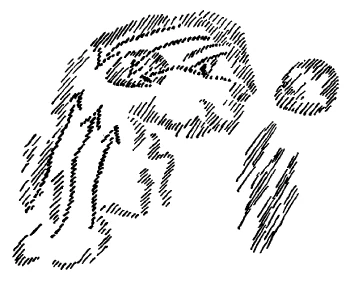
[ 8 ] Also, was vom Haupte ausgeht, das ist durchaus nur plastisch bildende Kraft. Und wenn so etwas jetzt ins Haupt hereindringt wie das, was beim Sehen hereinkommt, so wird es eigentlich gleich so empfangen, daß eine Kraft sich bildet, die gestalten will. Was da durch die Augen hineingeht, das will innerlich im Menschen Gestalt annehmen. Vor allen Dingen will es die Nerven, das Nervensystem so gestalten, daß gewissermaßen im Inneren des Menschen eine Art Abbild ist von dem, was als äußerer Eindruck da war. Man kann also sagen: in dieser Richtung (siehe Zeichnung, Pfeile von oben nach unten), von den Sinnen nach innen, geht eine gestaltende Kraft. Diese Kraft will den Menschen gewissermaßen in feiner Weise zur Bildsäule machen. Es ist wirklich so: alles, was wir sehen, will uns eigentlich in einer gewissen feinen Weise zur Bildsäule machen. Dagegen kommt dieser Kraft, also zum Beispiel hier vom Nierensystem in all dem, was ich hier beschrieben habe, eine andere Kraft entgegen (Pfeile von unten nach oben). Die löst fortwährend auf, was da gestaltet werden will. Denken Sie sich, wie das ist. Wenn ich Ihnen das aufzeichnen will, so müßte ich sagen: Vom Auge aus, da will sich hier ein sehr feines Bild, eine Gestalt bilden. Bis zum physischen Gestaltbilden will das gehen. Es findet immer eine Art solcher Einfluß statt, daß sich Salzsubstanzen, die sonst aufgelöst sind, gewissermaßen zusammenbacken, daß sie also festes Salz werden wollen. Es findet also fortwährend eine Tendenz zum Gestalten statt. Nun, von da unten geht immer eine Tendenz aus, das wiederum aufzulösen. So daß wir fortwährend im menschlichen Organismus von außen nach innen eine Tendenz haben, das, was eine Bildsäule werden soll; und von innen wird es immerfort wiederum aufgelöst.
[ 8 ] So, what emanates from the head is, in essence, purely a formative, plastic force. And when something like that enters the head—such as what enters during the act of seeing—it is actually received in such a way that a force is formed which seeks to shape. What enters through the eyes seeks to take shape within the human being. Above all, it seeks to shape the nerves—the nervous system—in such a way that, so to speak, there is a kind of image within the human being of what was there as an external impression. One can therefore say: in this direction (see drawing, arrows from top to bottom), from the senses inward, a formative force flows. This force seeks, in a sense, to transform the human being into a statue in a subtle way. It is truly the case that everything we see actually seeks to transform us into a statue in a certain subtle way. However, this force is counteracted—for example, here from the renal system in all that I have described—by another force (arrows from bottom to top). This force continually dissolves what is seeking to take shape. Imagine what this is like. If I were to illustrate this for you, I would have to say: Starting from the eye, a very subtle image, a form, seeks to take shape here. This process aims to extend all the way to the formation of a physical shape. There is always a kind of influence at work whereby salt substances—which are otherwise dissolved—clump together, as it were, seeking to become solid salt. So there is a constant tendency toward formation. Now, from down below there is always a tendency to dissolve it again. So that in the human organism we constantly have a tendency from the outside toward the inside to form what is to become a statue; and from the inside, it is constantly being dissolved again.
[ 9 ] Dieser Vorgang, der durch die Begegnung des Astralischen mit dem Ätherischen, das auf den Wogen des Flüssigen dem Astralischen entgegenkommt, sich abspielt, der ist für das menschliche Leben von einer immensen Wichtigkeit, er bedeutet eigentlich im Grunde genommen das ganze menschliche Leben. Denn nehmen Sie einmal an, es teilt Ihnen heute abend irgend jemand etwas mit. Das ist auch ein Eindruck. Er kommt auf andere Weise sinnenfällig zustande, als wenn Sie eine rote Fläche sehen, aber es ist auch ein Eindruck. Das, was Ihnen da mitgeteilt wird, das will wiederum in Ihnen Gestalt werden. Kann es Gestalt werden, dann bleibt es Ihnen in der Erinnerung. Und wenn Sie gerade einen Kopf haben, der sehr darauf aus ist, immer gleich alle Eindrücke einzusalzen, dann haben Sie ein wunderbares Gedächtnis. Sie können wie ein Automat immer alles abratschen, was Ihnen irgend jemand mitteilt. Aber so ist es bei den meisten Menschen nicht, denn bei den meisten Menschen ist sehr stark die Tendenz vorhanden, wiederum aufzulösen; was da als Flüssigkeitsstrahlung mit dem ätherischen Leib den plastischen Bildekräften entgegenkommt, das löst immerfort auf. Es ist eigentlich ein warmer Strom, der fortwährend auflöst. Wenn man diese Sache betrachtet, dann ergibt sich etwas außerordentlich Interessantes.
[ 9 ] This process, which takes place through the encounter of the astral with the etheric—which flows toward the astral on the waves of the liquid—is of immense importance for human life; in fact, it essentially constitutes the whole of human life. For suppose, for example, that someone tells you something this evening. That, too, is an impression. It arises in a different way than when you see a red surface, but it is still an impression. What is communicated to you in this way, in turn, seeks to take shape within you. If it can take shape, it remains in your memory. And if you happen to have a mind that is very keen on immediately committing every impression to memory, then you have a wonderful memory. You can, like a machine, always rattle off everything that anyone tells you. But that’s not the case for most people, because most people have a very strong tendency to dissolve things again; whatever comes toward the plastic formative forces as a fluid radiation through the etheric body is constantly being dissolved. It’s actually a warm current that is constantly dissolving. When you consider this, something extraordinarily interesting emerges.
[ 10 ] Wenn man zum Beispiel so richtig als Mensch, nicht als ein menschlicher Automat, die Dinge haben will, die man gedächtnismäßig behält, so soll das nicht so sein, daß wenn jemand einem etwas mitteilt, man gleich ein so festes inneres Salzgebilde kriegt, daß man immerzu die Sache abratschen kann. Es gibt solche Menschen, aber man wird dann unselbständig; man selbst ist es dann nicht mehr, der die Dinge erinnert, sondern die Dinge nehmen einen in Anspruch, man wird Automat. Will man ein selbständiger Mensch sein, dann muß folgender Vorgang sich abspielen.
[ 10 ] For example, if one truly wants—as a human being, not as a human automaton—to retain the things one remembers, it should not be the case that when someone tells you something, you immediately form such a solid inner structure of memory that you can constantly rattle off the information. There are people like that, but then you become dependent; it is no longer you yourself who remembers things, but rather the things take hold of you—you become an automaton. If you want to be an independent person, then the following process must take place.
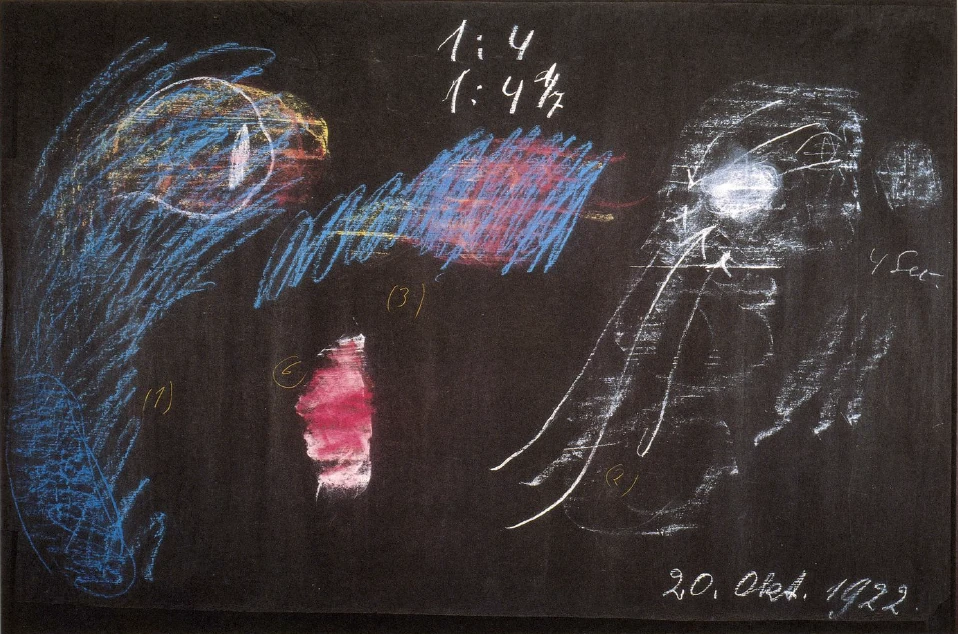
[ 11 ] Zunächst ist das, was Ihnen einer sagt und was man liest, im Ich und im astralischen Leibe und will jetzt durch die Gehirnorganisation, durch die Hauptesorganisation zunächst in die Flüssigkeit eindringen und dann sich konsolidieren, eine Art mineralisches Gebilde, ein salzartiges Gebilde hervorrufen. Aber es ist gut, wenn die innere Strömung kommt und das zunächst auslöscht, so daß höchstens der Eindruck in die Flüssigkeit eindringt — da verschwimmt er aber — und es zunächst zu keinem festen Gebilde kommt. Dadurch, daß es zunächst zu keinem festen Gebilde kommt, bleibt die Sache bloß im astralischen Leibe. Jetzt schläft man die nächste Nacht. Da geht es mit dem astralischen Leibe und mit dem Ich heraus. Da verstärkt es sich etwas während des Schlafzustandes (siehe Zeichnung, rechts). Dann kommt es wieder mit dem Aufwachen herein (links), wird womöglich wieder ausgelöscht; und das geschieht in der Regel drei- bis viermal. Erst nach dem vierten Schlafe ist dann die auslöschende Kraft nicht groß genug mehr, und dann setzt sich das so fest, daß dieses plastische Gebilde, was da drinnen nicht mehr aufgelöst wird, die Grundlage für die Gedächtnisvorstellungen, für die Erinnerungen wird.
[ 11 ] To begin with, what someone tells you and what you read exists in the “I” and in the astral body, and now seeks to penetrate, first through the brain and then through the head, into the fluid, and then to consolidate itself, giving rise to a kind of mineral formation, a salt-like formation. But it is good if the inner current comes and initially wipes this out, so that at most the impression penetrates into the fluid—where it blurs, however—and no solid formation arises at first. Because no solid formation arises at first, the matter remains solely in the astral body. Now one sleeps the following night. Then one goes out with the astral body and the “I.” There it strengthens somewhat during the state of sleep (see drawing, right). Then it returns upon waking (left), and may be erased again; and this usually happens three to four times. Only after the fourth sleep is the erasing force no longer strong enough, and then it becomes so firmly established that this three-dimensional form, which is no longer dissolved within, becomes the foundation for mental images and memories.
[ 12 ] Sie werden sagen: Ich erinnere mich aber auch an diejenigen Dinge, die ich gestern gehört habe, wo ich nicht ein paarmal darüber geschlafen habe. — Ganz richtig; aber darauf kommt es zunächst nicht an. Daß Sie sich an die Dinge, die Sie gestern gehört haben, erinnern, das rührt davon her, daß die Sache noch im astralischen Leibe ist, eventuell noch einen Eindruck im Atherleib macht. Aber man vergißt ja auch nicht gleich nach einem Tag, nicht nach dem zweiten, nach dem dritten Tag. Wenn die Sache wirklich vergessen wird, so ist die innere auflösende Kraft noch nach dem vierten Tag so stark, daß die ganze Sache aufgelöst wird; dann ist sie aufgelöst. Denn wenn bei der Stärke, die da vorhanden ist dadurch, daß das ein viertes Mal hereinkommt, es da noch aufgelöst werden kann, dann vergessen wir unweigerlich die Sache.
[ 12 ] You will say: But I also remember the things I heard yesterday—even though I haven’t slept on them a few times. — Quite right; but that is not what matters at first. The fact that you remember the things you heard yesterday stems from the fact that the matter is still in the astral body, and may still be making an impression on the etheric body. But one does not forget immediately after one day, nor after the second, nor after the third day. If the matter is truly forgotten, then even after the fourth day the inner dissolving force is still so strong that the whole matter is dissolved; then it is dissolved. For if, given the strength that is present due to its coming in a fourth time, it can still be dissolved there, then we inevitably forget the matter.
[ 13 ] Das ist eine sehr interessante Tatsache. Und diese Tatsache, die man beobachten kann auf dem Wege der Imagination, wenn man einfach schaut, wie die Dinge behalten werden, die führt uns auf etwas anderes; die führt uns darauf, zu erkennen, daß der Kopf, das Haupt des Menschen überhaupt ein viel langsamerer Patron ist als der übrige Mensch. Wenn wir von einer Dreigliederung des Menschen gesprochen haben und zunächst den rhythmischen Organismus in der Mitte halten, auf der einen Seite den Nerven-Sinnesorganismus, also den Hauptesorganismus haben, auf der anderen Seite den Gliedmaßen-Stoffwechselorganismus, so können wir sagen: der Hauptesorganismus, der schlägt eigentlich mit seiner ganzen Entwickelung, mit seinem ganzen Sein und Werden ein viel langsameres "Tempo ein als der Stoffwechsel-Gliedmaßenorganismus. Und es ist so, daß während dieses Innen-Zusammenballen (links), dieses Gestalten — es ist ja nicht so, aber ich will es beispielsweise sagen — für irgendeinen Eindruck, sagen wir, eine Sekunde brauchte, so gab es von seiten des Nierensystems aus schon vier Stöße des Auslöschens. Also vier Attacken des Auslöschens gab es schon. (Siehe Zeichnung Seite 56.)
[ 13 ] That is a very interesting fact. And this fact—which can be observed through the power of imagination, simply by looking at how things are retained—leads us to something else; it leads us to recognize that the head, the human head, is in general a much slower entity than the rest of the human being. When we have spoken of a threefold division of the human being and have placed the rhythmic organism in the center—with the nervous-sensory organism, that is, the head organism, on one side, and the limb-metabolic organism on the other—we can say: the head organism, in its entire development, in its entire being and becoming, actually sets a much slower “pace” than the metabolic-limb organism. And it is the case that while this inner gathering (on the left), this shaping—it is not actually like that, but I will say it by way of example—took, say, one second for some impression, there had already been four waves of extinction emanating from the kidney system. So there had already been four waves of extinction. (See drawing on page 56.)
[ 14 ] Das zeigt sich daran, daß unser Puls viermal schlägt, während wir einmal atmen. Das Atmungssystem ist dasjenige, das, was vom rhythmischen System aus hinauf nach dem Haupte wirkt und ihm das viermal langsamere Tempo beibringt. Der Puls, also die Blutzirkulation ist dasjenige, was nach dem Stoffwechsel-Gliedmaßensystem vom rhythmischen System aus wirkt, und ihm das viermal schnellere Tempo beibringt. Und in dem, was sich da ausdrückt durch das viermal schnellere Tempo der Blutzirkulation, in dem liegt alles Auflösende. In demjenigen, wie es sich ausdrückt durch das viermal langsamere Tempo des Kopfes, in dem liegt alles Verfestigende, alles das, was den Menschen eigentlich zur Bildsäule machen möchte.
[ 14 ] This is evident from the fact that our pulse beats four times for every single breath we take. The respiratory system is the one that acts from the rhythmic system upward toward the head and imparts to it a tempo four times slower. The pulse—that is, blood circulation—is what acts from the rhythmic system down toward the metabolic-limb system, imparting to it a pace four times faster. And in what is expressed there by the four times faster pace of blood circulation lies everything that dissolves. In the way it is expressed through the four times slower pace of the head lies everything that solidifies—everything that actually seeks to turn the human being into a statue.
[ 15 ] Es ist schon interessant, daß eigentlich diese Begegnung, die ich Ihnen geschildert habe, also, sagen wir, das Heraufschlagen der Stöße des Nierensystems und das Herunterschlagen der Stöße, die von den äußeren Einflüssen kommen, daß diese auch in einem Rhythmus von Atmung und Blutzirkulation stehen, daß eigentlich, während der Eindruck geschieht, viermai auf einen eine Auflösungsattacke gemacht wird. Und davon rührt es auch her, daß wir viermal darüber schlafen müssen, damit sich der Einschlag von außen genügend befestigt.
[ 15 ] It is quite interesting that this interaction I have described to you—that is, let’s say, the upward surges of the kidney system and the downward surges caused by external influences—is actually in sync with the rhythm of breathing and blood circulation; in fact, as the impact occurs, a dissolution attack is launched four times for every one. And this is also why we need to sleep on it four times, so that the external impact can become sufficiently established.
[ 16 ] Die Dinge gliedern sich in einer wunderbaren Weise zusammen, wenn man wirklich auf die innere Konfiguration des menschlichen Organismus eingehen kann. Aber es hängt das auch noch mit etwas anderem zusammen.
[ 16 ] Things come together in a wonderful way when one can truly understand the inner structure of the human organism. But this is also connected to something else.
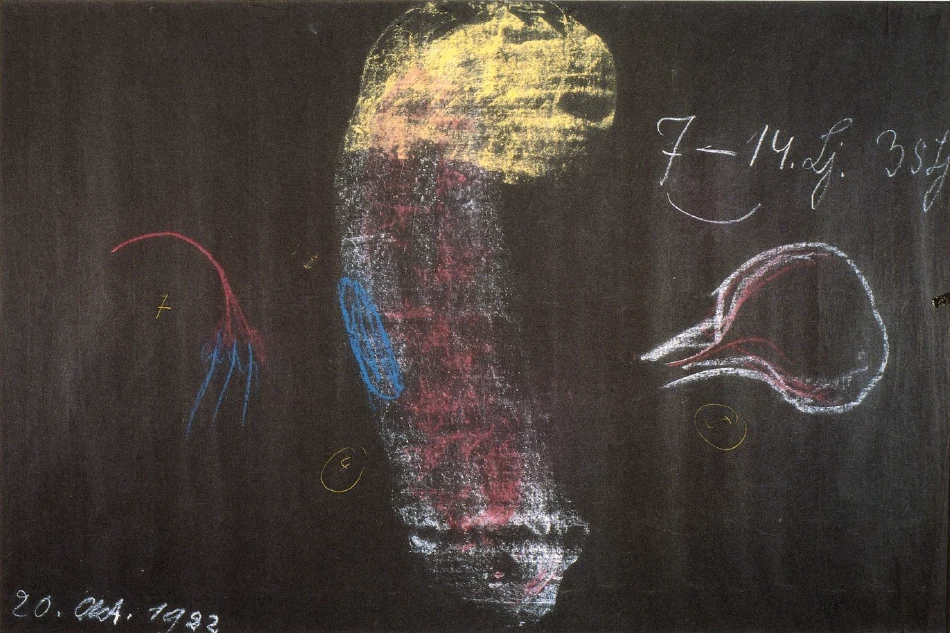
[ 17 ] Sie sehen also, indem wir nach aufwärts beim Menschen gehen, nach dem Haupte zu, kommen wir zu einem Lebenstempo, das viermal langsamer ist als dasjenige, das wir antreffen, wenn wir nach den Verdauungsorganen zum Beispiel gehen, oder sagen wir zu dem Nierensystem. Das Nierensystem arbeitet sehr rasch und bringt das, was es innerlich arbeitet, bis zum Ätherischen hin, das auf den Wogen des lebendigen Wassers schwimmt. Wenn der Mensch seine Augen verschließt und sein Gehirn bewußt abdämpft, und dann dasjenige durchschaut, was von den Nieren ausströmt, so sind es die Imaginationen, die auf dem lebendigen Wasser schwimmen; so stellt sich ihm in Imaginationen sein eigenes Inneres dar. Es ist das ein außerordentlich interessantes Gebilde. Wenn hier das Nierensystem ist (siehe Zeichnung), so strömt vom Nierensystem das sozusagen lebendige Wasser aus nach dem ganzen Organismus. Was da abgesondert wird, ist ja nur eben das Überschüssige, das durch den relativ festen Einsatz nach außen geht; aber gleichzeitig geht auch nach dem ganzen Organismus dieses lebendige Wasser, das durchsetzt wird von dem ätherischen Organismus. In diesem ätherischen Organismus sind aber lauter Imaginationen drinnen (rot), er ist ganz durchsetzt von Imaginationen. Diese Imaginationen, die kann man als das Bild des eigenen Organismus schauen, wenn man das Gehirnbewußtsein und alle Sinneswahrnehmungen abdämpft. Da ist die Sache gesund. Aber wenn die Niere krank ist und eben durch die kranke Niere ein zu starkes Ausstrahlen in das Lebenswasser stattfindet, dann entstehen allerlei Gebilde drinnen und dann kommen die bekannten subjektiven Erscheinungen, die die Nierenkranken zeigen. Was da also arbeitet, was eigentlich im Grunde genommen ein von innerer Körperwärme fortwährend durchpulsiertes Stoßen ist, aber Stoßen in inneren Bildern, was dann sich begegnet mit dem, was von außen kommt, was plastisch werden will, das arbeitet viermal schneller als das, was von außen nach innen arbeitet. Und das zeigt sich nun wieder darin, daß wir gewisse Perioden haben unseres Lebenslaufes, insofern diese Perioden angeschaut werden als vom ätherischen Organismus ausgehend, also gerade von dem ausgehend, was ich hier so gezeichnet habe. Wir müssen ja von siebenJährigen Perioden sprechen, was wir auch tun: vom Zahnwechsel, Geschlechtsreife und so weiter. Wir können zum Beispiel sagen: Der physische Organismus ist am Ende des siebenten Jahres, wenn er gerade daran ist, die zweiten Zähne zu bekommen, am Ende seiner Periode. Da beginnt der ätherische Organismus für sich nun ganz besonders tätig zu sein bis zur Geschlechtsreife. Aber demjenigen, was in diesen periodisch-rhythmischen Vorgängen sich abspielt von sieben zu sieben Jahren, wirkt vom Haupte her etwas entgegen, was diese Prozesse fortwährend verlangsamen will, denn das Haupt geht einen viel langsameren Gang. Das Haupt ist am Ende des achtundzwanzigsten Jahres erst da, wo der hauptsächlichste Mensch am Ende des siebenten Jahres ist. Das ist ein sehr wichtiges Geheimnis der menschlichen individuellen Entwickelung.
[ 17 ] So you see, as we move upward in the human body, toward the head, we encounter a pace of life that is four times slower than the one we find when we move toward the digestive organs, for example, or, let’s say, the renal system. The renal system works very rapidly and carries what it processes internally all the way up to the etheric, which floats on the waves of the living water. When a person closes their eyes and consciously quiets their brain, and then perceives what flows out from the kidneys, it is the imaginations that float on the living water; thus their own inner being is revealed to them in the form of imaginations. It is an extraordinarily interesting structure. When the renal system is here (see drawing), the so-called living water flows out from the renal system into the entire organism. What is secreted there is, after all, merely the excess that is expelled outward through the relatively firm action of the kidneys; but at the same time, this “living water”—interwoven with the etheric organism—also flows throughout the entire organism. Yet this etheric organism is filled entirely with imaginations (red); it is completely permeated by imaginations. These imaginations can be perceived as the image of one’s own organism when one quiets the brain consciousness and all sensory perceptions. In that state, the system is healthy. But when the kidney is diseased and, precisely because of the diseased kidney, there is an excessive outflow into the water of life, all sorts of formations arise within, and then the familiar subjective symptoms characteristic of kidney disease manifest. So what is at work there—which is essentially a continuous pulsation driven by internal body heat, but a pulsation in inner images—encounters what comes from the outside, which seeks to take on a three-dimensional form; this inner process works four times faster than what works from the outside inward. And this is evident once again in the fact that we have certain periods in the course of our lives, insofar as these periods are viewed as originating from the etheric organism—that is, precisely from what I have just sketched here. We must, of course, speak of seven-year cycles, which we do: the change of teeth, sexual maturity, and so on. We can say, for example: The physical organism reaches the end of its period at the end of the seventh year, just as it is in the process of getting its second set of teeth. From that point on, the etheric organism begins to be particularly active in its own right, right up to sexual maturity. But what takes place in these periodic, rhythmic processes every seven years is counteracted by the head, which continually seeks to slow down these processes, for the head proceeds at a much slower pace. At the end of the twenty-eighth year, the head is only where the “main” part of the human being is at the end of the seventh year. This is a very important secret of human individual development.
[ 18 ] Außerlich drückt es sich ja nur dadurch aus, daß wir erst wirklich so in den höheren Zwanzigerjahren uns nach allen Seiten vollständig innerlich und äußerlich ausgewachsen nennen können. Alles, was vom Haupte ausgeht, das vollendet sich wirklich erst in dieser Zeit. Das Haupt ist eigentlich mit achtundzwanzig Jahren erst sieben Jahre alt. Das ist also etwas, was man im ganzen Menschen hat. Wie man auf der einen Seite Atmung und Blutzirkulation hat, wie sich die Atmung zur Blutzirkulation verhält, so verhalten sich im Leben, im ganzen Lebenswerden die Hauptesvorgänge zu den Vorgängen, die vom Verdauungssystem, überhaupt vom Stoffwechsel-Gliedmaßensystem des Menschen ausgehen. Das schlägt auch so aufeinander wie eins zu vier. Das hat eine große Bedeutung für das Leben. Es hat die Bedeutung, daß zum Beispiel alles, was wir einem Kinde erziehend oder unterrichtend zwischen dem siebenten und dem vierzehnten Lebensjahre beibringen, sich eigentlich im Haupte langsam erst auslebt, und sich erst ausgelebt hat im Haupte, so daß es im Haupte nachgekommen ist, bis zum fünfunddreißigsten Lebensjahre; bis zum fünfunddreißigsten Lebensjahre hat es erst im Haupte vollständig ausvibriert. Es kommen viermal sieben Jahre in Betracht. Die ersten sieben Jahre sind vom siebenten bis vierzehnten Lebensjahre, die zweiten sieben Jahre vom vierzehnten bis einundzwanzigsten, die dritten vom einundzwanzigsten bis achtundzwanzigsten, die vierten vom achtundzwanzigsten bis fünfunddreißigsten. Da ist eigentlich erst das Haupt nachgekommen.
[ 18 ] Outwardly, this is expressed only in the fact that it is not until we are well into our late twenties that we can truly say we have fully matured, both internally and externally, in every respect. Everything that originates from the head is only truly completed during this period. The head is, in fact, only seven years old at the age of twenty-eight. This is therefore something present in the whole human being. Just as we have breathing and blood circulation, and just as breathing relates to blood circulation, so too do the processes of the head relate, in life and in the entire process of becoming, to the processes that originate in the digestive system—and indeed in the human metabolic-limb system as a whole. This relationship is roughly one to four. This has great significance for life. It means, for example, that everything we teach a child through upbringing or education between the ages of seven and fourteen actually plays out slowly within the head, and has only fully played out within the head—so that it has been fully realized there—by the age of thirty-five; it is not until the age of thirty-five that it has fully vibrated out in the head. There are four periods of seven years to consider. The first seven years are from the seventh to the fourteenth year of life, the second seven years from the fourteenth to the twenty-first, the third from the twenty-first to the twenty-eighth, and the fourth from the twenty-eighth to the thirty-fifth. It is only then that the mind has truly caught up.
[ 19 ] Das wirft auf eine richtige Erziehungs- und Unterrichtsmethode ein außerordentlich bedeutendes Licht, denn es zeigt Ihnen, daß der Unterricht und die Erziehung so eingerichtet werden müssen, daß es auch ausreicht. Sie können, wenn Sie nur darauf sehen, was das Kind vom siebenten bis vierzehnten Jahre als Interessantes aufnimmt, wodurch es beschäftigt ist, was seinem Auffassungsvermögen angemessen ist, dem Kinde beibringen, was es eben im gegenwärtigen Augenblicke auffassen will. Aber die Vorgänge des Gliedmaßen-Stoffwechselmenschen, die zunächst ja der Träger, der physische Träger sind desjenigen, was da aufgenommen wird, die gehen nach sieben Jahren fort. Jetzt muß etwas bleiben, wenn auch der Stoff fortgegangen ist, muß hingenommen werden können vom Kopf, muß auch bis zum einundzwanzigsten Jahre reichen, dann ist wiederum der Stoff fort; muß bis zum achtundzwanzigsten Jahre reichen, dann ist wiederum der Stoff fort, und muß jetzt noch bis zum fünfunddreißigsten Jahre reichen. Jetzt ist es endlich noch ganz im Ätherleib drinnen, und da ist es nicht so leicht herauszukriegen, weil der nicht immer in derselben Weise ausgeschieden wird.
[ 19 ] This sheds an extraordinarily significant light on proper methods of education and instruction, for it shows you that instruction and education must be structured in such a way that they are sufficient. If you simply observe what interests the child from the ages of seven to fourteen—what occupies the child’s attention and what is appropriate to the child’s capacity for understanding—you can teach the child exactly what the child is ready to grasp at that very moment. But the processes of the human being’s limb-metabolic body—which are, after all, the physical vehicle for what is being absorbed—cease after seven years. Now something must remain; even if the material has departed, it must be able to be assimilated by the head and must also last until the age of twenty-one; then the material is gone again; it must last until the age of twenty-eight, at which point the substance is gone again; and it must now last until the age of thirty-five. By then, it is finally entirely within the etheric body, and it is not so easy to extract from there, because it is not always excreted in the same way.
[ 20 ] Aber Sie sehen, wie im menschlichen Leben die Dinge ineinander wirken, wie wir tatsächlich wissen müssen, daß wir, wenn wir achtundzwanzig Jahre alt sind, wenn wir bloß Kopf wären, eigentlich erst sieben Jahre alt sein würden. Wenn wir fünfunddreißig Jahre alt sind, wenn wir bloß Kopf wären, würden wir eigentlich erst vierzehn Jahre alt sein. Wir werden fortwährend attackiert in unserer ruhigen Entwickelung durch das Stoffwechsel-Gliedmaßensystem in bezug auf das, was der Kopf, was das Haupt des Menschen eigentlich will. Man darf also, wenn man den Menschen verstehen will, das Substantielle des Hauptes nicht gleichwertig betrachten mit dem Substantiellen des übrigen Organismus, sondern man muß das Ineinanderspielen des Stoffwechsel-Gliedmaßenorganismus und des Hauptesorganismus in einem Rhythmus sehen; das geht aber bis ins einzelne Organ hinein.
[ 20 ] But you see how things interact in human life; how we must in fact realize that if we were merely a head at the age of twenty-eight, we would actually be only seven years old. If we were merely a head at the age of thirty-five, we would actually be only fourteen years old. Our peaceful development is constantly challenged by the metabolic-limb system in relation to what the head—what the human head actually wants. Therefore, if one wishes to understand the human being, one must not regard the substance of the head as equivalent to the substance of the rest of the organism; rather, one must see the interplay between the metabolic-limb organism and the head organism as a rhythm—and this extends down to the individual organ.
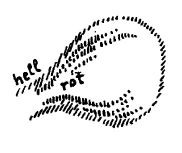
[ 21 ] Nehmen Sie das Auge. Im Auge breitet sich der Sehnerv einerseits aus, auf der anderen Seite aber Blutgefäße (siehe Zeichnung, rot). Dadurch, daß sich Blutgefäße ausbreiten, haben Sie den StoffwechselGliedmaßenorganismus im Auge. Dadurch, daß sich der Sehnerv ausbreitet, haben Sie den Sinnes-Nervenorganismus im Auge. Jetzt schauen Sie ins Auge hinein. Da besteht nämlich ein Verhältnis von eins zu vier im Auge zwischen den Vorgängen im Sehnerv, in der Netzhaut, und dem Blutschlagtempo. Im Auge vibriert fortwährend etwas ineinander, dessen Rhythmen sich verhalten wie eins zu vier. Und auf diesem Ineinandervibrieren zweier verschiedener Rhythmen beruhen die inneren Vorgänge des Auges. Und das, was in der Aderhaut des Auges sich abspielt, das will schon im Auge auflösen dasjenige, was sich im Nerv des Auges konsolidieren will. Der Nerv des Auges möchte fortwährend konturierte Gebilde im Auge schaffen. Die Aderhaut mit dem Blute, das da fließt, will das fortwährend auflösen.
[ 21 ] Consider the eye. In the eye, the optic nerve extends on one side, while blood vessels extend on the other (see diagram, red). Because the blood vessels extend, you have the metabolic system within the eye. Because the optic nerve extends, you have the sensory-nervous system within the eye. Now look into the eye. There is, in fact, a one-to-four ratio within the eye between the processes in the optic nerve and the retina, and the pulse rate. Within the eye, two rhythms are constantly vibrating in unison, their ratios behaving as one to four. And the internal processes of the eye are based on this interplay of two different rhythms. What takes place in the choroid of the eye seeks to dissolve, right within the eye, that which seeks to consolidate itself in the optic nerve. The optic nerve constantly seeks to create contoured structures within the eye. The choroid, with the blood flowing through it, constantly seeks to dissolve these structures.
[ 22 ] Es ist ja nicht so grob, wie man sich das gewöhnlich vorstellt, sondern es ist ja tatsächlich so, daß die Arterien des Auges einen eigenen Verlauf haben und dann die Venen sich wiederum eingliedern (siehe Zeichnung, rot), so daß nicht das eine sich auch an das andere anschließt. Gerade im Auge ist es so, daß eigentlich die Arterie so fließt, daß das Blut gewissermaßen ausströmt und dann erst wiederum von der Vene aufgesogen wird; so daß da ein leises Verfließen und Wiederaufgesogenwerden im Auge entsteht. Es ist nur eine ganz falsche und grobe Ansicht, wenn man glaubt, daß das Arterienblut unmittelbar da in das Venenblut übergeht. Es ist nicht so. Es entsteht da ein feines Ausfließen und wiederum ein Aufsaugen. Und in diesem, was da entsteht als ein solches Ausfließen, da vibriert der Zirkulationsrhythmus, und in dem Nerv, der daran grenzt, in dem vibriert eben der Atmungsrhythmus, und die gehen da ineinander im Auge. So daß das Sehen eigentlich darin besteht, daß diese zwei Rhythmen im Auge aufeinanderprallen. Denken Sie sich, diese zwei Rhythmen wären gleich: dann würden wir nicht sehen.
[ 22 ] It’s not as crude as one might usually imagine; rather, the arteries of the eye actually follow their own course, and the veins then branch off from them (see diagram, red), so that one does not simply connect to the other. In the eye in particular, the artery actually flows in such a way that the blood, so to speak, flows out and is only then reabsorbed by the vein; thus a gentle flow and reabsorption takes place within the eye. It is a completely false and crude view to believe that arterial blood immediately passes into venous blood there. That is not the case. What occurs there is a subtle outflow followed by reabsorption. And within this outflow, the rhythm of circulation vibrates, and in the nerve adjacent to it, the rhythm of respiration vibrates—and these two rhythms intertwine within the eye. Thus, seeing actually consists of these two rhythms colliding within the eye. Imagine if these two rhythms were the same: then we would not see.
[ 23 ] Nehmen Sie einmal an, Sie laufen neben einem Wagen her. Wenn Sie gerade so schnell laufen wie der Wagen, dann werden Sie nichts spüren vom Wagen. Wenn Sie aber viermal langsamer gehen und doch den Wagen halten, dann werden Sie einen Zug verspüren. Der Wagen, der wird weitergehen, und Sie werden zurückhalten müssen, wenn Sie ihn verlangsamen wollen. Und so ist es im Auge drinnen, Dasjenige, was Funktion des Sehnerven ist, das will aufhalten diesen Rhythmus, der viermal schneller ist. Und in diesem Aufhalten, da bildet sich das, was dann die Wahrnehmung ist, die als Gesichtswahrnehmung auftritt, so wie Sie den Wagen spüren, wenn Sie viermal langsamer laufen; wenn Sie gleich schnell mit ihm laufen, spüren Sie ihn nicht.
[ 23 ] Suppose you’re walking alongside a car. If you’re walking just as fast as the car, you won’t feel anything from it. But if you walk four times slower and still keep up with the car, you’ll feel a pulling sensation. The car will keep moving forward, and you’ll have to hold back if you want to slow it down. And that’s how it is inside the eye: the function of the optic nerve is to hold back this rhythm, which is four times faster. And in this holding back, what then becomes perception—which manifests as visual perception—is formed, just as you feel the car when you walk four times slower; when you walk at the same speed as it, you don’t feel it.
[ 24 ] Und sich selber, wodurch erleben Sie sich als Ich? Sie erleben sich dadurch, daß Ihr Kopf viermal langsamer läuft als Ihr übriger Organismus. Das ist das innere Sich-Spüren, das innere Sich-Wahrnehmen, dieses Nachlaufen hinter dem Tempo des Gliedmaßen-Stoffwechselorganismus mit dem, was die Hauptesfunktionen sind.
[ 24 ] And yourself—how do you experience yourself as “I”? You experience yourself through the fact that your head functions four times slower than the rest of your body. This is the inner sense of self, the inner perception of self—this lagging behind the pace of the metabolic activity in your limbs, as carried out by the functions of the head.
[ 25 ] Und unzählige von den Erkrankungserscheinungen des Menschen beruhen eben auf folgendem: Für jeden Organismus ist ein bestimmtes Maß von Gleichgewicht zwischen diesen vier und eins vorhanden. Man kann immer sagen, je nachdem der Mensch so oder so organisiert ist, ist ein gewisses Maß von Gleichgewicht vorhanden. Nicht wahr, es ist ja niemals genau eins zu vier, sondern es sind alle möglichen Verhältnisse; darnach individualisieren sich die Menschen. Aber für jede menschliche Individualität ist ein bestimmtes Verhältnis vorhanden. Wird das gestört, wäre bei einem Menschen, sagen wir, das normale Verhältnis eins zu vier für ein bestimmtes Lebensalter, und würden Verhältnisse eintreten, wodurch das Verhältnis nicht eins zu vier, sondern eins zu viereinsiebentel ist, dann arbeitet die auflösende Kraft zu stark, dann kann der Mensch nicht genug Bildsäule werden. Und Sie brauchen sich nur an gewisse Formen von Krankheiten zu erinnern, wo der Mensch zu stark in sich zerfließt, so haben Sie den Typus solcher Krankheiten.
[ 25 ] And countless human symptoms are based precisely on the following: For every organism, there is a certain degree of balance between these four and one. One can always say that, depending on how a person is constituted, a certain degree of balance exists. After all, it is never exactly one to four, but rather all sorts of ratios; this is what makes people unique. But for every human individual, a specific ratio exists. If this is disrupted—for example, if a person’s normal ratio for a certain age is one to four, and circumstances arise that cause the ratio to shift from one to four to one to four and seven-eighths—then the dissolving force is working too strongly, and the person cannot become a sufficient “statue.” And you need only recall certain forms of illness in which a person dissolves too strongly within themselves; there you have the archetype of such illnesses.
[ 26 ] Ebensogut kann aber auch das andere zu schnell vor sich gehen. Dann entstehen diejenigen Erscheinungen, die sich als Krampfartiges darstellen. Wenn das Astralische durch den ätherischen und den physischen Organismus zu schnell durchvibriert, wenn das Astralische zu schnell durchzuckt und sie nicht langsam genug faßt, dann entstehen die krampfartigen Erscheinungen.
[ 26 ] But the opposite can just as easily happen too quickly. This gives rise to phenomena that manifest as convulsions. When the astral body vibrates through the etheric and physical organisms too quickly—when the astral body flashes through them too rapidly and does not grasp them slowly enough—convulsive phenomena arise.
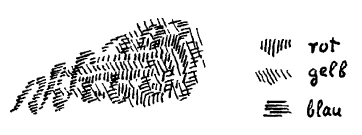
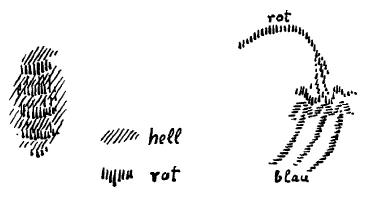
[ 27 ] Nehmen Sie zum Beispiel die gewöhnlichen Kinderkrämpfe. Diese gewöhnlichen Kinderkrämpfe beruhen auf nichts anderem als darauf, daß beim Kinde erst der astralische Organismus und das Ich in richtiger Weise untertauchen müssen in den physischen Organismus und in den ätherischen Organismus. Da muß sich erst das richtige Verhältnis herstellen. Denken Sie sich nun, der astralische Organismus und das Ich, die also zunächst hineinvibrieren in den Gliedmaßen-Stoffwechselmenschen, die vibrieren zu schnell. Der andere Mensch, der kann das nicht sogleich fassen. Wenn es richtig vibriert, dann ist es so, daß wenn Sie hier zum Beispiel ein Stück physischen und ätherischen Menschen haben, der vom astralischen Menschen und dem Ich durchsetzt werden soll, das langsam durchsetzt wird. Ich möchte sagen: Jede Strömung des Astralischen ergreift immer richtig ein Tröpfelchen des Lebenswassers, das vom Ätherischen durchströmt ist. Es paßt sich einander an, wenn das richtige Tempo darinnen ist. Wenn aber das zu schnell hineinvibriert (siehe Zeichnung, rot, hell), dann durchstößt das Astralische das Ätherische und damit auch das Lebenswasser, und es entstehen krampfartige Zustände, was insbesondere als Kinderkrämpfe auftreten kann, weil ja da erst der richtige Rhythmus in diesem Einströmen sich geltend machen muß (siehe Zeichnung, rot, blau).
[ 27 ] Take, for example, the common childhood convulsions. These common childhood convulsions are due to nothing other than the fact that, in the child, the astral organism and the “I” must first properly integrate into the physical organism and the etheric organism. The proper relationship must first be established. Now imagine that the astral organism and the “I”—which initially vibrate into the human being’s limb metabolism—are vibrating too quickly. The other human being cannot grasp this immediately. When the vibration is correct, it is such that if, for example, you have here a portion of the physical and etheric human being that is to be permeated by the astral human being and the “I,” this permeation occurs slowly. I would like to say: Every current of the astral always properly seizes a tiny drop of the water of life that is permeated by the etheric. They adapt to one another when the right tempo is present. But if it vibrates in too quickly (see diagram, red, light), then the astral penetrates the etheric and thus also the water of life, and convulsive states arise, which can occur particularly as childhood convulsions, because the correct rhythm in this inflow must first establish itself (see diagram, red, blue).
[ 28 ] Das hat eine sehr weittragende Bedeutung; das hat zum Beispiel die Bedeutung, daß eine sehr böse Krankheitsform, die heute sehr viel Kopfzerbrechen macht, wenigstens damit ihre Erklärung finden wird: nämlich, daß das richtige Zusammenschlagen in einer besonderen Weise gestört wird; eine solche Erkrankung ist zum Beispiel die bitterböse Kinderlähmung, die dadurch erklärlich wird, aber damit allerdings nicht gleich ihre Heilung findet, weil durch weiter zurückliegende Verhältnisse das Nichtzusammenstimmen bewirkt wird.
[ 28 ] This has very far-reaching implications; for example, it means that a very serious form of illness, which is causing a great deal of concern today, will at least find its explanation in this: namely, that the proper interplay is disrupted in a particular way; one such disease is, for example, the extremely vicious polio, which can be explained in this way, though this does not immediately provide a cure, because the lack of coordination is caused by conditions that lie further back in time.
[ 29 ] Überhaupt ist es nur möglich, in den menschlichen Organismus hineinzuschauen, wenn man solche Verhältnisse wirklich berücksichtigen kann, wenn man weiß, daß da nicht nur in abstrakter Weise der Mensch schläft mit seinem Ich und astralischen Leib außer dem physischen und dem Ätherleib, sondern wenn man weiß, daß in dem, was in der Nacht außer dem physischen und dem Ätherleibe ist, die Impulse liegen zu einer viel langsameren Lebenstätigkeit als in demjenigen, was dann zurückbleibt in der Nacht. Schlafend ist der Mensch fast ganz Gliedmaßen-Stoffwechselmensch, bis ins Gehirn hinauf, denn alles vollzieht sich da unter dem Einfluß vom Gliedmaßen-Stoffwechselmenschen.
[ 29 ] In general, it is only possible to gain insight into the human organism if one can truly take such circumstances into account—if one knows that it is not merely in an abstract sense that a person sleeps with their ego and astral body separate from the physical and etheric bodies, but also when one knows that what exists at night apart from the physical and etheric bodies contains the impulses for a much slower life activity than what remains behind during the night. While asleep, the human being is almost entirely a “limb-metabolic being,” right up to the brain, for everything there takes place under the influence of the limb-metabolic being.
[ 30 ] Nun ist innerlich der Mensch mit Bezug auf alles das, was dem langsamen Rhythmus unterliegt, sehr stark den ahrimanischen Kräften ausgesetzt, mit Bezug auf all das, was dem schnellen Rhythmus entspricht, sehr stark den luziferischen Kräften. Und so könnten Sie auch sagen, wenn Sie sich einmal die Holzgruppe ansehen würden: An derselben ist alles Ahrimanische hingestellt auf den langsamen Rhythmus, der daher verhärtet die Formen und sie spitz und steif macht. In allem Luziferischen ist auf den schnellen Rhythmus hingearbeitet, der alles rundet, weil er schneller abläuft, der daher alles rundet, es nicht versteift, sondern wogend macht. Sie können es da den plastischen Formen ansehen, daß man es zu tun hat mit einem Zusammenschlagen im Verhältnis von drei oder vier zu eins.
[ 30 ] Now, inwardly, the human being is very strongly exposed to the Ahrimanic forces in relation to everything that is subject to the slow rhythm, and very strongly to the Luciferic forces in relation to everything that corresponds to the fast rhythm. And so you could also say, if you were to look at the Wood Group: In it, everything Ahrimanic is set to the slow rhythm, which consequently hardens the forms and makes them pointed and stiff. In everything Luciferic, the focus is on the fast rhythm, which rounds everything out because it proceeds more rapidly; it therefore rounds everything out, does not stiffen it, but makes it undulating. You can see from the sculptural forms that we are dealing with a ratio of three or four to one.
[ 31 ] Diese Dinge sind sowohl wichtig für das Verständnis des gesunden menschlichen Organismus, wie sie wichtig sind für das Verständnis des kranken menschlichen Organismus. Und man wird schon sehen, wie man für die Wissenschaft nötig haben wird diese Ergänzung, die nur von seiten dessen kommen kann, was hier anthroposophische Geisteswissenschaft genannt wird. Ich werde diese Betrachtungen fortsetzen, um sie dann so zusammenzuschließen, daß uns auf der einen Seite aus dem Menschen die Geschichte, und auf der anderen Seite aus der Geschichte der Mensch entgegenkommen wird.
[ 31 ] These things are just as important for understanding the healthy human organism as they are for understanding the diseased human organism. And we shall see how science will need this complement, which can come only from what is here called anthroposophical spiritual science. I will continue these reflections so that I may then bring them together in such a way that, on the one hand, history emerges from the human being, and on the other hand, the human being emerges from history.