

The Relationship of Man to the Starry World
The Spiritual Communion of Mankind
GA 219
23 December 1921, Dornach
Translated by Steiner Online Library
Eighth Lecture
[ 1 ] The mystery underlying the Christmas festival may prompt us to compare it with the mysteries that have arisen from other stages of human development. The Christmas mystery, when understood as a mystery, manifests itself as a distinct winter mystery. It has emerged from views of the spiritual world that focused above all on the relationships established between human beings and their entire earthly environment at the beginning of winter.
[ 2 ] When we turn our attention to those mysteries that, on the one hand, were celebrated in parts of Asia long before the establishment of Christianity and were linked to magnificent cosmic concepts, and when we compare the Christmas mystery with those mysteries that were celebrated in Central Europe, in Western Europe, Northern Europe, were also celebrated in the time before the founding of Christianity, then what strikes us above all is that these mysteries were summer mysteries—that is, they were intended to focus on the connections that link the human being to what takes place in earthly life during the summer season. One can understand what this is all about only by first turning one’s gaze to that part of human development that preceded the Mystery of Golgotha.
[ 3 ] If we look back to the very early stages of human evolution, as we have often done, we find that what was taught in the mysteries was addressed to a humanity that still possessed an older, instinctive form of clairvoyance—a humanity that, in certain states of consciousness lying between the state of deep sleep and the waking state, one might say, in a state of real dreaming, had insight into the spiritual worlds from which human beings descended to take on their physical form on Earth.
[ 4 ] It was a time when virtually everyone could speak of the spiritual worlds and think about them in the same way that people today speak of what they learn through ordinary knowledge acquired in school. I have hinted at this many times before: what people in those ancient times perceived as spiritual and supersensible appeared to them in images. Not in dream images—the images were merely similar to dream images. But while we know quite precisely that dream images are woven together from memories of life, that they arise from the human organism, and do not, like thoughts, represent a reality, it was known through those imaginations of ancient clairvoyance that, although they did not refer to an external sensory reality—nor to the historical reality of human beings—they did refer to a spiritual world hidden behind the sensory world. The spiritual world was thus initially given to human beings in images.
[ 5 ] But one should not imagine that these older people had no thoughts at all. They did have thoughts, but they did not acquire them in the same way that people today acquire their thoughts. If a person today wants to have thoughts, they must make an inner effort to bring them about. They must, so to speak, shape these thoughts from within. These ancient people already engaged in a similar activity, specifically with regard to their images, which depicted a spiritual existence for them. But when they received the images, they received the thoughts along with them. One can even be amazed—highly amazed—at the magnificent, luminous thoughts of this ancient humanity. They were not conceived; they were received as a revelation. Just as we have schools and universities today, people in those days had mysteries in which science, art, and religion were one. No distinction was made between faith and knowledge. Knowledge had become pictorial, but what people believed was firmly grounded in that knowledge.
[ 6 ] Nor was any distinction made between what was created as works of art using various materials and what was acquired as wisdom. Today, people make the distinction by saying that what they acquire as wisdom must be true. But what they incorporate into their materials as painters, sculptors, or musicians is simply imagination. One might say: Goethe was the last holdout who did not share this view. For Goethe regarded what he, as an artist, incorporated into his material as containing truth just as much as he regarded what was scientific to him as containing truth. The true philistinism of distinguishing between the artistic and the pedantic-scientific—this true philistinism—did not begin until later. And Goethe had not yet gone along with this philistinism. Goethe was still able to utter those momentous words when he stood before the works of art he had seen in Italy: “I suspect that the Greeks, in creating their works of art, followed the same laws by which nature itself proceeds, and which I am on the trail of.” — Before he went to Italy, he had carefully studied Spinoza’s philosophy together with Herder in Weimar; he had attempted to immerse himself in a divine-spiritual essence that permeates all beings in the human environment. But he sought to trace this divine-spiritual essence down to the finest details—down to the leaf and the flower of a plant. And the way in which he shaped the forms of plants and animals in his botanical and zoological studies was, in essence, the very same thing he sought to imbue his works of art with.
[ 7 ] Today, it is considered unscientific to speak of a “truth” in art, science, and religion. As I said, those earlier institutions of human education were such that art, science, and religion formed a complete unity. And those who led these mysteries were, above all, the ones who gradually began to extract what was revealed to other people through their instinctive clairvoyance—as thoughts, as specific thoughts—and to establish a wisdom of thought. Everywhere in the mysteries, we see the wisdom of thought springing forth from the clairvoyant perception. While the majority of humanity was, in essence, content to live and weave within a world of imagery, and while the majority of humanity was satisfied to have this imagery elaborated into myths, legends, sagas, and fairy tales by those capable of creating such sagas, myths, and fairy tales, the leaders of the Mysteries developed the teaching for humanity: a wisdom of thought. But they were aware that this wisdom of thought is not acquired through human beings’ own powers; this wisdom of thought has been revealed.
[ 8 ] One need only try to imagine this entirely different state of mind. This state of mind is such that one can say: modern people attribute the formation of a thought to their own mental activity. And they structure the connections between thoughts according to logical rules—their own rules, the rules of their mental activity. People of the past received their thoughts. They did not give any thought to how these connections should be structured, for they received these structures as ready-made revelations. However, these people of the past did not live within their thoughts in the same way that we live within ours. We regard these thoughts as the property of our soul. We know that we have worked to acquire them. They have, so to speak, emerged from our soul, rising up from within ourselves. We regard them as our own. The people of old could not regard their thoughts as their own. These thoughts were illuminations. They had come with the illuminated images. They evoked a very specific mood in these people of old in response to the wise thought. As people looked upon their thoughts, they said to themselves: Something divine from a higher world has descended into me. I share in the thoughts that are actually thought by other beings—beings higher than human beings—who inspire me, who live within me, and who give me these thoughts. I can only regard these thoughts as bestowed upon me by a grace from above.
[ 9 ] Because this older person told himself this, he felt the need, at certain times, to offer these thoughts back to the higher beings through his feelings, so to speak. And this took place in the Summer Mysteries. In the summer mysteries, human beings are open to the expanses of the world because the Earth lives more fully within its sphere, its sphere of influence, its atmosphere; because the Earth has not contracted due to the cold; because the Earth, so to speak, has not wrapped itself in winter’s snowy mantle; because it opens itself to its atmospheric surroundings through constant atmospheric exchange—that is why human beings are open to the expanses of the world. In summer, he felt connected to the higher gods. In those earlier times, he sought out the height of summer—what we would today call the time of St. John, the time when the sun reaches its highest point in the summer sky—he sought this time to connect with the higher gods at certain places that had become sacred to him, in a sense, they sought to make use of what is a natural connection between human beings and the entire ethereal environment—the summertime—in order to offer sacrifices, out of a sense of gratitude, to the gods who had given them their thoughts and revealed themselves to them.
[ 10 ] And when we look into the mysteries—into what the mystery teachers taught their students—it was something like the following. They said: Every year at the height of summer, a sacrifice must be offered to the gods—to the higher gods—for the thoughts they bestow upon human beings; for otherwise, Luciferic forces all too easily interfere with the human experience of thought. — Human beings are permeated by Luciferic powers and forces. They escape this by remembering every summer that the higher gods have given them these thoughts, and by allowing them, as it were, to flow back to the higher gods during this height of summer. This older person sought to protect himself from Luciferic influences by having the leaders of the mysteries summon those who were their adherents and by performing before them that ritual which culminated in offering up to the higher gods, in feelings flowing upward toward them, the very thoughts that had been revealed to them by the higher gods.
[ 11 ] What was performed externally as part of the ritual—the rising smoke into which the recitative words were spoken, causing the smoke to form corresponding waves— was intended only as if people were inscribing into an external medium—into the sacrificial smoke through the form-shaping word—precisely that which actually rose as the spiritual sacrificial smoke from their inner being to the higher gods. In a sense, prayer merely inscribed into the sacrificial smoke what the soul wished to send upward in feelings for the revealed thoughts. This was essentially the mood from which the midsummer mystery celebrations arose. These midsummer mystery celebrations actually had only one purpose as long as people received their thoughts as revelations.
[ 12 ] But in the centuries beginning as early as the 8th and 9th centuries B.C., in the centuries that preceded the Mystery of Golgotha, the thoughts from above—these revealed thoughts—became obscured, and more and more the human being’s ability to attain his own thoughts through his own powers began to awaken. This placed human beings in an entirely different state of mind. Whereas they had previously experienced thoughts as something that came to them as if from the vastness of the cosmos, sinking into their inner being, they began to experience thoughts as something that grows within them, something that belongs to them as much as their own blood. In ancient times, thoughts were regarded as something that belonged to one just as the breath one receives from the atmosphere and constantly returns to it. Just as one regards the air as that which surrounds one, which one draws into oneself but always gives back again, so one perceived thoughts as something one did not draw into oneself but received as a revelation—something one had to deliver, as it were, to the gods again and again during the height of summer.
[ 13 ] These ceremonies were even staged in a dramatic manner, such that the leaders of the mysteries proceeded to their sacrificial rites while bearing the symbols of wisdom. As they performed the sacrifices I have described, they laid aside one symbol after another. And they departed from these sacrificial rites, appearing—after having laid aside the symbols of wisdom—as fools who would have to reclaim their wisdom again in the course of the year. And it was, in a sense, a confession inherent in these ancient sacrificial rites that, having completed their sacrifice, they declared before the crowd—who were their followers: “We have become fools once more.”
[ 14 ] In fact, people saw this as a means of avoiding succumbing to the Luciferic forces by participating in the cycle of the year in such a way that, as midsummer approached, they would ascend into the possession of wisdom, then pass into folly, only to return once more to wisdom. In a sense, this was a way of experiencing the cosmos firsthand. Just as the cosmos alternated between winter and summer, so too did people seek to alternate within themselves between the time of wisdom and the time of entering into the darkness of folly. And it was the case that those whose wisdom was needed throughout the entire year—for example, the Mystery teachers who practiced medicine, since medicine, too, was an integral part of the Mystery system and was one with the rest of it—could not participate in this cycle. For, of course, one was not allowed—if I speak in terms of our months, in August and September—to become a fool as a physician. They were, of course, allowed to retain their wisdom, but in return they made the sacrifice of being merely serving members of the Mysteries, while those who were the leading figures in the Mysteries entered into folly every year.
[ 15 ] What remained of this immersion in folly was something like what Goethe, for example, describes as the Thirteenth in his Mysteries, where a person actually guided others through dullness, not through wisdom. This was a completely different attitude toward what constituted humanity’s guiding wisdom than the later one, in which people began to regard their thoughts as something they had achieved on their own. Whereas, as mentioned, what was once perceived as wisdom—just like the air we breathe—was later perceived as something generated within the human being, much like blood. One might say that in ancient times, thoughts were perceived as being similar to the air we breathe. In the age that then witnessed the Mystery of Golgotha, people began to perceive thoughts as something akin to blood. But with this, people also told themselves: What I experience as a thought is no longer heavenly; it is no longer something that has descended from above. It is something that arises within the human being themselves, something earthly.
[ 16 ] This sentiment—that there is something earthly in human thought—was particularly prominent among the ancient followers of the ancient mysteries, even at the time of the Mystery of Golgotha. Those who were at the forefront of the development of their time said to themselves: One can no longer have thoughts such as those held by the ancient sages, who, in a sense, lived together with the gods in the nurturing of their thoughts; one must develop purely human thoughts. — But these purely human thoughts are in danger of falling prey to the Ahrimanic forces. Just as those thoughts that are revealed to human beings from above are in danger of falling prey to the Luciferic forces, so too are human thoughts—thoughts achieved through one’s own efforts—in danger of falling prey to the Ahrimanic forces.
[ 17 ] Those who were able to think in this way, especially during the time of the Mystery of Golgotha—this sense was then lost in the 4th century—perceived the Mystery of Golgotha as the true redemption of humanity. They said to themselves: The spiritual power that lives with the sun could previously be attained only by the superhuman. Now it must be attained by the human, for human beings have brought their thoughts into themselves. They must now accomplish something else: they must now inwardly elevate these thoughts of theirs to the divine. As an earthly thinker, human beings must inwardly imbue their thoughts with the Divine. They can do this through their emotional and intellectual connection to the Mystery of Golgotha.
[ 18 ] But with this, the mystery rite transformed from a midsummer celebration into a winter celebration. In winter, when the earth is cloaked in its mantle of snow, when the earth is not in lively interaction with its atmospheric surroundings, human beings, too, are more bound to the earth. Then human beings do not experience the vastness of the world; rather, they experience that which, I might say, is rooted beneath the earth. You need only understand this “rootedness” beneath the earth correctly. We can constantly become aware of how, in the earth’s surroundings, it is not only that which comes directly from the sun or from the environment that is alive, but also that which, beneath the earth’s surface, participates in the life of the earth. I have already explained this matter here using very simple examples. Some of you who have lived in the countryside will know that farmers in the countryside dig pits in the winter and put their potatoes in them. The potatoes overwinter well in there, which they would not do if they were simply placed in the cellar. Why?
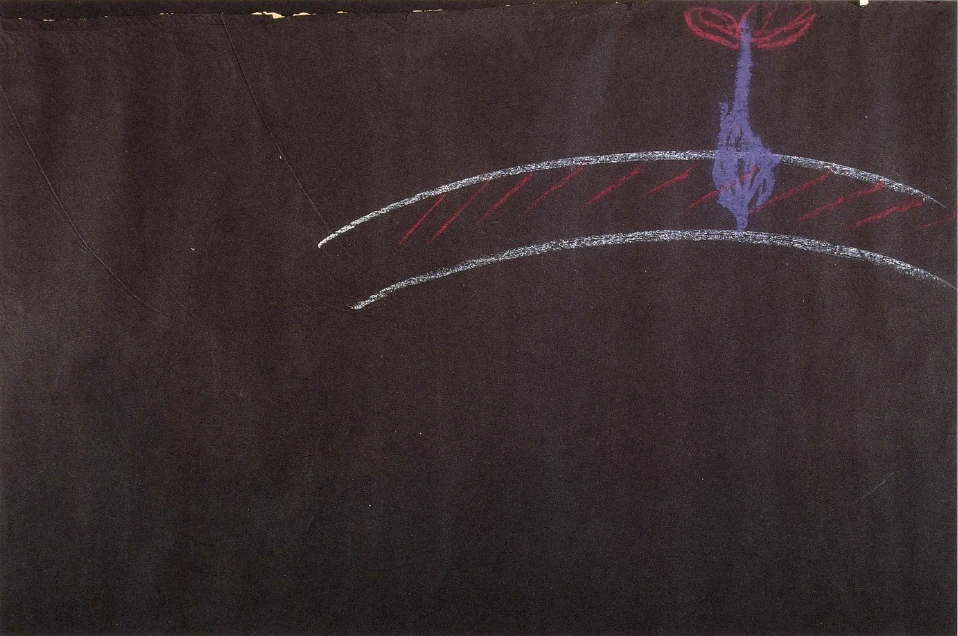
[ 19 ] If you imagine a section of the Earth’s surface here (see drawing): the Earth’s surface absorbs the solar heat and sunlight that flow in during the summer. It sinks, so to speak, into the ground. So that when we turn our attention in winter to what lies beneath the ground, we still have summer there. During winter, summer is beneath the ground. And this summer beneath the ground during winter also allows the roots of plants to thrive. The seeds become roots; the seed develops in such a way that when you see a plant growing this year, it is actually growing out of the power of the sun from the previous year, which has only just entered the earth.
[ 20 ] So when you look at the roots—and even some of the leaves—you see last summer in the plant, and this summer has only just been brought to life in the flower by the sunlight and warmth of the present moment. In fact, in the plant’s new growth we still have last year, and in the flowers we have only this year. And if you look inside the plant’s ovary, which is in the center of the flower, you must say: This is still the result of winter—actually, of last summer—and only what surrounds the ovary is from this year. — The times overlap, just as in another case—as I explained to you yesterday—where, in human beings, the times overlap through sleep; so too do the times overlap here.
[ 21 ] So you can imagine: when the Earth dons its winter mantle of snow, beneath that mantle lies the continuation of summer. Human beings do not connect with what lies in the vast expanses outside, but rather turn their inner lives inward, toward the Earth’s core. They turn to the lower gods. And this was precisely the view held by those who were the heirs to the ancient wisdom at the time of the Mystery of Golgotha, which led them to say to themselves: We must seek, within that which is connected to the Earth, the power of Christ—the new wisdom that permeates the Earth’s becoming.
[ 22 ] And as human beings turned to their own hard-won thoughts, they felt the need to now inwardly unite these thoughts with the Divine—in other words, to imbue them inwardly with the spirit of Christ. He can do this during the time when he is most turned toward the earth—in the depths of winter. He can do this when the earth itself, so to speak, shuts itself off from the cosmos, and when he, too, is shut off. Then he is closest to God, who has descended from those vast expanses—from which we are shut off during the winter—and has united Himself with the earth. And it is a beautiful thought to connect the Christmas season precisely with that time when the earth is cut off from the cosmos, when the human being, in the solitude of the earth, seeks communion with the divine, spiritual, and supersensible for his self-won thoughts. And by understanding what is actually meant here, he seeks to protect himself from the Ahrimanic forces, just as in ancient times he had protected himself from the Luciferic forces through the Midsummer Mysteries.
[ 23 ] And just as the people of old, under the guidance of their mystery teachers, felt as though their world of thought were in a twilight during the midsummer festivals, so too should the person who understands the Christmas mystery in the right way—by imbuing themselves during the Christmas season with truths such as those we have just mentioned—feel strengthened. He should, so to speak, feel how, through the proper relationship he develops to the Mystery of Golgotha, the thoughts he inwardly struggles to attain in darkness can be illuminated by his truly realizing: once, in the process of becoming earthly, the being who in earlier pre-Christian times could only be conceived in connection with the sun made the transition to earthly existence and now inhabits the earth with human beings as spiritual beings. And the Christmas sacrifice should actually be conceived in such a way that, in contrast to the ancient midsummer sacrificial festivals—which were as external as possible—it represents the greatest possible turning inward on the part of human beings; that Christmas is precisely the festival during which human beings attempt to internalize and spiritualize within themselves what they seek to acquire as knowledge of the entire world.
[ 24 ] Ancient people did not regard knowledge as their property, but as a gift. They gave it back each year. People today must regard their world of thought, their intellectual knowledge, as their property. Therefore, they must welcome into their own hearts the One to whom they align themselves—the spirit being connected to the Earth—to whom, in a sense, they surrender their thoughts within themselves, so as not to stand in selfish seclusion with their intellectual possessions, but rather to unite these intellectual possessions with the One who, as the Solar Being, became an earthly being through the Mystery of Golgotha.
[ 25 ] In a certain sense, the ancient mysteries had a sort of—one might say—aristocratic character; indeed, everything aristocratic essentially has its origins in these ancient mysteries, for the individual mystery priests stood there and performed the sacrifices on behalf of everyone else.
[ 26 ] The celebration of the Christmas Mystery has a democratic character, for what people in modern times acquire as that which actually makes them human is their inner world of thought. And the Christmas Mystery is seen in its true light only when one person does not make a sacrifice for another, but when one experiences a sense of community with the other: the becoming equal of human beings in the presence of the being who descended to Earth as a solar being. And this is also what was perceived as particularly significant for Christianity, especially in the early days of Christian development up through the 4th century or so. It was only then that the ancient mystery forms from Egypt, passing through the Roman Empire and spreading up into Western Europe, took root again and, one might say, obscured original Christianity and also shrouded it in traditions that must in turn be abandoned if Christianity is to be properly understood. For the very essence into which Christianity was clothed during the Roman era is still, through and through, the essence of the ancient mysteries.
[ 27 ] Christianity itself certainly calls for this discovery of the spiritual and supersensible within the human being—not when the human being, so to speak, is lost in the outside world and surrendered to the cosmos, but when the human being is centered within themselves. This is most true when a person is connected to the Earth, during the time when the Earth itself is cut off from the cosmic expanses—that is, in the depths of winter.
[ 28 ] With this, I have attempted to explain to you why, over the course of human evolution, the midsummer mystery rituals have transformed into the midwinter Christmas mystery. This must simply be understood in the right sense. And it is precisely a look back at the development of humanity that can help us internalize what the Christmas mystery is meant to embody in a very special way. We can truly feel what a human being must increasingly become—by seeking within themselves the mysteries they would otherwise have sought outside themselves—through the contrast with the old times.
[ 29 ] My Outline of Esoteric Science was also written from this perspective. If such a book—well, if it had become a book, it would have turned out quite differently!—had been written in ancient times, one would have begun by describing the vastness of the stars. In my Occult Science, the starting point is entirely the human being: the human being is, so to speak, contemplated from within, and the world is sought out from the perspective of the human being, with the human inner world expanded to encompass the ancient Saturn, Sun, and Moon eras, and onward to the future epochs of Earth’s evolution.
[ 30 ] In ancient times, when people sought the world’s knowledge, they began with the stars, which they observed from the outside, and tried to take in what the stars told them into the human soul. So, for example, people studied the sun. In the old, imaginative way of knowing, much became clear to them as they came to know the sun. Today, for the true scientist, the sun is a ball of gas—something it naturally cannot be for unbiased observation. For people of the past, insofar as they saw it outwardly with their eyes, it was just as much the physical expression of a spiritual-soul aspect as the human body is the physical expression of a spiritual-soul aspect. People saw much in the sun. Then, once they had, so to speak, read in the cosmos what they saw in the sun, they could lay their hand on their own heart and say: Now I understand the human heart. The sun has told me what the essence of the human heart is. — And in the other celestial bodies, too, people found what they themselves are.
[ 31 ] This approach could not be taken in my Occult Science. Although this is not explained in every detail there—because the time for that has not yet come—the approach taken is nevertheless such that the human being is first considered as a whole (it is drawn), including the heart, lungs, and so on—the individual organs—so that by understanding the individual organs, one can understand the universe. So that today one studies the human heart, one reads within the human heart. And what one has read there tells one what the Sun is; it tells one something about the nature of the Sun. One thus comes to know the nature of the sun from the inside out through the heart. In ancient times, people came to know the nature of the sun, and by knowing the nature of the sun, they knew what the human heart is. In more recent times, people learn what the heart is, what the lungs are, and come to know the entire cosmos, the entire universe, starting from the human being.
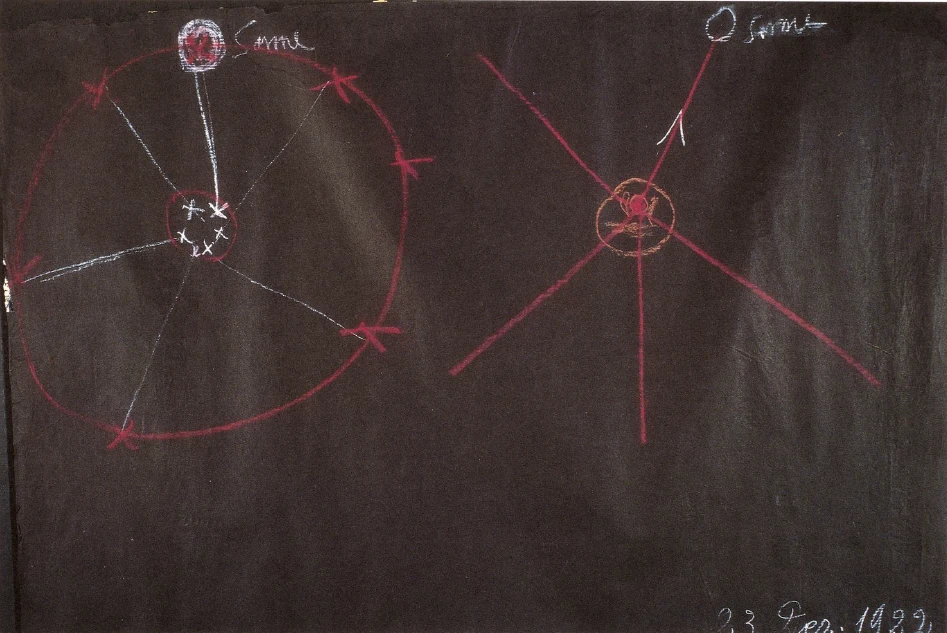
[ 32 ] If one wishes to solemnly express a sensitive awareness of this relationship between humanity and the universe, as an older person one could do so only by standing in the height of summer and looking straight up, because that was when it was easiest and best to gaze upward toward the sun and the rest of the starry sky, in order to become one with the cosmos. If one wishes today to deeply absorb into one’s world of feeling how one can come to know the universe, one must turn one’s gaze deeply inward. According to what I have explained to you, the right time for this is the depths of winter, the Christmas season.
[ 33 ] Try to come to terms with this Christmas idea, because in today’s world we really need such old customs—for that is what they have become—to be revitalized, so that we can once again be sincere about what we experience as part of the cycle of the year, for example. How much do people in many circles today know about the Christmas season other than that gifts are exchanged, and that, in a rather superficial way, they go along with thoughts that simply remind them of the Mystery of Golgotha!
[ 34 ] Such externalizations are precisely to blame for the great misfortune into which humanity has steered itself today with its civilization; they are the true cause. The true cause lies in our habitual clinging to the past and our aversion to the necessity of renewing what, for example, the spirit of Christmas or the Christmas feeling is meant to be. We certainly need such a renewal. We need it because we can only become truly human again by finding our spiritual aspect in the world. A universal Christmas—as I have often said, especially at this time of year—is what we need: a birth of spiritual life. Then we will once again celebrate Christmas as honest people; then it will once again make sense—especially when the earth is cloaked in snow—to seek to draw closer, in the feeling of the permeation of our world of thought by Christ, which is now like the blood within us, as opposed to the old world of thought, which was like the breath within us,
[ 35 ] However, we will once again have to live more in tune with the passage of time than we are accustomed to today. It was not long ago—two decades—that the idea arose to always move Easter, which is at least still aligned with the passage of time, to April 1, so that the ledgers would not constantly be thrown into disarray by this holiday falling on a different day each year. Everything should also be incorporated into the materialistic course of human development with regard to the experience of the passage of time. One could understand that materialistic thinking would gradually—and ultimately—become the norm, since we have seen that people, for example, begin the annual cycle with the current New Year on January 1, even though December—decem—is the tenth month, and January and February quite obviously belong to the previous year, and the new year can begin at the earliest in March, just as it did in Roman times. But once upon a time, a foolish French king—whose folly is even acknowledged by history—decided to start the year in the middle of winter, on January 1, and humanity has followed suit.
[ 36 ] One must truly grasp profound ideas if one wishes to honestly acknowledge: The salvation of human development must be sought through humanity’s connection with wisdom. For there are many facts that suggest that humanity has by no means always been connected with wisdom, but also with folly. Try to grasp the Christmas message in such a way that you become sincere in connecting it to the power that spoke these words: “I am the way, the truth, and the life.” But the path to truth and to life in the spirit must be sought. To this end, it is necessary—especially for humanity today—to truly plunge into the depths of midnight in order to find the light that kindles within the human being.
[ 37 ] We must not cling to the old tradition of celebrating the first Christmas Mass only at midnight; rather, we must return to a time when people experience how their very best—namely, their light—is born out of their darkness. For it is indeed a truth that true light is born out of darkness. However, it is not necessarily further darkness that must be born from this darkness, but rather the light.
[ 38 ] Try to let the spirit of Christmas permeate your soul with that power which comes from the realization that the darkness of other forms of knowledge must be penetrated by the light of spiritual insight and spiritual vision. Then, at Christmas, Christ will be born in each of your hearts. And you will once again experience within yourselves, together with other people, a World Christmas.