The Relationship of Man to the Starry World
The Spiritual Communion of Mankind
GA 219
22 December 1921, Dornach
Translated by Steiner Online Library
Seventh Lecture
[ 1 ] Human beings perceive the things of the world through their senses, but they do not perceive, with ordinary consciousness, what is taking place within their senses themselves. If they were to do so in ordinary life, they would not be able to perceive the external world. The senses must, so to speak, deny themselves if they are to bring to human awareness what lies outside the senses in the world that initially surrounds us on Earth. If, so to speak, our ears spoke, if our eyes spoke—that is, if we were to perceive the processes taking place within our ears and eyes—then we would not be able to hear what is audible externally, nor would we be able to see what is visible externally. But it is precisely through this that human beings come to know the world around them—insofar as they are, first and foremost, earthly beings—yet they do not come to know themselves. Getting to know oneself presupposes that, during this process of self-knowledge, one can bring the perception of the external world to a standstill—that is, that one experiences nothing from the external world.
[ 2 ] It has always been the aim of research in the humanities to identify methods through which human beings can truly come to know themselves, and you know from the various lectures I have given that by this self-knowledge I do not mean that general brooding over one’s everyday self, for through that one experiences nothing other than a kind of reflected image of the external world. In a sense, one learns nothing new. One merely comes to know, as in a mirror, what one has experienced with the sensory external world. True self-knowledge, as you know, must employ methods that not only silence the ordinary earthly external world but also silence the ordinary, everyday inner life of the soul—which, insofar as it exists in actual consciousness, is nothing other than a mirror image of the external world. And through the methods described in my treatise How Does One Attain Knowledge of the Higher Worlds?, you know that spiritual research first advances to what is called imaginative knowledge. Whoever advances to such imaginative knowledge initially has before them everything from the supersensible world that can take the form of the images of imaginative knowledge. But once they have acquired the spiritual practice necessary to view the world imaginatively at all, they are then able to observe precisely what takes place within the human sense organs. One would not be able to observe what takes place in the sense organs if anything were to occur in them only when one perceives the external world through them.
[ 3 ] When I see an object in the external world, my eye remains silent. When I hear any sequence of sounds from the external world, my ear remains silent; that is to say, the ear does not perceive the process taking place within the ear itself, but rather perceives what extends from the external world into the ear. But if, for example, the ear were to perform only an activity related to the external world as long as this external perception is present, we would never be able to observe the process that takes place within the ear itself, independently of the external world. But you all know that a sensory impression continues to have an effect in the senses, apart from the fact that the senses are always involved even when we think vividly with ordinary consciousness.
[ 4 ] It may well be that we, in a sense, abstract from the entire external world—insofar as it is a world of colors, a world of sounds, a world of smells, and so on—and yet devote ourselves to what takes place within our sense organs themselves, or rather, through them. When we reach this point, we arrive at true knowledge of the human being—specifically, the first stage of such knowledge. Let us take, for example—to consider the simplest case—an impression that the external world exerts on the eye and how it fades away. Anyone who has acquired the gift of imaginative perception then observes—without seeing anything outside—this fading of the sensory impression; that is, a process that engages the sense organ as such, without the sense organ being in correspondence with the external world at that moment. Or someone who, thinking in a vivid manner, is able to bring what they have seen to mind, can observe the role played by the organ of sight in such vivid thinking about colors and the like. This can be done for all the senses. Then one becomes aware, in fact, that what takes place within the human senses themselves can only be the object of imaginative cognition.
[ 5 ] A world of imaginings, as it were, immediately conjures itself before our soul when we are not living in the external world, when we are living in our senses. And then we realize how, in fact, our senses themselves belong to a world other than the one we perceive through them during our earthly existence. No one who is truly capable, through imaginative insight, of observing their own sensory activity can ever harbor any doubt that human beings, even as sensory beings, already belong to the supersensible world. The world one comes to know by, so to speak, withdrawing in this way from the external world and living within one’s own senses is the one I also described in my Outline of Esoteric Science as the world of the Angeloi, the world of those beings who stand one level above human beings.
[ 6 ] What actually happens within our senses? We can understand this if we observe the inner workings of the senses in this way while we are not perceiving anything. Just as we can have a memory of what we experienced years ago, even though it is not present now, we can also gain insight from what we observe when we observe the senses without them perceiving anything. It cannot be called a memory, because that would be a very imprecise term, but we can nevertheless perceive, within what we are observing, the processes that occur in our senses through the external world when we are confronted with the entire world of colors, sounds, smells, tastes, tactile sensations, and so on.
[ 7 ] In this way, we can gain insight into something that otherwise always remains unconscious to human beings: the activity of their own senses as they perceive the external world. And there we become aware that the process of breathing—the inhalation of air, its distribution throughout the human organism, and its exhalation—works in an extraordinary way throughout the entire organism. When we inhale, for example, the inhaled air reaches even the finest branches of the senses. And in these finest branches of the senses, the respiratory rhythm interacts with what we in spiritual science call the human astral body. What takes place in the senses is based on the fact that the human astral body perceives the respiratory rhythm. So when you hear a sound, it happens because, in your organ of hearing, the astral body is able to come into contact with the vibrating air. It cannot do this, for example, in any other organ of the human organism; it can only do so in the senses. The senses exist in human beings precisely so that the astral body can encounter what arises in the human body through the rhythm of breathing. And this does not happen only in the organ of hearing; it happens in every sense organ. In each one—including the sense of touch or feeling, which is spread throughout the entire organism—the astral body encounters the respiratory rhythm, that is, the activity of the air within our organism.
[ 8 ] It is precisely when one considers something like this that one realizes all the more how essential it is, in order to view the whole human being, to take into account that the human being is not merely a solid entity; nearly ninety percent of the human body consists of water, and there is a constant exchange of air in its internal processes—thus, the human being is also an air organism. And this air organism, which represents a living, weaving entity, encounters the human astral body within the sensory organ. This occurs, of course, in the sense organs in the most varied ways, but in general one can say that this encounter is the essence of the sensory process. One cannot observe externally how an astral entity encounters the air without entering the world of imagination. Admittedly, when one arrives at imaginative insight, one also perceives other phenomena in the earthly environment that unfold in such a way that an astral entity encounters only the air. But within us as human beings, it is essential that the astral realm encounters the processes of respiration—specifically, in a substantial way, with what is sent through the human organism by the process of respiration.
[ 9 ] Here, then, we come to know the weaving and nature of those beings who belong to the hierarchy of the Angeloi, so that we, as human beings, can only imagine that in the unconscious process that takes place in sensory perception, this world of supersensory beings weaves and lives, entering and exiting, as it were, through the gates of our senses. When we hear or see, this is a process that does not take place solely at our discretion, but also belongs to the objective world—a world in which we, as human beings, are not initially even present, yet through which we are in fact human beings, and indeed human beings already endowed with the senses.
[ 10 ] When, between waking and falling asleep, our astral body comes into contact within the realms of our senses with the air—which has become part of our breathing rhythm and has undergone natural changes—we come to know, I might say, the outermost periphery of the human being. But we can ascend even further. We can come to know even more about the human being. This happens in the following way. It arises from that level of supersensible knowledge which I have described in the works mentioned as “inspired knowledge.”
[ 11 ] Here one must consider how human beings are subject to the alternating state between waking and sleeping. This state, as such, is not so far removed from sensory perception. Our sensory perception, too, is subject to change. We would indeed have perceptions, but they would not have the proper meaning for our consciousness if we could not continually interrupt the act of perceiving. You also know from purely external observations that prolonged immersion in a sensory impression impairs our awareness of that sensory impression. We must, so to speak, repeatedly detach our attention from a single sensory impression; we must therefore alternate between the impression and a state in which we do not have that impression. And the fact that our consciousness functions properly with regard to sensory impressions is based on our ability to always withdraw our senses from their impressions—that is, we actually engage in sensory perception continuously through brief alternating states. We do this for extended periods of our experience by constantly alternating between waking and sleeping over the course of twenty-four hours.
[ 12 ] You know that when we fall asleep, our astral body, together with our “I,” emerges from our physical body and etheric body. And this astral body thus enters into a relationship with the external world between falling asleep and waking up, whereas between waking up and falling asleep it was related only to what takes place within the human body. Consider these two states or these two occurrences: the astral body, between waking and falling asleep, in relation to what takes place within the human physical and etheric bodies; and the astral body, between falling asleep and waking, in relation to the external world—no longer in relation to the human physical and etheric bodies themselves.
[ 13 ] The sensory realms within us—I’d like to use this paradoxical expression; you’ll understand what I mean—are almost like an external world. Consider the human eye, for example: it is like an independent entity—this is all just a comparison, of course—but it really is like an independent entity placed inside a cavity in the skull, continuing inward with a certain degree of autonomy. But if you look at the eye itself: although it is alive, it is strangely similar to a physical apparatus. We can characterize the processes in the eye in a manner strikingly similar to how we characterize them in a physical apparatus. The soul certainly encompasses the processes that arise in this way, but one can certainly say that the sense organs are what I have often chosen to call them: that the sense organs or the sensory realms are like gulfs through which the external world flows into our own human inner being. In a sense, the external world continues within us through the senses, and we humans participate much more in the external world through our sensory regions than through the other regions of our organism.
[ 14 ] When one focuses on any organ—say, the kidney or another internal organ of the human body—one cannot say that one is participating in something external by experiencing the organ’s processes within oneself. But by experiencing what takes place in the senses, we also experience the external world. Please set aside for the moment any knowledge you may have of sensory physiology and the like. That is not what I mean at all; rather, I am referring to the fact—which is entirely accessible to ordinary common sense—that the process taking place in the sensory realm can indeed be understood more as something that extends into us from the outside and in which we participate, rather than as something we bring about internally through our own organism.
[ 15 ] This is also why, in terms of the senses, our astral body is virtually within the external world. In particular, when we are fully and willingly absorbed in sensory perception of the external world, our astral body is in fact almost immersed in the external world—not to the same degree for all the senses, but it is almost immersed in the external world. It is fully immersed when we sleep, so that sleep, from this point of view, is, so to speak, a kind of intensification of sensory immersion in the external world. When you close your eyes, your astral body also withdraws further into the interior of your head; it belongs more to you yourself. When you look outwards properly, the astral body draws into the eye and participates in the external world. When it withdraws completely from your organism, you fall asleep. Sensory devotion to the external world is not, in fact, what is usually meant by the term; rather, it is actually a stage on the path to falling asleep in terms of the nature of consciousness.
[ 16 ] Thus, as a human being, one participates in the external world almost through sensory perception; when sleeping, one participates fully in the external world. Then, between falling asleep and waking up, one can perceive with inspired insight what is happening in the world one now inhabits with one’s astral body. But with this inspired insight, one can also perceive something else: namely, the moment of waking up, the return. In a sense, the moment of waking up becomes something that is merely more intense and stronger, yet can still be compared to closing one’s eyes.
[ 17 ] When I look at a color, I surrender my astral body to that part of the eye which, as I said, is almost on the outside—namely, to the process triggered by a color from the external world making an impression on my eye. When I close my eye, I draw my astral body back into myself. When I wake up, I draw my astral body back from the external world, from the entire cosmos. In fact, I often—indefinitely often—while awake during the day, for example with regard to my eyes or my ears, do the same thing with my astral body that I do—only in its entirety, with regard to the whole organism—when I wake up. I draw my entire astral body back upon waking. This drawing back of the astral body upon waking naturally remains unconscious even to ordinary consciousness, just as the sensory process itself remains unconscious. But when this moment of waking becomes conscious to one who is gifted with inspired insight, it becomes evident that the entry of the astral body belongs to a world entirely different from the one in which we normally find ourselves; and above all, it is very often strongly perceptible how difficult it is for the astral body to return to the physical and etheric bodies. There are obstacles present.
[ 18 ] One might say that anyone who begins to perceive this process of the astral body returning to the physical body and the etheric body experiences spiritual storms with all manner of counter-reactions—spiritual storms with such counter-reactions that reveal the astral body is submerging into the physical and etheric bodies; yet during this submergence, the physical and etheric bodies do not appear as the anatomist and physiologist describe them, but rather as something that also belongs to a spiritual world. What is otherwise the innocent physical body, or what is presumed to be the somewhat nebulous innocent etheric body, reveals itself as rooted in a spiritual world. In its true nature, the physical body reveals itself to be something entirely different from what it outwardly appears to be in a sensory image to the eye or to conventional science.
[ 19 ] This immersion of the astral body into the physical and etheric bodies can manifest in countless ways, such as when a burning piece of wood plunges with a roar into water. This is still the simplest, most abstract form that may initially appear to someone who is just beginning to recognize such things. But then the process takes on a great variety of concrete forms internally, and is subsequently imbued with spirit in such a way that what at first can only—I might say—be compared in its appearance to a roaring thunderstorm or rising storms becomes interwoven with harmonious movements; yet in all their parts, these movements are simultaneously something of which one must say: It speaks, it says something, it proclaims something.
[ 20 ] At first, however, what is emerging takes the form of reminiscences from everyday life. But this transforms over time, and little by little one comes to experience much of a world that is also around us—a world in which one experiences things that cannot be described as reminiscences of ordinary perception, because they are of an entirely different nature; for in this experience one truly knows that one is dealing with another world. Then one realizes that when a person, with their astral body, moves from their surroundings into their physical and etheric bodies, this now takes place through the process of full respiration. The astral body, which is active in the senses, touches the subtle ramifications of the respiratory process and, in a sense, intervenes in the subtle rhythms through which the respiratory process continues into the sensory realms. The astral body, drawing back into the physical and etheric bodies upon awakening from the external world, takes hold of the entire respiratory process, which is left to its own devices between falling asleep and waking up. Following the pathways of the respiratory processes and movements, the astral body enters the physical and etheric bodies, spreading out just as the breath itself spreads out.
[ 21 ] Ordinary consciousness, I would say, quickly plunges into the perception of the external world upon waking and rapidly links the experience of the breathing process with the experience of the entire organism. Inspired consciousness can separate this movement of the astral body along the pathways of the respiratory rhythm and perceive the rest of the organic process separately. Of course, it does not actually occur separately. Not only at this moment, but at every moment, the respiratory movement is naturally intimately connected with the other processes in the human organism. But in insight—in inspired insight—this can be separated. One observes how the astral body enters the physical body along the pathways of the respiratory rhythm, and thereby comes to know something that otherwise remains completely unconscious. After one has passed through all the states—which are objective, not subjective, emotional states—that accompany this entry, one knows that, since the human being is not merely a sensory being but a breathing being, he is rooted in the world that I have called the world of the Archangels in my Occult Science. Just as the beings of the supersensible world who stand one level above human beings are active in the human sensory process, so too are the spiritual beings who stand two levels above human beings active in the human respiratory process. They, so to speak, come and go with our falling asleep and waking up.
[ 22 ] Now, when we consider these processes, something very significant for human life presents itself to our soul. If we had a life that were not interrupted by sleep, we would receive impressions from the outside world, but these impressions would last only briefly. We would be unable to develop a lasting memory. You know how fleeting the images are that appear as afterimages in the senses. Admittedly, what is stimulated deeper within the organism has a longer-lasting effect. But even that would not last longer than a few days if we did not sleep.
[ 23 ] What actually happens while we sleep? I must remind you of a discussion I gave here recently, in which I described how, between falling asleep and waking up, a person actually relives—with their astral body and their “I”—in reverse what they experienced in the physical world during the preceding waking period. Let’s assume a regular waking and sleeping pattern—though it’s quite similar for irregular patterns as well—so let’s assume we wake up one morning, go about our business during the day, retire for the night in the evening, and sleep through the night for about one-third of the time we are awake. Such a person thus experiences a series of events between waking and falling asleep—namely, their daily experiences. During sleep, they truly relive in reverse what was experienced during the day. And the sleep experience unfolds at a faster pace, so that it takes only one-third of the time.
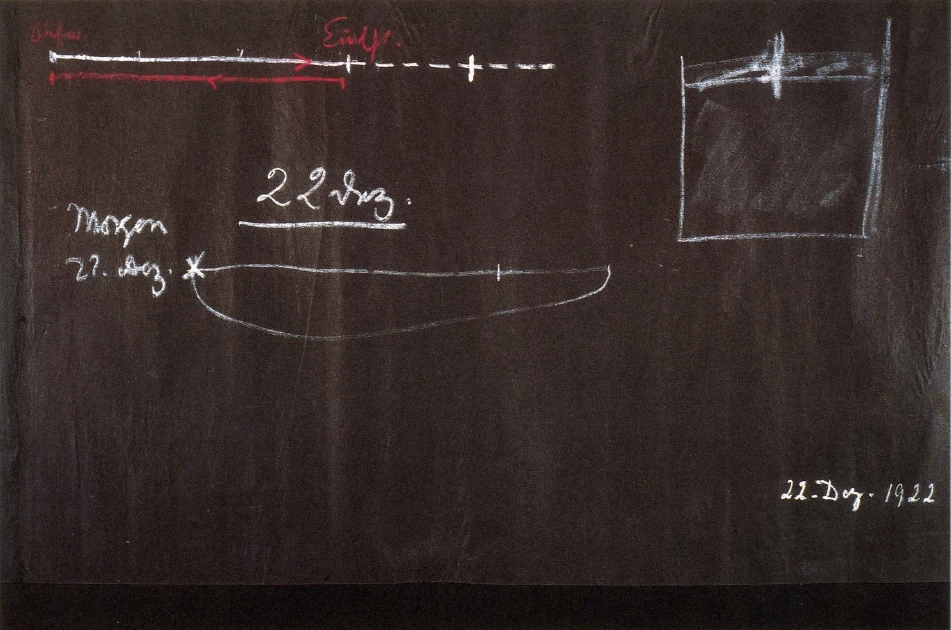
[ 24 ] But now, what actually happened there? If the situation were such that you were sleeping according to the laws of the physical world—and I don’t mean that the body sleeps according to the laws of the external physical world; of course it does— but if you were in states outside the physical and etheric bodies—that is, if you were sleeping in your I and in your astral body according to the same laws by which you are awake during the day—then you would not be able to perform this movement, because you would simply have to move forward in time. We are subject to entirely different laws when we are in our astral body and in our “I,” outside the physical and etheric bodies. And viewed from the outside, how does this actually work? Well, consider this: today is December 22; this morning when you woke up, you were on the morning of December 22. Now, when you go to sleep later, when you wake up tomorrow, your experience of moving backward in time will bring you back to this morning—December 22. You have thus undergone an inner process through which you have moved backward in time. By waking up on the morning of December 23, this process has brought you back to the morning of December 22. You wake up. At that very moment, you are compelled—as your astral body now, contrary to the laws it observed between your falling asleep and waking up, makes the leap through your physical body into the ordinary physical world—to rapidly advance in your innermost soul being, together with your “I” and your astral body, toward the morning of December 23. You are actually undergoing this process internally.
[ 25 ] I now ask you to take what I am saying here in all seriousness—that is, to grasp its full meaning. If you have a gaseous substance—say, in a vessel sealed by some device—you can compress that gaseous substance: it becomes denser and denser. This is a spatial process. But it can be compared—merely compared, of course—to what I have just described to you. You go back in your astral body and in your “I” to the morning of December 22 and move rapidly forward upon waking to the morning of December 23. You propel your soul being forward within time. This is a condensation of time—or, more precisely, of that which lives within time. And through this process, our soul life—our astral body—is condensed within time to such an extent that it carries the impressions of the external world not merely briefly, but as a lasting memory. Just as any gas that you compress exerts greater pressure—that is, possesses greater internal force—so your astral body gains the powerful force of recollection, the powerful force of memory, through this internal compression within time.
[ 26 ] In this way, one gains an idea of something that otherwise always eludes us. We imagine time as something that flows steadily, and everything that takes place within time also flows steadily along with it. With regard to space, we know that what is extended in space can be condensed; its inner force of expansion grows. But what lives in time—the soul—can also be condensed—relatively speaking, of course—and then its inner force grows. And for human beings, one of these forces is the power of memory.
[ 27 ] We do indeed owe this power of memory to the processes that take place while we sleep. From the moment we fall asleep until we wake up, we are in the world of the Archangels, and together with the beings of the hierarchy of the Archangels, we develop this power of memory. Just as we develop the power of sensory perception and the ability to combine sensory perceptions with the beings of the hierarchy of the Angeloi, so too do we develop this more internalized power of memory—one more closely connected to the center—in the world of the Archangeloi.
[ 28 ] True knowledge of humanity does not exist in a nebulous, mystical sense, where one broods inwardly; true knowledge of humanity leads, with every step one takes inward, immediately upward into higher worlds. Today we have spoken of two such steps. If one looks at the realm of the senses—one is in the realm of the Angeloi; if one looks at the realm of memory—one is in the realm of the Archangeloi. Self-knowledge is at the same time knowledge of the gods, knowledge of the spirit, because every step that leads into the human inner being also leads into the spiritual world. And the deeper one penetrates into the inner self, the higher—I would say, to use this paradox—one ascends into the world of spiritual beings. Self-knowledge is true knowledge of the world, namely, knowledge of the spiritual content of the world, when this self-knowledge is a serious one.
[ 29 ] Once again, from this discussion you can see why, in earlier times—when the peoples of the East sought to cultivate an instinctive form of spiritual contemplation—the breathing process was to be transformed into a conscious act through special breathing exercises. As soon as the breathing process becomes conscious, one enters a spiritual world. I need not repeat today that those older exercises should not be repeated by modern people with their altered constitution, but must be replaced by others, which you will find described in the books mentioned. But the following applies to both types of insight—to the insight of the older mystical clairvoyance and to the insight of the newer, precise clairvoyance—namely, that through genuine observation of the processes taking place within the human being, one simultaneously enters the spiritual world.
[ 30 ] There are people who say: Yes, but that way you end up in the non-spiritual realm. You want to investigate sensory processes, investigate respiratory processes. — Some people even call this “materialistic self-knowledge” in contrast to a nebulous mysticism. Just try it once! You will see that the sensory process immediately becomes a spiritual one when you truly get to know it, and that it is merely an illusion to regard it as a material process. The same applies to the respiratory process. The process of breathing is a material process only when viewed from the outside. Viewed from the inside, it is a spiritual process through and through—indeed, one that takes place in a far higher world than the one we perceive through our senses.
[ 31 ] Tomorrow I will give a lecture that is intended to follow on from today’s, but which may perhaps serve more as a transition into a kind of Christmas reflection.