The Relationship of Man to the Starry World
The Spiritual Communion of Mankind
GA 219
17 December 1921, Dornach
Translated by Steiner Online Library
Sixth Lecture
[ 1 ] I have often mentioned how, starting around the first third of the 15th century, a special era in human development began. It can be said that the period that began around the 8th century B.C. and lasted until the first third of the 15th century was the era of Greco-Latin cultural development, and that the most recent phase, in which we still find ourselves today, began at the time indicated. Today, we would like to consider the tasks facing humanity in the present from a certain perspective, in light of this fact.
[ 2 ] We know, of course—and we know this specifically from the lectures I have given here recently—how, during the course of human development on Earth—that is, between birth and death—a person carries within themselves, in their physical, soul, and spiritual development, the legacy of what they experienced in their pre-earthly existence. And we have seen in particular how social and moral life is the legacy of that state between death and rebirth in which the human being lives in intimate connection with the beings of the higher hierarchies. From this coexistence—which, as I have described, the human being experiences rhythmically in alternation with another state—the human being brings with them the capacity for the power of love, and this power of love is the foundation of morality on Earth. The other state, which alternates with this one, is the one in which human beings withdraw into themselves, in which they, so to speak, detach themselves from their coexistence with the beings of the higher hierarchies. And as a legacy of this state, human beings bring with them the power of recollection, the power of memory, which, on the one hand, finds expression in their egoism, but on the other hand is also the predisposition toward freedom—toward everything that gives human beings inner strength and independence. But that which enabled human beings to organize their civilization from within was, even up to this Greco-Latin period of which I spoke earlier, in a certain sense a legacy of pre-earthly existence.
[ 3 ] If we go back to even earlier periods of human development—to the ancient Indian, ancient Persian, and Egyptian eras—we find everywhere a human knowledge, an imaginative life of humanity, that springs from within the human being, but which is also connected to the life between death and a new birth. In the ancient Indian period, we find that human beings have a clear awareness that they actually—one might say—belong to the same race as the divine-spiritual beings of the other hierarchies. The sage of ancient Indian culture feels much less like an inhabitant of the earth than like a citizen of that world to which these divine-spiritual beings belong. He feels, as it were, sent down to Earth from the ranks of these divine-spiritual beings, and this ancient Indian feels that what he spreads on Earth as civilization is done in order to shape human deeds on Earth—including earthly objects and earthly beings—in a way befitting the divine-spiritual beings to whom he feels related.
[ 4 ] This sense of belonging has already faded somewhat in the ancient Persian, but even he still clearly feels that his true home is what he calls the Realm of Light—to which he belonged between death and a new birth—and he wants to make himself a champion of the spirits of this Realm of Light. In a sense, he wishes to combat those beings who come from the darkness of the Earth, so that these dark beings cannot be part of the retinue of the spirits of the Realm of Light, and he devotes his entire mission to the service of these spirits of the Realm of Light. And when we then turn to the Egyptian and Chaldean peoples, we see that the science of these Egyptians and Chaldeans is thoroughly permeated by what relates to the movements of the stars. People’s destinies are gauged by what is revealed in the stars. Whatever is done on Earth is done only after consulting the stars first to determine whether one should do this or that. This science, too, which governs all earthly life, is perceived as a legacy of what a person has experienced between death and a new birth—a time during which their experiences are such that they are one with the movements and the laws of the stars, just as here on earth, between birth and death, they are one with the beings of the mineral, plant, and animal kingdoms.
[ 5 ] When the fourth post-Atlantean period—the Greco-Latin era—began, spanning from the 8th century B.C. to the 15th century A.D., people already felt themselves to be citizens of the Earth. They feel that in their imagination, in the time between birth and death, there is no longer an intense echo of what is experienced in pre-earthly existence. In a sense, people strive to feel at home on this Earth. But if one truly delves into the spirit of Greek—and even early Latin—civilization, one can assert the following. The people who established knowledge in that era said to themselves: We want to come to know everything that takes place here on Earth in the three kingdoms of nature, but we want to come to know it in such a way that our knowledge is, in fact, something that can also manifest itself in an extraterrestrial existence. — The Greeks certainly harbored the feeling that through the knowledge that serves human beings on Earth—the knowledge by which human beings on Earth govern their actions—human beings should at the same time retain something like a dim memory of the divine-spiritual world. Although the Greek knows that he can gain his knowledge only from observing the earthly world, he has a clear sense that what he observes in minerals, plants, and animals—and in the stars, mountains, rivers, and so on—is meant to be a reflection of the divine-spiritual realm, which he can experience in a world other than the sensory one.
[ 6 ] This is because, at that time, human beings still feel that the best part of their being belongs to a supersensible world. This supersensible world has, however, become obscured from human perception—or so human beings imagine—but one should strive, even during one’s earthly existence, to shed light on what has been obscured. And even if, in those times, one can no longer—as, for example, in ancient Egypt or ancient Chaldea— regulate the ordinary activities of earthly humanity according to the movements of the stars—because one does not master the science of the stars in the same way as the Chaldeans and the Egyptians did—one is at least, in a somewhat obscure way, striving to bring something divine-spiritual into the earthly world through the study of the expressions of will of the divine-spiritual beings.
[ 7 ] At the oracle sites and in the temples, the will of the gods is discerned by the priestesses and soothsayers in the manner familiar to you from history. And we see how this exploration of the divine-spiritual will—in which human beings themselves are immersed even in their pre-earthly existence—was also common throughout the rest of Europe during the period when Greek-Latin culture flourished in southern Europe. We see, for example, how within the Germanic-Central European world priestesses and prophetesses are highly revered, how people make pilgrimages to them, and how, through their ecstatic state of mind, the will of the divine is to be revealed to human beings so that they may align their earthly deeds with this will. Indeed, one might say that, albeit in a considerably less pronounced form, we can still clearly see that throughout the Middle Ages, up through the 12th and 13th centuries, people shaped all the knowledge they sought in such a way that this knowledge actually embodied the will of the divine-spiritual world. For all these centuries, right up to the 12th and 13th centuries, we can look into those places that were once regarded as a kind of sacred site, which have since become our abstract laboratories or our abstract physics laboratories. We can look into those places where the so-called alchemists sought to fathom the forces of matter and the forces of natural processes. We can open those writings that still contain, albeit faintly, a kind of depiction of the way of thinking that unfolded in those ancient places of research, and we will find everywhere that the will is present to bring the substances themselves into connection and interaction with one another in such a way that the spiritual-divine works within the vial, within the retort.
[ 8 ] We can see, after all, how Goethe still allows a echo of this state of mind to resonate in his Faust at the very moment when Wagner is working in his laboratory on the depiction of the homunculus. We can see how it was not until the turn of the 14th to the 15th century in the civilized Western world that a certain mood arose through which human beings, relying on themselves and without placing their ideas in a direct connection with a divine-spiritual will that governs the world, sought to establish a body of knowledge for their civilization. It is, so to speak, only around this time that we see the emergence of a purely human knowledge, one emancipated from the divine-spiritual will. And this purely human knowledge, emancipated from the divine-spiritual will, is what we must call Galilean-Copernican knowledge. It is that knowledge through which the world presents itself to humanity in such an abstract image as today’s worldview, through which we imagine a space such as Giordano Bruno first had in mind: in which the stars revolve as mere material bodies, or even participate in the course of world events in a state of rest. Through this worldview, one imagines that an immense mechanism acts upon the Earth from cosmic space, and, fundamentally, even when considering earthly matters, one remains confined to what can be calculated and measured—that is, what can also be integrated into an abstract mechanism. But this is a world of ideas that human beings can spin out of themselves in connection with external observation and experimentation—through which, I would say, only the materials themselves are to interact, the processes themselves are to manifest—those that exist in nature—and nothing divine-spiritual is to be investigated in nature anymore.
[ 9 ] There is a tremendous difference in this world of imagination compared to everything that came before in human development. It is only in this period, beginning in the first third of the 15th century, that the human world of imagination has become purely human, and what people have primarily developed in their world of imagination since that time is the spatial dimension.
[ 10 ] If you go back to those times I have alluded to today—the times of the ancient Indian, ancient Persian, and Egyptian-Chaldean cultures—you will find everywhere that these worldviews refer to world ages. They point back to an ancient age when human beings still communed with the gods—a Golden Age, so to speak. They point back to another age when human beings, at least on Earth, still experienced the divine radiance of the sun—a Silver Age, and so on. Time and its passage play a powerful role in the worldview of humanity’s earlier development. And even if you consider the Greek era—indeed, if you consider the worldview that existed in the more northern and Central European world simultaneously with this Greek worldview—you will find that the concept of time plays a major role everywhere. The Greeks look back to that ancient age when Uranus and Gaia, through their interaction, brought about the events of the cosmos. They refer to the next age, that of Cronus and Rhea, and then to the age in which Zeus, together with the other gods known from Greek mythology, governs the cosmos and the earthly realm. And you find the same thing in Germanic-European mythology. Time plays a powerful role throughout these worldviews.
[ 11 ] Space plays a much smaller role in these worldviews. How obscure the concept of space remains when we consider, for example, the Norse-Germanic worldview with the World Tree, the giant Ymir, and so on. It is quite clear that something is happening there over time. But the concept of space is only just beginning to dawn. It is not until the age of Galileo, Copernicus, and Giordano Bruno that space actually begins to play a major role in the worldview. Even the Ptolemaic system of the world, which does indeed already work with space, is nevertheless more oriented toward time than the worldview that has prevailed since the 15th century, in which time actually plays a secondary role. The starting point is the present distribution of the stars in the cosmos, and through calculation, one deduces the way in which this worldview was previously structured. For the most part, however, it is the spatial conception—the spatial worldview—that becomes central, and all human judgment is based on space in general.
[ 12 ] Modern human beings have increasingly developed this orientation toward space—not only in terms of their external worldview, but also in terms of all their thinking—and today we actually find ourselves, I would say, at the peak of this spatial conception. Just imagine how difficult it is for people today to follow a discussion purely in terms of time. People are already grateful when space is at least brought into play by drawing something on the board. But when space is further brought in through the use of slides, modern people feel as though that is where proper teaching truly begins. Illustration—or rather, spatialization—is what modern people actually strive for in all discussions. The temporal, as it flows by, has become something uncomfortable to them. They still accept it in the musical realm, but even there they are definitely striving toward the spatial.
[ 13 ] We need only look at one very specific element of the present to see this tendency of modern people to rely on the spatial. In the movies, they are actually quite indifferent to whether there is any temporal element underlying the experience. They are content with as little of that temporal element as possible. They are completely absorbed in a spatial world. This focusing of the entire soul on the spatial is the defining characteristic of the present. On the one hand, we have today this longing for such a focus on the spatial. Anyone who observes contemporary culture and civilization with open eyes will find this focus on the spatial everywhere.
[ 14 ] But on the other hand, through what we call anthroposophical spiritual science, we strive to transcend the spatial realm. We do, however, accommodate spatial longing by making the spiritual tangible as well. That may well be necessary, may it not, to aid the imagination. Yet we must always remain conscious that this is merely a form of making the spiritual tangible, and that what really matters is a striving—or at least ought to be a striving—to move beyond the spatial. Sometimes we are misled by all sorts of “spatial fanatics” living among us, who organize the successive ages into all kinds of schemes and charts: the first age with sub-ages and so on, and then there are many words, and the sequence is thus reduced to the spatial. But we strive to move beyond this spatial realm. We strive toward the temporal and also toward the supratemporal—toward that which leads us out of the sensory realm altogether.
[ 15 ] Now, the sensory realm exists in its coarsest form within the spatial realm, but it tends toward a certain direction. I have often described what anthroposophical spiritual science actually aims to achieve. It by no means seeks to belittle or even reject what has emerged in human thought through the Galilean-Copernican-Giordano Bruno era. Our anthroposophical spiritual science fully acknowledges this perspective, which is oriented toward space. It takes it into account. That is why it should also be able to shed light on all areas of scientific thought. It should not approach these scientific fields in a layman’s manner, but rather shed light on them through its own way of viewing things. But we must emphasize again and again how anthroposophical spiritual science strives to lead this judgment oriented toward space—this purely human knowledge, this knowledge emancipated from the divine-spiritual—back toward the divine-spiritual. We do not wish to return to the old states of mind, but rather we wish to lead precisely the most recent state of mind away from its attachment to the merely spatial and material and toward the spiritual. In other words, we wish to learn to speak of spiritual matters in the same way that we have become accustomed to speaking of matter and forces in the Galilean-Copernican era. Thus, this spiritual science has in fact, through its mode of observation, grown out of the particular approach that has developed since the first third of the 15th century as a way of conceiving external, sensory things and processes. The aim, therefore, is to attain a spiritual knowledge that is related to this natural science, even though it is opposed to it because it concerns the supersensible.
[ 16 ] From an inner perspective, what is the goal here? Well, if we were to mentally place ourselves in the position of the divine-spiritual beings among whose ranks we live between death and a new birth—how they, I might say, turn their spiritual eye downward—as I described right here some time ago—and observe the course of earthly life through the various means I have described, then we find that these beings looked down upon the Earth during the earlier periods of human development—the Proto-Indian, the Proto-Persian, and the Chaldean-Egyptian eras—to see what people were doing there and how they viewed what existed in nature and in their own social life. And there, if I may put it this way, the gods could say to one another, in response to what people were doing and imagining: “Down there, they are doing what arises from their memory or from the echoes of what they experienced here above among us.” — Even among the Chaldeans and the Egyptians, it was still quite clear that the people down on Earth actually only wanted to carry out what the gods above had conceived or were continuing to conceive. When the gods looked down upon the earth, they saw, as it were, things happening on earth that were akin to themselves, and when they looked into the thoughts of human beings—and gods can see through human thoughts—they saw things akin to themselves.
[ 17 ] This has changed since the first third of the 15th century. When, from that time onward—and especially in the present—the divine-spiritual beings look down upon the Earth, they essentially find something foreign to them everywhere. Down there on Earth, human beings are doing something they themselves have pieced together from earthly events and things. This is an element foreign to the gods with whom human beings live between death and a new birth.
[ 18 ] While the alchemist was still attempting in his laboratory to explore the divine-spiritual will through the combination and separation of the elements, God, in a sense, was still looking into the laboratory in such a way that He saw something akin to Himself in the alchemist’s actions. When God looks into a laboratory today, everything that goes on there is, in fact, terribly foreign to Him. It is certainly true that among the gods—if I may put it that way—the view has prevailed since the first third of the 15th century that the entire human race has, in a certain sense, slipped their minds, as if the people down there were pursuing their own fancies on Earth—things that the gods can no longer truly understand in the proper way — certainly not those gods who, during the Greco-Roman period, so to speak, guided the hands and minds of human beings—those who conducted scientific research down below or the like. These divine-spiritual beings have a keen interest, but not in what is done in today’s laboratories or even in today’s hospitals. In a previous reflection, I had to point out that the gods look down through the “windows,” as I called them at the time, and that what the professors on Earth are up to interests them the least of all. But this is precisely what touches the heart particularly deeply for those who look into modern initiatory science. They say to themselves: We humans have actually become estranged from the gods in this most recent period. We must once again seek out bridges connecting us to the divine-spiritual world. And this is what, when we contemplate these matters inwardly, provides the impetus for anthroposophical spiritual science. We want to transform the scientific concepts that are incomprehensible to the gods in such a way that they are spiritualized, so that they may once again serve as a bridge to the divine-spiritual.
[ 19 ] One should certainly be aware that—and this is particularly evident in the ancient Persian cultural world—light, for example, is something in which the divine dwells. But when people today draw a lens, a point of light, and then try to determine through all sorts of lines how the rays refract there, this is a language of space that no god understands—one that is entirely non-divine and ungodly, and which makes not the slightest sense to the gods. All of this must, in turn, be traced back to a state of the human soul in which the bridge to the divine can be rediscovered. When one views the matter in this way, one’s sense of the task that falls to the present age—the transformation, the metamorphosis of the non-spiritual realm of imagination—deepens immensely.
[ 20 ] Now, however, all of this is based on an extraordinarily important cosmic fact. Namely, the concept of space is, in fact, a distinctly human concept. The gods with whom human beings live during their most crucial period—between death and a new birth—do indeed have a distinct concept of time, but they lack entirely this concept of space that human beings acquire on Earth. This concept of space is a specifically human trait. Human beings actually only enter into space when they descend from the divine-spiritual world into the physical world of the Earth. Certainly, viewed from here, everything appears in a spatial perspective, but the judgment in terms of dimensions is something thoroughly earthly.
[ 21 ] Since the 15th century, Western culture has become deeply immersed in this conception of space. But if this conception of space is grasped in the right way—that is, if bridges to the divine world are once again built in the manner just described through the spiritualization of pure knowledge of space—then what humanity has acquired—precisely during the period when it has most emancipated itself from its divine world, namely since the 15th century — has acquired in terms of spatial knowledge becomes significant for the divine-spiritual world as well. And human beings can conquer a new realm for the gods if they do so in the right way—if they do not stop at space alone, but instead reintroduce the spiritual into their perception of space. For what happens there?
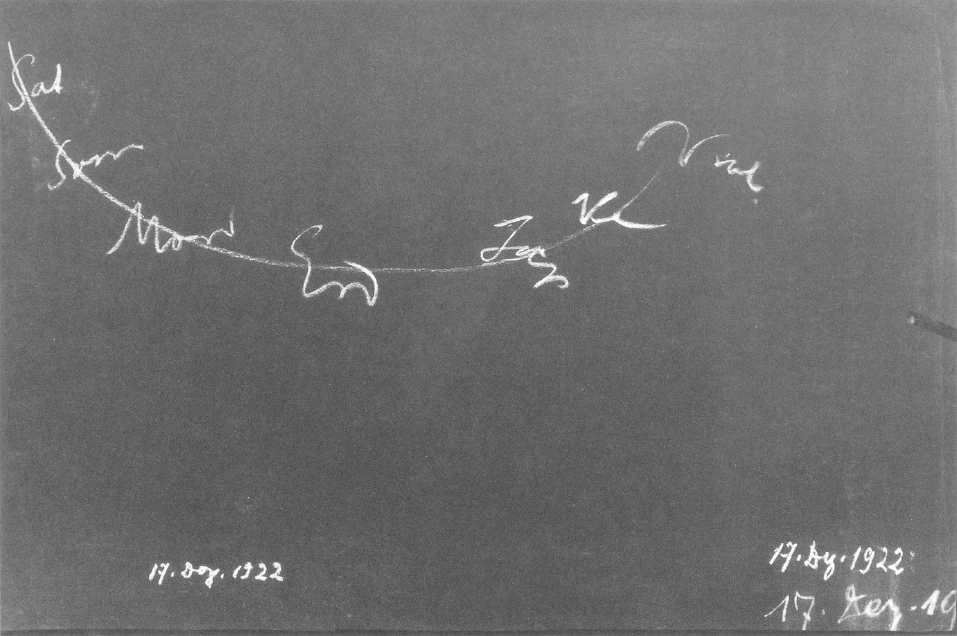
[ 22 ] For the gods, what actually exists in the timeline is what I have discussed in my Outline of Esoteric Science: the ancient Saturn Age, the Sun Age, the Moon Age, the Earth Age, and the future ages: the Jupiter Age, the Venus Age, and the Vulcan Age. This is what exists for the gods in the sequence of ages. Here on Earth, however, all of this also plays out spatially. We live today in the Earth Age; that is correct. But within this process, which pertains to the Earth, there are also still echoes of the Lunar, Solar, and Saturn Ages. Try for a moment to let the description of the Saturn Age, as I presented it in Outline of Esoteric Science, sink in. You will then say: We no longer have a Saturn Age, to be sure, but its thermal effects are also present within our earthly events. — Saturn, Sun, Moon, and Earth are intertwined; they exist simultaneously. The gods perceive them one after the other. We see them interlocked—spatially interlocked—precisely because we used to see them in succession, even during the Chaldean era. Yes, this goes much further, and it is precisely when we examine these things in detail that we come to understand what actually lies behind them.
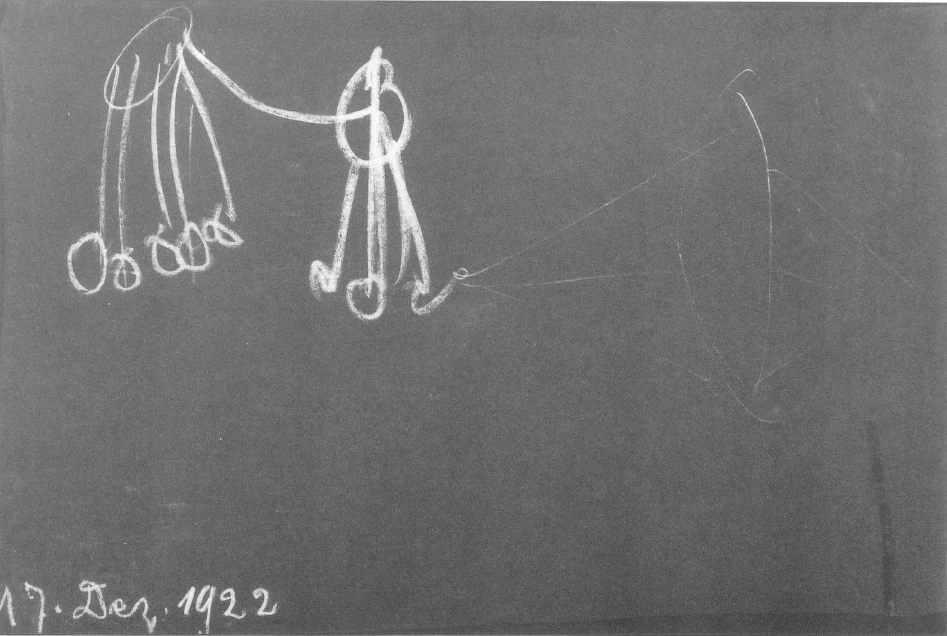
[ 23 ] Suppose you extend your left hand. The Divine lives within everything earthly. The Divine lives in your muscles, in your nerves. The Divine lives in the act of extending your hand. Now touch the fingers of your right hand with the fingers of your left hand—this can only be done in space. The fact that you feel your left hand with your right, and your right hand with your left—the divine-spiritual beings do not perceive this. They follow the left and right hands up to the moment of contact, but the sensation that takes place between the two—the feeling of the left hand with the right hand, and the right hand with the left hand—the gods do not possess this through their own abilities; this is something that emerges only through space. Just as the gods do not see Saturn, the Sun, the Moon, and the Earth all at once, but only see them one after the other, within time, so too do the gods lack everything that human beings experience in the most spatial sense. When you look with your left and right eyes and have the lines of sight from the right and from the left, you have the divine effect in the gaze from the right and the divine effect in the gaze from the left; the encounter is purely human. Thus, as human beings, precisely because we are situated in space, we experience something that is experienced in emancipation from the divine effect.
[ 24 ] You need only extend this image—which I have used to represent the right and left hands—to other events within the earthly sphere of humanity, and you will find much that falls outside the scope of human experiences as viewed through the lens of the gods. It is only since the first third of the 15th century that human beings have truly begun to grasp all these purely human realms in their imagination, so that, in fact, humanity’s conception of the world has become increasingly incomprehensible to the gods as they look down upon it. And precisely when we consider this, we must point to that momentous, significant event in the last third of the 19th century, of which we have spoken often before and which is expressed in the following way: The dominion of that spiritual being known as Gabriel has been replaced by the dominion of that other spiritual being known as Michael.
[ 25 ] In the last third of the 19th century, the spiritual being known as Michael becomes, so to speak, the ruler of all that is spiritual, which corresponds to human events on Earth. While the Gabriel being is more oriented toward the passive qualities of human beings, Michael is the active being—the one who, so to speak, pulses through our breath, our veins, and our nerves—so that we may develop and actively acquire our humanity within the cosmic context. This is what stands before us, so to speak, as a call from Michael: that we become active even in our thoughts, so that we develop our worldview through inner activity as human beings. Only in this way do we truly belong to the Age of Michael—not by sitting idly by and waiting for external and internal insights to come to us, but by actively engaging with the observations and experiences the world presents to us.
[ 26 ] When someone sets up an experiment, this is, in essence, not an activity—not an activity of the mind—but rather an event like any other natural phenomenon, except that it is guided by the human intellect. But all natural phenomena have also been guided by the intellect. Yet how does humanity today use the experiment for its conceptualization? Not through active engagement, for people merely observe and wish to be as passive as possible; they want the experiment to reveal everything to them, and they immediately regard anything arising from inner activity as fantastical. They are as little as possible engaged in their scientific conceptualizations within the Michael Age. They must enter the Michael Age, for this age has a very specific and important characteristic. When we ask ourselves: What significance does it actually have, within the entire cosmic context, that—if I may put it this way—Gabriel has handed over the scepter to Michael? — then we must say to ourselves: The meaning is that Michael is the spirit who, of all the beings capable of spiritual leadership within humanity, is best able to relate to what people here on Earth have been pursuing in this emancipation of knowledge since the first third of the 15th century.
[ 27 ] Gabriel stands utterly bewildered before what constitutes the content of the imagination of a modern, educated person. Michael, who is extraordinarily attuned to the forces of the sun, can at least direct his activity toward the thoughts that human beings develop—thoughts that serve as impulses for their free action. Michael can work into all of this what I have called, for example, in my Occult Science, free, pure thinking—which in modern times must be the actual impulse for the individual will of human beings in freedom. And Michael has a special affinity for that action which springs from the impulse of love. Therefore, he is the messenger whom the gods have sent down so that he may, as it were, receive what is now being conveyed from emancipated knowledge into spiritualized knowledge. Science—which, as anthroposophical spiritual science, spiritualizes the spatial judgment once again, rendering it supersensory—works from the bottom up, reaching out, as it were, with its hands from below to grasp the hands of Michael, which are extended from above. For it is there that the bridge can be built between human beings and the gods. And Michael has become the ruler of this age for the very reason that he is to receive what the gods wish to receive from what human beings can add to divine knowledge by supplementing the mere concept of time with the concept of space.
[ 28 ] We can say that the gods represent: Saturn, the Sun, the Moon, and the Earth in chronological order; human beings perceive this spatially when they develop the latest phase of their imagination in the proper way. The gods can visualize the left hand as it reaches forward, the right hand as it reaches forward. Human beings adapt to touch. The gods can live in the line of sight of the left eye, in the line of sight of the right eye. Human beings visualize spatially how the line of sight of the right eye and the line of sight of the left eye meet. Michael directs his gaze down toward the Earth. By connecting with what human beings develop in pure thought and realize in pure will, he is able to take note of what is gained here by the inhabitants of Earth—by human beings—through their spatial imagination, in order to carry it up into the divine worlds.
[ 29 ] If people were to limit themselves to developing their knowledge of space, if they were not to spiritualize it, if they were to remain within anthropology and not seek to move toward anthroposophy, then the Age of Michael would come to an end. Michael would step down from his reign and bring the message to the gods: Humanity wishes to separate itself from the gods. — If Michael is to bring back the correct message to the world of the gods, he will have to say: During my age, human beings have elevated what they developed apart from the divine-spiritual world—their pure spatial judgments—into the supersensible, and we can accept human beings once again, for they have connected their thinking and their imagination with our thinking and our imagination. — Yes, Michael will not be allowed to say to the gods, if humanity is to undergo its proper development: “Humanity has become accustomed to staring at everything merely in spatial terms; they have learned to despise that which lives only in time.” — Rather, he will have to say, if humanity is to achieve its earthly goal: People have striven to bring the temporal and the supersensible back into the spatial realm, and through this, people who do not wish merely to stare at the spatial, who do not wish merely to accept the kind of sensualizations that were popular at the beginning of the 20th century, can once again be grasped in such a way that their lives are directly linked to the life of the gods.
[ 30 ] If one truly practices anthroposophy in the spirit of the science of initiation, it means engaging with cosmic matters—with what humanity must address in harmony with the world of the gods. And in this present age, there is, in essence, a great deal at stake. The question is whether we wish to sow the seed for what constitutes the proper future coexistence with the divine-spiritual world, or whether we do not wish to sow this seed. And when you consider the immense significance of what has been said here, you will realize with what seriousness, with what inner steadfastness, that state of mind must be established which seeks to make anthroposophy the content of its imagination.