

The Relationship of Man to the Starry World
The Spiritual Communion of Mankind
GA 219
31 December 1921, Dornach
Translated by Steiner Online Library
Twelfth Lecture
[ 1 ] The day before yesterday, I spoke about how the annual cycle can be found _ even within human beings. I drew attention to how the natural phenomena around us unfold, as it were, within a temporal organism over the course of the annual cycle, so that one can observe a kind of interplay and mutual influence among what are otherwise seen as individual natural processes and phenomena occurring throughout the year. However, the essential difference between this natural cycle and its reflection in human beings is that what unfolds sequentially for a particular region of the Earth occurs simultaneously within the human being. It is true that human beings as a whole are similar to the Earth as a whole in that, when it is summer on one half of the Earth, it is winter on the other, and so on. But with the Earth, the winter effects of one region and the summer effects of another are, so to speak, separated from one another across the vast expanse of space; so that when we consider the winter effects of one region and the summer effects of another simultaneously, they flow apart from one another—that is, they do not in any way weaken or interfere with one another’s existence.
[ 2 ] In the case of human beings, however, when they are asleep, their physical body and also their etheric body are in a kind of summer state, in a state of sprouting and budding life. Spiritual insight reveals to us that during sleep—when the “I” and the astral body are separated from the physical and etheric bodies—the physical and etheric bodies are in this sprouting, budding summer state. One could even say that while a person sleeps, their physical and etheric organisms, left behind, successively experience a sort of spring and summer state. But the astral body—which is, after all, in interaction with this entire human organism—and the “I” are at the same time in a sort of winter state. Thus, summer and winter states coexist here; yet they interact with one another—they are not turned away from each other, but rather work together. The same is true, however, of the human waking state. When a person is awake, their physical and etheric bodies are in a sort of autumn and winter state. In contrast, stimulated by impressions from the external world and by the thoughts the person forms about this external world, the astral body and the “I” organization are in a full summer or full spring state. Here, too, the inner spring, the inner summer, and the inner winter interact within the human being; they are not turned away from one another, but rather interpenetrate one another.
[ 3 ] This is indeed what emerges from research in the humanities: that, in a sense, if we wanted to compare the entire Earth—with all its human inhabitants—to the processes of winter and summer, we would have to flip the two opposing hemispheres. In the case of human beings, it is as if, with the Earth, we were to make the summer of one hemisphere immediately coincide with the winter of the other by turning the Earth upside down. This, however, would in fact give rise to something that can be characterized by saying: The effects of winter counteract the effects of summer, and the effects of summer counteract the effects of winter, creating a kind of state of equilibrium. This is an important conclusion that conventional science has not yet reached, and as a result, it is bound to completely misunderstand the nature inherent in human beings. In human beings, the workings of nature are indeed such that winter and summer—if I may use these terms, for they truly refer to a process that justifies their use—that is, the summer and winter states cancel each other out.
[ 4 ] Human beings do, however, carry the nature that surrounds them within themselves, but the effects cancel each other out, and a state arises that, in essence, truly brings the workings of nature within the human being to rest. Just as with a scale, when weights are placed on both sides and there is a point of rest in the middle of the beam—a point on which neither the force on the right nor that on the left acts, a state of equilibrium in relation to what would otherwise pull down on the beam—so, in fact, there is a balance of opposing natural forces within human beings.
[ 5 ] Anyone who truly and correctly considers the threefold human being—as I have outlined it in the appendix to my book Riddles of the Soul, in a way that people are not yet accustomed to today—will indeed find the following. We divide the human being into a nervous-sensory organization, a rhythmic organization, and a metabolic-limb organization. These three organizations interact with one another. One can say that the nervous-sensory organization acts primarily in the head; but in a certain sense, the whole human being is functionally the head once again. The same is true of the other systems: the rhythmic organization and the metabolic-limb organization.
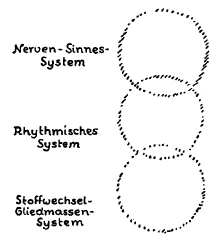
[ 6 ] Now, taking into account the threefold nature of the human being, we can schematically represent the human being in roughly the following way. We thus have the nervous-sensory organization, the rhythmic organization, and the limb-metabolic organization.
[ 7 ] Now, in fact, if we consider the two outer organizational systems of the human being—the nervous-sensory system and the metabolic-limb system—there is a contrast between them that is very clearly evident in spiritual-scientific anatomy and physiology. When we walk, for example, we have a movement in our limb system that is actually a movement through space. This movement corresponds, in a certain part of our nervous-sensory system and in a certain part of our head system, to a state of rest to the same degree that the limb system is in motion. I ask you to try to understand this correctly. I said “is at rest to the same degree.” Rest is usually taken as an absolute concept. When one sits, one sits, and one does not distinguish whether one is sitting with greater or lesser intensity. In a certain sense, this is also true for everyday life. In that context, these things do not differ greatly from one another.
[ 8 ] But it is different with our nervous-sensory system. When we run faster—when we run faster using our limbs—there is a certain tendency toward rest in our nervous-sensory system, a tendency to remain at rest that is stronger than when we walk slowly. And everything that takes place in our limb system—as well as in our metabolic system, for example, when digestive juices make their way through the movement of the intestines—is accompanied by a tendency toward rest in our nervous-sensory system. This is also expressed outwardly.
[ 9 ] The head, which is the primary seat of the nervous-sensory system, is actually a slacker when it comes to our limb system. It behaves much like someone who sits comfortably in a horse-drawn carriage and lets the horse do the driving. It remains still. In the same way, our head sits calmly atop the rest of our body at all times. It isn’t even interested when, for example, I wave my arms about. When I wave my left arm, it creates a tendency toward stillness in the right half of my head; when I wave my right arm, it creates a tendency toward stillness in the left half of my head. And because of this tendency toward stillness, it is possible for us to accompany our movements with thoughts and mental images.
[ 10 ] It is entirely incorrect for a materialistic worldview, for example, to claim that perceptions are based on nerve impulses. On the contrary, if these perceptions involve any kind of movement in space, they are based on stable tendencies of the nervous system. The nervous system calms down, and as it does so—and as its vital activity itself subsides—thoughts penetrate this calm and become real. Anyone who is able to observe, from a spiritual-scientific perspective, what takes place in a human being during thinking and imagination cannot possibly become a materialist, because they know that to the very extent that thoughts act vigorously and actively as a spiritual-psychic substance, to that very extent the nerves become calm and even lose their vital intensity—indeed, they are even numbed. The nervous system must first make way for the spiritual-psychic nature of thoughts by ceasing its material activity. It is precisely in such matters that we see why we have materialism. We have had materialism since the time when science did not know matter. This is precisely the characteristic of materialistic science: that it has no inkling of the nature of material processes and therefore attributes all sorts of things to them that are not there.
[ 11 ] There you can already see how opposing states—which nevertheless tend toward equilibrium—are present in human beings. Just as opposing natural forces exist in midsummer in relation to midwinter, so too are opposing forces distributed throughout the human organism, forces that nevertheless maintain a balance with one another. However, we will only be able to think correctly about these opposing forces that maintain a balance with one another if we further subdivide the human being in the following way. If we divide the human being’s middle system—its rhythmic system—into two parts, we essentially distinguish—it is not entirely precise, but essentially—between the respiratory rhythm and the blood circulation rhythm; and then we speak of an upper middle rhythmic system and a lower middle rhythmic system. But then, in the middle of this rhythmic system, between the upper and lower parts, lies the part of the human being that strives most toward balance, because it is permeated, influenced, and affected by natural forces from above and below in opposite ways.
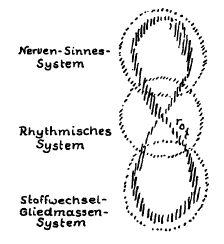
[ 12 ] If, therefore, I wish to incorporate this fact—the opposing natural forces within human beings—into my schematic diagram here, I must supplement this diagram in the following manner (in red): In the upper part of this figure-eight line, I have schematically outlined the natural effects that are directed in a manner opposite to those natural effects that I have outlined with the lower part of the figure-eight line.
[ 13 ] In a sense, the human being is divided into two halves: an upper and a lower half. The upper half comprises the nervous and sensory system, which naturally extends throughout the entire body. The diagram is schematic. Sometimes one must look for the “upper” part in the big toe, because there are also nervous and sensory organs there. So the diagram is schematic, but you will easily be able to imagine this schematic diagram applied to reality. So I have to imagine how, on the one hand, the nervous-sensory system—and essentially the respiratory system associated with it—and, on the other hand, the circulatory system and the metabolic-limb system have opposing natural effects. They cancel each other out.
[ 14 ] The organ in the human being in which this balancing takes place—in which there is a constant striving for equilibrium, both from the bottom up and from the top down—is the human heart. This heart is not, as modern physiology conceives it, merely a pump that circulates blood through the body, but rather it serves as the organ of equilibrium for the upper and lower systems of the human being. Thus, even in the human being’s external physical organism, what is brought about spiritually within him is expressed by the fact that summer and winter influences are always simultaneously counteracting one another within him.
[ 15 ] In any region of the Earth, winter can exist only because summer is not occurring at the same time; otherwise, summer would bring winter into a state of equilibrium—that is, there would be neither summer nor winter, but rather a state of equilibrium. Yet this is indeed the case within human beings. Human beings are, in themselves, a part of nature, but because the forces of nature within the human organism are directed in opposite directions, they cancel each other out, and human beings are thus as if they were not part of nature at all. This, however, makes human beings free beings. One must not apply the laws of natural necessity to human beings, for there is not one natural necessity, but rather two natural forces oriented in opposite directions, and these cancel each other out within the human being. And within this realm of canceling natural forces lies the human spirit and soul, unaffected by natural forces, and must be understood according to its own laws. From this you can see how we must proceed to a fundamental and comprehensive observation if we wish to understand human beings, and how the mere application of external natural laws—which are always oriented in only one direction—is actually not applicable to human beings.
[ 16 ] Now, however, having set before our minds the true nature of the human being, let us consider what consequences this has. One comes to know the human being only when one views him in this way: he carries a part of nature within himself, so that the opposing natural forces cancel each other out. But if one comes to know this element of nature through spiritual scientific insight, it reveals itself—in relation to the human sleep state as it pertains to the physical and etheric bodies—as permeated by mineral and plant forces which, if we look only at what remains in the bed of the sleeping person, represent the summer state. But now, by learning to observe this sprouting, budding life in the proper way, we come to know it for the first time in its true significance. When does it sprout, when does it bud? When the “I” and the astral body are not present—when the “I” and the astral body are outside the body during sleep. And where does this sprouting and budding come from? This is revealed precisely through spiritual scientific observation.
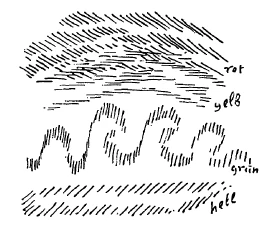
[ 17 ] If I were to draw this for you schematically, I would have to do so in the following way. This would be the diagram of a sleeping person (light, green, yellow, red). The lower light-green line represents the physical body lying in bed and the etheric body, which, from the perspective of spiritual science, appears like the earth’s surface—the mineral realm—from which plant life sprouts, naturally in a different form, but recognizable to the spiritual-scientific perspective. Above it, glowing like a flame that cannot draw near, are the “I” and the astral body, represented by the red-yellow line above. Thus, when one observes a person asleep, one sees, as it were, a sprouting, budding piece of earth in the bed and, belonging to it, a separate, glowing astral “I.”
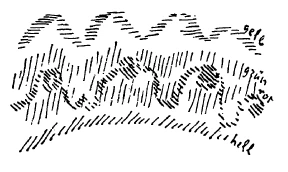
[ 18 ] What is it like to be awake? Well, I would have to depict the schema in the following way (light, red, green, yellow): the withering, lower mineral and plant aspects, and—as it were—the astral-ego aspect, which burns these mineral and plant aspects and smolders within them. So there we have the waking human being with the mineral element crumbling within. The mineral element crumbles within the human being during waking hours. The vegetative process makes an impression, as it were, everywhere—even if it looks quite different—like the trees in autumn, like the drooping, withering plant leaves, everything dying off, diminishing, yet glowing and smoldering as if from flames or little flames. These flames and little flames, which cause this glowing and smoldering, are the astral body and the “I” living within the physical and etheric bodies. And the question arises: Well, what exactly is the nature of this flaming glow during sleep, when it is separated in the “I” and the astral body from the physical and etheric bodies?
[ 19 ] If one now tackles this with research in the humanities—and you can, in a sense, draw this conclusion for yourselves by considering the coherence of various descriptions I have given over time—one arrives at the following. That which first and foremost propels forth the flaming and glowing of the “I” and the astral body, and which then stimulates the sprouting, budding, vegetative life of the summery, sleeping physical body—and the mineral element within it that also develops a kind of life—that which causes the little crumbs, so to speak, the particles—the atomizing aspect of the mineral in the physical body—appear, in turn, as if the atoms were dissolving, as if a continuous, internally moving, universally active, mineral-fluid-air-like mass were forming from the whole, a mass permeated everywhere by sprouting life—this inner force that brings this about, what is it? Well, what vibrates within us while we sleep, in both the physical and etheric bodies, is the lingering wave of our life from our pre-earthly existence. We bring this to a standstill during our waking life on earth.
[ 20 ] When this fiery flickering of the astral body and the “I” are one with the physical and etheric bodies, we bring to rest those impulses that are present during sleep from our pre-earthly life. And now, for the first time, through what we learn about ourselves, we learn to look at the external natural world in the right way; we learn to look at this external natural world in such a way that we say to ourselves: Everything that is active in outer nature—in the laws of nature, in the natural forces of mineral and plant life—is equivalent to that which, within us during sleep, constitutes mineral and plant life: summery, sprouting, and budding life. — That is to say, just as when we observe our sleeping physical and etheric bodies we are pointed toward our past—toward the spiritual life we had in our pre-earthly existence—so too does external nature, insofar as it is mineral and vegetative, point us toward the past.
[ 21 ] If we wish to truly understand the active forces and laws of nature in the natural world around us—with the exception of the animal and physical-human realms—then we must recognize that the laws and forces of nature point us to the Earth’s past, to the Earth’s decline. — So when we reflect on the external natural world, these reflections are devoted to the dying element of earthly existence. If this dying earthly existence is to be revived, to contain impulses for the future, then this can only happen in the same way as it does with human beings—through the infusion of the soul and spirit into the mineral and plant realms. The soul enters the animal realm, and the spirit enters the human realm.
[ 22 ] As a result, however, the entire structure of the world is essentially divided into two parts. We look out at external nature, and insofar as it—and this is the main feature of external nature—is of a mineral and plant nature, we can only compare it to our sleeping physical and etheric organism. When we look at the external physical effects, we must also say to ourselves: All other physical effects also depend on these effects of external nature in the mineral and plant realms. — For when you consider the physical effects associated with the nourishment of living beings, you must say: Nourishment begins with the intake of mineral and plant substances. Animals then further process these substances to provide nourishment for humans. — But first and foremost, everything that constitutes external nature—in its external physical and also etheric effects—depends on the very essence that we find in our dormant physical and etheric organisms. But what we carry within us as the “I” and the astral organism—which, for example, during the waking state—when the physical and etheric organisms are in their “winter sleep,” if I may put it that way— it is, of course, a paradox in relation to reality, as you sense—is in a summer-like state, stimulated by external sensory impressions and by the thoughts that arise; this creates a balance with the winter-like state of the physical and etheric bodies.
[ 23 ] But anyone who approaches the matter from a spiritual-scientific perspective will find that, even though what one must conceive of as occurring simultaneously in human beings is separated by the course of the year, there is always a spiritual summer state associated with the Earth’s winter state, and a spiritual winter state associated with the Earth’s summer state. The only difference is that these do not form a state of equilibrium on Earth, but rather manifest themselves on opposite hemispheres, so that on Earth, the physical winter state is strengthened by the soul-spiritual winter state, and the physical summer state is reinforced by the spiritual summer state. This, however, points to the fact that just as human beings carry their past and present within themselves, so too does the entire natural world surrounding us carry its past and present within itself.
[ 24 ] We actually experience the present only in our physical body—in relation to the activity and laws that permeate it—when we are awake. During sleep, the physical and etheric organisms are influenced by the past—specifically, a past that was lived out in the spiritual realm. We find the corresponding phenomenon in the mineral and plant worlds that surround us and influence us: they are, in essence, the results of past existence, and they become present only because the Earth is enveloped by the spiritual-soul realm just as the human being is permeated by it. And in the present moment lies the seed of the future.
[ 25 ] But if it is true—and what I have described to you is true—that we carry within us effects of the past in our physical and etheric organisms, precisely when these are independent of spiritual and soul activity, then we may seek the influence extending into the future only in our “I” and in our astral body; likewise, we may seek the future for the Earth only in the spiritual realm.
[ 26 ] Humanity has now reached the point where, through natural elemental forces, it has added the “I” and the astral body to the physical and etheric organisms. The mineral and plant realms of the Earth have not yet done so. They envelop the Earth spiritually and psychically, but they do not permeate the Earth’s mineral and vegetative modes of action. The mineral essence of the Earth, as we see it before us, appears as something that does not allow the spirit and the soul to enter within it, but only allows itself to be surrounded and enveloped by the spirit and the soul.
[ 27 ] The nature of the plant reveals itself in such a way that it, too, does not allow the soul into itself, but in its uppermost parts it comes into contact, in a certain sense—I would say—with the spiritual-soul aspect. For spiritual scientific research reveals the following about the plant: If I have the root at the bottom, the stem in the middle, and the flower at the top of the plant, then I must view this flower in such a way that, within the flower, the plant striving upward comes into contact with the astral realm, which does not penetrate it but touches it. The flower comes into being through this contact between the uppermost part of the plant and the astral realm that envelops the Earth. I have often expressed this using a comparison—which, of course, must be taken with due discretion—that the flowering of the plant is essentially the kiss that the sun, the sunlight, exchanges with the plant itself. This is an astral effect, but it is merely a touch.
[ 28 ] So when we look out at the natural world around us, we do not immediately see in the mineral and plant kingdoms the same things we see within ourselves as human beings. Within ourselves as human beings, we see, as a unified whole, a mineral nature, a plant nature, an astral nature, and an “I” nature. We must now set aside the animals for the moment. We will speak of them again in the future. But what the physical effects essentially depend on, we must find in the mineral and plant worlds. This reveals itself to us—I would say—in external nature, stripped of the astral-mental and of what constitutes the experience of the “I”: the self-conscious spiritual sense. These are not out there, not in the mineral realm, not in the plant realm. The mineral and plant realms are, in essence, results of the past.
[ 29 ] Anyone who truly observes the mineral soil and the plants sprouting from the earth must, when considering earthly life, say to themselves: In you, crystal forms; in you, mountain formations; in you, sprouting and growing plants—I see the monuments of that which once created and gave life, and which is now passing away. But in human beings themselves—if we understand how to properly structure this fading force, this power flowing in from pre-earthly existence and becoming enfeebled in the physical and etheric bodies, that which is dying away—we see the physical and etheric organism permeated by that which shines into the future from the astral and I-being, which, as a life of thought and imagination, unfolds freely within the human being on the plane of equilibrium of natural forces.
[ 30 ] In a sense, we see both the past and the future coexisting within the human being. When we look into nature—insofar as it consists of the mineral and plant kingdoms—we see only the past. That which already acts as the future within the human being in the present is precisely what gives the human being the essence of freedom. This essence of freedom does not exist in external nature. If external nature were condemned to remain as it is through its mineral and plant kingdoms, it would also be condemned to die, just as the purely physical and etheric organism of the human being dies in the universe. The physical and etheric organisms die, but the human being does not die, because the astral entity and the “I” entity within him do not carry death within themselves, but rather becoming and coming into being.
[ 31 ] If, therefore, the outer natural world is not to perish, it must be given what human beings possess through their astral body and their “I”-body. That is to say, since human beings have self-conscious perceptions through their astral body and their I-body, if they wish to secure the future of the Earth—which would otherwise perish—they must instill into it that which is supersensible and invisible within them. Just as human beings must expect reincarnation in a future earthly existence from what is supersensible and invisible within them—but cannot expect this from their dying physical and etheric bodies—so, too, can no future for the Earth arise from what constitutes the mineral and plant spheres of the Earth and surrounds us as such. Only and exclusively if we are able to place within this Earth something it does not possess can a future Earth come into being. That which is not present on Earth of its own accord is the active thoughts of human beings, which live and weave within their organism—an organism independent of external nature due to its state of equilibrium. If human beings realize these independent thoughts, then they give the Earth a future. But to do so, he must first possess these independent thoughts himself, for all thoughts we form about what is fading away in ordinary knowledge of nature are mirror-images; they are not realities. The thoughts we draw from spiritual research are brought to life through imagination, inspiration, and intuition. When we take them in, they become independent entities existing within earthly life.
[ 32 ] I once wrote the following about these creative thoughts in my little book on the epistemology of Goethe’s worldview: This way of thinking represents the spiritual form of humanity’s communication. — For when a person abandons himself to his reflective thoughts about external nature, he merely repeats the past; he lives in the corpses of the Divine. By enlivening his thoughts himself, he connects—through his own being, communicating and receiving communion—with the Divine-Spiritual that permeates the world and secures its future.
[ 33 ] Thus, spiritual insight is a true communion, the beginning of a cosmic cult appropriate to present-day humanity, which can then grow as human beings become aware of how they interweave their physical -mineral and vegetative organisms permeate his astral and ego organisms; and how, by bringing the spirit to life within himself, he now also imbues with spirit that which otherwise surrounds him as “Tootes,” as that which is dying.
[ 34 ] Then the human being experiences that, when he looks at his organism—which functions in a solid state—he feels connected within it to the world of the stars, insofar as it is a resting entity. Insofar as the world of the stars is a resting entity—for example, as it relates calmly to the Earth in the images of the ‘zodiac’ within the cosmos—insofar is the human being, through his physical organism, connected to these formative structures of the cosmos. But by allowing his spiritual and soul life to flow into them—into these formative structures—he himself transforms the world.
[ 35 ] Likewise, the human being is permeated by the flow of his bodily fluids. The etheric organism already lives within this flow of fluids. That which causes the blood to circulate within us, that which sets the other bodily fluids in motion, is the etheric organism. Through this etheric organism, the human being is now connected—I would say—to the celestial events, to the movement of the planets. Just as the stationary images of the fixed-star sky act upon or are related to the fixed form of the human organism, so too do the planetary movements of the planetary system to which we belong interact with the flow of bodily fluids.
[ 36 ] But as it appears at first glance, this is a lifeless world. Human beings transform it through their own spiritual nature when they share their spirituality with the world by enlivening thoughts into imagination, inspiration, and intuition, and by bringing about the spiritual communion of humanity.
[ 37 ] First, a person must become aware of this. This awareness must be kept ever more alive and ever more active; then the person will find the path to this spiritual communion more and more.
[ 38 ] Today I would like to give you just a small foundation for this by first sharing with you those words which, if you allow them to take effect properly on your soul—if you continually bring them to life within your soul so that you experience their full meaning, their dynamic meaning— give rise to something in the human soul that transforms the dead aspects of the world with which we interact into something living, thereby enlivening the past so that it can emerge from its lifelessness to become the life of the future. This can only happen if we become aware of our oneness with the cosmos in the following way. I will write down an initial formula along these lines:
[ 39 ] It draws near to me in my earthly life
[ 40 ] — I imagine the earthly matter that I take in as being one with that which forms the solid structure of my organism
[ 41 ] It draws near to me in my earthly life,
Given to me in the image of matter,
The celestial beings of the stars
[ 42 ] The fact is that when we look at any earthly substance that we take into our bodies as food, we find in it a reflection of the tranquil constellations. We take that in. We take in the stellar being, the celestial being, along with the substance of the earth that is contained in the earth’s workings. But we must be aware that we, as human beings, through our will—our will imbued with love—transform that which has become matter back into spirit, accomplishing a true transubstantiation, when we become conscious of our inner presence in the world, so that the intellectual and spiritual life within us comes alive.
[ 43 ] It draws near to me in my earthly existence,
Given to me in the image of matter,
The celestial beings of the stars:
I see them moving lovingly as they will.
[ 44 ] And when we think of what we take in in such a way that it permeates the fluid part of our organism—the action of the humors, the circulation of the blood—then, insofar as it originates from the Earth, this is now a reflection not of the nature of the heavens or the nature of the stars, but of the deeds of the stars, that is, the movements of the planets. And I can become aware of how I spiritualize this—when I am properly situated within the world—through the following formula:
[ 45 ] They penetrate me in the watery realm,
Shaping me through the mighty power of matter,
The celestial deeds of the stars —
[ 46 ] That is, the actions of the planetary movements. And now:
[ 47 ] I see them walking wisely in their feelings.
[ 48 ] Just as I can see the beings and the weaving of the stars in my will, as they lovingly transform into the spiritual substance of the future, so too do I see, in my feeling, a wise transformation of that which is given to me here on Earth, as I absorb the image of the heavenly deeds in that which permeates my vital organism. Placed within this context, human beings can experience themselves through their will and their feeling. Surrendered to the universal governance of the world existence surrounding him—the cosmic existence—he can experience that which is carried out through him in the great temple of the cosmos as transubstantiation, standing within it in a purely spiritual manner as a sacrifice.
[ 49 ] What would otherwise be merely abstract knowledge becomes a relationship with the world characterized by feeling and will. The world becomes a temple; the world becomes a house of God. The thinking human being, rousing himself through feeling and will, becomes a being who offers sacrifice. Humanity’s fundamental relationship to the world rises from cognition to a worship of the world, to a cosmic cult. The fact that everything that constitutes our relationship to the world is first recognized within the human being as a cosmic cult—this is the very beginning of what must happen if anthroposophy is to fulfill its mission in the world.
[ 50 ] That is what I wanted to tell you first, as a starting point. I will continue discussing the nature of the cultic in relation to the understanding of nature next Friday. Today I wanted to say this in particular. I scheduled this lecture for this day specifically so that this content would come to the fore today, because I believe that when the very nature of time once again presents itself to our souls, which is present in the cycle of the year—when such a cycle is completed, at least as far as external observation and external experience are concerned—we should become aware of how our relationship to time should take shape, how we should seek the future from the past, and how we should know how to create for the future in order to bring forth the spiritual.
[ 51 ] This afternoon, one of the poems that was recited began with these words: “Every new year brings new graves.” — How profoundly true that is! But it is just as true that every new year brings new cradles. — Just as it touches the past, so it touches the future. Today, it is above all up to us to grasp this future, to remember that the sprouting and blossoming life, as it appears to us outwardly, contains death within itself, but that we must seek life through our own energy. And the renewal of each year is a symbol of this for us. Let us look—even as we rightly gaze upon the graves on one side—to the other side, toward the renewing life that waits to receive the seed of the future within itself.
[ 52 ] That is our great task today: to recognize how the world is filled with a New Year’s Eve atmosphere—one of passing away and dying—but how, in the hearts of those who become aware of their true humanity, their divine-human nature, there must be a New Year’s spirit, a spirit of the new age, a spirit of renewal. Let us not direct our thoughts merely in a trivial, festive, philistine manner from the symbolic New Year’s Eve to the symbolic New Year; let us direct them—so that they may become active and creative, as the evolution of the Earth requires—from what now confronts us everywhere in the life of civilization as something dying, as ancient graves, from New Year’s Eve toward the New Year, toward the New Year of the World! But this will only come about if humanity resolves to work toward it.
It draws near to me in my earthly existence,
Given to me in the image of matter,
The celestial beings of the stars:
I see them moving lovingly as they will.They penetrate me in the watery realm,
Shaping me through the mighty power of matter,
The celestial deeds of the stars:
I see them moving wisely within my senses.